ShigellosisShigellosis
Infectious Diseases, AIDS & ClinicalInfectious Diseases, AIDS & Clinical
Immunology Research Center TbilisiImmunology Research Center Tbilisi
 Shigellosis = inflammation of intestinesShigellosis = inflammation of intestines
(especially the colon) with(especially the colon) with
accompanying severe abdominalaccompanying severe abdominal
cramps, tenesmus and frequent, low-cramps, tenesmus and frequent, low-
volume stools containing blood, mucusvolume stools containing blood, mucus
and fecal leukocytes.and fecal leukocytes.
 Shigella causes abdominal painShigella causes abdominal pain
(Intestinal cramps) and bloody(Intestinal cramps) and bloody
diarrhea ± sudden fever, headachediarrhea ± sudden fever, headache
and occasionally neck stiffness.and occasionally neck stiffness.
EtiologyEtiology
 Gram-negative non-spore forming,Gram-negative non-spore forming,
nonmotile bacteria;nonmotile bacteria;
 Primarily parasite of the digestive tract ofPrimarily parasite of the digestive tract of
humans;humans;
 Infective dose is small;Infective dose is small;
 Cause a severe form of dysentery calledCause a severe form of dysentery called
shigellosis;shigellosis;
 Resistant to bile salts;Resistant to bile salts;
 Discovered by a Japanese scientist K.Discovered by a Japanese scientist K.
Shiga.Shiga.
Four well-defined speciesFour well-defined species
• Shigella sonneiShigella sonnei (most common in industrial(most common in industrial
world)world)
• Shigella flexneriShigella flexneri (most common in(most common in
developing countries)developing countries)
• Shigella boydiiShigella boydii
• Shigella dysenteriaeShigella dysenteriae – produces a more– produces a more
serious disease than the other species.serious disease than the other species.
 Shigella dysenteriae produces anShigella dysenteriae produces an
exotoxin (Shiga Toxin) which acts asexotoxin (Shiga Toxin) which acts as
an enterotoxin, a neurotoxinan enterotoxin, a neurotoxin
(meningismus and coma) and a(meningismus and coma) and a
cytotoxin.cytotoxin.
 Shiga Toxin is similar to the Shiga-likeShiga Toxin is similar to the Shiga-like
toxin of enterohemorrhagic E. colitoxin of enterohemorrhagic E. coli
(EHEC).(EHEC).
EpidemiologyEpidemiology
Low infectious dose (10Low infectious dose (1022
-10-1044
CFU)CFU)
The human intestinal tract represents theThe human intestinal tract represents the
major reservoir of Shigella.major reservoir of Shigella.
TransmissionTransmission –– person to person,person to person,
primarily fecal-oral by contaminated hands.primarily fecal-oral by contaminated hands.
Although onsumption of contaminatedAlthough onsumption of contaminated
water or food.water or food.
Who is at risk?Who is at risk? – Anyone exposed to– Anyone exposed to
carrier, particularly young children.carrier, particularly young children.
In a review of WHO, the total annualIn a review of WHO, the total annual
number of cases in 1966-1997 wasnumber of cases in 1966-1997 was
estimated at 165 million and 69% of theseestimated at 165 million and 69% of these
cases occurred in children < 5 years ofcases occurred in children < 5 years of
age.age.
 Shigella is common in developing
countries or refugee camps.
 Outbreaks of shigellosis are
associated with poor sanitation,
contaminated food and water, and
crowded living conditions.

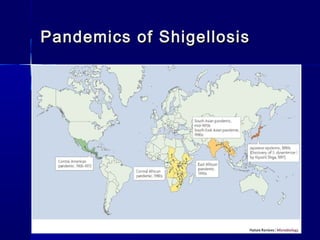
Pandemics of ShigellosisPandemics of Shigellosis
 More recent data (2000-2004) from sixMore recent data (2000-2004) from six
Asian countries (Bangladesh, China,Asian countries (Bangladesh, China,
Pakistan, Indonesia, Vietnam and Thailand)Pakistan, Indonesia, Vietnam and Thailand)
indicate that even though the incidence ofindicate that even though the incidence of
shigellosis remain stable.shigellosis remain stable.
 Epidemics follow a cyclic pattern in areasEpidemics follow a cyclic pattern in areas
such as the Indian subcontinent and sub-such as the Indian subcontinent and sub-
Saharan Africa.Saharan Africa.
pathogenesispathogenesis
 Bacteria shigella are able to invade intestinalBacteria shigella are able to invade intestinal
epithelial cells.epithelial cells.
 Shigella attaches to epithelial cell of colon;Shigella attaches to epithelial cell of colon;
 Shigella triggers phagocytosis;Shigella triggers phagocytosis;
 Shigella multiplies in cytosol;Shigella multiplies in cytosol;
 Shigella invades neighboring epithelial cells, thusShigella invades neighboring epithelial cells, thus
avoiding immune defenses;avoiding immune defenses;
 An mucosal abscess forms as epithelial cells areAn mucosal abscess forms as epithelial cells are
killed by the infection;killed by the infection;
 Shigella that enters the blood is quicklyShigella that enters the blood is quickly
phagocytized.phagocytized.
pathogenesispathogenesis
Clinical ManifestationsClinical Manifestations
 Incubation periodIncubation period :: 1-4 days, but may be as1-4 days, but may be as
long as 8 days.long as 8 days.
 Watery diarrhea period:Watery diarrhea period:
– Transient feverTransient fever
– Watery diarrheaWatery diarrhea
– MalaiseMalaise
– AnorexiaAnorexia
(Unlike most diarrheal syndromes, dysenteric(Unlike most diarrheal syndromes, dysenteric
syndromes do not have dehydration as asyndromes do not have dehydration as a
major feature).major feature).
 Dysentery period:Dysentery period:
– Small volumes of bloody mucopurulentSmall volumes of bloody mucopurulent
stools with increased tenesmus andstools with increased tenesmus and
abdominal cramps.abdominal cramps.
– At this stage, Shigella produces acuteAt this stage, Shigella produces acute
colitis involving mainly the distal coloncolitis involving mainly the distal colon
and the rectum.and the rectum.
ComplicationsComplications
Most often in children <5 years of ageMost often in children <5 years of age
Intestinal:Intestinal:
Toxic megacolonToxic megacolon
Intestinal perforationsIntestinal perforations
Rectal prolapseRectal prolapse
Metabolic:Metabolic:
HypoglycemiaHypoglycemia
HyponatremiaHyponatremia
dehydrationdehydration
 The postinfectious immunologic complication known asThe postinfectious immunologic complication known as
reactive arthritis (Reiter’s syndrome) can develop weeksreactive arthritis (Reiter’s syndrome) can develop weeks
or months after shigellosis.or months after shigellosis.
 About 3% of patients infected with S. flexneri laterAbout 3% of patients infected with S. flexneri later
develop Reiter’s syndrome, with arthritis, oculardevelop Reiter’s syndrome, with arthritis, ocular
inflammation and urethritis – a condition that can last forinflammation and urethritis – a condition that can last for
months or years and progress to difficult-to-treat chronicmonths or years and progress to difficult-to-treat chronic
arthritis.arthritis.
 Postinfectious arthropathy occurs only after infection withPostinfectious arthropathy occurs only after infection with
S. flexneri and not after the other Shigella serotypes.S. flexneri and not after the other Shigella serotypes.
Laboratory DiagnosisLaboratory Diagnosis
 The “gold standard” for the diagnosisThe “gold standard” for the diagnosis
of Shigella infection is the isolationof Shigella infection is the isolation
and identification of the pathogen fromand identification of the pathogen from
fecal material.fecal material.
TreatmentTreatment
 Antibiotic treatmentAntibiotic treatment
 Rehydration and nutritionRehydration and nutrition
 Non-specific, symptom-based therapyNon-specific, symptom-based therapy
 Treatment of complicationsTreatment of complications
(Beause of the ready transmissibility of Shigella,(Beause of the ready transmissibility of Shigella,
current public health recommendations in thecurrent public health recommendations in the
United States are that every case be treated withUnited States are that every case be treated with
antibiotics).antibiotics).
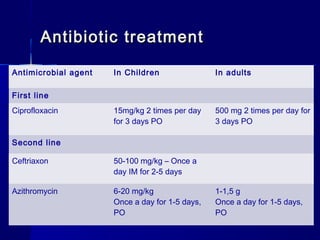
Antibiotic treatmentAntibiotic treatment
Antimicrobial agent In Children In adults
First line
Ciprofloxacin 15mg/kg 2 times per day
for 3 days PO
500 mg 2 times per day for
3 days PO
Second line
Ceftriaxon 50-100 mg/kg – Once a
day IM for 2-5 days
Azithromycin 6-20 mg/kg
Once a day for 1-5 days,
PO
1-1,5 g
Once a day for 1-5 days,
PO

Shigelosis

  • 1.
    ShigellosisShigellosis Infectious Diseases, AIDS& ClinicalInfectious Diseases, AIDS & Clinical Immunology Research Center TbilisiImmunology Research Center Tbilisi
  • 2.
     Shigellosis =inflammation of intestinesShigellosis = inflammation of intestines (especially the colon) with(especially the colon) with accompanying severe abdominalaccompanying severe abdominal cramps, tenesmus and frequent, low-cramps, tenesmus and frequent, low- volume stools containing blood, mucusvolume stools containing blood, mucus and fecal leukocytes.and fecal leukocytes.
  • 3.
     Shigella causesabdominal painShigella causes abdominal pain (Intestinal cramps) and bloody(Intestinal cramps) and bloody diarrhea ± sudden fever, headachediarrhea ± sudden fever, headache and occasionally neck stiffness.and occasionally neck stiffness.
  • 4.
    EtiologyEtiology  Gram-negative non-sporeforming,Gram-negative non-spore forming, nonmotile bacteria;nonmotile bacteria;  Primarily parasite of the digestive tract ofPrimarily parasite of the digestive tract of humans;humans;  Infective dose is small;Infective dose is small;  Cause a severe form of dysentery calledCause a severe form of dysentery called shigellosis;shigellosis;  Resistant to bile salts;Resistant to bile salts;  Discovered by a Japanese scientist K.Discovered by a Japanese scientist K. Shiga.Shiga.
  • 5.
    Four well-defined speciesFourwell-defined species • Shigella sonneiShigella sonnei (most common in industrial(most common in industrial world)world) • Shigella flexneriShigella flexneri (most common in(most common in developing countries)developing countries) • Shigella boydiiShigella boydii • Shigella dysenteriaeShigella dysenteriae – produces a more– produces a more serious disease than the other species.serious disease than the other species.
  • 6.
     Shigella dysenteriaeproduces anShigella dysenteriae produces an exotoxin (Shiga Toxin) which acts asexotoxin (Shiga Toxin) which acts as an enterotoxin, a neurotoxinan enterotoxin, a neurotoxin (meningismus and coma) and a(meningismus and coma) and a cytotoxin.cytotoxin.  Shiga Toxin is similar to the Shiga-likeShiga Toxin is similar to the Shiga-like toxin of enterohemorrhagic E. colitoxin of enterohemorrhagic E. coli (EHEC).(EHEC).
  • 7.
    EpidemiologyEpidemiology Low infectious dose(10Low infectious dose (1022 -10-1044 CFU)CFU) The human intestinal tract represents theThe human intestinal tract represents the major reservoir of Shigella.major reservoir of Shigella. TransmissionTransmission –– person to person,person to person, primarily fecal-oral by contaminated hands.primarily fecal-oral by contaminated hands. Although onsumption of contaminatedAlthough onsumption of contaminated water or food.water or food.
  • 8.
    Who is atrisk?Who is at risk? – Anyone exposed to– Anyone exposed to carrier, particularly young children.carrier, particularly young children. In a review of WHO, the total annualIn a review of WHO, the total annual number of cases in 1966-1997 wasnumber of cases in 1966-1997 was estimated at 165 million and 69% of theseestimated at 165 million and 69% of these cases occurred in children < 5 years ofcases occurred in children < 5 years of age.age.
  • 9.
     Shigella iscommon in developing countries or refugee camps.  Outbreaks of shigellosis are associated with poor sanitation, contaminated food and water, and crowded living conditions. 
  • 10.
  • 11.
     More recentdata (2000-2004) from sixMore recent data (2000-2004) from six Asian countries (Bangladesh, China,Asian countries (Bangladesh, China, Pakistan, Indonesia, Vietnam and Thailand)Pakistan, Indonesia, Vietnam and Thailand) indicate that even though the incidence ofindicate that even though the incidence of shigellosis remain stable.shigellosis remain stable.  Epidemics follow a cyclic pattern in areasEpidemics follow a cyclic pattern in areas such as the Indian subcontinent and sub-such as the Indian subcontinent and sub- Saharan Africa.Saharan Africa.
  • 12.
    pathogenesispathogenesis  Bacteria shigellaare able to invade intestinalBacteria shigella are able to invade intestinal epithelial cells.epithelial cells.  Shigella attaches to epithelial cell of colon;Shigella attaches to epithelial cell of colon;  Shigella triggers phagocytosis;Shigella triggers phagocytosis;  Shigella multiplies in cytosol;Shigella multiplies in cytosol;  Shigella invades neighboring epithelial cells, thusShigella invades neighboring epithelial cells, thus avoiding immune defenses;avoiding immune defenses;  An mucosal abscess forms as epithelial cells areAn mucosal abscess forms as epithelial cells are killed by the infection;killed by the infection;  Shigella that enters the blood is quicklyShigella that enters the blood is quickly phagocytized.phagocytized.
  • 13.
  • 14.
    Clinical ManifestationsClinical Manifestations Incubation periodIncubation period :: 1-4 days, but may be as1-4 days, but may be as long as 8 days.long as 8 days.  Watery diarrhea period:Watery diarrhea period: – Transient feverTransient fever – Watery diarrheaWatery diarrhea – MalaiseMalaise – AnorexiaAnorexia (Unlike most diarrheal syndromes, dysenteric(Unlike most diarrheal syndromes, dysenteric syndromes do not have dehydration as asyndromes do not have dehydration as a major feature).major feature).
  • 15.
     Dysentery period:Dysenteryperiod: – Small volumes of bloody mucopurulentSmall volumes of bloody mucopurulent stools with increased tenesmus andstools with increased tenesmus and abdominal cramps.abdominal cramps. – At this stage, Shigella produces acuteAt this stage, Shigella produces acute colitis involving mainly the distal coloncolitis involving mainly the distal colon and the rectum.and the rectum.
  • 16.
    ComplicationsComplications Most often inchildren <5 years of ageMost often in children <5 years of age Intestinal:Intestinal: Toxic megacolonToxic megacolon Intestinal perforationsIntestinal perforations Rectal prolapseRectal prolapse Metabolic:Metabolic: HypoglycemiaHypoglycemia HyponatremiaHyponatremia dehydrationdehydration
  • 17.
     The postinfectiousimmunologic complication known asThe postinfectious immunologic complication known as reactive arthritis (Reiter’s syndrome) can develop weeksreactive arthritis (Reiter’s syndrome) can develop weeks or months after shigellosis.or months after shigellosis.  About 3% of patients infected with S. flexneri laterAbout 3% of patients infected with S. flexneri later develop Reiter’s syndrome, with arthritis, oculardevelop Reiter’s syndrome, with arthritis, ocular inflammation and urethritis – a condition that can last forinflammation and urethritis – a condition that can last for months or years and progress to difficult-to-treat chronicmonths or years and progress to difficult-to-treat chronic arthritis.arthritis.  Postinfectious arthropathy occurs only after infection withPostinfectious arthropathy occurs only after infection with S. flexneri and not after the other Shigella serotypes.S. flexneri and not after the other Shigella serotypes.
  • 18.
    Laboratory DiagnosisLaboratory Diagnosis The “gold standard” for the diagnosisThe “gold standard” for the diagnosis of Shigella infection is the isolationof Shigella infection is the isolation and identification of the pathogen fromand identification of the pathogen from fecal material.fecal material.
  • 19.
    TreatmentTreatment  Antibiotic treatmentAntibiotictreatment  Rehydration and nutritionRehydration and nutrition  Non-specific, symptom-based therapyNon-specific, symptom-based therapy  Treatment of complicationsTreatment of complications (Beause of the ready transmissibility of Shigella,(Beause of the ready transmissibility of Shigella, current public health recommendations in thecurrent public health recommendations in the United States are that every case be treated withUnited States are that every case be treated with antibiotics).antibiotics).
  • 20.
    Antibiotic treatmentAntibiotic treatment Antimicrobialagent In Children In adults First line Ciprofloxacin 15mg/kg 2 times per day for 3 days PO 500 mg 2 times per day for 3 days PO Second line Ceftriaxon 50-100 mg/kg – Once a day IM for 2-5 days Azithromycin 6-20 mg/kg Once a day for 1-5 days, PO 1-1,5 g Once a day for 1-5 days, PO

Editor's Notes

  • #11 The first member of the genus Shigella to be identified, Shigella dysenteriae 1, was isolated by Kiyoshi Shiga during epidemics that occurred in Japan in the 1890s. Beginning in Central America in the late 1960s, pandemics of S. dysenteriae 1 caused severe disease with many complications and high case-fatality rates in all age groups. Subsequent pandemics occurred in Asia and Africa over the following 3 decades.
  • #15 Signs and symptoms may range from mild abdominal discomfort to severe cramps, diarrhea, fever, vomiting and tenesmus. The manifestations are usually exacerbated in children, with temperatures up to 40-41 and more severe anorexia and watery diarrhea.
  • #16 The extent of the lesions correlates with the number and frequency of stools and with the degree of protein loss by exudative mechanisms. Most episodes are self-limited and resolve without treatment in 1 week.
  • #17 Two complications of particular importance are toxic megacolon and HUS. Toxic megacolon is a consequence of severe inflammation extending to the colonic smooth-muscle layer and causing paralysis and dilatation. The patient presents with abdominal distention and tenderness, with or without signes of localized or generalized peritonitis.