QUANTUM NUMBERS
Quantum numbers can be used to describe the
location of any one electron within an atom.
Four components:
1.Principal quantum number (n)
2.Azimuthal quantum number (l)
3.Magnetic quantum number (ml)
4.Spin quantum number (ms or s)
QUANTUM NUMBERS
1. Principal Quantum Number1. Principal Quantum Number
Represented as “n”.
n indicates the energy level.
n has a whole number value ≥ 1.
QUANTUM NUMBERS
2. Azimuthal Quantum Number2. Azimuthal Quantum Number
Represented as “l ”.
l indicates the orbital type.
l has a whole number value ≥ 0.
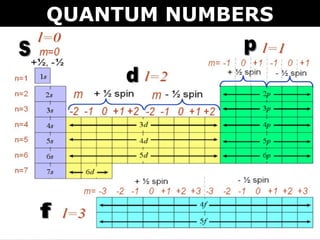
l = 0 represents the s-orbital
l = 1 represents the p-orbitals
etc.
QUANTUM NUMBERS
3. Magnetic Quantum Number3. Magnetic Quantum Number
Represented as “ml”.
ml is determined by the l value:
–l ≤ ml ≤ +l, where ml are integers
Each ml value represents a specific orbital.
QUANTUM NUMBERS
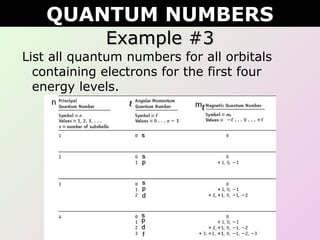
Example #3Example #3
List all quantum numbers for all orbitals
containing electrons for the first four
energy levels.
QUANTUM NUMBERS
4. Spin Quantum Number4. Spin Quantum Number
Represented as “s” or “ms”.
Electrons spin in one of two directions.
s = +1/2 (up-spin) or s = -1/2 (down-spin)
Convention suggest up-spin electrons are
placed in orbitals first.
QUANTUM NUMBERS
4. Spin Quantum Number4. Spin Quantum Number
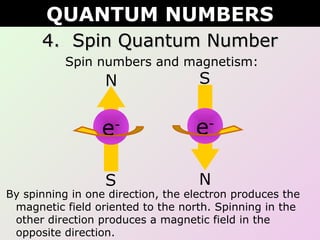
Spin numbers and magnetism:
QUANTUM NUMBERS
e-
N
S
e-
S
N
By spinning in one direction, the electron produces the
magnetic field oriented to the north. Spinning in the
other direction produces a magnetic field in the
opposite direction.
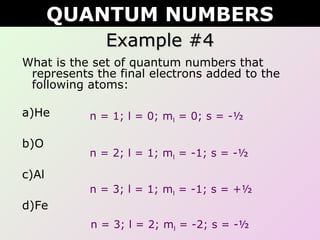
Example #4Example #4
What is the set of quantum numbers that
represents the final electrons added to the
following atoms:
a)He
b)O
c)Al
d)Fe
QUANTUM NUMBERS
n = 1; l = 0; ml = 0; s = -½
n = 2; l = 1; ml = -1; s = -½
n = 3; l = 1; ml = -1; s = +½
n = 3; l = 2; ml = -2; s = -½
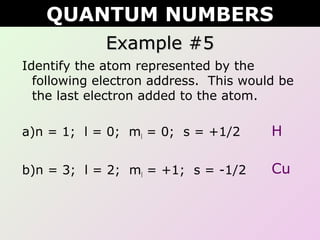
Example #5Example #5
Identify the atom represented by the
following electron address. This would be
the last electron added to the atom.
a)n = 1; l = 0; ml = 0; s = +1/2
b)n = 3; l = 2; ml = +1; s = -1/2
QUANTUM NUMBERS
H
Cu
QUANTUM NUMBERS
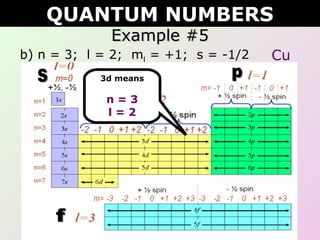
b) n = 3; l = 2; ml = +1; s = -1/2 Cu
Example #5Example #5
3d means
n = 3
l = 2
QUANTUM NUMBERS
QUANTUM NUMBERS
Homework: Page 159 # 1 – 3, 5 - 12

Tang 03 quantum numbers

  • 1.
  • 2.
    Quantum numbers canbe used to describe the location of any one electron within an atom. Four components: 1.Principal quantum number (n) 2.Azimuthal quantum number (l) 3.Magnetic quantum number (ml) 4.Spin quantum number (ms or s) QUANTUM NUMBERS
  • 3.
    1. Principal QuantumNumber1. Principal Quantum Number Represented as “n”. n indicates the energy level. n has a whole number value ≥ 1. QUANTUM NUMBERS
  • 4.
    2. Azimuthal QuantumNumber2. Azimuthal Quantum Number Represented as “l ”. l indicates the orbital type. l has a whole number value ≥ 0. l = 0 represents the s-orbital l = 1 represents the p-orbitals etc. QUANTUM NUMBERS
  • 5.
    3. Magnetic QuantumNumber3. Magnetic Quantum Number Represented as “ml”. ml is determined by the l value: –l ≤ ml ≤ +l, where ml are integers Each ml value represents a specific orbital. QUANTUM NUMBERS
  • 6.
    Example #3Example #3 Listall quantum numbers for all orbitals containing electrons for the first four energy levels. QUANTUM NUMBERS
  • 7.
    4. Spin QuantumNumber4. Spin Quantum Number Represented as “s” or “ms”. Electrons spin in one of two directions. s = +1/2 (up-spin) or s = -1/2 (down-spin) Convention suggest up-spin electrons are placed in orbitals first. QUANTUM NUMBERS
  • 8.
    4. Spin QuantumNumber4. Spin Quantum Number Spin numbers and magnetism: QUANTUM NUMBERS e- N S e- S N By spinning in one direction, the electron produces the magnetic field oriented to the north. Spinning in the other direction produces a magnetic field in the opposite direction.
  • 9.
    Example #4Example #4 Whatis the set of quantum numbers that represents the final electrons added to the following atoms: a)He b)O c)Al d)Fe QUANTUM NUMBERS n = 1; l = 0; ml = 0; s = -½ n = 2; l = 1; ml = -1; s = -½ n = 3; l = 1; ml = -1; s = +½ n = 3; l = 2; ml = -2; s = -½
  • 10.
    Example #5Example #5 Identifythe atom represented by the following electron address. This would be the last electron added to the atom. a)n = 1; l = 0; ml = 0; s = +1/2 b)n = 3; l = 2; ml = +1; s = -1/2 QUANTUM NUMBERS H Cu
  • 11.
    QUANTUM NUMBERS b) n= 3; l = 2; ml = +1; s = -1/2 Cu Example #5Example #5 3d means n = 3 l = 2
  • 12.
  • 13.
    QUANTUM NUMBERS Homework: Page159 # 1 – 3, 5 - 12

Editor's Notes

  • #12 Homework: Page 159 # 1 – 3, 5 - 12
  • #13 Homework: Page 159 # 1 – 3, 5 - 12
  • #14 Homework: Page 159 # 1 – 3, 5 - 12