OBJECTIVE:
Describe the
Internal
structure of
the Earth.
(S10ES-Ia-j-36.5)
EARTH’S INTERIOR
SPELLING
TIME!
ASTHENOSPHERE
MANTLE
UPWARD
DENSITY
CONVECTION
CURRENT
OBJECTIVE:
Describe the
process of
Convection
Current in the
mantle.
(S10ES-Ia-j-36.5)
CONVECTION
CURRENT
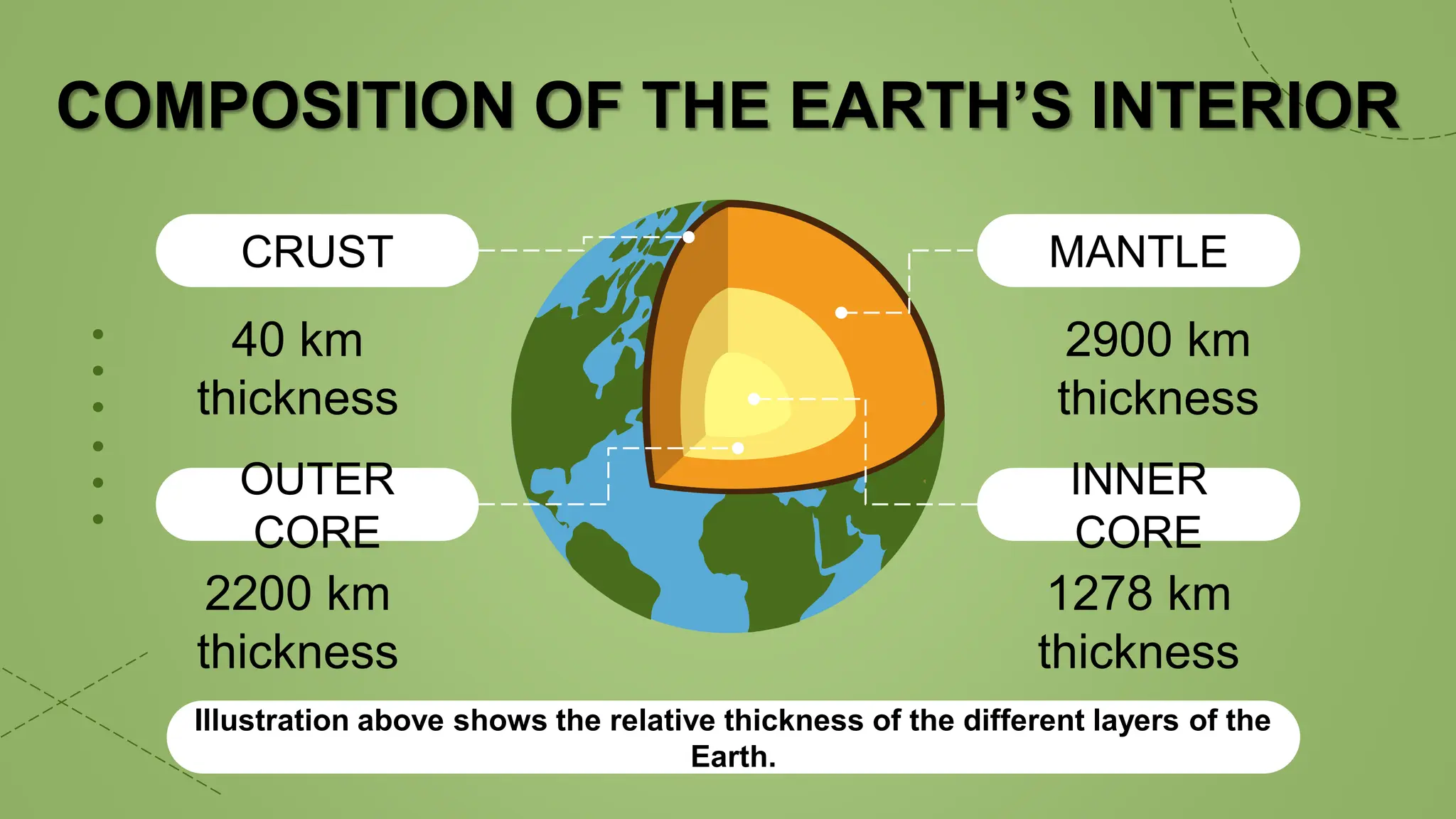
COMPOSITION OF THE EARTH’S INTERIOR
CRUST
OUTER
CORE
MANTLE
INNER
CORE
40 km
thickness
2900 km
thickness
2200 km
thickness
1278 km
thickness
Illustration above shows the relative thickness of the different layers of the
Earth.
CRUST
CONTINENTAL CRUST
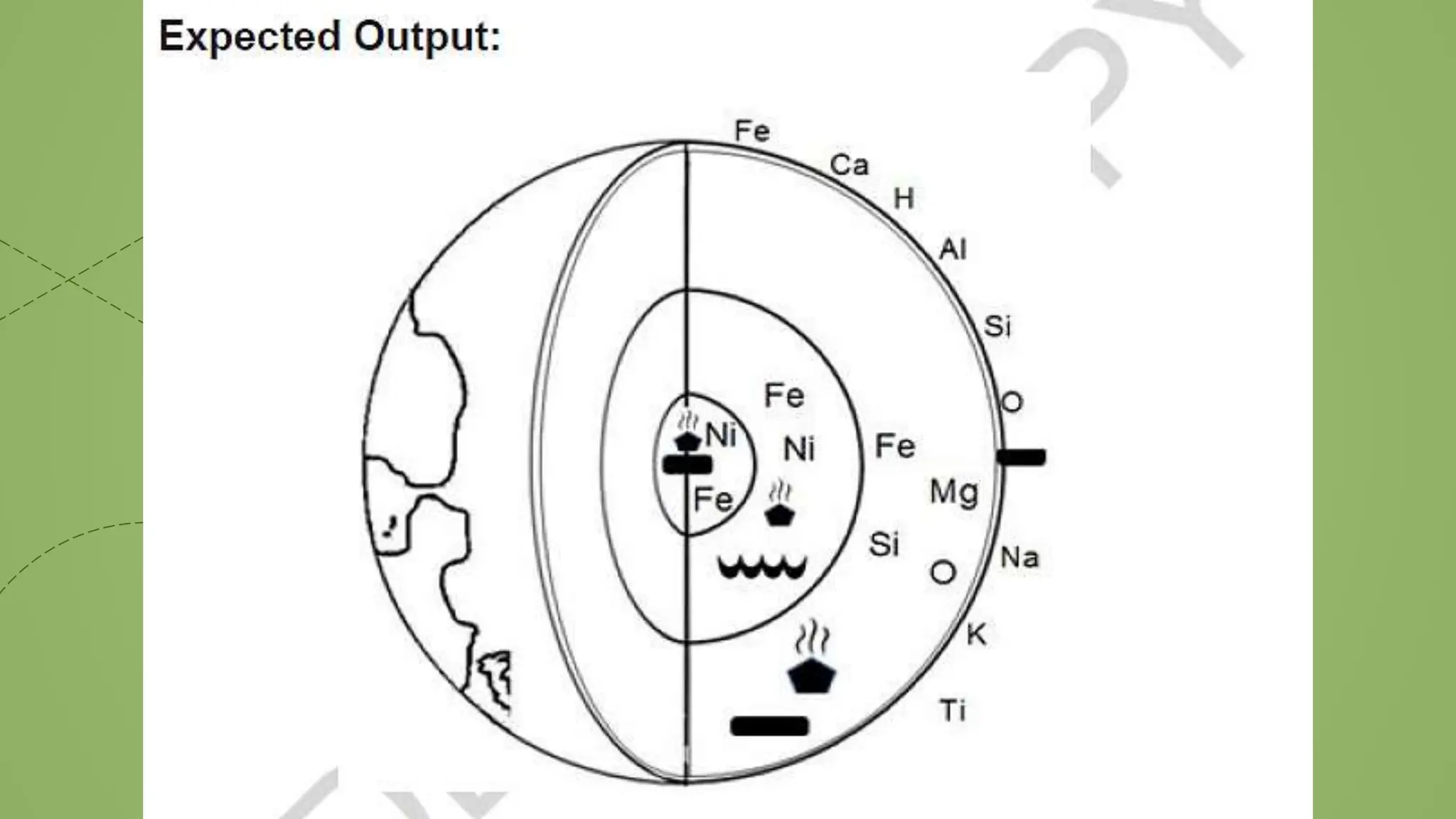
Si, O, Al, Ca, Na,
and K
35-40 kilometers thick
Less dense rocks - Granite
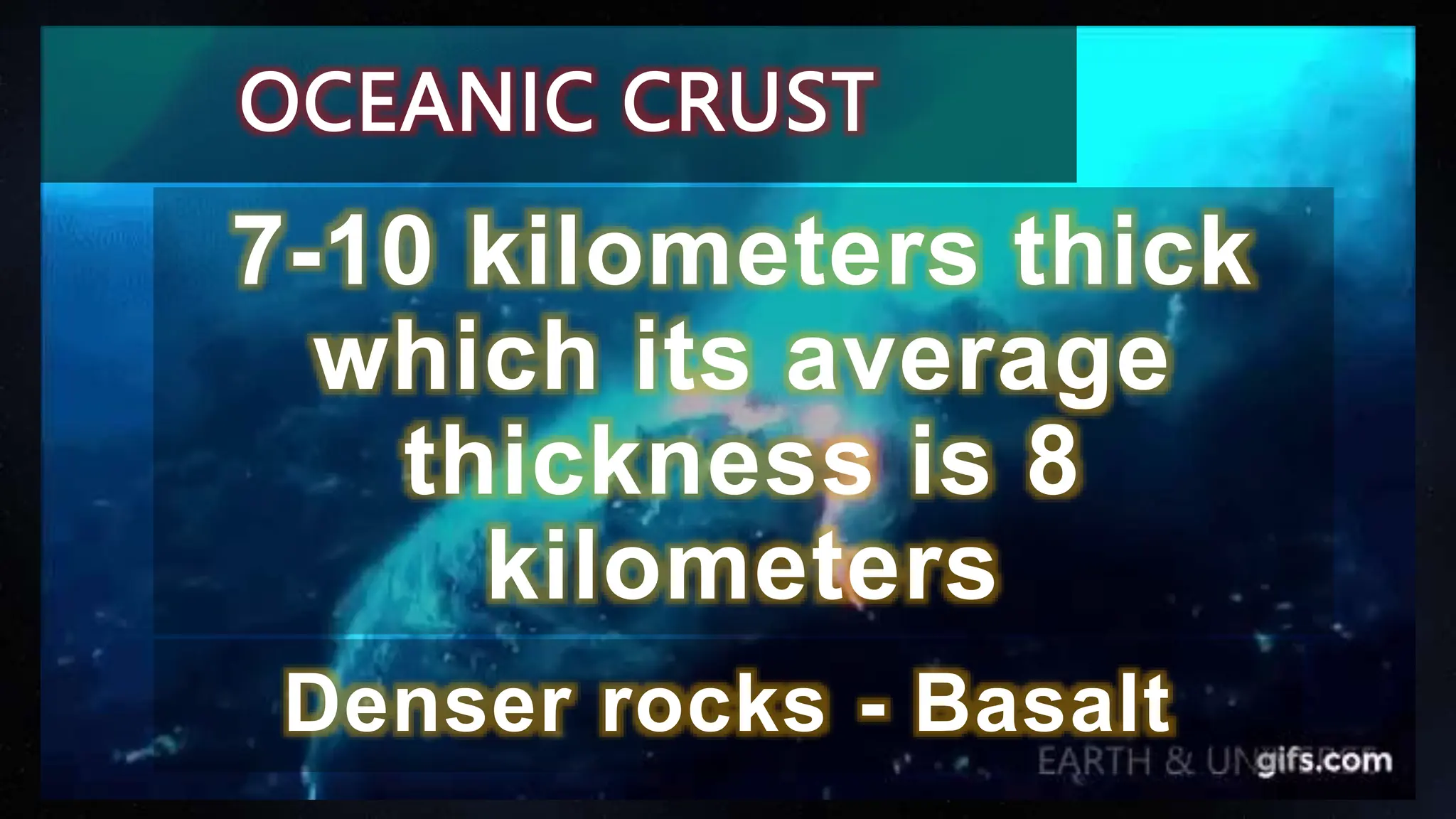
OCEANIC CRUST
7-10 kilometers thick
which its average
thickness is 8
kilometers
Denser rocks - Basalt
MANTLE
MANTLE
Silicate rocks
Extends to about 2900
kilometers from the
Earth’s surface.
Fe, Si, Mg, and O
MANTLE
Lower part of the mantle
consists of more iron than the
upper part.
The lower mantle is denser than
the upper portion.
MANTLE
Beneath the lithosphere lies the
soft, weak layer, made of hot molten
material. Its temperature is about
300 – 800˚C. Facilitates the
movement of the lithospheric plates.
ASTHENOSPHERE
SIMULATING
PLASTICITY
The ability of the
asthenosphere to
flow slowly.
PLASTICITY
QUIZ
TIME!!!
1. What makes up the Lithosphere?
a. Continental crust
b. Crust and the Upper mantle
c. Oceanic and Continental crust
d. Upper mantle
2. It is the ability of the asthenosphere to
flow slowly.
a. Convection current
b. Plasticity
c. Pressure Freezing
d. Subduction
3. The thickest layer of the Earth.
a. Crust
b. Mantle
c. Outer core
d. Inner core
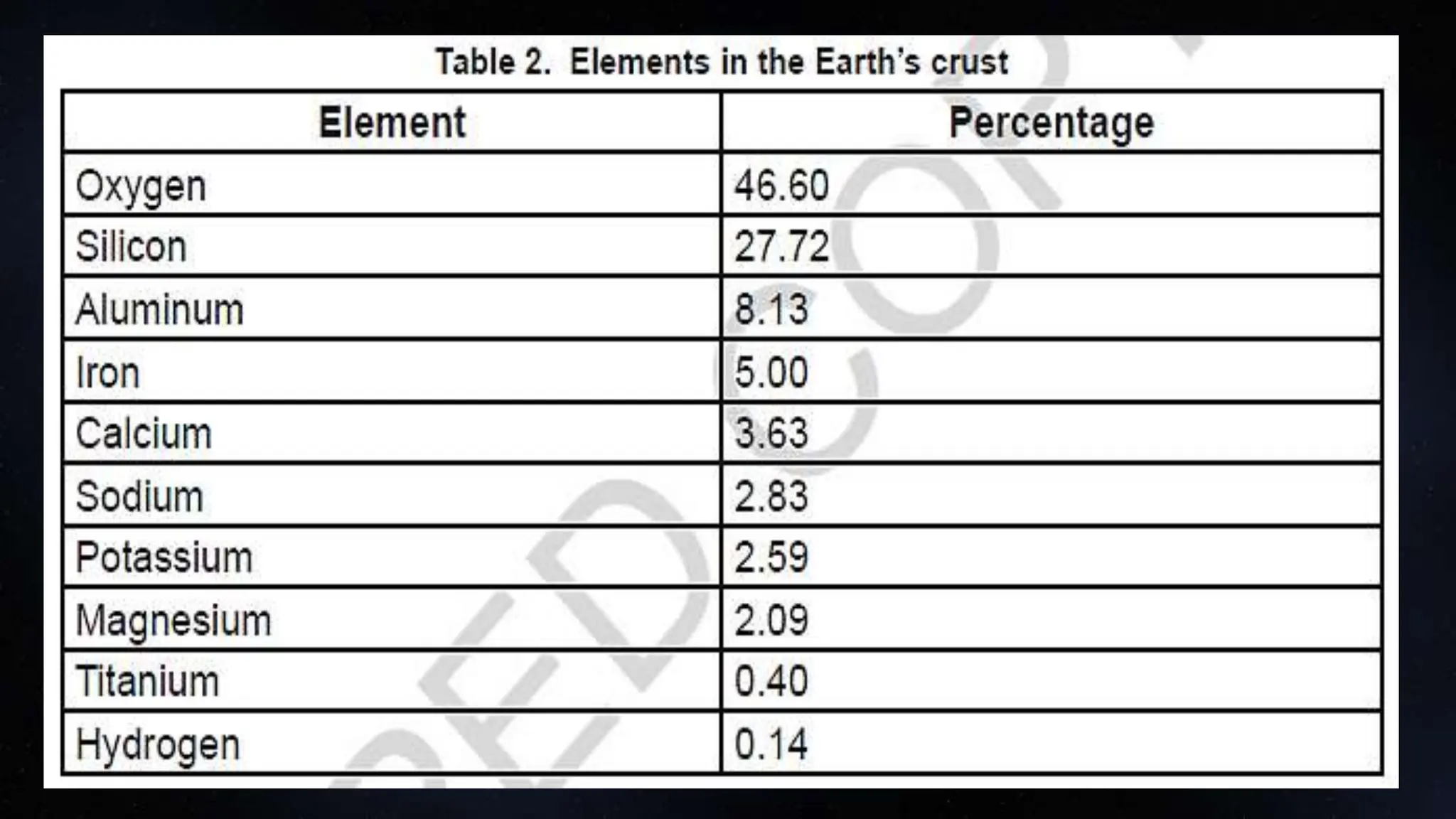
4. What element has the most abundant
percentage in the Earth’s crust?
a. Aluminum
b. Oganesson
c. Oxygen
d. Silicon
5. Soft, weak layer, made of hot molten
material on the upper mantle.
a. Molten Iron and Nickel
b. Magma
c. Lithosphere
d. Asthenosphere
LET’S
CHECK!
1. What makes up the Lithosphere?
a. Continental crust
b. Crust and the Upper mantle
c. Oceanic and Continental crust
d. Upper mantle
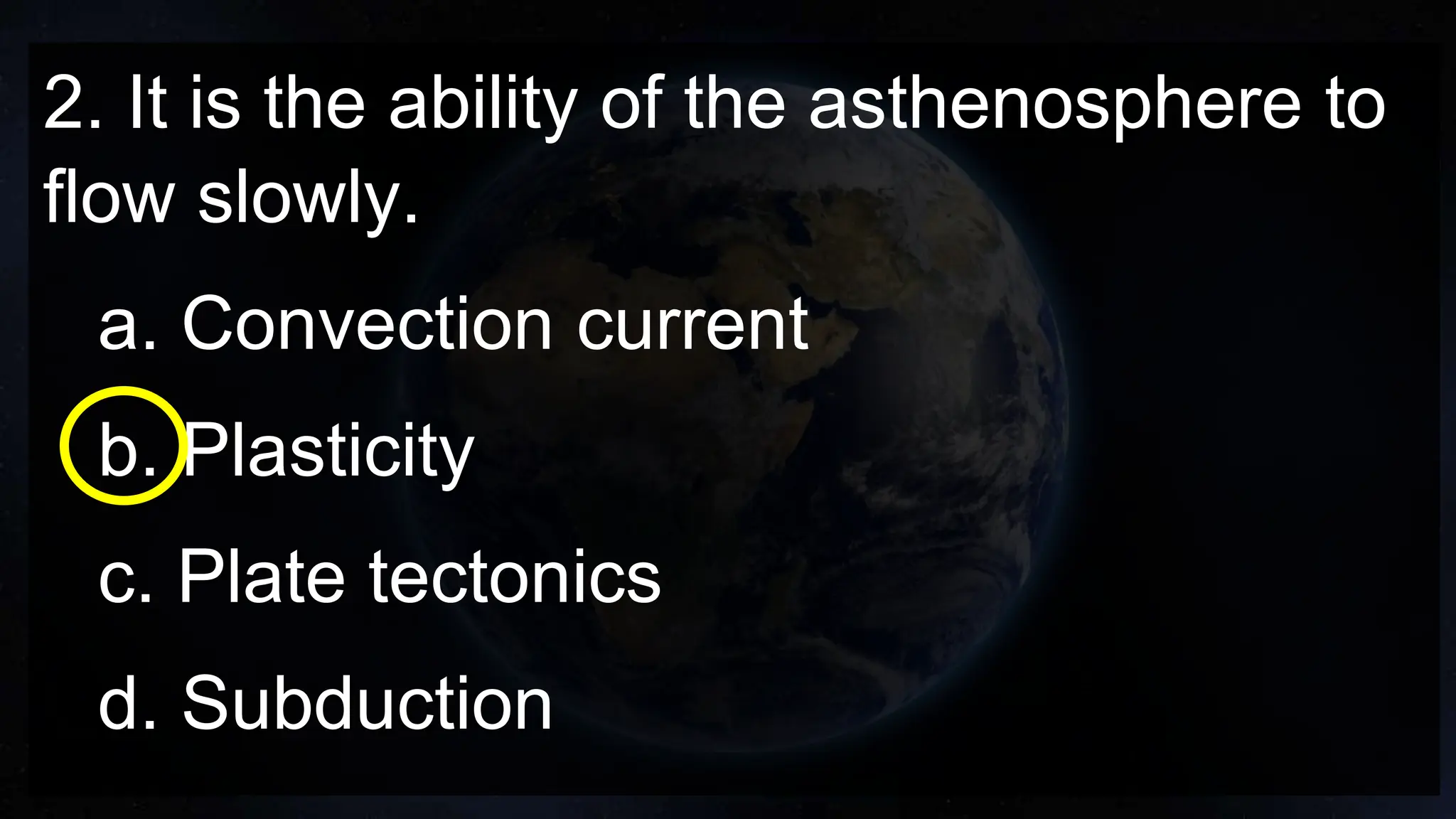
2. It is the ability of the asthenosphere to
flow slowly.
a. Convection current
b. Plasticity
c. Plate tectonics
d. Subduction
3. The thickest layer of the Earth.
a. Crust
b. Mantle
c. Outer core
d. Inner core
4. What element has the most abundant
percentage in the Earth’s crust?
a. Aluminum
b. Oganesson
c. Oxygen
d. Silicon
5. Soft, weak layer, made of hot molten
material on the upper mantle.
a. Molten Iron and Nickel
b. Magma
c. Lithosphere
d. Asthenosphere
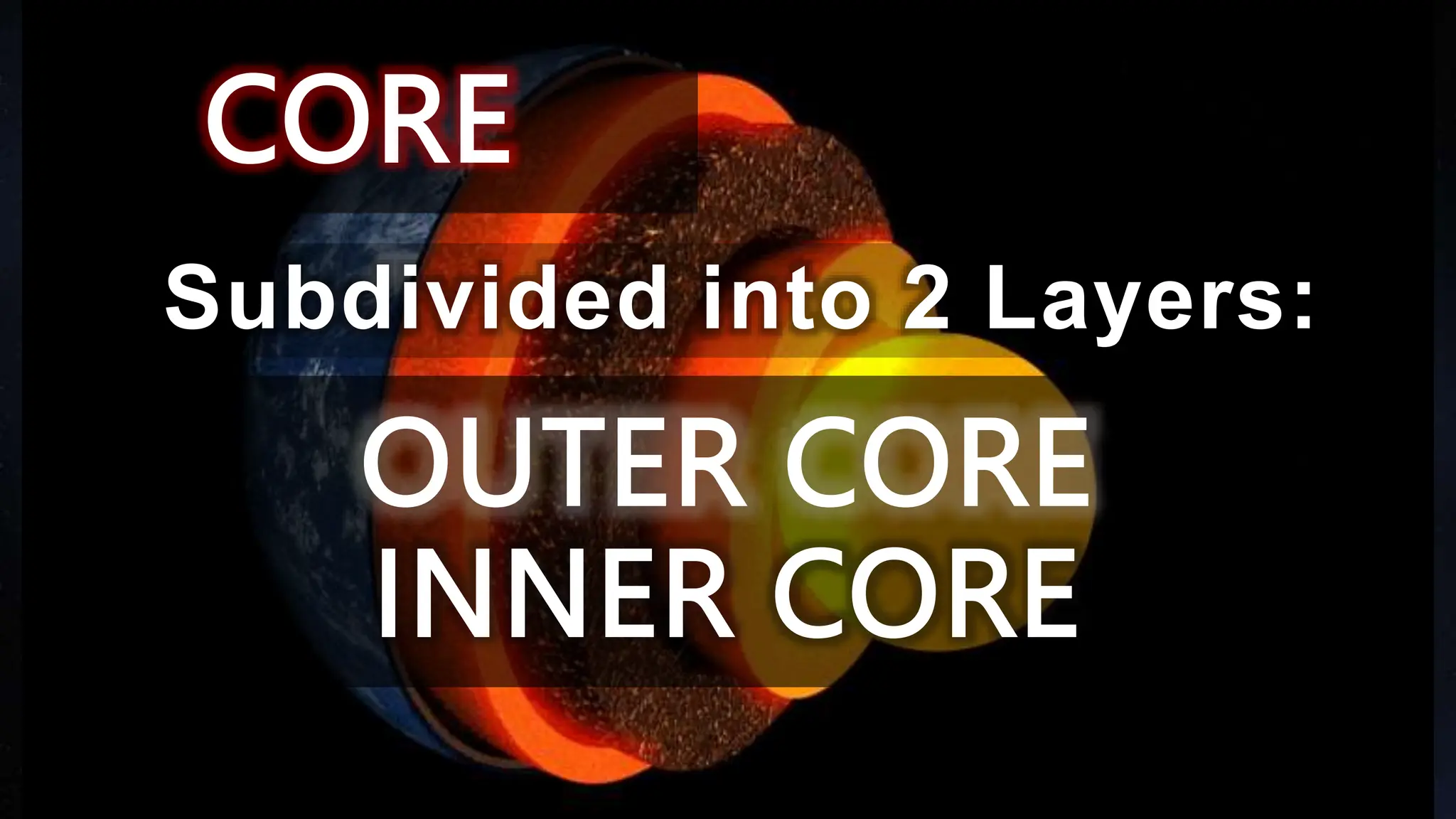
CORE
Subdivided into 2 Layers:
OUTER CORE
INNER CORE
OUTER CORE
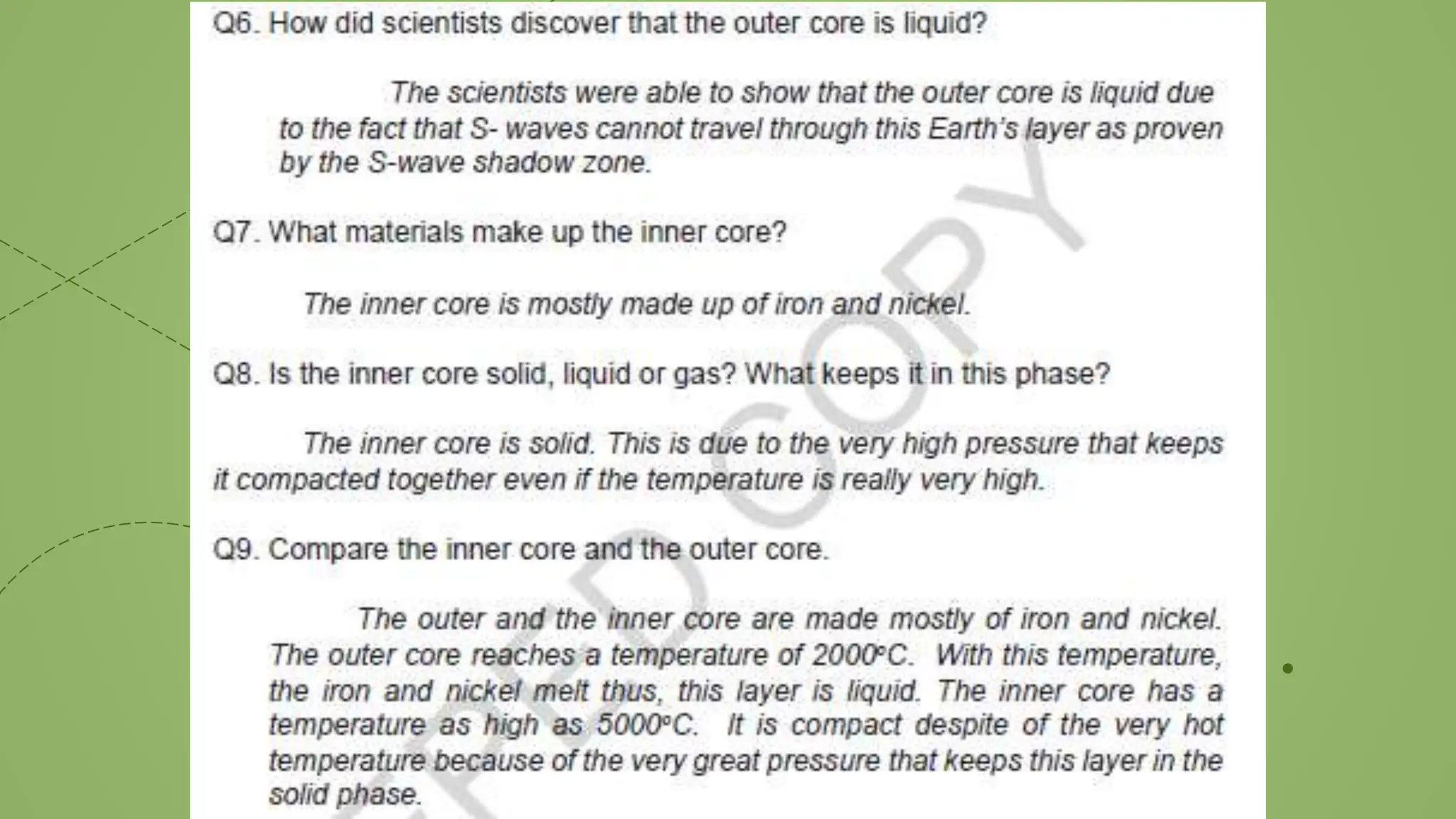
Fe, Ni (molten/liquid)
2900 kilometers below the
Earth’s surface
2250 kilometers thick
2000˚C temperature
OUTER CORE
The outer core is mainly
made up of iron and
nickel moving around the
solid inner core, creating
Earth’s magnetic field
(magnetism).
INNER CORE
Fe, Ni (solid) 1300
kilometers
thick
Iron and nickel are believed to have
solidified as a result of pressure freezing,
which is common to liquids subjected under
tremendous pressure.
5000˚C temperature
What tells us that the
inner core is made up of
iron?
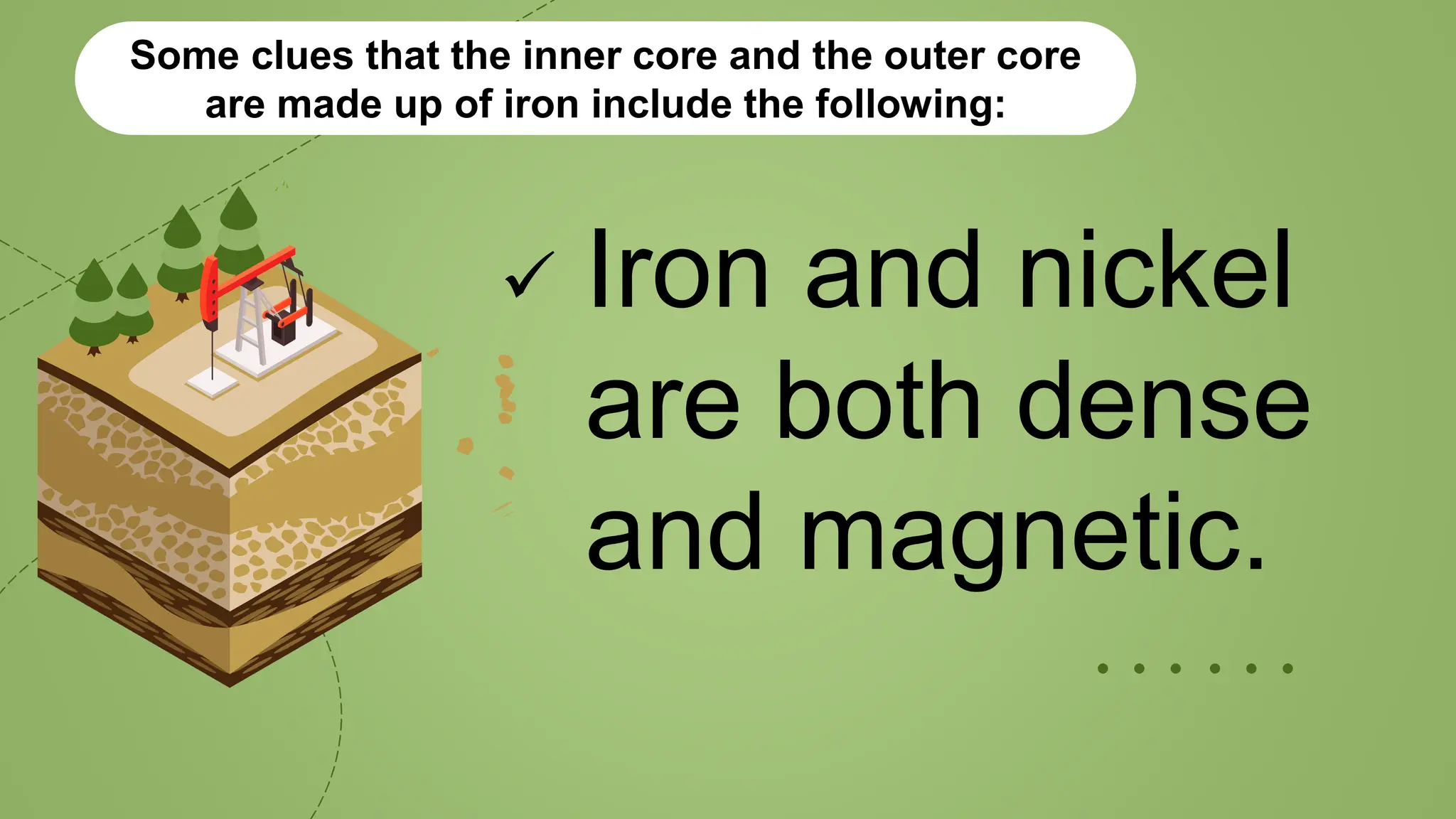
Some clues that the inner core and the outer core
are made up of iron include the following:
 Iron and nickel
are both dense
and magnetic.
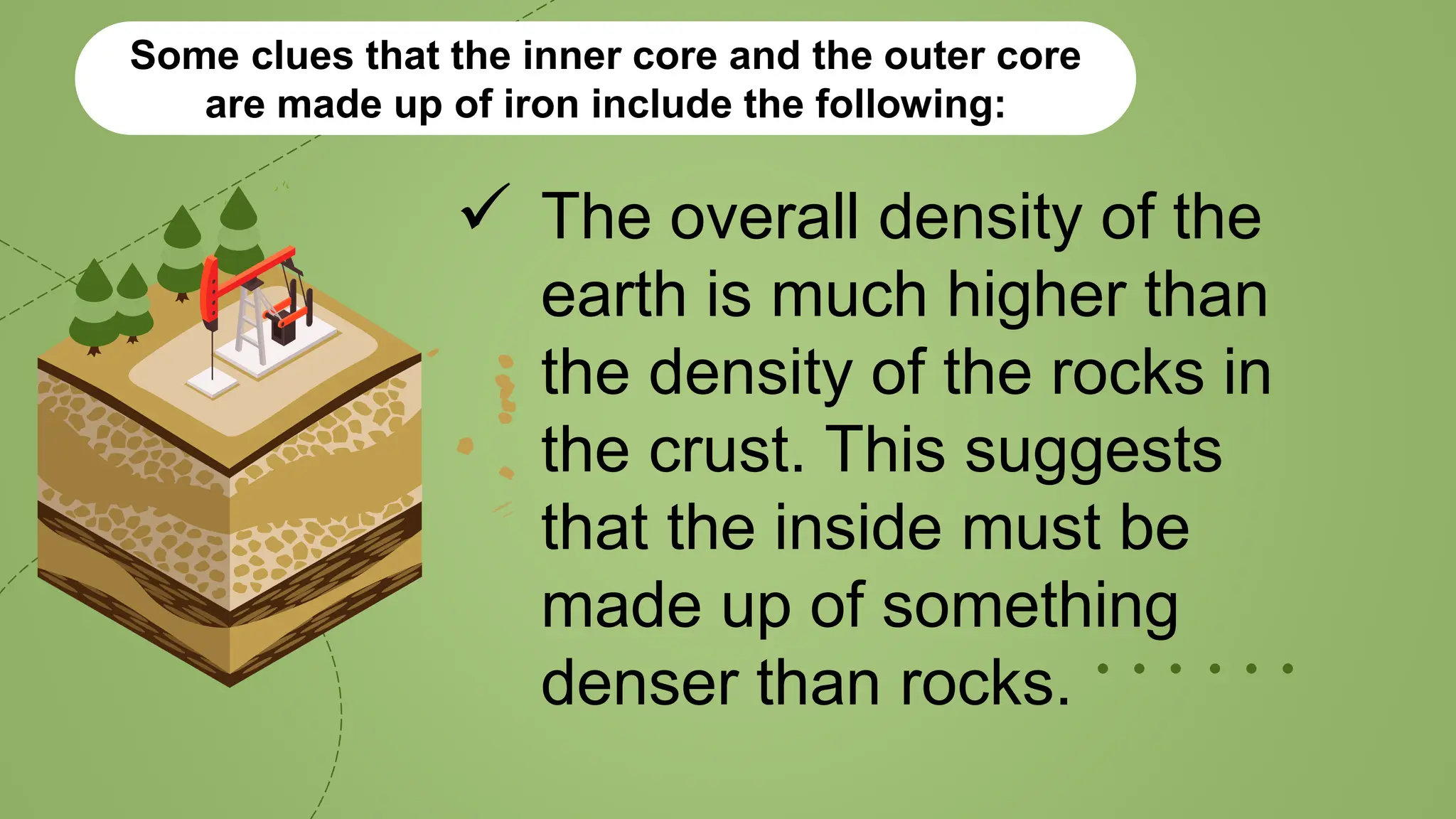
Some clues that the inner core and the outer core
are made up of iron include the following:
 The overall density of the
earth is much higher than
the density of the rocks in
the crust. This suggests
that the inside must be
made up of something
denser than rocks.
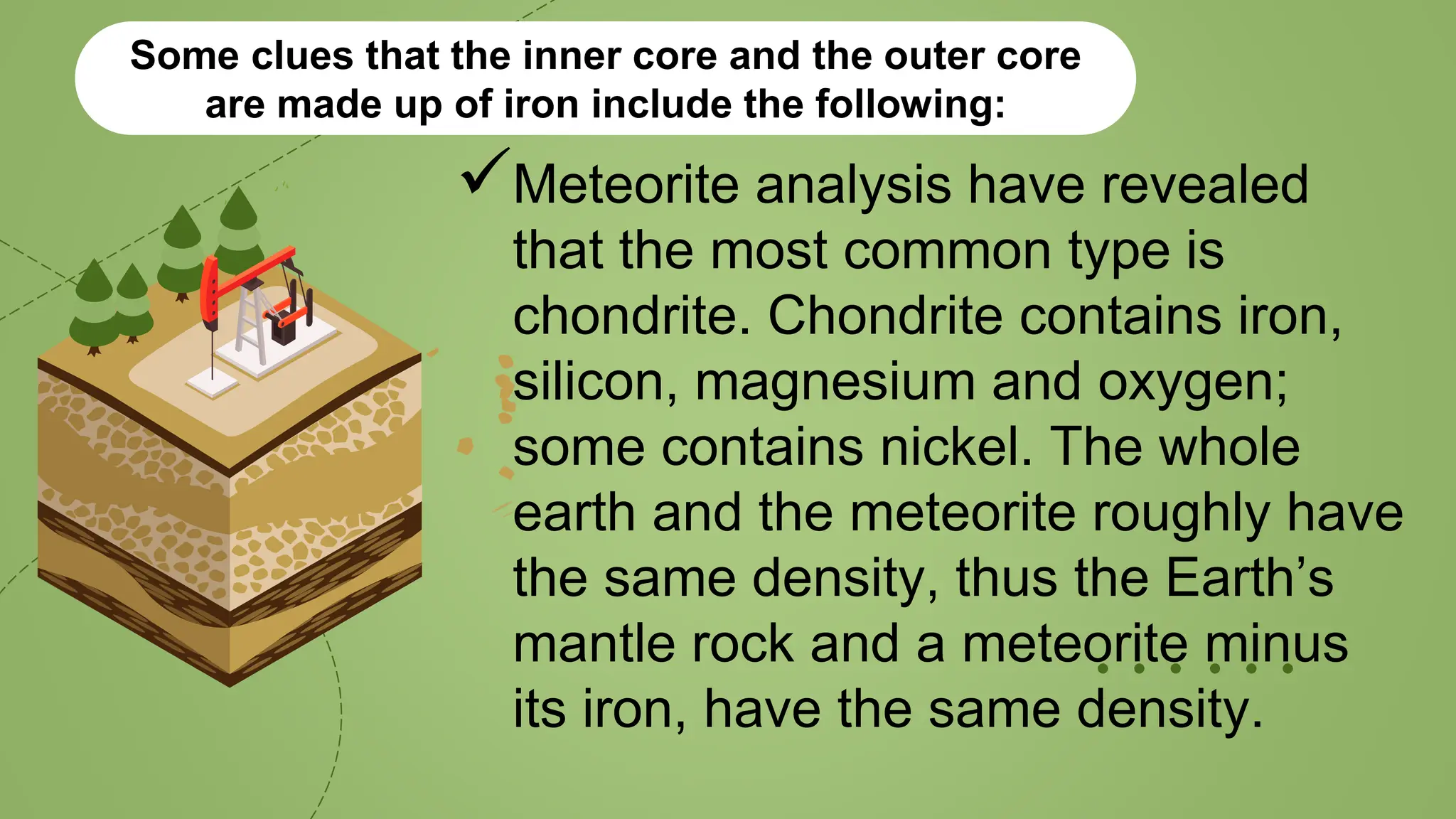
Some clues that the inner core and the outer core
are made up of iron include the following:
Meteorite analysis have revealed
that the most common type is
chondrite. Chondrite contains iron,
silicon, magnesium and oxygen;
some contains nickel. The whole
earth and the meteorite roughly have
the same density, thus the Earth’s
mantle rock and a meteorite minus
its iron, have the same density.
QUIZ
TIME!!!
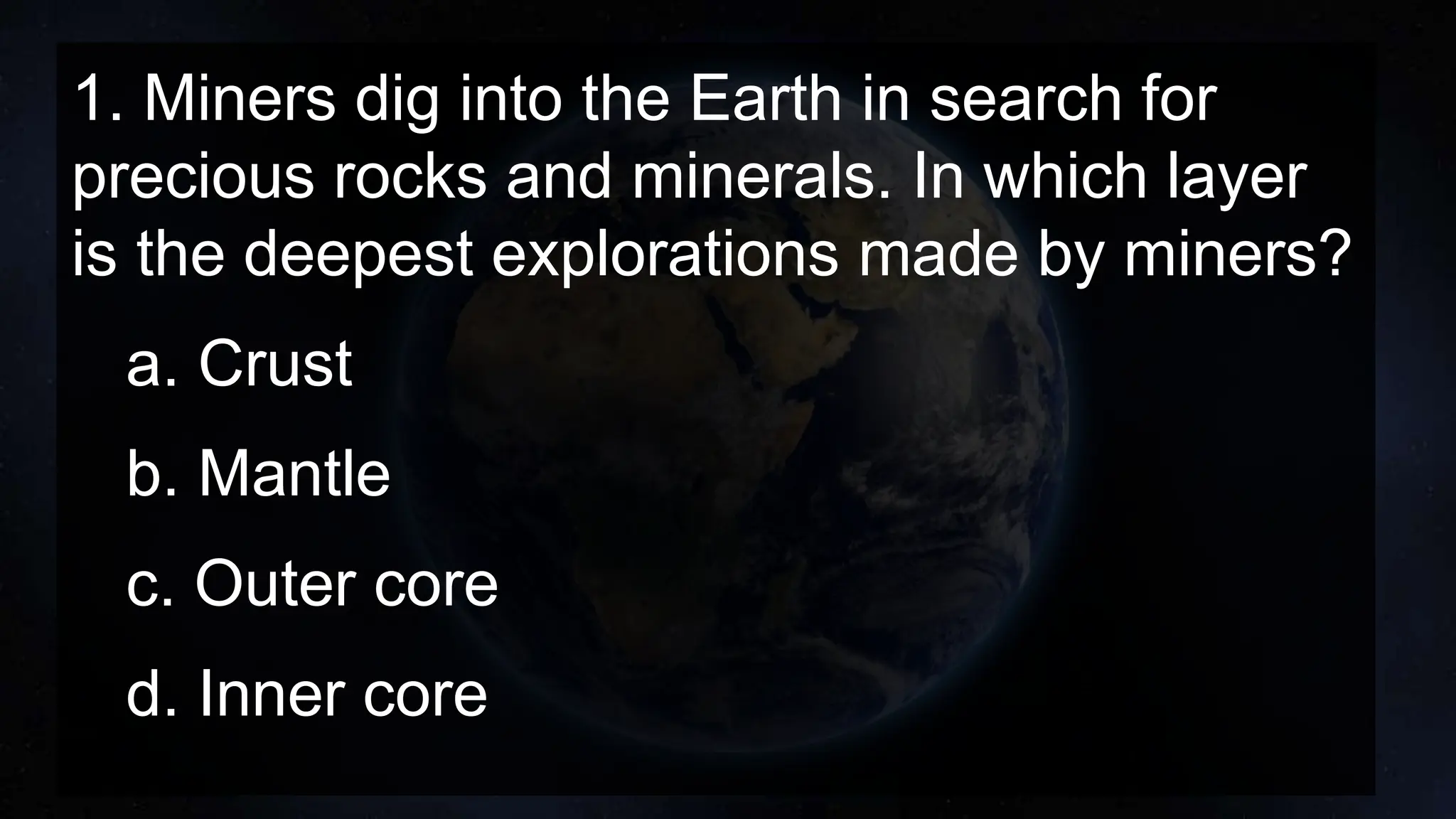
1. Miners dig into the Earth in search for
precious rocks and minerals. In which layer
is the deepest explorations made by miners?
a. Crust
b. Mantle
c. Outer core
d. Inner core
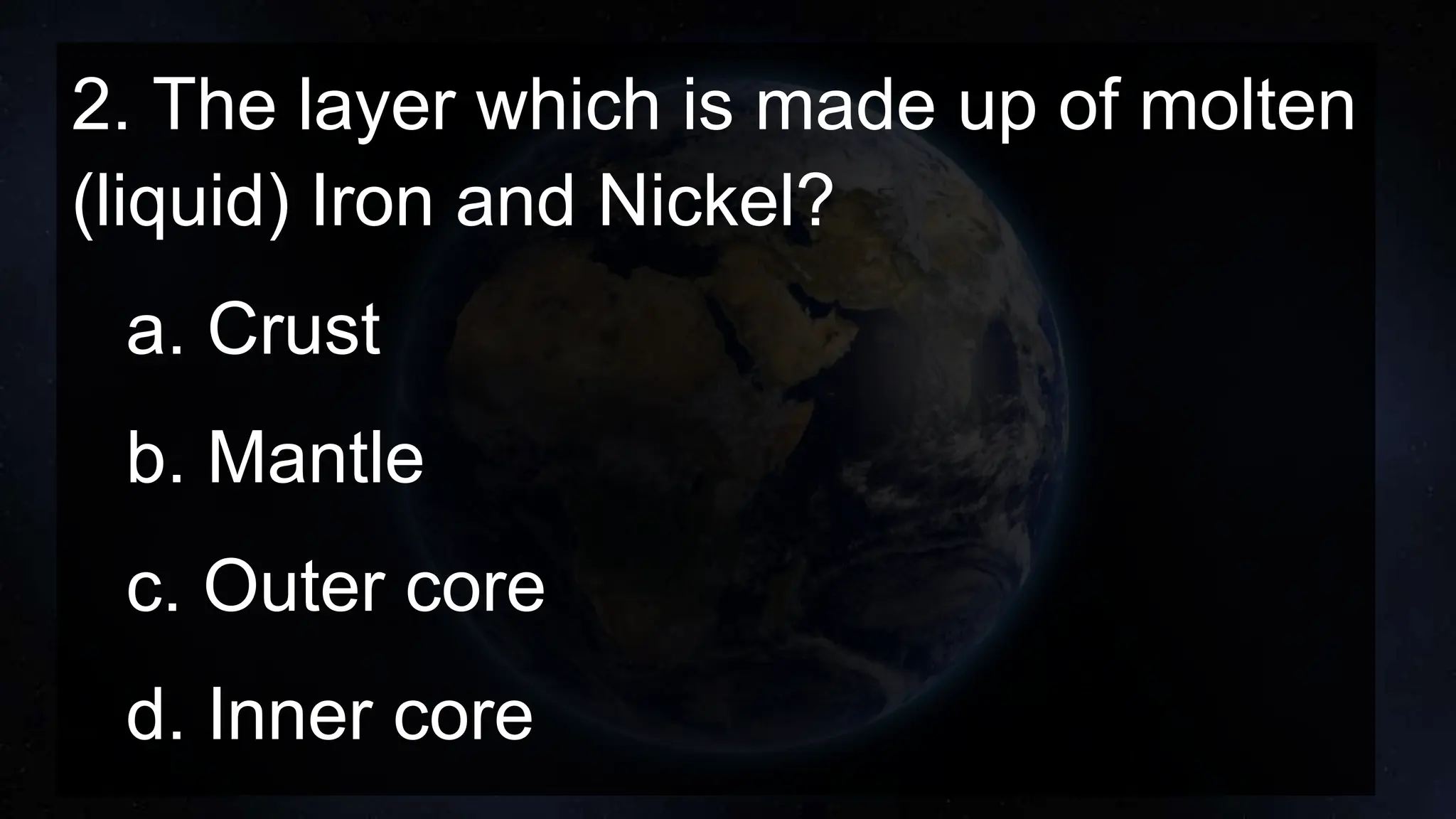
2. The layer which is made up of molten
(liquid) Iron and Nickel?
a. Crust
b. Mantle
c. Outer core
d. Inner core
3. Iron and nickel are believed to have
solidified because of under tremendous
pressure which is common to liquids.
a. Convection current
b. Plasticity
c. Pressure Freezing
d. Subduction
4. A layer which is made up of iron and
nickel moving around, creating Earth’s
magnetic field (magnetism).
a. Crust
b. Mantle
c. Outer core
d. Inner core
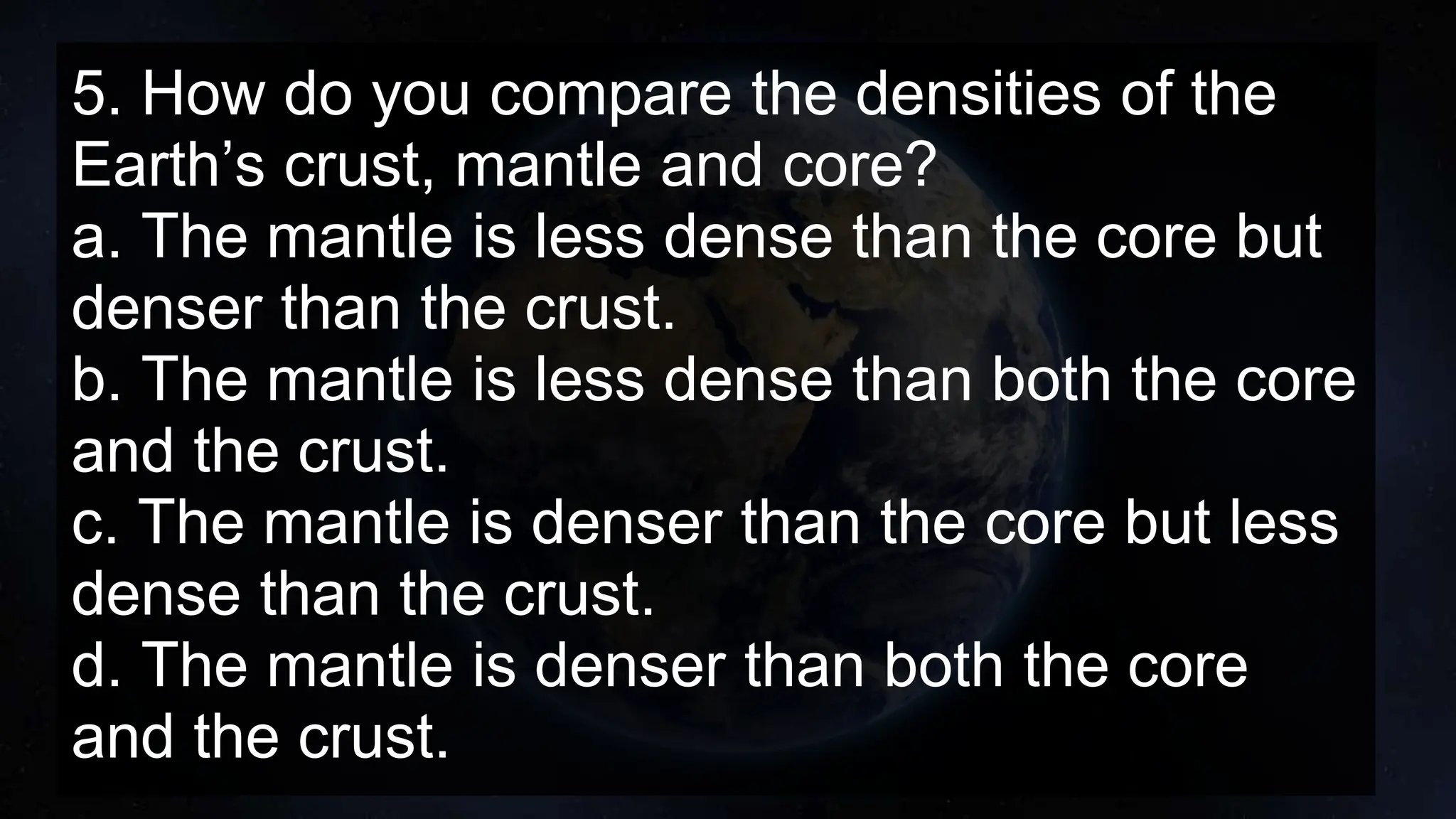
5. How do you compare the densities of the
Earth’s crust, mantle and core?
a. The mantle is less dense than the core but
denser than the crust.
b. The mantle is less dense than both the core
and the crust.
c. The mantle is denser than the core but less
dense than the crust.
d. The mantle is denser than both the core
and the crust.
LET’S
CHECK!
1. Miners dig into the Earth in search for
precious rocks and minerals. In which layer
is the deepest explorations made by miners?
a. Crust
b. Mantle
c. Outer core
d. Inner core
2. The layer which is made up of molten
(liquid) Iron and Nickel?
a. Crust
b. Mantle
c. Outer core
d. Inner core
3. Iron and nickel are believed to have
solidified because of under tremendous
pressure which is common to liquids.
a. Convection current
b. Plasticity
c. Pressure Freezing
d. Subduction
4. A layer which is made up of iron and
nickel moving around, creating Earth’s
magnetic field (magnetism).
a. Crust
b. Mantle
c. Outer core
d. Inner core
5. How do you compare the densities of the
Earth’s crust, mantle and core?
a. The mantle is less dense than the core but
denser than the crust.
b. The mantle is less dense than both the core
and the crust.
c. The mantle is denser than the core but less
dense than the crust.
d. The mantle is denser than both the core
and the crust.
Here is where your presentation begins
End of the
Lesson
CONTENTS OF THIS TEMPLATE
Here’s what you’ll find in this Slidesgo template:
1. A slide structure based on a Thesis defense presentation, which you can easily adapt to your
needs. For more info on how to edit the template, please visit Slidesgo School or read our FAQs.
2. To view this template with the correct fonts in ppt format, download and install on your computer the
fonts that we have used. You can learn how to download and install fonts here.
3. An assortment of graphic resources that are suitable for use in the presentation can be found in the
alternative resources slide.
4. A thanks slide, which you must keep so that proper credits for our design are given.
5. A resources slide, where you’ll find links to all the elements used in the template.
6. Instructions for use.
7. Final slides with:
8. The fonts and colors used in the template.
9. A selection of illustrations. You can also customize and animate them as you wish with the
online editor. Visit Storyset to find more.
10. More infographic resources, whose size and color can be edited.
11. Sets of customizable icons of the following themes: general, business, avatar, creative
process, education, help & support, medical, nature, performing arts, SEO & marketing, and
teamwork.
You can delete this slide when you’re done editing the presentation.
RESULTS
ANALYSIS
METHODOLOGY
CONCLUSIONS
OBJECTIVES
TABLE OF CONTENTS
You can describe the topic of
the section here
You can describe the topic of
the section here
You can describe the topic of
the section here
You can describe the topic of
the section here
01
03
02
04
You can give a brief description of the topic you
want to talk about here. For example, if you want to
talk about Mercury, you can say that it’s the
smallest planet in the entire Solar System
INTRODUCTIO
N
-SOMEONE FAMOUS
“This is a quote, words full of wisdom that
someone important said and can make
the reader get inspired.”
AWESOM
E WORDS
VENUS
MARS
MERCURY
STUDY OBJECTIVES
It’s the closest planet to the
Sun and the smallest one
in the Solar System
Despite being red, Mars is
actually a cold place. It’s
full of iron oxide dust
Venus has a beautiful
name and is the second
planet from the Sun
THEORY 1 THEORY 2
LITERATURE REVIEW
Mercury is the closest planet to
the Sun and the smallest one in
the Solar System. The name
has nothing to do with the liquid
metal
Venus has a beautiful name
and is the second planet from
the Sun. It’s hot and is the
second-brightest natural object
in the night sky
VENUS SATURN MARS
NEPTUN
E
SCHEDULE
01 02 03 04
Venus is the second
planet from the Sun
Saturn is composed of
hydrogen and helium
Despite being red,
Mars is actually a cold
place
Neptune is the farthest
planet from the Sun
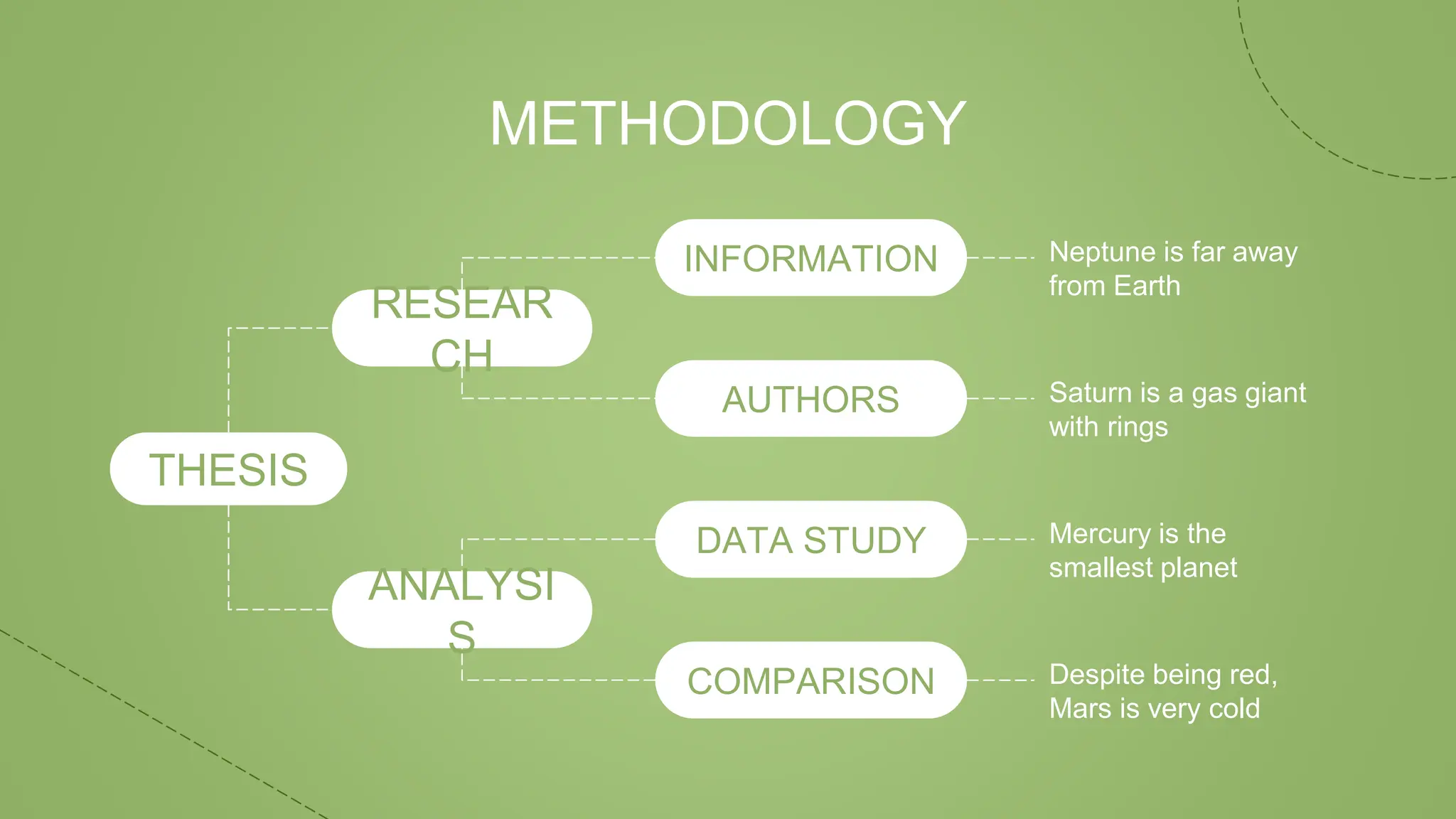
METHODOLOGY
Despite being red,
Mars is very cold
Neptune is far away
from Earth
Mercury is the
smallest planet
INFORMATION
DATA STUDY
COMPARISON
THESIS
Saturn is a gas giant
with rings
AUTHORS
RESEAR
CH
ANALYSI
S
TABLE
EARTH
LAYER
DESCRIPTIO
N
DEPTH TEMPERATU
RE
MARS
Despite being red,
Mars is very cold
100 km 1,600 F°
MERCURY
Mercury is the
smallest planet
400 km 3,000 F°
VENUS
Venus has a
beautiful name
5,000 km 4,000 F°
SATURN
Saturn is a gas
giant with rings
10,000 km 9,000 F°
35%
40%
25%
RESULTS ANALYSIS
Saturn is composed of
hydrogen and helium
Despite being red, Mars
is actually a cold place
Neptune is the farthest
planet from the Sun
Follow the link in the graph to modify its data and then
paste the new one here. For more info, click here
MARS
NEPTUN
E
SATURN
MAP
Despite being red,
Mars is cold
Venus is the second
planet from the Sun
Saturn is a gas giant
with rings
MARS
VENUS
SATURN
A PICTURE IS WORTH A
THOUSAND WORDS
A PICTURE
ALWAYS
REINFORCES
THE CONCEPT
You can replace the image on the screen with
your own work. Just right-click on it and select
“Replace image”
MARS
SATURN
NEPTUNE
VENUS
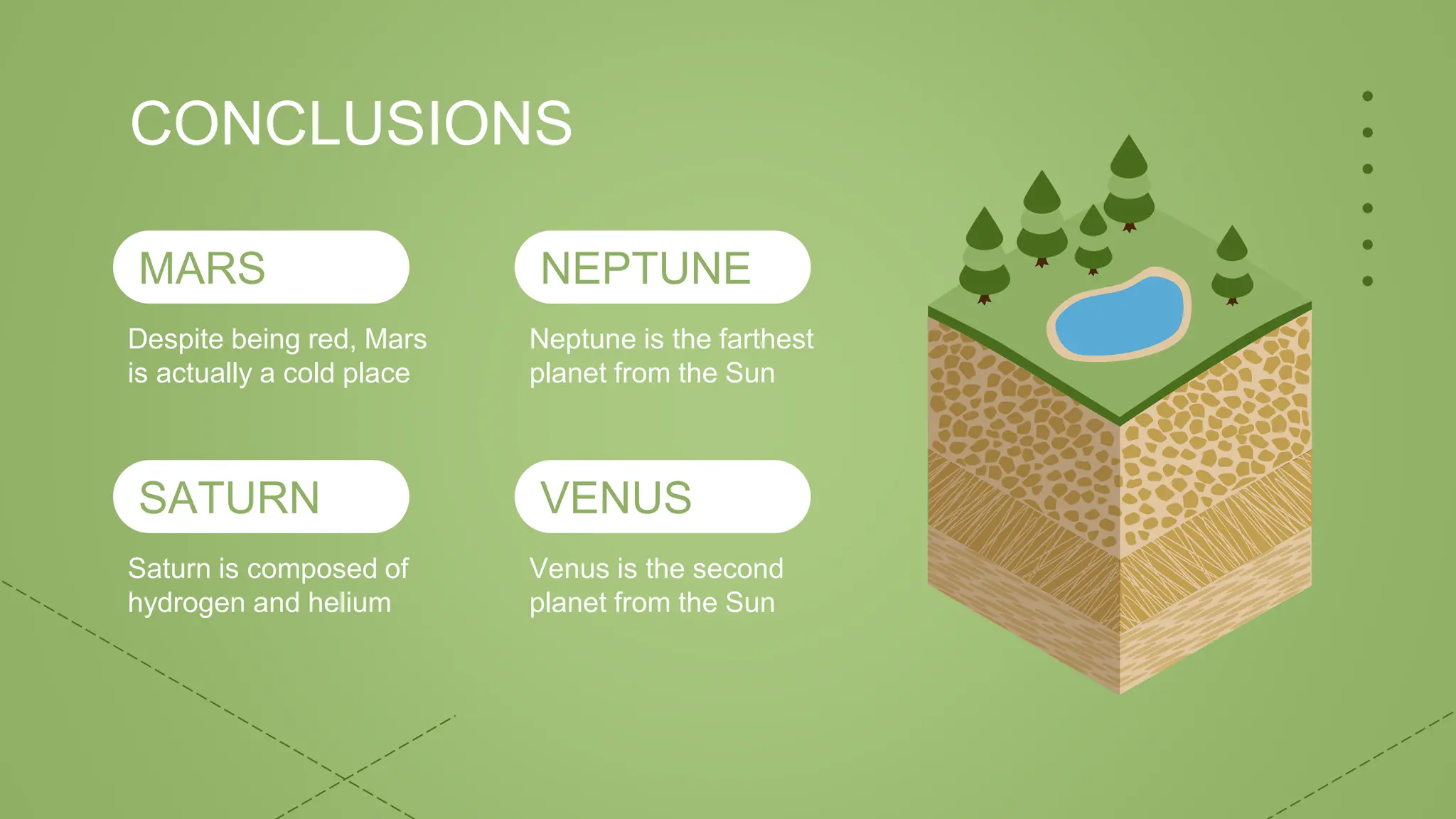
CONCLUSIONS
Despite being red, Mars
is actually a cold place
Neptune is the farthest
planet from the Sun
Saturn is composed of
hydrogen and helium
Venus is the second
planet from the Sun
Big numbers catch your audience’s attention
6,000,000
Is the distance between Earth and the Moon
Earths is the Sun’s mass
333,000
386,000 km
NEPTUNE
MARS
SATURN
VENUS
JUPITER
MERCURY
Jupiter is the biggest
planet of them all
MINERAL CHARACTERISTICS
Mercury is the smallest
planet of them all
Venus is the second
planet from the Sun
Saturn is composed of
hydrogen and helium
Despite being red, Mars is
actually a cold place
Neptune is the farthest
planet from the Sun
BIBLIOGRAPHICAL REFERENCES
● AUTHOR (YEAR). Title of the publication. Publisher
You can replace the image on the
screen with your own work. Just
right-click on it and select
“Replace image”
MOCKUP
CREDITS: This presentation template was
created by Slidesgo, including icons by Flaticon
and infographics & images by Freepik
THANKS!
Do you have any questions?
youremail@freepik.com
+91 620 421 838
yourcompany.com
Please keep this slide for attribution
ALTERNATIVE RESOURCES
Here’s an assortment of alternative resources whose style fits the one of this template
PHOTOS:
● Rough surface of stone
● Lichen and moss on old rock
VECTORS:
● Earth exploration isometric structure of globe soil layers scientific laboratory geological
RESOURCES
Did you like the resources on this template? Get them for free at our other websites:
PHOTOS:
● Green tree in front of rocky mountain against blue sky
● Full frame shot of rock
VECTORS:
● Earth exploration isometric structure of globe soil layers scientific laboratory geological
● Isometric geology collection with outdoor landscape illustration
In order to use this template, you must credit Slidesgo by keeping the Thanks slide.
You are allowed to:
- Modify this template.
- Use it for both personal and commercial projects.
You are not allowed to:
- Sublicense, sell or rent any of Slidesgo Content (or a modified version of Slidesgo Content).
- Distribute Slidesgo Content unless it has been expressly authorized by Slidesgo.
- Include Slidesgo Content in an online or offline database or file.
- Offer Slidesgo templates (or modified versions of Slidesgo templates) for download.
- Acquire the copyright of Slidesgo Content.
For more information about editing slides, please read our FAQs or visit Slidesgo School:
https://slidesgo.com/faqs and https://slidesgo.com/slidesgo-school
Instructions for use
As a Premium user, you can use this template without attributing Slidesgo or keeping the "Thanks" slide.
You are allowed to:
● Modify this template.
● Use it for both personal and commercial purposes.
● Hide or delete the “Thanks” slide and the mention to Slidesgo in the credits.
● Share this template in an editable format with people who are not part of your team.
You are not allowed to:
● Sublicense, sell or rent this Slidesgo Template (or a modified version of this Slidesgo Template).
● Distribute this Slidesgo Template (or a modified version of this Slidesgo Template) or include it in a database or in
any other product or service that offers downloadable images, icons or presentations that may be subject to
distribution or resale.
● Use any of the elements that are part of this Slidesgo Template in an isolated and separated way from this
Template.
● Register any of the elements that are part of this template as a trademark or logo, or register it as a work in an
intellectual property registry or similar.
For more information about editing slides, please read our FAQs or visit Slidesgo School:
https://slidesgo.com/faqs and https://slidesgo.com/slidesgo-school
Instructions for use (premium users)
This presentation has been made using the following fonts:
Hammersmith one
(https://fonts.google.com/specimen/Hammersmith+one)
Roboto
(https://fonts.google.com/specimen/Roboto)
#47260d #7fd6f7 #59aad6 #496d1c
#fff87f #8fb065 #e0c7a2 #c29e4e
#f49a1f
Fonts & colors used
Create your Story with our illustrated concepts. Choose the style you like the most, edit its colors, pick
the background and layers you want to show and bring them to life with the animator panel! It will boost
your presentation. Check out how it works.
Pana Amico Bro Rafiki Cuate
Storyset
You can easily resize these resources without losing quality. To change the color, just ungroup the resource
and click on the object you want to change. Then, click on the paint bucket and select the color you want.
Group the resource again when you’re done. You can also look for more infographics on Slidesgo.
Use our editable graphic resources...
JANUARY FEBRUARY MARCH APRIL MAY JUNE
PHASE 1
PHASE 2
Task 1
Task 2
Task 1
Task 2
JANUARY FEBRUARY MARCH APRIL
PHASE 1
Task 1
Task 2
You can resize these icons without losing quality.
You can change the stroke and fill color; just select the icon and click on the paint bucket/pen.
In Google Slides, you can also use Flaticon’s extension, allowing you to customize and add even more icons.
...and our sets of editable icons
Educational Icons Medical Icons
Business Icons Teamwork Icons
Help & Support Icons Avatar Icons
Creative Process Icons Performing Arts Icons
Nature Icons
SEO & Marketing Icons
Add the title here
Text 1 Text 2 Text 3
Text 4 Text 5 Text 6
2016 2017 2018 2019 2020
“Despite being red,
Mars is actually a
very cold place”
“Mercury is closest
planet to the Sun
and the smallest”
“Neptune is the
farthest-known
planet from the Sun”
“Saturn is a gas
giant and has
several rings”
“Venus has a
beautiful name and
is the second planet”
Premium infographics
“Mercury is closest
planet to the Sun
and the smallest”
“Mercury is closest
planet to the Sun
and the smallest”
“Mercury is closest
planet to the Sun
and the smallest”
“Mercury is closest
planet to the Sun
and the smallest”
TITLE 1
75%
75%
Premium infographics
Digital Marketing
Premium Icons
Online Learning
Premium Icons
Laboratory
Premium Icons
Goals & Results
Premium Icons
Infographic Elements
Premium Icons
Earths Internal Structure for Grade 10 Learners.pptx

Earths Internal Structure for Grade 10 Learners.pptx

  • 1.
  • 2.
  • 5.
  • 6.
  • 7.
  • 8.
  • 9.
  • 10.
  • 11.
  • 12.
  • 13.
    COMPOSITION OF THEEARTH’S INTERIOR CRUST OUTER CORE MANTLE INNER CORE 40 km thickness 2900 km thickness 2200 km thickness 1278 km thickness Illustration above shows the relative thickness of the different layers of the Earth.
  • 14.
  • 15.
    CONTINENTAL CRUST Si, O,Al, Ca, Na, and K 35-40 kilometers thick Less dense rocks - Granite
  • 16.
    OCEANIC CRUST 7-10 kilometersthick which its average thickness is 8 kilometers Denser rocks - Basalt
  • 18.
  • 19.
    MANTLE Silicate rocks Extends toabout 2900 kilometers from the Earth’s surface. Fe, Si, Mg, and O
  • 20.
    MANTLE Lower part ofthe mantle consists of more iron than the upper part. The lower mantle is denser than the upper portion.
  • 21.
    MANTLE Beneath the lithospherelies the soft, weak layer, made of hot molten material. Its temperature is about 300 – 800˚C. Facilitates the movement of the lithospheric plates. ASTHENOSPHERE
  • 22.
  • 23.
    The ability ofthe asthenosphere to flow slowly. PLASTICITY
  • 24.
  • 25.
    1. What makesup the Lithosphere? a. Continental crust b. Crust and the Upper mantle c. Oceanic and Continental crust d. Upper mantle
  • 26.
    2. It isthe ability of the asthenosphere to flow slowly. a. Convection current b. Plasticity c. Pressure Freezing d. Subduction
  • 27.
    3. The thickestlayer of the Earth. a. Crust b. Mantle c. Outer core d. Inner core
  • 28.
    4. What elementhas the most abundant percentage in the Earth’s crust? a. Aluminum b. Oganesson c. Oxygen d. Silicon
  • 29.
    5. Soft, weaklayer, made of hot molten material on the upper mantle. a. Molten Iron and Nickel b. Magma c. Lithosphere d. Asthenosphere
  • 30.
  • 31.
    1. What makesup the Lithosphere? a. Continental crust b. Crust and the Upper mantle c. Oceanic and Continental crust d. Upper mantle
  • 32.
    2. It isthe ability of the asthenosphere to flow slowly. a. Convection current b. Plasticity c. Plate tectonics d. Subduction
  • 33.
    3. The thickestlayer of the Earth. a. Crust b. Mantle c. Outer core d. Inner core
  • 34.
    4. What elementhas the most abundant percentage in the Earth’s crust? a. Aluminum b. Oganesson c. Oxygen d. Silicon
  • 35.
    5. Soft, weaklayer, made of hot molten material on the upper mantle. a. Molten Iron and Nickel b. Magma c. Lithosphere d. Asthenosphere
  • 36.
    CORE Subdivided into 2Layers: OUTER CORE INNER CORE
  • 37.
    OUTER CORE Fe, Ni(molten/liquid) 2900 kilometers below the Earth’s surface 2250 kilometers thick 2000˚C temperature
  • 38.
    OUTER CORE The outercore is mainly made up of iron and nickel moving around the solid inner core, creating Earth’s magnetic field (magnetism).
  • 39.
    INNER CORE Fe, Ni(solid) 1300 kilometers thick Iron and nickel are believed to have solidified as a result of pressure freezing, which is common to liquids subjected under tremendous pressure. 5000˚C temperature
  • 40.
    What tells usthat the inner core is made up of iron?
  • 41.
    Some clues thatthe inner core and the outer core are made up of iron include the following:  Iron and nickel are both dense and magnetic.
  • 42.
    Some clues thatthe inner core and the outer core are made up of iron include the following:  The overall density of the earth is much higher than the density of the rocks in the crust. This suggests that the inside must be made up of something denser than rocks.
  • 43.
    Some clues thatthe inner core and the outer core are made up of iron include the following: Meteorite analysis have revealed that the most common type is chondrite. Chondrite contains iron, silicon, magnesium and oxygen; some contains nickel. The whole earth and the meteorite roughly have the same density, thus the Earth’s mantle rock and a meteorite minus its iron, have the same density.
  • 48.
  • 49.
    1. Miners diginto the Earth in search for precious rocks and minerals. In which layer is the deepest explorations made by miners? a. Crust b. Mantle c. Outer core d. Inner core
  • 50.
    2. The layerwhich is made up of molten (liquid) Iron and Nickel? a. Crust b. Mantle c. Outer core d. Inner core
  • 51.
    3. Iron andnickel are believed to have solidified because of under tremendous pressure which is common to liquids. a. Convection current b. Plasticity c. Pressure Freezing d. Subduction
  • 52.
    4. A layerwhich is made up of iron and nickel moving around, creating Earth’s magnetic field (magnetism). a. Crust b. Mantle c. Outer core d. Inner core
  • 53.
    5. How doyou compare the densities of the Earth’s crust, mantle and core? a. The mantle is less dense than the core but denser than the crust. b. The mantle is less dense than both the core and the crust. c. The mantle is denser than the core but less dense than the crust. d. The mantle is denser than both the core and the crust.
  • 54.
  • 55.
    1. Miners diginto the Earth in search for precious rocks and minerals. In which layer is the deepest explorations made by miners? a. Crust b. Mantle c. Outer core d. Inner core
  • 56.
    2. The layerwhich is made up of molten (liquid) Iron and Nickel? a. Crust b. Mantle c. Outer core d. Inner core
  • 57.
    3. Iron andnickel are believed to have solidified because of under tremendous pressure which is common to liquids. a. Convection current b. Plasticity c. Pressure Freezing d. Subduction
  • 58.
    4. A layerwhich is made up of iron and nickel moving around, creating Earth’s magnetic field (magnetism). a. Crust b. Mantle c. Outer core d. Inner core
  • 59.
    5. How doyou compare the densities of the Earth’s crust, mantle and core? a. The mantle is less dense than the core but denser than the crust. b. The mantle is less dense than both the core and the crust. c. The mantle is denser than the core but less dense than the crust. d. The mantle is denser than both the core and the crust.
  • 60.
    Here is whereyour presentation begins End of the Lesson
  • 61.
    CONTENTS OF THISTEMPLATE Here’s what you’ll find in this Slidesgo template: 1. A slide structure based on a Thesis defense presentation, which you can easily adapt to your needs. For more info on how to edit the template, please visit Slidesgo School or read our FAQs. 2. To view this template with the correct fonts in ppt format, download and install on your computer the fonts that we have used. You can learn how to download and install fonts here. 3. An assortment of graphic resources that are suitable for use in the presentation can be found in the alternative resources slide. 4. A thanks slide, which you must keep so that proper credits for our design are given. 5. A resources slide, where you’ll find links to all the elements used in the template. 6. Instructions for use. 7. Final slides with: 8. The fonts and colors used in the template. 9. A selection of illustrations. You can also customize and animate them as you wish with the online editor. Visit Storyset to find more. 10. More infographic resources, whose size and color can be edited. 11. Sets of customizable icons of the following themes: general, business, avatar, creative process, education, help & support, medical, nature, performing arts, SEO & marketing, and teamwork. You can delete this slide when you’re done editing the presentation.
  • 62.
    RESULTS ANALYSIS METHODOLOGY CONCLUSIONS OBJECTIVES TABLE OF CONTENTS Youcan describe the topic of the section here You can describe the topic of the section here You can describe the topic of the section here You can describe the topic of the section here 01 03 02 04
  • 63.
    You can givea brief description of the topic you want to talk about here. For example, if you want to talk about Mercury, you can say that it’s the smallest planet in the entire Solar System INTRODUCTIO N
  • 64.
    -SOMEONE FAMOUS “This isa quote, words full of wisdom that someone important said and can make the reader get inspired.”
  • 65.
  • 66.
    VENUS MARS MERCURY STUDY OBJECTIVES It’s theclosest planet to the Sun and the smallest one in the Solar System Despite being red, Mars is actually a cold place. It’s full of iron oxide dust Venus has a beautiful name and is the second planet from the Sun
  • 67.
    THEORY 1 THEORY2 LITERATURE REVIEW Mercury is the closest planet to the Sun and the smallest one in the Solar System. The name has nothing to do with the liquid metal Venus has a beautiful name and is the second planet from the Sun. It’s hot and is the second-brightest natural object in the night sky
  • 68.
    VENUS SATURN MARS NEPTUN E SCHEDULE 0102 03 04 Venus is the second planet from the Sun Saturn is composed of hydrogen and helium Despite being red, Mars is actually a cold place Neptune is the farthest planet from the Sun
  • 69.
    METHODOLOGY Despite being red, Marsis very cold Neptune is far away from Earth Mercury is the smallest planet INFORMATION DATA STUDY COMPARISON THESIS Saturn is a gas giant with rings AUTHORS RESEAR CH ANALYSI S
  • 70.
    TABLE EARTH LAYER DESCRIPTIO N DEPTH TEMPERATU RE MARS Despite beingred, Mars is very cold 100 km 1,600 F° MERCURY Mercury is the smallest planet 400 km 3,000 F° VENUS Venus has a beautiful name 5,000 km 4,000 F° SATURN Saturn is a gas giant with rings 10,000 km 9,000 F°
  • 71.
    35% 40% 25% RESULTS ANALYSIS Saturn iscomposed of hydrogen and helium Despite being red, Mars is actually a cold place Neptune is the farthest planet from the Sun Follow the link in the graph to modify its data and then paste the new one here. For more info, click here MARS NEPTUN E SATURN
  • 72.
    MAP Despite being red, Marsis cold Venus is the second planet from the Sun Saturn is a gas giant with rings MARS VENUS SATURN
  • 73.
    A PICTURE ISWORTH A THOUSAND WORDS
  • 74.
    A PICTURE ALWAYS REINFORCES THE CONCEPT Youcan replace the image on the screen with your own work. Just right-click on it and select “Replace image”
  • 75.
    MARS SATURN NEPTUNE VENUS CONCLUSIONS Despite being red,Mars is actually a cold place Neptune is the farthest planet from the Sun Saturn is composed of hydrogen and helium Venus is the second planet from the Sun
  • 76.
    Big numbers catchyour audience’s attention 6,000,000
  • 77.
    Is the distancebetween Earth and the Moon Earths is the Sun’s mass 333,000 386,000 km
  • 78.
    NEPTUNE MARS SATURN VENUS JUPITER MERCURY Jupiter is thebiggest planet of them all MINERAL CHARACTERISTICS Mercury is the smallest planet of them all Venus is the second planet from the Sun Saturn is composed of hydrogen and helium Despite being red, Mars is actually a cold place Neptune is the farthest planet from the Sun
  • 79.
    BIBLIOGRAPHICAL REFERENCES ● AUTHOR(YEAR). Title of the publication. Publisher ● AUTHOR (YEAR). Title of the publication. Publisher ● AUTHOR (YEAR). Title of the publication. Publisher ● AUTHOR (YEAR). Title of the publication. Publisher ● AUTHOR (YEAR). Title of the publication. Publisher ● AUTHOR (YEAR). Title of the publication. Publisher ● AUTHOR (YEAR). Title of the publication. Publisher ● AUTHOR (YEAR). Title of the publication. Publisher ● AUTHOR (YEAR). Title of the publication. Publisher ● AUTHOR (YEAR). Title of the publication. Publisher ● AUTHOR (YEAR). Title of the publication. Publisher
  • 80.
    You can replacethe image on the screen with your own work. Just right-click on it and select “Replace image” MOCKUP
  • 81.
    CREDITS: This presentationtemplate was created by Slidesgo, including icons by Flaticon and infographics & images by Freepik THANKS! Do you have any questions? youremail@freepik.com +91 620 421 838 yourcompany.com Please keep this slide for attribution
  • 82.
  • 83.
    ALTERNATIVE RESOURCES Here’s anassortment of alternative resources whose style fits the one of this template PHOTOS: ● Rough surface of stone ● Lichen and moss on old rock VECTORS: ● Earth exploration isometric structure of globe soil layers scientific laboratory geological
  • 84.
    RESOURCES Did you likethe resources on this template? Get them for free at our other websites: PHOTOS: ● Green tree in front of rocky mountain against blue sky ● Full frame shot of rock VECTORS: ● Earth exploration isometric structure of globe soil layers scientific laboratory geological ● Isometric geology collection with outdoor landscape illustration
  • 85.
    In order touse this template, you must credit Slidesgo by keeping the Thanks slide. You are allowed to: - Modify this template. - Use it for both personal and commercial projects. You are not allowed to: - Sublicense, sell or rent any of Slidesgo Content (or a modified version of Slidesgo Content). - Distribute Slidesgo Content unless it has been expressly authorized by Slidesgo. - Include Slidesgo Content in an online or offline database or file. - Offer Slidesgo templates (or modified versions of Slidesgo templates) for download. - Acquire the copyright of Slidesgo Content. For more information about editing slides, please read our FAQs or visit Slidesgo School: https://slidesgo.com/faqs and https://slidesgo.com/slidesgo-school Instructions for use
  • 86.
    As a Premiumuser, you can use this template without attributing Slidesgo or keeping the "Thanks" slide. You are allowed to: ● Modify this template. ● Use it for both personal and commercial purposes. ● Hide or delete the “Thanks” slide and the mention to Slidesgo in the credits. ● Share this template in an editable format with people who are not part of your team. You are not allowed to: ● Sublicense, sell or rent this Slidesgo Template (or a modified version of this Slidesgo Template). ● Distribute this Slidesgo Template (or a modified version of this Slidesgo Template) or include it in a database or in any other product or service that offers downloadable images, icons or presentations that may be subject to distribution or resale. ● Use any of the elements that are part of this Slidesgo Template in an isolated and separated way from this Template. ● Register any of the elements that are part of this template as a trademark or logo, or register it as a work in an intellectual property registry or similar. For more information about editing slides, please read our FAQs or visit Slidesgo School: https://slidesgo.com/faqs and https://slidesgo.com/slidesgo-school Instructions for use (premium users)
  • 87.
    This presentation hasbeen made using the following fonts: Hammersmith one (https://fonts.google.com/specimen/Hammersmith+one) Roboto (https://fonts.google.com/specimen/Roboto) #47260d #7fd6f7 #59aad6 #496d1c #fff87f #8fb065 #e0c7a2 #c29e4e #f49a1f Fonts & colors used
  • 88.
    Create your Storywith our illustrated concepts. Choose the style you like the most, edit its colors, pick the background and layers you want to show and bring them to life with the animator panel! It will boost your presentation. Check out how it works. Pana Amico Bro Rafiki Cuate Storyset
  • 89.
    You can easilyresize these resources without losing quality. To change the color, just ungroup the resource and click on the object you want to change. Then, click on the paint bucket and select the color you want. Group the resource again when you’re done. You can also look for more infographics on Slidesgo. Use our editable graphic resources...
  • 92.
    JANUARY FEBRUARY MARCHAPRIL MAY JUNE PHASE 1 PHASE 2 Task 1 Task 2 Task 1 Task 2 JANUARY FEBRUARY MARCH APRIL PHASE 1 Task 1 Task 2
  • 95.
    You can resizethese icons without losing quality. You can change the stroke and fill color; just select the icon and click on the paint bucket/pen. In Google Slides, you can also use Flaticon’s extension, allowing you to customize and add even more icons. ...and our sets of editable icons
  • 96.
  • 97.
  • 98.
    Help & SupportIcons Avatar Icons
  • 99.
    Creative Process IconsPerforming Arts Icons
  • 100.
  • 101.
  • 102.
    Add the titlehere Text 1 Text 2 Text 3 Text 4 Text 5 Text 6 2016 2017 2018 2019 2020 “Despite being red, Mars is actually a very cold place” “Mercury is closest planet to the Sun and the smallest” “Neptune is the farthest-known planet from the Sun” “Saturn is a gas giant and has several rings” “Venus has a beautiful name and is the second planet” Premium infographics
  • 103.
    “Mercury is closest planetto the Sun and the smallest” “Mercury is closest planet to the Sun and the smallest” “Mercury is closest planet to the Sun and the smallest” “Mercury is closest planet to the Sun and the smallest” TITLE 1 75% 75% Premium infographics
  • 104.
  • 105.
  • 106.
  • 107.
  • 108.

Editor's Notes

  • #14 The Earth’s composition tells a story about itself. It gives us clues to its past and proofs about the gradual and slow changes that it has undergone for over 4.6 billion years.
  • #15 The crust is the thinnest and the outermost layer of the Earth that extends from the surface to about 32 kilometers below. Underneath some mountains, the crust’s thickness extends to 72 kilometers. The Earth’s crust, as gleaned from Figure, is subdivided into two regions: the continental crust and the oceanic crust.
  • #16 The continental crust is mainly made up of silicon, oxygen, aluminum, calcium, sodium, and potassium. The thickness of the continental crust is mostly 35-40 kilometers. Continental crust, found under land masses, is made of less dense rocks such as granite. The oceanic crust is around 7-10 kilometers thick which its average thickness is 8 kilometers. It is found under the ocean floor and is made of dense rocks such as basalt. The oceanic crust is heavier than the continental crust. The crust consists of two layers. The upper layer is composed of granite and is only found in the continental crust. Below the granite is a layer made mainly of basalt. This is found on both under the continents and the oceans.
  • #17 The oceanic crust is around 7-10 kilometers thick which its average thickness is 8 kilometers. It is found under the ocean floor and is made of dense rocks such as basalt. The oceanic crust is heavier than the continental crust. The crust consists of two layers. The upper layer is composed of granite and is only found in the continental crust. Below the granite is a layer made mainly of basalt. This is found on both under the continents and the oceans.
  • #18 The oceanic crust is around 7-10 kilometers thick which its average thickness is 8 kilometers. It is found under the ocean floor and is made of dense rocks such as basalt. The oceanic crust is heavier than the continental crust. The crust consists of two layers. The upper layer is composed of granite and is only found in the continental crust. Below the granite is a layer made mainly of basalt. This is found on both under the continents and the oceans.
  • #19 Extends to about 2900 kilometers from the Earth’s surface. It makes up about 80% of the Earth’s total volume and about 68% of its total mass. The mantle is mainly made up of silicate rocks, and contrary to common belief, is solid, since both S-waves and P-waves pass through it.
  • #20 Extends to about 2900 kilometers from the Earth’s surface. It makes up about 80% of the Earth’s total volume and about 68% of its total mass. The mantle is mainly made up of silicate rocks, and contrary to common belief, is solid, since both S-waves and P-waves pass through it.
  • #21 This explains that the lower mantle is denser than the upper portion. The temperature and the pressure increase with depth. The high temperature and pressure in the mantle allows the solid rock to flow slowly.
  • #22 Extends to about 2900 kilometers from the Earth’s surface. It makes up about 80% of the Earth’s total volume and about 68% of its total mass. The mantle is mainly made up of silicate rocks, and contrary to common belief, is solid, since both S-waves and P-waves pass through it.
  • #23 Extends to about 2900 kilometers from the Earth’s surface. It makes up about 80% of the Earth’s total volume and about 68% of its total mass. The mantle is mainly made up of silicate rocks, and contrary to common belief, is solid, since both S-waves and P-waves pass through it.
  • #24 Extends to about 2900 kilometers from the Earth’s surface. It makes up about 80% of the Earth’s total volume and about 68% of its total mass. The mantle is mainly made up of silicate rocks, and contrary to common belief, is solid, since both S-waves and P-waves pass through it.
  • #37 The core is subdivided into two layers: the inner and the outer core.
  • #38 2900 kilometers below the Earth’s surface. It is 2250 kilometers thick and is made up of iron and nickel. The temperature in the outer core reaches up to 2000oC at this very high temperature, iron and nickel melt.
  • #39 2900 kilometers below the Earth’s surface. It is 2250 kilometers thick and is made up of iron and nickel. The temperature in the outer core reaches up to 2000oC at this very high temperature, iron and nickel melt.
  • #40 The inner core is made up of solid iron and nickel and has a radius of 1300 kilometers. Its temperature reaches to about 5000˚C. The extreme temperature could have molten the iron and nickel but it is believed to have solidified as a result of pressure freezing, which is common to liquids subjected under tremendous pressure.
  • #41 The inner core is made up of solid iron and nickel and has a radius of 1300 kilometers. Its temperature reaches to about 5000oC. The extreme temperature could have molten the iron and nickel but it is believed to have solidified as a result of pressure freezing, which is common to liquids subjected under tremendous pressure.
  • #42 Some clues that the inner core and the outer core are made up of iron include the following.
  • #43 Some clues that the inner core and the outer core are made up of iron include the following.
  • #44 Some clues that the inner core and the outer core are made up of iron include the following.