Memory
Specification:
• The working memory model: central executive,
phonological loop, visuo-spatial sketchpad and
episodic buffer. Features of the model: coding and
capacity.
Memory: working memory model
(WMM)
• Baddeley & Hitch (1974)
• Thought the multi-store model was right but
STM was more complex.
• They did not think STM was:
• A single temporary store.
• A simple store for transferring information to
LTM.
Memory: working memory model
(WMM)
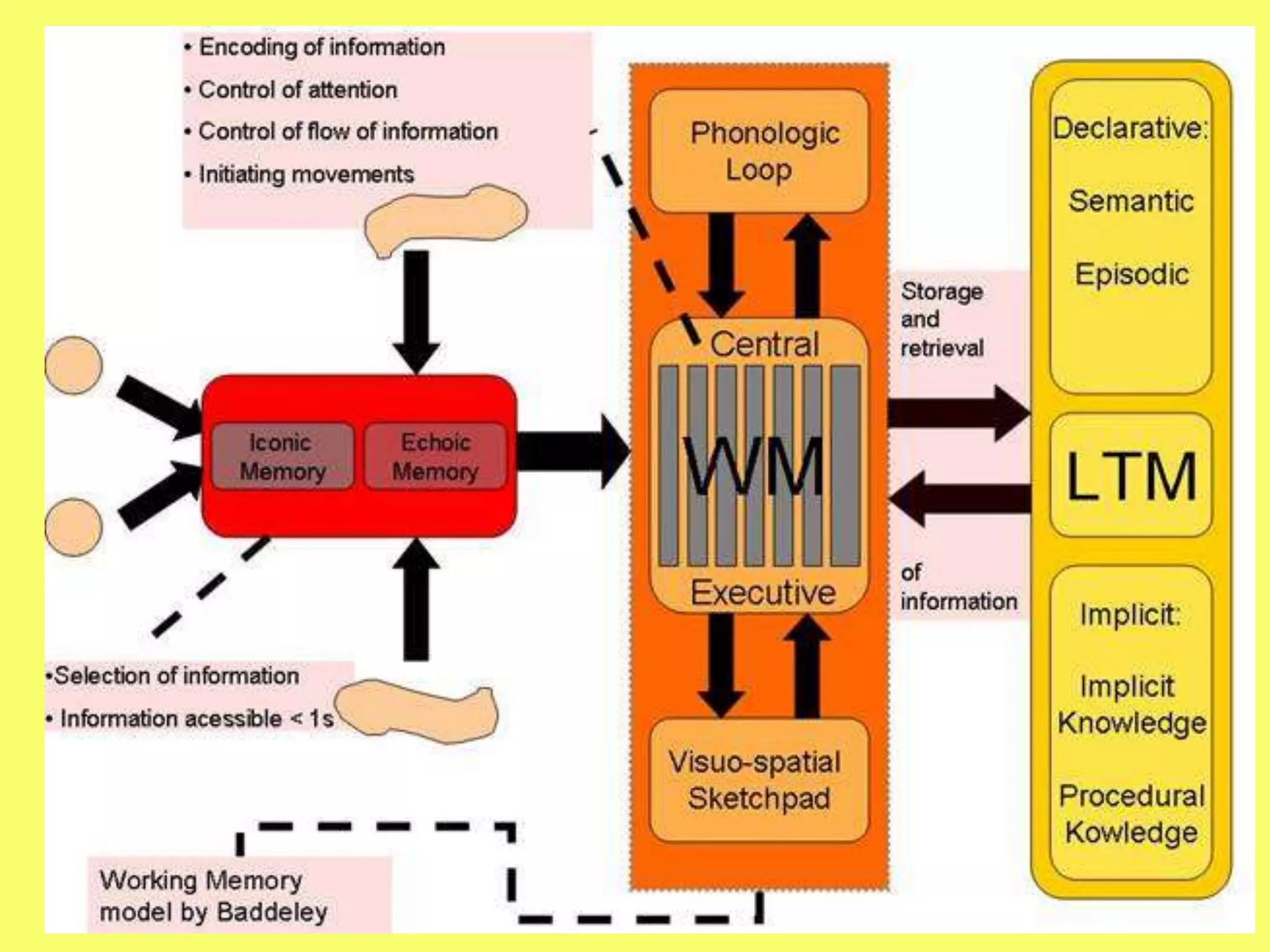
• They argued that STM was an ‘active store’ that
stored different types of information while they
were being worked on.
• STM can be thought of as consciousness: it holds
information that is consciously thought about
now.
• To replace the STM store of the MSM they
proposed a multi-component working memory.
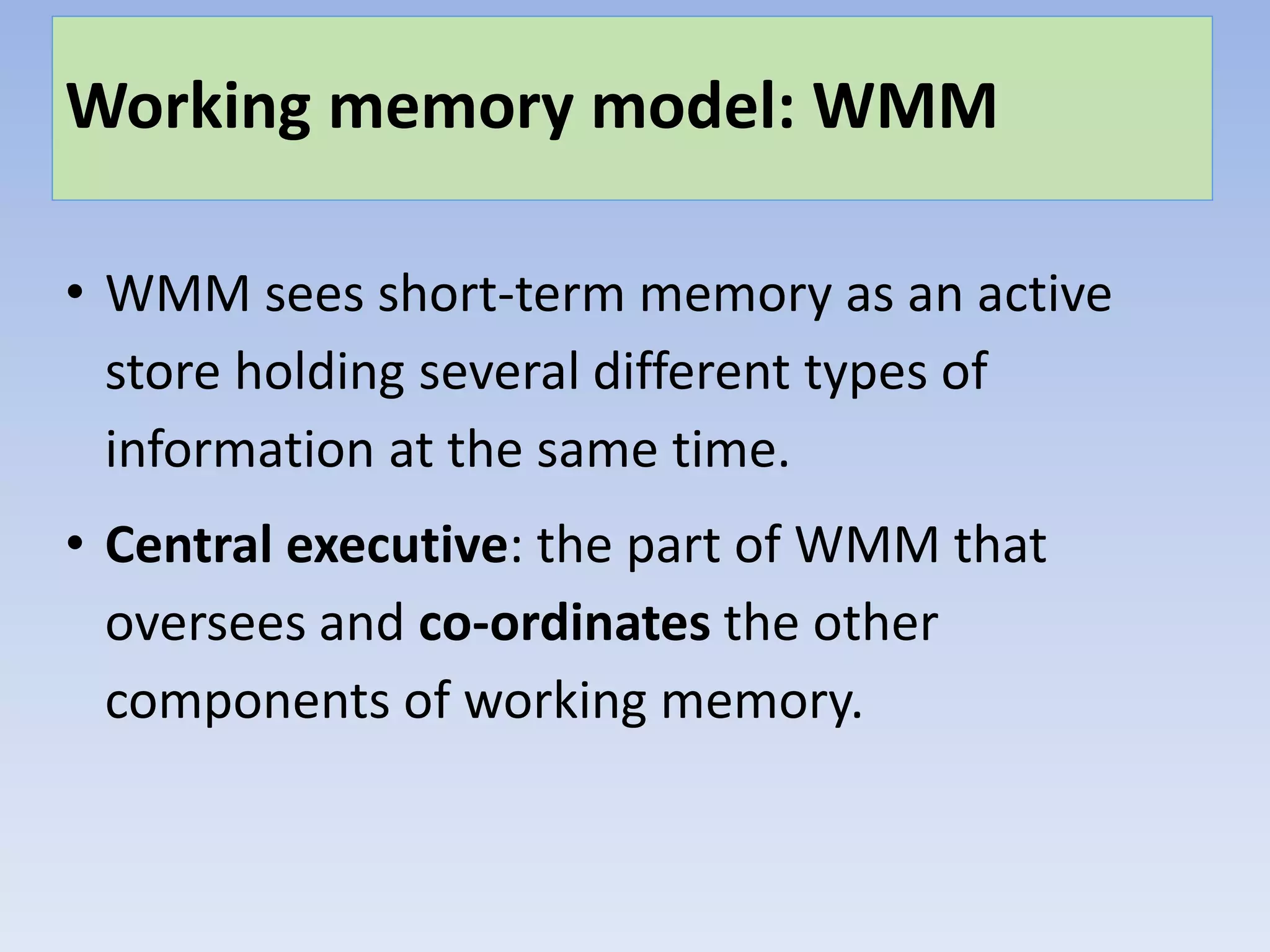
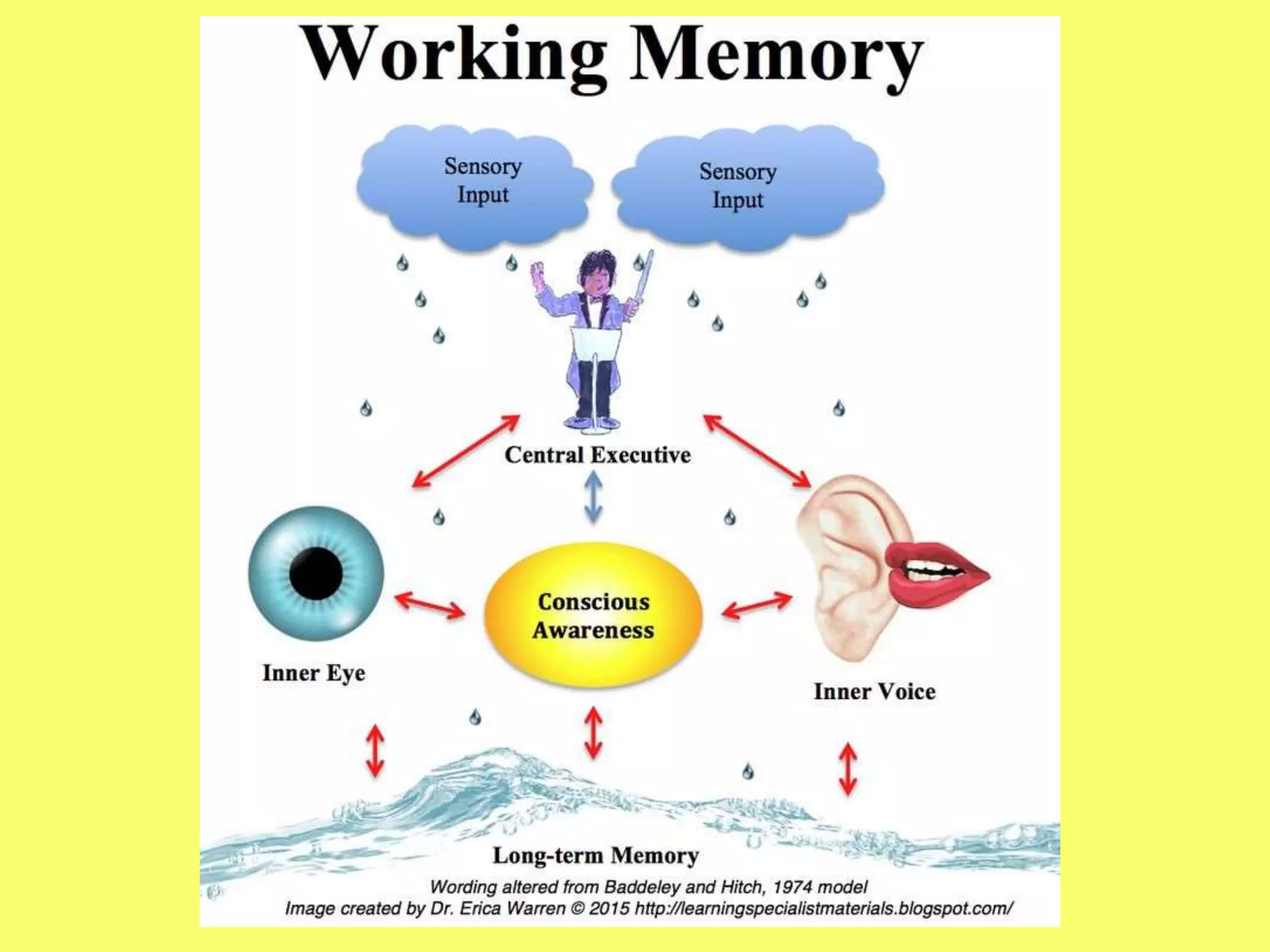
Working memory model: WMM
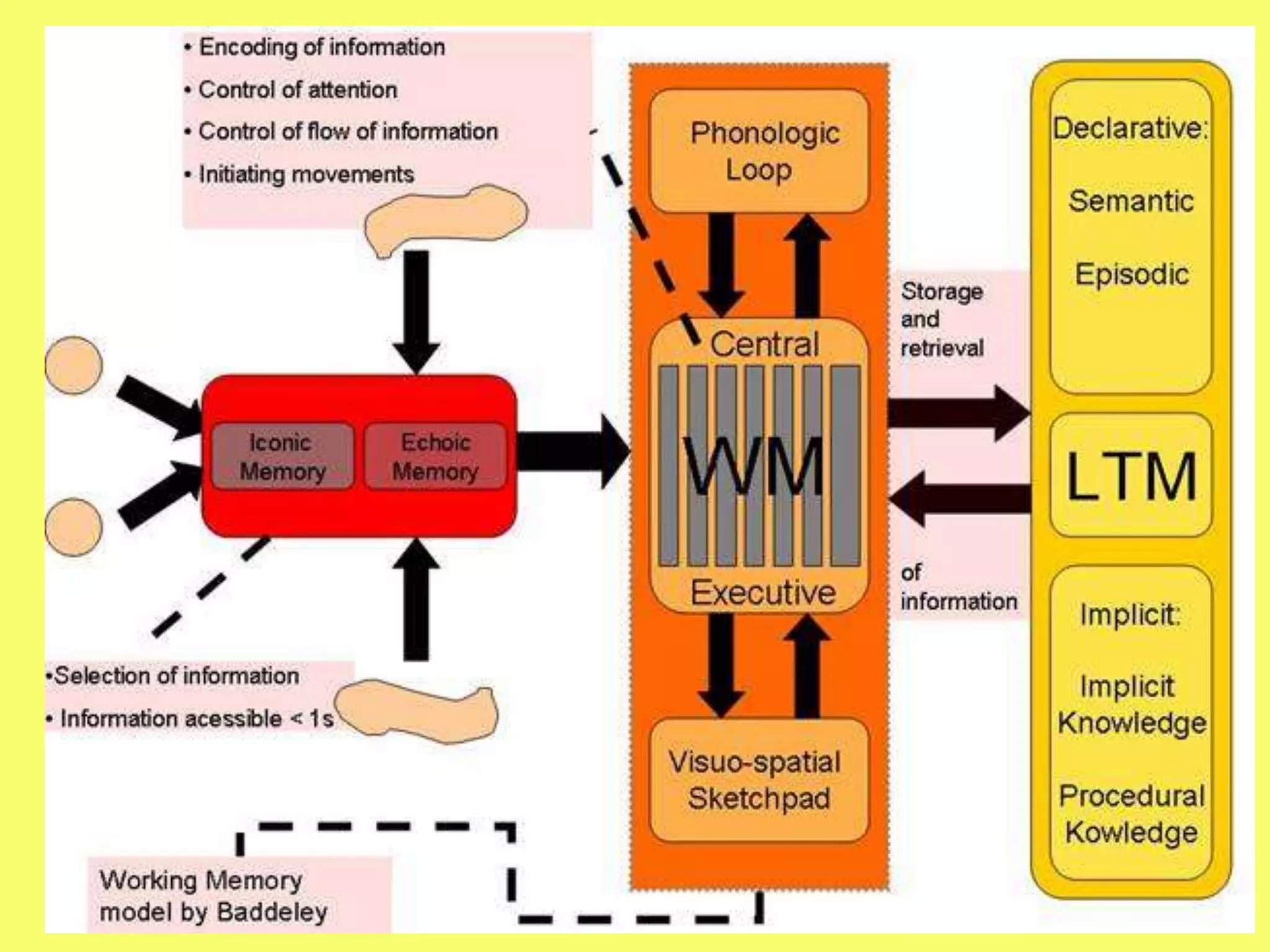
• WMM sees short-term memory as an active
store holding several different types of
information at the same time.
• Central executive: the part of WMM that
oversees and co-ordinates the other
components of working memory.
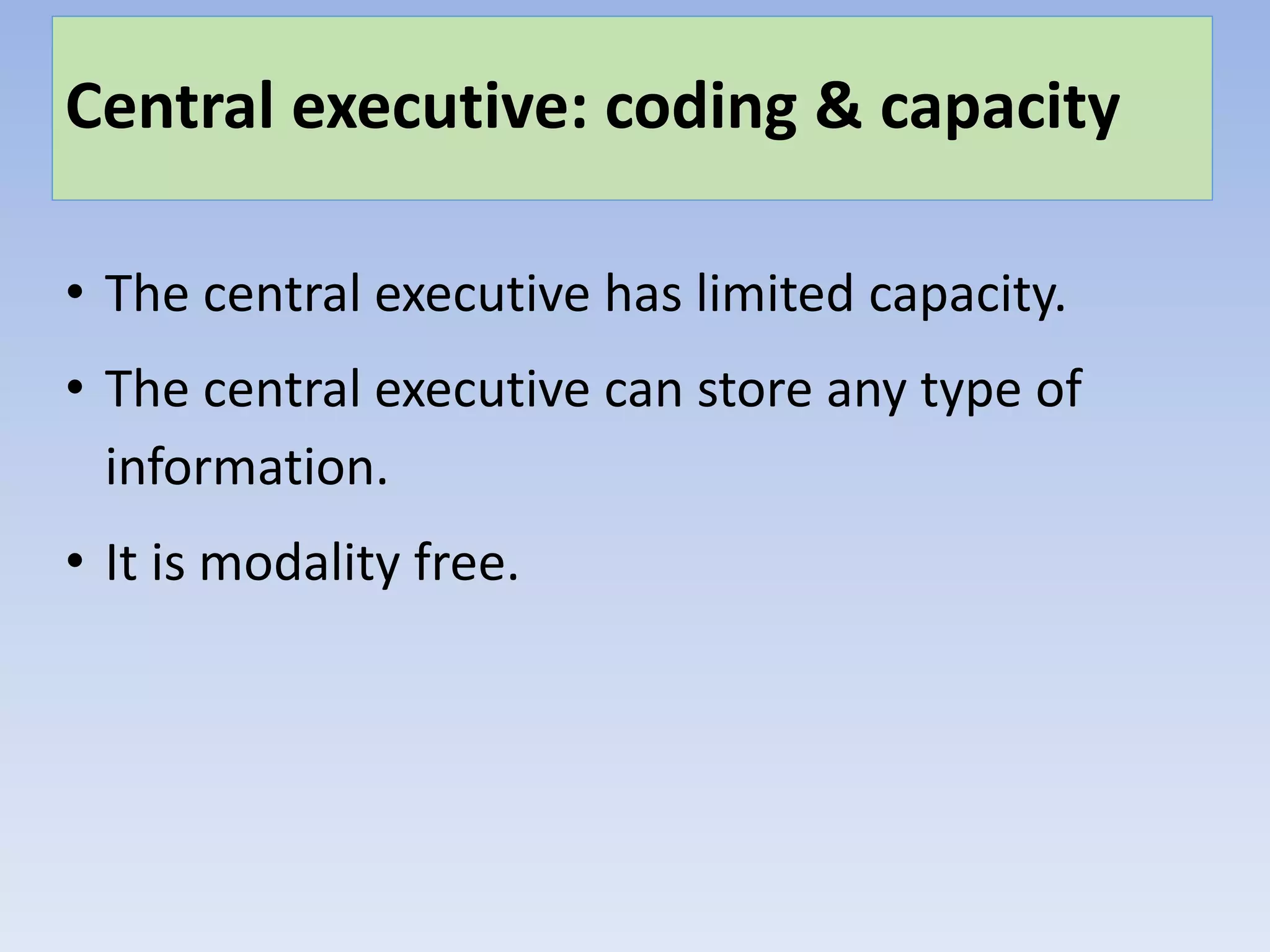
Central executive: coding & capacity
• The central executive has limited capacity.
• The central executive can store any type of
information.
• It is modality free.
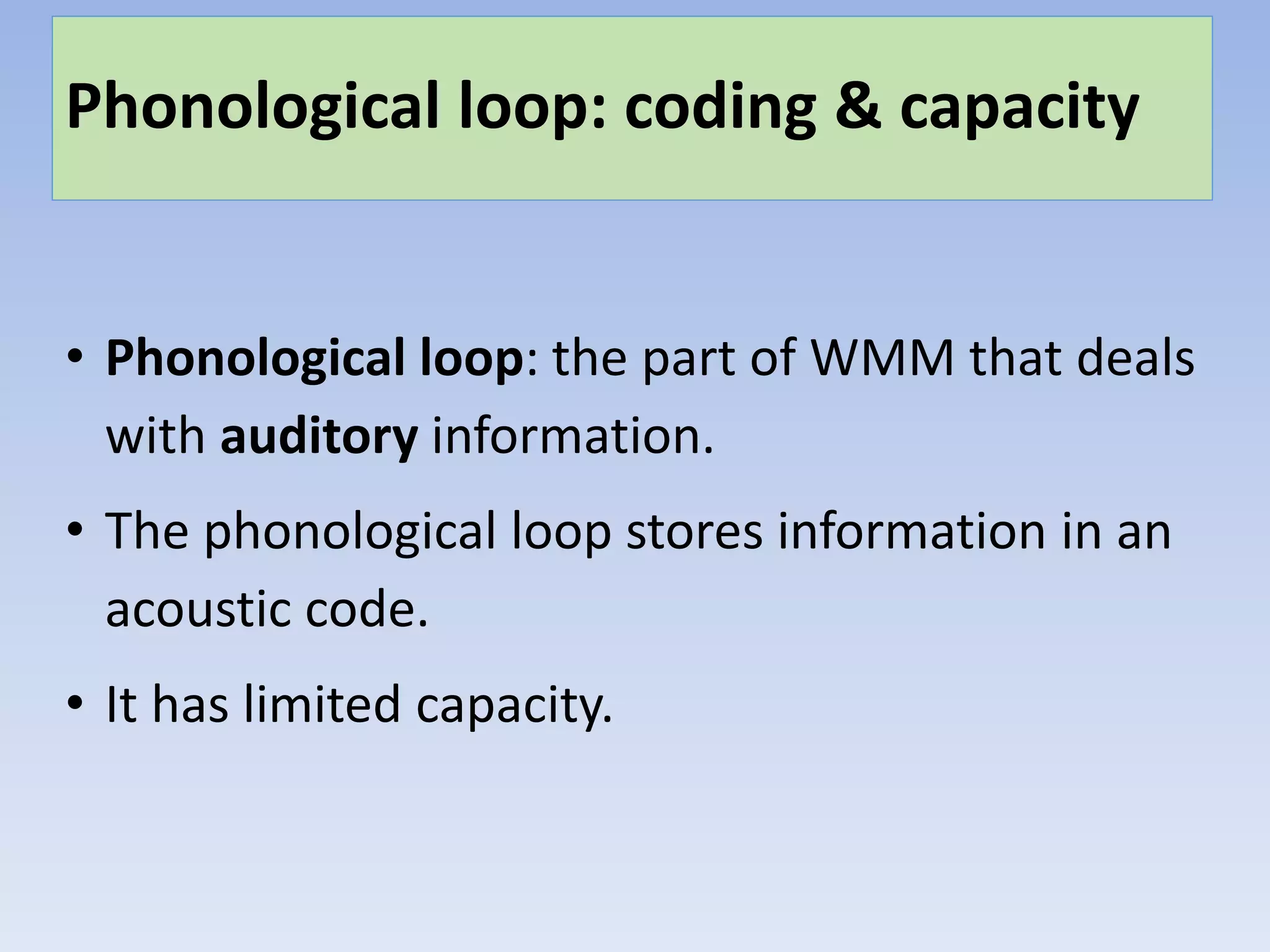
Phonological loop: coding & capacity
• Phonological loop: the part of WMM that deals
with auditory information.
• The phonological loop stores information in an
acoustic code.
• It has limited capacity.
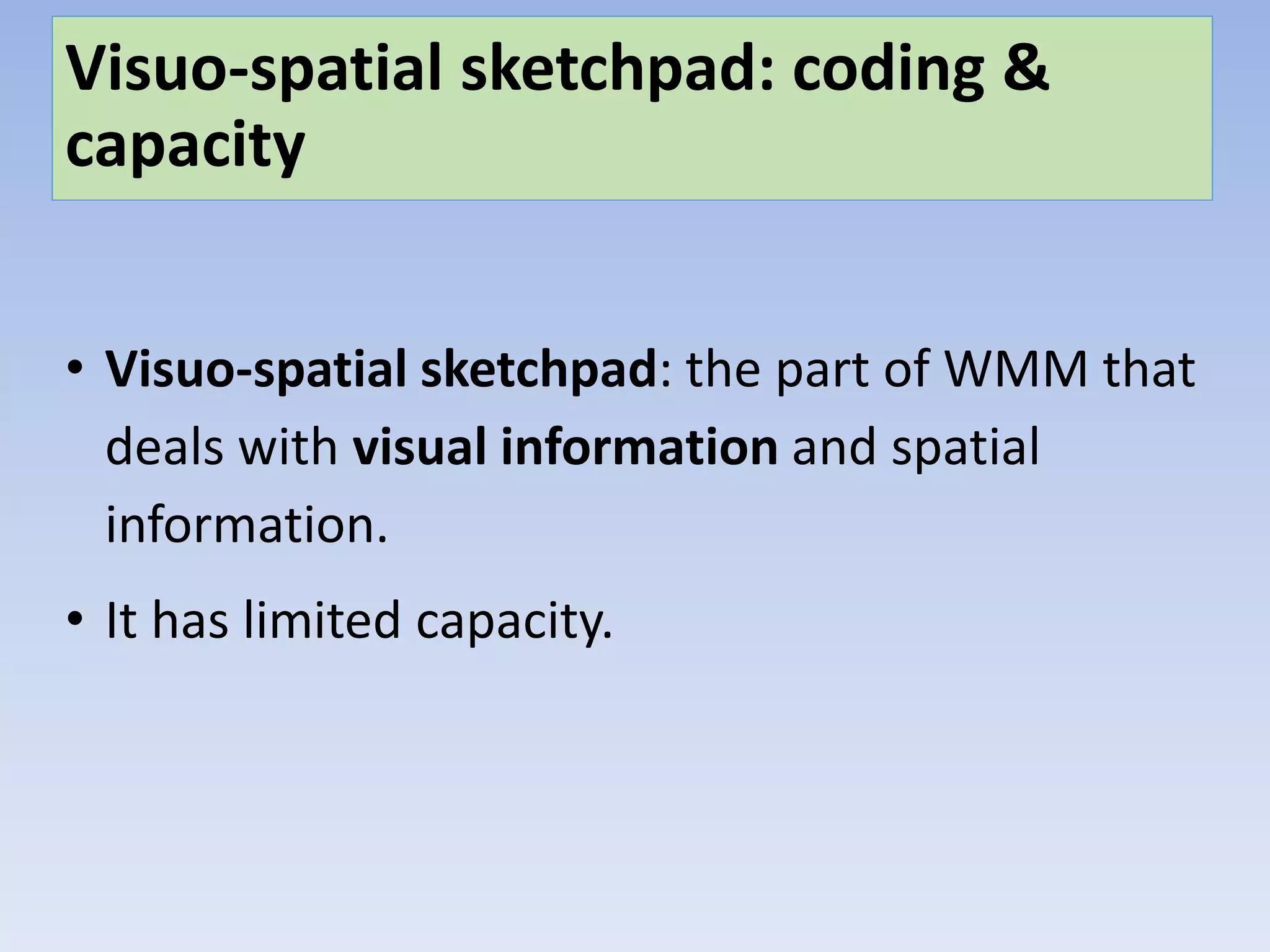
Visuo-spatial sketchpad: coding &
capacity
• Visuo-spatial sketchpad: the part of WMM that
deals with visual information and spatial
information.
• It has limited capacity.
Working memory model: WMM
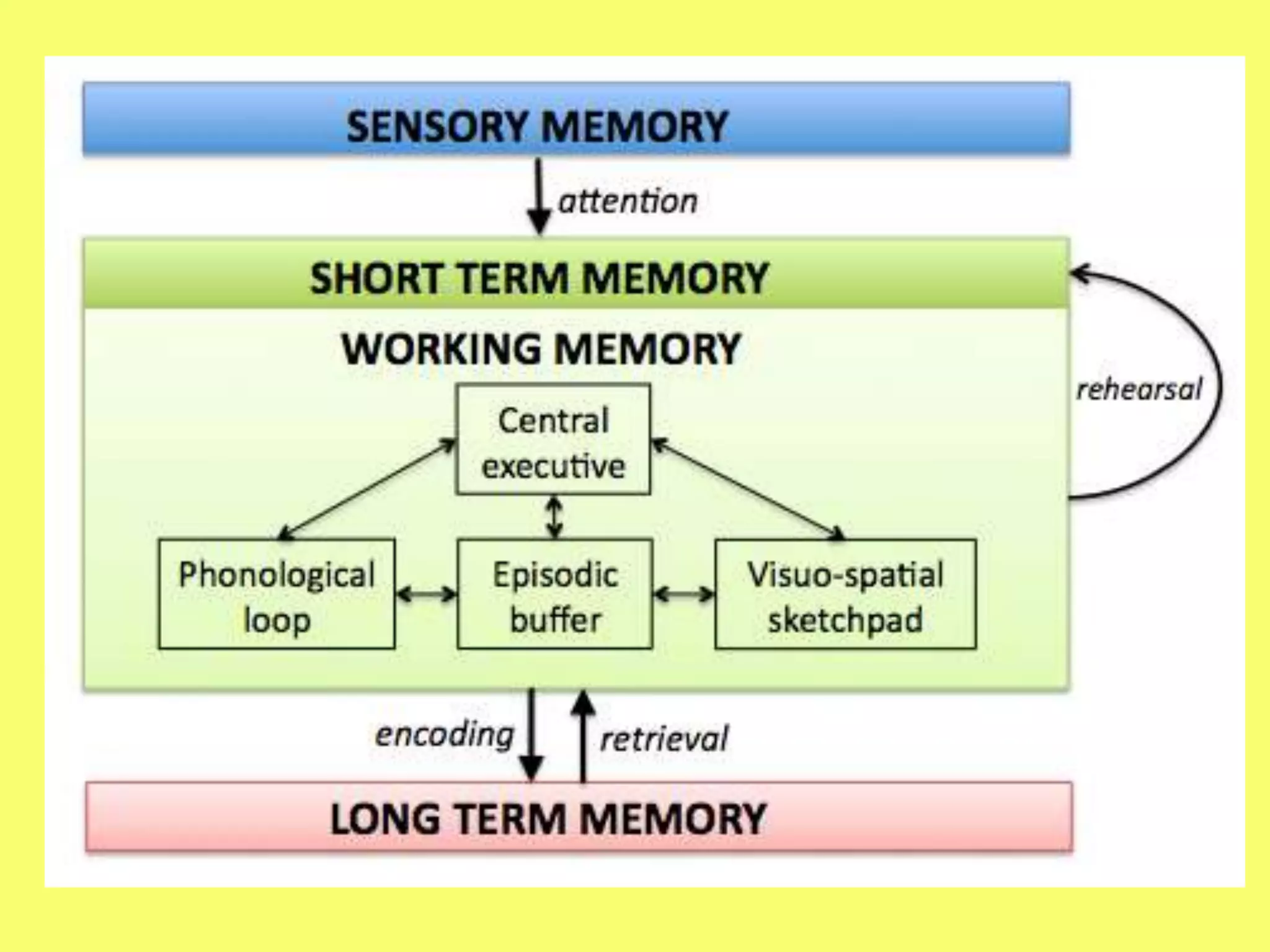
• Baddeley & Hitch added one more component to the
WMM in 2000.
• They called this the episodic buffer.
• This is the part of the WMM that acts as a temporary
store of integrated information from the central
executive, phonological loop, visuo-spatial sketchpad
and LTM.
Episodic buffer: coding & capacity
• The episodic buffer can store any
type of information: acoustic,
visual, spatial.
• It has a limited capacity.
Working memory model: WMM
• Complete the working memory
model description worksheet.
Evaluation: strengths
• Dual task performance studies.
• Baddeley (1975)
Evaluation: strengths
• Case studies of brain damaged
people.
• K.F.
• Shallice & Warrington (1970)
Evaluation: limitations
• The central executive.
• Very little is known about it.
• We don’t really know how much
information it can store.
• We don’t know exactly how it works.

Mod 3 working memory model slides

  • 1.
    Memory Specification: • The workingmemory model: central executive, phonological loop, visuo-spatial sketchpad and episodic buffer. Features of the model: coding and capacity.
  • 2.
    Memory: working memorymodel (WMM) • Baddeley & Hitch (1974) • Thought the multi-store model was right but STM was more complex. • They did not think STM was: • A single temporary store. • A simple store for transferring information to LTM.
  • 3.
    Memory: working memorymodel (WMM) • They argued that STM was an ‘active store’ that stored different types of information while they were being worked on. • STM can be thought of as consciousness: it holds information that is consciously thought about now. • To replace the STM store of the MSM they proposed a multi-component working memory.
  • 5.
    Working memory model:WMM • WMM sees short-term memory as an active store holding several different types of information at the same time. • Central executive: the part of WMM that oversees and co-ordinates the other components of working memory.
  • 6.
    Central executive: coding& capacity • The central executive has limited capacity. • The central executive can store any type of information. • It is modality free.
  • 7.
    Phonological loop: coding& capacity • Phonological loop: the part of WMM that deals with auditory information. • The phonological loop stores information in an acoustic code. • It has limited capacity.
  • 8.
    Visuo-spatial sketchpad: coding& capacity • Visuo-spatial sketchpad: the part of WMM that deals with visual information and spatial information. • It has limited capacity.
  • 10.
    Working memory model:WMM • Baddeley & Hitch added one more component to the WMM in 2000. • They called this the episodic buffer. • This is the part of the WMM that acts as a temporary store of integrated information from the central executive, phonological loop, visuo-spatial sketchpad and LTM.
  • 11.
    Episodic buffer: coding& capacity • The episodic buffer can store any type of information: acoustic, visual, spatial. • It has a limited capacity.
  • 14.
    Working memory model:WMM • Complete the working memory model description worksheet.
  • 15.
    Evaluation: strengths • Dualtask performance studies. • Baddeley (1975)
  • 16.
    Evaluation: strengths • Casestudies of brain damaged people. • K.F. • Shallice & Warrington (1970)
  • 17.
    Evaluation: limitations • Thecentral executive. • Very little is known about it. • We don’t really know how much information it can store. • We don’t know exactly how it works.