Memory: specification
• Improving the accuracy of eyewitness testimony,
including the use of the cognitive interview.
Memory: the cognitive interview
• Cognitive Interview: Fisher and Gieselman
(1992)
• A way of interviewing eyewitnesses to improve
the accuracy and detail of their memory of a
crime.
Memory: the cognitive interview
•The cognitive interview is helps the witness to
reconstruct the original context of the crime.
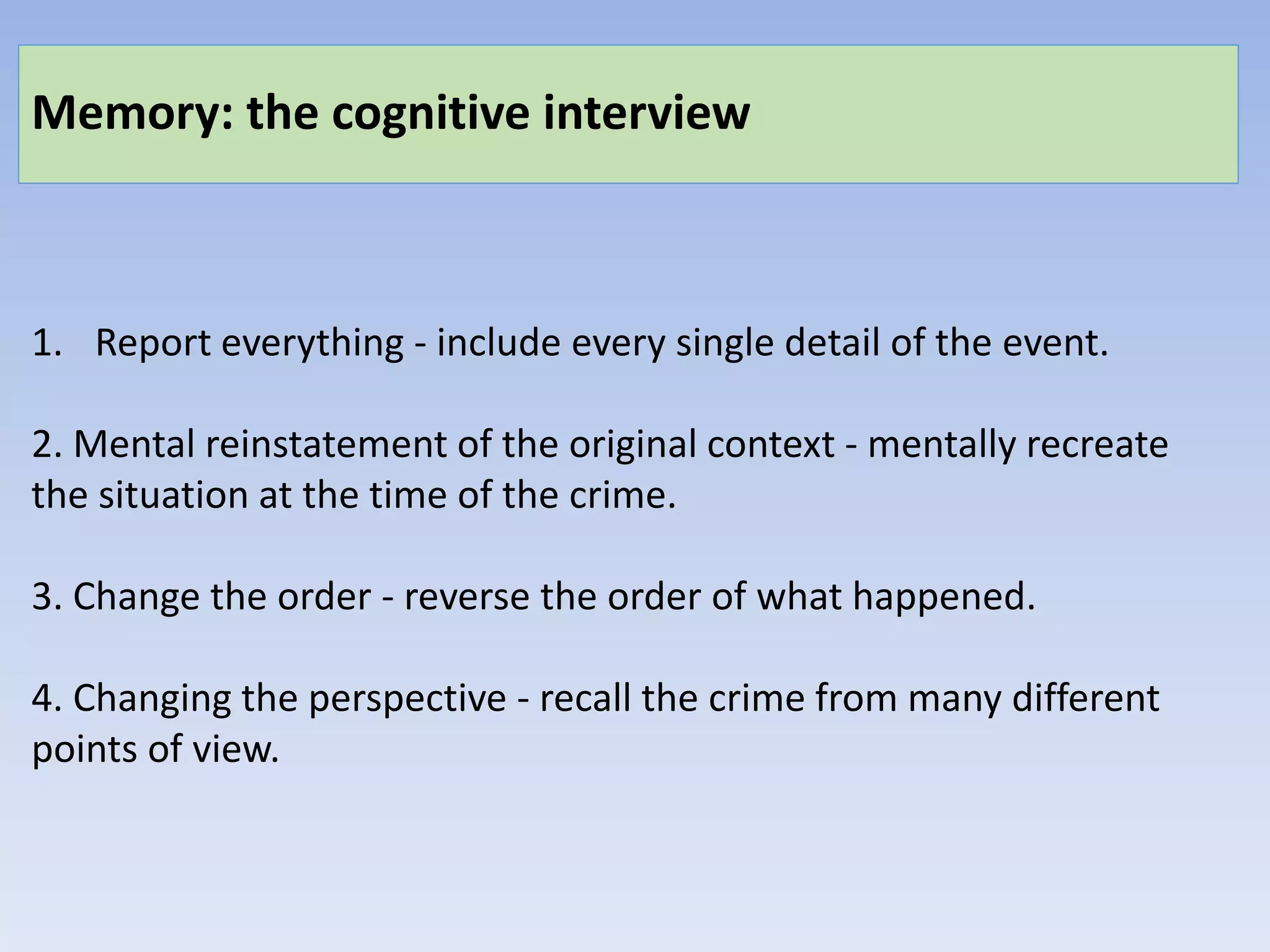
Memory: the cognitive interview
1. Report everything - include every single detail of the event.
2. Mental reinstatement of the original context - mentally recreate
the situation at the time of the crime.
3. Change the order - reverse the order of what happened.
4. Changing the perspective - recall the crime from many different
points of view.
The cognitive interview: evaluation
• The cognitive interview is effective.
• Kohnken et al conducted a meta analysis of 53 studies and found a
34% increase in correct recall using the cognitive interview
compared with standard interview techniques.
• This is support for the cognitive interview as a better way to
interview eyewitnesses than standard interview techniques
The cognitive interview: evaluation
• The cognitive interview is effective.
• Kohnken et al conducted a meta analysis of 53 studies and found a
34% increase in correct recall using the cognitive interview
compared with standard interview techniques.
• This is support for the cognitive interview as a better way to
interview eyewitnesses than standard interview techniques
The cognitive interview: evaluation
• Milne and Bull(2002) found the cognitive interview
produced more accurate information than the standard
police interview.
The cognitive interview: evaluation
•Many of the studies on the effectiveness of the cognitive
interview are lab studies that used videos of crimes.
•The findings may be valid for the experimental situation
but may not generalise to real life interview situations.
The cognitive interview: evaluation
•Many police forces that have been trained to use
the cognitive interview don't use it. It is expensive
and takes time to carry out.

Cognitive interview1

  • 1.
    Memory: specification • Improvingthe accuracy of eyewitness testimony, including the use of the cognitive interview.
  • 2.
    Memory: the cognitiveinterview • Cognitive Interview: Fisher and Gieselman (1992) • A way of interviewing eyewitnesses to improve the accuracy and detail of their memory of a crime.
  • 3.
    Memory: the cognitiveinterview •The cognitive interview is helps the witness to reconstruct the original context of the crime.
  • 4.
    Memory: the cognitiveinterview 1. Report everything - include every single detail of the event. 2. Mental reinstatement of the original context - mentally recreate the situation at the time of the crime. 3. Change the order - reverse the order of what happened. 4. Changing the perspective - recall the crime from many different points of view.
  • 5.
    The cognitive interview:evaluation • The cognitive interview is effective. • Kohnken et al conducted a meta analysis of 53 studies and found a 34% increase in correct recall using the cognitive interview compared with standard interview techniques. • This is support for the cognitive interview as a better way to interview eyewitnesses than standard interview techniques
  • 6.
    The cognitive interview:evaluation • The cognitive interview is effective. • Kohnken et al conducted a meta analysis of 53 studies and found a 34% increase in correct recall using the cognitive interview compared with standard interview techniques. • This is support for the cognitive interview as a better way to interview eyewitnesses than standard interview techniques
  • 7.
    The cognitive interview:evaluation • Milne and Bull(2002) found the cognitive interview produced more accurate information than the standard police interview.
  • 8.
    The cognitive interview:evaluation •Many of the studies on the effectiveness of the cognitive interview are lab studies that used videos of crimes. •The findings may be valid for the experimental situation but may not generalise to real life interview situations.
  • 9.
    The cognitive interview:evaluation •Many police forces that have been trained to use the cognitive interview don't use it. It is expensive and takes time to carry out.