Short Term Memory
Dr Rajesh Verma
Assistant Professor in Psychology
Govt. College Adampur, Hisar (Haryana)
Stage Model of Memory
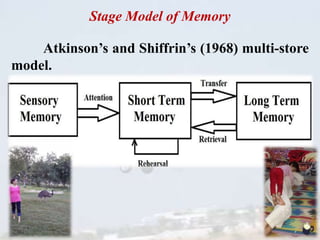
Atkinson’s and Shiffrin’s (1968) multi-store
model.
Introduction
Short term memory is a kind of information relay
system found between sensory memory and long term
memory. The information that had entered sensory
memory now by virtue of attention travels to next
memory system, called STM. STM is a memory system
in which information is
held for brief periods of
time while being used
(Ciccarelli & Meyer,
2016). STM is a active
system which not only
store information also
processes it for use.
The capacity of STM is 7±2 items. This was stated
by George Miller in 1956. He used digit span test to
arrive at this number and called it Magic Number.
However, chunking is used for recording, storing and
reorganizing more information in STM. According to
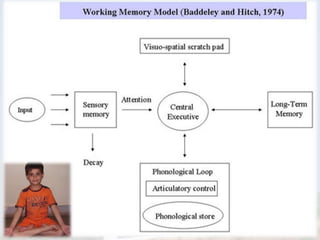
Baddeley and Hitch (1974) Model, STM contains three
interrelated systems i.e.
(i) Central
Executive
(ii) Visuo-spatial
Sketch Pad
(iii) Phonological
Loop
(i) Central Executive – Regulate, control and
coordinate the all systems of STM such as
allocation of information to respective systems.
It can be called as cognitive controller. Helps in
mental arithmetic and problem solving.
(ii) Visuo-spatial Sketch Pad – Also known as
inner eye that stores
and process visual
information.
(iii) Phonological Loop – Also known as inner
ear that helps in storing and processing audio
information. It plays the dialogue in person’s
head. It further contains two subsystems i.e.
Articulatory control (Speech production) and
phonological store (Speech perception).
Characteristics
1. Short term memory is also known as working
memory
2. The short term memory or short term storage
system is the basic component of our cognition. The
information that has passed through the sensory store
reaches short term
memory. In this system
the information tends
to disappear completely
in a short duration i.e.
within 12 to 30
seconds.
3. STM only holds the information does not
manipulate it.
4. Short term functions are susceptible for
interruptions while long term functions seems to remain
intact (Solso, 2006).
5. A phenomenon
of Interference
(information more
than 5 to 9 items is
thrown out to make
room for new
information) is
found in STM.
6. Primacy & Recency phenomenon, commonly
known as Recency effect is found in STM.
7. Temporal decay and
chunk capacity limit is found
in STM.
8. Forgetting occurs in
STM due to limited capacity,
duration, displacement and
trace decay.
9. Fading of information
is faster in STM which leads
to forgetting.
References:
1. NCERT, XI Psychology Text book.
2. McLeod, S. A. (2009, Dec 14). Short-term
memory. Simply psychology: https://www.
simplypsychology.org/short-term-memory.html.
vermasujit@yahoo.com
Next Discussion
Long Term Memory

short term memory (STM)

  • 1.
    Short Term Memory DrRajesh Verma Assistant Professor in Psychology Govt. College Adampur, Hisar (Haryana)
  • 2.
    Stage Model ofMemory Atkinson’s and Shiffrin’s (1968) multi-store model.
  • 3.
    Introduction Short term memoryis a kind of information relay system found between sensory memory and long term memory. The information that had entered sensory memory now by virtue of attention travels to next memory system, called STM. STM is a memory system in which information is held for brief periods of time while being used (Ciccarelli & Meyer, 2016). STM is a active system which not only store information also processes it for use.
  • 4.
    The capacity ofSTM is 7±2 items. This was stated by George Miller in 1956. He used digit span test to arrive at this number and called it Magic Number. However, chunking is used for recording, storing and reorganizing more information in STM. According to Baddeley and Hitch (1974) Model, STM contains three interrelated systems i.e. (i) Central Executive (ii) Visuo-spatial Sketch Pad (iii) Phonological Loop
  • 5.
    (i) Central Executive– Regulate, control and coordinate the all systems of STM such as allocation of information to respective systems. It can be called as cognitive controller. Helps in mental arithmetic and problem solving. (ii) Visuo-spatial Sketch Pad – Also known as inner eye that stores and process visual information.
  • 6.
    (iii) Phonological Loop– Also known as inner ear that helps in storing and processing audio information. It plays the dialogue in person’s head. It further contains two subsystems i.e. Articulatory control (Speech production) and phonological store (Speech perception).
  • 8.
    Characteristics 1. Short termmemory is also known as working memory 2. The short term memory or short term storage system is the basic component of our cognition. The information that has passed through the sensory store reaches short term memory. In this system the information tends to disappear completely in a short duration i.e. within 12 to 30 seconds.
  • 9.
    3. STM onlyholds the information does not manipulate it. 4. Short term functions are susceptible for interruptions while long term functions seems to remain intact (Solso, 2006). 5. A phenomenon of Interference (information more than 5 to 9 items is thrown out to make room for new information) is found in STM.
  • 10.
    6. Primacy &Recency phenomenon, commonly known as Recency effect is found in STM. 7. Temporal decay and chunk capacity limit is found in STM. 8. Forgetting occurs in STM due to limited capacity, duration, displacement and trace decay. 9. Fading of information is faster in STM which leads to forgetting.
  • 11.
    References: 1. NCERT, XIPsychology Text book. 2. McLeod, S. A. (2009, Dec 14). Short-term memory. Simply psychology: https://www. simplypsychology.org/short-term-memory.html.
  • 12.