Executive Functions and Working Memory
Introduction
Executive functions are cognitive skills essential for goal-directed behavior. These include the
ability to control our attention, be flexible in our thinking, and set and obtain goals. Diamond (2013)
has linked these skills to improved performance in various learning contexts. Executive functions
also include the management of working memory. Both memory and executive functions (EF) play
critical roles in learning and productivity.
Current models of memory include concepts of short-term memory, working memory, long-term
memory, and their various subsystems. These systems interact with executive functions such as
attention control, cognitive flexibility, and goal setting. Understanding these processes will help you
to learn more effectively and attain your goals more often.
Environmental factors and lifestyle choices also affect cognitive performance, including executive
functions. These factors include sleep, nutrition, exercise, stress management, and mindfulness.
Employing techniques that enhance working memory capacity, such as chunking information or
using mnemonic devices, can facilitate acquiring new skills and knowledge. Developing strong
executive functions through targeted exercises or cognitive training can improve the ability to
manage time, prioritize tasks, and maintain focus on learning objectives (Klingberg, 2010).
Role of Executive Functions
Executive function (EF) “occupies a central role in neuropsychological theories of behavior control”
(McCabe et al., 2010). Executive functions include reasoning, problem-solving, planning,
management of working memory, and control of focus. Executive function has a significant impact
on social, academic, and financial success as well as self-management, emotional regulation, and
mental and physical health. Numerous studies have investigated these effects, such as those
described in Diamond (2013).
Our perceptions and memory have more internal, built-in structure than might be assumed without
prior knowledge of the underlying evidence. This contradicts the concept of the mind as a tabula
Home Articles Subscribe
rosa or blank slate. Current theories of how our memory and cognition function are based on
findings from these experiments and discoveries. A high-level overview of some of the key studies
related to memory is the article 10 Influential Memory Theories and Studies in Psychology from
Psychologist World.
There is some agreement that there are three core EFs on which the other, higher-level functions
are built (Diamond, 2013).
1. Self-control (behavioral inhibition) and interference control (selective attention & cognitive inhibition)
2. Working memory
3. Cognitive flexibility (also called set shifting, mental flexibility, and linked to creativity)
Short-term, long-term, and working memory
Short-term memory acts as a temporary holding space for information, while working memory
manipulates and manages this information to support complex cognitive tasks (Baddeley, 2012).
Long-term memory is responsible for the encoding, storage, and retrieval of information over
extended periods (Atkinson and Shiffrin, 1968). These memory systems are not isolated; they
interact to support learning and problem-solving tasks (Cowan, 2017).
Some models distinguish working memory from short-term memory, while others treat them as
equivalent terms. When treated as distinct, working memory is only what is being actively used in
some conscious mental process, while short-term memory includes things that are not being
actively used but are available for recall.
We will present a model that aligns roughly with the most established expert views, keeping in mind
that the details vary. A working model is still useful, even if imperfect.
Working Memory Model
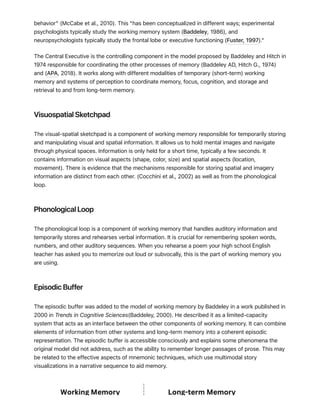
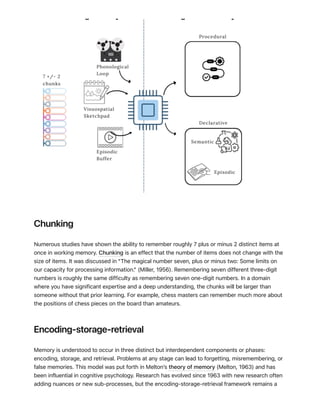
The model of working memory we describe here was proposed by cognitive psychologists
Baddeley and Hitch initially in 1974 (Baddeley AD, Hitch G., 1974), then updated based on new
studies over the years.
The Central Executive
Models of cognition usually include some sort of controlling component that is responsible for
managing working memory, focus, and other higher-level functions. “Theories of cognitive control
typically include an executive component that is responsible for coordinating goal-directed
behavior” (McCabe et al., 2010). This “has been conceptualized in different ways; experimental
psychologists typically study the working memory system (Baddeley, 1986), and
neuropsychologists typically study the frontal lobe or executive functioning (Fuster, 1997)."
The Central Executive is the controlling component in the model proposed by Baddeley and Hitch in
1974 responsible for coordinating the other processes of memory (Baddeley AD, Hitch G., 1974)
and (APA, 2018). It works along with different modalities of temporary (short-term) working
memory and systems of perception to coordinate memory, focus, cognition, and storage and
retrieval to and from long-term memory.
Visuospatial Sketchpad
The visual-spatial sketchpad is a component of working memory responsible for temporarily storing
and manipulating visual and spatial information. It allows us to hold mental images and navigate
through physical spaces. Information is only held for a short time, typically a few seconds. It
contains information on visual aspects (shape, color, size) and spatial aspects (location,
movement). There is evidence that the mechanisms responsible for storing spatial and imagery
information are distinct from each other. (Cocchini et al., 2002) as well as from the phonological
loop.
Phonological Loop
The phonological loop is a component of working memory that handles auditory information and
temporarily stores and rehearses verbal information. It is crucial for remembering spoken words,
numbers, and other auditory sequences. When you rehearse a poem your high school English
teacher has asked you to memorize out loud or subvocally, this is the part of working memory you
are using.
Episodic Buffer
The episodic buffer was added to the model of working memory by Baddeley in a work published in
2000 in Trends in Cognitive Sciences(Baddeley, 2000). He described it as a limited-capacity
system that acts as an interface between the other components of working memory. It can combine
elements of information from other systems and long-term memory into a coherent episodic
representation. The episodic buffer is accessible consciously and explains some phenomena the
original model did not address, such as the ability to remember longer passages of prose. This may
be related to the effective aspects of mnemonic techniques, which use multimodal story
visualizations in a narrative sequence to aid memory.
Chunking
Numerous studies have shown the ability to remember roughly 7 plus or minus 2 distinct items at
once in working memory. Chunking is an effect that the number of items does not change with the
size of items. It was discussed in “The magical number seven, plus or minus two: Some limits on
our capacity for processing information.” (Miller, 1956). Remembering seven different three-digit
numbers is roughly the same difficulty as remembering seven one-digit numbers. In a domain
where you have significant expertise and a deep understanding, the chunks will be larger than
someone without that prior learning. For example, chess masters can remember much more about
the positions of chess pieces on the board than amateurs.
Encoding-storage-retrieval
Memory is understood to occur in three distinct but interdependent components or phases:
encoding, storage, and retrieval. Problems at any stage can lead to forgetting, misremembering, or
false memories. This model was put forth in Melton’s theory of memory (Melton, 1963) and has
been influential in cognitive psychology. Research has evolved since 1963 with new research often
adding nuances or new sub-processes, but the encoding-storage-retrieval framework remains a
fundamental concept in understanding human memory.
1. Encoding is the initial process of converting incoming information into a form that can be stored in memory.
This can be in different modalities (visual, auditory, tactile, etc.) and at different processing depths.
2. Storage refers to the retention of encoded information over time. This process involves creating and
maintaining a record of the encoded information in the brain. This includes short-term memory, working
memory, and long-term memory.
3. Retrieval is the process of accessing and recalling stored information back into conscious awareness.
Retrieval is influenced by various factors, including the strength of the initial encoding, the presence of
retrieval cues, and the context in which recall occurs.
Depth of encoding
The levels of processing model of memory is a theory that the depth of encoding of memory and
length of retention afterward depends on the depth of elaboration the information receives (Craik &
Lockhart, 1972) (APA 2018b). For example, using the quadratic formula multiple times versus just
rereading it would be a deeper level of processing. A further level would be working through a proof
of the formula yourself. This also relates to desirable difficulty, incorporating additional difficulties
during learning that may impede short-term learning but are beneficial for long-term learning.
(Nelson & Eliasz, 2023).
Modalities of learning
The modality effect is a theory that presenting graphical information visually and related textual
information through an auditory mode is more effective than presenting the information only
visually, including the text. This engages both auditory and visual channels of information in
working memory rather than just the visual channel. Studies of a related concept, the split-attention
effect, have shown that diagrams with the text integrated into them are more effective than
diagrams with separate text, separated spatially. (Chandler & Sweller 1992).
A meta-analysis of the modality effect concluded that “students who learned from instructional
materials using graphics with spoken text outperformed those who learned from a graphics with
printed text" (Ginns, 2005).
Procedural vs declarative memory
Long-term memory consists of both explicit, declarative memories, such as the narrative of a story
or the knowledge of how the tax system works, and implicit memory, which is used unconsciously
and includes procedural memory, such as how to return a tennis serve successfully or tie your
shoes.
There is compelling evidence that declarative and procedural memory are distinct neurobiological
processes. Amnesiac patients with damage to the hippocampus who cannot form new long-term
explicit memories have been able to learn new procedures, such as how to play a new game
(Brooks & Bradley, 1976). Some of these studies involved the patient Henry Molaison, known as
H.M. who was a patient responsible for numerous contributions to the study of human memory.
(Wikipedia Contributors, 2024).
Declarative memory, also known as explicit memory, is divided into episodic memory and semantic
memory. Narrative memory consists of narrative stores of linked, sequential events. Semantic
memory is what we typically associate with knowledge, such as concepts from high school
chemistry about atomic structure and chemical reactions. This distinction was first made by Tulving
in 1972.
Modes of Thought
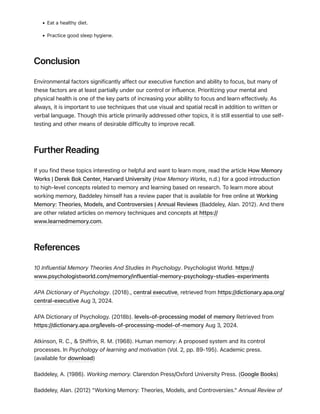
An important differentiation in mental processes that relates to executive, function, and memory are
System 1 and System 2. System 1 is the more automatic thought, which uses heuristics and can
help you quickly recognize faces, duck when something comes towards you, and make quick
intuitive judgments. System 1 is very efficient but tends towards bias. System 2 is used when you
put in focused, deliberate effort and think analytically, for example, to work on a new type of
mathematics problem. This concept and the implications, details, and related research form the
core of the book Thinking Fast and Slow by Daniel Kahneman (2013).
Daniel Kahneman’s explanation of System 1 and System 2 modes of thinking (Kahneman, 2011).
Effects of outside factors
Environmental factors and lifestyle choices play a significant role in cognitive function. Executive
functions can be impaired by mental health conditions such as ADHD, ASD, OCD, addiction,
anxiety, or depression. Stress, lack of sleep, loneliness, poor nutrition, or lack of exercise can also
impair EFs. (Diamond, 2013).
Adequate sleep is essential for memory consolidation and efficient functioning of executive
processes (Walker, 2017). Proper nutrition, especially essential nutrients, supports cognitive health
and affects memory and executive function performance (Gómez-Pinilla, 2008). Regular exercise
has been shown to improve cognitive functions and may enhance neuroplasticity, the brain's ability
to reorganize (Erickson et al., 2011). Stress management and mindfulness practices can mitigate
the negative effects of stress on cognitive processes and promote a more focused and attentive
mind (Tang et al., 2015).
Specific Recommendations
How can we use this information about how our mental systems work to improve our lives and
maximize our abilities? Here are specific recommendations for optimizing your executive functions
to learn, retain, and use information more effectively.
• Eliminate distractions whenever possible while doing focused work or studying.
• I find the Pomodoro system together with silencing notifications helpful.
• Make the struggle real (desirable difficulty).
• Use self-testing, interleaved practice, and spaced retrieval (see Testing Effect).
• Aim for a deeper level of processing.
• Summarize or rephrase into your own words.
• Practice problems yourself.
• Create diagrams, infographics, or mind maps.
• Do research of your own.
• Teach new concepts to others.
• Reflect on what you have learned.
• Leverage modalities of learning
• Link information together into a narrative (aka the Story Method).
• Visualize imagery, places, actions, and movement (especially the Method of Loci).
• Use auditory and verbal rehearsal.
• Support cognitive function with self-care.
• Use mindfulness techniques like meditation.
• Exercise regularly.
• Eat a healthy diet.
• Practice good sleep hygiene.
Conclusion
Environmental factors significantly affect our executive function and ability to focus, but many of
these factors are at least partially under our control or influence. Prioritizing your mental and
physical health is one of the key parts of increasing your ability to focus and learn effectively. As
always, it is important to use techniques that use visual and spatial recall in addition to written or
verbal language. Though this article primarily addressed other topics, it is still essential to use self-
testing and other means of desirable difficulty to improve recall.
Further Reading
If you find these topics interesting or helpful and want to learn more, read the article How Memory
Works | Derek Bok Center, Harvard University (How Memory Works, n.d.) for a good introduction
to high-level concepts related to memory and learning based on research. To learn more about
working memory, Baddeley himself has a review paper that is available for free online at Working
Memory: Theories, Models, and Controversies | Annual Reviews (Baddeley, Alan. 2012). And there
are other related articles on memory techniques and concepts at https://
www.learnedmemory.com.
References
10 Influential Memory Theories And Studies In Psychology. Psychologist World. https://
www.psychologistworld.com/memory/influential-memory-psychology-studies-experiments
APA Dictionary of Psychology. (2018)., central executive, retrieved from https://dictionary.apa.org/
central-executive Aug 3, 2024.
APA Dictionary of Psychology. (2018b). levels-of-processing model of memory Retrieved from
https://dictionary.apa.org/levels-of-processing-model-of-memory Aug 3, 2024.
Atkinson, R. C., & Shiffrin, R. M. (1968). Human memory: A proposed system and its control
processes. In Psychology of learning and motivation (Vol. 2, pp. 89-195). Academic press.
(available for download)
Baddeley, A. (1986). Working memory. Clarendon Press/Oxford University Press. (Google Books)
Baddeley, Alan. (2012) "Working Memory: Theories, Models, and Controversies." Annual Review of
Psychology, vol. 63, 2012, pp. 1-29, https://www.annualreviews.org/doi/10.1146/annurev-
psych-120710-100422.
Baddeley AD, Hitch G. (1974) Working memory. In: Bower GH, editor. The psychology of learning
and motivation: Advances in research and theory. Vol. 8. New York: Academic Press; 1974. pp. 47–
89.
Baddeley A. (1994). The magical number seven: still magic after all these years? Psychological
Review, 101(2), 353–356. https://doi.org/10.1037/0033-295x.101.2.353
Baddeley, A.D. (2000). The episodic buffer: a new component of working memory? Trends in
Cognitive Sciences, 4, 417-423. https://doi.org/10.1016/S1364-6613(00)01538-2
Brooks, D.N.; Baddeley, A.D. (1976). "What can amnesic patients learn?". Neuropsychologia. 14 (1):
111–129.doi:10.1016/0028-3932(76)90012-9.PMID 1272505.S2CID 12300915.
Chandler, P., & Sweller, J. (1992). The split-attention effect as a factor in the design of instruction.
British Journal of Educational Psychology, 62(2), 233-246. (download)
Cocchini, G., Logie, R.H., Sala, S.D. et al. Concurrent performance of two memory tasks: Evidence
for domain-specific working memory systems. Memory & Cognition 30, 1086–1095 (2002). https://
doi.org/10.3758/BF03194326
Cowan N. (2014). Working Memory Underpins Cognitive Development, Learning, and Education.
Educational psychology review, 26(2), 197–223. https://doi.org/10.1007/s10648-013-9246-y
Cowan N. (2017). The many faces of working memory and short-term storage. Psychonomic
bulletin & review, 24(4), 1158–1170. https://doi.org/10.3758/s13423-016-1191-6
Craik, F. I., & Lockhart, R. S. (1972). Levels of processing: A framework for memory research.
Journal of verbal learning and verbal behavior, 11(6), 671-684. (download)
Diamond A. (2013). Executive functions. Annual review of psychology, 64, 135–168. https://
doi.org/10.1146/annurev-psych-113011-143750
Erickson, Kirk I., et al. "Exercise Training Increases Size of Hippocampus and Improves Memory."
Proceedings of the National Academy of Sciences, vol. 108, no. 7, 2011, pp. 3017-3022, https://
www.pnas.org/content/108/7/3017.
Ginns, P. (2005). Meta-analysis of the modality effect. Learning and instruction, 15(4), 313-331.
Gómez-Pinilla F. (2008). Brain foods: the effects of nutrients on brain function. Nature reviews.
Neuroscience, 9(7), 568–578. https://doi.org/10.1038/nrn2421
How Memory Works. (n.d.). Derek Bok Center, Harvard University. https://bokcenter.harvard.edu/
how-memory-works
Kahneman, D. (2011). Thinking, fast and slow (1st ed.). Farrar, Straus, and Giroux.
Klingberg T. (2010). Training and plasticity of working memory. Trends in cognitive sciences, 14(7),
317–324. https://doi.org/10.1016/j.tics.2010.05.002
McCabe, D. P., Roediger, H. L., McDaniel, M. A., Balota, D. A., & Hambrick, D. Z. (2010). The
relationship between working memory capacity and executive functioning: evidence for a common
executive attention construct. Neuropsychology, 24(2), 222–243. https://doi.org/10.1037/a0017619
Melton, A.W. (1963). Implications of short-term memory for a general theory of memory. Journal of
Verbal Learning and Verbal Behavior, 2, 1-21.
Miller, G. A. (1956). The magical number seven, plus or minus two: Some limits on our capacity for
processing information. Psychological review, 63(2), 81. https://doi.org/10.1037/h0043158
Miller, R. B., & Brickman, S. J. (2004). A Model of Future-Oriented Motivation and Self-Regulation.
Educational Psychology Review, 16(1), 9–33. https://doi.org/10.1023/
B:EDPR.0000012343.96370.39
Nelson, A., & Eliasz, K. L. (2023). Desirable Difficulty: Theory and application of intentionally
challenging learning. Medical education, 57(2), 123–130. https://doi.org/10.1111/medu.14916
Sweller, J. (1994). Cognitive load theory, learning difficulty, and instructional design. Learning and
instruction, 4(4), 295-312. (available for download)
Tang, Y. Y., Hölzel, B. K., & Posner, M. I. (2015). The neuroscience of mindfulness meditation.
Nature Reviews Neuroscience, 16(4), 213-225.
Tulving, E. (1972). "Episodic and semantic memory." In Tulving, E.; Donaldson, W. (eds.).
Organization of Memory. New York: Academic Press. pp. 381–402.
Walker M. P. (2010). Sleep, memory and emotion. Progress in brain research, 185, 49–68. https://
doi.org/10.1016/B978-0-444-53702-7.00004-X
Wikipedia contributors. (2024, June 26). Executive functions. In Wikipedia, The Free Encyclopedia.
Retrieved 16:04, July 29, 2024, from https://en.wikipedia.org/w/index.php?
title=Executive_functions&oldid=1231102437
Wikipedia contributors. (2024, May 9). Henry Molaison. In Wikipedia, The Free Encyclopedia.
Retrieved 20:19, August 3, 2024, from https://en.wikipedia.org/w/index.php?
title=Henry_Molaison&oldid=1222991127
Learned Memory
Follow me on
Home Articles Subscribe

Executive Functions and Working Memory.pdf

  • 1.
    Executive Functions andWorking Memory Introduction Executive functions are cognitive skills essential for goal-directed behavior. These include the ability to control our attention, be flexible in our thinking, and set and obtain goals. Diamond (2013) has linked these skills to improved performance in various learning contexts. Executive functions also include the management of working memory. Both memory and executive functions (EF) play critical roles in learning and productivity. Current models of memory include concepts of short-term memory, working memory, long-term memory, and their various subsystems. These systems interact with executive functions such as attention control, cognitive flexibility, and goal setting. Understanding these processes will help you to learn more effectively and attain your goals more often. Environmental factors and lifestyle choices also affect cognitive performance, including executive functions. These factors include sleep, nutrition, exercise, stress management, and mindfulness. Employing techniques that enhance working memory capacity, such as chunking information or using mnemonic devices, can facilitate acquiring new skills and knowledge. Developing strong executive functions through targeted exercises or cognitive training can improve the ability to manage time, prioritize tasks, and maintain focus on learning objectives (Klingberg, 2010). Role of Executive Functions Executive function (EF) “occupies a central role in neuropsychological theories of behavior control” (McCabe et al., 2010). Executive functions include reasoning, problem-solving, planning, management of working memory, and control of focus. Executive function has a significant impact on social, academic, and financial success as well as self-management, emotional regulation, and mental and physical health. Numerous studies have investigated these effects, such as those described in Diamond (2013). Our perceptions and memory have more internal, built-in structure than might be assumed without prior knowledge of the underlying evidence. This contradicts the concept of the mind as a tabula Home Articles Subscribe
  • 2.
    rosa or blankslate. Current theories of how our memory and cognition function are based on findings from these experiments and discoveries. A high-level overview of some of the key studies related to memory is the article 10 Influential Memory Theories and Studies in Psychology from Psychologist World. There is some agreement that there are three core EFs on which the other, higher-level functions are built (Diamond, 2013). 1. Self-control (behavioral inhibition) and interference control (selective attention & cognitive inhibition) 2. Working memory 3. Cognitive flexibility (also called set shifting, mental flexibility, and linked to creativity) Short-term, long-term, and working memory Short-term memory acts as a temporary holding space for information, while working memory manipulates and manages this information to support complex cognitive tasks (Baddeley, 2012). Long-term memory is responsible for the encoding, storage, and retrieval of information over extended periods (Atkinson and Shiffrin, 1968). These memory systems are not isolated; they interact to support learning and problem-solving tasks (Cowan, 2017). Some models distinguish working memory from short-term memory, while others treat them as equivalent terms. When treated as distinct, working memory is only what is being actively used in some conscious mental process, while short-term memory includes things that are not being actively used but are available for recall. We will present a model that aligns roughly with the most established expert views, keeping in mind that the details vary. A working model is still useful, even if imperfect. Working Memory Model The model of working memory we describe here was proposed by cognitive psychologists Baddeley and Hitch initially in 1974 (Baddeley AD, Hitch G., 1974), then updated based on new studies over the years. The Central Executive Models of cognition usually include some sort of controlling component that is responsible for managing working memory, focus, and other higher-level functions. “Theories of cognitive control typically include an executive component that is responsible for coordinating goal-directed
  • 3.
    behavior” (McCabe etal., 2010). This “has been conceptualized in different ways; experimental psychologists typically study the working memory system (Baddeley, 1986), and neuropsychologists typically study the frontal lobe or executive functioning (Fuster, 1997)." The Central Executive is the controlling component in the model proposed by Baddeley and Hitch in 1974 responsible for coordinating the other processes of memory (Baddeley AD, Hitch G., 1974) and (APA, 2018). It works along with different modalities of temporary (short-term) working memory and systems of perception to coordinate memory, focus, cognition, and storage and retrieval to and from long-term memory. Visuospatial Sketchpad The visual-spatial sketchpad is a component of working memory responsible for temporarily storing and manipulating visual and spatial information. It allows us to hold mental images and navigate through physical spaces. Information is only held for a short time, typically a few seconds. It contains information on visual aspects (shape, color, size) and spatial aspects (location, movement). There is evidence that the mechanisms responsible for storing spatial and imagery information are distinct from each other. (Cocchini et al., 2002) as well as from the phonological loop. Phonological Loop The phonological loop is a component of working memory that handles auditory information and temporarily stores and rehearses verbal information. It is crucial for remembering spoken words, numbers, and other auditory sequences. When you rehearse a poem your high school English teacher has asked you to memorize out loud or subvocally, this is the part of working memory you are using. Episodic Buffer The episodic buffer was added to the model of working memory by Baddeley in a work published in 2000 in Trends in Cognitive Sciences(Baddeley, 2000). He described it as a limited-capacity system that acts as an interface between the other components of working memory. It can combine elements of information from other systems and long-term memory into a coherent episodic representation. The episodic buffer is accessible consciously and explains some phenomena the original model did not address, such as the ability to remember longer passages of prose. This may be related to the effective aspects of mnemonic techniques, which use multimodal story visualizations in a narrative sequence to aid memory.
  • 4.
    Chunking Numerous studies haveshown the ability to remember roughly 7 plus or minus 2 distinct items at once in working memory. Chunking is an effect that the number of items does not change with the size of items. It was discussed in “The magical number seven, plus or minus two: Some limits on our capacity for processing information.” (Miller, 1956). Remembering seven different three-digit numbers is roughly the same difficulty as remembering seven one-digit numbers. In a domain where you have significant expertise and a deep understanding, the chunks will be larger than someone without that prior learning. For example, chess masters can remember much more about the positions of chess pieces on the board than amateurs. Encoding-storage-retrieval Memory is understood to occur in three distinct but interdependent components or phases: encoding, storage, and retrieval. Problems at any stage can lead to forgetting, misremembering, or false memories. This model was put forth in Melton’s theory of memory (Melton, 1963) and has been influential in cognitive psychology. Research has evolved since 1963 with new research often adding nuances or new sub-processes, but the encoding-storage-retrieval framework remains a
  • 5.
    fundamental concept inunderstanding human memory. 1. Encoding is the initial process of converting incoming information into a form that can be stored in memory. This can be in different modalities (visual, auditory, tactile, etc.) and at different processing depths. 2. Storage refers to the retention of encoded information over time. This process involves creating and maintaining a record of the encoded information in the brain. This includes short-term memory, working memory, and long-term memory. 3. Retrieval is the process of accessing and recalling stored information back into conscious awareness. Retrieval is influenced by various factors, including the strength of the initial encoding, the presence of retrieval cues, and the context in which recall occurs. Depth of encoding The levels of processing model of memory is a theory that the depth of encoding of memory and length of retention afterward depends on the depth of elaboration the information receives (Craik & Lockhart, 1972) (APA 2018b). For example, using the quadratic formula multiple times versus just rereading it would be a deeper level of processing. A further level would be working through a proof of the formula yourself. This also relates to desirable difficulty, incorporating additional difficulties during learning that may impede short-term learning but are beneficial for long-term learning. (Nelson & Eliasz, 2023). Modalities of learning The modality effect is a theory that presenting graphical information visually and related textual information through an auditory mode is more effective than presenting the information only visually, including the text. This engages both auditory and visual channels of information in working memory rather than just the visual channel. Studies of a related concept, the split-attention effect, have shown that diagrams with the text integrated into them are more effective than diagrams with separate text, separated spatially. (Chandler & Sweller 1992). A meta-analysis of the modality effect concluded that “students who learned from instructional materials using graphics with spoken text outperformed those who learned from a graphics with printed text" (Ginns, 2005). Procedural vs declarative memory Long-term memory consists of both explicit, declarative memories, such as the narrative of a story or the knowledge of how the tax system works, and implicit memory, which is used unconsciously and includes procedural memory, such as how to return a tennis serve successfully or tie your
  • 6.
    shoes. There is compellingevidence that declarative and procedural memory are distinct neurobiological processes. Amnesiac patients with damage to the hippocampus who cannot form new long-term explicit memories have been able to learn new procedures, such as how to play a new game (Brooks & Bradley, 1976). Some of these studies involved the patient Henry Molaison, known as H.M. who was a patient responsible for numerous contributions to the study of human memory. (Wikipedia Contributors, 2024). Declarative memory, also known as explicit memory, is divided into episodic memory and semantic memory. Narrative memory consists of narrative stores of linked, sequential events. Semantic memory is what we typically associate with knowledge, such as concepts from high school chemistry about atomic structure and chemical reactions. This distinction was first made by Tulving in 1972. Modes of Thought An important differentiation in mental processes that relates to executive, function, and memory are System 1 and System 2. System 1 is the more automatic thought, which uses heuristics and can help you quickly recognize faces, duck when something comes towards you, and make quick intuitive judgments. System 1 is very efficient but tends towards bias. System 2 is used when you put in focused, deliberate effort and think analytically, for example, to work on a new type of mathematics problem. This concept and the implications, details, and related research form the core of the book Thinking Fast and Slow by Daniel Kahneman (2013). Daniel Kahneman’s explanation of System 1 and System 2 modes of thinking (Kahneman, 2011). Effects of outside factors Environmental factors and lifestyle choices play a significant role in cognitive function. Executive functions can be impaired by mental health conditions such as ADHD, ASD, OCD, addiction, anxiety, or depression. Stress, lack of sleep, loneliness, poor nutrition, or lack of exercise can also
  • 7.
    impair EFs. (Diamond,2013). Adequate sleep is essential for memory consolidation and efficient functioning of executive processes (Walker, 2017). Proper nutrition, especially essential nutrients, supports cognitive health and affects memory and executive function performance (Gómez-Pinilla, 2008). Regular exercise has been shown to improve cognitive functions and may enhance neuroplasticity, the brain's ability to reorganize (Erickson et al., 2011). Stress management and mindfulness practices can mitigate the negative effects of stress on cognitive processes and promote a more focused and attentive mind (Tang et al., 2015). Specific Recommendations How can we use this information about how our mental systems work to improve our lives and maximize our abilities? Here are specific recommendations for optimizing your executive functions to learn, retain, and use information more effectively. • Eliminate distractions whenever possible while doing focused work or studying. • I find the Pomodoro system together with silencing notifications helpful. • Make the struggle real (desirable difficulty). • Use self-testing, interleaved practice, and spaced retrieval (see Testing Effect). • Aim for a deeper level of processing. • Summarize or rephrase into your own words. • Practice problems yourself. • Create diagrams, infographics, or mind maps. • Do research of your own. • Teach new concepts to others. • Reflect on what you have learned. • Leverage modalities of learning • Link information together into a narrative (aka the Story Method). • Visualize imagery, places, actions, and movement (especially the Method of Loci). • Use auditory and verbal rehearsal. • Support cognitive function with self-care. • Use mindfulness techniques like meditation. • Exercise regularly.
  • 8.
    • Eat ahealthy diet. • Practice good sleep hygiene. Conclusion Environmental factors significantly affect our executive function and ability to focus, but many of these factors are at least partially under our control or influence. Prioritizing your mental and physical health is one of the key parts of increasing your ability to focus and learn effectively. As always, it is important to use techniques that use visual and spatial recall in addition to written or verbal language. Though this article primarily addressed other topics, it is still essential to use self- testing and other means of desirable difficulty to improve recall. Further Reading If you find these topics interesting or helpful and want to learn more, read the article How Memory Works | Derek Bok Center, Harvard University (How Memory Works, n.d.) for a good introduction to high-level concepts related to memory and learning based on research. To learn more about working memory, Baddeley himself has a review paper that is available for free online at Working Memory: Theories, Models, and Controversies | Annual Reviews (Baddeley, Alan. 2012). And there are other related articles on memory techniques and concepts at https:// www.learnedmemory.com. References 10 Influential Memory Theories And Studies In Psychology. Psychologist World. https:// www.psychologistworld.com/memory/influential-memory-psychology-studies-experiments APA Dictionary of Psychology. (2018)., central executive, retrieved from https://dictionary.apa.org/ central-executive Aug 3, 2024. APA Dictionary of Psychology. (2018b). levels-of-processing model of memory Retrieved from https://dictionary.apa.org/levels-of-processing-model-of-memory Aug 3, 2024. Atkinson, R. C., & Shiffrin, R. M. (1968). Human memory: A proposed system and its control processes. In Psychology of learning and motivation (Vol. 2, pp. 89-195). Academic press. (available for download) Baddeley, A. (1986). Working memory. Clarendon Press/Oxford University Press. (Google Books) Baddeley, Alan. (2012) "Working Memory: Theories, Models, and Controversies." Annual Review of
  • 9.
    Psychology, vol. 63,2012, pp. 1-29, https://www.annualreviews.org/doi/10.1146/annurev- psych-120710-100422. Baddeley AD, Hitch G. (1974) Working memory. In: Bower GH, editor. The psychology of learning and motivation: Advances in research and theory. Vol. 8. New York: Academic Press; 1974. pp. 47– 89. Baddeley A. (1994). The magical number seven: still magic after all these years? Psychological Review, 101(2), 353–356. https://doi.org/10.1037/0033-295x.101.2.353 Baddeley, A.D. (2000). The episodic buffer: a new component of working memory? Trends in Cognitive Sciences, 4, 417-423. https://doi.org/10.1016/S1364-6613(00)01538-2 Brooks, D.N.; Baddeley, A.D. (1976). "What can amnesic patients learn?". Neuropsychologia. 14 (1): 111–129.doi:10.1016/0028-3932(76)90012-9.PMID 1272505.S2CID 12300915. Chandler, P., & Sweller, J. (1992). The split-attention effect as a factor in the design of instruction. British Journal of Educational Psychology, 62(2), 233-246. (download) Cocchini, G., Logie, R.H., Sala, S.D. et al. Concurrent performance of two memory tasks: Evidence for domain-specific working memory systems. Memory & Cognition 30, 1086–1095 (2002). https:// doi.org/10.3758/BF03194326 Cowan N. (2014). Working Memory Underpins Cognitive Development, Learning, and Education. Educational psychology review, 26(2), 197–223. https://doi.org/10.1007/s10648-013-9246-y Cowan N. (2017). The many faces of working memory and short-term storage. Psychonomic bulletin & review, 24(4), 1158–1170. https://doi.org/10.3758/s13423-016-1191-6 Craik, F. I., & Lockhart, R. S. (1972). Levels of processing: A framework for memory research. Journal of verbal learning and verbal behavior, 11(6), 671-684. (download) Diamond A. (2013). Executive functions. Annual review of psychology, 64, 135–168. https:// doi.org/10.1146/annurev-psych-113011-143750 Erickson, Kirk I., et al. "Exercise Training Increases Size of Hippocampus and Improves Memory." Proceedings of the National Academy of Sciences, vol. 108, no. 7, 2011, pp. 3017-3022, https:// www.pnas.org/content/108/7/3017. Ginns, P. (2005). Meta-analysis of the modality effect. Learning and instruction, 15(4), 313-331. Gómez-Pinilla F. (2008). Brain foods: the effects of nutrients on brain function. Nature reviews. Neuroscience, 9(7), 568–578. https://doi.org/10.1038/nrn2421 How Memory Works. (n.d.). Derek Bok Center, Harvard University. https://bokcenter.harvard.edu/ how-memory-works
  • 10.
    Kahneman, D. (2011).Thinking, fast and slow (1st ed.). Farrar, Straus, and Giroux. Klingberg T. (2010). Training and plasticity of working memory. Trends in cognitive sciences, 14(7), 317–324. https://doi.org/10.1016/j.tics.2010.05.002 McCabe, D. P., Roediger, H. L., McDaniel, M. A., Balota, D. A., & Hambrick, D. Z. (2010). The relationship between working memory capacity and executive functioning: evidence for a common executive attention construct. Neuropsychology, 24(2), 222–243. https://doi.org/10.1037/a0017619 Melton, A.W. (1963). Implications of short-term memory for a general theory of memory. Journal of Verbal Learning and Verbal Behavior, 2, 1-21. Miller, G. A. (1956). The magical number seven, plus or minus two: Some limits on our capacity for processing information. Psychological review, 63(2), 81. https://doi.org/10.1037/h0043158 Miller, R. B., & Brickman, S. J. (2004). A Model of Future-Oriented Motivation and Self-Regulation. Educational Psychology Review, 16(1), 9–33. https://doi.org/10.1023/ B:EDPR.0000012343.96370.39 Nelson, A., & Eliasz, K. L. (2023). Desirable Difficulty: Theory and application of intentionally challenging learning. Medical education, 57(2), 123–130. https://doi.org/10.1111/medu.14916 Sweller, J. (1994). Cognitive load theory, learning difficulty, and instructional design. Learning and instruction, 4(4), 295-312. (available for download) Tang, Y. Y., Hölzel, B. K., & Posner, M. I. (2015). The neuroscience of mindfulness meditation. Nature Reviews Neuroscience, 16(4), 213-225. Tulving, E. (1972). "Episodic and semantic memory." In Tulving, E.; Donaldson, W. (eds.). Organization of Memory. New York: Academic Press. pp. 381–402. Walker M. P. (2010). Sleep, memory and emotion. Progress in brain research, 185, 49–68. https:// doi.org/10.1016/B978-0-444-53702-7.00004-X Wikipedia contributors. (2024, June 26). Executive functions. In Wikipedia, The Free Encyclopedia. Retrieved 16:04, July 29, 2024, from https://en.wikipedia.org/w/index.php? title=Executive_functions&oldid=1231102437 Wikipedia contributors. (2024, May 9). Henry Molaison. In Wikipedia, The Free Encyclopedia. Retrieved 20:19, August 3, 2024, from https://en.wikipedia.org/w/index.php? title=Henry_Molaison&oldid=1222991127
  • 11.
    Learned Memory Follow meon Home Articles Subscribe