Types of attachment
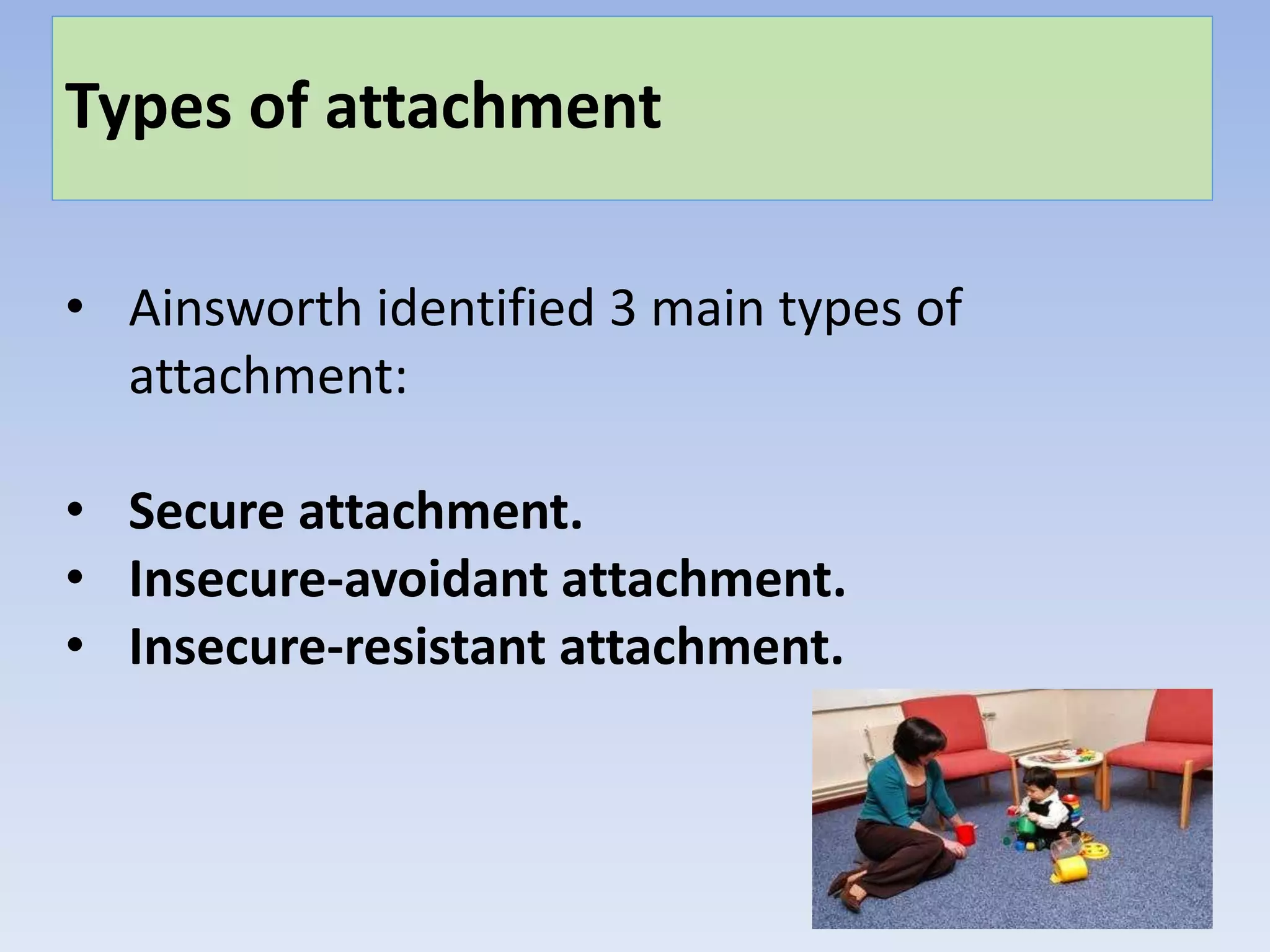
• Ainsworth identified 3 main types of
attachment:
• Secure attachment.
• Insecure-avoidant attachment.
• Insecure-resistant attachment.
Types of attachment
• You need to be able to describe each type of
attachment.
• You may also be asked to identify the type of
attachment from a description of behaviour.
Andrea has noticed that her two sons are quite different.
When she gets home from work the first thing Sam does
is to run to her and give her a great big hug, whilst she
has to go to find rob to make sure he is okay. When a
plumber came to the house the other day Sam was fine
with him, but Rob wouldn’t stop crying and appeared
scared.
(a) Identify:
(i) the type of attachment shown by Rob. (1 mark)
(II) The type of attachment shown by Sam. (1 mark)
(b) Explain how the type of attachment shown by each
child could be assessed.
(4 marks)
Evaluation: strengths
• The strange situation has been found to be reliable
and valid.
• Inter-rater reliability is very high.
• Two different observers give the same child the same
attachment type.
• This means we can be confident that it is able to
identify distinct patterns of attachment behaviour
that can be classified as secure, insecure-avoidant,
insecure-resistant.
Evaluation: strengths
• Research has also found that the strange
situation has good predictive validity.
• Attachment type is closely linked emotional
and psychological development and
psychological health as adults.
Evaluation: limitations
• Some psychologists have identified more than 3
attachment types.
• Main & Solomon (1986) have identified a
disorganised attachment type that is a mixture of
insecure-avoidant and insecure-resistant attachment
types.
• This means that Ainsworth’s 3 attachment types do
not identify all attachment relationships.
Evaluation: limitations
• Kagen (1982) argues that the strange situation does
not measure attachment but the temperament of
the child.
• Temperament is the child’s basic personality.
• The strange situation measures the child’s basic
temperamental response to an unfamiliar situation
not the type of attachment they have to their
caregiver.
Evaluation: limitations
• The strange situation may be culture specific.
• The strange situation has been replicated in non-
western societies and the behaviour of children and
parents have been very different to western
societies.
• This makes it difficult to accurately assess the type of
attachment children have with their caregivers.

Mod 3 attachment types evaluation

  • 1.
    Types of attachment •Ainsworth identified 3 main types of attachment: • Secure attachment. • Insecure-avoidant attachment. • Insecure-resistant attachment.
  • 2.
    Types of attachment •You need to be able to describe each type of attachment. • You may also be asked to identify the type of attachment from a description of behaviour.
  • 3.
    Andrea has noticedthat her two sons are quite different. When she gets home from work the first thing Sam does is to run to her and give her a great big hug, whilst she has to go to find rob to make sure he is okay. When a plumber came to the house the other day Sam was fine with him, but Rob wouldn’t stop crying and appeared scared. (a) Identify: (i) the type of attachment shown by Rob. (1 mark) (II) The type of attachment shown by Sam. (1 mark) (b) Explain how the type of attachment shown by each child could be assessed. (4 marks)
  • 4.
    Evaluation: strengths • Thestrange situation has been found to be reliable and valid. • Inter-rater reliability is very high. • Two different observers give the same child the same attachment type. • This means we can be confident that it is able to identify distinct patterns of attachment behaviour that can be classified as secure, insecure-avoidant, insecure-resistant.
  • 5.
    Evaluation: strengths • Researchhas also found that the strange situation has good predictive validity. • Attachment type is closely linked emotional and psychological development and psychological health as adults.
  • 6.
    Evaluation: limitations • Somepsychologists have identified more than 3 attachment types. • Main & Solomon (1986) have identified a disorganised attachment type that is a mixture of insecure-avoidant and insecure-resistant attachment types. • This means that Ainsworth’s 3 attachment types do not identify all attachment relationships.
  • 7.
    Evaluation: limitations • Kagen(1982) argues that the strange situation does not measure attachment but the temperament of the child. • Temperament is the child’s basic personality. • The strange situation measures the child’s basic temperamental response to an unfamiliar situation not the type of attachment they have to their caregiver.
  • 8.
    Evaluation: limitations • Thestrange situation may be culture specific. • The strange situation has been replicated in non- western societies and the behaviour of children and parents have been very different to western societies. • This makes it difficult to accurately assess the type of attachment children have with their caregivers.