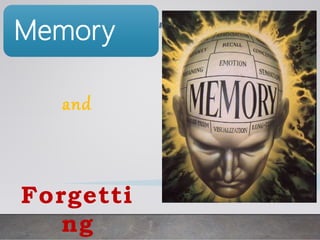
Memory
and
Forgetti
ng
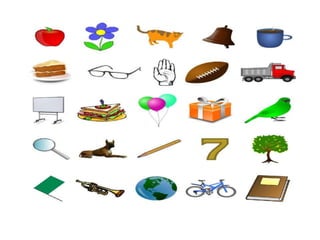
QUESTIONS
• HOW MANY ANIMALS ARE THERE IN PICTURE?
• WHAT IS THE SECOND OBJECT IN THE LAST ROW FROM LEFT SIDE?
• IS THERE A PEN IN THE PICTURE OR NOT?
• TOTAL HOWMANY OBJECTS ARE THERE?
• HOWMANY BALOONS ARE THERE? WHAT ARE THE COLOURS OF
THOSE?
• WHAT’S WRITTEN ON THE BLACK BOARD?
ANSWERS
• TWO
• TRUMPET
• NO, IT’S A PENCIL
• 25
• 3 – LIGHT GREEN, DARK GREEN AND PURPLE
• THERE IS NO BLACK BOARD. ONLY WHITE BOARD AND
IT IS EMPTY.
Takeout a piece of paper…..
•Name the seven
dwarves…..
Now name them…..
Wasit easy orhard?
• It depends on several
things….
• If you like Disney
movies?
• When was the last time you
have seen the movie?
• Are you having
difficulty concentrating?
CONTENT
S
MEMORY
• INTRODUCTION
• DEFINITIONS
• PROCESS OF MEMORIZATION
• COMPONENTS OF MEMORY
• PROCESSING MODEL OF
MEMORY
• TYPES/KINDS OF MEMORY
• CHARACTERISTICS OF GOOD
MEMORY
• FACTORS INFLUENCING MEMORY
• METHODS OF MEMORY
• STAGES OF MEMORY
• TECHNIQUES OF MEMORIZATION
• FORGETTING
MEMORY
INTRODUCTION
WHAT IS MEMORY?
Memory is our ability to encode, store, retain and
subsequently recall information and past
experiences in the human brain.
 Toretain useful skills, knowledge, and expertise
 Torecognize familiar people and places
 Tobuild our capacity to use language
 Toenjoy, share, and sustain culture
 To build a sense of self that endures: what do I believe,
value, remember, and understand?
 To go beyond conditioning in learning from
experience, including lessons from one’s past and
from the experiences of others.
Why do we need to have memory?
DEFINITIONS
Memory
Definition:
The persistence of
learning over time
through the storage and
retrieval of information.
DEFINITION:
Ryburn defines memory as, “the
power we have to store our experiences and to bring
them into the field of consciousness sometimes after
the experiences have occurred”
The process of memorization, cannot be
viewed merely in terms of reproduction or retrieval of past
experiences or learning. It is quite a complex process which
involves factors like learning, retention, recall and
recognition.
Memory is the sum total of what we remember, and gives us
the capability to learn and adapt from previous experiences as
well as to build relationships.
It is the ability to remember past experiences , and the power
or process of recalling to mind previously learned facts,
experiences, impressions, skills and habits.
Studying Memory
Memory: the persistence of learning over time,
through the storage and retrieval of
information and skills.
Three behaviors show that memory is functioning.
 Recall is analogous to “fill-in-the-blanks.” You retrieve
information previously learned and unconsciously stored.
 Recognition is a form of “multiple choice.” You identify
which stimuli match your stored information.
 Relearning is a measure of how much less work it takes you to
learn information you had studied before, even if you don’t
recall having seen the information before.
PROCESS OF
MEMORIZATION
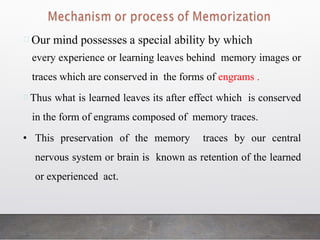
Our mind possesses a special ability by which
every experience or learning leaves behind memory images or
traces which are conserved in the forms of engrams .
Thus what is learned leaves its after effect which is conserved
in the form of engrams composed of memory traces.
• This preservation of the memory traces by our central
nervous system or brain is known as retention of the learned
or experienced act.
Brain Areas Included in Memory
 The hippocampus, a primitive structure deep in the brain, plays the
single largest role in processing information as memory.
 The amygdala, an almond-shaped area near the hippocampus,
processes emotion and helps imprint memories that involve emotion.
 The cerebral cortex, the outer layer of the brain, stores most long-
term memory in different zones, depending on what kind of
processing the information involves: language, sensory input,
problem-solving, and so forth.
In addition, memory involves communication among the
brain’s network of neurons, millions of cells activated by brain
chemicals called neurotransmitters.
COMPONENTS OF
MEMORY
Learning
Memory depends upon learning. It is not possible to keep memorized
any thing without learning. Learning by understanding and learning
mechanically have significance in learning.
Retention
Keeping the learnt things in the brain is its retention. If the retention
power of a person is weaken, his related memory also weaken.
There are found individual difference in the retention power
Recall
Remembering a prior experience is its recall. Recall is such a mental
process by which we bring to our present consciousness the past
incidents and experiences without presenting a physical stimuli.
Recall classified into two:
Natural or Dispositional : Natural recall occurs by itself when we
let the thought flow freely, any thought can come to the mind.
Reflective or Deliberative : here the thought occur to the mind on
making effort.
Eg. student recall the answer pertaining to the question given to the
question paper.
Recognition
It is a mental process by which an individual separates or
distinguishes recognized objects and places from unknown
objects and places from a new objects or places.
Recognition is the completeness of memory.
PROCESSING MODEL OF
MEMORY
The Basic Memory Process
Encoding Storage Retrieval
Here is a simplified description of how memory works:



Encoding: the information gets
into our brains in a way that
allows it to be stored
Storage: the information is held in
a way that allows it to later be
retrieved
Retrieval: reactivating and
recalling the information,
producing it in a form similar to
what was encoded
Encoding
Storage
Retrieval
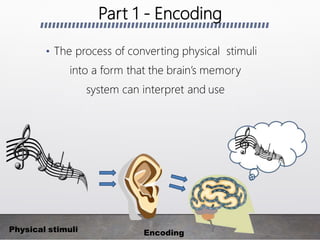
Part 1 - Encoding
• The process of converting physical stimuli
into a form that the brain’s memory
system can interpret and use
Physical stimuli Encoding
Types of Encoding
1) Acoustic: Sounds, spoken words
2) Visual: Images, “mental snapshots”
3) Semantic: “General meanings”
– Concepts andideas
• Dual Coding: Using 2+ types of encoding
– Moreeffective
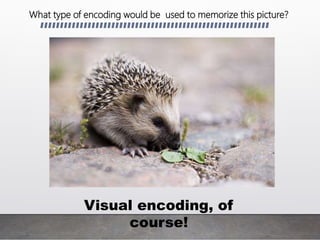
What type of encoding would be used to memorize this picture?
Visual encoding, of
course!
How about this problem…?
Semantic encoding – the idea
of addition is conceptual
What about this last one…?
Trick question! It’s visual AND acoustic
(dual coding)
Part 2 - Storage
The process of keeping memories intact in the
brain’s memory system over time.
Types of Memories
1) Episodic – Specific events or “episodes”
2) Procedural – Information on how to do things
– Repetition is key
– How to ride a bike, tie shoes, walk, etc
3) Semantic – Generalized knowledge of
concepts
– NOT based on specific events
Checkpoint!
What types of memories are described in the
following?
1) Knowledge of how to take a shower
– Procedural memory
2) Information about Newton’s three laws of motion
– Semantic memory
3) Memory of going to picnic in the summer before
10th grade?
– Episodic memory
Part 3 – Retrieval
The process of “locating” specific memories in
storage and bringing them into consciousness.
Retrieval is the process of getting information out of
memory.
Types of Retrieval
1) Recall – Unaided retrieval of
memories
– Free response questions, oral exams
2) Recognition – Retrieval with help of hints
– Easier than recall
– Multiple choice tests
Categories of Memories Retrieved
• Explicit – Deliberately remembered
• Implicit – Unintentional recollection
– Influence of prior experiences
– Unconscious, you have no control over
this
– “Good guys” and “bad guys”
LION BEAR PIG
COW CHICKEN BIRD
ELEPHANT GIRAFFE DOG
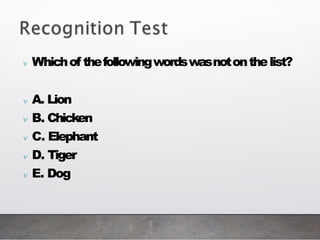
 Whichof thefollowingwordswasnotonthelist?
 A. Lion
 B. Chicken
 C. Elephant
 D. Tiger
 E. Dog
TYPES/KINDS OF
MEMORY
Types/Kinds ofmemory
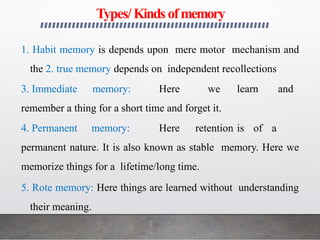
1. Habit memory is depends upon mere motor mechanism and
the 2. true memory depends on independent recollections
3. Immediate memory: Here we learn and
remember a thing for a short time and forget it.
4. Permanent memory: Here retention is of a
permanent nature. It is also known as stable memory. Here we
memorize things for a lifetime/long time.
5. Rote memory: Here things are learned without understanding
their meaning.
Active memory : when we are able to bring the past experience to
the upper level of consciousness with effort , it is called active
memory.
Passive memory : when our past experiences surface to the upper
level of consciousness without any effort, it is called passive
memory.
Logical memory: materials are learned with insight,
understanding and logical thinking is known as logical
memory.
Associate memory: Here the individual associate newly learned
things so many related things existing in the memory and then
establish a multiple connections.
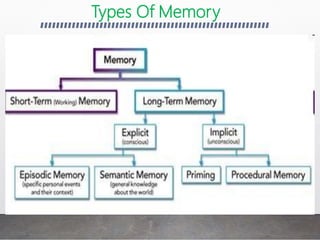
Types Of Memory
CHARACTERISTICS OF
GOOD MEMORY
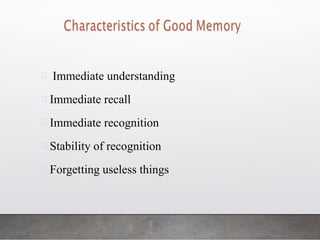
Immediate understanding
Immediate recall
Immediate recognition
Stability of recognition
Forgetting useless things
FACTORS INFLUENCING
MEMORY
Factors influencing memory
1. Physical and mental health
A physically and mentally healthy individual can learn a new topic
soon. Diseased body and mind weaken memory.
2. Motivation
Motivation occupies a very prominent place in memory. Motivation
makes a difficult task easy .
3. Desire to learn
Desire or curiosity to learn also influence on memory . No task can
be accomplished by pressure.
4. Subject matter
If the subject matter is simple, clear, interesting and useful, the child
memorize subject matter easily.
5. Method of learning
The method of learning has influence on memory. If the method
suitable to the subject is not adapted the children never learn nor
memorize it.
6. Testing
Child memory can be developed by testing, so testing and
evaluation should continue in order to keep memory active .
METHODS OF MEMORY
Methods of Memory
a) Whole method
Under this method the whole subject matter is learnt at a time. Under this
method the lesson is read from beginning to end repeatedly. This method
is quite useful for smaller lessons.
b) Part method
Here the subject matter is divided into separate parts. Eg: learning long
poetry in parts. This method is simple and convenient.
c) Break/interval method
Here the subject matter is learnt by taking intervals . Learning things over
long time continuously may weaken memory. It relaxes the mind and
readies learning.
d) Continuous Method
Under this method the whole subject matter is memorized in one sitting
without giving a break in between. This method is effective for immediate
memory.
e) Active method
Under this method the subject matter is memorized by
speaking loudly . This method is more beneficial for children.
f) Passive method
Under this method the subject matter is learnt silently.
g) Association method
Here the subject matter is correlated to any other important subject matter, by
which there are less chance of forgetting the subject matter.
h) Learning by activity
Here the subject matter is learned through an activity by which
all senses of the child become active and it helps to memorize
easily and conveniently.
i) Repetition method
Here the subject matter is repeated at the end of the lesson.
Generally the more time given to repetition of a subject, the
more it is memorized.
STAGES OF MEMORY
Stages of Memory
According to the most acceptable model of
memory, there are three major systems of memory :
1. The Sensory Memory;
2. Short-term memory(STM), and
3. Long-Term Memory(LTM).
Information moves successively through these
three systems, if attention is given to the material. If attention
(focused awareness) is not given, information does not move
further into the system.
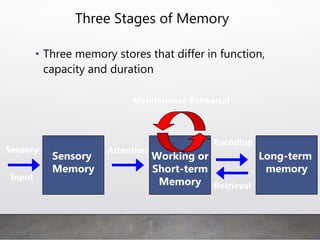
Three Stages of Memory
• Three memory stores that differ in function,
capacity and duration
Long-term
memory
Working or
Short-term
Memory
Sensory
Input
Sensory
Memory
Attention
Encoding
Retrieval
Maintenance Rehearsal
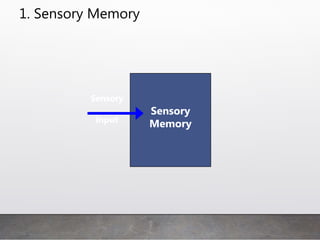
1. Sensory Memory
Sensory
Input
Sensory
Memory
Sensory memory holds representations of sensory input for brief periods of
time, depending upon the modality involved.
There are different sensory registers for each of the senses.
The visual register is called iconic memory and auditory register,
echoic memory.
The iconic memory lasts about half a second and the echoic memory
lasts several seconds.
Most of the information that enters our sensory registers is lost because
we do not attend to all that is registered, whatever we attend to moves on
to the next stage of memory.
Sensory Memory
• Visual sensory memory—brief memory of an image or icon.
Also called iconic memory.
• Auditory sensory memory—brief memory of a sound or
echo. Also called echoic memory.
• Auditory sensory memories may last a bit longer than visual
sensory memories
In this memory , the retention time is extremely
brief. Old sensory impressions are disappear as they are
erased by new memory.
Here we learn a thing immediately with speed and
accuracy, remember it for a short duration and forget it
rapidly after usage.
2. Short Term or Working Memory
Working or
Short-term
Memory
Sensory
Input
Sensory
Memory
Attention
A second type of memory is known as short-term memory or
STM. It holds relatively small amounts of information for brief
periods of time, usually 30 seconds or less.
Where sensory data is first transmitted to- for processing and
evaluation
This is the memory system we use when we look up at the phone
number and dial it. If we are connected on the first instance the telephone number
is forgotten. However, if we get the line engaged for some time, we keep on
dialing the number and through repeated dialing rehearsal of the telephone
number pushes it to the long-term memory (LTM) storage.
Short term Memory holds small amounts of information
briefly.
◦ Working Memory is the another name for STM
◦ Selective Attention: Focusing (voluntarily) on a
selected portion of sensory input (e.g., selective
hearing)
◦ Phonetically: Storing information by sound; how most
things are stored in STM by sound (phonetically)
Maintenance Rehearsal
• Mental or verbal repetition of information allows
information to remain in working memory longer
than the usual 30 seconds
Working or
Short-term
Memory
Sensory
Input
Sensory
Memory
Attention
Maintenance Rehearsal
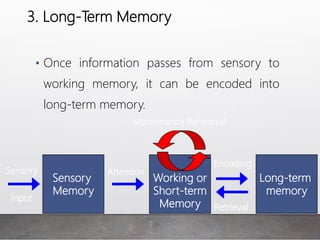
3. Long-Term Memory
• Once information passes from sensory to
working memory, it can be encoded into
long-term memory.
Long-term
memory
Working or
Short-term
Memory
Sensory
Input
Sensory
Memory
Attention
Encoding
Retrieval
Maintenance Rehearsal
Long - Term Memory (LTM) : It is a memory
system for the retention of large amounts of information for
long periods of time.
It is the memory system that permits us to
remember events that happened many years ago, yesterday, last
year, and so on.
It is the long term memory that allows you to
remember factual information that makes it possible for us to
remember.
•
LTM codes information according to meaning,
pattern and other characteristics.
In LTM we can learn different subjects, appear in the
examinations and perform communication with others etc. It
brings continuity and meaning in our life.
• Storing information relatively permanently
Stored on basis of meaning and importance.
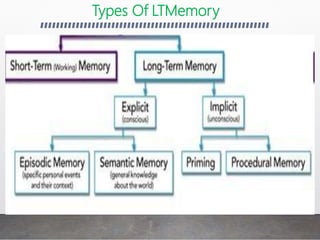
Types Of LTMemory
Types of Long-Term Memory
• Explicit memory—memory with awareness;
information can be consciously recollected; also called
declarative memory.
• Implicit memory—memory without awareness;
memory that affects behavior but cannot consciously be
recalled; also called nondeclarative memory.
1. Explicit Memory
• Declarative or conscious memory
• Two subtypes of explicit memory
• Episodic information—information about events or
“episodes”
• Semantic information—information about facts,
general knowledge, school work
a. Episodic Memory
• Memory tied to your own personal experiences
• Examples:
• What month is your birthday?
• Do you like to eat caramel apples?
b. Semantic Memory
• Memory not tied to personal events
• General facts and definitions about the world
• Examples:
• How many tires on a car?
• What is a cloud?
• What color is a banana?
2. Implicit Memory
• Nondeclarative memory
• Influences your thoughts or behavior, but does
not enter consciousness
Procedural Memory
• Memory that enables you to perform specific learned skills or habitual
responses.
• Examples:
• Riding a bike
• Tying your shoe laces
• Q: Why are these procedural memories implicit?
• A: Don’t have to consciously remember the steps involved in these actions
to perform them.
TECHNIQUIES OF
MEMORIZATION
Techniques for memorisation
Improvement of memory mainly influenced by –
A. the techniques and methods of learning
B. the learning situation and environment
C. the learners state of mind
1.Association
Association is technique for memorisation in which the new
information that needs to be memorised is associated/linked to
information that is not likely to forget.
2. Mnemonics
Mnemonics are techniques for improving memory. It is Greek word
meaning “aid” to memory. A mnemonics is defined as some
device which aids the memorisation of something.
Common mnemonic techniques
Acronym: it is a technique for remembering names, phrases etc by
using the first letter of each word to form a new word.
Acrostic : it is an invented where the first letter of each word is a cue
to an idea we need to remember. VIBGYOR
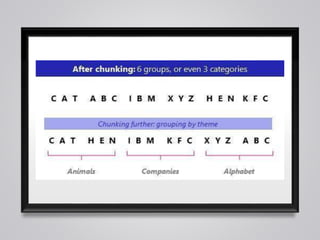
3. Chunking
Method of loci. The word loci means
location or places in Latin and the loci
method is based on the assumption that
location can be serve as an effective cue
for remembering the material.
4. Interest:
For proper memorizing, interest in the topic or subject is essential.
There is a popular saying "we can take the horse to water for
drinking but we can not make him drink unless he is interested
in drinking." Similar is the case with the children.
5. Repetition:
Repetition and its quality affect memorizing. Several
psychological experiments have shown that the items repeated
more often are remembered longer than those repeated less.
However, repetition should be with understanding.
6. Recitation:
In this method, the learner tries to recite and recall the subject
matter without looking at the paper.
In this method, the learner checks up from time to time.
According to A. I. Gates (1942), in this method, weak connections
are easily discovered and more attention is paid to them. Errors are
easily detected and are soon eliminated.
FORGETTING
Forgetting
Forgetting is inability to recall a learnt topic or
inability recognize a seen object.
“Forgetting means failure at any time to recall an experience when
attempting to do so or to perform an action previously learned” –
-Drever
“Forgetting is the failure of the individual to revive in
consciousness an idea or group of ideas without the help of the
original stimuli”- Bhatia
Types of forgetting
Forgetting may be broadly classified into natural and morbid
forgetting
In natural or passive forgetting, forgetting occurs with the lapse
of time in a quite normal way without any intention of forgetting
on the part of the individual.
In morbid or abnormal forgetting one deliberately tries to forget
something.
Causes of forgetting
Meaninglessness of content
We forget meaningless and useless content as compared to
meaningful and useful content, because meaningless content
does not leave any imprint on the mind and it fails to establish
any relationship with life.
Time Lapse
We forget with the passage of time. Memory weakens with the
passage of time and forgetting strengthen.
Exercise
So long the knowledge or activity is not repeatedly exercised, it
gradually forget. Forgetting occurs due to the absence of
exercise, therefore; more exercise is helpful in memory.
Mental conflict or Mental illness
Situations like mental conflicts or illness people find himself
unable to retain a thing in memory for a long time.
Anxiety
Anxiety also cause in enhancing forgetting. An individual
forgets many things or does them wrongly when he is anxious.
Learning methods
When the teacher does not use the method which are according
to the physical, mental, emotional and social levels of the
child, then the forgetting occurs more by the use of these
methods.
Intoxicants
Excessive use of different type of intoxicants has ill effect on
the mind and memory power weakens.
Theories of forgetting
The trace decay theory
Some psychologists think that it is due to fading of memory traces or
decay that happens with lapse of time. Decay is what supposedly occur
when the passage of time causes us to forget. The memory trace (or
engram) fades and the memory is no longer available.
The trace decay theory of forgetting states that all memories fade
automatically as a function of time. Under this theory, you need to
follow a certain pathway, or trace, to recall a memory. If this pathway
goes unused for some amount of time, the memory decays, which
leads to difficulty recalling, or the inability to recall, the memory.
Rehearsal or mentally going over a memory, can slow this
process. But disuse of a trace will lead to memory decay, which
will ultimately cause retrieval failure. This process begins almost
immediately if the information is not used: for example,
sometimes we forget a person's name even though we have just
met them.
Interference Theory
• It is easier to remember recent events than those further in the
past.
• "Transience" refers to the general deterioration of a specific
memory over time.
• Under interference theory, transience occurs because all memories
interfere with the ability to recall other memories.
• Proactive and retroactive interference can impact how well we are
able to recall a memory, andsometimes cause us to forget
things permanently.
(i) Proactive Interference
• Proactive interference occurs when old memories hinder the
ability to make new memories.
• In this type of interference, old information inhibits the ability
to remember new information, such as when outdated
scientific facts interfere with the ability to remember updated
facts.
• This often occurs when memories are learned in similar
contexts, or regarding similar things. use us to forget things
permanently.
(ii)Retroactive Interference
• Retroactive interference occurs when old memories are changed by new
ones, sometimes so much that the original memory is forgotten.
• This is when newly learned information interferes with and impedes the
recall of previously learned information.
• The ability to recall previously learned information is greatly reduced if
that information is not utilized, and there is substantial new information
being presented.
• This often occurs when hearing recent news figures, then trying to
remember earlier facts and figures.
Cue-Dependent Forgetting
When we store a memory, we not only record all sensory data, we also
store our mood and emotional state.
Our current mood thus will affect the memories that are most effortlessly
available to us, such that when we are in a good mood, we recollect
good memories, and when we are in a bad mood, we recollect bad ones.
This suggests that we are sometimes cued to remember certain things
by, for example, our emotional state or our environment.
Cue-dependent forgetting, also known as retrieval failure, is the failure
to recall information in the absence of memory cues.
There are three types of cues that can stop this type of forgetting:
Semantic cues are used when a memory is retrieved because of its
association with another memory. For example, someone forgets
everything about his trip to a place until he is reminded that he visited a
certain friend there, and that cue causes him to recollect many more
events of the trip.
State-dependent cues are governed by the state of mind at the time of
encoding. The emotional or mental state of the person (such as being
drugged, upset, anxious, or happy) is key to establishing cues.
Context-dependent cues depend on the environment and situation.
Memory retrieval can be facilitated or triggered by replication of the
context in which the memory was encoded. Such conditions can include
weather, company, location, the smell of a particular odor, hearing a
certain song, or even tasting a specific flavor.
Motivated forgetting: repression
Freud emphasized the emotional basis of forgetting and through the concept of
repression suggests a means by which threatening material can be kept from
consciousness
— motivated forgetting. He used the term repression to describe the tendency
to avoid remembering anything associated with fear or unpleasantness of kind.
This account of forgetting is highly controversial. While there is general
agreement that traumatic experiences have the potential to disturb people’s
memories, there are many concerns over the implications of the theory of
repressed memories. One area has been the suggestion that repressed memories
from childhood can be recovered using appropriate therapeutic techniques.
Memory
Memory

Memory

  • 1.
  • 3.
    QUESTIONS • HOW MANYANIMALS ARE THERE IN PICTURE? • WHAT IS THE SECOND OBJECT IN THE LAST ROW FROM LEFT SIDE? • IS THERE A PEN IN THE PICTURE OR NOT? • TOTAL HOWMANY OBJECTS ARE THERE? • HOWMANY BALOONS ARE THERE? WHAT ARE THE COLOURS OF THOSE? • WHAT’S WRITTEN ON THE BLACK BOARD?
  • 4.
    ANSWERS • TWO • TRUMPET •NO, IT’S A PENCIL • 25 • 3 – LIGHT GREEN, DARK GREEN AND PURPLE • THERE IS NO BLACK BOARD. ONLY WHITE BOARD AND IT IS EMPTY.
  • 5.
    Takeout a pieceof paper….. •Name the seven dwarves….. Now name them…..
  • 6.
    Wasit easy orhard? •It depends on several things…. • If you like Disney movies? • When was the last time you have seen the movie? • Are you having difficulty concentrating?
  • 7.
    CONTENT S MEMORY • INTRODUCTION • DEFINITIONS •PROCESS OF MEMORIZATION • COMPONENTS OF MEMORY • PROCESSING MODEL OF MEMORY • TYPES/KINDS OF MEMORY • CHARACTERISTICS OF GOOD MEMORY • FACTORS INFLUENCING MEMORY • METHODS OF MEMORY • STAGES OF MEMORY • TECHNIQUES OF MEMORIZATION • FORGETTING
  • 8.
  • 9.
  • 10.
    Memory is ourability to encode, store, retain and subsequently recall information and past experiences in the human brain.
  • 11.
     Toretain usefulskills, knowledge, and expertise  Torecognize familiar people and places  Tobuild our capacity to use language  Toenjoy, share, and sustain culture  To build a sense of self that endures: what do I believe, value, remember, and understand?  To go beyond conditioning in learning from experience, including lessons from one’s past and from the experiences of others. Why do we need to have memory?
  • 12.
  • 13.
    Memory Definition: The persistence of learningover time through the storage and retrieval of information.
  • 14.
    DEFINITION: Ryburn defines memoryas, “the power we have to store our experiences and to bring them into the field of consciousness sometimes after the experiences have occurred” The process of memorization, cannot be viewed merely in terms of reproduction or retrieval of past experiences or learning. It is quite a complex process which involves factors like learning, retention, recall and recognition.
  • 15.
    Memory is thesum total of what we remember, and gives us the capability to learn and adapt from previous experiences as well as to build relationships. It is the ability to remember past experiences , and the power or process of recalling to mind previously learned facts, experiences, impressions, skills and habits.
  • 16.
    Studying Memory Memory: thepersistence of learning over time, through the storage and retrieval of information and skills. Three behaviors show that memory is functioning.  Recall is analogous to “fill-in-the-blanks.” You retrieve information previously learned and unconsciously stored.  Recognition is a form of “multiple choice.” You identify which stimuli match your stored information.  Relearning is a measure of how much less work it takes you to learn information you had studied before, even if you don’t recall having seen the information before.
  • 17.
  • 18.
    Our mind possessesa special ability by which every experience or learning leaves behind memory images or traces which are conserved in the forms of engrams . Thus what is learned leaves its after effect which is conserved in the form of engrams composed of memory traces. • This preservation of the memory traces by our central nervous system or brain is known as retention of the learned or experienced act.
  • 19.
    Brain Areas Includedin Memory  The hippocampus, a primitive structure deep in the brain, plays the single largest role in processing information as memory.  The amygdala, an almond-shaped area near the hippocampus, processes emotion and helps imprint memories that involve emotion.  The cerebral cortex, the outer layer of the brain, stores most long- term memory in different zones, depending on what kind of processing the information involves: language, sensory input, problem-solving, and so forth. In addition, memory involves communication among the brain’s network of neurons, millions of cells activated by brain chemicals called neurotransmitters.
  • 20.
  • 21.
    Learning Memory depends uponlearning. It is not possible to keep memorized any thing without learning. Learning by understanding and learning mechanically have significance in learning. Retention Keeping the learnt things in the brain is its retention. If the retention power of a person is weaken, his related memory also weaken. There are found individual difference in the retention power
  • 22.
    Recall Remembering a priorexperience is its recall. Recall is such a mental process by which we bring to our present consciousness the past incidents and experiences without presenting a physical stimuli. Recall classified into two: Natural or Dispositional : Natural recall occurs by itself when we let the thought flow freely, any thought can come to the mind. Reflective or Deliberative : here the thought occur to the mind on making effort. Eg. student recall the answer pertaining to the question given to the question paper.
  • 23.
    Recognition It is amental process by which an individual separates or distinguishes recognized objects and places from unknown objects and places from a new objects or places. Recognition is the completeness of memory.
  • 24.
  • 25.
    The Basic MemoryProcess Encoding Storage Retrieval
  • 26.
    Here is asimplified description of how memory works:    Encoding: the information gets into our brains in a way that allows it to be stored Storage: the information is held in a way that allows it to later be retrieved Retrieval: reactivating and recalling the information, producing it in a form similar to what was encoded Encoding Storage Retrieval
  • 27.
    Part 1 -Encoding • The process of converting physical stimuli into a form that the brain’s memory system can interpret and use Physical stimuli Encoding
  • 28.
    Types of Encoding 1)Acoustic: Sounds, spoken words 2) Visual: Images, “mental snapshots” 3) Semantic: “General meanings” – Concepts andideas • Dual Coding: Using 2+ types of encoding – Moreeffective
  • 29.
    What type ofencoding would be used to memorize this picture? Visual encoding, of course!
  • 30.
    How about thisproblem…? Semantic encoding – the idea of addition is conceptual
  • 31.
    What about thislast one…? Trick question! It’s visual AND acoustic (dual coding)
  • 32.
    Part 2 -Storage The process of keeping memories intact in the brain’s memory system over time.
  • 33.
    Types of Memories 1)Episodic – Specific events or “episodes” 2) Procedural – Information on how to do things – Repetition is key – How to ride a bike, tie shoes, walk, etc 3) Semantic – Generalized knowledge of concepts – NOT based on specific events
  • 34.
    Checkpoint! What types ofmemories are described in the following? 1) Knowledge of how to take a shower – Procedural memory 2) Information about Newton’s three laws of motion – Semantic memory 3) Memory of going to picnic in the summer before 10th grade? – Episodic memory
  • 35.
    Part 3 –Retrieval The process of “locating” specific memories in storage and bringing them into consciousness. Retrieval is the process of getting information out of memory.
  • 36.
    Types of Retrieval 1)Recall – Unaided retrieval of memories – Free response questions, oral exams 2) Recognition – Retrieval with help of hints – Easier than recall – Multiple choice tests
  • 37.
    Categories of MemoriesRetrieved • Explicit – Deliberately remembered • Implicit – Unintentional recollection – Influence of prior experiences – Unconscious, you have no control over this – “Good guys” and “bad guys”
  • 38.
    LION BEAR PIG COWCHICKEN BIRD ELEPHANT GIRAFFE DOG
  • 39.
     Whichof thefollowingwordswasnotonthelist? A. Lion  B. Chicken  C. Elephant  D. Tiger  E. Dog
  • 42.
  • 43.
    Types/Kinds ofmemory 1. Habitmemory is depends upon mere motor mechanism and the 2. true memory depends on independent recollections 3. Immediate memory: Here we learn and remember a thing for a short time and forget it. 4. Permanent memory: Here retention is of a permanent nature. It is also known as stable memory. Here we memorize things for a lifetime/long time. 5. Rote memory: Here things are learned without understanding their meaning.
  • 45.
    Active memory :when we are able to bring the past experience to the upper level of consciousness with effort , it is called active memory. Passive memory : when our past experiences surface to the upper level of consciousness without any effort, it is called passive memory. Logical memory: materials are learned with insight, understanding and logical thinking is known as logical memory. Associate memory: Here the individual associate newly learned things so many related things existing in the memory and then establish a multiple connections.
  • 46.
  • 47.
  • 48.
    Immediate understanding Immediate recall Immediaterecognition Stability of recognition Forgetting useless things
  • 49.
  • 50.
    Factors influencing memory 1.Physical and mental health A physically and mentally healthy individual can learn a new topic soon. Diseased body and mind weaken memory. 2. Motivation Motivation occupies a very prominent place in memory. Motivation makes a difficult task easy . 3. Desire to learn Desire or curiosity to learn also influence on memory . No task can be accomplished by pressure.
  • 51.
    4. Subject matter Ifthe subject matter is simple, clear, interesting and useful, the child memorize subject matter easily. 5. Method of learning The method of learning has influence on memory. If the method suitable to the subject is not adapted the children never learn nor memorize it. 6. Testing Child memory can be developed by testing, so testing and evaluation should continue in order to keep memory active .
  • 52.
  • 53.
    Methods of Memory a)Whole method Under this method the whole subject matter is learnt at a time. Under this method the lesson is read from beginning to end repeatedly. This method is quite useful for smaller lessons. b) Part method Here the subject matter is divided into separate parts. Eg: learning long poetry in parts. This method is simple and convenient. c) Break/interval method Here the subject matter is learnt by taking intervals . Learning things over long time continuously may weaken memory. It relaxes the mind and readies learning.
  • 54.
    d) Continuous Method Underthis method the whole subject matter is memorized in one sitting without giving a break in between. This method is effective for immediate memory. e) Active method Under this method the subject matter is memorized by speaking loudly . This method is more beneficial for children. f) Passive method Under this method the subject matter is learnt silently. g) Association method Here the subject matter is correlated to any other important subject matter, by which there are less chance of forgetting the subject matter.
  • 55.
    h) Learning byactivity Here the subject matter is learned through an activity by which all senses of the child become active and it helps to memorize easily and conveniently. i) Repetition method Here the subject matter is repeated at the end of the lesson. Generally the more time given to repetition of a subject, the more it is memorized.
  • 56.
  • 57.
    Stages of Memory Accordingto the most acceptable model of memory, there are three major systems of memory : 1. The Sensory Memory; 2. Short-term memory(STM), and 3. Long-Term Memory(LTM). Information moves successively through these three systems, if attention is given to the material. If attention (focused awareness) is not given, information does not move further into the system.
  • 58.
    Three Stages ofMemory • Three memory stores that differ in function, capacity and duration Long-term memory Working or Short-term Memory Sensory Input Sensory Memory Attention Encoding Retrieval Maintenance Rehearsal
  • 59.
  • 60.
    Sensory memory holdsrepresentations of sensory input for brief periods of time, depending upon the modality involved. There are different sensory registers for each of the senses. The visual register is called iconic memory and auditory register, echoic memory. The iconic memory lasts about half a second and the echoic memory lasts several seconds. Most of the information that enters our sensory registers is lost because we do not attend to all that is registered, whatever we attend to moves on to the next stage of memory.
  • 61.
    Sensory Memory • Visualsensory memory—brief memory of an image or icon. Also called iconic memory. • Auditory sensory memory—brief memory of a sound or echo. Also called echoic memory. • Auditory sensory memories may last a bit longer than visual sensory memories
  • 62.
    In this memory, the retention time is extremely brief. Old sensory impressions are disappear as they are erased by new memory. Here we learn a thing immediately with speed and accuracy, remember it for a short duration and forget it rapidly after usage.
  • 63.
    2. Short Termor Working Memory Working or Short-term Memory Sensory Input Sensory Memory Attention
  • 64.
    A second typeof memory is known as short-term memory or STM. It holds relatively small amounts of information for brief periods of time, usually 30 seconds or less. Where sensory data is first transmitted to- for processing and evaluation This is the memory system we use when we look up at the phone number and dial it. If we are connected on the first instance the telephone number is forgotten. However, if we get the line engaged for some time, we keep on dialing the number and through repeated dialing rehearsal of the telephone number pushes it to the long-term memory (LTM) storage.
  • 65.
    Short term Memoryholds small amounts of information briefly. ◦ Working Memory is the another name for STM ◦ Selective Attention: Focusing (voluntarily) on a selected portion of sensory input (e.g., selective hearing) ◦ Phonetically: Storing information by sound; how most things are stored in STM by sound (phonetically)
  • 66.
    Maintenance Rehearsal • Mentalor verbal repetition of information allows information to remain in working memory longer than the usual 30 seconds Working or Short-term Memory Sensory Input Sensory Memory Attention Maintenance Rehearsal
  • 70.
    3. Long-Term Memory •Once information passes from sensory to working memory, it can be encoded into long-term memory. Long-term memory Working or Short-term Memory Sensory Input Sensory Memory Attention Encoding Retrieval Maintenance Rehearsal
  • 71.
    Long - TermMemory (LTM) : It is a memory system for the retention of large amounts of information for long periods of time. It is the memory system that permits us to remember events that happened many years ago, yesterday, last year, and so on. It is the long term memory that allows you to remember factual information that makes it possible for us to remember. •
  • 72.
    LTM codes informationaccording to meaning, pattern and other characteristics. In LTM we can learn different subjects, appear in the examinations and perform communication with others etc. It brings continuity and meaning in our life. • Storing information relatively permanently Stored on basis of meaning and importance.
  • 73.
  • 74.
    Types of Long-TermMemory • Explicit memory—memory with awareness; information can be consciously recollected; also called declarative memory. • Implicit memory—memory without awareness; memory that affects behavior but cannot consciously be recalled; also called nondeclarative memory.
  • 75.
    1. Explicit Memory •Declarative or conscious memory • Two subtypes of explicit memory • Episodic information—information about events or “episodes” • Semantic information—information about facts, general knowledge, school work
  • 76.
    a. Episodic Memory •Memory tied to your own personal experiences • Examples: • What month is your birthday? • Do you like to eat caramel apples? b. Semantic Memory • Memory not tied to personal events • General facts and definitions about the world • Examples: • How many tires on a car? • What is a cloud? • What color is a banana?
  • 77.
    2. Implicit Memory •Nondeclarative memory • Influences your thoughts or behavior, but does not enter consciousness Procedural Memory • Memory that enables you to perform specific learned skills or habitual responses. • Examples: • Riding a bike • Tying your shoe laces • Q: Why are these procedural memories implicit? • A: Don’t have to consciously remember the steps involved in these actions to perform them.
  • 78.
  • 79.
    Techniques for memorisation Improvementof memory mainly influenced by – A. the techniques and methods of learning B. the learning situation and environment C. the learners state of mind 1.Association Association is technique for memorisation in which the new information that needs to be memorised is associated/linked to information that is not likely to forget.
  • 80.
    2. Mnemonics Mnemonics aretechniques for improving memory. It is Greek word meaning “aid” to memory. A mnemonics is defined as some device which aids the memorisation of something. Common mnemonic techniques Acronym: it is a technique for remembering names, phrases etc by using the first letter of each word to form a new word. Acrostic : it is an invented where the first letter of each word is a cue to an idea we need to remember. VIBGYOR
  • 83.
    3. Chunking Method ofloci. The word loci means location or places in Latin and the loci method is based on the assumption that location can be serve as an effective cue for remembering the material.
  • 84.
    4. Interest: For propermemorizing, interest in the topic or subject is essential. There is a popular saying "we can take the horse to water for drinking but we can not make him drink unless he is interested in drinking." Similar is the case with the children. 5. Repetition: Repetition and its quality affect memorizing. Several psychological experiments have shown that the items repeated more often are remembered longer than those repeated less. However, repetition should be with understanding.
  • 85.
    6. Recitation: In thismethod, the learner tries to recite and recall the subject matter without looking at the paper. In this method, the learner checks up from time to time. According to A. I. Gates (1942), in this method, weak connections are easily discovered and more attention is paid to them. Errors are easily detected and are soon eliminated.
  • 86.
  • 87.
    Forgetting Forgetting is inabilityto recall a learnt topic or inability recognize a seen object. “Forgetting means failure at any time to recall an experience when attempting to do so or to perform an action previously learned” – -Drever “Forgetting is the failure of the individual to revive in consciousness an idea or group of ideas without the help of the original stimuli”- Bhatia
  • 88.
    Types of forgetting Forgettingmay be broadly classified into natural and morbid forgetting In natural or passive forgetting, forgetting occurs with the lapse of time in a quite normal way without any intention of forgetting on the part of the individual. In morbid or abnormal forgetting one deliberately tries to forget something.
  • 89.
    Causes of forgetting Meaninglessnessof content We forget meaningless and useless content as compared to meaningful and useful content, because meaningless content does not leave any imprint on the mind and it fails to establish any relationship with life. Time Lapse We forget with the passage of time. Memory weakens with the passage of time and forgetting strengthen.
  • 90.
    Exercise So long theknowledge or activity is not repeatedly exercised, it gradually forget. Forgetting occurs due to the absence of exercise, therefore; more exercise is helpful in memory. Mental conflict or Mental illness Situations like mental conflicts or illness people find himself unable to retain a thing in memory for a long time. Anxiety Anxiety also cause in enhancing forgetting. An individual forgets many things or does them wrongly when he is anxious.
  • 91.
    Learning methods When theteacher does not use the method which are according to the physical, mental, emotional and social levels of the child, then the forgetting occurs more by the use of these methods. Intoxicants Excessive use of different type of intoxicants has ill effect on the mind and memory power weakens.
  • 92.
    Theories of forgetting Thetrace decay theory Some psychologists think that it is due to fading of memory traces or decay that happens with lapse of time. Decay is what supposedly occur when the passage of time causes us to forget. The memory trace (or engram) fades and the memory is no longer available. The trace decay theory of forgetting states that all memories fade automatically as a function of time. Under this theory, you need to follow a certain pathway, or trace, to recall a memory. If this pathway goes unused for some amount of time, the memory decays, which leads to difficulty recalling, or the inability to recall, the memory.
  • 93.
    Rehearsal or mentallygoing over a memory, can slow this process. But disuse of a trace will lead to memory decay, which will ultimately cause retrieval failure. This process begins almost immediately if the information is not used: for example, sometimes we forget a person's name even though we have just met them.
  • 94.
    Interference Theory • Itis easier to remember recent events than those further in the past. • "Transience" refers to the general deterioration of a specific memory over time. • Under interference theory, transience occurs because all memories interfere with the ability to recall other memories. • Proactive and retroactive interference can impact how well we are able to recall a memory, andsometimes cause us to forget things permanently.
  • 95.
    (i) Proactive Interference •Proactive interference occurs when old memories hinder the ability to make new memories. • In this type of interference, old information inhibits the ability to remember new information, such as when outdated scientific facts interfere with the ability to remember updated facts. • This often occurs when memories are learned in similar contexts, or regarding similar things. use us to forget things permanently.
  • 96.
    (ii)Retroactive Interference • Retroactiveinterference occurs when old memories are changed by new ones, sometimes so much that the original memory is forgotten. • This is when newly learned information interferes with and impedes the recall of previously learned information. • The ability to recall previously learned information is greatly reduced if that information is not utilized, and there is substantial new information being presented. • This often occurs when hearing recent news figures, then trying to remember earlier facts and figures.
  • 98.
    Cue-Dependent Forgetting When westore a memory, we not only record all sensory data, we also store our mood and emotional state. Our current mood thus will affect the memories that are most effortlessly available to us, such that when we are in a good mood, we recollect good memories, and when we are in a bad mood, we recollect bad ones. This suggests that we are sometimes cued to remember certain things by, for example, our emotional state or our environment. Cue-dependent forgetting, also known as retrieval failure, is the failure to recall information in the absence of memory cues. There are three types of cues that can stop this type of forgetting:
  • 99.
    Semantic cues areused when a memory is retrieved because of its association with another memory. For example, someone forgets everything about his trip to a place until he is reminded that he visited a certain friend there, and that cue causes him to recollect many more events of the trip. State-dependent cues are governed by the state of mind at the time of encoding. The emotional or mental state of the person (such as being drugged, upset, anxious, or happy) is key to establishing cues. Context-dependent cues depend on the environment and situation. Memory retrieval can be facilitated or triggered by replication of the context in which the memory was encoded. Such conditions can include weather, company, location, the smell of a particular odor, hearing a certain song, or even tasting a specific flavor.
  • 100.
    Motivated forgetting: repression Freudemphasized the emotional basis of forgetting and through the concept of repression suggests a means by which threatening material can be kept from consciousness — motivated forgetting. He used the term repression to describe the tendency to avoid remembering anything associated with fear or unpleasantness of kind. This account of forgetting is highly controversial. While there is general agreement that traumatic experiences have the potential to disturb people’s memories, there are many concerns over the implications of the theory of repressed memories. One area has been the suggestion that repressed memories from childhood can be recovered using appropriate therapeutic techniques.