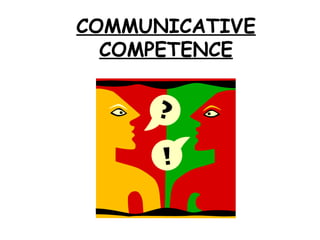
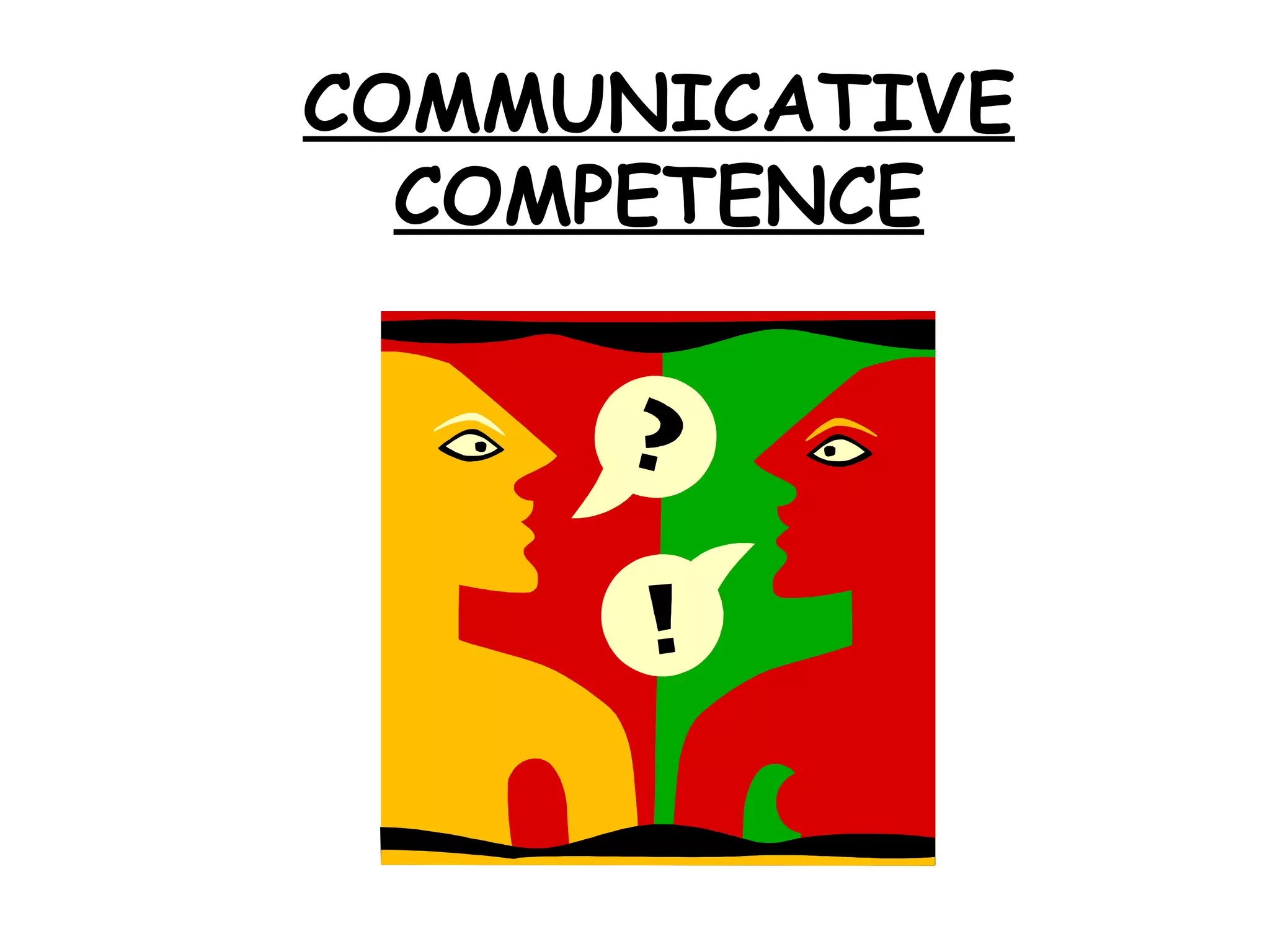
COMMUNICATIVE
  COMPETENCE
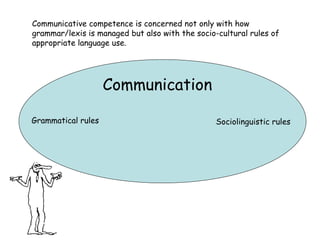
Communicative competence is concerned not only with how
grammar/lexis is managed but also with the socio-cultural rules of
appropriate language use.


                    Communication

Grammatical rules                                Sociolinguistic rules
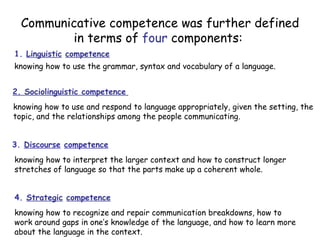
Communicative competence was further defined
         in terms of four components:
1. Linguistic competence
knowing how to use the grammar, syntax and vocabulary of a language.


2. Sociolinguistic competence
knowing how to use and respond to language appropriately, given the setting, the
topic, and the relationships among the people communicating.


3. Discourse competence
knowing how to interpret the larger context and how to construct longer
stretches of language so that the parts make up a coherent whole.


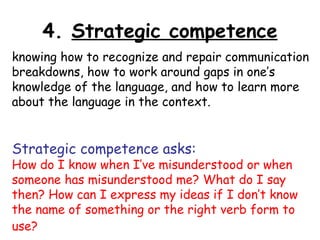
4. Strategic competence
knowing how to recognize and repair communication breakdowns, how to
work around gaps in one’s knowledge of the language, and how to learn more
about the language in the context.
1. Linguistic competence
knowing how to use the grammar, syntax
  and vocabulary of a language.

Linguistic competence asks:
What words do I use?
How do I put them into phrases and
sentences?
2. Sociolinguistic competence
knowing how to use and respond to
language appropriately, given the setting,
the topic and the relationships among the
people communicating.
Sociolinguistic competence asks:
Which words and phrases fit this setting and
this topic? How can I express a specific attitude
(courtesy, authority, friendliness, respect) when
I need to?
How do I know what attitude another person is
expressing?
3. Discourse competence
knowing how to interpret the larger
context and how to construct longer
stretches of language so that the parts
make up a coherent whole.

Discourse competence asks:
How are words, phrases and sentences put
together to create conversations,
speeches, email messages, newspaper
articles?
4. Strategic competence
knowing how to recognize and repair communication
breakdowns, how to work around gaps in one’s
knowledge of the language, and how to learn more
about the language in the context.


Strategic competence asks:
How do I know when I’ve misunderstood or when
someone has misunderstood me? What do I say
then? How can I express my ideas if I don’t know
the name of something or the right verb form to
use?
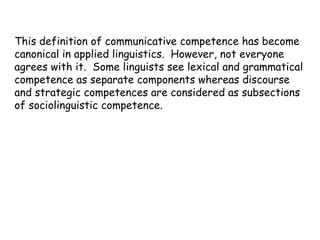
This definition of communicative competence has become
canonical in applied linguistics. However, not everyone
agrees with it. Some linguists see lexical and grammatical
competence as separate components whereas discourse
and strategic competences are considered as subsections
of sociolinguistic competence.
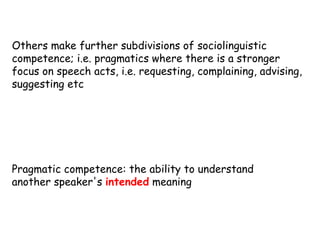
Others make further subdivisions of sociolinguistic
competence; i.e. pragmatics where there is a stronger
focus on speech acts, i.e. requesting, complaining, advising,
suggesting etc


Pragmatic competence: the ability to understand
another speaker's intended meaning
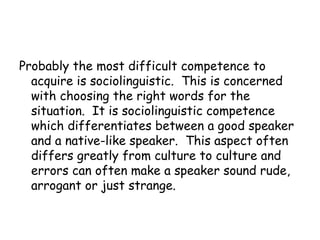
Probably the most difficult competence to
  acquire is sociolinguistic. This is concerned
  with choosing the right words for the
  situation. It is sociolinguistic competence
  which differentiates between a good speaker
  and a native-like speaker. This aspect often
  differs greatly from culture to culture and
  errors can often make a speaker sound rude,
  arrogant or just strange.
So what is sociolinguistic
           competence?
• Holmes : ‘the knowledge which underlies
  people’s ability to use language appropriately’.
  and further ‘how to use language for
  different functions […]. Learning to speak
  appropriately in a range of contexts is
  important if one wants to avoid giving
  offence, reducing everyone to hysterical
  laughter, or embarrassing others by a
  sociolinguistic faux pas’.
So what is sociolinguistic
          competence?

2. Bayley and Regan: ‘knowledge of
    variation is part of speaker
    competence. […] in order to become
    fully proficient in the target language
    learners need to acquire native
    speaker patterns of variation’.
So what is sociolinguistic
             competence?
Regionally / socially / culturally
 accepted language ability

Features of sociolinguistic competence:
1.  Dialect:  regional OR social differences in
    Dialect
  language.  (For example, RP is social and not regional). 
2.  Register:  considering one's audience AND social
    Register
  context
3.  Naturalness:  staying in the bounds of what is
    Naturalness
  "common" usage of the language.
4.  Cultural Aspects:  adhering to cultural
               Aspects
  expectations when using the language, including
  figures of speech, proper time and place, etc.
Sociolinguistic competence is
      evident in many aspects of
               language:

•   Phonology
•   Grammar
•   Lexical
•   Pragmatics
Phonology
From a phonological point of view, the
  most studied point has been /in/ and
  /iŋ/ as in ‘I’m goin’ to the cinema’ and
  ‘I’m going to the cinema’
Other points include:
• Do you like ice-cream?
/dju/ like ice-cream?
• In an Irish context:
/d/, /t/ and /ð/ /θ/
Grammar

• I did my homework /
  *I done my homework

• I should have gone there /
  *I should have went there

• I’ll take those books /
  *I’ll take them books
Lexical
Including:
• informal/formal (e.g. pop in/visit)
• Dialect (e.g. cops/police/guards)
However, also consider these statements by
  non-native speakers:
• ‘My daddy is a fireman’ - spoken by a 30 year
  old male
• ‘We’re going to the seaside today’ - spoken by
  a secondary school teacher
Pragmatics
speech acts such as greeting, requesting,
   advising, suggesting, complaining etc.
This is the area where non-native speakers can
   have serious problems.
Obvious examples include:
• Hi, Jim!
• Good morning, Mr Smith
And
• Give me a pen!
• Could you pass me the pen?
Pragmatics
But it is important to stress that it is not just
  about register. Look at the following
  examples:

• Excuse me; do you know where the post office
  is?
• Sorry; you don’t happen to know where the
  post office is, do you?
                         *
• What is your name?
• And, what is your name again?
Pragmatics
English pragmatics has been defined by:

•   Indirectness
•   Orientation towards other
•   Orientation towards addressees
•   Implicitness
•   Verbal routines
                             (House 2002)
Softeners
Another important feature of English is the
 use of softeners, particularly softening
 questions.

E.g.
A Can I ask you a question?’

B Can I just ask you a question? – “just” softens
  the question to mean
‘I want to ask you a question but I don’t want to
  inconvenience you and it’ll only take a short time’.

Communicative competence slides

  • 1.
  • 2.
    Communicative competence isconcerned not only with how grammar/lexis is managed but also with the socio-cultural rules of appropriate language use. Communication Grammatical rules Sociolinguistic rules
  • 3.
    Communicative competence wasfurther defined in terms of four components: 1. Linguistic competence knowing how to use the grammar, syntax and vocabulary of a language. 2. Sociolinguistic competence knowing how to use and respond to language appropriately, given the setting, the topic, and the relationships among the people communicating. 3. Discourse competence knowing how to interpret the larger context and how to construct longer stretches of language so that the parts make up a coherent whole. 4. Strategic competence knowing how to recognize and repair communication breakdowns, how to work around gaps in one’s knowledge of the language, and how to learn more about the language in the context.
  • 4.
    1. Linguistic competence knowinghow to use the grammar, syntax and vocabulary of a language. Linguistic competence asks: What words do I use? How do I put them into phrases and sentences?
  • 5.
    2. Sociolinguistic competence knowinghow to use and respond to language appropriately, given the setting, the topic and the relationships among the people communicating. Sociolinguistic competence asks: Which words and phrases fit this setting and this topic? How can I express a specific attitude (courtesy, authority, friendliness, respect) when I need to? How do I know what attitude another person is expressing?
  • 6.
    3. Discourse competence knowinghow to interpret the larger context and how to construct longer stretches of language so that the parts make up a coherent whole. Discourse competence asks: How are words, phrases and sentences put together to create conversations, speeches, email messages, newspaper articles?
  • 7.
    4. Strategic competence knowinghow to recognize and repair communication breakdowns, how to work around gaps in one’s knowledge of the language, and how to learn more about the language in the context. Strategic competence asks: How do I know when I’ve misunderstood or when someone has misunderstood me? What do I say then? How can I express my ideas if I don’t know the name of something or the right verb form to use?
  • 8.
    This definition ofcommunicative competence has become canonical in applied linguistics. However, not everyone agrees with it. Some linguists see lexical and grammatical competence as separate components whereas discourse and strategic competences are considered as subsections of sociolinguistic competence.
  • 9.
    Others make furthersubdivisions of sociolinguistic competence; i.e. pragmatics where there is a stronger focus on speech acts, i.e. requesting, complaining, advising, suggesting etc Pragmatic competence: the ability to understand another speaker's intended meaning
  • 10.
    Probably the mostdifficult competence to acquire is sociolinguistic. This is concerned with choosing the right words for the situation. It is sociolinguistic competence which differentiates between a good speaker and a native-like speaker. This aspect often differs greatly from culture to culture and errors can often make a speaker sound rude, arrogant or just strange.
  • 11.
    So what issociolinguistic competence? • Holmes : ‘the knowledge which underlies people’s ability to use language appropriately’. and further ‘how to use language for different functions […]. Learning to speak appropriately in a range of contexts is important if one wants to avoid giving offence, reducing everyone to hysterical laughter, or embarrassing others by a sociolinguistic faux pas’.
  • 12.
    So what issociolinguistic competence? 2. Bayley and Regan: ‘knowledge of variation is part of speaker competence. […] in order to become fully proficient in the target language learners need to acquire native speaker patterns of variation’.
  • 13.
    So what issociolinguistic competence? Regionally / socially / culturally accepted language ability Features of sociolinguistic competence: 1.  Dialect:  regional OR social differences in Dialect language.  (For example, RP is social and not regional).  2.  Register:  considering one's audience AND social Register context 3.  Naturalness:  staying in the bounds of what is Naturalness "common" usage of the language. 4.  Cultural Aspects:  adhering to cultural Aspects expectations when using the language, including figures of speech, proper time and place, etc.
  • 14.
    Sociolinguistic competence is evident in many aspects of language: • Phonology • Grammar • Lexical • Pragmatics
  • 15.
    Phonology From a phonologicalpoint of view, the most studied point has been /in/ and /iŋ/ as in ‘I’m goin’ to the cinema’ and ‘I’m going to the cinema’ Other points include: • Do you like ice-cream? /dju/ like ice-cream? • In an Irish context: /d/, /t/ and /ð/ /θ/
  • 16.
    Grammar • I didmy homework / *I done my homework • I should have gone there / *I should have went there • I’ll take those books / *I’ll take them books
  • 17.
    Lexical Including: • informal/formal (e.g.pop in/visit) • Dialect (e.g. cops/police/guards) However, also consider these statements by non-native speakers: • ‘My daddy is a fireman’ - spoken by a 30 year old male • ‘We’re going to the seaside today’ - spoken by a secondary school teacher
  • 18.
    Pragmatics speech acts suchas greeting, requesting, advising, suggesting, complaining etc. This is the area where non-native speakers can have serious problems. Obvious examples include: • Hi, Jim! • Good morning, Mr Smith And • Give me a pen! • Could you pass me the pen?
  • 19.
    Pragmatics But it isimportant to stress that it is not just about register. Look at the following examples: • Excuse me; do you know where the post office is? • Sorry; you don’t happen to know where the post office is, do you? * • What is your name? • And, what is your name again?
  • 20.
    Pragmatics English pragmatics hasbeen defined by: • Indirectness • Orientation towards other • Orientation towards addressees • Implicitness • Verbal routines (House 2002)
  • 21.
    Softeners Another important featureof English is the use of softeners, particularly softening questions. E.g. A Can I ask you a question?’ B Can I just ask you a question? – “just” softens the question to mean ‘I want to ask you a question but I don’t want to inconvenience you and it’ll only take a short time’.