Animal studies: Lorenz & Harlow
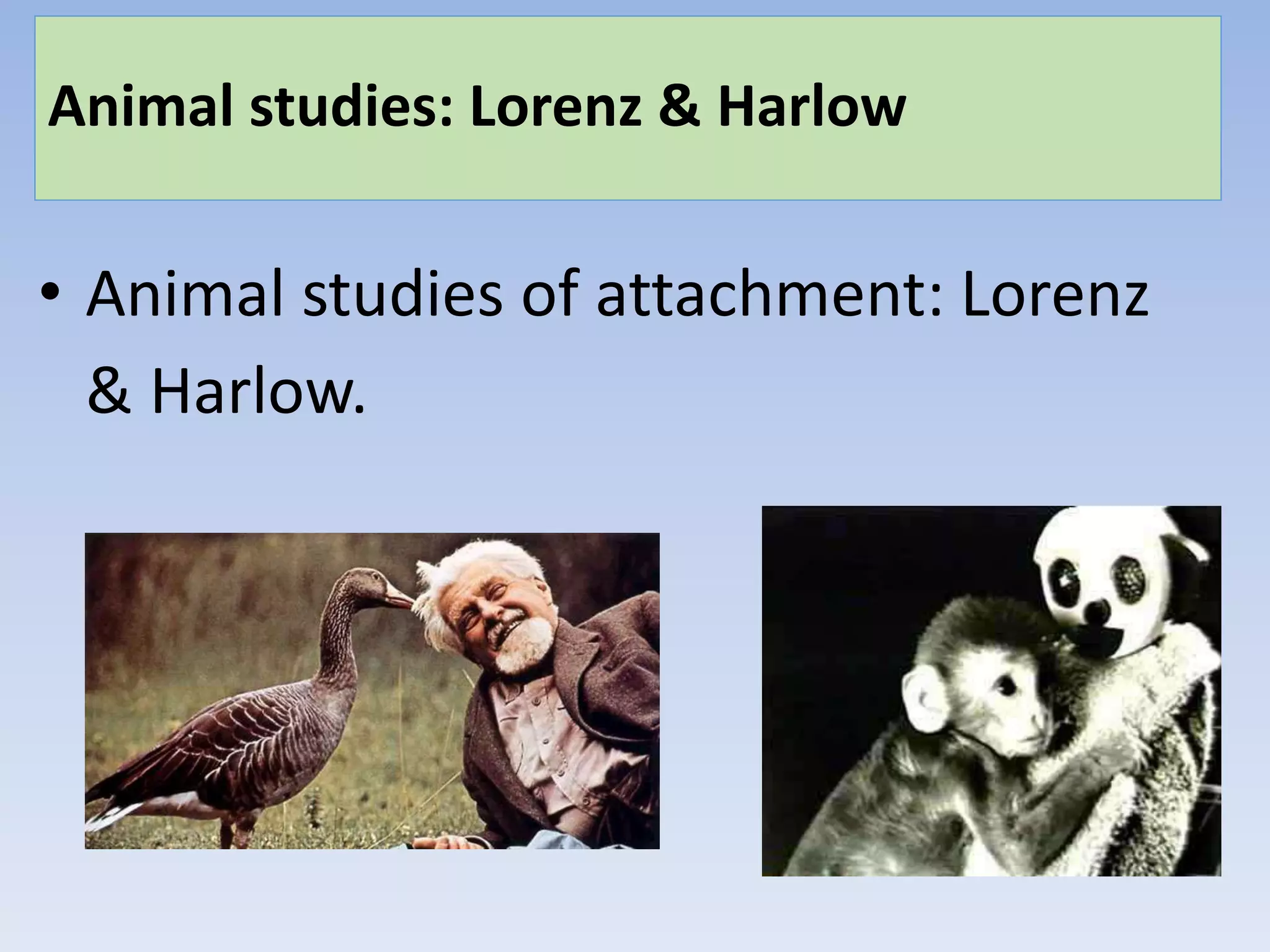
• Animal studies of attachment: Lorenz
& Harlow.
Animal studies: Lorenz & Harlow
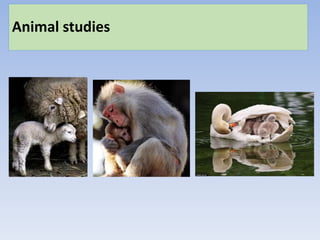
• Many animals show attachment behaviour.
• Animal studies have helped psychologists explain
why humans make attachments.
• Animal studies have also helped psychologists
understand the effects of a lack of attachment
bonds in early childhood on child development
and adult behaviour.
Animal studies
Animal studies: Lorenz
• Ethology: the study of animal behaviour.
• Konrad Lorenz was the first ethologist to
identify and explain attachment in
animals.
Animal studies: Lorenz
• Lorenz identified a fast and automatic process of
attachment in animals.
• This is called imprinting.
• Imprinting is an innate process that causes an animal
to make a very strong attachment to its biological
parents or another member of its species because this
is important for its survival.
Animal studies: Lorenz
• According to Lorenz attachment has evolved to help the
survival of vulnerable offspring.
• Attachment is hardwired.
• All animals respond to visual and behavioural cues to
take care of and protect their young.
• These are called social releasers.
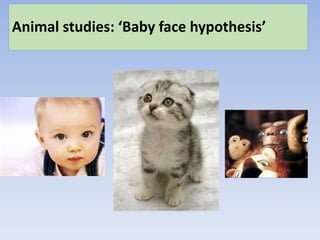
Animal studies: ‘Baby face hypothesis’
Animal studies: Lorenz
• Lorenz identified that birds appeared to make an
attachment to the first moving object that they
see.
• To test the hypothesis that birds make an
attachment to the first moving object that they
see Lorenz carried out an experiment.
• Read the textbook extract ‘Imprinting – Konrad
Lorenz and complete the key study table.
Evaluation: strengths
• Lorenz conducted a field experiment with an
independent groups design to test the
hypothesis that Goslings will follow the first
moving object that they see.
• I.V: Whether the goslings saw Lorenz or their
mother first.
• D.V: Who they imprinted on.
Evaluation: strengths
• It has high ecological validity because it is a
field experiment.
• The findings are reliable because the
experiment has been repeated with the
same results.
Evaluation: strengths
• The experiment was important in the development of
John Bowlby’s theory of attachment in humans.
• It influenced Bowlby’s idea of a critical period in babies
forming an attachment to a caregiver.
• It influenced Bowlby’s continuity hypothesis, the idea
that early attachment has an influence on adult
relationships.
Evaluation: limitations
• Lorenz only investigated attachment in one
species: geese.
• This means it’s not possible to generalise the
findings of this research to other animals
including humans.
• Other animals and humans may have very
different attachment processes.
Evaluation: limitations
• Konrad concluded that imprinting was permanent in
birds.
• Later research found that this was not true.
• Guiton (1966) found that chickens that imprinted on an
object and attempted to mate with that object as
adults learnt to mate with members of their own
species.
Lorenz: evalaution
• Use your notes and read p.12 to complete
the evaluation summary table.

Mod 6 lorenz

  • 1.
    Animal studies: Lorenz& Harlow • Animal studies of attachment: Lorenz & Harlow.
  • 2.
    Animal studies: Lorenz& Harlow • Many animals show attachment behaviour. • Animal studies have helped psychologists explain why humans make attachments. • Animal studies have also helped psychologists understand the effects of a lack of attachment bonds in early childhood on child development and adult behaviour.
  • 3.
  • 4.
    Animal studies: Lorenz •Ethology: the study of animal behaviour. • Konrad Lorenz was the first ethologist to identify and explain attachment in animals.
  • 5.
    Animal studies: Lorenz •Lorenz identified a fast and automatic process of attachment in animals. • This is called imprinting. • Imprinting is an innate process that causes an animal to make a very strong attachment to its biological parents or another member of its species because this is important for its survival.
  • 6.
    Animal studies: Lorenz •According to Lorenz attachment has evolved to help the survival of vulnerable offspring. • Attachment is hardwired. • All animals respond to visual and behavioural cues to take care of and protect their young. • These are called social releasers.
  • 7.
    Animal studies: ‘Babyface hypothesis’
  • 8.
    Animal studies: Lorenz •Lorenz identified that birds appeared to make an attachment to the first moving object that they see. • To test the hypothesis that birds make an attachment to the first moving object that they see Lorenz carried out an experiment. • Read the textbook extract ‘Imprinting – Konrad Lorenz and complete the key study table.
  • 9.
    Evaluation: strengths • Lorenzconducted a field experiment with an independent groups design to test the hypothesis that Goslings will follow the first moving object that they see. • I.V: Whether the goslings saw Lorenz or their mother first. • D.V: Who they imprinted on.
  • 10.
    Evaluation: strengths • Ithas high ecological validity because it is a field experiment. • The findings are reliable because the experiment has been repeated with the same results.
  • 11.
    Evaluation: strengths • Theexperiment was important in the development of John Bowlby’s theory of attachment in humans. • It influenced Bowlby’s idea of a critical period in babies forming an attachment to a caregiver. • It influenced Bowlby’s continuity hypothesis, the idea that early attachment has an influence on adult relationships.
  • 12.
    Evaluation: limitations • Lorenzonly investigated attachment in one species: geese. • This means it’s not possible to generalise the findings of this research to other animals including humans. • Other animals and humans may have very different attachment processes.
  • 13.
    Evaluation: limitations • Konradconcluded that imprinting was permanent in birds. • Later research found that this was not true. • Guiton (1966) found that chickens that imprinted on an object and attempted to mate with that object as adults learnt to mate with members of their own species.
  • 14.
    Lorenz: evalaution • Useyour notes and read p.12 to complete the evaluation summary table.