Caregiver – infant interactions
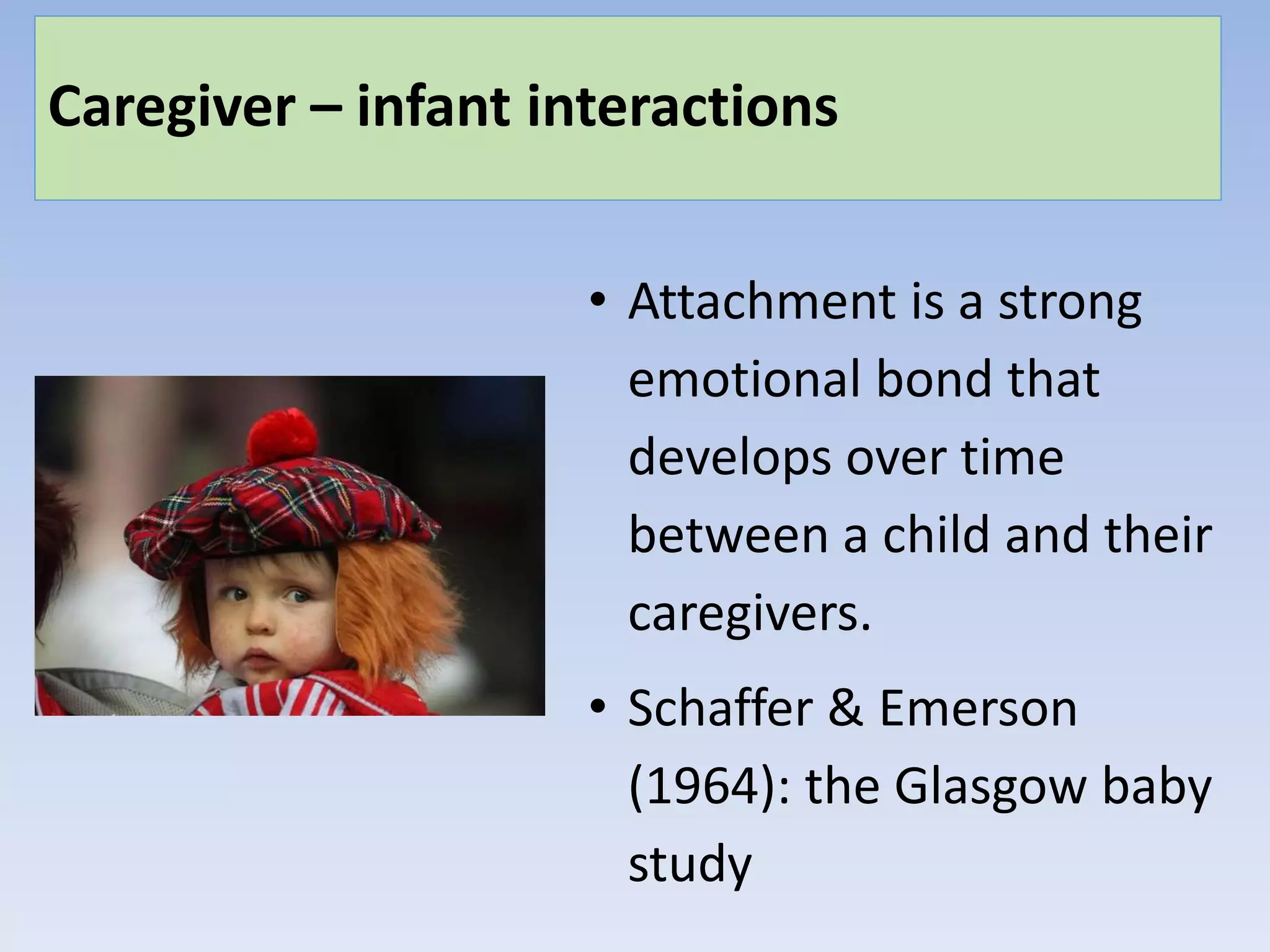
• Attachment is a strong
emotional bond that
develops over time
between a child and their
caregivers.
• Schaffer & Emerson
(1964): the Glasgow baby
study
Schaffer & Emerson: stages of attachment
• Schaffer & Emerson identified 4 stages in the
development of attachment:
• Stage 1: asocial stage 0 – 2 months
• Stage 2: indiscriminate attachment 2 – 7 months
• Stage 3: specific attachment 7 months onwards
• Stage 4: multiple attachments 7 months onwards
Schaffer & Emerson
• Schaffer & Emerson found that the first specific
attachment was usually made to the biological
mother.
• 65% of the babies in their sample made a
specific attachment to the biological mother.
• This person is called the primary attachment
figure.
Schaffer & Emerson
• Psychologists have been interested in identifying who
else a child makes an attachment to.
• These are called secondary attachment figures.
• The main secondary attachment figure is usually the
father.
• Schaffer & Emerson found that by 18 months 75% of
the babies in their sample had made a secondary
attachment to the biological father.
• This finding led to research on the role of the father in
the child’s development of attachments.
The role of the father
• Grossman (2002) conducted a longitudinal study that
found differences in the nature of the attachment
children made to fathers and mothers.
• They found that mothers became primary attachment
figure because they took physical and emotional care of
their children.
• They found that fathers became secondary attachment
figures because they played with their children.
• They concluded that fathers played a distinct role in the
development of attachment: play and stimulation.
The role of the father: evaluation
• Research has not identified clearly what the role of the
father is in the development of attachments.
• Some research has focussed on the role of the father
as the primary attachment figure.
• This research has found no difference in the role of the
father in attachment.
The role of the father: rvaluation
Other research has focussed on the role of the father as a
secondary attachment figure.
This research has found that the father does have a
different role to the mother.
This means psychologists are unable to state clearly what
the role of the father is in children’s development.
The role of the father: evaluation
• Some research has investigated if the father does have a
distinct role in children’s development.
• This research has focussed on children who grow up
without a father.
• This research has found no difference in children’s
development to the development of children in
conventional heterosexual two parent families.
• This suggests that the father does not have a specific role
in children’s development.
The role of the father
Read p.4 – 6 and complete the role of the
father summary table.

Mod 6 fathers

  • 1.
    Caregiver – infantinteractions • Attachment is a strong emotional bond that develops over time between a child and their caregivers. • Schaffer & Emerson (1964): the Glasgow baby study
  • 2.
    Schaffer & Emerson:stages of attachment • Schaffer & Emerson identified 4 stages in the development of attachment: • Stage 1: asocial stage 0 – 2 months • Stage 2: indiscriminate attachment 2 – 7 months • Stage 3: specific attachment 7 months onwards • Stage 4: multiple attachments 7 months onwards
  • 3.
    Schaffer & Emerson •Schaffer & Emerson found that the first specific attachment was usually made to the biological mother. • 65% of the babies in their sample made a specific attachment to the biological mother. • This person is called the primary attachment figure.
  • 4.
    Schaffer & Emerson •Psychologists have been interested in identifying who else a child makes an attachment to. • These are called secondary attachment figures. • The main secondary attachment figure is usually the father. • Schaffer & Emerson found that by 18 months 75% of the babies in their sample had made a secondary attachment to the biological father. • This finding led to research on the role of the father in the child’s development of attachments.
  • 5.
    The role ofthe father • Grossman (2002) conducted a longitudinal study that found differences in the nature of the attachment children made to fathers and mothers. • They found that mothers became primary attachment figure because they took physical and emotional care of their children. • They found that fathers became secondary attachment figures because they played with their children. • They concluded that fathers played a distinct role in the development of attachment: play and stimulation.
  • 6.
    The role ofthe father: evaluation • Research has not identified clearly what the role of the father is in the development of attachments. • Some research has focussed on the role of the father as the primary attachment figure. • This research has found no difference in the role of the father in attachment.
  • 7.
    The role ofthe father: rvaluation Other research has focussed on the role of the father as a secondary attachment figure. This research has found that the father does have a different role to the mother. This means psychologists are unable to state clearly what the role of the father is in children’s development.
  • 8.
    The role ofthe father: evaluation • Some research has investigated if the father does have a distinct role in children’s development. • This research has focussed on children who grow up without a father. • This research has found no difference in children’s development to the development of children in conventional heterosexual two parent families. • This suggests that the father does not have a specific role in children’s development.
  • 9.
    The role ofthe father Read p.4 – 6 and complete the role of the father summary table.