Cognitive Level of Analysis
Cognitive Processes
Principles of the CLA
• Cognitive psychology: concerning
the structure and functions of the
mind
• Find out how the human mind comes
to know things about the world and
how this knowledge is used
• Cognitive neuroscience: Combines
knowledge about the brain with
knowledge about cognitive processes
The Mind
• The mind = set of mental processes
that are carried out by the brain
• Cognitive processes:
– Perception
– Problem solving
– Thinking
– Memory
– Language
– Attention
• These processes = cognition
Cognition
• Cognition is based on one’s mental
representations of the world
– i.e. images, words, concepts
• People have different experiences
which culminate in different mental
representations
1st Principle
• Humans are information processors and
mental processes guide behavior
• CLA wants to discover possible principles
underlying cognitive processes
• The mind is like a complex machine
– Information is inputted (bottom-up
processing)
– Information is processed (top-down
processing)
– Behavior is outputted
Memories
• Memory is not infallible because of its
reconstructive nature
• Experiences are stored as outlines not
exact copies
• False memories occur because one
cannot distinguish between the actual
event and what they’ve heard after
– The mind can fabricate illusions that are so
realistic we think they are true
Perception
• Perception: Cognitive process that
interprets/organizes information
from the senses to produce some
meaningful experience of the world
• Context, frequency, and recency
influence how one percieves a
situation
2nd Principle
• The mind can be studied scientifically
– By developing theories
– Using a number of scientific research
methods
• Experimental method is the most
“scientific”, but sometimes they are
not accurate to daily life
• Now psychologists use both lab
studies and real-life studies
3rd Principle
• Cognitive processes are influenced
by social and cultural factors
– Frederic Bartlett pretty much came up
with this idea
• Schema: mental representation of
knowledge
• Schemas can influence the mind
– i.e. how cultural schemas influence
remembering
Frederic Bartlett
• How cultural schemas influence
remembering:
– People had trouble remembering a story
from another culture
– Reconstructed the story to fit the norms of
their own cultural schema
• Memory is not a tape recorder
– People remember it in ways that make
sense to them and their pre-existing
schemas
• Memory is subject to distortions
Studying the Mind
• Used to always use controlled experiments
– Pro: All variables can be controlled
– Con: Artificial
• Now they use other methods such as case
studies
• Nuero-imaging technology (i.e. fMRI, CAT)
– Allows researchers to see which brain areas
are active during certain activities
– See how brain damage affects cognitive
processes
Cognitive Processes
• Mental representations:
– How you view yourself (self-representation)
– How you view others
– Objects, ideas, people
• Used when we plan, imagine, daydream…
• Manipulations of these mental
representations allow us to think about
situations and imagine possible outcomes
– Mental representations are categorized
– Lots of mental representations stored in
memory
Cognitive Schemas
• Cognitive schemas: Pre-stored
mental representations
– Lead to expectations
• Mental representations are how we
store images and ideas in our
memories
– What we already know affects they way
we interpret events and store
knowledge in our memories
Schema Theory
• Schema Theory: cognitive theory about
information processing
• Cognitive schema: Networks of
knowledge, beliefs, and expectations
about particular aspects of the world
• Schemas can describe how specific
knowledge is organized and stored in
memory so that it can be accessed and
used when it is needed
Schema Theory
• Schema theory suggests that what we
already know will influence the outcome of
information processing
• Based on the assumption that humans are
active processors of information
• People don’t respond passively to information
– They interpret and integrate it to make sense of
their experiences
– (both consciously and unconsciously)
• Brain fills in blanks when info is missing with
info from schemas
– Can cause mistakes (distortions)
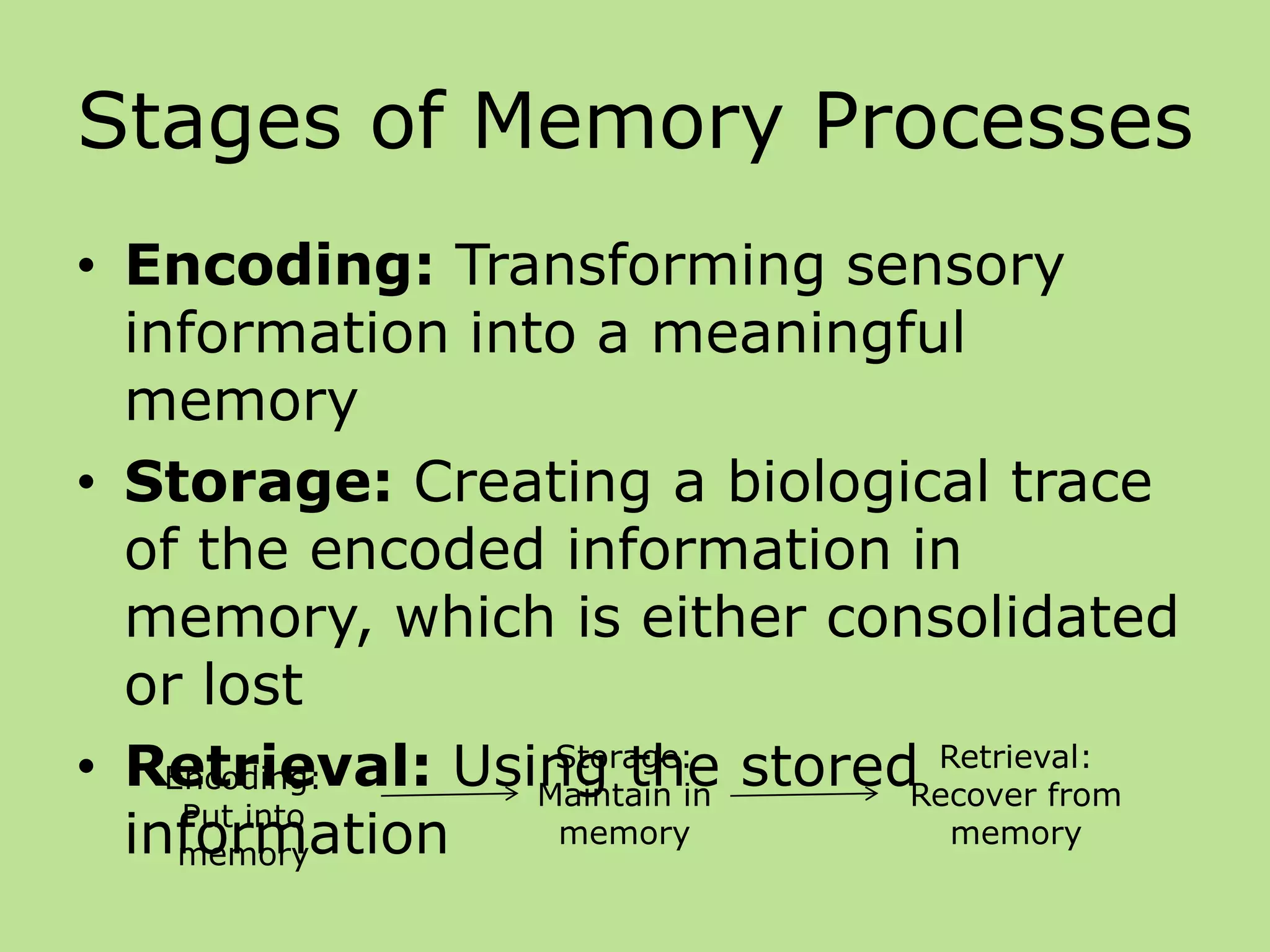
Stages of Memory Processes
• Encoding: Transforming sensory
information into a meaningful
memory
• Storage: Creating a biological trace
of the encoded information in
memory, which is either consolidated
or lost
• Retrieval: Using the stored
information
Encoding:
Put into
memory
Storage:
Maintain in
memory
Retrieval:
Recover from
memory
Anderson and Pichert
(1978)
• Aim: See if schema processing influences
encoding and retrieval
• Results: Schema processing must have some
effect at retrieval as well as at encoding because
the new schema could only have influenced recall
at the retrieval stage
– People encode information even when it is irrelevant to
previous schemas
• Pros: Variable control to establish cause-and-
effect
• Cons: Conducted in a lab (Low ecological validity)
Evolution of Schema Theory
• Theory is useful for understanding
how people categorize information,
interpret stories, make predictions,
etc.
• Helps us understand memory
distortions and social cognition
Limitations of Schema Theory
• Cohen (1993) says the concept of
schemas is too vague to be useful
• Not entirely clear how schemas are
acquired
• Not clear how schemas influence
cognitive processes
Multi-Store Memory Model
• Atkinson and Shiffrin (1968)
• Model is based on two assumptions:
– Memory consists of a number of
separate stores
– Memory processes are sequential
• The memory stores operate in
conjunction with the permanent
memory store
Memory Stores
• Need attention, coding, and
rehearsal for memory
• Attention because you need to pay
attention to remember (obviously)
• Coding to give the information a
memorable form
• Rehearsal to keep the information
active in memory until it can be
stored
Memory Stores
• Sensory memory store is modality
specific
– Hearing info has its own location, visual
info has its own location, etc…
• Info stays in these stores for a few
seconds
• Only a small portion continue into
short-term memory store (STM)
Short-Term Memory
• Capacity is limited to approx 7 items
• Lasts about 6-12 seconds
• Material is quickly lost if not given
attention
• Rehearsal plays a key role in
determining what is stored in long-
term memory store
Long-Term Memory
• Vast storehouse of information
• Indefinite duration, potentially
unlimited capacity
• Memories are not perfect; stored in
outlines which can lead to errors
– We fill in the gaps of these outlines
Multi-Store Model
• This is an outdated model
• Very simplistic
• Shows the amount of
knowledge available in the
1960s
Working Memory Model
• This is a newer, more complex
model for memory
• Baddeley and Hitch (1974) based it
on the multi-store model
• Challenged the view that Short-Term
Memory is one single storage unit
– This model includes many components
for STM
The Central Executive
• Controlling system that
monitors/coordinates the other
components
– These other components are called
slave systems (cute, huh?)
• Central executive has limited
capacity and can process info from
any of the senses
Attentional Control
• Most important job of Central Executive
• Two ways for attentional control:
– Automatic level: based on habit and is more
or less controlled by the environment
• i.e. routine procedures like riding your bike to school
– Supervisory attentional level: Creates new
strategies when the old ones are insufficient
• i.e. while you’re riding your bike to school, a car
suddenly comes at you
• People rely on automatic processing in
daily lives a lot!
The Episodic Buffer
• How information appears when we
consciously try to recall the details of a
landscape or the sound of a song
• The buffer acts as a temporary and
passive display store until the info is
needed
– Like a television screen
The Phonological Loop
• Two components:
– Articulatory control system
• AKA the inner voice
• Holds information in verbal form
• Holds words ready as you prepare to speak
– Phonological store
• AKA the inner ear
• Holds speech-based material in a phonological form
• Receives information from:
– Aensory memory in the form of auditory material
– LTM in the form of verbal information
– Articulatory control system
The visuospatial sketchpad
• The Inner Eye
• Deals with visual and spatial
information
• Receives information from:
– Sensory memory
– LTM
Evidence of Working Memory
Model
• Dual-task techniques (AKA interference
tasks)
• i.e. telling a story while learning a list of numbers
• Participant carries out a cognitive task
that uses most of the capacity of working
memory
• At the same time performs a second
cognitive task
• If the two tasks interfere and impair one
another, then both tasks are from the
same component in STM
Baddeley and Hitch (1974)
• Asked participants to read prose and
understand it while also remembering
sequences of numbers
• Took more time to reason
• There was impairment, but it was not
catastrophic
• Concluded that STM has more than one
unitary store
• Needs more stress than that to break
down the STM!
Evaluation of the Model
• It includes active storage and processing
– Makes it useful for understanding all sorts of
cognitive tasks
• i.e. reading comprehension and mental arithmetic
• Assumes that mental processes are
passive
• Can explain why people are able to
perform different cognitive tasks at the
same time w/o disruption
– AKA Multi-tasking!
Working Memory Test Battery
for Children
• Pickering and Gathercole (2001)
• There is an improvement in performance
in working memory capacity from the age
of 5 years until about 15 years
• Their work provides evidence that
problems with working memory are
associated with problems in academic
performance
– i.e. issues with phonological loop = issues in
math and reading
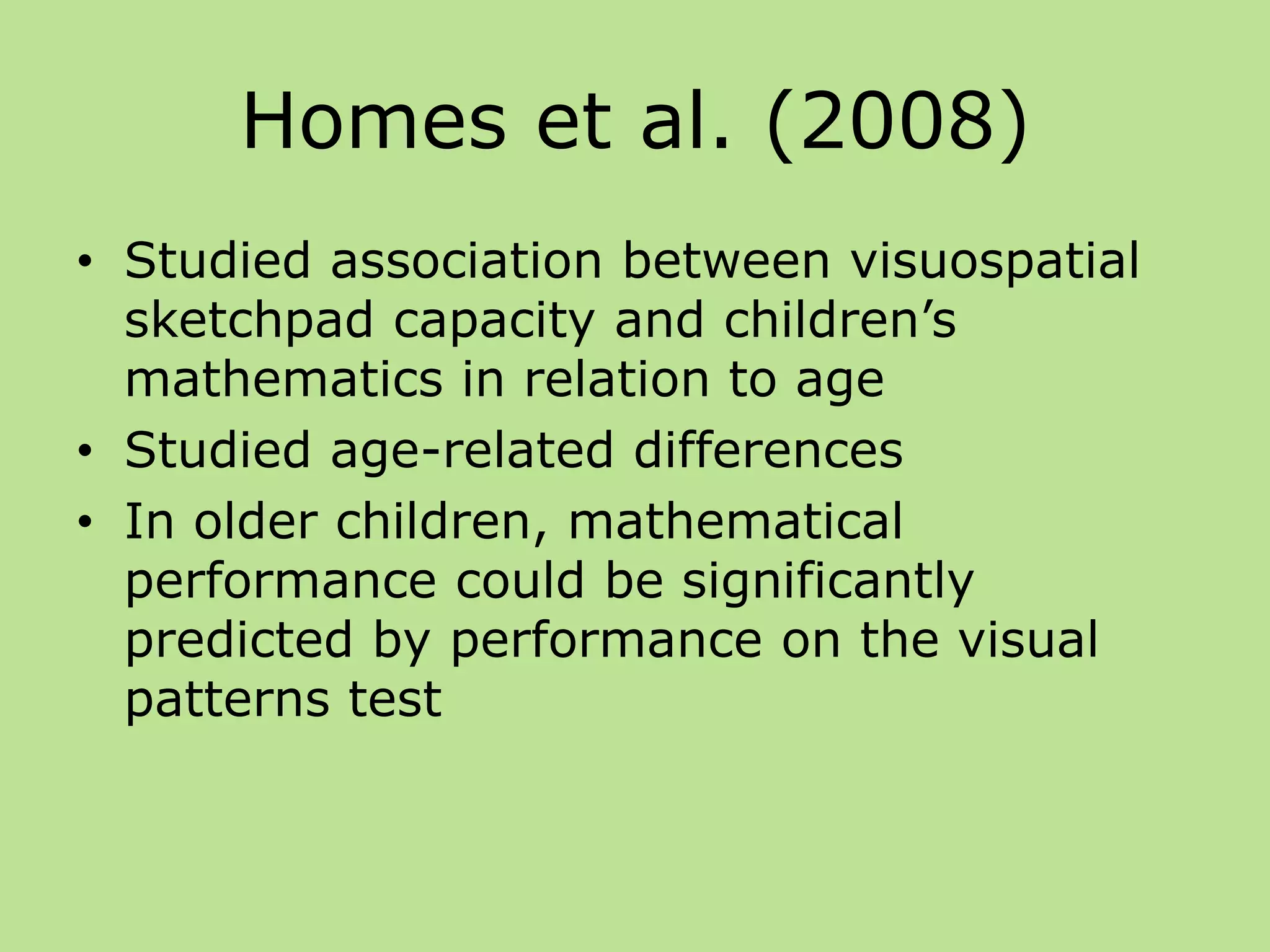
Homes et al. (2008)
• Studied association between visuospatial
sketchpad capacity and children’s
mathematics in relation to age
• Studied age-related differences
• In older children, mathematical
performance could be significantly
predicted by performance on the visual
patterns test
Biology in Memory
• Learning means formation of a memory
(forming neural networks)
• Lesioning (AKA WORST THING EVER):
Cutting away brain tissue to see how
much needs to be removed before an
animal can no longer carry out a task it
has learned
• We study people with brain damage to
observe the same thing
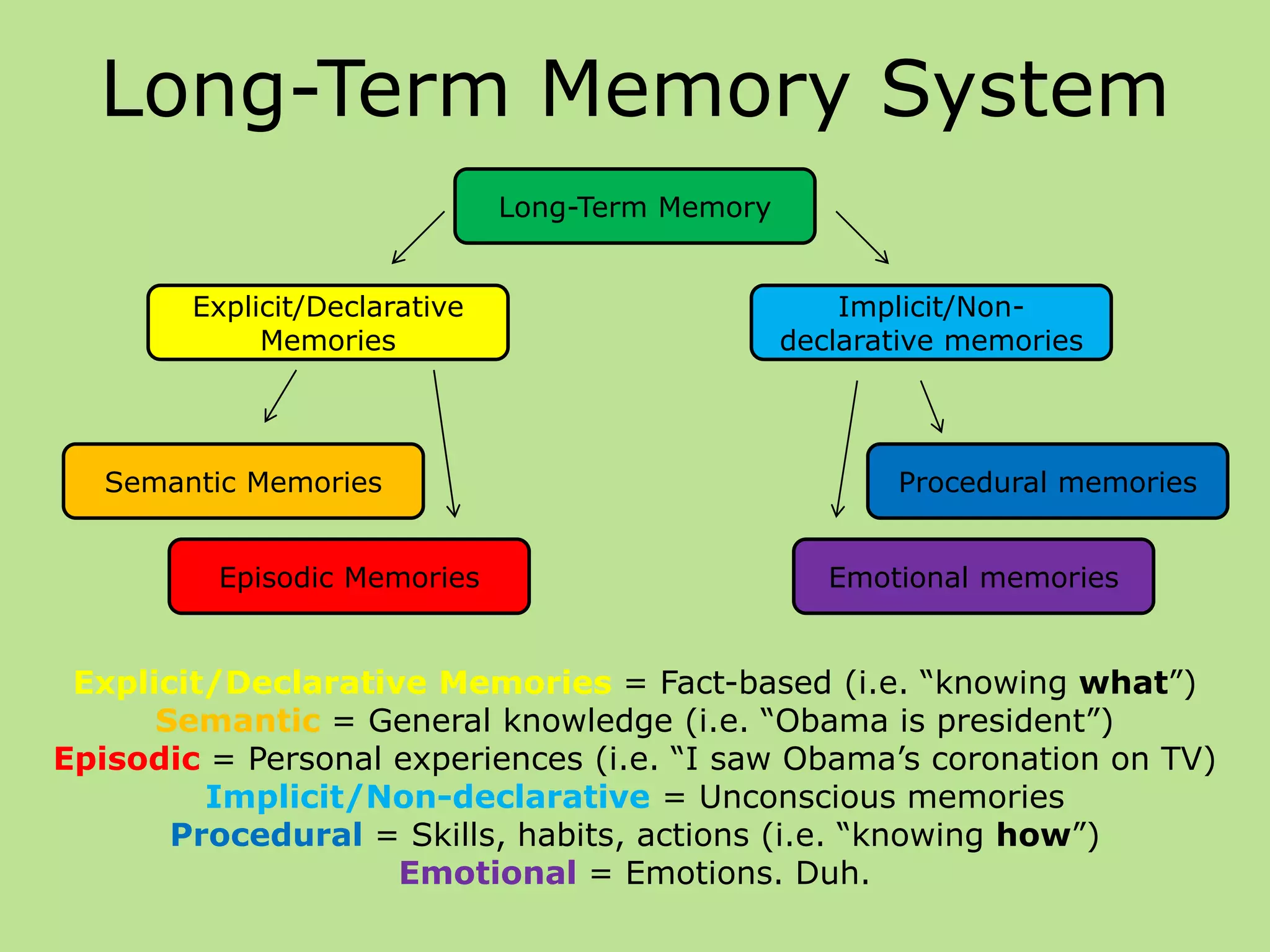
Long-Term Memory System
Long-Term Memory
Explicit/Declarative
Memories
Implicit/Non-
declarative memories
Semantic Memories
Episodic Memories
Procedural memories
Emotional memories
Explicit/Declarative Memories = Fact-based (i.e. “knowing what”)
Semantic = General knowledge (i.e. “Obama is president”)
Episodic = Personal experiences (i.e. “I saw Obama’s coronation on TV)
Implicit/Non-declarative = Unconscious memories
Procedural = Skills, habits, actions (i.e. “knowing how”)
Emotional = Emotions. Duh.
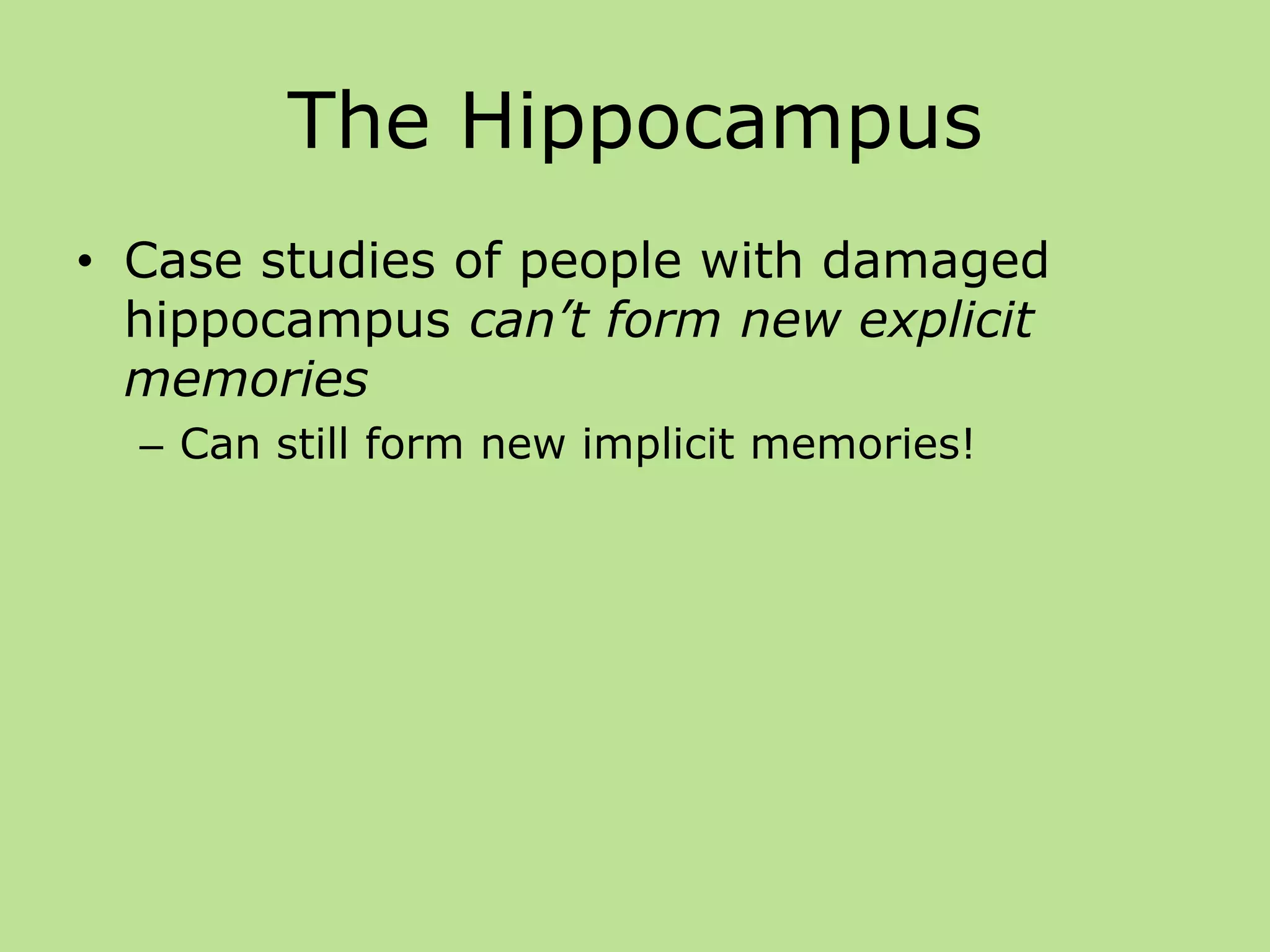
The Hippocampus
• Case studies of people with damaged
hippocampus can’t form new explicit
memories
– Can still form new implicit memories!
The Amygdala
• Plays a role in storage of emotional
memories
• Not much is known about emotional
memories
• Emotional memories are remembered
better (especially for poor PTSD sufferers)
• When part of the pre-frontal cortex is
damaged:
– Emotional memory is hard to eliminate
– Hard to control emotional outbursts
Clive Wearing
• Suffers from the most extensive amnesia ever
seen
– Both anterograde and retrograde amnesia
– Damage to hippocampus and some frontal regions
– Episodic memory and some semantic memory are lost
– Cannot transfer new info into LTM either
• Can still play piano and conduct music he
knew before his illness (part of his implicit
memory)
– Implicit memory must be in a brain structure other than
hippocampus
– Emotional memory is intact (still loves his wife!)
Milner and Scoville (1957)
• Case Study of HM
• Tissue removed from temporal lobe including
hippocampus to relieve epileptic siezures
• HM could recall information, but could not
form new memories
– Could carry out a conversation
– Unable to remember faces of the people he meets
• Damage to hippocampus, amygadala, and
other close areas
Cultural Factors in Cognition
• Different challenges around the
world = different developments of
cognitive abilities needed to survive
• Jerome Bruner says children of any
culture learn the basics of culture
from school and daily interactions
(i.e. parents, friends, teachers,
siblings, grandparents)
Cole and Scribner (1974)
• Investigate memory strategies in different
cultures
• The non-schooled children did not improve
their performance on free-recall tasks after
age 10
• Recalled 10 items first time; after 15 practice
trials only recalled 2 more
• Illiterate children did not use chunking
method (grouping bits of info in larger main
group)
• Presenting information in a narrative allowed
children to chunk/recall info
Memory
• Ability to remember is universal, but
strategies for remembering are not!
• People learn to remember in ways that are
relevant for their daily lives
• These methods do not always mirror the
activities that cognitive psychologists use
to study their intelligence and mental
processes
Reliability of Memory
• Memory isn’t super reliable because
of its reconstructive nature
– Brain actively processes information to
make sense of it
• However, we use memory like
eyewitness accounts to determine
people’s fate/guilt!
Recovered Memories
• Sigmund Freud thought people
forgot memories with repression
• Thought that people use defense
mechanisms (like repression) to save
their conscious self from things they
cannot cope with
– Send dangerous memories to the
unconscious and repress/deny them
Recovered Memories
• Aim of therapy is to gain access to the
unconscious
• False Memory Sundrome Foundation
supports families who’ve been shattered
by accusations of childhood abuse after
their children have gone through therapy
• Some of these recovered memories are
false! It is possible to manipulate people’s
memories
– False memories created by post-event
information
Empirical testing of Reliability
• Frederic Bartlett argued memory is
reconstructive and schemas influence
recall
– Demonstrated role of culture in schema
processing
• Serial reproduction: One person tells a
story, then another retells it, then another,
etc…
– Found people reconstruct the past by trying to
fit it into existing schemas
– More complicated the story = more likely to
have distorted/forgotten elements
Empirical Testing of Reliability
• Efforts after meaning: people try
to find a familiar pattern in
experiences
• Memory is an imaginative
reconstruction of experience
Reliability of Eyewitness Testimony
• Loftus claims the nature of questions can
influence witnesses’ memory
• Suggestive questions and post-event
information can cause schema processing
which affects accuracy
– Use of different verbs used to ask about car crash
(smashed/hit/contacted) caused witnesses to
change their view of the cars’ speed
(40.8/34.0/31.8)
• Different words = different perception of
consequences as well
– i.e. Was there broken glass?
Reliability of Eyewitness Testimony
• It is possible to create a false memory
using post-event information
• Memory is not reliable
• Issues with Loftus’s study:
– Ecological validity (it was in a lab)
– Closed questions (only yes or no answers)
– Culturally biased (only US students)
– Not everyone is good at estimating speed!
Might not have to do with leading questions at
all!
Yuille and Cutshall (1986)
• Real life robbery; testing witnesses with
suggestive questions like Lofte
• No distortion on memory
– Memory for details in this situation was
amazing!
– Particularly for those close to the event
• Wording of questions had no effect on
recall
• Those who were most distressed had
the most accurate memories
Use of Modern Technology to
Investigate Cognition & Behavior
• New technology allows us to
understand the relationship between
cognitive processes and behavior
• Technology such as:
– PET scan (Positron emission
tomography)
– MRI scan (magnetic resonance imaging)
PET Scan
• Measures important functions in the
brain like glucose consumption and
blood flow
• Can detect Alzheimer’s disease very
early on
MRI Scan
• 3D picture of brain structures
• Detect changes of oxygen in blood
– When brain areas are active, they have
more oxygen in the blood
• Therefore, we can see what areas
are active when people are
reading/problem solving/etc

Cognitive Level of Analysis: Cognitive Processes

  • 1.
    Cognitive Level ofAnalysis Cognitive Processes
  • 2.
    Principles of theCLA • Cognitive psychology: concerning the structure and functions of the mind • Find out how the human mind comes to know things about the world and how this knowledge is used • Cognitive neuroscience: Combines knowledge about the brain with knowledge about cognitive processes
  • 3.
    The Mind • Themind = set of mental processes that are carried out by the brain • Cognitive processes: – Perception – Problem solving – Thinking – Memory – Language – Attention • These processes = cognition
  • 4.
    Cognition • Cognition isbased on one’s mental representations of the world – i.e. images, words, concepts • People have different experiences which culminate in different mental representations
  • 5.
    1st Principle • Humansare information processors and mental processes guide behavior • CLA wants to discover possible principles underlying cognitive processes • The mind is like a complex machine – Information is inputted (bottom-up processing) – Information is processed (top-down processing) – Behavior is outputted
  • 6.
    Memories • Memory isnot infallible because of its reconstructive nature • Experiences are stored as outlines not exact copies • False memories occur because one cannot distinguish between the actual event and what they’ve heard after – The mind can fabricate illusions that are so realistic we think they are true
  • 7.
    Perception • Perception: Cognitiveprocess that interprets/organizes information from the senses to produce some meaningful experience of the world • Context, frequency, and recency influence how one percieves a situation
  • 8.
    2nd Principle • Themind can be studied scientifically – By developing theories – Using a number of scientific research methods • Experimental method is the most “scientific”, but sometimes they are not accurate to daily life • Now psychologists use both lab studies and real-life studies
  • 9.
    3rd Principle • Cognitiveprocesses are influenced by social and cultural factors – Frederic Bartlett pretty much came up with this idea • Schema: mental representation of knowledge • Schemas can influence the mind – i.e. how cultural schemas influence remembering
  • 10.
    Frederic Bartlett • Howcultural schemas influence remembering: – People had trouble remembering a story from another culture – Reconstructed the story to fit the norms of their own cultural schema • Memory is not a tape recorder – People remember it in ways that make sense to them and their pre-existing schemas • Memory is subject to distortions
  • 11.
    Studying the Mind •Used to always use controlled experiments – Pro: All variables can be controlled – Con: Artificial • Now they use other methods such as case studies • Nuero-imaging technology (i.e. fMRI, CAT) – Allows researchers to see which brain areas are active during certain activities – See how brain damage affects cognitive processes
  • 12.
    Cognitive Processes • Mentalrepresentations: – How you view yourself (self-representation) – How you view others – Objects, ideas, people • Used when we plan, imagine, daydream… • Manipulations of these mental representations allow us to think about situations and imagine possible outcomes – Mental representations are categorized – Lots of mental representations stored in memory
  • 13.
    Cognitive Schemas • Cognitiveschemas: Pre-stored mental representations – Lead to expectations • Mental representations are how we store images and ideas in our memories – What we already know affects they way we interpret events and store knowledge in our memories
  • 14.
    Schema Theory • SchemaTheory: cognitive theory about information processing • Cognitive schema: Networks of knowledge, beliefs, and expectations about particular aspects of the world • Schemas can describe how specific knowledge is organized and stored in memory so that it can be accessed and used when it is needed
  • 15.
    Schema Theory • Schematheory suggests that what we already know will influence the outcome of information processing • Based on the assumption that humans are active processors of information • People don’t respond passively to information – They interpret and integrate it to make sense of their experiences – (both consciously and unconsciously) • Brain fills in blanks when info is missing with info from schemas – Can cause mistakes (distortions)
  • 16.
    Stages of MemoryProcesses • Encoding: Transforming sensory information into a meaningful memory • Storage: Creating a biological trace of the encoded information in memory, which is either consolidated or lost • Retrieval: Using the stored information Encoding: Put into memory Storage: Maintain in memory Retrieval: Recover from memory
  • 17.
    Anderson and Pichert (1978) •Aim: See if schema processing influences encoding and retrieval • Results: Schema processing must have some effect at retrieval as well as at encoding because the new schema could only have influenced recall at the retrieval stage – People encode information even when it is irrelevant to previous schemas • Pros: Variable control to establish cause-and- effect • Cons: Conducted in a lab (Low ecological validity)
  • 18.
    Evolution of SchemaTheory • Theory is useful for understanding how people categorize information, interpret stories, make predictions, etc. • Helps us understand memory distortions and social cognition
  • 19.
    Limitations of SchemaTheory • Cohen (1993) says the concept of schemas is too vague to be useful • Not entirely clear how schemas are acquired • Not clear how schemas influence cognitive processes
  • 20.
    Multi-Store Memory Model •Atkinson and Shiffrin (1968) • Model is based on two assumptions: – Memory consists of a number of separate stores – Memory processes are sequential • The memory stores operate in conjunction with the permanent memory store
  • 21.
    Memory Stores • Needattention, coding, and rehearsal for memory • Attention because you need to pay attention to remember (obviously) • Coding to give the information a memorable form • Rehearsal to keep the information active in memory until it can be stored
  • 22.
    Memory Stores • Sensorymemory store is modality specific – Hearing info has its own location, visual info has its own location, etc… • Info stays in these stores for a few seconds • Only a small portion continue into short-term memory store (STM)
  • 23.
    Short-Term Memory • Capacityis limited to approx 7 items • Lasts about 6-12 seconds • Material is quickly lost if not given attention • Rehearsal plays a key role in determining what is stored in long- term memory store
  • 24.
    Long-Term Memory • Vaststorehouse of information • Indefinite duration, potentially unlimited capacity • Memories are not perfect; stored in outlines which can lead to errors – We fill in the gaps of these outlines
  • 25.
    Multi-Store Model • Thisis an outdated model • Very simplistic • Shows the amount of knowledge available in the 1960s
  • 26.
    Working Memory Model •This is a newer, more complex model for memory • Baddeley and Hitch (1974) based it on the multi-store model • Challenged the view that Short-Term Memory is one single storage unit – This model includes many components for STM
  • 27.
    The Central Executive •Controlling system that monitors/coordinates the other components – These other components are called slave systems (cute, huh?) • Central executive has limited capacity and can process info from any of the senses
  • 28.
    Attentional Control • Mostimportant job of Central Executive • Two ways for attentional control: – Automatic level: based on habit and is more or less controlled by the environment • i.e. routine procedures like riding your bike to school – Supervisory attentional level: Creates new strategies when the old ones are insufficient • i.e. while you’re riding your bike to school, a car suddenly comes at you • People rely on automatic processing in daily lives a lot!
  • 29.
    The Episodic Buffer •How information appears when we consciously try to recall the details of a landscape or the sound of a song • The buffer acts as a temporary and passive display store until the info is needed – Like a television screen
  • 30.
    The Phonological Loop •Two components: – Articulatory control system • AKA the inner voice • Holds information in verbal form • Holds words ready as you prepare to speak – Phonological store • AKA the inner ear • Holds speech-based material in a phonological form • Receives information from: – Aensory memory in the form of auditory material – LTM in the form of verbal information – Articulatory control system
  • 31.
    The visuospatial sketchpad •The Inner Eye • Deals with visual and spatial information • Receives information from: – Sensory memory – LTM
  • 32.
    Evidence of WorkingMemory Model • Dual-task techniques (AKA interference tasks) • i.e. telling a story while learning a list of numbers • Participant carries out a cognitive task that uses most of the capacity of working memory • At the same time performs a second cognitive task • If the two tasks interfere and impair one another, then both tasks are from the same component in STM
  • 33.
    Baddeley and Hitch(1974) • Asked participants to read prose and understand it while also remembering sequences of numbers • Took more time to reason • There was impairment, but it was not catastrophic • Concluded that STM has more than one unitary store • Needs more stress than that to break down the STM!
  • 34.
    Evaluation of theModel • It includes active storage and processing – Makes it useful for understanding all sorts of cognitive tasks • i.e. reading comprehension and mental arithmetic • Assumes that mental processes are passive • Can explain why people are able to perform different cognitive tasks at the same time w/o disruption – AKA Multi-tasking!
  • 35.
    Working Memory TestBattery for Children • Pickering and Gathercole (2001) • There is an improvement in performance in working memory capacity from the age of 5 years until about 15 years • Their work provides evidence that problems with working memory are associated with problems in academic performance – i.e. issues with phonological loop = issues in math and reading
  • 36.
    Homes et al.(2008) • Studied association between visuospatial sketchpad capacity and children’s mathematics in relation to age • Studied age-related differences • In older children, mathematical performance could be significantly predicted by performance on the visual patterns test
  • 37.
    Biology in Memory •Learning means formation of a memory (forming neural networks) • Lesioning (AKA WORST THING EVER): Cutting away brain tissue to see how much needs to be removed before an animal can no longer carry out a task it has learned • We study people with brain damage to observe the same thing
  • 38.
    Long-Term Memory System Long-TermMemory Explicit/Declarative Memories Implicit/Non- declarative memories Semantic Memories Episodic Memories Procedural memories Emotional memories Explicit/Declarative Memories = Fact-based (i.e. “knowing what”) Semantic = General knowledge (i.e. “Obama is president”) Episodic = Personal experiences (i.e. “I saw Obama’s coronation on TV) Implicit/Non-declarative = Unconscious memories Procedural = Skills, habits, actions (i.e. “knowing how”) Emotional = Emotions. Duh.
  • 39.
    The Hippocampus • Casestudies of people with damaged hippocampus can’t form new explicit memories – Can still form new implicit memories!
  • 40.
    The Amygdala • Playsa role in storage of emotional memories • Not much is known about emotional memories • Emotional memories are remembered better (especially for poor PTSD sufferers) • When part of the pre-frontal cortex is damaged: – Emotional memory is hard to eliminate – Hard to control emotional outbursts
  • 41.
    Clive Wearing • Suffersfrom the most extensive amnesia ever seen – Both anterograde and retrograde amnesia – Damage to hippocampus and some frontal regions – Episodic memory and some semantic memory are lost – Cannot transfer new info into LTM either • Can still play piano and conduct music he knew before his illness (part of his implicit memory) – Implicit memory must be in a brain structure other than hippocampus – Emotional memory is intact (still loves his wife!)
  • 42.
    Milner and Scoville(1957) • Case Study of HM • Tissue removed from temporal lobe including hippocampus to relieve epileptic siezures • HM could recall information, but could not form new memories – Could carry out a conversation – Unable to remember faces of the people he meets • Damage to hippocampus, amygadala, and other close areas
  • 43.
    Cultural Factors inCognition • Different challenges around the world = different developments of cognitive abilities needed to survive • Jerome Bruner says children of any culture learn the basics of culture from school and daily interactions (i.e. parents, friends, teachers, siblings, grandparents)
  • 44.
    Cole and Scribner(1974) • Investigate memory strategies in different cultures • The non-schooled children did not improve their performance on free-recall tasks after age 10 • Recalled 10 items first time; after 15 practice trials only recalled 2 more • Illiterate children did not use chunking method (grouping bits of info in larger main group) • Presenting information in a narrative allowed children to chunk/recall info
  • 45.
    Memory • Ability toremember is universal, but strategies for remembering are not! • People learn to remember in ways that are relevant for their daily lives • These methods do not always mirror the activities that cognitive psychologists use to study their intelligence and mental processes
  • 46.
    Reliability of Memory •Memory isn’t super reliable because of its reconstructive nature – Brain actively processes information to make sense of it • However, we use memory like eyewitness accounts to determine people’s fate/guilt!
  • 47.
    Recovered Memories • SigmundFreud thought people forgot memories with repression • Thought that people use defense mechanisms (like repression) to save their conscious self from things they cannot cope with – Send dangerous memories to the unconscious and repress/deny them
  • 48.
    Recovered Memories • Aimof therapy is to gain access to the unconscious • False Memory Sundrome Foundation supports families who’ve been shattered by accusations of childhood abuse after their children have gone through therapy • Some of these recovered memories are false! It is possible to manipulate people’s memories – False memories created by post-event information
  • 49.
    Empirical testing ofReliability • Frederic Bartlett argued memory is reconstructive and schemas influence recall – Demonstrated role of culture in schema processing • Serial reproduction: One person tells a story, then another retells it, then another, etc… – Found people reconstruct the past by trying to fit it into existing schemas – More complicated the story = more likely to have distorted/forgotten elements
  • 50.
    Empirical Testing ofReliability • Efforts after meaning: people try to find a familiar pattern in experiences • Memory is an imaginative reconstruction of experience
  • 51.
    Reliability of EyewitnessTestimony • Loftus claims the nature of questions can influence witnesses’ memory • Suggestive questions and post-event information can cause schema processing which affects accuracy – Use of different verbs used to ask about car crash (smashed/hit/contacted) caused witnesses to change their view of the cars’ speed (40.8/34.0/31.8) • Different words = different perception of consequences as well – i.e. Was there broken glass?
  • 52.
    Reliability of EyewitnessTestimony • It is possible to create a false memory using post-event information • Memory is not reliable • Issues with Loftus’s study: – Ecological validity (it was in a lab) – Closed questions (only yes or no answers) – Culturally biased (only US students) – Not everyone is good at estimating speed! Might not have to do with leading questions at all!
  • 53.
    Yuille and Cutshall(1986) • Real life robbery; testing witnesses with suggestive questions like Lofte • No distortion on memory – Memory for details in this situation was amazing! – Particularly for those close to the event • Wording of questions had no effect on recall • Those who were most distressed had the most accurate memories
  • 54.
    Use of ModernTechnology to Investigate Cognition & Behavior • New technology allows us to understand the relationship between cognitive processes and behavior • Technology such as: – PET scan (Positron emission tomography) – MRI scan (magnetic resonance imaging)
  • 55.
    PET Scan • Measuresimportant functions in the brain like glucose consumption and blood flow • Can detect Alzheimer’s disease very early on
  • 56.
    MRI Scan • 3Dpicture of brain structures • Detect changes of oxygen in blood – When brain areas are active, they have more oxygen in the blood • Therefore, we can see what areas are active when people are reading/problem solving/etc