Postmodernism
    (in a nutshell)


Dr. John Bradford
Notes on Terminology
•   Very few of authors regarded as ‘Postmodern’
    consider themselves postmodernists!
•   Most intellectuals considered ‘Postmodern’ are
    French (or French Canadian)
•   ‘Postmodern’ is often used as a term of derision
    (especially by neo-Marxists and conservatives)
•   ‘Post-modernism’ is often used interchangeably
    with ‘Post-structuralism’ although these mean
    different things in different fields.
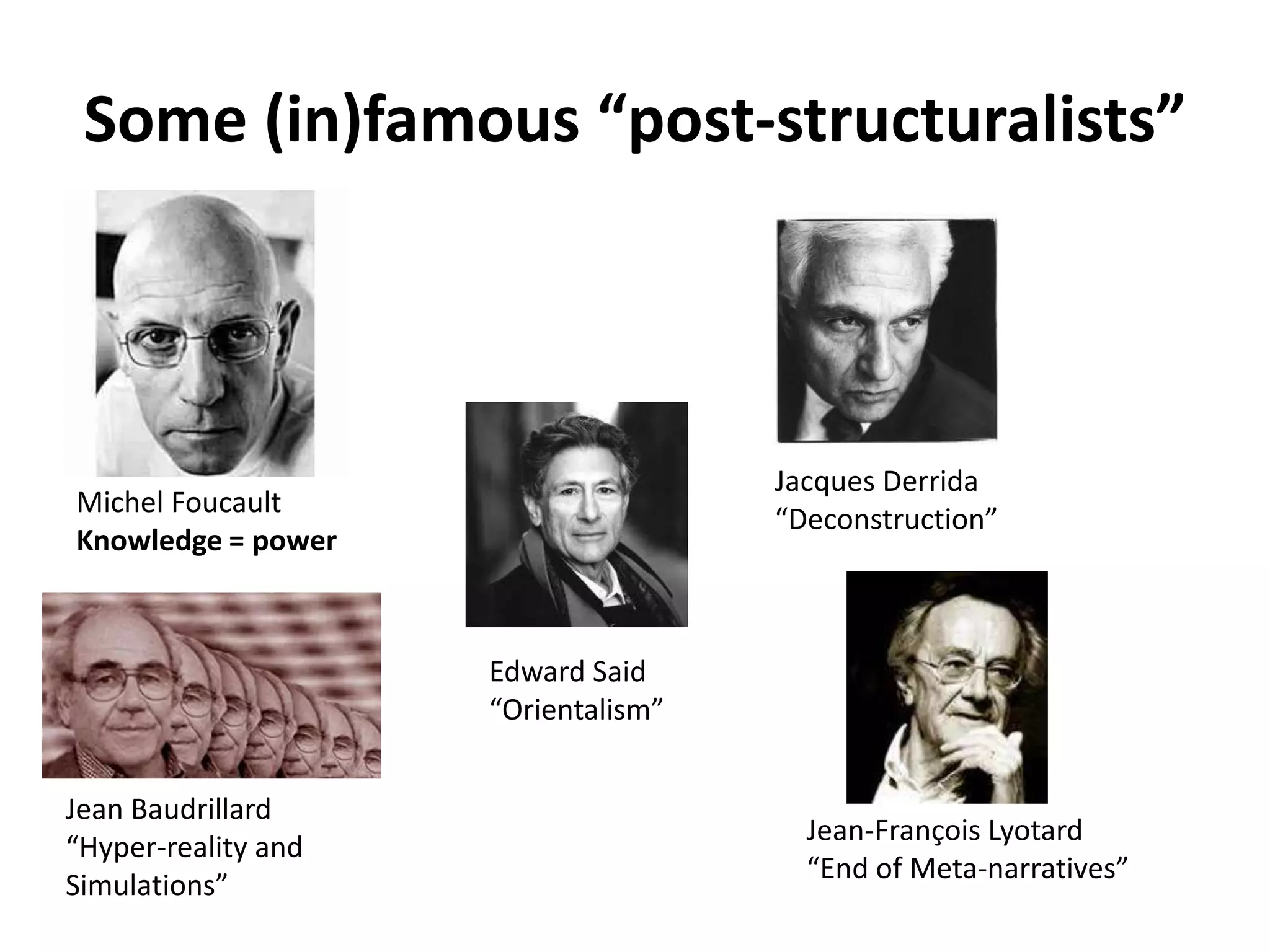
Some (in)famous “post-structuralists”


                                     Jacques Derrida
Michel Foucault
                                     “Deconstruction”
Knowledge = power


                     Edward Said
                     “Orientalism”


Jean Baudrillard
                                       Jean-François Lyotard
“Hyper-reality and
                                       “End of Meta-narratives”
Simulations”
Postmodernism: within or beyond
           Modernity?
1. Opponents of ‘postmodernism’: We still live in
   the same old, modern society. These people use
   the term “postmodernism” to refer to a cultural
   reaction within modern societies, e.g. a sense
   of disillusionment.
2. ‘Postmodernists’: Even though they don’t call
   themselves ‘Postmodernists’, these authors
   argue (or are understood as arguing) that we
   have entered a new era beyond modernity.
Postmodern buzz-words and slogans
 – Opposition to universals,      • Opposes essentialism,
   ‘meta-narratives’, and           binaries and binary
   generality; critical of the
                                    thinking, the ‘subject’,
   Enlightenment.
                                    Western meta-narratives,
 – History isn’t progress
 – There is no ‘Truth’ (or        • Supports sub-altern
   Truth has no                     peoples, marginalized,
   ‘foundations’)                   identities, ‘the Other’.
 – People (‘subjects’ or
   ‘subjectivity’) are products
   of power, and power is
   everywhere [Foucault]
“The Masters of Suspicion”
•   Three intellectual figures can be regarded as
    the three most important progenitors
    (originators) of Postmodern thinking:
•   Marx, Nietzsche, and Freud (although Marx is
    considered a modernist)
C Wright Mills
       • Postmodernism as
         “fourth Epoch”
          – Our ways of thinking are
            inherited from a world that
            no longer exists.
       • Rationality has not lead
         to increased freedom
         -The Idea of Reason and Freedom
         are of no practical significance
         anymore.
         -Freedom cannot exist without
         reason
C Wright Mills
    • Note: Mills is generally not
      considered a ‘postmodernist’
      despite the fact that he was
      the first sociologist to use the
      term! He argued that we had
      entered a postmodern age.
    • Foucault and Baudrillard,
      however, are regarded as
      ‘Postmodernist’ but didn’t use
      the term!
Are we becoming “Cheerful Robots?”
Michel Foucault Power/Knowledge
Power/Knowledge
1. Knowledge is always made possible by a “will to
   power” (Nietzsche’s term). Knowledge is a form of
   power.
   – Foucault adopts Nietzsche’s radical perspectivalism.
2. The individual is an effect of power.
   – Focuses on how our bodies and emotions are shaped by
     power.
3. The enlightenment was not emancipatory.
  –   Merely another apparatus of power/knowledge. There
      was no “progress”.
Power/Knowledge
• Basic Idea: Truth is produced by power.
• What counts as knowledge differs across societies
  and across time. Foucault argues that the idea of
  progress is illusory: knowledge does not make one
  free.
• Each society has its own ‘truth discourse’ (e.g.
  religion, science, etc.) which presupposes some
  social power relationships. What we think of as
  Western ‘progress’ is really just another form of
  domination and control. We replace one experience
  of reality with another…
Power/Knowledge
• This is similar to the adage that “Knowledge is power”, but this
  usually just means that we can acquire personal power if we study a
  lot or if we are ‘in the know’. For Foucault, the identity of power
  and knowledge also contains an epistemological (philosophical)
  meaning, in the sense that what counts as knowledge always
  depends on social relations.
• In other words, he brackets or suspends the question of the Truth
  of knowledge, and instead examines its pragmatic effects. Because
  knowledge is always produced and communicated socially, he looks
  at the social correlates of knowledge, the social causes and
  consequences of different forms of knowledge, its social (i.e.
  institutional, organizational, relational) preconditions and effects.
  In short, everything is (reduced to) power! Unlike Habermas and
  Chomsky, Foucault does not believe in a universal Truth, Human
  Nature, or Justice.
Power/Knowledge
• Foucault is suggesting that power is not a tool
  that individuals or groups of people use;
  rather we are the tools of power. In
  Foucault’s analysis, power becomes the
  subject or agent of history. You may be not far
  off to say that he anthropomorphizes power.
• For Foucault, there is no outside to power.
  We cannot escape it. We are always
  embedded in the web of power relations.
Power/Knowledge
• How to Study Power:
  1. Focus on ‘capillaries’ of power; power at its end-
     points, rather than at its centers; less focus on legal
     power
  2. Power is not always conscious or intended; do not
     ask ‘why people want to dominate others’
  3. Power is not possessed, but rather circulates in a
     web or network
  4. “We all have a fascism in our heads”, or “We all have
     a power in our bodies”

            - “The Soul is the Prison of the Body”
Foucault on Sex and the ‘Repressive
             Hypothesis’
Basic Argument: power produces that which it
  represses.
  – Power is productive; production Is primary
  – 17th Century entailed a “proliferation of discourses
    about sex”; people became obsessed with talking
    about sex!
  – Example: Confession
Foucault on Sex and the ‘Repressive
              Hypothesis’
• Foucault argues against the so-called “Repressive
  Hypothesis” held by Reich and Freud. The Repressive
  Hypothesis states that sex has historically been repressed in
  Western society. Power is that which says ‘NO’ or ‘Thou
  Shalt Not.’
• Foucault argues that power has produced or “incited”
  numerous discourses on sex and sexuality. Power is not
  only that which says “No”; rather, power affirms, incites,
  and generates. Power “deploys” sexuality, and generates
  rules and etiquette for when to speak about sex and when
  to remain silent. Foucault counters that the cultural
  obsession with sex, and its constitution as an object of
  knowledge (religious, ethical, scientific, medical, etc.) is a
  consequence of power.
Criticisms of Foucault: Giddens
1. Giddens rejects idea of ‘subject-less history’ (i.e.
   that history is dominated by forces of which
   people are totally unaware.)
     •   He develops his theory of structuration to counter this
         view. There is no transcendent subject, but there are
         definitely knowledgelable human subjects. Remember
         Marx: “men make history but under conditions of their
         own choosing.”
2. Giddens rejects idea that Power is the real agent
   of history.
     •   But prisons were built by sate authorities with specific aims
         in mind.
Criticisms of Foucault: Giddens
3. Prison and factory are too closely related by
   Foucault.
    •   Work-place is not a “total institution” to use
        Goffmans’ term. Workers are forced into the factory.
        Docile bodies are not so docile after-all!
4. Foucault underplays the real gains made by
  liberal freedoms. Liberalism is not despotism.
5. Like Marx, Foucault over-generalizes “the
  state”- there is no ‘the’ state, only multiple
  nation-states
Habermas on Foucault
1. No normative basis for criticizing power
     • Nancy Fraser writes: Why fight at all? Foucault can’t
       provide normative reasons for resisting power. Hence
       his cryptonormativism.
     • Performative contradiction: Is Foucault is correct, his
       own discourse is without foundation, and only an effect
       of power. On the other hand, if his truth claims were
       merely illusory effects, then the undertaking has no
       point.
Habermas on Foucault
2. His philosophy is a monism of power. It is
   also ahistorical.
3. Foucault’s theory lacks a mechanism of
   social integration, e.g. language.
    •   Are we to explain the socialization of children, for
        example, as arising solely through a confrontation
        with power?
Other criticisms
• Foucault fails to recognize that different objects
  of knowledge are self-referential or self-
  generated to varying degrees. Foucault’s analysis
  of power, then, is more appropriate to the social
  sciences than to the natural sciences. By failing to
  recognize this, Foucault over-generalizes the
  scope of his analysis.
• In addition, he fails to articulate criteria by which
  we can evaluate the relative importance of
  different forces in the construction of domains of
  knowledge.
Jean Baudrillard
Simulations and Hyper-reality
Introducing Baudrillard
• The Gulf War did not take place!
• The World Trade Center bombing of
  Sept. 11th heralded the (fractal)
  Fourth World War!
• History has reached its end, the
  Crystal has taken revenge!
• There is no truth!
• Hyper-reality: it’s more real than
  real, to the extreme!
Baudrillard’s influences
1. Marx
   – Now production is eclipsed by re-production.
2. Guy Debord’s idea of “society of the spectacle” We
   become passive spectators. Images and symbols
   exchange like commodities.
3. Nietzsche
   – Perspectivalism. Truth is a simulation.
4. De Saussure and semiotics theory
   – Sign and signifiers
   – Baudrillard argues that signs only refer to other signs
5. Marcel Mauss (anthropology)
   – The “gift” as opposed to exchange.
   – The idea of the potlatch
Baudrillard’s influence on culture
• Jean Baudrillard’s
  Simulacra and Simulation
  appeared in the first
  Matrix movie.
• Baudrillard argues that
  there are only
  appearances! There is
  nothing underneath
  illusion, just other
  illusions!
Signs deter the Real

                     Sign
Reality            (words,
                   images)
                                          Sign               Sign

Signs deter reality; Just as the legal system functions by utilizing
images of punishment in order to make unnecessary real
punishment, so to signs anticipate and substitute for the real:
"simulations deter every real process via an operational
double" (SS, 2).
Simulations and Signs
• To simulate = “to feign to have something
  one does not have”
   – {To dissimulate = “to feign not to have what
     one has”}
   – The term "simulacrum" goes all the way
     back to Plato, who used it to describe a
     false copy of something.
• Phases of the image/sign:
   1. The reflection of a profound reality;
   2. A mask of a profound reality;
   3. A mask of the absence of a profound
      reality;
   4. A simulacra bearing no relation to
      reality whatsoever
Simulations and Signs
• Phases of the image/sign:
  1. The reflection of a profound reality;
     •   The image of god is God (e.g. a God-king)
  2. A mask of a profound reality;
     •   A name or image re-represents (symbolizes) God
  3. A mask of the absence of a profound reality;
     •   Talk of God conceals the fact that God doesn’t
         exist.
  4. A simulacra bearing no relation to reality
     whatsoever
     •   God is a simulation (??)
Three Orders of Simulation
1. The emergence of counterfeits (fakes)
2. The reduplication of signs in an infinite
   series during the Industrial Revolution
  – (what Walter Benjamin called the ''Age of
    Mechanical Reproduction" in which the
    singular aura of objects is lost).
  – The legal system of right and wrong also
    corresponds to this order.
3. The age of hyperreality and simulation.
  – Can you ‘fake’ a bank robbery?
Simulations
• “All Western faith and good faith became engaged in this
  wager on representation: that a sign could refer to the depth
  of meaning, that a sign could be exchanged for meaning and
  that something could guarantee this meaning exchange- God
  of course. But what if God himself can be simulated, that is to
  say can be reduced to the signs that constitute faith? Then
  the whole system becomes weightless, it no longer but a
  gigantic simulacrum- not unreal, but a simulacrum, that is to
  say never exchanged for the real, but exchanged for itself, in
  an uninterrupted circuit without circuit or circumference.”
  (SS, 6)
Hyper-Reality of Disneyland
• "Disneyland is presented
  as imaginary in order to
  make us believe that the
  rest is real, whereas Los
  Angeles [is] no longer real,
  but belongs to the
  hyperreal order and to the
  order of simulation."
Hyper-Reality
• Although the US lost the
  Vietnam war on the ground,
  they won it in the hyperreal
  realm through films like
  Apocalypse Now and Platoon,
  which fantastically replay the
  war not as the story of defeat
  by a determined enemy, but
  as that of internal division.

Postmodernism (Foucault and Baudrillard)

  • 1.
    Postmodernism (in a nutshell) Dr. John Bradford
  • 2.
    Notes on Terminology • Very few of authors regarded as ‘Postmodern’ consider themselves postmodernists! • Most intellectuals considered ‘Postmodern’ are French (or French Canadian) • ‘Postmodern’ is often used as a term of derision (especially by neo-Marxists and conservatives) • ‘Post-modernism’ is often used interchangeably with ‘Post-structuralism’ although these mean different things in different fields.
  • 3.
    Some (in)famous “post-structuralists” Jacques Derrida Michel Foucault “Deconstruction” Knowledge = power Edward Said “Orientalism” Jean Baudrillard Jean-François Lyotard “Hyper-reality and “End of Meta-narratives” Simulations”
  • 4.
    Postmodernism: within orbeyond Modernity? 1. Opponents of ‘postmodernism’: We still live in the same old, modern society. These people use the term “postmodernism” to refer to a cultural reaction within modern societies, e.g. a sense of disillusionment. 2. ‘Postmodernists’: Even though they don’t call themselves ‘Postmodernists’, these authors argue (or are understood as arguing) that we have entered a new era beyond modernity.
  • 5.
    Postmodern buzz-words andslogans – Opposition to universals, • Opposes essentialism, ‘meta-narratives’, and binaries and binary generality; critical of the thinking, the ‘subject’, Enlightenment. Western meta-narratives, – History isn’t progress – There is no ‘Truth’ (or • Supports sub-altern Truth has no peoples, marginalized, ‘foundations’) identities, ‘the Other’. – People (‘subjects’ or ‘subjectivity’) are products of power, and power is everywhere [Foucault]
  • 6.
    “The Masters ofSuspicion” • Three intellectual figures can be regarded as the three most important progenitors (originators) of Postmodern thinking: • Marx, Nietzsche, and Freud (although Marx is considered a modernist)
  • 7.
    C Wright Mills • Postmodernism as “fourth Epoch” – Our ways of thinking are inherited from a world that no longer exists. • Rationality has not lead to increased freedom -The Idea of Reason and Freedom are of no practical significance anymore. -Freedom cannot exist without reason
  • 8.
    C Wright Mills • Note: Mills is generally not considered a ‘postmodernist’ despite the fact that he was the first sociologist to use the term! He argued that we had entered a postmodern age. • Foucault and Baudrillard, however, are regarded as ‘Postmodernist’ but didn’t use the term!
  • 9.
    Are we becoming“Cheerful Robots?”
  • 10.
  • 11.
    Power/Knowledge 1. Knowledge isalways made possible by a “will to power” (Nietzsche’s term). Knowledge is a form of power. – Foucault adopts Nietzsche’s radical perspectivalism. 2. The individual is an effect of power. – Focuses on how our bodies and emotions are shaped by power. 3. The enlightenment was not emancipatory. – Merely another apparatus of power/knowledge. There was no “progress”.
  • 12.
    Power/Knowledge • Basic Idea:Truth is produced by power. • What counts as knowledge differs across societies and across time. Foucault argues that the idea of progress is illusory: knowledge does not make one free. • Each society has its own ‘truth discourse’ (e.g. religion, science, etc.) which presupposes some social power relationships. What we think of as Western ‘progress’ is really just another form of domination and control. We replace one experience of reality with another…
  • 13.
    Power/Knowledge • This issimilar to the adage that “Knowledge is power”, but this usually just means that we can acquire personal power if we study a lot or if we are ‘in the know’. For Foucault, the identity of power and knowledge also contains an epistemological (philosophical) meaning, in the sense that what counts as knowledge always depends on social relations. • In other words, he brackets or suspends the question of the Truth of knowledge, and instead examines its pragmatic effects. Because knowledge is always produced and communicated socially, he looks at the social correlates of knowledge, the social causes and consequences of different forms of knowledge, its social (i.e. institutional, organizational, relational) preconditions and effects. In short, everything is (reduced to) power! Unlike Habermas and Chomsky, Foucault does not believe in a universal Truth, Human Nature, or Justice.
  • 14.
    Power/Knowledge • Foucault issuggesting that power is not a tool that individuals or groups of people use; rather we are the tools of power. In Foucault’s analysis, power becomes the subject or agent of history. You may be not far off to say that he anthropomorphizes power. • For Foucault, there is no outside to power. We cannot escape it. We are always embedded in the web of power relations.
  • 15.
    Power/Knowledge • How toStudy Power: 1. Focus on ‘capillaries’ of power; power at its end- points, rather than at its centers; less focus on legal power 2. Power is not always conscious or intended; do not ask ‘why people want to dominate others’ 3. Power is not possessed, but rather circulates in a web or network 4. “We all have a fascism in our heads”, or “We all have a power in our bodies” - “The Soul is the Prison of the Body”
  • 16.
    Foucault on Sexand the ‘Repressive Hypothesis’ Basic Argument: power produces that which it represses. – Power is productive; production Is primary – 17th Century entailed a “proliferation of discourses about sex”; people became obsessed with talking about sex! – Example: Confession
  • 17.
    Foucault on Sexand the ‘Repressive Hypothesis’ • Foucault argues against the so-called “Repressive Hypothesis” held by Reich and Freud. The Repressive Hypothesis states that sex has historically been repressed in Western society. Power is that which says ‘NO’ or ‘Thou Shalt Not.’ • Foucault argues that power has produced or “incited” numerous discourses on sex and sexuality. Power is not only that which says “No”; rather, power affirms, incites, and generates. Power “deploys” sexuality, and generates rules and etiquette for when to speak about sex and when to remain silent. Foucault counters that the cultural obsession with sex, and its constitution as an object of knowledge (religious, ethical, scientific, medical, etc.) is a consequence of power.
  • 18.
    Criticisms of Foucault:Giddens 1. Giddens rejects idea of ‘subject-less history’ (i.e. that history is dominated by forces of which people are totally unaware.) • He develops his theory of structuration to counter this view. There is no transcendent subject, but there are definitely knowledgelable human subjects. Remember Marx: “men make history but under conditions of their own choosing.” 2. Giddens rejects idea that Power is the real agent of history. • But prisons were built by sate authorities with specific aims in mind.
  • 19.
    Criticisms of Foucault:Giddens 3. Prison and factory are too closely related by Foucault. • Work-place is not a “total institution” to use Goffmans’ term. Workers are forced into the factory. Docile bodies are not so docile after-all! 4. Foucault underplays the real gains made by liberal freedoms. Liberalism is not despotism. 5. Like Marx, Foucault over-generalizes “the state”- there is no ‘the’ state, only multiple nation-states
  • 20.
    Habermas on Foucault 1.No normative basis for criticizing power • Nancy Fraser writes: Why fight at all? Foucault can’t provide normative reasons for resisting power. Hence his cryptonormativism. • Performative contradiction: Is Foucault is correct, his own discourse is without foundation, and only an effect of power. On the other hand, if his truth claims were merely illusory effects, then the undertaking has no point.
  • 21.
    Habermas on Foucault 2.His philosophy is a monism of power. It is also ahistorical. 3. Foucault’s theory lacks a mechanism of social integration, e.g. language. • Are we to explain the socialization of children, for example, as arising solely through a confrontation with power?
  • 22.
    Other criticisms • Foucaultfails to recognize that different objects of knowledge are self-referential or self- generated to varying degrees. Foucault’s analysis of power, then, is more appropriate to the social sciences than to the natural sciences. By failing to recognize this, Foucault over-generalizes the scope of his analysis. • In addition, he fails to articulate criteria by which we can evaluate the relative importance of different forces in the construction of domains of knowledge.
  • 23.
  • 24.
    Introducing Baudrillard • TheGulf War did not take place! • The World Trade Center bombing of Sept. 11th heralded the (fractal) Fourth World War! • History has reached its end, the Crystal has taken revenge! • There is no truth! • Hyper-reality: it’s more real than real, to the extreme!
  • 25.
    Baudrillard’s influences 1. Marx – Now production is eclipsed by re-production. 2. Guy Debord’s idea of “society of the spectacle” We become passive spectators. Images and symbols exchange like commodities. 3. Nietzsche – Perspectivalism. Truth is a simulation. 4. De Saussure and semiotics theory – Sign and signifiers – Baudrillard argues that signs only refer to other signs 5. Marcel Mauss (anthropology) – The “gift” as opposed to exchange. – The idea of the potlatch
  • 26.
    Baudrillard’s influence onculture • Jean Baudrillard’s Simulacra and Simulation appeared in the first Matrix movie. • Baudrillard argues that there are only appearances! There is nothing underneath illusion, just other illusions!
  • 27.
    Signs deter theReal Sign Reality (words, images) Sign Sign Signs deter reality; Just as the legal system functions by utilizing images of punishment in order to make unnecessary real punishment, so to signs anticipate and substitute for the real: "simulations deter every real process via an operational double" (SS, 2).
  • 28.
    Simulations and Signs •To simulate = “to feign to have something one does not have” – {To dissimulate = “to feign not to have what one has”} – The term "simulacrum" goes all the way back to Plato, who used it to describe a false copy of something. • Phases of the image/sign: 1. The reflection of a profound reality; 2. A mask of a profound reality; 3. A mask of the absence of a profound reality; 4. A simulacra bearing no relation to reality whatsoever
  • 29.
    Simulations and Signs •Phases of the image/sign: 1. The reflection of a profound reality; • The image of god is God (e.g. a God-king) 2. A mask of a profound reality; • A name or image re-represents (symbolizes) God 3. A mask of the absence of a profound reality; • Talk of God conceals the fact that God doesn’t exist. 4. A simulacra bearing no relation to reality whatsoever • God is a simulation (??)
  • 30.
    Three Orders ofSimulation 1. The emergence of counterfeits (fakes) 2. The reduplication of signs in an infinite series during the Industrial Revolution – (what Walter Benjamin called the ''Age of Mechanical Reproduction" in which the singular aura of objects is lost). – The legal system of right and wrong also corresponds to this order. 3. The age of hyperreality and simulation. – Can you ‘fake’ a bank robbery?
  • 31.
    Simulations • “All Westernfaith and good faith became engaged in this wager on representation: that a sign could refer to the depth of meaning, that a sign could be exchanged for meaning and that something could guarantee this meaning exchange- God of course. But what if God himself can be simulated, that is to say can be reduced to the signs that constitute faith? Then the whole system becomes weightless, it no longer but a gigantic simulacrum- not unreal, but a simulacrum, that is to say never exchanged for the real, but exchanged for itself, in an uninterrupted circuit without circuit or circumference.” (SS, 6)
  • 32.
    Hyper-Reality of Disneyland •"Disneyland is presented as imaginary in order to make us believe that the rest is real, whereas Los Angeles [is] no longer real, but belongs to the hyperreal order and to the order of simulation."
  • 33.
    Hyper-Reality • Although theUS lost the Vietnam war on the ground, they won it in the hyperreal realm through films like Apocalypse Now and Platoon, which fantastically replay the war not as the story of defeat by a determined enemy, but as that of internal division.

Editor's Notes

  • #15 This is in contrast to the theories we have examined so far: that power is possessed by one group or individual over another (including Lukes, but also Mills, Domhoff, and pluralists like Dahl); that power is the capacity of concrete individuals acting in concert to produce some result (Arendt); that power is the capacity of a system of roles rather than concrete individuals (Parsons); that Power is a ‘circulating medium’ (Habermas, Parsons), and so on.
  • #20 Foucault famously links the architecture of schools, prisons, and factories to a common design: that of the “Panopticon” of the utilitarian philosopher and social reformer Jeremy Bentham. The Panopticon is a prison in which the cells circle around a central guard tower. The guards can see the prisoners, but the prisoners cannot see the guards or each other. The prisoners can only guess when they are being watched, and therefore internalize the sense of being watched (surveillance).