Religion creates social order by unifying people around shared sacred symbols and collective representations of morality. Without a shared system of religious beliefs and practices, social order and solidarity would break down.
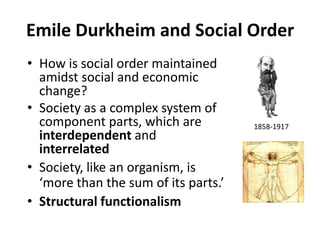
Emile Durkheim andSocial Order
• How is social order maintained
amidst social and economic
change?
• Society as a complex system of
component parts, which are 1858-1917
interdependent and
interrelated
• Society, like an organism, is
‘more than the sum of its parts.’
• Structural functionalism
3.
‘Social Facts’
• Definition:“[social facts] consist of manners
of acting, thinking and feeling external to the
individual, which are invested with a coercive
power by virtue of which they exercise control
over him.”
• Explanation: Social facts are those social
forces in our environment that influence us
but which we cannot change or control.
• Social facts have a reality sui generis
– ‘Sui generis’ = Latin phrase meaning, ‘of its own
kind’
– Social facts cannot be reduced to individual
facts.
4.
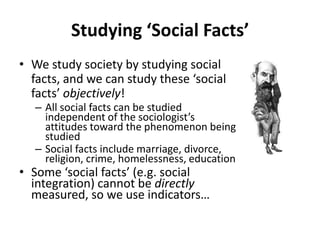
Studying ‘Social Facts’
•We study society by studying social
facts, and we can study these ‘social
facts’ objectively!
– All social facts can be studied
independent of the sociologist’s
attitudes toward the phenomenon being
studied
– Social facts include marriage, divorce,
religion, crime, homelessness, education
• Some ‘social facts’ (e.g. social
integration) cannot be directly
measured, so we use indicators…
5.
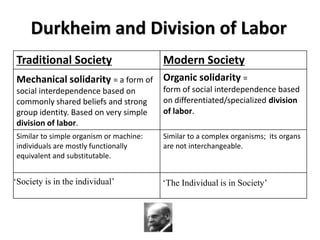
Durkheim and Divisionof Labor
Traditional Society Modern Society
Mechanical solidarity = a form of Organic solidarity =
social interdependence based on form of social interdependence based
commonly shared beliefs and strong on differentiated/specialized division
group identity. Based on very simple of labor.
division of labor.
Similar to simple organism or machine: Similar to a complex organisms; its organs
individuals are mostly functionally are not interchangeable.
equivalent and substitutable.
‘Society is in the individual’ ‘The Individual is in Society’
6.
Collective Conscience
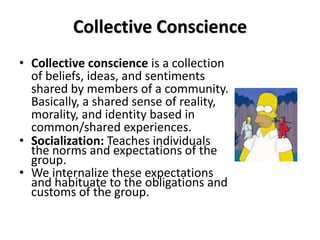
• Collectiveconscience is a collection
of beliefs, ideas, and sentiments
shared by members of a community.
Basically, a shared sense of reality,
morality, and identity based in
common/shared experiences.
• Socialization: Teaches individuals
the norms and expectations of the
group.
• We internalize these expectations
and habituate to the obligations and
customs of the group.
7.
Collective Conscience
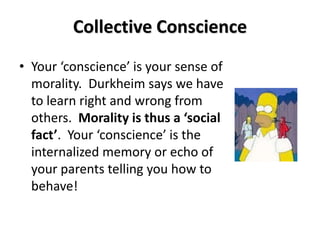
• Your‘conscience’ is your sense of
morality. Durkheim says we have
to learn right and wrong from
others. Morality is thus a ‘social
fact’. Your ‘conscience’ is the
internalized memory or echo of
your parents telling you how to
behave!
8.
Ritual Solidarity
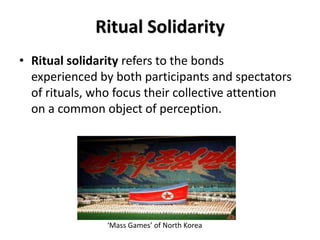
• Ritualsolidarity refers to the bonds
experienced by both participants and spectators
of rituals, who focus their collective attention
on a common object of perception.
‘Mass Games’ of North Korea
9.
Durkheim and ‘Anomie’
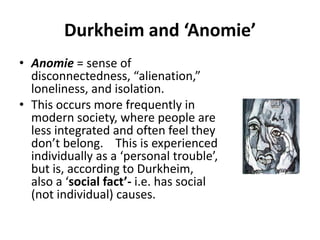
•Anomie = sense of
disconnectedness, “alienation,”
loneliness, and isolation.
• This occurs more frequently in
modern society, where people are
less integrated and often feel they
don’t belong. This is experienced
individually as a ‘personal trouble’,
but is, according to Durkheim,
also a ‘social fact’- i.e. has social
(not individual) causes.
10.
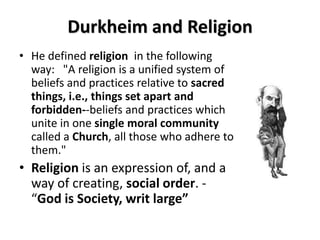
Durkheim and Religion
•He defined religion in the following
way: "A religion is a unified system of
beliefs and practices relative to sacred
things, i.e., things set apart and
forbidden--beliefs and practices which
unite in one single moral community
called a Church, all those who adhere to
them."
• Religion is an expression of, and a
way of creating, social order. -
“God is Society, writ large”
11.
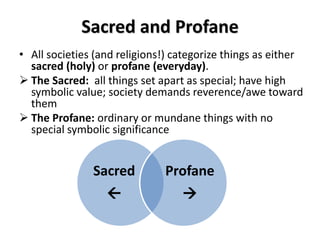
Sacred and Profane
•All societies (and religions!) categorize things as either
sacred (holy) or profane (everyday).
The Sacred: all things set apart as special; have high
symbolic value; society demands reverence/awe toward
them
The Profane: ordinary or mundane things with no
special symbolic significance
Sacred Profane
12.
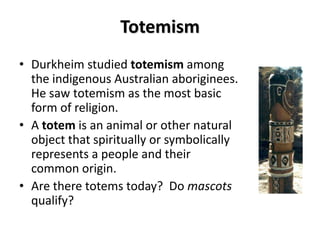
Totemism
• Durkheim studiedtotemism among
the indigenous Australian aboriginees.
He saw totemism as the most basic
form of religion.
• A totem is an animal or other natural
object that spiritually or symbolically
represents a people and their
common origin.
• Are there totems today? Do mascots
qualify?
13.
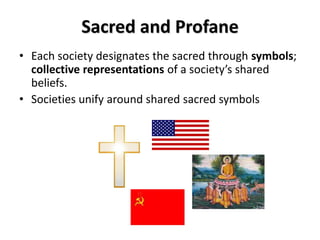
Sacred and Profane
•Each society designates the sacred through symbols;
collective representations of a society’s shared
beliefs.
• Societies unify around shared sacred symbols
14.
Sacred and Profane
The Sacred:
• Collectively shared beliefs
• Collectively shared rituals
• We see and experience the sacred at collective
assemblies (e.g., funerals, sports events, national civic
events)
• What makes a thing holy/sacred is the collective feeling
attached to it
Church:
• The collective coming together of people with shared
beliefs and rituals
• A moral community; shared solidarity
15.
Religion and SocialOrder
• Religion is an expression of,
and a way of creating, social
order. -“God is Society, writ
large”
• To say that ‘Society is God’
means that deities are
reflections of ourselves. God’s
beliefs mirror our own. We try
to see ourselves as God would
see us.
16.
Religion and SocialOrder
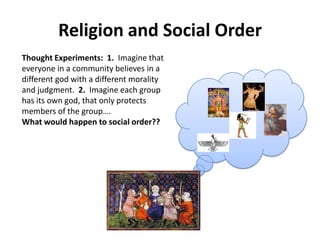
Thought Experiments: 1. Imagine that
everyone in a community believes in a
different god with a different morality
and judgment. 2. Imagine each group
has its own god, that only protects
members of the group….
What would happen to social order??
Editor's Notes
#16 If everyone shares the same perception of God, they also share the same perception or idea of how God is perceiving them. Hence, sharing the same perception of God is equivalent to sharing the same perception of themselves, of right and wrong, and of the world.
![‘Social Facts’
• Definition: “[social facts] consist of manners
of acting, thinking and feeling external to the
individual, which are invested with a coercive
power by virtue of which they exercise control
over him.”
• Explanation: Social facts are those social
forces in our environment that influence us
but which we cannot change or control.
• Social facts have a reality sui generis
– ‘Sui generis’ = Latin phrase meaning, ‘of its own
kind’
– Social facts cannot be reduced to individual
facts.](https://image.slidesharecdn.com/theorylecture3durkheim-111107121520-phpapp01/85/Emile-Durkheim-3-320.jpg)



![Language and identity[1]](https://cdn.slidesharecdn.com/ss_thumbnails/languageandidentity1-100521043013-phpapp02-thumbnail.jpg?width=640&height=640&fit=bounds)


