

Welcome to
INTRODUCTION TO SOCIOLOGY
(SOC 211)
John Bradford, Ph.D.
THIS WEEK’S
LEARNING OBJECTIVES
1. Define Sociology
2. Explanations are comparisons
3. Individual vs. Structural Explanations,
4. Weak vs Strong Interaction
1. DEFINING SOCIOLOGY
What is Sociology?
• Definition #1: Sociology is the scientific study of
interactions and relations among human beings (p.
3).
– Socius (Latin) = ‘associate’; logy (Greek) = ‘study’
• Definition #2: Sociology explains the intended and
unintended consequences of human influence.
What is Sociology?
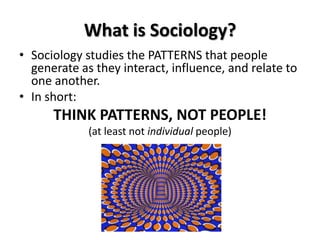
• Sociology studies the PATTERNS that people
generate as they interact, influence, and relate to
one another.
• In short:
THINK PATTERNS, NOT PEOPLE!
(at least not individual people)
2. WHAT DOES IT MEAN TO
EXPLAIN SOMETHING?
What is an explanation?
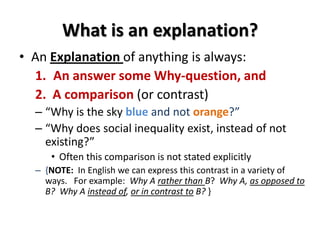
• An Explanation of anything is always:
1. An answer some Why-question, and
2. A comparison (or contrast)
– “Why is the sky blue and not orange?”
– “Why does social inequality exist, instead of not
existing?”
• Often this comparison is not stated explicitly
– {NOTE: In English we can express this contrast in a variety of
ways. For example: Why A rather than B? Why A, as opposed to
B? Why A instead of, or in contrast to B? }
What is an explanation?
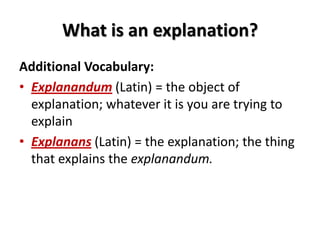
Additional Vocabulary:
• Explanandum (Latin) = the object of
explanation; whatever it is you are trying to
explain
• Explanans (Latin) = the explanation; the thing
that explains the explanandum.
What is an explanation?
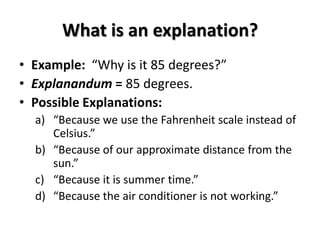
• Example: “Why is it 85 degrees?”
• Explanandum = 85 degrees.
• Possible Explanations:
a) “Because we use the Fahrenheit scale instead of
Celsius.”
b) “Because of our approximate distance from the
sun.”
c) “Because it is summer time.”
d) “Because the air conditioner is not working.”
What is an explanation?
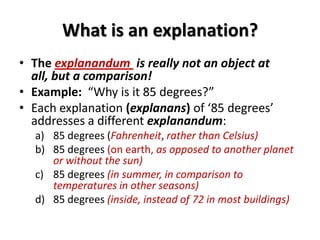
• The explanandum is really not an object at
all, but a comparison!
• Example: “Why is it 85 degrees?”
• Each explanation (explanans) of ‘85 degrees’
addresses a different explanandum:
a) 85 degrees (Fahrenheit, rather than Celsius)
b) 85 degrees (on earth, as opposed to another planet
or without the sun)
c) 85 degrees (in summer, in comparison to
temperatures in other seasons)
d) 85 degrees (inside, instead of 72 in most buildings)
What is an explanation?
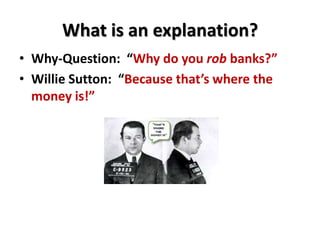
• Why-Question: “Why do you rob banks?”
• Willie Sutton: “Because that’s where the
money is!”
What is an explanation?
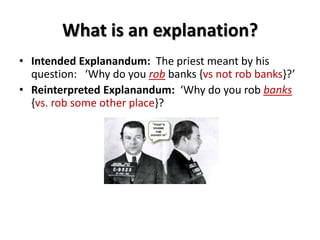
• Intended Explanandum: The priest meant by his
question: ‘Why do you rob banks {vs not rob banks}?’
• Reinterpreted Explanandum: ‘Why do you rob banks
{vs. rob some other place}?
What is an explanation?
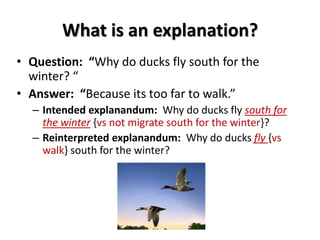
• Question: “Why do ducks fly south for the
winter? “
• Answer: “Because its too far to walk.”
– Intended explanandum: Why do ducks fly south for
the winter {vs not migrate south for the winter}?
– Reinterpreted explanandum: Why do ducks fly {vs
walk} south for the winter?
What is an explanation?
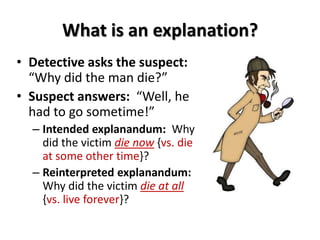
• Detective asks the suspect:
“Why did the man die?”
• Suspect answers: “Well, he
had to go sometime!”
– Intended explanandum: Why
did the victim die now {vs. die
at some other time}?
– Reinterpreted explanandum:
Why did the victim die at all
{vs. live forever}?
What is an explanation?
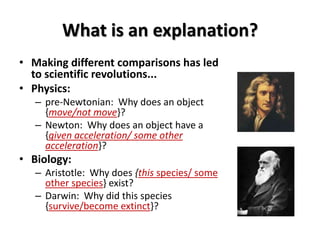
• Making different comparisons has led
to scientific revolutions...
• Physics:
– pre-Newtonian: Why does an object
{move/not move}?
– Newton: Why does an object have a
{given acceleration/ some other
acceleration}?
• Biology:
– Aristotle: Why does {this species/ some
other species} exist?
– Darwin: Why did this species
{survive/become extinct}?
What is an explanation?
• In a nutshell, “Thinking without
comparison is unthinkable.” (Swanson
1971: 145).
3. INDIVIDUAL VS STRUCTURAL
EXPLANATIONS
Individual vs. Structural Explanations
Two Types of Explanations:
1. Individual explanation
– Explanandum = some characteristic or behavior
of an individual person.
– Why does person A have property X?
2. Structural explanation:
– Explanandum = an overall
pattern, distribution, or ‘structure.’
– Why does this structure (pattern) of properties
exist instead of some other?
Individual vs. Structural Explanations
• Individual explanations often presuppose that
the properties of individuals being explained are
isolated and independent of other
individuals, when in fact they exist only in relation
to (or ‘relative to’) other individuals.
• Very often what we think of as individual
properties (e.g. whether you are employed, your
GPA, etc.) are actually properties of social
relationships.
Individual vs. Structural Explanations
Additional Vocabulary:
• Structure = overall pattern (of non-
independent events)
• Independence = no influence; one person
doing something does not increase or
decrease the chance that someone else will.
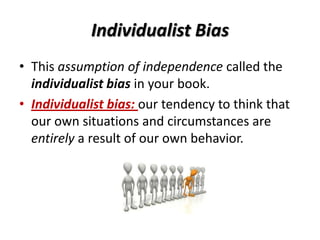
Individualist Bias
• This assumption of independence called the
individualist bias in your book.
• Individualist bias: our tendency to think that
our own situations and circumstances are
entirely a result of our own behavior.
Individualist Bias
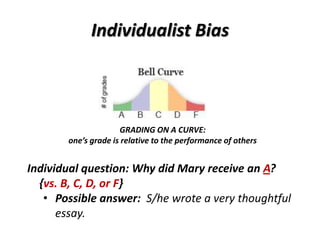
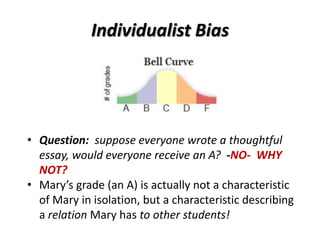
GRADING ON A CURVE:
one’s grade is relative to the performance of others
Individual question: Why did Mary receive an A?
{vs. B, C, D, or F}
• Possible answer: S/he wrote a very thoughtful
essay.
Individualist Bias
• Question: suppose everyone wrote a thoughtful
essay, would everyone receive an A? -NO- WHY
NOT?
• Mary’s grade (an A) is actually not a characteristic
of Mary in isolation, but a characteristic describing
a relation Mary has to other students!
Individualist Bias
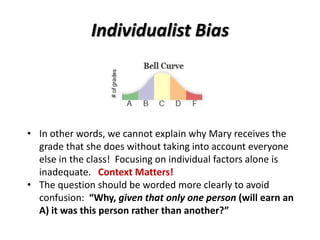
• In other words, we cannot explain why Mary receives the
grade that she does without taking into account everyone
else in the class! Focusing on individual factors alone is
inadequate. Context Matters!
• The question should be worded more clearly to avoid
confusion: “Why, given that only one person (will earn an
A) it was this person rather than another?”
Individualist Bias
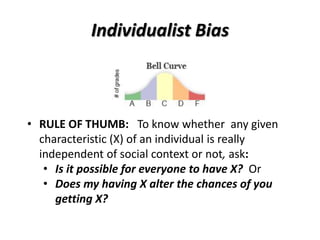
• RULE OF THUMB: To know whether any given
characteristic (X) of an individual is really
independent of social context or not, ask:
• Is it possible for everyone to have X? Or
• Does my having X alter the chances of you
getting X?
Individualist Bias
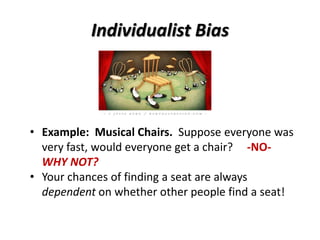
• Example: Musical Chairs. Suppose everyone was
very fast, would everyone get a chair? -NO-
WHY NOT?
• Your chances of finding a seat are always
dependent on whether other people find a seat!
4. WEAK VS STRONG INTERACTION
Human
attributes
Non-Social
Social
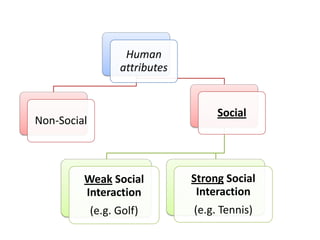
Weak Social
Interaction
(e.g. Golf)
Strong Social
Interaction
(e.g. Tennis)
Weak vs Strong Interaction
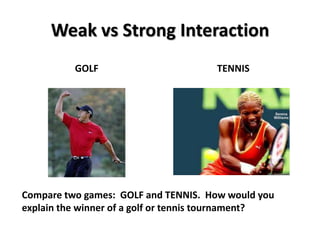
GOLF TENNIS
Compare two games: GOLF and TENNIS. How would you
explain the winner of a golf or tennis tournament?
Weak vs Strong Interaction
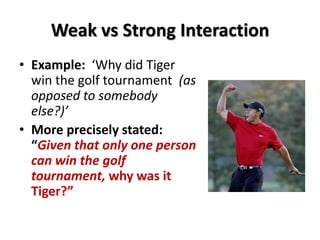
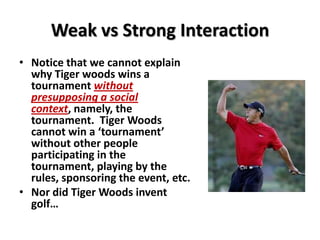
• Example: ‘Why did Tiger
win the golf tournament (as
opposed to somebody
else?)’
• More precisely stated:
“Given that only one person
can win the golf
tournament, why was it
Tiger?”
Weak vs Strong Interaction
• Notice that we cannot explain
why Tiger woods wins a
tournament without
presupposing a social
context, namely, the
tournament. Tiger Woods
cannot win a ‘tournament’
without other people
participating in the
tournament, playing by the
rules, sponsoring the event, etc.
• Nor did Tiger Woods invent
golf…
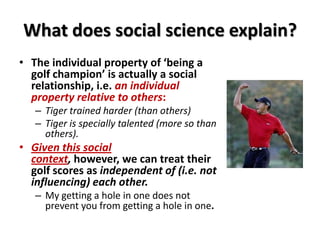
What does social science explain?
• The individual property of ‘being a
golf champion’ is actually a social
relationship, i.e. an individual
property relative to others:
– Tiger trained harder (than others)
– Tiger is specially talented (more so than
others).
• Given this social
context, however, we can treat their
golf scores as independent of (i.e. not
influencing) each other.
– My getting a hole in one does not
prevent you from getting a hole in one.
Weak vs Strong Interaction
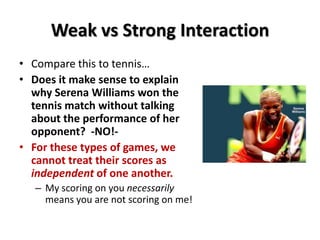
• Compare this to tennis…
• Does it make sense to explain
why Serena Williams won the
tennis match without talking
about the performance of her
opponent? -NO!-
• For these types of games, we
cannot treat their scores as
independent of one another.
– My scoring on you necessarily
means you are not scoring on me!
Weak vs Strong Interaction
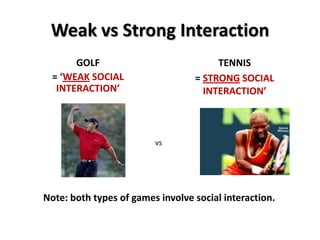
GOLF
= ‘WEAK SOCIAL
INTERACTION’
TENNIS
= STRONG SOCIAL
INTERACTION’
vs
Note: both types of games involve social interaction.
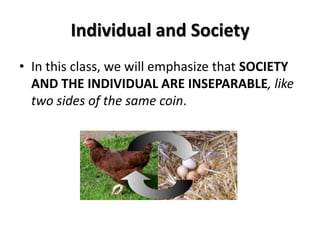
Individual and Society
• In this class, we will emphasize that SOCIETY
AND THE INDIVIDUAL ARE INSEPARABLE, like
two sides of the same coin.
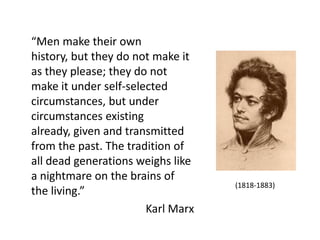
“Men make their own
history, but they do not make it
as they please; they do not
make it under self-selected
circumstances, but under
circumstances existing
already, given and transmitted
from the past. The tradition of
all dead generations weighs like
a nightmare on the brains of
the living.”
Karl Marx
(1818-1883)

Lecture 1 so 211

  • 1.
    Welcome to INTRODUCTION TOSOCIOLOGY (SOC 211) John Bradford, Ph.D.
  • 2.
    THIS WEEK’S LEARNING OBJECTIVES 1.Define Sociology 2. Explanations are comparisons 3. Individual vs. Structural Explanations, 4. Weak vs Strong Interaction
  • 3.
  • 4.
    What is Sociology? •Definition #1: Sociology is the scientific study of interactions and relations among human beings (p. 3). – Socius (Latin) = ‘associate’; logy (Greek) = ‘study’ • Definition #2: Sociology explains the intended and unintended consequences of human influence.
  • 5.
    What is Sociology? •Sociology studies the PATTERNS that people generate as they interact, influence, and relate to one another. • In short: THINK PATTERNS, NOT PEOPLE! (at least not individual people)
  • 6.
    2. WHAT DOESIT MEAN TO EXPLAIN SOMETHING?
  • 7.
    What is anexplanation? • An Explanation of anything is always: 1. An answer some Why-question, and 2. A comparison (or contrast) – “Why is the sky blue and not orange?” – “Why does social inequality exist, instead of not existing?” • Often this comparison is not stated explicitly – {NOTE: In English we can express this contrast in a variety of ways. For example: Why A rather than B? Why A, as opposed to B? Why A instead of, or in contrast to B? }
  • 8.
    What is anexplanation? Additional Vocabulary: • Explanandum (Latin) = the object of explanation; whatever it is you are trying to explain • Explanans (Latin) = the explanation; the thing that explains the explanandum.
  • 9.
    What is anexplanation? • Example: “Why is it 85 degrees?” • Explanandum = 85 degrees. • Possible Explanations: a) “Because we use the Fahrenheit scale instead of Celsius.” b) “Because of our approximate distance from the sun.” c) “Because it is summer time.” d) “Because the air conditioner is not working.”
  • 10.
    What is anexplanation? • The explanandum is really not an object at all, but a comparison! • Example: “Why is it 85 degrees?” • Each explanation (explanans) of ‘85 degrees’ addresses a different explanandum: a) 85 degrees (Fahrenheit, rather than Celsius) b) 85 degrees (on earth, as opposed to another planet or without the sun) c) 85 degrees (in summer, in comparison to temperatures in other seasons) d) 85 degrees (inside, instead of 72 in most buildings)
  • 11.
    What is anexplanation? • Why-Question: “Why do you rob banks?” • Willie Sutton: “Because that’s where the money is!”
  • 12.
    What is anexplanation? • Intended Explanandum: The priest meant by his question: ‘Why do you rob banks {vs not rob banks}?’ • Reinterpreted Explanandum: ‘Why do you rob banks {vs. rob some other place}?
  • 13.
    What is anexplanation? • Question: “Why do ducks fly south for the winter? “ • Answer: “Because its too far to walk.” – Intended explanandum: Why do ducks fly south for the winter {vs not migrate south for the winter}? – Reinterpreted explanandum: Why do ducks fly {vs walk} south for the winter?
  • 14.
    What is anexplanation? • Detective asks the suspect: “Why did the man die?” • Suspect answers: “Well, he had to go sometime!” – Intended explanandum: Why did the victim die now {vs. die at some other time}? – Reinterpreted explanandum: Why did the victim die at all {vs. live forever}?
  • 15.
    What is anexplanation? • Making different comparisons has led to scientific revolutions... • Physics: – pre-Newtonian: Why does an object {move/not move}? – Newton: Why does an object have a {given acceleration/ some other acceleration}? • Biology: – Aristotle: Why does {this species/ some other species} exist? – Darwin: Why did this species {survive/become extinct}?
  • 16.
    What is anexplanation? • In a nutshell, “Thinking without comparison is unthinkable.” (Swanson 1971: 145).
  • 17.
    3. INDIVIDUAL VSSTRUCTURAL EXPLANATIONS
  • 18.
    Individual vs. StructuralExplanations Two Types of Explanations: 1. Individual explanation – Explanandum = some characteristic or behavior of an individual person. – Why does person A have property X? 2. Structural explanation: – Explanandum = an overall pattern, distribution, or ‘structure.’ – Why does this structure (pattern) of properties exist instead of some other?
  • 19.
    Individual vs. StructuralExplanations • Individual explanations often presuppose that the properties of individuals being explained are isolated and independent of other individuals, when in fact they exist only in relation to (or ‘relative to’) other individuals. • Very often what we think of as individual properties (e.g. whether you are employed, your GPA, etc.) are actually properties of social relationships.
  • 20.
    Individual vs. StructuralExplanations Additional Vocabulary: • Structure = overall pattern (of non- independent events) • Independence = no influence; one person doing something does not increase or decrease the chance that someone else will.
  • 21.
    Individualist Bias • Thisassumption of independence called the individualist bias in your book. • Individualist bias: our tendency to think that our own situations and circumstances are entirely a result of our own behavior.
  • 22.
    Individualist Bias GRADING ONA CURVE: one’s grade is relative to the performance of others Individual question: Why did Mary receive an A? {vs. B, C, D, or F} • Possible answer: S/he wrote a very thoughtful essay.
  • 23.
    Individualist Bias • Question:suppose everyone wrote a thoughtful essay, would everyone receive an A? -NO- WHY NOT? • Mary’s grade (an A) is actually not a characteristic of Mary in isolation, but a characteristic describing a relation Mary has to other students!
  • 24.
    Individualist Bias • Inother words, we cannot explain why Mary receives the grade that she does without taking into account everyone else in the class! Focusing on individual factors alone is inadequate. Context Matters! • The question should be worded more clearly to avoid confusion: “Why, given that only one person (will earn an A) it was this person rather than another?”
  • 25.
    Individualist Bias • RULEOF THUMB: To know whether any given characteristic (X) of an individual is really independent of social context or not, ask: • Is it possible for everyone to have X? Or • Does my having X alter the chances of you getting X?
  • 26.
    Individualist Bias • Example:Musical Chairs. Suppose everyone was very fast, would everyone get a chair? -NO- WHY NOT? • Your chances of finding a seat are always dependent on whether other people find a seat!
  • 27.
    4. WEAK VSSTRONG INTERACTION
  • 28.
  • 29.
    Weak vs StrongInteraction GOLF TENNIS Compare two games: GOLF and TENNIS. How would you explain the winner of a golf or tennis tournament?
  • 30.
    Weak vs StrongInteraction • Example: ‘Why did Tiger win the golf tournament (as opposed to somebody else?)’ • More precisely stated: “Given that only one person can win the golf tournament, why was it Tiger?”
  • 31.
    Weak vs StrongInteraction • Notice that we cannot explain why Tiger woods wins a tournament without presupposing a social context, namely, the tournament. Tiger Woods cannot win a ‘tournament’ without other people participating in the tournament, playing by the rules, sponsoring the event, etc. • Nor did Tiger Woods invent golf…
  • 32.
    What does socialscience explain? • The individual property of ‘being a golf champion’ is actually a social relationship, i.e. an individual property relative to others: – Tiger trained harder (than others) – Tiger is specially talented (more so than others). • Given this social context, however, we can treat their golf scores as independent of (i.e. not influencing) each other. – My getting a hole in one does not prevent you from getting a hole in one.
  • 33.
    Weak vs StrongInteraction • Compare this to tennis… • Does it make sense to explain why Serena Williams won the tennis match without talking about the performance of her opponent? -NO!- • For these types of games, we cannot treat their scores as independent of one another. – My scoring on you necessarily means you are not scoring on me!
  • 34.
    Weak vs StrongInteraction GOLF = ‘WEAK SOCIAL INTERACTION’ TENNIS = STRONG SOCIAL INTERACTION’ vs Note: both types of games involve social interaction.
  • 35.
    Individual and Society •In this class, we will emphasize that SOCIETY AND THE INDIVIDUAL ARE INSEPARABLE, like two sides of the same coin.
  • 36.
    “Men make theirown history, but they do not make it as they please; they do not make it under self-selected circumstances, but under circumstances existing already, given and transmitted from the past. The tradition of all dead generations weighs like a nightmare on the brains of the living.” Karl Marx (1818-1883)

Editor's Notes

  • #5 Here are some definitions found in textbooks on sociology [You do not need to remember these!]:“Scientific study of ‘Society’” [But what is ‘society’?]“systematic study of human groups.”“scientific study of human groups”“scientific study of human behavior, social groups, and society”“systematic study of society and human behavior.”
  • #23 Emile Durkheim said that individualism is (ironically) a social value. He described this focus on individualism as the ‘cult of the individual’.
  • #25 2. Structural reinterpretation: Given that only one person will receive an A, why did Mary receive it? {vs other students}
  • #28 2. Structural Reinterpretation: Given that one person will always be without a chair, why was person A the unlucky one? {vs. everyone else}