





Tuğba Boz


Michel Foucault
Power & Knowledge
on Education
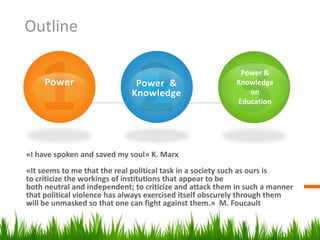
Outline

                                                            Power &
     Power                    Power &                      Knowledge
                             Knowledge                        on
                                                           Education


«I have spoken and saved my soul» K. Marx
«It seems to me that the real political task in a society such as ours is
to criticize the workings of institutions that appear to be
both neutral and independent; to criticize and attack them in such a manner
that political violence has always exercised itself obscurely through them
will be unmasked so that one can fight against them.» M. Foucault
Power
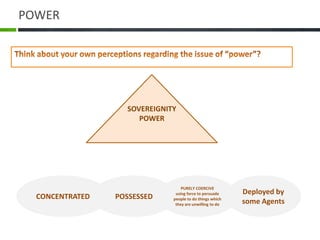
POWER


                   SOVEREIGNITY
                      POWER


                                  PURELY COERCIVE
                               using force to persuade    Deployed by
  CONCENTRATED   POSSESSED    people to do things which
                               they are unwilling to do   some Agents
...you can't prevent me
                                from believing that
                                these notions of human
                                nature, of justice, of the
                                realisation of the
                                essence of human
                                beings, are all notions
                                and concepts which
                                have been formed
                                within our civilisation,
                                within our type of
                                knowledge and our form
                                of philosophy, and that
                                as a result form part of
Foucault – Chomsky on Justice   our class system...
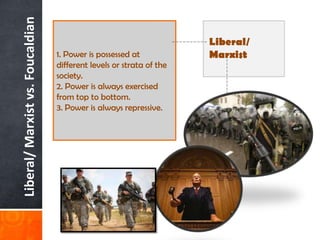
Liberal/ Marxist vs. Foucaldian
                                                                      Liberal/
                                  1. Power is possessed at            Marxist
                                  different levels or strata of the
                                  society.
                                  2. Power is always exercised
                                  from top to bottom.
                                  3. Power is always repressive.
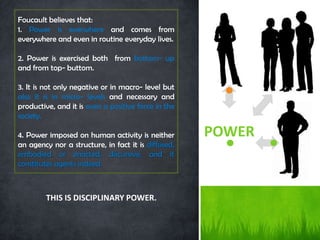
Foucault believes that:
1. Power is everwhere and comes from
everywhere and even in routine everyday lives.

2. Power is exercised both from bottom- up
and from top- buttom.

3. It is not only negative or in macro- level but
also it is in micro- levels and necessary and
productive, and it is even a positive force in the
society.

4. Power imposed on human activity is neither        POWER
an agency nor a structure, in fact it is diffused,
embodied or enacted, discursive, and it
constitutes agents indeed.


        THIS IS DISCIPLINARY POWER.
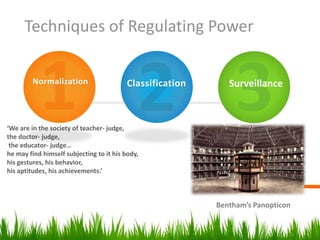
Techniques of Regulating Power

        Normalization                     Classification      Surveillance


‘We are in the society of teacher- judge,
the doctor- judge,
 the educator- judge…
he may find himself subjecting to it his body,
his gestures, his behavior,
his aptitudes, his achievements.’


                                                           Bentham’s Panopticon
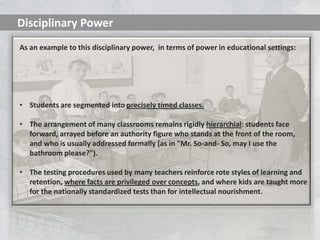
Disciplinary Power
As an example to this disciplinary power, in terms of power in educational settings:


• Students are segmented into precisely timed classes.

• The arrangement of many classrooms remains rigidly hierarchial: students face
  forward, arrayed before an authority figure who stands at the front of the room,
  and who is usually addressed formally (as in "Mr. So-and- So, may I use the
  bathroom please?").

• The testing procedures used by many teachers reinforce rote styles of learning and
  retention, where facts are privileged over concepts, and where kids are taught more
  for the nationally standardized tests than for intellectual nourishment.
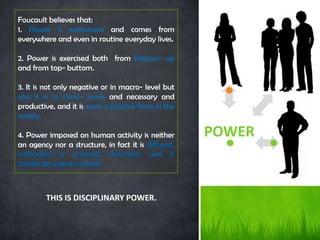
Foucault believes that:
1. Power is everwhere and comes from
everywhere and even in routine everyday lives.

2. Power is exercised both from bottom- up
and from top- buttom.

3. It is not only negative or in macro- level but
also it is in micro- levels and necessary and
productive, and it is even a positive force in the
society.

4. Power imposed on human activity is neither        POWER
an agency nor a structure, in fact it is diffused,
embodied or enacted, discursive, and it
constitutes agents indeed.


        THIS IS DISCIPLINARY POWER.
Power & Knowledge


According to Foucault, power is knowledge and knowledge is power.
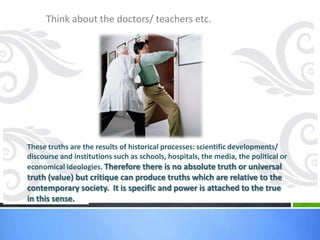
Think about the doctors/ teachers etc.


These truths are the results of historical processes: scientific developments/
discourse and institutions such as schools, hospitals, the media, the political or
economical ideologies. Therefore there is no absolute truth or universal
truth (value) but critique can produce truths which are relative to the
contemporary society. It is specific and power is attached to the true
in this sense.
Power- Knowledge & Curriculum
                   Relativism/Truth and the Curriculum
 Moral Relativism
Moral systems vary across cultures, historical periods, different people within the
same culture. Even if most societies or every society shared the same moral belief,
that does not necessarily prove any moral absolutes. They might be all wrong.
 Conseptual Relativism
Thought, belief, and knowledge systems are embedded in particular social
arrangements, which cannot be changed through individual willpower, but
nevertheless do not persist over timen and are different in different cultures.
 Perceptual Relativism
Remember Whorf «we dissect nature along lines laid down by our native
language.»
 Truth Relativism
No universal absolutes embedded in logic or rationality.

Opposed to Hirst’s ideas on making distinctions between disciplines according to
their particular concepts and including them at that way.
POWER- KNOWLEDGE & CURRICULUM


                    Foucault and Education
               Foucault and the Examination
Foucault and Education

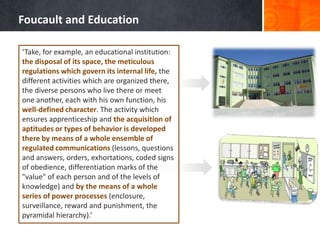
‘Take, for example, an educational institution:
the disposal of its space, the meticulous
regulations which govern its internal life, the
different activities which are organized there,
the diverse persons who live there or meet
one another, each with his own function, his
well-defined character. The activity which
ensures apprenticeship and the acquisition of
aptitudes or types of behavior is developed
there by means of a whole ensemble of
regulated communications (lessons, questions
and answers, orders, exhortations, coded signs
of obedience, differentiation marks of the
"value" of each person and of the levels of
knowledge) and by the means of a whole
series of power processes (enclosure,
surveillance, reward and punishment, the
pyramidal hierarchy).’
• A progressive mechanism for combatting
  nepotism, favouritism, arbitrariness, for contributing to a more efficient
  society,
• A reliable and valid way to choosing the appropriate members of a
  population for imporatant roles in the society.
Foucault and the Examination


«(The examination) combines the techniques of observing
hierarchy and those of a normalizing judgment. It is a
normalizing gaze, a surveillance that makes it possible to qualify,
to classify and to punish. It establishes over individuals a
visibility through which one differentiates them and judges
them.»
Any Qs?
What’s Your Message?
28th of March, 2012

POWER and EDUCATION

  • 1.
    Tuğba Boz Michel Foucault Power& Knowledge on Education
  • 2.
    Outline Power & Power Power & Knowledge Knowledge on Education «I have spoken and saved my soul» K. Marx «It seems to me that the real political task in a society such as ours is to criticize the workings of institutions that appear to be both neutral and independent; to criticize and attack them in such a manner that political violence has always exercised itself obscurely through them will be unmasked so that one can fight against them.» M. Foucault
  • 3.
  • 4.
    POWER SOVEREIGNITY POWER PURELY COERCIVE using force to persuade Deployed by CONCENTRATED POSSESSED people to do things which they are unwilling to do some Agents
  • 5.
    ...you can't preventme from believing that these notions of human nature, of justice, of the realisation of the essence of human beings, are all notions and concepts which have been formed within our civilisation, within our type of knowledge and our form of philosophy, and that as a result form part of Foucault – Chomsky on Justice our class system...
  • 6.
    Liberal/ Marxist vs.Foucaldian Liberal/ 1. Power is possessed at Marxist different levels or strata of the society. 2. Power is always exercised from top to bottom. 3. Power is always repressive.
  • 7.
    Foucault believes that: 1.Power is everwhere and comes from everywhere and even in routine everyday lives. 2. Power is exercised both from bottom- up and from top- buttom. 3. It is not only negative or in macro- level but also it is in micro- levels and necessary and productive, and it is even a positive force in the society. 4. Power imposed on human activity is neither POWER an agency nor a structure, in fact it is diffused, embodied or enacted, discursive, and it constitutes agents indeed. THIS IS DISCIPLINARY POWER.
  • 8.
    Techniques of RegulatingPower Normalization Classification Surveillance ‘We are in the society of teacher- judge, the doctor- judge, the educator- judge… he may find himself subjecting to it his body, his gestures, his behavior, his aptitudes, his achievements.’ Bentham’s Panopticon
  • 9.
    Disciplinary Power As anexample to this disciplinary power, in terms of power in educational settings: • Students are segmented into precisely timed classes. • The arrangement of many classrooms remains rigidly hierarchial: students face forward, arrayed before an authority figure who stands at the front of the room, and who is usually addressed formally (as in "Mr. So-and- So, may I use the bathroom please?"). • The testing procedures used by many teachers reinforce rote styles of learning and retention, where facts are privileged over concepts, and where kids are taught more for the nationally standardized tests than for intellectual nourishment.
  • 10.
    Foucault believes that: 1.Power is everwhere and comes from everywhere and even in routine everyday lives. 2. Power is exercised both from bottom- up and from top- buttom. 3. It is not only negative or in macro- level but also it is in micro- levels and necessary and productive, and it is even a positive force in the society. 4. Power imposed on human activity is neither POWER an agency nor a structure, in fact it is diffused, embodied or enacted, discursive, and it constitutes agents indeed. THIS IS DISCIPLINARY POWER.
  • 11.
    Power & Knowledge Accordingto Foucault, power is knowledge and knowledge is power.
  • 12.
    Think about thedoctors/ teachers etc. These truths are the results of historical processes: scientific developments/ discourse and institutions such as schools, hospitals, the media, the political or economical ideologies. Therefore there is no absolute truth or universal truth (value) but critique can produce truths which are relative to the contemporary society. It is specific and power is attached to the true in this sense.
  • 13.
    Power- Knowledge &Curriculum Relativism/Truth and the Curriculum  Moral Relativism Moral systems vary across cultures, historical periods, different people within the same culture. Even if most societies or every society shared the same moral belief, that does not necessarily prove any moral absolutes. They might be all wrong.  Conseptual Relativism Thought, belief, and knowledge systems are embedded in particular social arrangements, which cannot be changed through individual willpower, but nevertheless do not persist over timen and are different in different cultures.  Perceptual Relativism Remember Whorf «we dissect nature along lines laid down by our native language.»  Truth Relativism No universal absolutes embedded in logic or rationality. Opposed to Hirst’s ideas on making distinctions between disciplines according to their particular concepts and including them at that way.
  • 14.
    POWER- KNOWLEDGE &CURRICULUM Foucault and Education Foucault and the Examination
  • 15.
    Foucault and Education ‘Take,for example, an educational institution: the disposal of its space, the meticulous regulations which govern its internal life, the different activities which are organized there, the diverse persons who live there or meet one another, each with his own function, his well-defined character. The activity which ensures apprenticeship and the acquisition of aptitudes or types of behavior is developed there by means of a whole ensemble of regulated communications (lessons, questions and answers, orders, exhortations, coded signs of obedience, differentiation marks of the "value" of each person and of the levels of knowledge) and by the means of a whole series of power processes (enclosure, surveillance, reward and punishment, the pyramidal hierarchy).’
  • 16.
    • A progressivemechanism for combatting nepotism, favouritism, arbitrariness, for contributing to a more efficient society, • A reliable and valid way to choosing the appropriate members of a population for imporatant roles in the society.
  • 17.
    Foucault and theExamination «(The examination) combines the techniques of observing hierarchy and those of a normalizing judgment. It is a normalizing gaze, a surveillance that makes it possible to qualify, to classify and to punish. It establishes over individuals a visibility through which one differentiates them and judges them.»
  • 18.
    Any Qs? What’s YourMessage? 28th of March, 2012