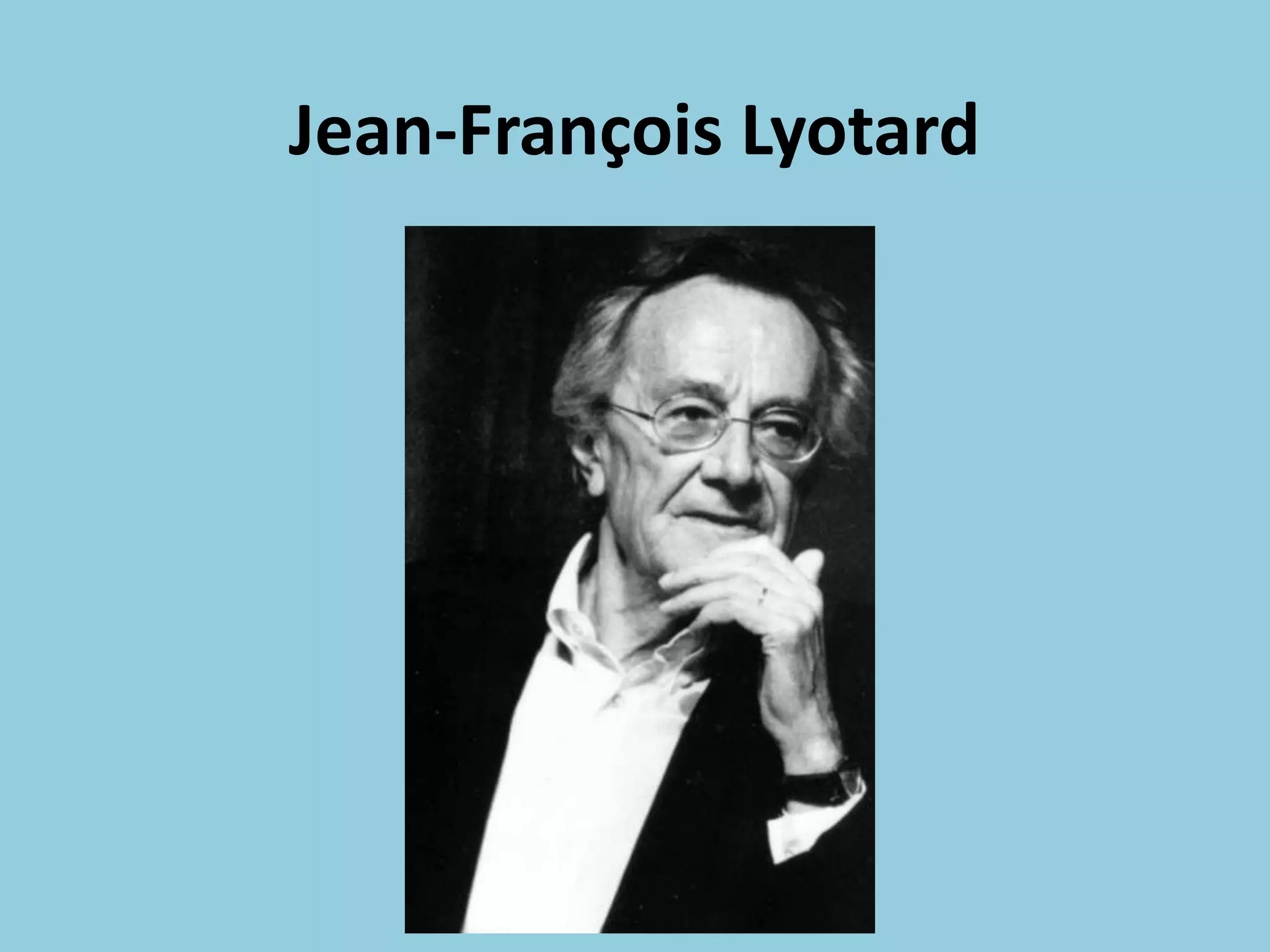
Jean-François Lyotard
Lyotard
• Was a French philosopher and literary
  theorist.
• He is well known for his articulation of
  postmodernism after the late 1970s and the
  analysis of the impact of postmodernity on
  the human condition.
• He was co-founder of the International
  College of Philosophy with Jacques
  Derrida, François Châtelet, and Gilles Deleuze.
Work
• Lyotard's work is characterised by a persistent opposition to
  universals, meta-narratives, and generality.
• He is fiercely critical of many of the 'universalist' claims of the
  Enlightenment, and several of his works serve to undermine the
  fundamental principles that generate these broad claims.
• In his writings of the early 1970s, he rejects what he regards as theological
  underpinnings of both Karl Marx and Sigmund Freud: "In Freud, it is
  judicial, critical sombre (forgetful of the political); in Marx it is catholic.
  Hegelian, reconciliatory (...) in the one and in the other the relationship of
  the economic with meaning is blocked in the category of representation
  (...) Here a politics, there a therapeutics, in both cases a laical theology, on
  top of the arbitrariness and the roaming of forces".
• Consequently he rejected Adorno's negative dialectics which he regarded
  as seeking a "therapeutic resolution in the framework of a religion, here
  the religion of history". In Lyotard's "libidinal economics" (the title of one
  of his books of that time), he aimed at "discovering and describing
  different social modes of investment of libidinal intensities".
“Grand Narrative”
•   Most famously, in La Condition postmoderne: Rapport sur
    le savoir (The Postmodern Condition: A Report on
    Knowledge) (1979), he proposes what he calls an extreme
    simplification of the "postmodern" as an 'incredulity
    towards meta-narratives'.
•   These meta-narratives - sometimes 'grand narratives' - are
    grand, large-scale theories and philosophies of the
    world, such as the progress of history, the know ability of
    everything by science, and the possibility of absolute
    freedom.
•   Lyotard argues that we have ceased to believe that
    narratives of this kind are adequate to represent and
    contain us all. We have become alert to
    difference, diversity, the incompatibility of our
    aspirations, beliefs and desires, and for that reason
    postmodernity is characterised by an abundance of
    micronarratives. For this concept Lyotard draws from the
    notion of 'language-games' found in the work of
    Wittgenstein.
The Sublime
• Lyotard was a frequent writer on aesthetic matters. He was, despite his
  reputation as a postmodernist, a great promoter of modernist art. Lyotard
  saw 'postmodernism' as a latent tendency within thought throughout time
  and not a narrowly-limited historical period.
• He favoured the startling and perplexing works of the high modernist
  avant-garde. In them he found a demonstration of the limits of our
  conceptuality, a valuable lesson for anyone too imbued with
  Enlightenment confidence. Lyotard has written extensively also on few
  contemporary artists of his choice: Valerio Adami, Daniel Buren, Marcel
  Duchamp, Bracha Ettinger and Barnett Newman, as well as on Paul
  Cézanne and Wassily Kandinsky.
• He developed these themes in particular by discussing the sublime. The
  "sublime" is a term in aesthetics whose fortunes revived under
  postmodernism after a century or more of neglect. It refers to the
  experience of pleasurable anxiety that we experience when confronting
  wild and threatening sights like, for example, a massive craggy
  mountain, black against the sky, looming terrifyingly in our vision.

Jean françois lyotard

  • 1.
  • 2.
    Lyotard • Was aFrench philosopher and literary theorist. • He is well known for his articulation of postmodernism after the late 1970s and the analysis of the impact of postmodernity on the human condition. • He was co-founder of the International College of Philosophy with Jacques Derrida, François Châtelet, and Gilles Deleuze.
  • 3.
    Work • Lyotard's workis characterised by a persistent opposition to universals, meta-narratives, and generality. • He is fiercely critical of many of the 'universalist' claims of the Enlightenment, and several of his works serve to undermine the fundamental principles that generate these broad claims. • In his writings of the early 1970s, he rejects what he regards as theological underpinnings of both Karl Marx and Sigmund Freud: "In Freud, it is judicial, critical sombre (forgetful of the political); in Marx it is catholic. Hegelian, reconciliatory (...) in the one and in the other the relationship of the economic with meaning is blocked in the category of representation (...) Here a politics, there a therapeutics, in both cases a laical theology, on top of the arbitrariness and the roaming of forces". • Consequently he rejected Adorno's negative dialectics which he regarded as seeking a "therapeutic resolution in the framework of a religion, here the religion of history". In Lyotard's "libidinal economics" (the title of one of his books of that time), he aimed at "discovering and describing different social modes of investment of libidinal intensities".
  • 4.
    “Grand Narrative” • Most famously, in La Condition postmoderne: Rapport sur le savoir (The Postmodern Condition: A Report on Knowledge) (1979), he proposes what he calls an extreme simplification of the "postmodern" as an 'incredulity towards meta-narratives'. • These meta-narratives - sometimes 'grand narratives' - are grand, large-scale theories and philosophies of the world, such as the progress of history, the know ability of everything by science, and the possibility of absolute freedom. • Lyotard argues that we have ceased to believe that narratives of this kind are adequate to represent and contain us all. We have become alert to difference, diversity, the incompatibility of our aspirations, beliefs and desires, and for that reason postmodernity is characterised by an abundance of micronarratives. For this concept Lyotard draws from the notion of 'language-games' found in the work of Wittgenstein.
  • 5.
    The Sublime • Lyotardwas a frequent writer on aesthetic matters. He was, despite his reputation as a postmodernist, a great promoter of modernist art. Lyotard saw 'postmodernism' as a latent tendency within thought throughout time and not a narrowly-limited historical period. • He favoured the startling and perplexing works of the high modernist avant-garde. In them he found a demonstration of the limits of our conceptuality, a valuable lesson for anyone too imbued with Enlightenment confidence. Lyotard has written extensively also on few contemporary artists of his choice: Valerio Adami, Daniel Buren, Marcel Duchamp, Bracha Ettinger and Barnett Newman, as well as on Paul Cézanne and Wassily Kandinsky. • He developed these themes in particular by discussing the sublime. The "sublime" is a term in aesthetics whose fortunes revived under postmodernism after a century or more of neglect. It refers to the experience of pleasurable anxiety that we experience when confronting wild and threatening sights like, for example, a massive craggy mountain, black against the sky, looming terrifyingly in our vision.