Postmodernism
THEORETICAL PERSPECTIVE
DERRIDA TO BRAUDRILLARD
Postmodernism Defined
The rejection of the scientific canon, of the idea that there
can be a single coherent rationality or that reality has a
unitary nature that can be definitively observed or
understood
Jacques Derrida
 Born in El-Biar, Algeria
 French philosopher and essayist
 Used a deconstructive approach
Illustrated in his three 1967 works
 Of grammatology, Writing and Difference,
Speech and Phenomena
Developed the concept of discourse
“emphasizes the primacy of the words we use, the concepts they
embody, and the rules that develop within a group about what are
appropriate ways of talking about things”
Logocentrism
Logocentrism: modes of thinking that apply truth claims to universal
propositions
◦ Our knowledge of the social world is grounded in a belief that we
can make sense of our ever-changing and highly complex societies
by referring to certain unchanging principles or foundations
◦ Derrida rejected this definition (what postmodernists call an anti-
foundational stance)
Hermeneutical Method
The understanding and interpretation of published writings
From Hermeneutics came the German word “Verstehen” which meant
“to understand”
◦ Sociologists should look at actions of individuals and examine the meanings
attached to behaviors
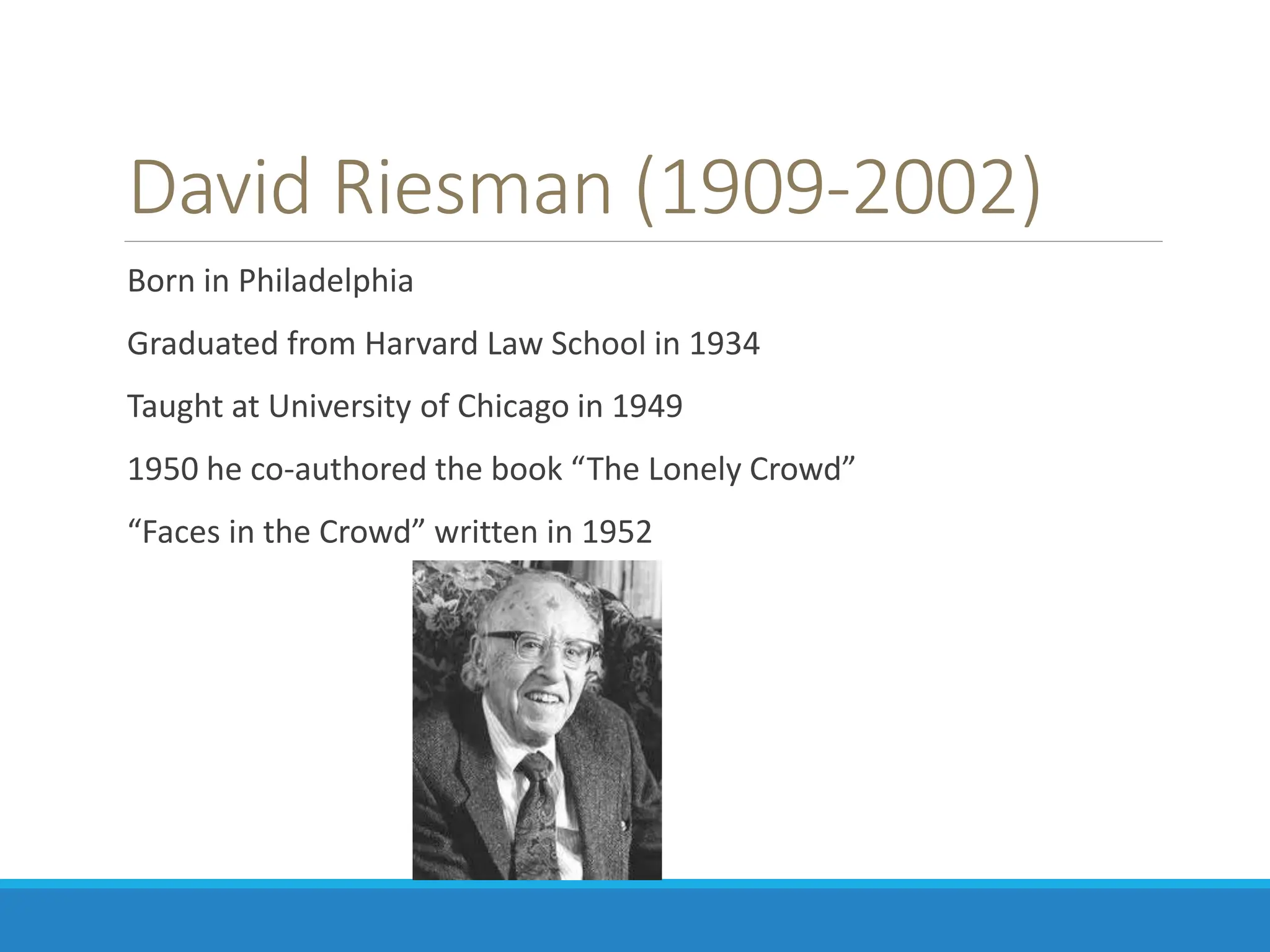
David Riesman (1909-2002)
Born in Philadelphia
Graduated from Harvard Law School in 1934
Taught at University of Chicago in 1949
1950 he co-authored the book “The Lonely Crowd”
“Faces in the Crowd” written in 1952
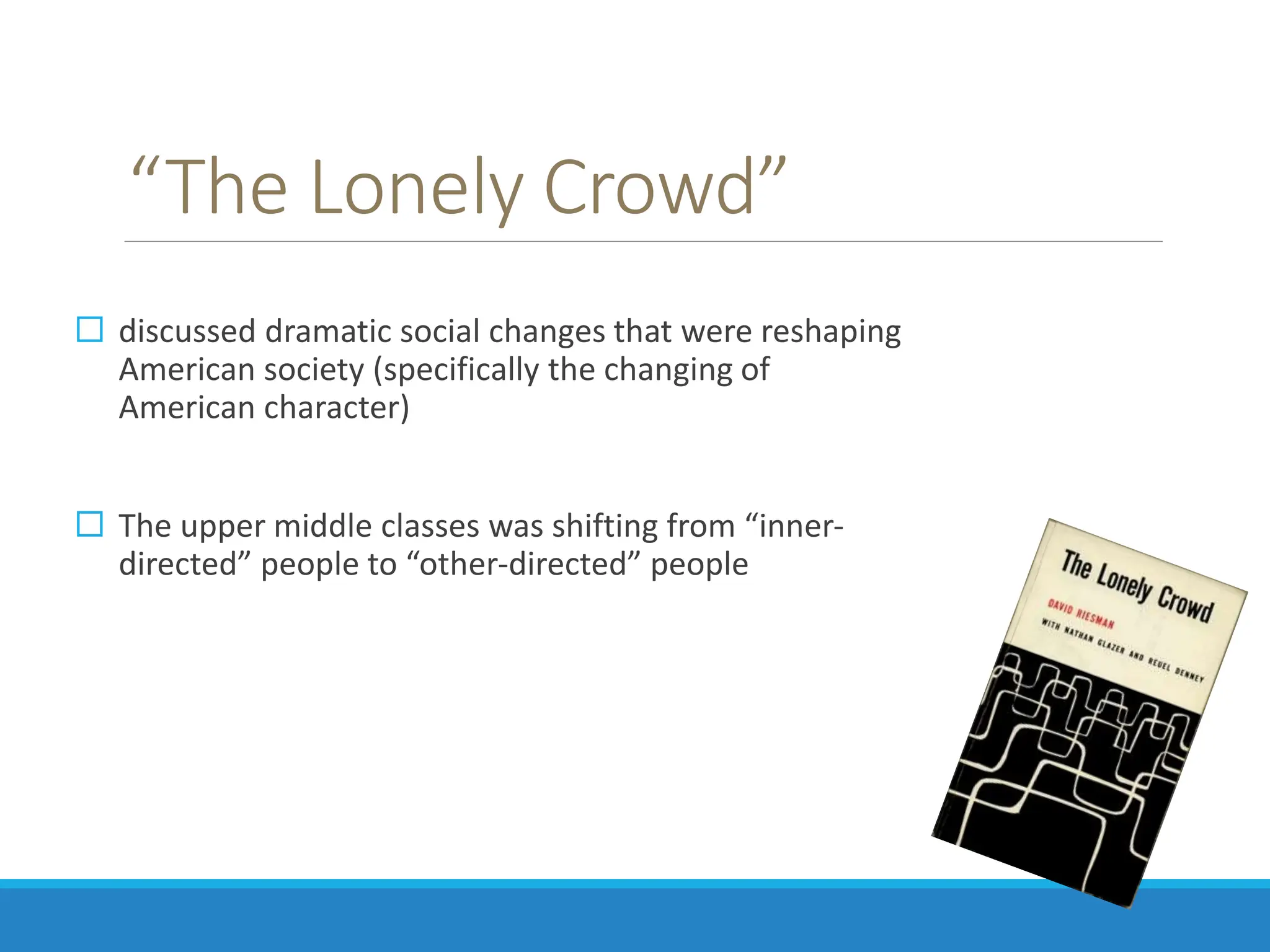
“The Lonely Crowd”
 discussed dramatic social changes that were reshaping
American society (specifically the changing of
American character)
 The upper middle classes was shifting from “inner-
directed” people to “other-directed” people
“The Lonely Crowd”
 Suggests that society ensures some degree of conformity
from the individuals who make it up
“In every society, a mode of ensuring conformity is built
into the child, and then either encouraged or frustrated in
later adult experience”
 Used the term ‘mode of conformity’ and social
character interchangeably
“Faces in the Crowd”
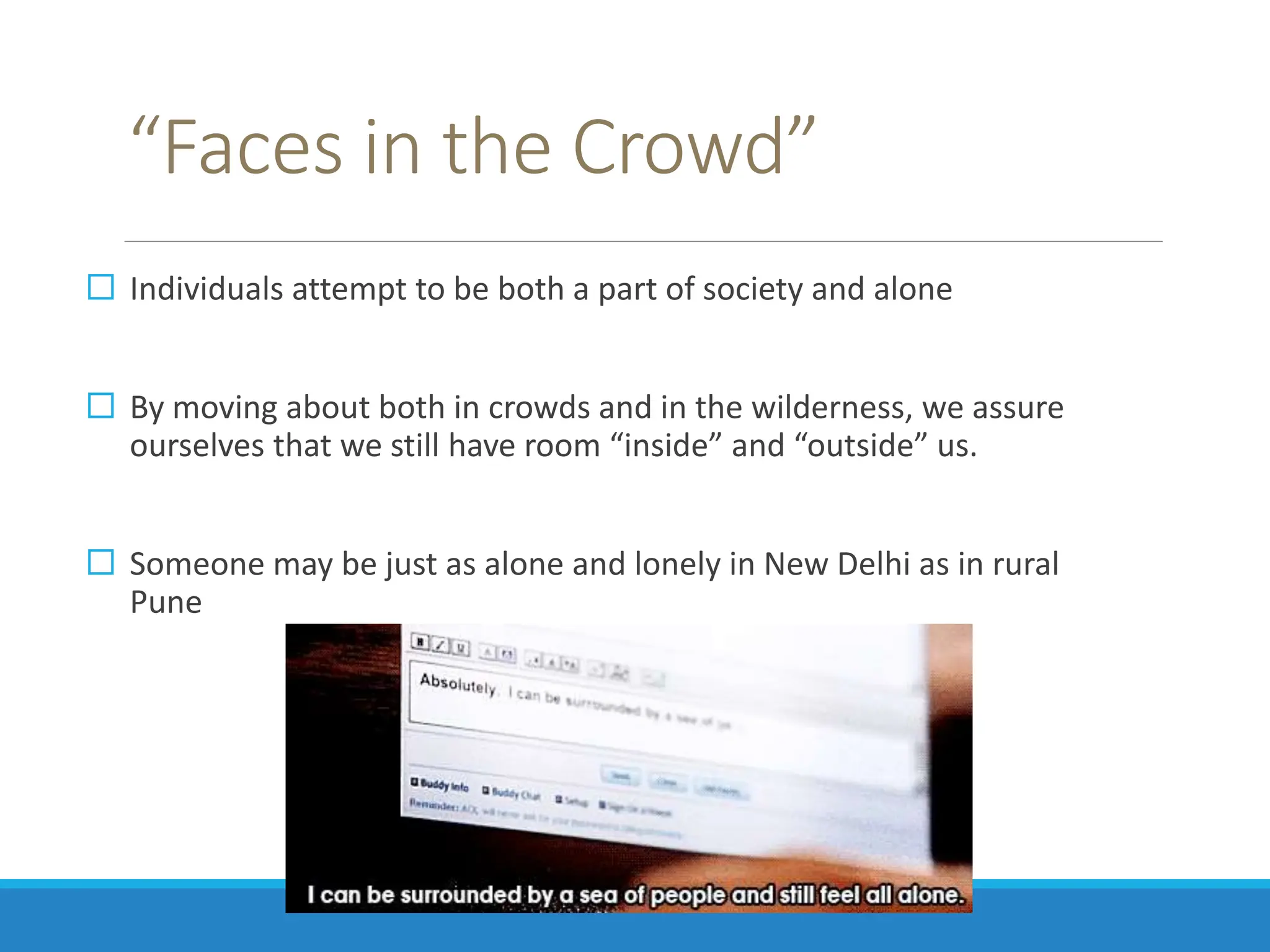
 Individuals attempt to be both a part of society and alone
 By moving about both in crowds and in the wilderness, we assure
ourselves that we still have room “inside” and “outside” us.
 Someone may be just as alone and lonely in New Delhi as in rural
Pune
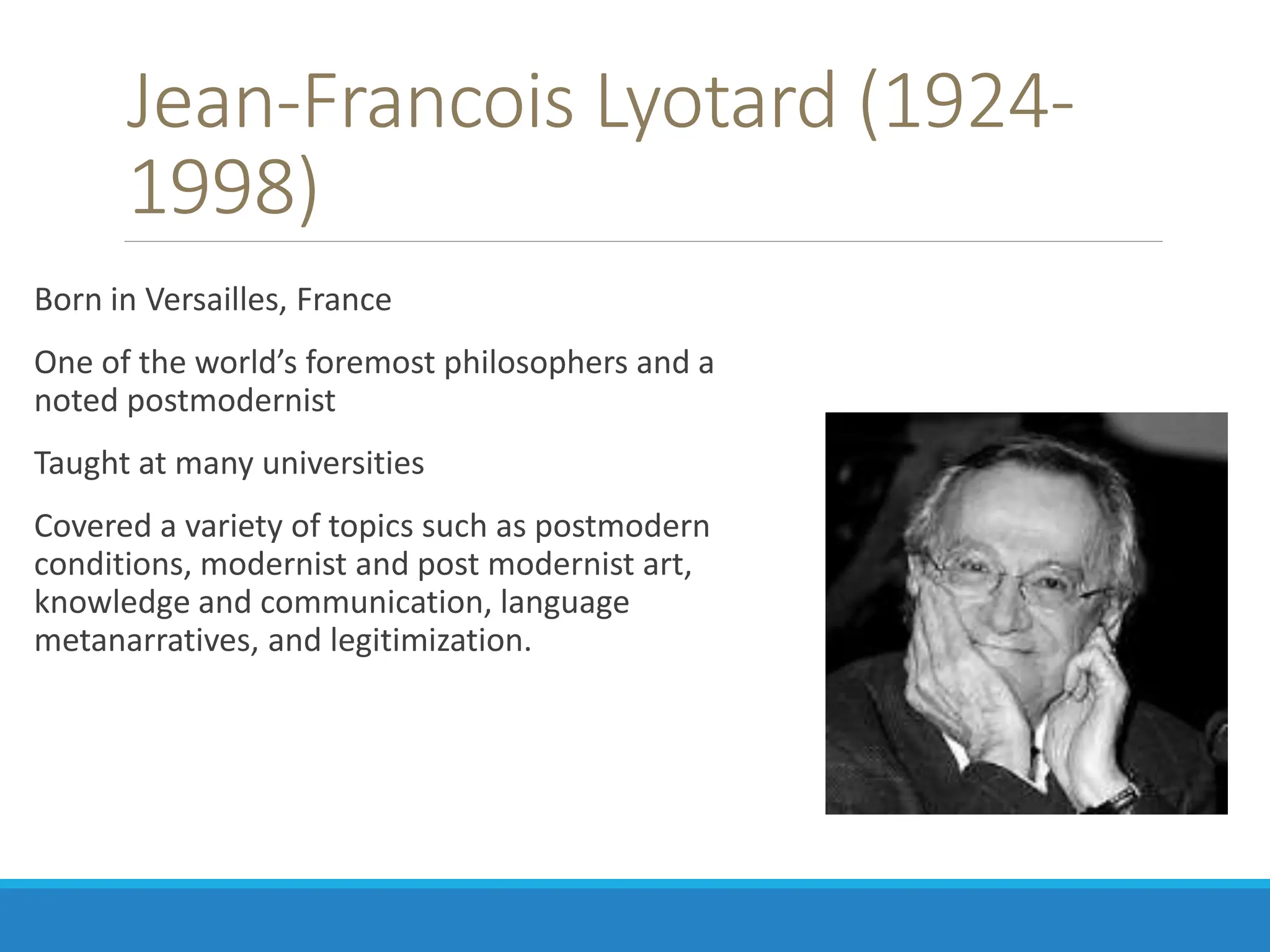
Jean-Francois Lyotard (1924-
1998)
Born in Versailles, France
One of the world’s foremost philosophers and a
noted postmodernist
Taught at many universities
Covered a variety of topics such as postmodern
conditions, modernist and post modernist art,
knowledge and communication, language
metanarratives, and legitimization.
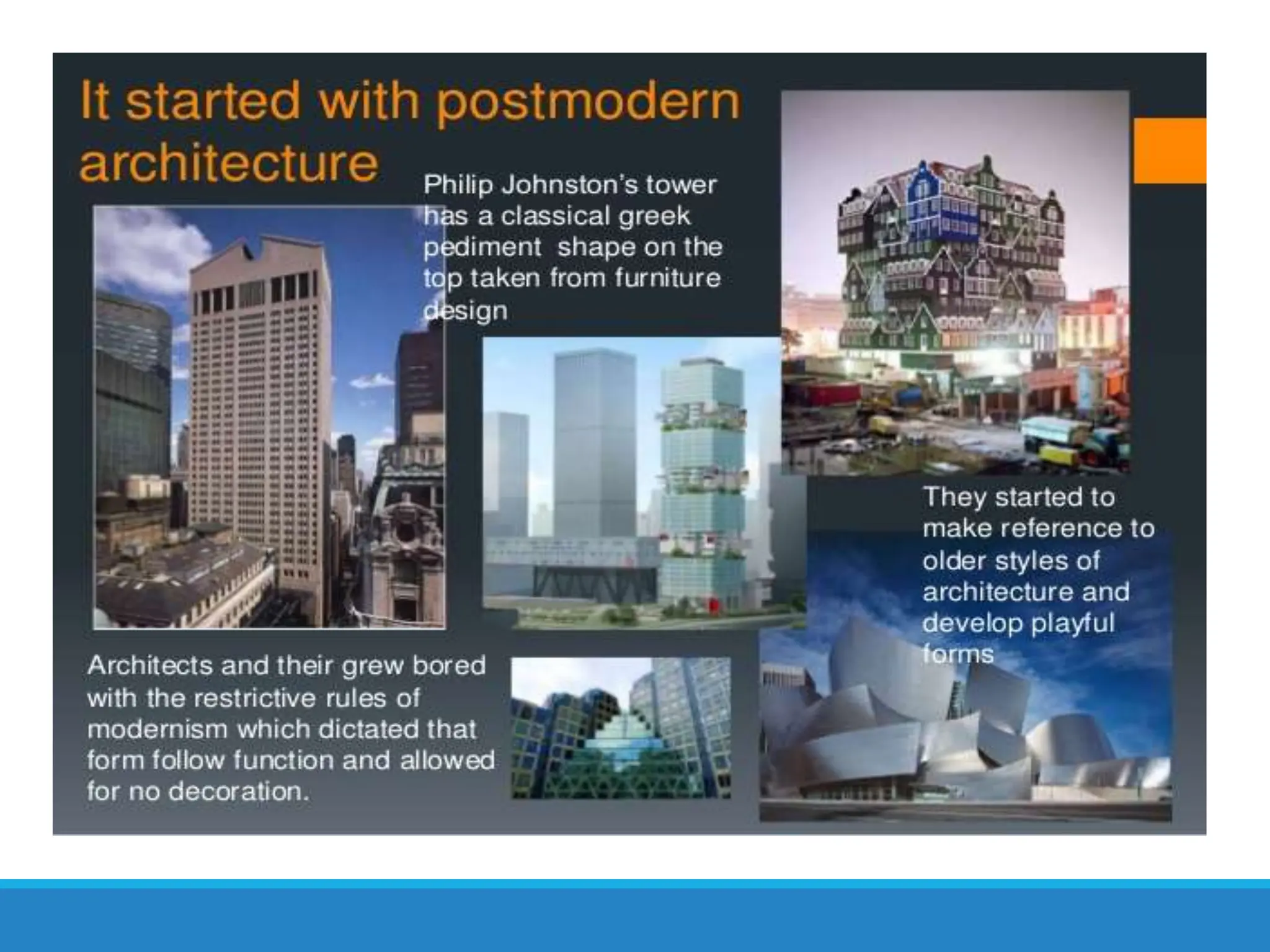
Art, Architecture, and
Postmodernism
Believed that the postmodern artist or writer is in the position of a
philosopher because the text she or he creates is not governed by pre-
established rules and cannot be judged according to the applications of
given categories
Defined postmodernity as a product, or an effect, of the development
of modernity itself
Postmodernism and
Knowledge
 Societies that have computer knowledge are at the forefront in the
transformation process to postmodernity
 Advancing technology has a direct effect on knowledge (economically
powerful nations have exerted their will on less-developed nations)
 Knowledge and power are two sides of the same question: Who
decides what knowledge is, and who knows what needs to be
decided?
Legitimation, Language,
Narratives
 Believed that grand narratives of knowledge had lost their credibility
in the postmodern society and their claims of legitimacy
 Believed narratives are an integral aspect of culture and directly
affect the language of any given society
 Used language games to contrast narrative and scientific knowledge
 Defines modernism as the attempt to legitimate science by appeal to
‘metanarratives’, or philosophical accounts of the progress of history
in which the hero or knowledge struggles toward a great goal
Language Games
Rules do not carry within themselves their own legitimation, but are
object of a contract between players
If there are no rules, there is no game, so even one modification of one
rule alters the nature of the game
Every utterance should be thought of as a ‘move’ in a game
Language Games
Language shows an example of the first efforts of legitimacy
Each human born into the world is born into a place that has already
been labeled or constructed by past events and/or by those in power
It is an infants responsibility to emancipate themselves (become an
owner of themselves)
Language is that tool of emancipation
JEAN BAUDRILLARD (1929-2006)
• He was born in 1929, in the northern French town of Reims.
• He was the first member of his family to attend university.
• 1966: became a professor of Nanterre University of Paris.
• 1968: started publishing: System of Objects; Consumer society, Critique of
the Political Economy of the Sign, The Mirror Production, Symbolic Exchange
and Death, America, On the Beach, and Cool Memories.
• His work changed: 1960’s modernist and Marxist
1980’s postmodernist and critic of Marxism
Postmodernism
 Baudrillard was a part of the French tradition challenging
traditional sociological thought.
 He refers to France as a “consumer society” (A culture of
consumption has so much taken over our ways of thinking that
all reality is filtered through the logic of exchange value and
advertising.
 "Our society thinks itself and speaks itself as a consumer
society. As much as it consumes anything, it consumes itself as
consumer society, as idea. Advertising is the triumphal
paean(s0ng) to that idea". )
Beyond Marxism
• “His relation to Marxism is extremely complex and volatile.” From
Marxism to Postmodernism and beyond
• He think the ideas about work and value, labor power, production
from Marx is a leftover product of an era long gone.
• “Baudrillard rejects Marxism both as a “mirror”, or reflection, of a
“productivist” capitalism and as a “classical” mode of representation
that purports to mirror “the real”
Contemporary Society
 Baudrillard argues in his book ‘In the Shadow of the Silent
Majorities (1983) that contemporary society has entered into a
phase of implosion.
 He believed that our society is no longer dominated by
production, but by developments of consumerism, the media,
entertainment, and information technologies.
 Mass media and entertainment led our society undergone a
“catastrophic” revolution that has led to the death of “social”
society. The postmodern society is bombard by too many
massages and means and so on.
Mass Media & Entertainment
He believed that mass media are so powerful that they have created a culture
characterized by hyper reality. (they are no longer mirror reality. Disagree with
Marxs)
The over simplification of events by the media are packaged as to appeal to
the largest audience of consumers.
Mass media are not the only social institution responsible for hyperreality, so
as all aspects of postmodern culture and entertainment.
New technologies have replaced industrial production and political economy
as the organizing principle of society.

Postmodernism for the beginners and for the school of media

  • 1.
  • 2.
    Postmodernism Defined The rejectionof the scientific canon, of the idea that there can be a single coherent rationality or that reality has a unitary nature that can be definitively observed or understood
  • 3.
    Jacques Derrida  Bornin El-Biar, Algeria  French philosopher and essayist  Used a deconstructive approach Illustrated in his three 1967 works  Of grammatology, Writing and Difference, Speech and Phenomena Developed the concept of discourse “emphasizes the primacy of the words we use, the concepts they embody, and the rules that develop within a group about what are appropriate ways of talking about things”
  • 4.
    Logocentrism Logocentrism: modes ofthinking that apply truth claims to universal propositions ◦ Our knowledge of the social world is grounded in a belief that we can make sense of our ever-changing and highly complex societies by referring to certain unchanging principles or foundations ◦ Derrida rejected this definition (what postmodernists call an anti- foundational stance)
  • 5.
    Hermeneutical Method The understandingand interpretation of published writings From Hermeneutics came the German word “Verstehen” which meant “to understand” ◦ Sociologists should look at actions of individuals and examine the meanings attached to behaviors
  • 6.
    David Riesman (1909-2002) Bornin Philadelphia Graduated from Harvard Law School in 1934 Taught at University of Chicago in 1949 1950 he co-authored the book “The Lonely Crowd” “Faces in the Crowd” written in 1952
  • 7.
    “The Lonely Crowd” discussed dramatic social changes that were reshaping American society (specifically the changing of American character)  The upper middle classes was shifting from “inner- directed” people to “other-directed” people
  • 8.
    “The Lonely Crowd” Suggests that society ensures some degree of conformity from the individuals who make it up “In every society, a mode of ensuring conformity is built into the child, and then either encouraged or frustrated in later adult experience”  Used the term ‘mode of conformity’ and social character interchangeably
  • 9.
    “Faces in theCrowd”  Individuals attempt to be both a part of society and alone  By moving about both in crowds and in the wilderness, we assure ourselves that we still have room “inside” and “outside” us.  Someone may be just as alone and lonely in New Delhi as in rural Pune
  • 10.
    Jean-Francois Lyotard (1924- 1998) Bornin Versailles, France One of the world’s foremost philosophers and a noted postmodernist Taught at many universities Covered a variety of topics such as postmodern conditions, modernist and post modernist art, knowledge and communication, language metanarratives, and legitimization.
  • 11.
    Art, Architecture, and Postmodernism Believedthat the postmodern artist or writer is in the position of a philosopher because the text she or he creates is not governed by pre- established rules and cannot be judged according to the applications of given categories Defined postmodernity as a product, or an effect, of the development of modernity itself
  • 15.
    Postmodernism and Knowledge  Societiesthat have computer knowledge are at the forefront in the transformation process to postmodernity  Advancing technology has a direct effect on knowledge (economically powerful nations have exerted their will on less-developed nations)  Knowledge and power are two sides of the same question: Who decides what knowledge is, and who knows what needs to be decided?
  • 16.
    Legitimation, Language, Narratives  Believedthat grand narratives of knowledge had lost their credibility in the postmodern society and their claims of legitimacy  Believed narratives are an integral aspect of culture and directly affect the language of any given society  Used language games to contrast narrative and scientific knowledge  Defines modernism as the attempt to legitimate science by appeal to ‘metanarratives’, or philosophical accounts of the progress of history in which the hero or knowledge struggles toward a great goal
  • 17.
    Language Games Rules donot carry within themselves their own legitimation, but are object of a contract between players If there are no rules, there is no game, so even one modification of one rule alters the nature of the game Every utterance should be thought of as a ‘move’ in a game
  • 18.
    Language Games Language showsan example of the first efforts of legitimacy Each human born into the world is born into a place that has already been labeled or constructed by past events and/or by those in power It is an infants responsibility to emancipate themselves (become an owner of themselves) Language is that tool of emancipation
  • 19.
    JEAN BAUDRILLARD (1929-2006) •He was born in 1929, in the northern French town of Reims. • He was the first member of his family to attend university. • 1966: became a professor of Nanterre University of Paris. • 1968: started publishing: System of Objects; Consumer society, Critique of the Political Economy of the Sign, The Mirror Production, Symbolic Exchange and Death, America, On the Beach, and Cool Memories. • His work changed: 1960’s modernist and Marxist 1980’s postmodernist and critic of Marxism
  • 20.
    Postmodernism  Baudrillard wasa part of the French tradition challenging traditional sociological thought.  He refers to France as a “consumer society” (A culture of consumption has so much taken over our ways of thinking that all reality is filtered through the logic of exchange value and advertising.  "Our society thinks itself and speaks itself as a consumer society. As much as it consumes anything, it consumes itself as consumer society, as idea. Advertising is the triumphal paean(s0ng) to that idea". )
  • 21.
    Beyond Marxism • “Hisrelation to Marxism is extremely complex and volatile.” From Marxism to Postmodernism and beyond • He think the ideas about work and value, labor power, production from Marx is a leftover product of an era long gone. • “Baudrillard rejects Marxism both as a “mirror”, or reflection, of a “productivist” capitalism and as a “classical” mode of representation that purports to mirror “the real”
  • 22.
    Contemporary Society  Baudrillardargues in his book ‘In the Shadow of the Silent Majorities (1983) that contemporary society has entered into a phase of implosion.  He believed that our society is no longer dominated by production, but by developments of consumerism, the media, entertainment, and information technologies.  Mass media and entertainment led our society undergone a “catastrophic” revolution that has led to the death of “social” society. The postmodern society is bombard by too many massages and means and so on.
  • 23.
    Mass Media &Entertainment He believed that mass media are so powerful that they have created a culture characterized by hyper reality. (they are no longer mirror reality. Disagree with Marxs) The over simplification of events by the media are packaged as to appeal to the largest audience of consumers. Mass media are not the only social institution responsible for hyperreality, so as all aspects of postmodern culture and entertainment. New technologies have replaced industrial production and political economy as the organizing principle of society.

Editor's Notes

  • #5 Derrida said we couldn’t be grounded in the belief that we can make sense of our world because it is ever-changing and highly complex
  • #6 Goal was not limited to merely undrestanding the basic structure of the text, but the thinking of the author as well
  • #8 Inner-directed: as children internalized goals that were essentially “implanted” by elders Other directed: sensitized to the expectations and preferences of others, (the new American no longer cared much about adult authority but rather was hyperalert to peer groups and gripped by mass media) The lonely crowd was jargon-free, making it easy to understand, (became the best-selling book by a sociologist with 1.4 million copies sold. “inner directed” and “other-directed” became staple words used at cocktail parties
  • #9 “while societies and individuals may live well enough---if rather boringly—without creativity, it is not likely that they can live without some mode of conformity—even be it one of rebellion”
  • #10 Torn between society and solitude (introvert and extrovert mixed) A Cinderella Story with Hilary Duff & Chad Michael Murry “I can be surrounded by a sea of people and still feel so alone” Riesman is trying to say that historical experiences of our society may have a bearing on what we, as individuals, have become today
  • #12 The modern refuses to fit in predertermined categories which forces it into a new category
  • #16 Lyotard wanted to abolish the monopoly that certain orthodoxies have enjoyed over claims to “truth” and “knowledge production”s
  • #18 Language can be used for the sheer pleasure of “making a move” in the game of life, and it can be used as a weapon, for if knowledge is power, communicating in tactical and purposeful manner may allow individuals to gain an advantage over others