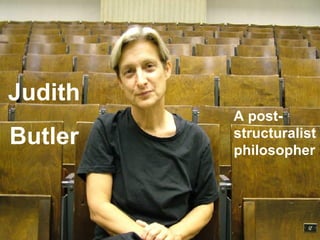
Judith Butler A post-structuralist philosopher
Biography Born on the 24 th  February, 1956, Cleveland, Ohio Butler identifies herself as an anti-Zionist Jewish American. She came out as a lesbian at the age of 14. She earned her PhD in Philosophy from Yale University in 1984, same place she got her BA. Currently she is Maxine Elliot professor of Rhetoric and Comparative Literature at University of California, Berkley. The most common subject associated with Butler is queer theory, but she has also written on subjects like language, political philosophy, jewish philosophy and psychoanalysis Butler was a member of a guerrilla theatre group called LIPS , which she says she enjoyed because “ it stood for nothing”. In 2004 she received the Brudner Prize at Yale.
Bibliography Subjects of Desire: Hegelian Reflections in Twentieth-Century France,  1987 Gender Trouble: Feminism and the Subversion of Identity . 1990   Edited (With Joan W. Scott),  Feminists Theorize the Political , 1992 Bodies that Matter: On the Discursive Limits of "Sex" , 1993 Feminist Contentions: A Philosophical Exchange  (with Seyla Benhabib, Drucilla Cornell, and Nancy Fraser), 1995 Excitable Speech: A Politics of the Performative,  1997   The Psychic Life of Power: Theories in Subjection , 1997 What's Left of Theory?: New Work on the State and Politics of Literary Theory  (with John Guillory and Kendall Thomas), 1999 Contingency, Hegemony, Universality: Contemporary Dialogues On The Left  (with Ernesto Laclau and Slavoj Zizek), 2000 Antigone’s Claim: The Kinship Between Life and Death,  2000 Women and Social Transformation  (with Elisabeth Beck-Gernsheim and Lilia Puigvert), 2003 Precarious Life: The Powers of Mourning and Violence , 2004 Undoing Gender , 2004 Giving an Account of Oneself,  2005 Who Sings the Nation-State?: Language, Politics, Belonging,  2007
Significant Influences on Butler Simone De Beauvoir Michel Foucault Gayle Rubin Eve Kosofsky Sedgwick Monique Wittig
Simone De Beauvoir A feminist existentialist, De Beauvoir was born 1908.  She passed a BA in mathematics and philosophy at Sorborne University, where her attention was drawn to Jean-Paul Sartre in 1929. They went on to become lovers and life-long companions. Selected works include  All Men Are Mortal  (1946),  The Ethics of Ambiguity  (1947),  The Second Sex  (1949),  The Mandarins  (1954), and  When Things of the Spirit Come First  (1979). In the essay  Women: Myth and Reality,  De Beauvoir claims that men have created women as the “other” sex and that women have been socially subjugated as a result, and argues that this is also true of other minority groups. The Second Sex  is De Beauvoir’s signature work. It was written as an attempt at defining herself, but she then realized the need to define what a woman is. This in turn became the aim of her book, which is a work about the treatment of women through history. She argues that women have been defined as the "other“ or “deviant” sex, in contrast to the "normal" male sex. As an existentialist, she believed that we are born neutral and create our worlds independently of other. One of her most famous quotes is  “Iwas not born a woman – I became one”.
Michel Foucault A philosopher and historian, Foucault was born in 1926 in Poitiers, France. A politically active person, he often protested and sympathised especially with homosexuals and prisoners. During his education, he became severely depressed and gained an interest in psychology as a result of the treatment he received. Like Butler, he taught at the University of California, Berkley. He was initially associated with the structuralist movement, but rejected this later, along with labels like post-structuralist. His major works include  Madness and Civilization  (1961),  The Order of Things  (1966),  The Archaeology of Knowledge  (1969) ,  and  The History of Sexuality  (1976) .   Foucault died of an AIDS-related illness in 1984, and was unable to complete the last three volumes of  The History of Sexuality .
Gayle Rubin Born 1949, Rubin is a cultural anthropologist concerned with gender politics, feminism and sadomasochism. She became one of the co-founders of two lesbian SM groups: Samois and The Outcasts.  Rubin’s most prominent work is  The Traffic in Women: Notes on the 'Political Economy' of Sex  (1975), an essay discussing how society creates a heterosexual norm by converting sex to gender. She felt that previous ideas failed to describe or identify the cause of women’s role as inferior members of society. Other essays include  Thinking Sex: Notes for a Radical Theory of the Politics of Sexuality  (1984) and  Of Catamites and Kings: Reflections on Butch, Gender, and Boundaries  (1992)
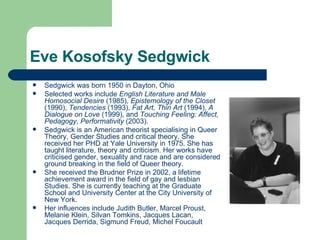
Eve Kosofsky Sedgwick Sedgwick was born 1950 in Dayton, Ohio Selected works include  English Literature and Male Homosocial Desire  (1985),  Epistemology of the Closet  (1990),  Tendencies  (1993),  Fat Art, Thin Art  (1994),  A Dialogue on Love  (1999), and  Touching Feeling: Affect, Pedagogy, Performativity  (2003). Sedgwick is an American theorist specialising in Queer Theory, Gender Studies and critical theory. She received her PHD at Yale University in 1975. She has taught literature, theory and criticism. Her works have criticised gender, sexuality and race and are considered ground breaking in the field of Queer theory.  She received the  Brudner Prize  in 2002, a lifetime achievement award in the field of gay and lesbian Studies. She is currently teaching at the Graduate School and University Center at the City University of New York. Her influences include Judith Butler, Marcel Proust,  Melanie Klein, Silvan Tomkins,  Jacques  Lacan ,  Jacques Derrida ,  Sigmund Freud ,  Michel Foucault
Monique Wittig An author and feminist theorist, Wittig was born in 1935 in France. Her main concern was feminism and overcoming gender. She was a member of the first lesbian group in Paris, the  Gouines Rouges . Major Works include  Les Guérillères  (1969),  The Lesbian Body  (1973), and  The Straight Mind  (1992).  She collaborated with Simone de Beauvoir in  Feminist Issues,  a series of essays concerned with rejecting male power. These essays became very popular within the feminist and gay community, and were published as  The Straight Mind. Wittig died in 2003 in Arizona, where she had been teaching for 12 years. “’ Woman’ has meaning only in heterosexual systems of thought and heterosexual economic systems. Lesbians are not women."
Key Terms associated with Butler Anti-Zionism : An opposition to the Zionist movement that believes there is a Jewish homeland in Palestine. Gender Construction : The act of becoming, or indentifying with, a certain gender.  Performativity : The behaviour of individuals based on social norms.  Post-Structuralism : A movement criticising Structuralism. Post-Structuralists are concerned with how there is no stable meaning in intellectual categories. The human has no single concept of ‘self’, a text does not mean one thing to every reader, and so on. Most theorists associated with post-structuralism do not use this label for themselves. Queer Theory : A field of gender studies that suggests one’s gender and sexuality can’t be defined or categorized. The identity of a person consists of a wide variety of parts which makes everyone individual rather than part of a group.  Third-Wave Feminism : The feminist activity beginning in the 1990’s, concerned with diversity, fair representation of women in the media, standards of beauty, as well as legal issues like abortion and sexual harassment.
Gender Trouble: Feminism and the Subversion of Identity (1990) Butler’s most popular work, discussing the extent to which gender and sexuality are  performative . What we consider to be gender-appropriate behaviour, or ‘natural’ sexual or gender behaviour is  culturally constructed .  The way people behave, men and women, create a framework for what our society considers to be biologically inherent. If we view this limited behaviour as ‘normal’, then everything else becomes ‘abnormal’.  Butler argues that we behave as individuals, performing individual acts, and these acts are not dependent on our biological gender. Rather than creating our gender based on our biological sex, we have created an idea of what is biological from the gender we have constructed.
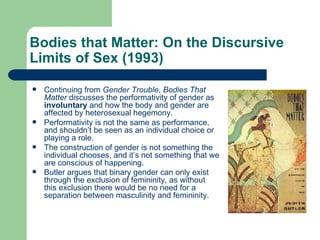
Bodies that Matter: On the Discursive Limits of Sex (1993) Continuing from  Gender Trouble ,  Bodies That Matter  discusses the performativity of gender as  involuntary  and how the body and gender are affected by heterosexual hegemony.  Performativity is not the same as performance, and shouldn’t be seen as an individual choice or playing a role.  The construction of gender is not something the individual chooses, and it’s not something that we are conscious of happening. Butler argues that binary gender can only exist through the exclusion of femininity, as without this exclusion there would be no need for a separation between masculinity and femininity.
Excitable Speech: A Politics of the Performative (1997) In  Excitable Speech , Butler brings up the subject of  hate speech  and  censorship , arguing from the point of view that speaking is not tantamount to acting. Hate speech is not hate speech in itself, but only becomes that when defined by an authority. Unlike actions, the performative meaning of words cannot be defined.  Individuals do not have a definite reaction to language except when this language is defined as something they should react to. By censoring certain words, we make the presumption that the words will inevitably have the intended effect on the recipient.
Undoing Gender  (2004) Undoing Gender  is a collection of recent essays concerned with the question of what it would mean to undo the conceptions of gender.  Beside Oneself: On the limits of sexual autonomy  deals with the ties of grief and desire and how loss affects our fundamental sense of oneself. It looks at the possibilities for using grief in a “collective responsibility for the physical lives of one another” rather than the usual alternative of violence. It looks at the issue of violence towards those outside the conjugal social norms in gender and questions whether a desire to kill those outside these norms suggests that life ‘requires a set of sheltering norms, and that to be outside it, is to court death.” Gender regulations  raises the question does gender pre-exist regulation or have regulations themselves created gendered subjects? To assume gender exclusively means masculine and famines is to miss the point that those genders that do not fit with the norm are just as much a part of the perceived gendered norms as they themselves. Butler discus’s Levi Straus’s point that cultural rules are not alterable in regards to incest where the prohibition comes from a universal law of culture. She looks at symbolic positions and social norms : “The norm is a measurement and a means of producing a common standard. To become an instance of the norm is not to fully exhaust the norm, but, rather to become subjected to an abstraction of commonality.”
Undoing Gender, cont. Doing Justice to someone  raises the issues made by the David Reimer case, a baby, who after a botched operation left him with a badly damaged penis, was surgically changed to a girl in the hope he would lead a better life. Reimer’s parents had been persuaded that if the child’s gender was surgically altered at an early age and the child was brought up in every way as a girl, he would adapt to his new gender and lead a normal life. However, despite continued monitoring by doctors for the purpose of fostering the adaption, Reimer continued to show signs of masculinity. Reimer was reassessed by a set of new psychiatrists and was offered the chance to be surgically changed back in to a male. Butler sites this case as an example that a person contains an inbuilt gender identity. Un-diagnosing gender  discusses the status of the DSM-IV (Diagnostic and statistical manual of mental disorders) in relation to gender identity disorder (GID) and it’s perception that to be diagnosed with GID is to deem the person as having a stigmatised abnormality. Butler discusses the un-diagnosing of GID, the complexities behind the debate and what it means to live with its diagnosis, “Does it help people to live, to achieve a life that feels worth living? Do the financial benefits afforded to operations achieved through GID diagnosis warrant its existence? Is kinship always already homosexual  considers the possible consequences legislation for gay marriages may have upon other non gender norms. She looks into the debates involved when looking at what a state should do and also provide when dealing with intimate relations in non gender norms and which of these ought to be eligible for state legitimisation. Butler suggests kinship is “neither a fully autonomous sphere, proclaimed to be distinct from community and friendship – or the regulations of the state…. It has lost the capacity to be formalised and tracked in the conventional ways.”
Undoing Gender, cont. In  Longing for Recognition , Butler discusses intersubjective recognition, citing works by Jessica Benjamin suggesting that recognition is a process engaged when a subject and an other “understand themselves to be reflected in one another, but where this reflection does not result in a collapse of the one into the other.” She suggests intersubjectivity is not the same as object relations and it “adds to object relations the notion of an external other.” In  Quandaries of the Incest Taboo,  Butler suggests incest and normative kinship are related throught the incest taboo. Contemporary social discussion questions whether incest is real or is fantasised and how to differentiate between them. “The distinction between event and wish is not as clear as it is sometimes held to be.” Bodily Confessions  discusses the act of confession and the relationship between language, body and psychoanalysis. Butler asks why “with difficulty and courage, [would we] speak our desires before another human being, and await the words they will speak in return?” The End of sexual difference  discusses the differences that emerge when dealing with equality for women; does this mean men and women should be treated interchangeably? She considers the confliction between sexual difference, gender and sexuality.
Giving an Account of Oneself  (2005) Giving an Account of Oneself  focuses on the possibilities of  self narration  and the  constitution of the self . It questions the ability to answer questions about yourself. Can we assume responsibility and give an account of ourselves if we are oblivious to where we came from, of who we are? Butler highlights the limits of  self-knowledge/narration , saying that no matter how you try you will not be able to convey your ideas accurately. The restraints of language are partly to blame for this, as we do not own language. Before we can narrate ourselves, we must first discover who we are, and how we came into being. Our first question in this process would be ‘who are you?’. We ask this to discover the ‘other’ in ourselves.  Once we have made this discovery, the narration of ourselves emerges from this, as we emerged from these others. When we can understand those through which we came into being, we can begin to understand ourselves. These others founded the way we speak and use language,
People inspired by Butler’s work Kate Bornstein Judith Halberstam Todd Haynes José Esteban Muñoz  Michael Warner
Kate Bornstein Born Albert Bornstein in 1948. Underwent sex reassignment surgery in 1986.  Bornstein is an author, playwright and performance artist concerned with changing people’s notions of gender. She believes we do not have to limit ourselves to being either male or female. Considers  Gender Outlaw: On Men, Women and the Rest of Us  as her major work, which she describes as a  “coming-of-age story and manifesto” . Plays include  The Opposite Sex is Neither, Virtually Yours,  and  Strangers in Paradox. Currently she is leading workshops for young people in schools, youth groups and colleges on subjects such as gender, sex and teenage suicide.
Judith Halberstam Born 1961, Halberstam is Professor of English and Director of the Center for Feminist Research at the University of Southern California. Halberstam contributes and teaches in the fields of gender and queer theory, art, film and literature. She is also a member of the drag king community under the name Jack. Selected works include  Female Masculinity  (1998) and  In a Queer Time and Place: Transgender Bodies, Subcultural Lives  (2005). She edited a special issue of  Social Text  called  What's Queer about Queer Studies Now?  with José Esteban Muñoz and David L. Eng in 2005, and has featured in the documentaries  Venus Boyz  (2002) and  Boy I Am  (2006).  “ I argue that despite an almost universal concurrence, femaleness does not automatically produce femininity and maleness does not produce masculinity“.
Todd Haynes Born 1961, Haynes is an award-winning director. Haynes made his first short film while in high school ( The Suicide , 1978) and gained a BA at Brown University. In his 1987 film  Superstar: The Karen Carpenter Story,  he used Barbie dolls to chronicle Carpenter’s life and eating disorder. The film gained great recognition on the film circuit, but  became subject to a lawsuit and was removed from distribution. Haynes is mostly associated with the ‘queer cinema’ label which he earned after making his 1991 film  Poison . A highly controversial film inspired by the writing of Jean Genet,  Poison  featured graphic scenes of homosexual rape and was targeted by the American Family Association.  Later productions are more detached from queer cinema and shows Haynes’ interest in issues of race and class, psychology, pop culture, music and sexuality.
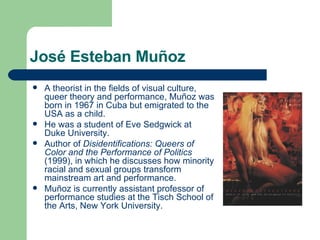
José Esteban Muñoz A theorist in the fields of visual culture, queer theory and performance, Muñoz was born in 1967 in Cuba but emigrated to the USA as a child. He was a student of Eve Sedgwick at Duke University. Author of  Disidentifications: Queers of Color and the Performance of Politics  (1999), in which he discusses how minority racial and sexual groups transform mainstream art and performance.  Muñoz is currently assistant professor of performance studies at the Tisch School of the Arts, New York University.
Michael Warner Considered one of the founders of Queer Theory, Warner is currently a senior professor at Yale and a prolific writer. His works include  Fear of a Queer Planet  (1993) and  The Trouble With Normal: Sex, Politics, and the Ethics of Queer Life  (2000) .  Both of these texts made him a major figure within the gay community. Warner coined the term ‘heteronormativity’, which aims to describe how people are forced to conform to heterosexual standards of identity through social and legal practices.
Other works inspired by Butler BORNSTEIN, KATE:  Gender Outlaw: On Men, Women and the Rest of Us.  Vintage, 1995 FOX, PAMELA:  Recycled ‘Trash’: Gender and Authenticity in Country Music Autobiography.  American Quarterly - Vol. 50, Nr. 2, June 1998, pp. 234-266  HALBERSTAM, JUDITH:  Female Masculinity.  Durham: Duke University Press, 1998  HAMILL, MEG:  Death Notices . Factory School, 2007 HARDING, JENNIFER:  Sex Acts: Practices of Femininity and Masculinity.  London: Sage, 1998 LAWLOR-MARIANO, ANDREA:  Judy!  [fanzine], 1992  MU Ñ OZ, JOS É  E.:  Disidentifications: Queers of Color and the Performance of Politics.  University of Minnesota Press, 1999 NEALON, JEFFREY T.:  Alterity Politics: Ethics and Performative Subjectivity.  Durham and London: Duke University Press, 1998 PLUMMER, KEN   (ed.):  Sexualities  [journal]. London: Sage, 1996 WARNER, MICHAEL:  Fear of a Queer Planet.  University of Minnesota Press, 1993 WORONOV, T. E.:  Performing the Nation: China's Children as Little Red Pioneers.  Anthropological Quarterly - Vol. 80, Nr. 3, Summer 2007, pp. 647-672
Queer Theory and the media The 1994 production  Beautiful Thing , as well as the American sitcoms  Ellen  (1994) and  Will & Grace  (1998) have been heralded as the forerunners of a string of programmes featuring homosexuals. Before the 1980’s, homosexuality was not a theme seen in the mainstream media, and it was not until 1999 that the first gay sex scene was shown on UK television, in Channel 4’s  Queer As Folk . The fact that there even is such a label as ‘queer cinema’ shows the effect of 1990’s theorists on the arts. In queer cinema, there is a wide representation of sexualities that do not follow societal norms, or are not conventional.
Effects of Queer Theory in society Butler’s theories on hate speech relate to the third-wave feminist idea of reclaiming negative terms associated with women. The word ‘bitch’ is used as the title for a feminist magazine, and in Eve Ensler’s  The Vagina Monologues  she encourages women to not be ashamed to say ‘cunt’.  Although it is often assumed that the gender we are born with is ‘who we are’, we also allow for people to not conform to their biological sex. Gender reassignment surgery is now available on the NHS, and it was only in 2005 that the acquired gender became the legal gender for the person concerned. Approximately one in 65,000 people seek to change their sex. The increasing acceptance of unconventional gender and sexuality has allowed gay couples to have the same rights as a married heterosexual couple through civil partnership in the UK as of 2005.
Sources Books and Journals: BUTLER, J.:  Gender Trouble: Feminism and the Subversion of Identity . New York and London: Routledge, 1990.  Bodies that Matter: On the Discursive Limits of "Sex" , Routledge, 1993.  Excitable Speech: A Politics of the Performative,  Routledge,   1997.  Undoing Gender , Routledge, 2004.  Giving an Account of Oneself,  Fordham University Press, 2005 DE BEAUVOIR, S.:  The Second Sex.  Vintage, 1997 (first published 1949). JAGOSE, A.:  Queer Theory: An Introduction . New Yoprk: New York University Press, 1996 OSBORNE, P. and SEGAL, L.:  Gender as Performance: An Interview with Judith Butler. Radical Philosophy,  no.67, summer 1994 PHELAN, S. (ed.):  Playing With Fire: Queer Politics, Queer Theories.  New York and London: Routledge, 1997 SPARGO, T.:  Foucault and Queer Theory . New York: Totem Book, 1999 WARNER, M.:  Fear of a Queer Planet: Queen Politics and Social Theory.  University of Minnesota Press, 1993 Websites: Butler’s Bibliography:  www.theory.org.uk/ctr-butl.htm Internet Encyclopaedia of Philosophy entry on Simone De Beauvoir:  www.iep.utm.edu/b/beauvoir.htm Stanford Encyclopaedia of Philosophy entry on Michel Foucault:  plato.stanford.edu/entries/foucault / Encyclopaedia Britannica Online entry on Monique Wittig:  www.britannica.com/eb/article-9100500/Monique-Wittig Kate Bornstein’s website:  www.tootallblondes.com/KatePages/indexkb.htm Judith Halberstam’s website:  www.egomego.com/judith/home.htm Review of  Undoing Gender  by Butler: www.genderforum.uni-koeln.de/illuminating/review_schultz.html New York Times’ biography of Todd Haynes:  movies.nytimes.com/person/93836/Todd-Haynes/biography University of Minnesota Press summary of  Disidentifications  by Haynes:  www.upress.umn.edu/Books/m/munoz_disidentifications.html Wikipedia on: Butler, De Beauvoir, Foucault, Halberstam.

Judith Butler - Resource Pack

  • 1.
    Judith Butler Apost-structuralist philosopher
  • 2.
    Biography Born onthe 24 th February, 1956, Cleveland, Ohio Butler identifies herself as an anti-Zionist Jewish American. She came out as a lesbian at the age of 14. She earned her PhD in Philosophy from Yale University in 1984, same place she got her BA. Currently she is Maxine Elliot professor of Rhetoric and Comparative Literature at University of California, Berkley. The most common subject associated with Butler is queer theory, but she has also written on subjects like language, political philosophy, jewish philosophy and psychoanalysis Butler was a member of a guerrilla theatre group called LIPS , which she says she enjoyed because “ it stood for nothing”. In 2004 she received the Brudner Prize at Yale.
  • 3.
    Bibliography Subjects ofDesire: Hegelian Reflections in Twentieth-Century France, 1987 Gender Trouble: Feminism and the Subversion of Identity . 1990 Edited (With Joan W. Scott), Feminists Theorize the Political , 1992 Bodies that Matter: On the Discursive Limits of "Sex" , 1993 Feminist Contentions: A Philosophical Exchange (with Seyla Benhabib, Drucilla Cornell, and Nancy Fraser), 1995 Excitable Speech: A Politics of the Performative, 1997 The Psychic Life of Power: Theories in Subjection , 1997 What's Left of Theory?: New Work on the State and Politics of Literary Theory (with John Guillory and Kendall Thomas), 1999 Contingency, Hegemony, Universality: Contemporary Dialogues On The Left (with Ernesto Laclau and Slavoj Zizek), 2000 Antigone’s Claim: The Kinship Between Life and Death, 2000 Women and Social Transformation (with Elisabeth Beck-Gernsheim and Lilia Puigvert), 2003 Precarious Life: The Powers of Mourning and Violence , 2004 Undoing Gender , 2004 Giving an Account of Oneself, 2005 Who Sings the Nation-State?: Language, Politics, Belonging, 2007
  • 4.
    Significant Influences onButler Simone De Beauvoir Michel Foucault Gayle Rubin Eve Kosofsky Sedgwick Monique Wittig
  • 5.
    Simone De BeauvoirA feminist existentialist, De Beauvoir was born 1908. She passed a BA in mathematics and philosophy at Sorborne University, where her attention was drawn to Jean-Paul Sartre in 1929. They went on to become lovers and life-long companions. Selected works include All Men Are Mortal (1946), The Ethics of Ambiguity (1947), The Second Sex (1949), The Mandarins (1954), and When Things of the Spirit Come First (1979). In the essay Women: Myth and Reality, De Beauvoir claims that men have created women as the “other” sex and that women have been socially subjugated as a result, and argues that this is also true of other minority groups. The Second Sex is De Beauvoir’s signature work. It was written as an attempt at defining herself, but she then realized the need to define what a woman is. This in turn became the aim of her book, which is a work about the treatment of women through history. She argues that women have been defined as the "other“ or “deviant” sex, in contrast to the "normal" male sex. As an existentialist, she believed that we are born neutral and create our worlds independently of other. One of her most famous quotes is “Iwas not born a woman – I became one”.
  • 6.
    Michel Foucault Aphilosopher and historian, Foucault was born in 1926 in Poitiers, France. A politically active person, he often protested and sympathised especially with homosexuals and prisoners. During his education, he became severely depressed and gained an interest in psychology as a result of the treatment he received. Like Butler, he taught at the University of California, Berkley. He was initially associated with the structuralist movement, but rejected this later, along with labels like post-structuralist. His major works include Madness and Civilization (1961), The Order of Things (1966), The Archaeology of Knowledge (1969) , and The History of Sexuality (1976) . Foucault died of an AIDS-related illness in 1984, and was unable to complete the last three volumes of The History of Sexuality .
  • 7.
    Gayle Rubin Born1949, Rubin is a cultural anthropologist concerned with gender politics, feminism and sadomasochism. She became one of the co-founders of two lesbian SM groups: Samois and The Outcasts. Rubin’s most prominent work is The Traffic in Women: Notes on the 'Political Economy' of Sex (1975), an essay discussing how society creates a heterosexual norm by converting sex to gender. She felt that previous ideas failed to describe or identify the cause of women’s role as inferior members of society. Other essays include Thinking Sex: Notes for a Radical Theory of the Politics of Sexuality (1984) and Of Catamites and Kings: Reflections on Butch, Gender, and Boundaries (1992)
  • 8.
    Eve Kosofsky SedgwickSedgwick was born 1950 in Dayton, Ohio Selected works include English Literature and Male Homosocial Desire (1985), Epistemology of the Closet (1990), Tendencies (1993), Fat Art, Thin Art (1994), A Dialogue on Love (1999), and Touching Feeling: Affect, Pedagogy, Performativity (2003). Sedgwick is an American theorist specialising in Queer Theory, Gender Studies and critical theory. She received her PHD at Yale University in 1975. She has taught literature, theory and criticism. Her works have criticised gender, sexuality and race and are considered ground breaking in the field of Queer theory. She received the Brudner Prize in 2002, a lifetime achievement award in the field of gay and lesbian Studies. She is currently teaching at the Graduate School and University Center at the City University of New York. Her influences include Judith Butler, Marcel Proust, Melanie Klein, Silvan Tomkins, Jacques Lacan , Jacques Derrida , Sigmund Freud , Michel Foucault
  • 9.
    Monique Wittig Anauthor and feminist theorist, Wittig was born in 1935 in France. Her main concern was feminism and overcoming gender. She was a member of the first lesbian group in Paris, the Gouines Rouges . Major Works include Les Guérillères (1969), The Lesbian Body (1973), and The Straight Mind (1992). She collaborated with Simone de Beauvoir in Feminist Issues, a series of essays concerned with rejecting male power. These essays became very popular within the feminist and gay community, and were published as The Straight Mind. Wittig died in 2003 in Arizona, where she had been teaching for 12 years. “’ Woman’ has meaning only in heterosexual systems of thought and heterosexual economic systems. Lesbians are not women."
  • 10.
    Key Terms associatedwith Butler Anti-Zionism : An opposition to the Zionist movement that believes there is a Jewish homeland in Palestine. Gender Construction : The act of becoming, or indentifying with, a certain gender. Performativity : The behaviour of individuals based on social norms. Post-Structuralism : A movement criticising Structuralism. Post-Structuralists are concerned with how there is no stable meaning in intellectual categories. The human has no single concept of ‘self’, a text does not mean one thing to every reader, and so on. Most theorists associated with post-structuralism do not use this label for themselves. Queer Theory : A field of gender studies that suggests one’s gender and sexuality can’t be defined or categorized. The identity of a person consists of a wide variety of parts which makes everyone individual rather than part of a group. Third-Wave Feminism : The feminist activity beginning in the 1990’s, concerned with diversity, fair representation of women in the media, standards of beauty, as well as legal issues like abortion and sexual harassment.
  • 11.
    Gender Trouble: Feminismand the Subversion of Identity (1990) Butler’s most popular work, discussing the extent to which gender and sexuality are performative . What we consider to be gender-appropriate behaviour, or ‘natural’ sexual or gender behaviour is culturally constructed . The way people behave, men and women, create a framework for what our society considers to be biologically inherent. If we view this limited behaviour as ‘normal’, then everything else becomes ‘abnormal’. Butler argues that we behave as individuals, performing individual acts, and these acts are not dependent on our biological gender. Rather than creating our gender based on our biological sex, we have created an idea of what is biological from the gender we have constructed.
  • 12.
    Bodies that Matter:On the Discursive Limits of Sex (1993) Continuing from Gender Trouble , Bodies That Matter discusses the performativity of gender as involuntary and how the body and gender are affected by heterosexual hegemony. Performativity is not the same as performance, and shouldn’t be seen as an individual choice or playing a role. The construction of gender is not something the individual chooses, and it’s not something that we are conscious of happening. Butler argues that binary gender can only exist through the exclusion of femininity, as without this exclusion there would be no need for a separation between masculinity and femininity.
  • 13.
    Excitable Speech: APolitics of the Performative (1997) In Excitable Speech , Butler brings up the subject of hate speech and censorship , arguing from the point of view that speaking is not tantamount to acting. Hate speech is not hate speech in itself, but only becomes that when defined by an authority. Unlike actions, the performative meaning of words cannot be defined. Individuals do not have a definite reaction to language except when this language is defined as something they should react to. By censoring certain words, we make the presumption that the words will inevitably have the intended effect on the recipient.
  • 14.
    Undoing Gender (2004) Undoing Gender is a collection of recent essays concerned with the question of what it would mean to undo the conceptions of gender. Beside Oneself: On the limits of sexual autonomy deals with the ties of grief and desire and how loss affects our fundamental sense of oneself. It looks at the possibilities for using grief in a “collective responsibility for the physical lives of one another” rather than the usual alternative of violence. It looks at the issue of violence towards those outside the conjugal social norms in gender and questions whether a desire to kill those outside these norms suggests that life ‘requires a set of sheltering norms, and that to be outside it, is to court death.” Gender regulations raises the question does gender pre-exist regulation or have regulations themselves created gendered subjects? To assume gender exclusively means masculine and famines is to miss the point that those genders that do not fit with the norm are just as much a part of the perceived gendered norms as they themselves. Butler discus’s Levi Straus’s point that cultural rules are not alterable in regards to incest where the prohibition comes from a universal law of culture. She looks at symbolic positions and social norms : “The norm is a measurement and a means of producing a common standard. To become an instance of the norm is not to fully exhaust the norm, but, rather to become subjected to an abstraction of commonality.”
  • 15.
    Undoing Gender, cont.Doing Justice to someone raises the issues made by the David Reimer case, a baby, who after a botched operation left him with a badly damaged penis, was surgically changed to a girl in the hope he would lead a better life. Reimer’s parents had been persuaded that if the child’s gender was surgically altered at an early age and the child was brought up in every way as a girl, he would adapt to his new gender and lead a normal life. However, despite continued monitoring by doctors for the purpose of fostering the adaption, Reimer continued to show signs of masculinity. Reimer was reassessed by a set of new psychiatrists and was offered the chance to be surgically changed back in to a male. Butler sites this case as an example that a person contains an inbuilt gender identity. Un-diagnosing gender discusses the status of the DSM-IV (Diagnostic and statistical manual of mental disorders) in relation to gender identity disorder (GID) and it’s perception that to be diagnosed with GID is to deem the person as having a stigmatised abnormality. Butler discusses the un-diagnosing of GID, the complexities behind the debate and what it means to live with its diagnosis, “Does it help people to live, to achieve a life that feels worth living? Do the financial benefits afforded to operations achieved through GID diagnosis warrant its existence? Is kinship always already homosexual considers the possible consequences legislation for gay marriages may have upon other non gender norms. She looks into the debates involved when looking at what a state should do and also provide when dealing with intimate relations in non gender norms and which of these ought to be eligible for state legitimisation. Butler suggests kinship is “neither a fully autonomous sphere, proclaimed to be distinct from community and friendship – or the regulations of the state…. It has lost the capacity to be formalised and tracked in the conventional ways.”
  • 16.
    Undoing Gender, cont.In Longing for Recognition , Butler discusses intersubjective recognition, citing works by Jessica Benjamin suggesting that recognition is a process engaged when a subject and an other “understand themselves to be reflected in one another, but where this reflection does not result in a collapse of the one into the other.” She suggests intersubjectivity is not the same as object relations and it “adds to object relations the notion of an external other.” In Quandaries of the Incest Taboo, Butler suggests incest and normative kinship are related throught the incest taboo. Contemporary social discussion questions whether incest is real or is fantasised and how to differentiate between them. “The distinction between event and wish is not as clear as it is sometimes held to be.” Bodily Confessions discusses the act of confession and the relationship between language, body and psychoanalysis. Butler asks why “with difficulty and courage, [would we] speak our desires before another human being, and await the words they will speak in return?” The End of sexual difference discusses the differences that emerge when dealing with equality for women; does this mean men and women should be treated interchangeably? She considers the confliction between sexual difference, gender and sexuality.
  • 17.
    Giving an Accountof Oneself (2005) Giving an Account of Oneself focuses on the possibilities of self narration and the constitution of the self . It questions the ability to answer questions about yourself. Can we assume responsibility and give an account of ourselves if we are oblivious to where we came from, of who we are? Butler highlights the limits of self-knowledge/narration , saying that no matter how you try you will not be able to convey your ideas accurately. The restraints of language are partly to blame for this, as we do not own language. Before we can narrate ourselves, we must first discover who we are, and how we came into being. Our first question in this process would be ‘who are you?’. We ask this to discover the ‘other’ in ourselves. Once we have made this discovery, the narration of ourselves emerges from this, as we emerged from these others. When we can understand those through which we came into being, we can begin to understand ourselves. These others founded the way we speak and use language,
  • 18.
    People inspired byButler’s work Kate Bornstein Judith Halberstam Todd Haynes José Esteban Muñoz Michael Warner
  • 19.
    Kate Bornstein BornAlbert Bornstein in 1948. Underwent sex reassignment surgery in 1986. Bornstein is an author, playwright and performance artist concerned with changing people’s notions of gender. She believes we do not have to limit ourselves to being either male or female. Considers Gender Outlaw: On Men, Women and the Rest of Us as her major work, which she describes as a “coming-of-age story and manifesto” . Plays include The Opposite Sex is Neither, Virtually Yours, and Strangers in Paradox. Currently she is leading workshops for young people in schools, youth groups and colleges on subjects such as gender, sex and teenage suicide.
  • 20.
    Judith Halberstam Born1961, Halberstam is Professor of English and Director of the Center for Feminist Research at the University of Southern California. Halberstam contributes and teaches in the fields of gender and queer theory, art, film and literature. She is also a member of the drag king community under the name Jack. Selected works include Female Masculinity (1998) and In a Queer Time and Place: Transgender Bodies, Subcultural Lives (2005). She edited a special issue of Social Text called What's Queer about Queer Studies Now? with José Esteban Muñoz and David L. Eng in 2005, and has featured in the documentaries Venus Boyz (2002) and Boy I Am (2006). “ I argue that despite an almost universal concurrence, femaleness does not automatically produce femininity and maleness does not produce masculinity“.
  • 21.
    Todd Haynes Born1961, Haynes is an award-winning director. Haynes made his first short film while in high school ( The Suicide , 1978) and gained a BA at Brown University. In his 1987 film Superstar: The Karen Carpenter Story, he used Barbie dolls to chronicle Carpenter’s life and eating disorder. The film gained great recognition on the film circuit, but became subject to a lawsuit and was removed from distribution. Haynes is mostly associated with the ‘queer cinema’ label which he earned after making his 1991 film Poison . A highly controversial film inspired by the writing of Jean Genet, Poison featured graphic scenes of homosexual rape and was targeted by the American Family Association. Later productions are more detached from queer cinema and shows Haynes’ interest in issues of race and class, psychology, pop culture, music and sexuality.
  • 22.
    José Esteban MuñozA theorist in the fields of visual culture, queer theory and performance, Muñoz was born in 1967 in Cuba but emigrated to the USA as a child. He was a student of Eve Sedgwick at Duke University. Author of Disidentifications: Queers of Color and the Performance of Politics (1999), in which he discusses how minority racial and sexual groups transform mainstream art and performance. Muñoz is currently assistant professor of performance studies at the Tisch School of the Arts, New York University.
  • 23.
    Michael Warner Consideredone of the founders of Queer Theory, Warner is currently a senior professor at Yale and a prolific writer. His works include Fear of a Queer Planet (1993) and The Trouble With Normal: Sex, Politics, and the Ethics of Queer Life (2000) . Both of these texts made him a major figure within the gay community. Warner coined the term ‘heteronormativity’, which aims to describe how people are forced to conform to heterosexual standards of identity through social and legal practices.
  • 24.
    Other works inspiredby Butler BORNSTEIN, KATE: Gender Outlaw: On Men, Women and the Rest of Us. Vintage, 1995 FOX, PAMELA: Recycled ‘Trash’: Gender and Authenticity in Country Music Autobiography. American Quarterly - Vol. 50, Nr. 2, June 1998, pp. 234-266 HALBERSTAM, JUDITH: Female Masculinity. Durham: Duke University Press, 1998 HAMILL, MEG: Death Notices . Factory School, 2007 HARDING, JENNIFER: Sex Acts: Practices of Femininity and Masculinity. London: Sage, 1998 LAWLOR-MARIANO, ANDREA: Judy! [fanzine], 1992 MU Ñ OZ, JOS É E.: Disidentifications: Queers of Color and the Performance of Politics. University of Minnesota Press, 1999 NEALON, JEFFREY T.: Alterity Politics: Ethics and Performative Subjectivity. Durham and London: Duke University Press, 1998 PLUMMER, KEN (ed.): Sexualities [journal]. London: Sage, 1996 WARNER, MICHAEL: Fear of a Queer Planet. University of Minnesota Press, 1993 WORONOV, T. E.: Performing the Nation: China's Children as Little Red Pioneers. Anthropological Quarterly - Vol. 80, Nr. 3, Summer 2007, pp. 647-672
  • 25.
    Queer Theory andthe media The 1994 production Beautiful Thing , as well as the American sitcoms Ellen (1994) and Will & Grace (1998) have been heralded as the forerunners of a string of programmes featuring homosexuals. Before the 1980’s, homosexuality was not a theme seen in the mainstream media, and it was not until 1999 that the first gay sex scene was shown on UK television, in Channel 4’s Queer As Folk . The fact that there even is such a label as ‘queer cinema’ shows the effect of 1990’s theorists on the arts. In queer cinema, there is a wide representation of sexualities that do not follow societal norms, or are not conventional.
  • 26.
    Effects of QueerTheory in society Butler’s theories on hate speech relate to the third-wave feminist idea of reclaiming negative terms associated with women. The word ‘bitch’ is used as the title for a feminist magazine, and in Eve Ensler’s The Vagina Monologues she encourages women to not be ashamed to say ‘cunt’. Although it is often assumed that the gender we are born with is ‘who we are’, we also allow for people to not conform to their biological sex. Gender reassignment surgery is now available on the NHS, and it was only in 2005 that the acquired gender became the legal gender for the person concerned. Approximately one in 65,000 people seek to change their sex. The increasing acceptance of unconventional gender and sexuality has allowed gay couples to have the same rights as a married heterosexual couple through civil partnership in the UK as of 2005.
  • 27.
    Sources Books andJournals: BUTLER, J.: Gender Trouble: Feminism and the Subversion of Identity . New York and London: Routledge, 1990. Bodies that Matter: On the Discursive Limits of "Sex" , Routledge, 1993. Excitable Speech: A Politics of the Performative, Routledge, 1997. Undoing Gender , Routledge, 2004. Giving an Account of Oneself, Fordham University Press, 2005 DE BEAUVOIR, S.: The Second Sex. Vintage, 1997 (first published 1949). JAGOSE, A.: Queer Theory: An Introduction . New Yoprk: New York University Press, 1996 OSBORNE, P. and SEGAL, L.: Gender as Performance: An Interview with Judith Butler. Radical Philosophy, no.67, summer 1994 PHELAN, S. (ed.): Playing With Fire: Queer Politics, Queer Theories. New York and London: Routledge, 1997 SPARGO, T.: Foucault and Queer Theory . New York: Totem Book, 1999 WARNER, M.: Fear of a Queer Planet: Queen Politics and Social Theory. University of Minnesota Press, 1993 Websites: Butler’s Bibliography: www.theory.org.uk/ctr-butl.htm Internet Encyclopaedia of Philosophy entry on Simone De Beauvoir: www.iep.utm.edu/b/beauvoir.htm Stanford Encyclopaedia of Philosophy entry on Michel Foucault: plato.stanford.edu/entries/foucault / Encyclopaedia Britannica Online entry on Monique Wittig: www.britannica.com/eb/article-9100500/Monique-Wittig Kate Bornstein’s website: www.tootallblondes.com/KatePages/indexkb.htm Judith Halberstam’s website: www.egomego.com/judith/home.htm Review of Undoing Gender by Butler: www.genderforum.uni-koeln.de/illuminating/review_schultz.html New York Times’ biography of Todd Haynes: movies.nytimes.com/person/93836/Todd-Haynes/biography University of Minnesota Press summary of Disidentifications by Haynes: www.upress.umn.edu/Books/m/munoz_disidentifications.html Wikipedia on: Butler, De Beauvoir, Foucault, Halberstam.