Dialectical Materialism
(Karl Marx and Friedrich Engels)
Prepared by Man Bdr Shahi
(Nepal)
Dialectical Materialism
 Definition : only matter/stuff exists, mind/ideas/consciousness are
not “real”
 Dialectical materialism is a philosophy of science and nature, based
on the writings of Karl Marx and Friedrich Engels, and developed
in Europe
 In Marx, it’s opposed to the idealism of Hegel, the dominant
philosopher at the time.
 Idealism holds that the ultimate reality depends on the mind.
 Hegel – Zeitgeist :The spirit (Geist) of the time (Zeit.)History flows
from changes in the dominant ideas of an age.
 Marx is said to have “stood Hegel on his head”
 Historical Materialism (HM): a methodological approach to the study
of human societies and their development over time.
 In simplified form, Dialectical Materialism states that ideas and thoughts
of human changes in a dialectical process due to the movement and
existence of the matter.
 Dialectical Materialism is not only philosophy but also a complete way
of thinking to explain the reality.
 HM looks for the causes of developments and changes in human society
in the means by which humans collectively produce the necessities of
life.
 Social classes and the relationship, along with the political structures and
ways of thinking are founded in society and reflect contemporary
economic activity.
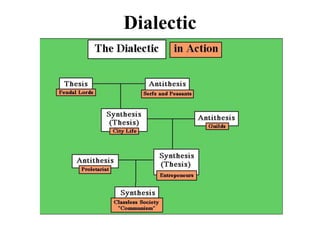
Dialectic
Dialectic
 Thesis – Antithesis - Synthesis
 Hegelian dialectic is about the evolution of ideas.
 Marxian dialectic is about the evolution of social
organization
Characteristics of DM
 Dynamism: Matter in motion. Nothing is fixed and permanent
 Changeability: Everything consists of opposing forces/sides
or contradictions
 Integrate Whole: Balances shift and sometimes one
overcomes other (quantitative change leads to qualitative
change).
 Unity of Opposite: Result is new reality with new internal
contradictions (Pole of Magnetic)
 Theory of Inner Contradiction: Social struggle
MARX’S VIEWS
 He was a materialist – to understand society, we have to
understand how it organizes production
 Forces of Production – land, technology, skills, knowledge,
etc.
 Social Relations of Production – who controls the forces of
production, and how

Dialectical materialism by Man Bahadur Shahi

  • 1.
    Dialectical Materialism (Karl Marxand Friedrich Engels) Prepared by Man Bdr Shahi (Nepal)
  • 2.
    Dialectical Materialism  Definition: only matter/stuff exists, mind/ideas/consciousness are not “real”  Dialectical materialism is a philosophy of science and nature, based on the writings of Karl Marx and Friedrich Engels, and developed in Europe  In Marx, it’s opposed to the idealism of Hegel, the dominant philosopher at the time.  Idealism holds that the ultimate reality depends on the mind.  Hegel – Zeitgeist :The spirit (Geist) of the time (Zeit.)History flows from changes in the dominant ideas of an age.  Marx is said to have “stood Hegel on his head”
  • 3.
     Historical Materialism(HM): a methodological approach to the study of human societies and their development over time.  In simplified form, Dialectical Materialism states that ideas and thoughts of human changes in a dialectical process due to the movement and existence of the matter.  Dialectical Materialism is not only philosophy but also a complete way of thinking to explain the reality.  HM looks for the causes of developments and changes in human society in the means by which humans collectively produce the necessities of life.  Social classes and the relationship, along with the political structures and ways of thinking are founded in society and reflect contemporary economic activity.
  • 4.
  • 5.
    Dialectic  Thesis –Antithesis - Synthesis  Hegelian dialectic is about the evolution of ideas.  Marxian dialectic is about the evolution of social organization
  • 6.
    Characteristics of DM Dynamism: Matter in motion. Nothing is fixed and permanent  Changeability: Everything consists of opposing forces/sides or contradictions  Integrate Whole: Balances shift and sometimes one overcomes other (quantitative change leads to qualitative change).  Unity of Opposite: Result is new reality with new internal contradictions (Pole of Magnetic)  Theory of Inner Contradiction: Social struggle
  • 7.
    MARX’S VIEWS  Hewas a materialist – to understand society, we have to understand how it organizes production  Forces of Production – land, technology, skills, knowledge, etc.  Social Relations of Production – who controls the forces of production, and how