Little
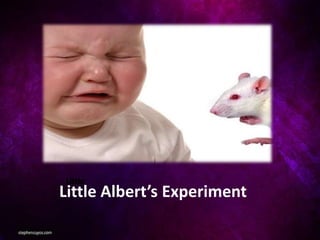
Little Albert’s Experiment
- Activity -
• Think of a teacher that’s most
unforgettable to you in your
elementary or high school…
• Are there things that when you
encounter at present make you “go
back to the past” and recall this
teacher? What are these things?
Proponent:
John B. Watson (1878 –1958)
• American psychologist who
established the Psychological School
of Behaviorism.
• Influenced by Pavlov’s Classical
Conditioning Theory.
• Famous research – related to
children’s emotion (Emotion learning:
Stimulus Generalization)
Proponent:
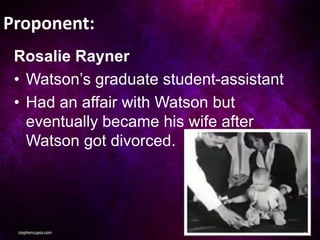
Rosalie Rayner
• Watson’s graduate student-assistant
• Had an affair with Watson but
eventually became his wife after
Watson got divorced.
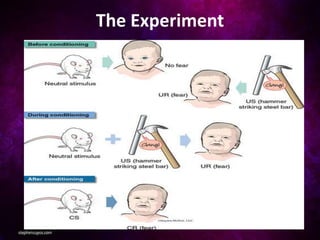
The Experiment
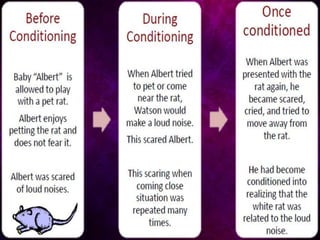
• Watson and Rayner took a 9mos. old
child.
• Paid the mother of the child $1.00
• Gave the child a Pseudo name, Albert
• Showed Albert neutral stimulus such
as a white rat, a puppy, santa mask, a
rabbit and a fur coat
The Experiment
The Experiment
• Unfortunately after the said
experiment they returned the child
without undoing what they have done
to Little Albert
• Little Albert died after 6 years with all
the fears he has without exactly
knowing why
Theory of Behaviorism
• focuses on the study of observable and
measurable behaviour.
• emphasizes that behaviour is mostly
learned through conditioning and
reinforcement (reward and punishment).
• does not give much attention to the
mind and the possibility of thought
processes occurring in the mind
Classical Conditioning
• Deals with the reflexes or responses
that are evoked from a specific
stimulus.
• People can be trained to perform a
certain task or response by providing
some sort of trigger, which may be a
sound, picture, phrase, etc.
Implications in Teaching and
Learning
• All types of behaviour can be learned
through conditioning process. Positive
behaviour can be taught by using
suitable stimulus.
• Pupils ought to relate the relationship
between all responses systematically in
order to master the skill of solving
problems.
Implications in Teaching and
Learning
• More exercises should be carried out
after learning in order to strengthen
what has been learned in the memory
• Teacher should use suitable stimulus
during the teaching process to motivate
pupils in learning, and at the same time,
avoid using stimulus which will produce
negative effect.
The Pros and Cons of Behaviorism
Pros:
• Behaviorism is based on observable
behaviors, making it easier to conduct
and collect data and research.
• Can be applicable/helpful for therapy of
children with behavioral disorders
The Pros and Cons of Behaviorism
Cons:
• Does not account for other ways of
learning that do not involve
reinforcement
• People can change their behavior when
presented with new information, even if
they have previously established a
different behavior through
reinforcement.
Little Albert Experiment

Little Albert Experiment

  • 1.
  • 2.
    - Activity - •Think of a teacher that’s most unforgettable to you in your elementary or high school… • Are there things that when you encounter at present make you “go back to the past” and recall this teacher? What are these things?
  • 3.
    Proponent: John B. Watson(1878 –1958) • American psychologist who established the Psychological School of Behaviorism. • Influenced by Pavlov’s Classical Conditioning Theory. • Famous research – related to children’s emotion (Emotion learning: Stimulus Generalization)
  • 4.
    Proponent: Rosalie Rayner • Watson’sgraduate student-assistant • Had an affair with Watson but eventually became his wife after Watson got divorced.
  • 5.
    The Experiment • Watsonand Rayner took a 9mos. old child. • Paid the mother of the child $1.00 • Gave the child a Pseudo name, Albert • Showed Albert neutral stimulus such as a white rat, a puppy, santa mask, a rabbit and a fur coat
  • 7.
  • 9.
    The Experiment • Unfortunatelyafter the said experiment they returned the child without undoing what they have done to Little Albert • Little Albert died after 6 years with all the fears he has without exactly knowing why
  • 10.
    Theory of Behaviorism •focuses on the study of observable and measurable behaviour. • emphasizes that behaviour is mostly learned through conditioning and reinforcement (reward and punishment). • does not give much attention to the mind and the possibility of thought processes occurring in the mind
  • 11.
    Classical Conditioning • Dealswith the reflexes or responses that are evoked from a specific stimulus. • People can be trained to perform a certain task or response by providing some sort of trigger, which may be a sound, picture, phrase, etc.
  • 12.
    Implications in Teachingand Learning • All types of behaviour can be learned through conditioning process. Positive behaviour can be taught by using suitable stimulus. • Pupils ought to relate the relationship between all responses systematically in order to master the skill of solving problems.
  • 13.
    Implications in Teachingand Learning • More exercises should be carried out after learning in order to strengthen what has been learned in the memory • Teacher should use suitable stimulus during the teaching process to motivate pupils in learning, and at the same time, avoid using stimulus which will produce negative effect.
  • 14.
    The Pros andCons of Behaviorism Pros: • Behaviorism is based on observable behaviors, making it easier to conduct and collect data and research. • Can be applicable/helpful for therapy of children with behavioral disorders
  • 15.
    The Pros andCons of Behaviorism Cons: • Does not account for other ways of learning that do not involve reinforcement • People can change their behavior when presented with new information, even if they have previously established a different behavior through reinforcement.