Developmental Psychology 
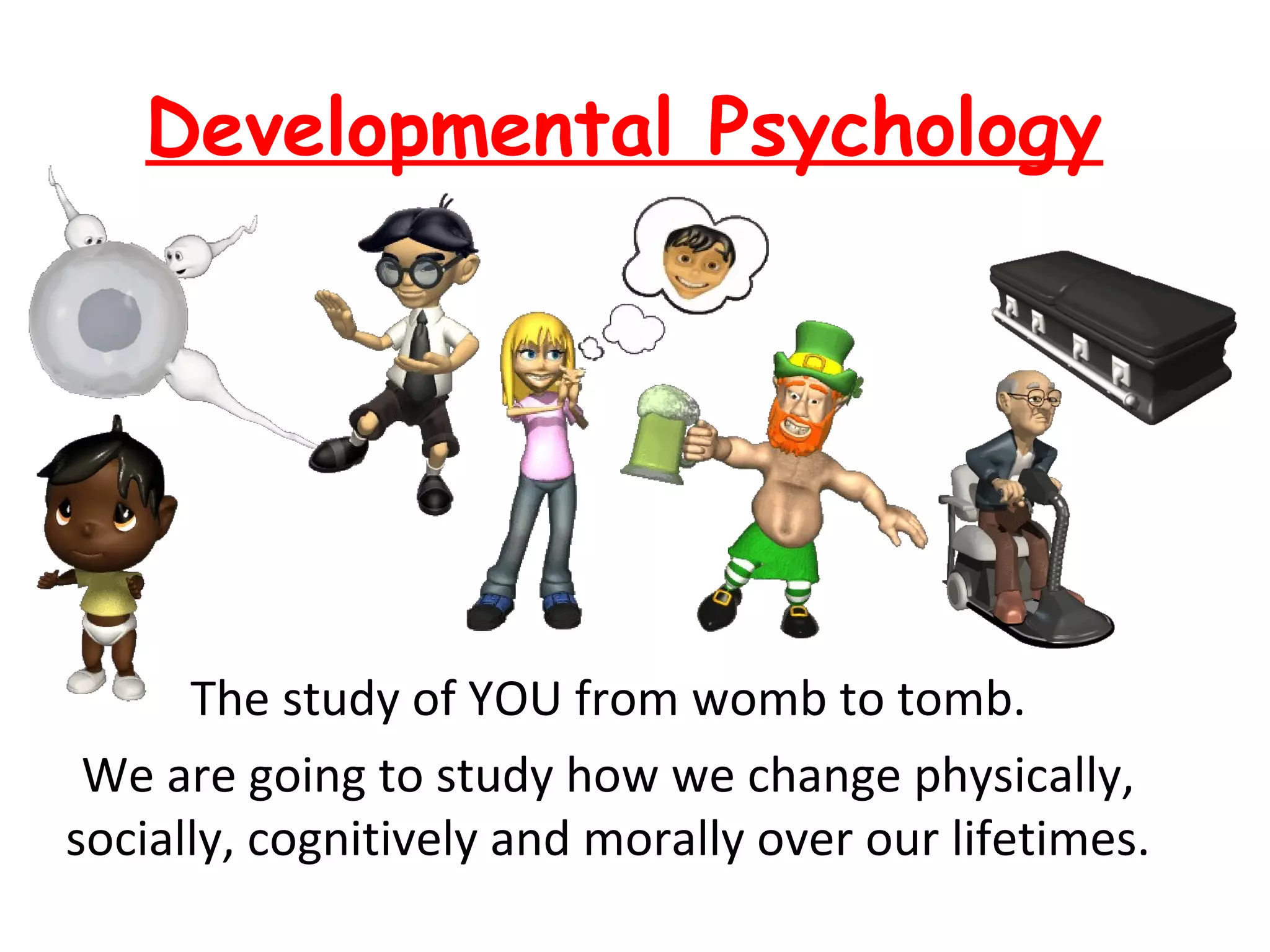
The study of YOU from womb to tomb. 
We are going to study how we change physically, 
socially, cognitively and morally over our lifetimes.
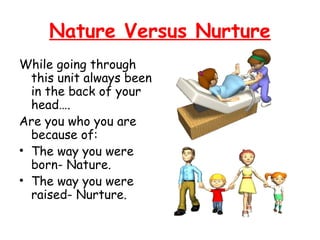
Nature Versus Nurture 
While going through 
this unit always been 
in the back of your 
head…. 
Are you who you are 
because of: 
• The way you were 
born- Nature. 
• The way you were 
raised- Nurture.
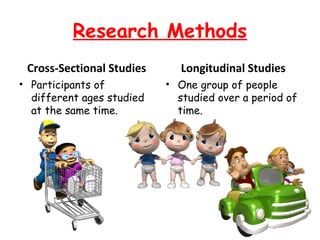
Research Methods 
Cross-Sectional Studies 
• Participants of 
different ages studied 
at the same time. 
Longitudinal Studies 
• One group of people 
studied over a period of 
time.
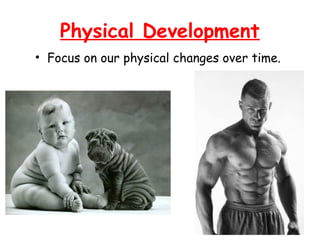
Physical Development 
• Focus on our physical changes over time.
Prenatal Development 
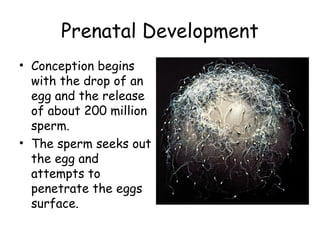
• Conception begins 
with the drop of an 
egg and the release 
of about 200 million 
sperm. 
• The sperm seeks out 
the egg and 
attempts to 
penetrate the eggs 
surface.
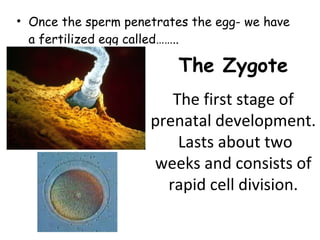
• Once the sperm penetrates the egg- we have 
a fertilized egg called…….. 
The Zygote 
The first stage of 
prenatal development. 
Lasts about two 
weeks and consists of 
rapid cell division.
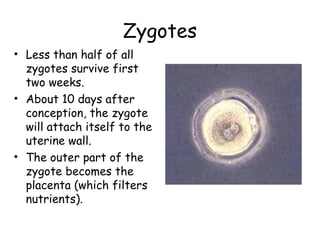
Zygotes 
• Less than half of all 
zygotes survive first 
two weeks. 
• About 10 days after 
conception, the zygote 
will attach itself to the 
uterine wall. 
• The outer part of the 
zygote becomes the 
placenta (which filters 
nutrients).
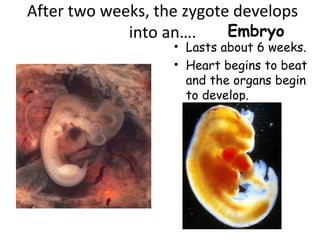
After two weeks, the zygote develops 
into an…. 
Embryo 
• Lasts about 6 weeks. 
• Heart begins to beat 
and the organs begin 
to develop.
Fetus 
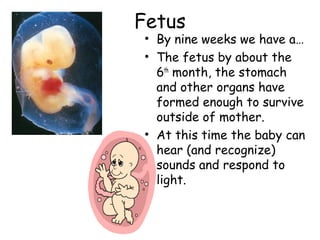
• By nine weeks we have a… 
• The fetus by about the 
6th month, the stomach 
and other organs have 
formed enough to survive 
outside of mother. 
• At this time the baby can 
hear (and recognize) 
sounds and respond to 
light.
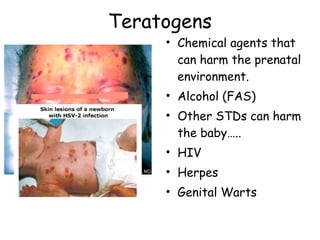
Teratogens 
• Chemical agents that 
can harm the prenatal 
environment. 
• Alcohol (FAS) 
• Other STDs can harm 
the baby….. 
• HIV 
• Herpes 
• Genital Warts
Childbirth 
Click the woman in labor to watch a birthing video. 
Please be aware that it is graphic….beautiful but can be difficult to watch.
Healthy Newborns 
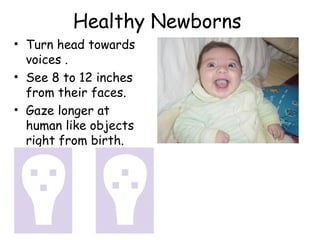
• Turn head towards 
voices . 
• See 8 to 12 inches 
from their faces. 
• Gaze longer at 
human like objects 
right from birth.
Reflexes 
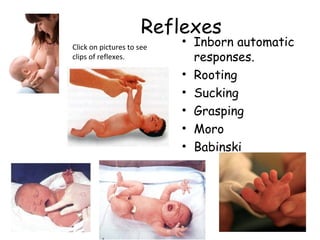
• Inborn automatic 
responses. 
• Rooting 
• Sucking 
• Grasping 
• Moro 
• Babinski 
Click on pictures to see 
clips of reflexes.
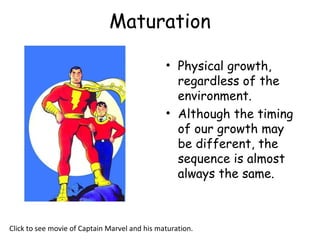
Maturation 
• Physical growth, 
regardless of the 
environment. 
• Although the timing 
of our growth may 
be different, the 
sequence is almost 
always the same. 
Click to see movie of Captain Marvel and his maturation.
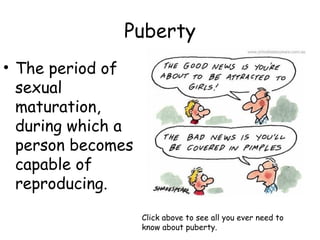
Puberty 
• The period of 
sexual 
maturation, 
during which a 
person becomes 
capable of 
reproducing. 
Click above to see all you ever need to 
know about puberty.
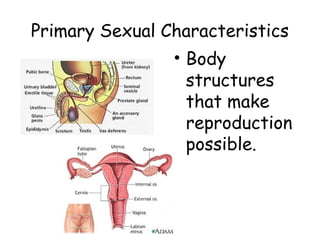
Primary Sexual Characteristics 
• Body 
structures 
that make 
reproduction 
possible.
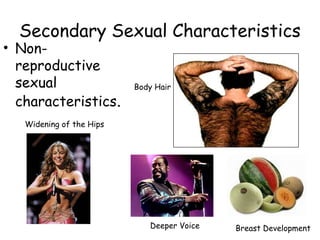
Secondary Sexual Characteristics 
• Non-reproductive 
sexual 
characteristics. 
Widening of the Hips 
Body Hair 
Deeper Voice Breast Development
Landmarks for Puberty 
• Menarche for girls. 
• First ejaculation for 
boys. 
Click Tampax for one of those ridiculous commercials.
Adulthood 
• All physical 
abilities 
essentially 
peak by our 
mid twenties.
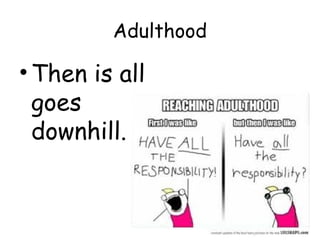
Adulthood 
•Then is all 
goes 
downhill.
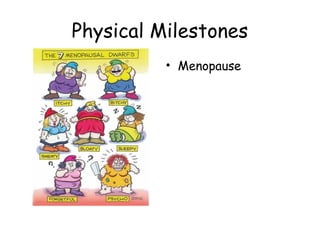
Physical Milestones 
• Menopause
Life Expectancy 
• Life Expectancy 
keeps increasing-now 
about 75. 
• Women outlive men 
by about 4 years. 
• But more men are 
conceived 126 to 
100. Then 105 to 
100 by birth. In 
other words, men die 
easier.
Death • Elizabeth Kubler-Ross’s 
Stages of Death/Grief. 
1.Denial 
2.Anger 
3.Bargaining 
4.Depression 
5.Acceptance
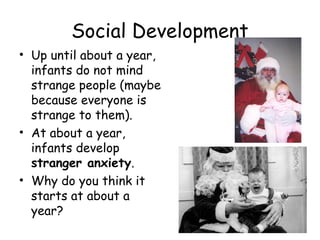
Social Development 
• Up until about a year, 
infants do not mind 
strange people (maybe 
because everyone is 
strange to them). 
• At about a year, 
infants develop 
stranger anxiety. 
• Why do you think it 
starts at about a 
year?
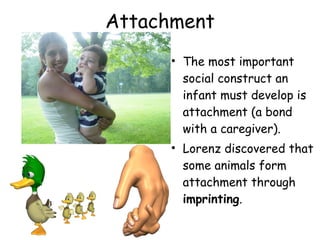
Attachment 
• The most important 
social construct an 
infant must develop is 
attachment (a bond 
with a caregiver). 
• Lorenz discovered that 
some animals form 
attachment through 
imprinting.
Attachment 
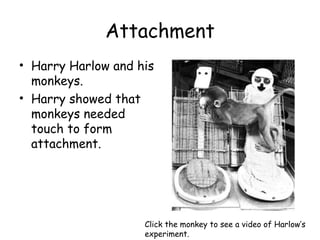
• Harry Harlow and his 
monkeys. 
• Harry showed that 
monkeys needed 
touch to form 
attachment. 
Click the monkey to see a video of Harlow’s 
experiment.
Attachment 
• Critical Periods: the 
optimal period shortly 
after birth when an 
organism’s exposure to 
certain stimuli or 
experiences produce 
proper development. 
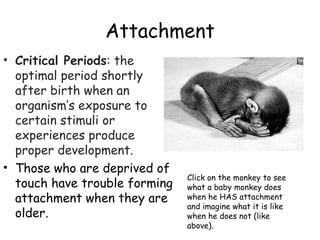
• Those who are deprived of 
touch have trouble forming 
attachment when they are 
older. 
Click on the monkey to see 
what a baby monkey does 
when he HAS attachment 
and imagine what it is like 
when he does not (like 
above).
Types of Attachment 
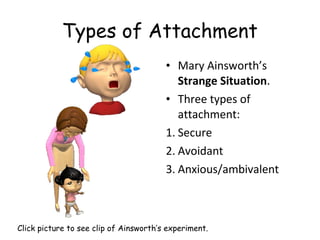
• Mary Ainsworth’s 
Strange Situation. 
• Three types of 
attachment: 
1. Secure 
2. Avoidant 
3. Anxious/ambivalent 
Click picture to see clip of Ainsworth’s experiment.
Parenting Styles 
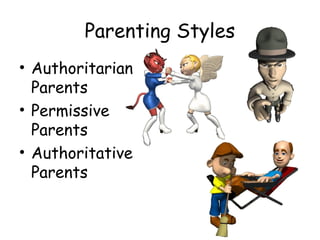
• Authoritarian 
Parents 
• Permissive 
Parents 
• Authoritative 
Parents
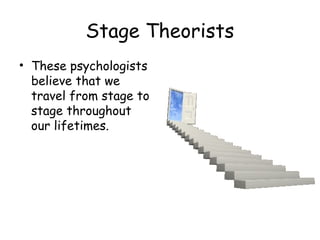
Stage Theorists 
• These psychologists 
believe that we 
travel from stage to 
stage throughout 
our lifetimes.
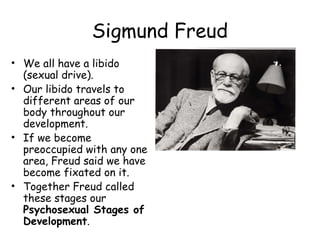
Sigmund Freud 
• We all have a libido 
(sexual drive). 
• Our libido travels to 
different areas of our 
body throughout our 
development. 
• If we become 
preoccupied with any one 
area, Freud said we have 
become fixated on it. 
• Together Freud called 
these stages our 
Psychosexual Stages of 
Development.
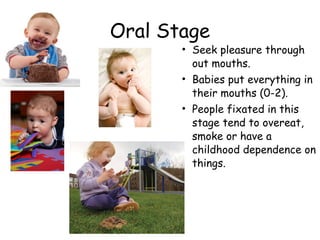
Oral Stage 
• Seek pleasure through 
out mouths. 
• Babies put everything in 
their mouths (0-2). 
• People fixated in this 
stage tend to overeat, 
smoke or have a 
childhood dependence on 
things.
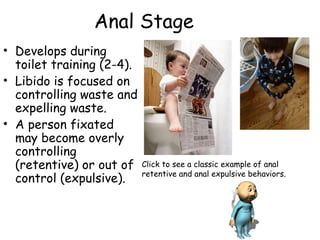
Anal Stage 
• Develops during 
toilet training (2-4). 
• Libido is focused on 
controlling waste and 
expelling waste. 
• A person fixated 
may become overly 
controlling 
(retentive) or out of 
control (expulsive). 
Click to see a classic example of anal 
retentive and anal expulsive behaviors.
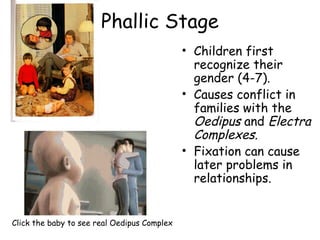
Phallic Stage 
• Children first 
recognize their 
gender (4-7). 
• Causes conflict in 
families with the 
Oedipus and Electra 
Complexes. 
• Fixation can cause 
later problems in 
relationships. 
Click the baby to see real Oedipus Complex
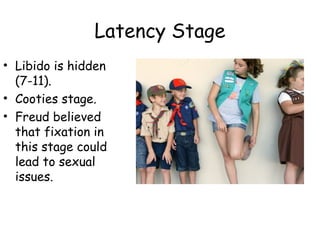
Latency Stage 
• Libido is hidden 
(7-11). 
• Cooties stage. 
• Freud believed 
that fixation in 
this stage could 
lead to sexual 
issues.
Genital Stage 
• Libido is focused on 
their genitals (12- 
death). 
• Freud thought 
fixation in this stage 
is normal.
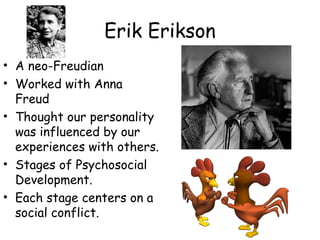
Erik Erikson 
• A neo-Freudian 
• Worked with Anna 
Freud 
• Thought our personality 
was influenced by our 
experiences with others. 
• Stages of Psychosocial 
Development. 
• Each stage centers on a 
social conflict.
Trust v. Mistrust 
• Can a baby trust the 
world to fulfill its 
needs? 
• The trust or 
mistrust they 
develop can carry on 
with the child for 
the rest of their 
lives.
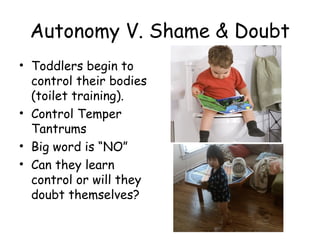
Autonomy V. Shame & Doubt 
• Toddlers begin to 
control their bodies 
(toilet training). 
• Control Temper 
Tantrums 
• Big word is “NO” 
• Can they learn 
control or will they 
doubt themselves?
Initiative V. Guilt 
• Word turns from 
“NO” to “WHY?” 
• Want to understand 
the world and ask 
questions. 
• Is there curiosity 
encouraged or 
scolded?
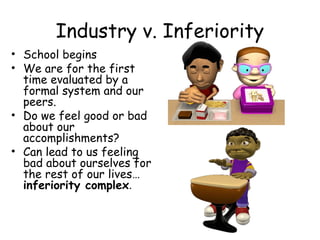
Industry v. Inferiority 
• School begins 
• We are for the first 
time evaluated by a 
formal system and our 
peers. 
• Do we feel good or bad 
about our 
accomplishments? 
• Can lead to us feeling 
bad about ourselves for 
the rest of our lives… 
inferiority complex.
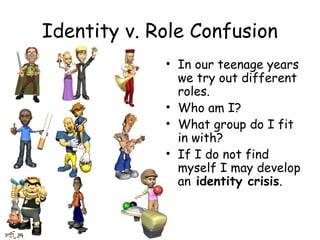
Identity v. Role Confusion 
• In our teenage years 
we try out different 
roles. 
• Who am I? 
• What group do I fit 
in with? 
• If I do not find 
myself I may develop 
an identity crisis.
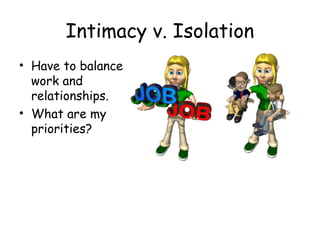
Intimacy v. Isolation 
• Have to balance 
work and 
relationships. 
• What are my 
priorities?
Marriage 
• At least a 5 to 1 
ratio of positive to 
negative interactions 
is a clear indicator 
of a healthy 
relationship.
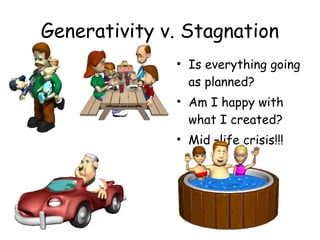
Generativity v. Stagnation 
• Is everything going 
as planned? 
• Am I happy with 
what I created? 
• Mid –life crisis!!!
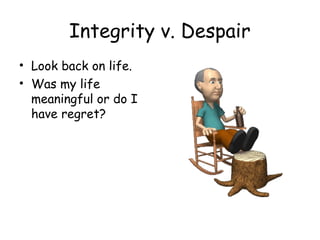
Integrity v. Despair 
• Look back on life. 
• Was my life 
meaningful or do I 
have regret?
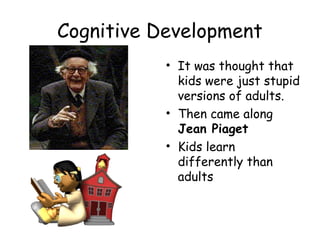
Cognitive Development 
• It was thought that 
kids were just stupid 
versions of adults. 
• Then came along 
Jean Piaget 
• Kids learn 
differently than 
adults
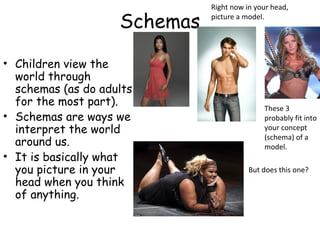
Schemas 
• Children view the 
world through 
schemas (as do adults 
for the most part). 
• Schemas are ways we 
interpret the world 
around us. 
• It is basically what 
you picture in your 
head when you think 
of anything. 
Right now in your head, 
picture a model. 
These 3 
probably fit into 
your concept 
(schema) of a 
model. 
But does this one?
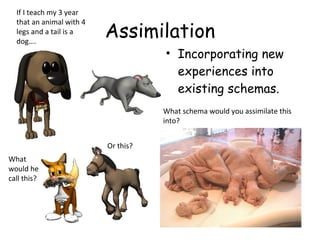
Assimilation 
• Incorporating new 
experiences into 
existing schemas. 
If I teach my 3 year 
that an animal with 4 
legs and a tail is a 
dog…. 
What 
would he 
call this? 
Or this? 
What schema would you assimilate this 
into?
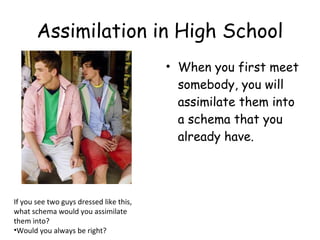
Assimilation in High School 
• When you first meet 
somebody, you will 
assimilate them into 
a schema that you 
already have. 
If you see two guys dressed like this, 
what schema would you assimilate 
them into? 
•Would you always be right?
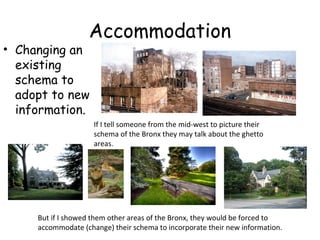
Accommodation 
• Changing an 
existing 
schema to 
adopt to new 
information. 
If I tell someone from the mid-west to picture their 
schema of the Bronx they may talk about the ghetto 
areas. 
But if I showed them other areas of the Bronx, they would be forced to 
accommodate (change) their schema to incorporate their new information.
Stages of Cognitive Development 
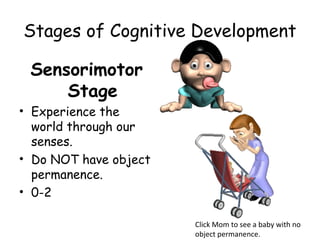
Sensorimotor 
Stage 
• Experience the 
world through our 
senses. 
• Do NOT have object 
permanence. 
• 0-2 
Click Mom to see a baby with no 
object permanence.
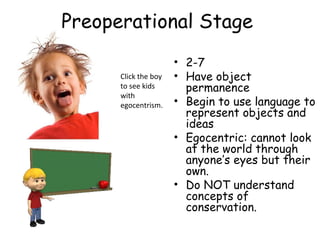
Preoperational Stage 
• 2-7 
• Have object 
permanence 
• Begin to use language to 
represent objects and 
ideas 
• Egocentric: cannot look 
at the world through 
anyone’s eyes but their 
own. 
• Do NOT understand 
concepts of 
conservation. 
Click the boy 
to see kids 
with 
egocentrism.
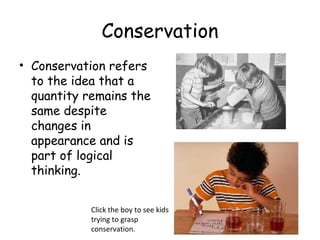
Conservation 
• Conservation refers 
to the idea that a 
quantity remains the 
same despite 
changes in 
appearance and is 
part of logical 
thinking. 
Click the boy to see kids 
trying to grasp 
conservation.
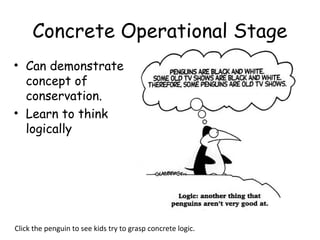
Concrete Operational Stage 
• Can demonstrate 
concept of 
conservation. 
• Learn to think 
logically 
Click the penguin to see kids try to grasp concrete logic.
Formal Operational Stage 
• What would the world 
look like with no light? 
• Picture god 
• What way do you best 
learn? 
• Abstract reasoning 
• Manipulate objects 
in our minds without 
seeing them 
• Hypothesis testing 
• Trial and Error 
• Metacognition 
• Not every adult gets 
to this stage
Criticisms of Piaget 
• Some say he 
underestimates the 
abilities of children. 
• Information- 
Processing Model says 
children to not learn in 
stages but rather a 
gradual continuous 
growth. 
• Studies show that our 
attention span grows 
gradually over time.
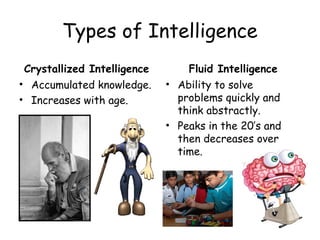
Types of Intelligence 
Crystallized Intelligence 
• Accumulated knowledge. 
• Increases with age. 
Fluid Intelligence 
• Ability to solve 
problems quickly and 
think abstractly. 
• Peaks in the 20’s and 
then decreases over 
time.
Moral Development 
Three Stage Theory by Lawrence Kohlberg!!!
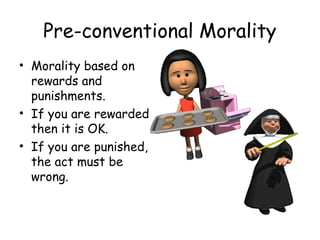
Pre-conventional Morality 
• Morality based on 
rewards and 
punishments. 
• If you are rewarded 
then it is OK. 
• If you are punished, 
the act must be 
wrong.
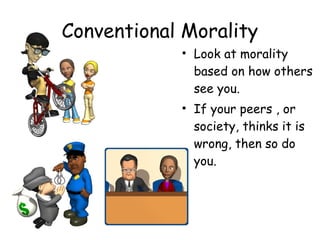
Conventional Morality 
• Look at morality 
based on how others 
see you. 
• If your peers , or 
society, thinks it is 
wrong, then so do 
you.
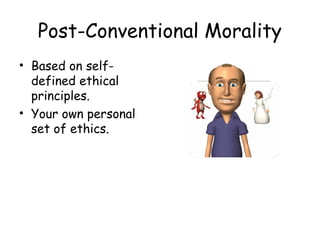
Post-Conventional Morality 
• Based on self-defined 
ethical 
principles. 
• Your own personal 
set of ethics.
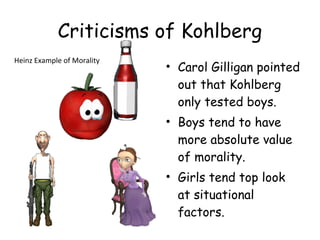
Criticisms of Kohlberg 
• Carol Gilligan pointed 
out that Kohlberg 
only tested boys. 
• Boys tend to have 
more absolute value 
of morality. 
• Girls tend top look 
at situational 
factors. 
Heinz Example of Morality
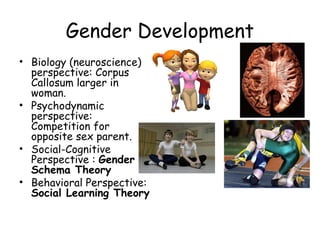
Gender Development 
• Biology (neuroscience) 
perspective: Corpus 
Callosum larger in 
woman. 
• Psychodynamic 
perspective: 
Competition for 
opposite sex parent. 
• Social-Cognitive 
Perspective : Gender 
Schema Theory 
• Behavioral Perspective: 
Social Learning Theory

Developmental psychology

  • 1.
    Developmental Psychology Thestudy of YOU from womb to tomb. We are going to study how we change physically, socially, cognitively and morally over our lifetimes.
  • 2.
    Nature Versus Nurture While going through this unit always been in the back of your head…. Are you who you are because of: • The way you were born- Nature. • The way you were raised- Nurture.
  • 3.
    Research Methods Cross-SectionalStudies • Participants of different ages studied at the same time. Longitudinal Studies • One group of people studied over a period of time.
  • 4.
    Physical Development •Focus on our physical changes over time.
  • 5.
    Prenatal Development •Conception begins with the drop of an egg and the release of about 200 million sperm. • The sperm seeks out the egg and attempts to penetrate the eggs surface.
  • 6.
    • Once thesperm penetrates the egg- we have a fertilized egg called…….. The Zygote The first stage of prenatal development. Lasts about two weeks and consists of rapid cell division.
  • 7.
    Zygotes • Lessthan half of all zygotes survive first two weeks. • About 10 days after conception, the zygote will attach itself to the uterine wall. • The outer part of the zygote becomes the placenta (which filters nutrients).
  • 8.
    After two weeks,the zygote develops into an…. Embryo • Lasts about 6 weeks. • Heart begins to beat and the organs begin to develop.
  • 9.
    Fetus • Bynine weeks we have a… • The fetus by about the 6th month, the stomach and other organs have formed enough to survive outside of mother. • At this time the baby can hear (and recognize) sounds and respond to light.
  • 10.
    Teratogens • Chemicalagents that can harm the prenatal environment. • Alcohol (FAS) • Other STDs can harm the baby….. • HIV • Herpes • Genital Warts
  • 11.
    Childbirth Click thewoman in labor to watch a birthing video. Please be aware that it is graphic….beautiful but can be difficult to watch.
  • 12.
    Healthy Newborns •Turn head towards voices . • See 8 to 12 inches from their faces. • Gaze longer at human like objects right from birth.
  • 13.
    Reflexes • Inbornautomatic responses. • Rooting • Sucking • Grasping • Moro • Babinski Click on pictures to see clips of reflexes.
  • 14.
    Maturation • Physicalgrowth, regardless of the environment. • Although the timing of our growth may be different, the sequence is almost always the same. Click to see movie of Captain Marvel and his maturation.
  • 15.
    Puberty • Theperiod of sexual maturation, during which a person becomes capable of reproducing. Click above to see all you ever need to know about puberty.
  • 16.
    Primary Sexual Characteristics • Body structures that make reproduction possible.
  • 17.
    Secondary Sexual Characteristics • Non-reproductive sexual characteristics. Widening of the Hips Body Hair Deeper Voice Breast Development
  • 18.
    Landmarks for Puberty • Menarche for girls. • First ejaculation for boys. Click Tampax for one of those ridiculous commercials.
  • 19.
    Adulthood • Allphysical abilities essentially peak by our mid twenties.
  • 20.
    Adulthood •Then isall goes downhill.
  • 21.
  • 22.
    Life Expectancy •Life Expectancy keeps increasing-now about 75. • Women outlive men by about 4 years. • But more men are conceived 126 to 100. Then 105 to 100 by birth. In other words, men die easier.
  • 23.
    Death • ElizabethKubler-Ross’s Stages of Death/Grief. 1.Denial 2.Anger 3.Bargaining 4.Depression 5.Acceptance
  • 24.
    Social Development •Up until about a year, infants do not mind strange people (maybe because everyone is strange to them). • At about a year, infants develop stranger anxiety. • Why do you think it starts at about a year?
  • 25.
    Attachment • Themost important social construct an infant must develop is attachment (a bond with a caregiver). • Lorenz discovered that some animals form attachment through imprinting.
  • 26.
    Attachment • HarryHarlow and his monkeys. • Harry showed that monkeys needed touch to form attachment. Click the monkey to see a video of Harlow’s experiment.
  • 27.
    Attachment • CriticalPeriods: the optimal period shortly after birth when an organism’s exposure to certain stimuli or experiences produce proper development. • Those who are deprived of touch have trouble forming attachment when they are older. Click on the monkey to see what a baby monkey does when he HAS attachment and imagine what it is like when he does not (like above).
  • 28.
    Types of Attachment • Mary Ainsworth’s Strange Situation. • Three types of attachment: 1. Secure 2. Avoidant 3. Anxious/ambivalent Click picture to see clip of Ainsworth’s experiment.
  • 29.
    Parenting Styles •Authoritarian Parents • Permissive Parents • Authoritative Parents
  • 30.
    Stage Theorists •These psychologists believe that we travel from stage to stage throughout our lifetimes.
  • 31.
    Sigmund Freud •We all have a libido (sexual drive). • Our libido travels to different areas of our body throughout our development. • If we become preoccupied with any one area, Freud said we have become fixated on it. • Together Freud called these stages our Psychosexual Stages of Development.
  • 32.
    Oral Stage •Seek pleasure through out mouths. • Babies put everything in their mouths (0-2). • People fixated in this stage tend to overeat, smoke or have a childhood dependence on things.
  • 33.
    Anal Stage •Develops during toilet training (2-4). • Libido is focused on controlling waste and expelling waste. • A person fixated may become overly controlling (retentive) or out of control (expulsive). Click to see a classic example of anal retentive and anal expulsive behaviors.
  • 34.
    Phallic Stage •Children first recognize their gender (4-7). • Causes conflict in families with the Oedipus and Electra Complexes. • Fixation can cause later problems in relationships. Click the baby to see real Oedipus Complex
  • 35.
    Latency Stage •Libido is hidden (7-11). • Cooties stage. • Freud believed that fixation in this stage could lead to sexual issues.
  • 36.
    Genital Stage •Libido is focused on their genitals (12- death). • Freud thought fixation in this stage is normal.
  • 37.
    Erik Erikson •A neo-Freudian • Worked with Anna Freud • Thought our personality was influenced by our experiences with others. • Stages of Psychosocial Development. • Each stage centers on a social conflict.
  • 38.
    Trust v. Mistrust • Can a baby trust the world to fulfill its needs? • The trust or mistrust they develop can carry on with the child for the rest of their lives.
  • 39.
    Autonomy V. Shame& Doubt • Toddlers begin to control their bodies (toilet training). • Control Temper Tantrums • Big word is “NO” • Can they learn control or will they doubt themselves?
  • 40.
    Initiative V. Guilt • Word turns from “NO” to “WHY?” • Want to understand the world and ask questions. • Is there curiosity encouraged or scolded?
  • 41.
    Industry v. Inferiority • School begins • We are for the first time evaluated by a formal system and our peers. • Do we feel good or bad about our accomplishments? • Can lead to us feeling bad about ourselves for the rest of our lives… inferiority complex.
  • 42.
    Identity v. RoleConfusion • In our teenage years we try out different roles. • Who am I? • What group do I fit in with? • If I do not find myself I may develop an identity crisis.
  • 43.
    Intimacy v. Isolation • Have to balance work and relationships. • What are my priorities?
  • 44.
    Marriage • Atleast a 5 to 1 ratio of positive to negative interactions is a clear indicator of a healthy relationship.
  • 45.
    Generativity v. Stagnation • Is everything going as planned? • Am I happy with what I created? • Mid –life crisis!!!
  • 46.
    Integrity v. Despair • Look back on life. • Was my life meaningful or do I have regret?
  • 47.
    Cognitive Development •It was thought that kids were just stupid versions of adults. • Then came along Jean Piaget • Kids learn differently than adults
  • 48.
    Schemas • Childrenview the world through schemas (as do adults for the most part). • Schemas are ways we interpret the world around us. • It is basically what you picture in your head when you think of anything. Right now in your head, picture a model. These 3 probably fit into your concept (schema) of a model. But does this one?
  • 49.
    Assimilation • Incorporatingnew experiences into existing schemas. If I teach my 3 year that an animal with 4 legs and a tail is a dog…. What would he call this? Or this? What schema would you assimilate this into?
  • 50.
    Assimilation in HighSchool • When you first meet somebody, you will assimilate them into a schema that you already have. If you see two guys dressed like this, what schema would you assimilate them into? •Would you always be right?
  • 51.
    Accommodation • Changingan existing schema to adopt to new information. If I tell someone from the mid-west to picture their schema of the Bronx they may talk about the ghetto areas. But if I showed them other areas of the Bronx, they would be forced to accommodate (change) their schema to incorporate their new information.
  • 52.
    Stages of CognitiveDevelopment Sensorimotor Stage • Experience the world through our senses. • Do NOT have object permanence. • 0-2 Click Mom to see a baby with no object permanence.
  • 53.
    Preoperational Stage •2-7 • Have object permanence • Begin to use language to represent objects and ideas • Egocentric: cannot look at the world through anyone’s eyes but their own. • Do NOT understand concepts of conservation. Click the boy to see kids with egocentrism.
  • 54.
    Conservation • Conservationrefers to the idea that a quantity remains the same despite changes in appearance and is part of logical thinking. Click the boy to see kids trying to grasp conservation.
  • 55.
    Concrete Operational Stage • Can demonstrate concept of conservation. • Learn to think logically Click the penguin to see kids try to grasp concrete logic.
  • 56.
    Formal Operational Stage • What would the world look like with no light? • Picture god • What way do you best learn? • Abstract reasoning • Manipulate objects in our minds without seeing them • Hypothesis testing • Trial and Error • Metacognition • Not every adult gets to this stage
  • 57.
    Criticisms of Piaget • Some say he underestimates the abilities of children. • Information- Processing Model says children to not learn in stages but rather a gradual continuous growth. • Studies show that our attention span grows gradually over time.
  • 58.
    Types of Intelligence Crystallized Intelligence • Accumulated knowledge. • Increases with age. Fluid Intelligence • Ability to solve problems quickly and think abstractly. • Peaks in the 20’s and then decreases over time.
  • 59.
    Moral Development ThreeStage Theory by Lawrence Kohlberg!!!
  • 61.
    Pre-conventional Morality •Morality based on rewards and punishments. • If you are rewarded then it is OK. • If you are punished, the act must be wrong.
  • 62.
    Conventional Morality •Look at morality based on how others see you. • If your peers , or society, thinks it is wrong, then so do you.
  • 63.
    Post-Conventional Morality •Based on self-defined ethical principles. • Your own personal set of ethics.
  • 64.
    Criticisms of Kohlberg • Carol Gilligan pointed out that Kohlberg only tested boys. • Boys tend to have more absolute value of morality. • Girls tend top look at situational factors. Heinz Example of Morality
  • 65.
    Gender Development •Biology (neuroscience) perspective: Corpus Callosum larger in woman. • Psychodynamic perspective: Competition for opposite sex parent. • Social-Cognitive Perspective : Gender Schema Theory • Behavioral Perspective: Social Learning Theory