INTRODU
CTION
Behavioral learning theorystarted in the early 20th century as
a response to psychology that focused on internal thoughts.
Psychologists like John B. Watson and B.F. Skinner believed
psychology should focus on observable behaviors, not mental
states. They suggested that behavior is shaped by the
environment through rewards and punishments, a process
called operant conditioning.
3.
Behavioral learning theorystarted in the early 20th century as a
response to psychology that focused on internal thoughts.
Psychologists like John B. Watson and B.F. Skinner believed
psychology should focus on observable behaviors, not mental
states. They suggested that behavior is shaped by the
environment through rewards and punishments, a process called
operant conditioning.
OPERANT
CONDITIONING
B.F. Skinner (March20, 1904 – August
18, 1990) was a leading American
psychologist, Harvard professor and
proponent of the behaviourist theory
of learning in which learning is a
process of 'conditioning' in an
environment of stimulus, reward and
punishment.
B.F.
Skinner
6.
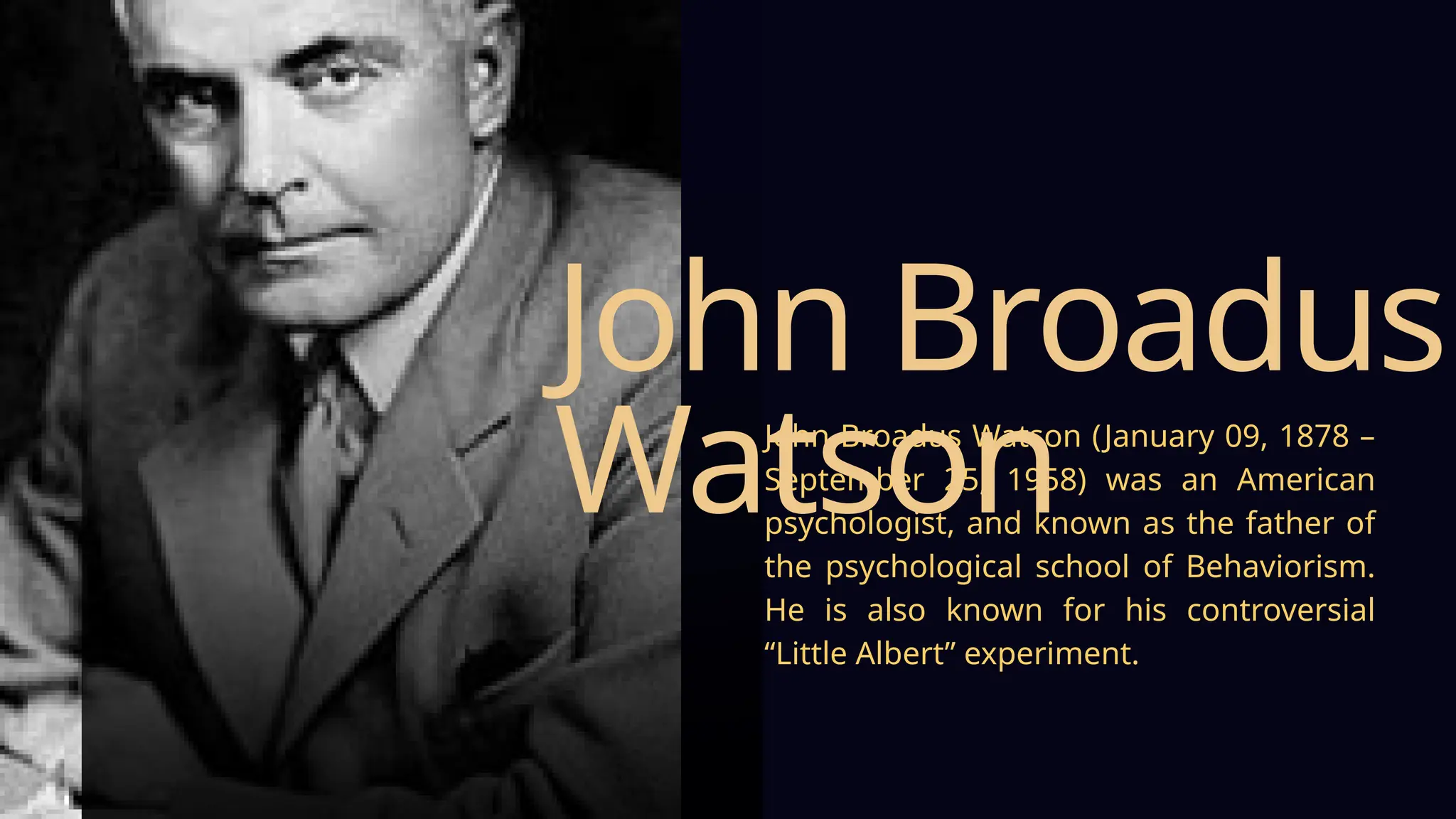
John Broadus Watson(January 09, 1878 –
September 25, 1958) was an American
psychologist, and known as the father of
the psychological school of Behaviorism.
He is also known for his controversial
“Little Albert” experiment.
John Broadus
Watson
KEY
CONTRIBUTIO
NS
rmalization of Behaviorismas a school of thought
mphasis on Objectivity and Scientific Methodology
e Primacy of Learning and Environmental Influence
ocus on Prediction and Control of Behavior
W HAT ARETHE
IMPLICATIONS AND
APPLICATIONS OF THE
THEORY IN THE
12.
IMPLICATIO
NS
• Behaviorist teachingmethods tend to rely on so-called “skill and drill”
exercises to provide the consistent repetition necessary for effective
reinforcement of response patterns.
• Other methods include question (stimulus) and answer (response)
frameworks in which questions are of gradually increasing difficulty;
guided practice; and regular reviews of material.
• Behaviorist methods also typically rely heavily on the use of positive
reinforcements such as verbal praise, good grades, and prizes.
• Behaviorist teaching methods have proven most successful in areas
where there is a “correct” response or easily memorized material.
13.
APPLICATIO
NS
Offers rewards orincentives to strengthen
desired behaviors. This can include verbal
praise, stickers, tokens, or other tangible
rewards. For example, a teacher can praise a
student for completing their homework, give
them a sticker for raising their hand, or reward
them with extra recess time for being
cooperative.
Positive reinforcement can have several
benefits, such as:
• It encourages students to repeat desirable
behaviors and achieve their goals.
For example, a teacher can reduce the amount
of homework for a student who performs well
on a test, allow them to skip a quiz if they score
high on a pre-test.
Negative reinforcement can have several
benefits, such as:
• It helps students avoid or escape from
unpleasant or aversive situations.
• It increases students’ motivation and
persistence.
• It reduces students’ anxiety and stress.
Positive
Reinforcement
Negative
Reinforcement
14.
Punishmen
t
Involves applying negativeconsequences to discourage
undesirable behaviors. It can take the form of reprimands, time-
outs, or loss of privileges. For example, a teacher can scold a
student for talking out of turn, take away their privileges for
breaking a rule, or give them extra work for not paying attention.
Punishment can have several drawbacks, such as:
• It can cause students to resent or fear the teacher or the
subject.
• It can damage students’ self-esteem and confidence.
15.
Modeling
Involves demonstrating desiredbehaviors for students to observe
and imitate. For example, a teacher can show students how to
solve a math problem, how to write an essay, or how to behave in a
group project.
Modeling can have several benefits, such as:
• It provides students with clear and concrete examples of what
to do and how to do it.
• It helps students acquire new skills and knowledge faster and
easier.
• It influences students’ attitudes and values by showing them
16.
Shaping
Gradually reinforcing successiveapproximations of a desired behavior until it is
mastered. Breaks down complex behaviors into smaller, manageable steps,
allowing students to develop the desired skills. For example, a teacher can reward a
student for writing one sentence, then two sentences, then a paragraph, until they
can write a full essay.
Shaping can have several benefits, such as:
• It helps students overcome difficulties and challenges by breaking down
complex tasks into manageable steps.
• It allows teachers to monitor and adjust instruction and feedback according to
each student’s progress and performance.
• It fosters creativity and innovation by encouraging students to try new things
and explore different possibilities.
17.
Cueing
Providing hints orprompts to steer a student’s behavior or performance.
For example, to facilitate students’ memory recall, problem-solving, and
task completion, educators have the option to employ different cues.
Cueing can have several benefits, such as:
• It helps students focus their attention and memory on relevant
aspects of the learning material or situation.
• It supports students’ comprehension and understanding by clarifying
concepts or instructions.
• It enhances students’ engagement and participation by stimulating
their curiosity and interest.
18.
CONCLUS
ION
Behaviorism in educationgives us helpful insights into how
outside factors can shape behavior and learning. By using
these principles, teachers can create better strategies, build
positive environments, and keep students more engaged.
REFERE
NCES
Kurt, S. (2022,September 25). Behaviorism, key terms, history, theorists, criticisms and
implications for teaching - educational technology. Educational Technology. Retrieve from:
https://educationaltechnology.net/behaviorism-key-terms-history-theorists-criticisms-and-
implications-for-teaching/
McLeod, S. (2024, September 3). John B. Watson: Contribution to Psychology. Simply
Psychology. Retrieve from: https://www.simplypsychology.org/john-b-watson.html
Behaviorism | GSI Teaching & Resource Center. (n.d.). Retrieve From:
https://gsi.berkeley.edu/gsi-guide-contents/learning-theory-research/behaviorism/
#:~:text=Implications%20for%20Teaching,-Behaviorist%20teaching
%20methods&text=Behaviorist%20methods%20also%20typically%20rely,behavior%20such
%20as%20exam%20performance.
National University & NU Editorial Contributors. (2023, August 17). Behaviorism in Education:
What Is Behavioral Learning Theory? National University. Retrieve from: