Course : Educational Psychology & Guidance
Presented by :
Shahzeen 2k17/MEDM/30
UNIVERSITY OF SINDH
FACULTY OF EDUCATION
Chapter #2 learning
2.2 Behavioral Views of Learning.
(Classical, Operant Conditioning + Applied Behavior Analysis)
Behavioral View
Behavioristic theories belong to the school of behaviorism.
They interpret learning in terms of association between
stimulus and response.
Behavior theorists define learning as nothing more than the
acquisition of new behavior based on environmental
conditions.
The Founder of Behavioral Theory
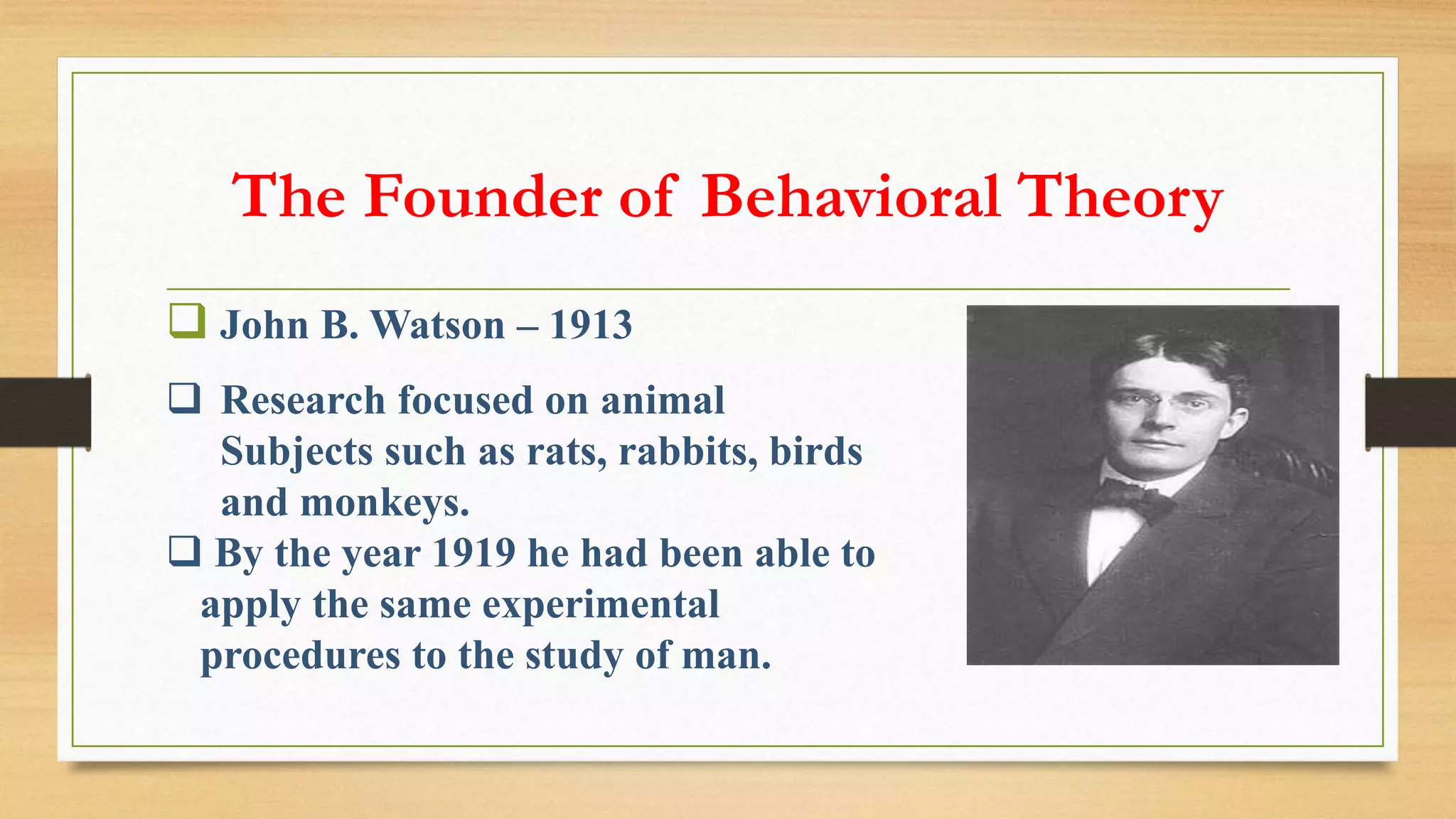
 John B. Watson – 1913
 Research focused on animal
Subjects such as rats, rabbits, birds
and monkeys.
 By the year 1919 he had been able to
apply the same experimental
procedures to the study of man.
Classical Conditioning
Proposed by Ivan Pavlov(1849-1936)
It involves learning a new behavior via the process of
association.
Two stimuli are linked together to produce a newly learned
response.
conditioning in which the conditioned stimulus (sound of a
bell) is paired with & precedes the unconditioned stimulus
(sight of food) until the conditioned stimulus alone is
sufficient to elicit the response (salivation in a dog).
Strength of classical conditioning
It is scientific.
 Based on empirical evidence carried out by controlled
experiments.
For example, Pavlov showed how classical conditioning
could be used to make a dog salivate to the sound of a
bell.
Operant Conditioning
Burrhus Frederic Skinner(B.F. Skinner 1938)
coined the term operant conditioning.
 It means roughly changing of behavior by the
use of reinforcement which is given after the
desired response. This theory is based on
rewards and punishments.
Operant Conditioning deals with operant -
intentional actions that have an effect on the
surrounding environment.
Positive reinforcement
Positive reinforcement strengthens a behavior by providing
a consequence an individual finds rewarding.
For example, if your teacher gives you rupees 20 each time
you complete your homework (i.e., a reward) you will be
more likely to repeat this behavior in the future, thus
strengthening the behavior of completing your homework.
Negative Reinforcement
A response or behavior is strengthened by stopping, removing or
avoiding a negative outcome or aversive stimulus.
Negative reinforcement strengthens behavior because it stops or
removes an unpleasant experience.
If you do not complete your homework, you give your teacher Rs
20. You will complete your homework to avoid paying Rs 20, thus
strengthening the behavior of completing your homework.
Applied Behavioral analysis
It is a scientifically validated approach to understanding
behavior and how it is affected by the environment.
 “Behavior" refers to actions and skills. "Environment"
includes any influence – physical or social – that might
change or be changed by one's behavior.
Behavior analysis have helped many different kinds of
learners acquire many different skills.
Autism
It is a neurodevelopmental disorder.
Characterized by impaired social
interaction, impaired verbal and non-
verbal communication, and restricted
and repetitive behavior.
Since 1960 therapist are using this.
Behavioral Views of Learning

Behavioral Views of Learning

  • 2.
    Course : EducationalPsychology & Guidance Presented by : Shahzeen 2k17/MEDM/30 UNIVERSITY OF SINDH FACULTY OF EDUCATION
  • 3.
    Chapter #2 learning 2.2Behavioral Views of Learning. (Classical, Operant Conditioning + Applied Behavior Analysis)
  • 4.
    Behavioral View Behavioristic theoriesbelong to the school of behaviorism. They interpret learning in terms of association between stimulus and response. Behavior theorists define learning as nothing more than the acquisition of new behavior based on environmental conditions.
  • 5.
    The Founder ofBehavioral Theory  John B. Watson – 1913  Research focused on animal Subjects such as rats, rabbits, birds and monkeys.  By the year 1919 he had been able to apply the same experimental procedures to the study of man.
  • 6.
    Classical Conditioning Proposed byIvan Pavlov(1849-1936) It involves learning a new behavior via the process of association. Two stimuli are linked together to produce a newly learned response. conditioning in which the conditioned stimulus (sound of a bell) is paired with & precedes the unconditioned stimulus (sight of food) until the conditioned stimulus alone is sufficient to elicit the response (salivation in a dog).
  • 7.
    Strength of classicalconditioning It is scientific.  Based on empirical evidence carried out by controlled experiments. For example, Pavlov showed how classical conditioning could be used to make a dog salivate to the sound of a bell.
  • 9.
    Operant Conditioning Burrhus FredericSkinner(B.F. Skinner 1938) coined the term operant conditioning.  It means roughly changing of behavior by the use of reinforcement which is given after the desired response. This theory is based on rewards and punishments. Operant Conditioning deals with operant - intentional actions that have an effect on the surrounding environment.
  • 11.
    Positive reinforcement Positive reinforcementstrengthens a behavior by providing a consequence an individual finds rewarding. For example, if your teacher gives you rupees 20 each time you complete your homework (i.e., a reward) you will be more likely to repeat this behavior in the future, thus strengthening the behavior of completing your homework.
  • 12.
    Negative Reinforcement A responseor behavior is strengthened by stopping, removing or avoiding a negative outcome or aversive stimulus. Negative reinforcement strengthens behavior because it stops or removes an unpleasant experience. If you do not complete your homework, you give your teacher Rs 20. You will complete your homework to avoid paying Rs 20, thus strengthening the behavior of completing your homework.
  • 15.
    Applied Behavioral analysis Itis a scientifically validated approach to understanding behavior and how it is affected by the environment.  “Behavior" refers to actions and skills. "Environment" includes any influence – physical or social – that might change or be changed by one's behavior. Behavior analysis have helped many different kinds of learners acquire many different skills.
  • 16.
    Autism It is aneurodevelopmental disorder. Characterized by impaired social interaction, impaired verbal and non- verbal communication, and restricted and repetitive behavior. Since 1960 therapist are using this.