AmputationDr. Muhammad shahiduzzamanProfessor and HeadOrthopaedics and TraumatologyDhaka Medical College hospital
Derived from the Latin amputare."to cut away", from ambi- ("about", "around") and putare ("to prune").Amputation is the complete removal of an injured or deformed body part.The English word "amputation" was first applied to surgery in the 17th century.AmputationNomenclature.
HistoryMost ancient of surgical procedure.Historically were stimulated by the aftermath of war.It was a crude procedure  by which limb was rapidly severed from unanesthetized patient.The open stamp was then crushed or dipped in boiling oil to obtain hemostasis.Hippocrates was the first to use ligature.Ambroise Pare ( a France military surgeon) introduced artery forceps. He also designed prosthesis.Amputation
Condition leading to amputationTraumaBurnsPeripheral Vascular DiseaseMalignant TumorsNeurologic ConditionsInfectionsCongenital DeformitiesAmputation
‘DDD’DeadDeadlyDam Nuisance AmputationIndications:
AmputationTrauma
AmputationMalignant Tumor
AmputationGangrene
CrushAmputation
Peripheral Vascular DiseaseAmputation
Congenial AnomalyPolydactylyAmputation
SclerodermaAmputation
Determination of levelZone of Injury (trauma)Adequate margins (tumor)Adequate circulation (vascular disease)Soft tissue envelopeBone and joint conditionControl of infectionNutritional statusAmputation
Level of Amputation
Debridement of all Nonviable tissue and foreign materialSeveral debridements may be requiredPrimary wound closure often contraindicatedHigh voltage, electrical burn injuries require careful evaluation because necrosis of deep muscle may be present while superficial muscles can remain viableTechniquesAmputation
NervePrevent neuroma formationDraw nerve distally, section it, allow it to retract proximallySkinOpportunistic flapsRotation flapsTension freeSkin graftsTechniquesAmputation
TechniquesBone:Choose appropriate levelSmooth edges of boneNarrow metaphyseal flare for some disarticulationsPostoperative Dressing:SoftRigidAmputation
Goals of Postoperative ManagementPrompt, uncomplicated wound healingControl of edemaControl of Postoperative painPrevention of joint contracturesRapid rehabilitationTechniquesAmputation
Below Knee Amputation
Principles of techniquesA tourniquet, Unless there is a arterial insufficiency.
Skin Flaps: Combined length must be 1.5X width.
Muscles are divided distal to the proposed site of bone section.
Myodesis: opposing groups are sutured over the bone end to each other  and with the periosteum.
Osteomyodesis:  Anchoring opposing muscles group  with the bone trough drill hole and sutures.Principles of techniques…Nerve are divided proximal to the bone cut to ensure nerve end do not bear weight.Tibia is swan across the proposed level and front of the tibia is usually beveled and filed to create a smooth rounded contour.Fibula is cut 3 cm shorter. The main vessels are tied.The tourniquet is removed and every	bleeding point meticulously ligated.The skin is sutured carefully without tension.Suction drain is advised.Soft figure of eight bandage is given.
BK Amputations:Post operative follow up after 14 daysAmputation
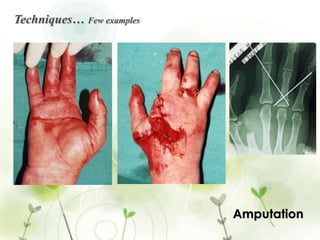
Techniques… Few examplesAmputation
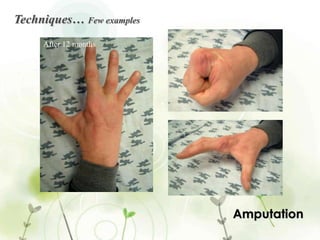
Techniques… Few examplesAfter 12 monthsAmputation
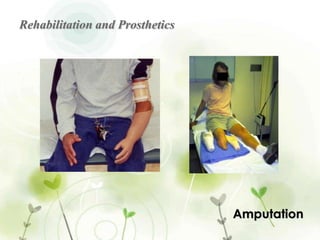
Rehabilitation and ProstheticsAmputation
Rehabilitations.Amputation1. Residual Limb Shrinkage and Shaping2. Limb Desensitization3. Maintain joint range of motion4. Strengthen residual limb5. Maximize Self reliance6. Patient education: Future goals and prosthetic options
Psychological stress.AmputationUp to 2/3 of amputees will manifest postoperative psychiatric symptomsDepressionAnxietyCrying spellsInsomniaLoss of appetiteSuicidal ideation

Amputation in Surgery