LIMB AMPUTATION CLINICAL TREATMENT AND APPROACH.pptx
1.
LIMB AMPUTATION
Dr. PhillipoLeo Chalya M.D. ; M. Med. (Surg.)
Consultant Surgeon & Senior Lecturer Dept Surgery
BMC/CUHAS
2.
DEFINITION
Limb amputationis defined as the surgical removal
of a limb, or part of a limb through bone
Derived from latin word “amputare” meaning
‘cutting around
3.
INDICATIONS
Amputation isindicated when part of a limb is dead, deadly (dangerous) or a dead loss
(damn nuisance)
• Dead (dying) limb
Peripheral vascular disease ( 90% )
Severe trauma
Burns
Frostbite
• Deadly (dangerous) limb
Malignant tumors
Lethal sepsis
Crush injury leading to Crush syndrome
• Dead loss (Damn nuisance) - retaning the limb is worse than having no limb at all …. because of
:-
Pain
Gross malformation
Recurrent sepsis
Severe loss of function
The most common indications for amputation include:-
• Congenital limb deformities
• Acquired limb diseases
4.
Congenital limb deformities
Deformities of digits and/or limbs (e.g., proximal
femoral focal deficiency)
Extra digits and/or limbs (e.g., polydactyly)
Amputation in utero (Amniotic band syndrome)
Congenital pseudoarthrosis of the tibia and fibula,
and radius and ulna
5.
Acquired limb diseases
Vascular diseases
Established gangrene due to peripheral vascular
disease
Traumatic conditions
Severe limb injuries in which the limb cannot be saved
or efforts to save the limb fail
Metabolic diseases
Diabetic foot
CLASSIFICATIONS
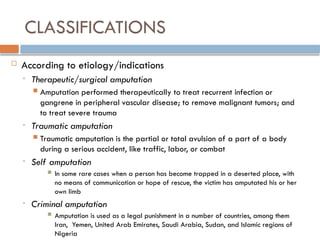
According toetiology/indications
• Therapeutic/surgical amputation
Amputation performed therapeutically to treat recurrent infection or
gangrene in peripheral vascular disease; to remove malignant tumors; and
to treat severe trauma
• Traumatic amputation
Traumatic amputation is the partial or total avulsion of a part of a body
during a serious accident, like traffic, labor, or combat
• Self amputation
In some rare cases when a person has become trapped in a deserted place, with
no means of communication or hope of rescue, the victim has amputated his or her
own limb
• Criminal amputation
Amputation is used as a legal punishment in a number of countries, among them
Iran, Yemen, United Arab Emirates, Saudi Arabia, Sudan, and Islamic regions of
Nigeria
8.
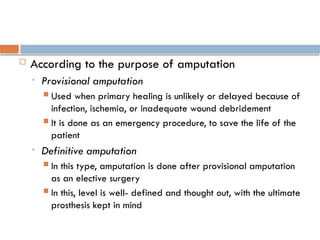
According tothe purpose of amputation
• Provisional amputation
Used when primary healing is unlikely or delayed because of
infection, ischemia, or inadequate wound debridement
It is done as an emergency procedure, to save the life of the
patient
• Definitive amputation
In this type, amputation is done after provisional amputation
as an elective surgery
In this, level is well- defined and thought out, with the ultimate
prosthesis kept in mind
9.
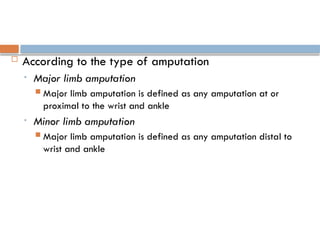
According tothe type of amputation
• Major limb amputation
Major limb amputation is defined as any amputation at or
proximal to the wrist and ankle
• Minor limb amputation
Major limb amputation is defined as any amputation distal to
wrist and ankle
10.
According toanatomical site
• Upper limb amputation
Amputation through the bones of the upper limb
• Lower limb amputation
Amputation through the bones of the lower limb
According to the levels of amputation
Levels of amputation in the lower limb
Levels of amputation in the upper limb
11.
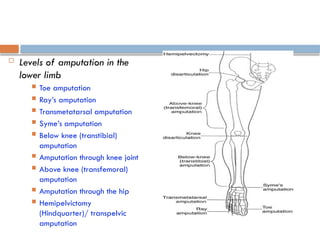
Levels ofamputation in the
lower limb
Toe amputation
Ray’s amputation
Transmetatarsal amputation
Syme’s amputation
Below knee (transtibial)
amputation
Amputation through knee joint
Above knee (transfemoral)
amputation
Amputation through the hip
Hemipelvictomy
(Hindquarter)/ transpelvic
amputation
12.
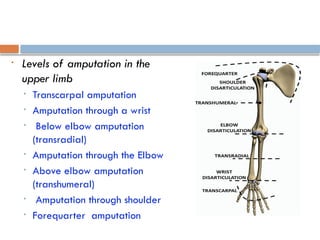
• Levels ofamputation in the
upper limb
• Transcarpal amputation
• Amputation through a wrist
• Below elbow amputation
(transradial)
• Amputation through the Elbow
• Above elbow amputation
(transhumeral)
• Amputation through shoulder
• Forequarter amputation
13.
According tothe timing of surgery
• Emergency amputation
Amputation done on emergency setting
• Elective amputation
Amputation done electively (i.e. planned amputation)
According to the type of amputation stump wound closure
• Closed amputation
Closed amputation is one in which the skin of the amputation stump wound is closed
primarily
• Open / guillotine amputation
Open amputation is one in which the skin is not closed over the end of the stump
It is indicated in infection and severe traumatic wounds with extensive destruction of
tissue and gross contamination by foreign materials
14.
PRINCIPLES FOR AMPUTATIONS
The principles for amputations include the following:-
• General principles
To save as much limb as possible while providing a residual limb
that is able to tolerate the stress of the prosthesis and return to
mobility
• Surgical principles
The use of tourniquet is advised to obtain a bloodless field – except
in ischemic conditions
Level of amputation – effort should be made to preserve all
possible limb length, keeping in mind the prosthesis to be fit
The surgical principles for amputation surgery involve appropriate
management of the skin, bone, nerves, and vessels
15.
Skin flap
The greatest skin length possible should be maintained for
muscle coverage and a tension-free closure
Skin flaps are cut so that their combined length equals
one and half times the width of the limb
As a rule:-
Anterior and posterior flaps of equal length for the upper limb
and for transfemoral(AKA)
Long posterior flap for BKA
Muscles
Muscles should be divided at least 5 cm distal to the level
of bone section
16.
Nerves
Nervesshould be isolated, gently pulled distally into
wound, and divided cleanly with a sharp knife so that the
cut end retracts well proximal to the level of bone
amputation
Ligation of large nerves can be performed when an
associated vessel is present
Blood vessels
The larger arteries and veins are dissected and separately
ligated
This prevents the development of arteriovenous fistulas and
aneurysms
17.
Bone
Boneshould be cut at least 5 cm proximal to the level of
muscles division
Excessive periostrial stripping that may result in formation
of ring sequestra or bone overgrowth should be avoided
Bony prominences that would not be well padded by soft
tissue always should be resected and the remaining bone
should be rasped to form a smooth contour
18.
PREOPERATIVE CARE
Requiresa multidisciplinary approach involving general surgeons,
orthopedic /trauma surgeons, physicians, anesthetists and physiotherapist
Investigate and treating co-morbid conditions in consultation with
physicians, anesthetists and physiotherapist
Preoperative routine investigations such as complete blood count, blood
grouping and cross matching, blood sugar, serum urea and creatinine,
urinalysis, chest x-ray, ECG, serum albumin should be done
Determine the level of amputation
Informed written consent regarding the underlying pathology, inevitability
of amputation, complications, availability of prosthesis
19.
INTRA-OPERATIVE CARE
Intra-operativecare for amputation include the following:-
• Anesthesia: General/spinal
• Position: supine
• Pre-incision: prophylactic antibiotics, exsanguinate, tourniquet,
skin preparation and drapping
• Procedure
• Should be done according to the principles for amputation
The goal of the surgeon is to:-
• Adhere to the principles for amputation
• Find a place where healing is mostly to be complete
• To have an ideal stump for prosthesis fitting
20.
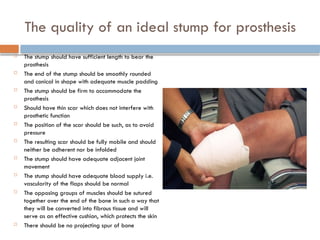
The quality ofan ideal stump for prosthesis
The stump should have sufficient length to bear the
prosthesis
The end of the stump should be smoothly rounded
and conical in shape with adequate muscle padding
The stump should be firm to accommodate the
prosthesis
Should have thin scar which does not interfere with
prosthetic function
The position of the scar should be such, as to avoid
pressure
The resulting scar should be fully mobile and should
neither be adherent nor be infolded
The stump should have adequate adjacent joint
movement
The stump should have adequate blood supply i.e.
vascularity of the flaps should be normal
The opposing groups of muscles should be sutured
together over the end of the bone in such a way that
they will be converted into fibrous tissue and will
serve as an effective cushion, which protects the skin
There should be no projecting spur of bone
21.
POSTOPERATIVE CARE
Thepost-operative care for amputation include the
following:-
Pain management includes the brief use of intravenous
narcotics followed by oral analgesics
Antibiotics
Deep venous thrombosis prophylaxisis
Stump elevation by raising the foot of the bed which
help manage edema and pain
22.
Avoid flexioncontracture at the knee and hip by:
proper positioning of the stump
Gentle passive-stretching exercises
Having the patient engage in exercise to strengthen the
muscles controlling the joint
Severe contracture may require wedging casts or surgical
release of the contracture
Mobilize out of bed in first postoperative day
Remove stitches in two weeks postoperatively
23.
Early physiotherapy
Muscle setting exercise first
Joint movement exercise
Ambulation with parallel bar, then crutches
Early complications
Hemorrhage
3 types
Primary hemorrhage
1st
hge is one which occurs at the time of injury or operation
Reactionary hemorrhage
Reactionary hge is one which occurs within 24 hours of injury or operation
Such hge takes place due to dislodgement of blood clots or slipping of
ligatures
Secondary hemorrhage
This occurs usually after 7 to 14 days of injury or operation
This is usually due to infection and sloughing of part of the arterial wall
26.
Hematoma
Inadequatehaemostasis, loosening of the ligature and inadequate
wound drainage are the common causes
Hematoma results in delayed wound healing and infection
It should be aspirated and a pressure bandage given
Surgical site infection
The cause generally is an underlying peripheral vascular disease,
diabetes or a hematoma
Wound breakdown and occasionally the spread of infection proximally
may necessitate amputation at a higher level
A wound should not be closed whenever the surgeon is in doubt about the
vascularity of the muscles or the skin at the cut end
Any discharge from the wound should be treated promptly
27.
Skin flapnecrosis
A minor or major skin flap necrosis indicates insufficient
circulation of the skin flap
It can be avoided by taking care at the time of
designing skin flaps that as much subcutaneous tissues
remain with the skin flap as possible
Small areas of flap necrosis may heel with dressings
but for larger areas, redesigning of the flaps may be
required
28.
Wound dehiscence
Wound dehiscence may occur when the wound is closed
under tension or if there poor vascularity of the muscles
or the skin at the cut end
Deep venous thrombosis
Amputation may be followed by deep vein thrombosis and
pulmonary embolism in the early postoperative days
So subcutaneous heparin 5,000 units twice daily is
strongly advised for several weeks after operation
29.
Stump ulceration
Ulceration of the stump may occur due to pressure
effects of the prosthesis
Some patients may be troubled by cold and
discoloured stump particularly during winter due to
ischaemia
30.
Late complications
Deformitiesof joints (Joint contracture/ stiffness)
These results from improper positioning of the amputation
stump, leading to contractures
A mild or moderate contracture is treated by appropriate
positioning and gentle passive-stretching exercises; severe
deformity may need surgical correction
Causalgia (i.e. persistent painful stump scar)
Causalgia is defined as a persistent pain at the end of the
amputation stump
This is mostly seen in case of amputation of digits
31.
Neuroma
Stumpneuroma, which is proliferation of nerve fibre at the point
of nerve division
It results from the nerve trauma and can be of two types:
Terminal neuroma which originates at the end of the nerve, being the
pattern of nerve healing, often asymptomatic
Spindle neuroma which is far from the nerve extremity resulting from
microtrauma due to stretching or compression by the localized scar
tissue
Painful neuroma can usually be prevented by dividing the nerves
sharply at a proximal level and allowing it to retract well
proximal to the end of the stump to lie in normal soft-tissues
If it does form, it is to be excised at a more proximal level
32.
Phantom pain
Phantom pain is the awareness of pain in the amputated
limb
Treatment is difficult
Phantom limb
All individuals with acquired amputations experience
some form of phantom sensation, a sensation as if the
amputated part is still present
This sensation is most prominent in the period immediately
following amputation, and gradually diminishes with time
33.
Osteomyelitis
Osteomyelitismight occur by direct spread from a
contiguous soft tissue infection, haematogenous
dissemination or in a previous quiescent septic focus
Osteoporosis and tendency to fracture
 Most read
 Most read