Amputation of
extremities
Professor doctor
Seif Elden M. A. Farag
Professor of Physical Medicine, Rheumatology and
Renabilitatiom
Definition
O Cutting of the extremity or part of the
extremity through the bone
While ………..
O Cutting of the extremity extremity or part
of the extremity through the joint is
disarticulation
indications
O Amputation can be regarded as a
treatment and not tragedy
O indications :-
1. Dead ( or dying ) limb
2. Dangerous limb
3. Damn nuisance limb
Injury is the most common cause of
amputation
Indication according age
Congenial anomaly usually in children
Crush injury at any age
Peripheral vascular disease and infections
at elderly
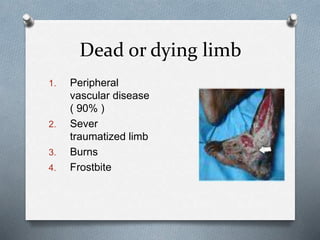
Dead or dying limb
1. Peripheral
vascular disease
( 90% )
2. Sever
traumatized limb
3. Burns
4. Frostbite
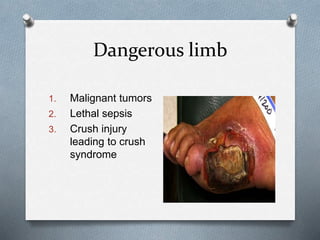
Dangerous limb
1. Malignant tumors
2. Lethal sepsis
3. Crush injury
leading to crush
syndrome
Damn nuisance
Remaining the limb is more worse than
having no limb at all …. Because of :-
1. Pain
2. Gross malformation
3. Recurrent sepsis
4. Sever loss of function
Varieties of amputations
Provisional
amputation
O When primary healing is unlikely
O The limb amputate as distal as the causal
factor will allow
O Skin flap suture loosely over a pack
O Re-amputation perform when stump
condition is favorable
Definitive end-
bearing
O When weight is taken through the end of
the stump
O The scar must not be terminal
O Bone end must be solid (cut near the joint)
O Example through knee , syme’s
Definitive non-end-
bearing
O Commonest variety
O All upper limb & most lower limb
amputations are come under this type
O The scar can be terminal
Amputation
s at the
sites of
O The “ sites of election
”are determined by :-
1. the demand of the prosthetic design
2. local function e.g bellow the most distal
palpable arterial pulsation
Too short a stump
slips out from the prosthesis
Too long a stump
painful , ulcerate , complicates the
incorporation of the joint in the prosthesis
Now a day the skill of orthotiest make
amputation possible at any level
Principles
of technique
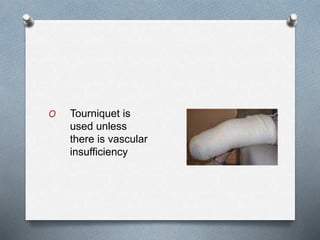
O Tourniquet is
used unless
there is vascular
insufficiency
O Skin flaps are cut so that there
combined length equals one & half the
width of the limb at the site of the
amputation
O Equal flaps are for upper limb & trans-
femoral amputations , long posterior
flap for bellow – knee
O Muscle cut at distal level from the level of
the bone proposed
OMyoplasty …. When the
muscles sutured together over the bone
O A raw nerve end should not bear weight
Divide the nerve proximal to
the bone cut
O Saw is used to make the bone ends
smooth , and for beveling the tibia
interiorly
O Fibula is cut 3 cm shorter
O Remove the tourniquet and stop bleeding
O Suture the skin without tension
O Apply suction drain
O Bandage the stump tightly
Aftercare
O Evacuate the hematoma as soon
O Elastic bandaging the stump for shrinkage
O Exercise the muscles
O Keep joints mobile
O Advice using the prosthesis
Level of amputation
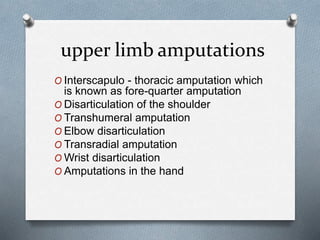
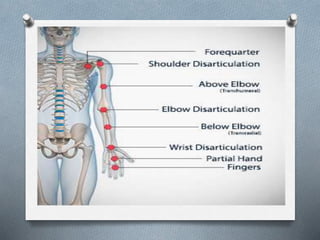
upper limb amputations
O Interscapulo - thoracic amputation which
is known as fore-quarter amputation
O Disarticulation of the shoulder
O Transhumeral amputation
O Elbow disarticulation
O Transradial amputation
O Wrist disarticulation
O Amputations in the hand
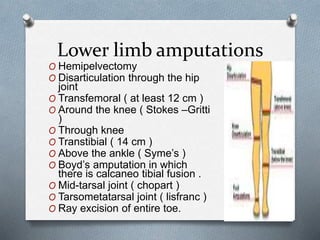
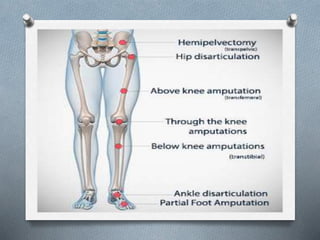
Lower limb amputations
O Hemipelvectomy
O Disarticulation through the hip
joint
O Transfemoral ( at least 12 cm )
O Around the knee ( Stokes –Gritti
)
O Through knee
O Transtibial ( 14 cm )
O Above the ankle ( Syme’s )
O Boyd’s amputation in which
there is calcaneo tibial fusion .
O Mid-tarsal joint ( chopart )
O Tarsometatarsal joint ( lisfranc )
O Ray excision of entire toe.
OStump is the
terminal segment of
the limb remaining
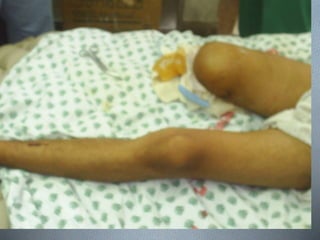
after the amputation
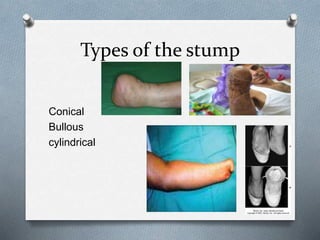
Types of the stump
Conical
Bullous
cylindrical
Complication
s of the
amputation
Psychological rejection
O Proper preoperative preparation
O Psychological therapy
O Group therapy
O Motivation
O Recall pervious similar condition
Early stump complications
1. Secondary hemorrhage
2. Breakdown of the skin
flaps (may be due to
ischemia or excessive
suture tension )
3. Gas gangrene
Late stump complications
Skin
O eczema
O purulent lumps
O fissuring & ulceration
O infected epidermoid cyst
O Squamouse cell carcinoma
O Verrucous hyperplasia
O A superficial skin defect can usually be
closed adequately with a Split –thickness
skin graft (STSG).
O Full –thickness defect over bony
prominence is better handled with full –
thickness coverage (either with local flap,
pedicle flap, or free island flap).
O Physical therapy can enhance wound
healing and reduce associated
complication (such as development of
hypertrophic scar) through using low level
laser therapy (LLLT) (Helium neon laser
therapy and or Gl-Al-Ars), with following
treatment protocol
Muscle ..
O If excessive muscle left , it will produce
unstable , loose cushion
O If loose muscle left, it will give conical
stump appearance and poorly fitting
prosthesis
O So, muscle condition is highly interesting
to get better fitting prosthesis furthermore
better control in residual limb
Artery… poor vascularity gives
O cold
O blue color stump
O liable to ulcerate
Nerve .
O Painful neuromas attached to the scar
O So, nerves should be retracted during
surgery
O Nerve ends should be non weight bering
areas in the prosthesis
O Irritation of nerve ends would precipitate
phantom pain
Pain
neuropathic pain variable from prepheral
tingling to severe intense burning pain
Phantom
Causalgia
Telescoping
A feeling that the
amputated limb still present
Intense burning pain and
sensitivity
Due to division of peripheral
nerves
Feeling of shrinking of
amputee limb
Pain managment
O Good preoperative preparation and early
psychological acceptance
O Good surgical procedure (nerves should
be retracted above level of suture)
O Post operative care
psychological therapy
medical treatment for neuropathic pain
physiotherapy (electrical stimulation,
TENS, hydrotherapy)
nerve block
sympathectomy
.
Joint
O the joint above the site of amputation
may become stiff or deformed
O Deformities are fixed flexion & fixed
abduction in above knee ….. Fixed flexion
in bellow knee amputations .
O Fore-foot amputation may be complicated
by equineus deformity.
O Contracture
O Lax joint
Bones
O terminal bone spur may cause pain &
infection
O Stump bone fracture may result from
sever osteoporosis
O Protrusion
O Periosteal exostosis
O deformity
Rehabilitation
It is a program designated by rehabilitation
team to restore maximal function capacity of
the amputee
With respecting of his disability limitation
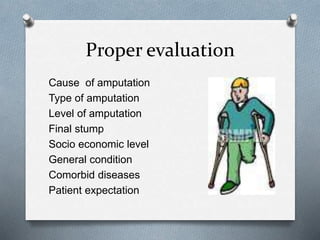
Proper evaluation
Cause of amputation
Type of amputation
Level of amputation
Final stump
Socio economic level
General condition
Comorbid diseases
Patient expectation
1- presurgical stage
In elective amputation prior to surgery
psycological consultation is highly
recommended to allow early acceptance
and avoid post operative complication
Proper evaluation to socio economic level
Evaluation General condition and comorbid
diseases
Family education and support
2- early post operative
rehabilitation
Target
1- rapid uncomplicated wound healing
2- short stay hospital
3- early patient acceptance
4- pain management
5- minimal scaring and proper stump out
come.
6- control oedema
7- maintain muscle stregnth
8- desensitization
9- avoid joint contructure
Patient positioning
Description
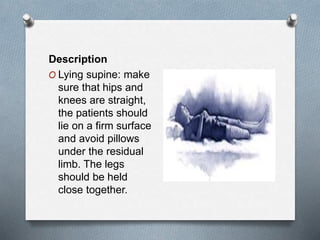
O Lying supine: make
sure that hips and
knees are straight,
the patients should
lie on a firm surface
and avoid pillows
under the residual
limb. The legs
should be held
close together.
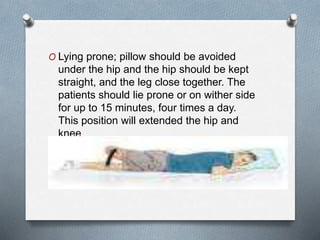
O Lying prone; pillow should be avoided
under the hip and the hip should be kept
straight, and the leg close together. The
patients should lie prone or on wither side
for up to 15 minutes, four times a day.
This position will extended the hip and
knee
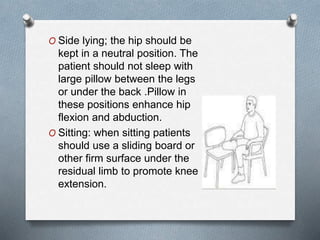
O Side lying; the hip should be
kept in a neutral position. The
patient should not sleep with
large pillow between the legs
or under the back .Pillow in
these positions enhance hip
flexion and abduction.
O Sitting: when sitting patients
should use a sliding board or
other firm surface under the
residual limb to promote knee
extension.
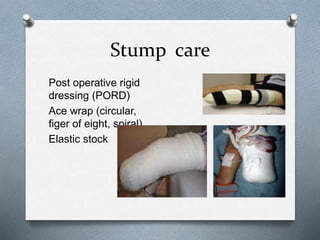
Stump care
Post operative rigid
dressing (PORD)
Ace wrap (circular,
figer of eight, spiral)
Elastic stock
Desensitization
program
By
O Circular massage
O Gentile tapping and
friction
O Brush with soft cloth
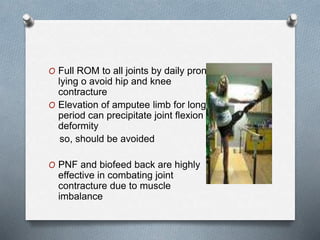
O Full ROM to all joints by daily prone
lying o avoid hip and knee
contracture
O Elevation of amputee limb for long
period can precipitate joint flexion
deformity
so, should be avoided
O PNF and biofeed back are highly
effective in combating joint
contracture due to muscle
imbalance
Daily exercise is a cardinal
protocol
O The exercises program is designed individually
and includes ROM, exercises, isometric,
isotonic, and endurance activities, and these
dependent largely on
(i)-Postoperative healing.
(ii)-Postoperative pain
(iii)-Post-surgical dressing.
O This exercise should not produce more than
mild discomfort and put less stress on suture
line, otherwise stop exercises.
O The hip extensor, abductors and knee extensor
and flexors are particularly important for
prosthetic ambulation.
O Strengthening exercise for upper extremity
muscles of shoulder depressor, elbow extensor,
wrist extensor, and hand flexor should
encouraged, with general strengthening
program for trunk and abdominal muscles.
O The program should emphasize active or active
assistive ROM of the joint (s) proximal to the
amputation, at 1st to 2nd day postoperative.
O Active motion of all proximal joints through the
full ROM should be obtained by 10 -14 days
following amputation unless grafting procedure
precludes exercising.
These exercises help to
O (i)-Reduce edema, and promote healing.
O (ii)-Maintain joint ROM,
O (iii)-Prevent contracture and correct
existing contracture
O (iv)-Allow early mobility self care and
O (v)-Maintain muscle strength, and
kinesthetic sense of residual and phantom
limb, which can later be used in prosthetic
training
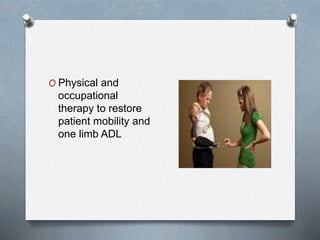
O Physical and
occupational
therapy to restore
patient mobility and
one limb ADL
3- Prescription and
ambulation stage
O Need expert doctor to select proper
prosthesis
O Patient must be
motivated , intelligent and respect
prosthesis
Learn patient how to do on and off
Daily patient protocol
O Daily exercise for remaining limb
O Daily stump hygiene (clean, dry and
soothing).
O Strengthen exercise to sound limb
O Basic Prosthesis Care
oiling and maintenance
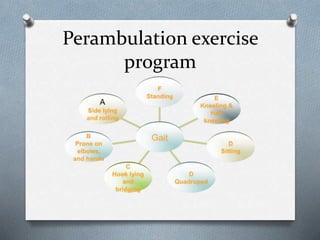
Perambulation exercise
program
parellel bar ambulation
activities
Turning
&
Returning
Stepping
Forward
Backward
Standing
Push up
Hip
Hiking
Lateral
Weight
Shift
Anterior
Posterior
Weight
Shift
Standing
Balance
Parallel
Bar
Activities
prosthes
is
Characteristics of amputated
limb which can functional well
in prosthesis
O Pain free
O Well padded by soft tissue
O Non adherent scar
O Cylindrical shape
O Greatest bone length
O Normal sensation
Ideal prosthesis
1. Fits comfortably
2. Function well
3. Looks presentable
4. Fit as soon after the operation
O In the upper limb the distal portion is
detachable & can be replaced
O In lower limb weight can be transmitted
through the greater trochanter , tibial
tuberocity , patellar tendon , upper tibia or
soft tissues
O Electrically powered limb is present now
4- follow up stage
Regular follow up visits
stump complication
residual limb muscle and joint state
prosthesis maintenance
pain management
occupational and psychological support
Functional classification of the
amputee
Class 1
O Full restortion of
functional capacity
O Return to work
O Sport practice
O Do well with
prosthesis
Class 2
O Partial restoration of
functional capacity
O Modify his work
O Stop sport
O Get benefit with
prosthesis
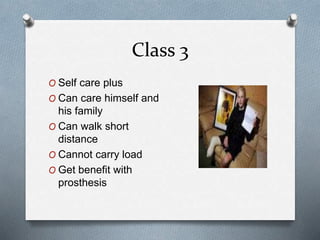
Class 3
O Self care plus
O Can care himself and
his family
O Can walk short
distance
O Cannot carry load
O Get benefit with
prosthesis
Class 4
O Self care minus
O Can hardly care himself
O Cannot walk short distance
O Cannot go out alone
O Get benefit with prosthesis
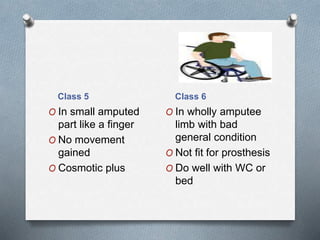
Class 5 Class 6
O In small amputed
part like a finger
O No movement
gained
O Cosmotic plus
O In wholly amputee
limb with bad
general condition
O Not fit for prosthesis
O Do well with WC or
bed
thanks

amputation prof dr seif.ppt

  • 1.
    Amputation of extremities Professor doctor SeifElden M. A. Farag Professor of Physical Medicine, Rheumatology and Renabilitatiom
  • 2.
    Definition O Cutting ofthe extremity or part of the extremity through the bone While ……….. O Cutting of the extremity extremity or part of the extremity through the joint is disarticulation
  • 3.
    indications O Amputation canbe regarded as a treatment and not tragedy O indications :- 1. Dead ( or dying ) limb 2. Dangerous limb 3. Damn nuisance limb Injury is the most common cause of amputation
  • 4.
    Indication according age Congenialanomaly usually in children Crush injury at any age Peripheral vascular disease and infections at elderly
  • 5.
    Dead or dyinglimb 1. Peripheral vascular disease ( 90% ) 2. Sever traumatized limb 3. Burns 4. Frostbite
  • 6.
    Dangerous limb 1. Malignanttumors 2. Lethal sepsis 3. Crush injury leading to crush syndrome
  • 7.
    Damn nuisance Remaining thelimb is more worse than having no limb at all …. Because of :- 1. Pain 2. Gross malformation 3. Recurrent sepsis 4. Sever loss of function
  • 8.
    Varieties of amputations Provisional amputation OWhen primary healing is unlikely O The limb amputate as distal as the causal factor will allow O Skin flap suture loosely over a pack O Re-amputation perform when stump condition is favorable
  • 9.
    Definitive end- bearing O Whenweight is taken through the end of the stump O The scar must not be terminal O Bone end must be solid (cut near the joint) O Example through knee , syme’s
  • 10.
    Definitive non-end- bearing O Commonestvariety O All upper limb & most lower limb amputations are come under this type O The scar can be terminal
  • 11.
  • 12.
    O The “sites of election ”are determined by :- 1. the demand of the prosthetic design 2. local function e.g bellow the most distal palpable arterial pulsation
  • 13.
    Too short astump slips out from the prosthesis Too long a stump painful , ulcerate , complicates the incorporation of the joint in the prosthesis Now a day the skill of orthotiest make amputation possible at any level
  • 14.
  • 15.
    O Tourniquet is usedunless there is vascular insufficiency
  • 16.
    O Skin flapsare cut so that there combined length equals one & half the width of the limb at the site of the amputation O Equal flaps are for upper limb & trans- femoral amputations , long posterior flap for bellow – knee
  • 17.
    O Muscle cutat distal level from the level of the bone proposed OMyoplasty …. When the muscles sutured together over the bone
  • 18.
    O A rawnerve end should not bear weight Divide the nerve proximal to the bone cut
  • 19.
    O Saw isused to make the bone ends smooth , and for beveling the tibia interiorly O Fibula is cut 3 cm shorter
  • 20.
    O Remove thetourniquet and stop bleeding O Suture the skin without tension O Apply suction drain O Bandage the stump tightly
  • 21.
    Aftercare O Evacuate thehematoma as soon O Elastic bandaging the stump for shrinkage O Exercise the muscles O Keep joints mobile O Advice using the prosthesis
  • 22.
  • 23.
    upper limb amputations OInterscapulo - thoracic amputation which is known as fore-quarter amputation O Disarticulation of the shoulder O Transhumeral amputation O Elbow disarticulation O Transradial amputation O Wrist disarticulation O Amputations in the hand
  • 25.
    Lower limb amputations OHemipelvectomy O Disarticulation through the hip joint O Transfemoral ( at least 12 cm ) O Around the knee ( Stokes –Gritti ) O Through knee O Transtibial ( 14 cm ) O Above the ankle ( Syme’s ) O Boyd’s amputation in which there is calcaneo tibial fusion . O Mid-tarsal joint ( chopart ) O Tarsometatarsal joint ( lisfranc ) O Ray excision of entire toe.
  • 27.
    OStump is the terminalsegment of the limb remaining after the amputation
  • 28.
    Types of thestump Conical Bullous cylindrical
  • 30.
  • 31.
    Psychological rejection O Properpreoperative preparation O Psychological therapy O Group therapy O Motivation O Recall pervious similar condition
  • 32.
    Early stump complications 1.Secondary hemorrhage 2. Breakdown of the skin flaps (may be due to ischemia or excessive suture tension ) 3. Gas gangrene
  • 33.
    Late stump complications Skin Oeczema O purulent lumps O fissuring & ulceration O infected epidermoid cyst O Squamouse cell carcinoma O Verrucous hyperplasia
  • 34.
    O A superficialskin defect can usually be closed adequately with a Split –thickness skin graft (STSG). O Full –thickness defect over bony prominence is better handled with full – thickness coverage (either with local flap, pedicle flap, or free island flap). O Physical therapy can enhance wound healing and reduce associated complication (such as development of hypertrophic scar) through using low level laser therapy (LLLT) (Helium neon laser therapy and or Gl-Al-Ars), with following treatment protocol
  • 35.
    Muscle .. O Ifexcessive muscle left , it will produce unstable , loose cushion O If loose muscle left, it will give conical stump appearance and poorly fitting prosthesis O So, muscle condition is highly interesting to get better fitting prosthesis furthermore better control in residual limb
  • 36.
    Artery… poor vascularitygives O cold O blue color stump O liable to ulcerate
  • 37.
    Nerve . O Painfulneuromas attached to the scar O So, nerves should be retracted during surgery O Nerve ends should be non weight bering areas in the prosthesis O Irritation of nerve ends would precipitate phantom pain
  • 38.
    Pain neuropathic pain variablefrom prepheral tingling to severe intense burning pain Phantom Causalgia Telescoping A feeling that the amputated limb still present Intense burning pain and sensitivity Due to division of peripheral nerves Feeling of shrinking of amputee limb
  • 39.
    Pain managment O Goodpreoperative preparation and early psychological acceptance O Good surgical procedure (nerves should be retracted above level of suture) O Post operative care psychological therapy medical treatment for neuropathic pain physiotherapy (electrical stimulation, TENS, hydrotherapy) nerve block sympathectomy
  • 40.
    . Joint O the jointabove the site of amputation may become stiff or deformed O Deformities are fixed flexion & fixed abduction in above knee ….. Fixed flexion in bellow knee amputations . O Fore-foot amputation may be complicated by equineus deformity. O Contracture O Lax joint
  • 41.
    Bones O terminal bonespur may cause pain & infection O Stump bone fracture may result from sever osteoporosis O Protrusion O Periosteal exostosis O deformity
  • 42.
    Rehabilitation It is aprogram designated by rehabilitation team to restore maximal function capacity of the amputee With respecting of his disability limitation
  • 43.
    Proper evaluation Cause ofamputation Type of amputation Level of amputation Final stump Socio economic level General condition Comorbid diseases Patient expectation
  • 44.
    1- presurgical stage Inelective amputation prior to surgery psycological consultation is highly recommended to allow early acceptance and avoid post operative complication Proper evaluation to socio economic level Evaluation General condition and comorbid diseases Family education and support
  • 45.
    2- early postoperative rehabilitation Target 1- rapid uncomplicated wound healing 2- short stay hospital 3- early patient acceptance 4- pain management 5- minimal scaring and proper stump out come.
  • 46.
    6- control oedema 7-maintain muscle stregnth 8- desensitization 9- avoid joint contructure
  • 47.
  • 48.
    Description O Lying supine:make sure that hips and knees are straight, the patients should lie on a firm surface and avoid pillows under the residual limb. The legs should be held close together.
  • 49.
    O Lying prone;pillow should be avoided under the hip and the hip should be kept straight, and the leg close together. The patients should lie prone or on wither side for up to 15 minutes, four times a day. This position will extended the hip and knee
  • 50.
    O Side lying;the hip should be kept in a neutral position. The patient should not sleep with large pillow between the legs or under the back .Pillow in these positions enhance hip flexion and abduction. O Sitting: when sitting patients should use a sliding board or other firm surface under the residual limb to promote knee extension.
  • 51.
    Stump care Post operativerigid dressing (PORD) Ace wrap (circular, figer of eight, spiral) Elastic stock
  • 52.
    Desensitization program By O Circular massage OGentile tapping and friction O Brush with soft cloth
  • 53.
    O Full ROMto all joints by daily prone lying o avoid hip and knee contracture O Elevation of amputee limb for long period can precipitate joint flexion deformity so, should be avoided O PNF and biofeed back are highly effective in combating joint contracture due to muscle imbalance
  • 54.
    Daily exercise isa cardinal protocol
  • 55.
    O The exercisesprogram is designed individually and includes ROM, exercises, isometric, isotonic, and endurance activities, and these dependent largely on (i)-Postoperative healing. (ii)-Postoperative pain (iii)-Post-surgical dressing. O This exercise should not produce more than mild discomfort and put less stress on suture line, otherwise stop exercises. O The hip extensor, abductors and knee extensor and flexors are particularly important for prosthetic ambulation.
  • 56.
    O Strengthening exercisefor upper extremity muscles of shoulder depressor, elbow extensor, wrist extensor, and hand flexor should encouraged, with general strengthening program for trunk and abdominal muscles. O The program should emphasize active or active assistive ROM of the joint (s) proximal to the amputation, at 1st to 2nd day postoperative. O Active motion of all proximal joints through the full ROM should be obtained by 10 -14 days following amputation unless grafting procedure precludes exercising.
  • 57.
    These exercises helpto O (i)-Reduce edema, and promote healing. O (ii)-Maintain joint ROM, O (iii)-Prevent contracture and correct existing contracture O (iv)-Allow early mobility self care and O (v)-Maintain muscle strength, and kinesthetic sense of residual and phantom limb, which can later be used in prosthetic training
  • 58.
    O Physical and occupational therapyto restore patient mobility and one limb ADL
  • 59.
  • 60.
    O Need expertdoctor to select proper prosthesis O Patient must be motivated , intelligent and respect prosthesis Learn patient how to do on and off
  • 61.
    Daily patient protocol ODaily exercise for remaining limb O Daily stump hygiene (clean, dry and soothing). O Strengthen exercise to sound limb O Basic Prosthesis Care oiling and maintenance
  • 62.
  • 63.
    parellel bar ambulation activities Turning & Returning Stepping Forward Backward Standing Pushup Hip Hiking Lateral Weight Shift Anterior Posterior Weight Shift Standing Balance Parallel Bar Activities
  • 64.
  • 65.
    Characteristics of amputated limbwhich can functional well in prosthesis O Pain free O Well padded by soft tissue O Non adherent scar O Cylindrical shape O Greatest bone length O Normal sensation
  • 66.
    Ideal prosthesis 1. Fitscomfortably 2. Function well 3. Looks presentable 4. Fit as soon after the operation
  • 67.
    O In theupper limb the distal portion is detachable & can be replaced O In lower limb weight can be transmitted through the greater trochanter , tibial tuberocity , patellar tendon , upper tibia or soft tissues O Electrically powered limb is present now
  • 69.
    4- follow upstage Regular follow up visits stump complication residual limb muscle and joint state prosthesis maintenance pain management occupational and psychological support
  • 70.
  • 71.
    Class 1 O Fullrestortion of functional capacity O Return to work O Sport practice O Do well with prosthesis
  • 72.
    Class 2 O Partialrestoration of functional capacity O Modify his work O Stop sport O Get benefit with prosthesis
  • 73.
    Class 3 O Selfcare plus O Can care himself and his family O Can walk short distance O Cannot carry load O Get benefit with prosthesis
  • 74.
    Class 4 O Selfcare minus O Can hardly care himself O Cannot walk short distance O Cannot go out alone O Get benefit with prosthesis
  • 75.
    Class 5 Class6 O In small amputed part like a finger O No movement gained O Cosmotic plus O In wholly amputee limb with bad general condition O Not fit for prosthesis O Do well with WC or bed
  • 76.