PELVIC FRACTURES
Dr. Raman Ghimire
2018/01/16 Pelvic Fractures
Overview
• Introduction
• Epidemiology
• Etiology
• Relevant anatomy
• Classification
• Approach to Polytrauma
• Complications
• Take home messages
• MCQs
• References
2018/01/16 Pelvic Fractures
Introduction
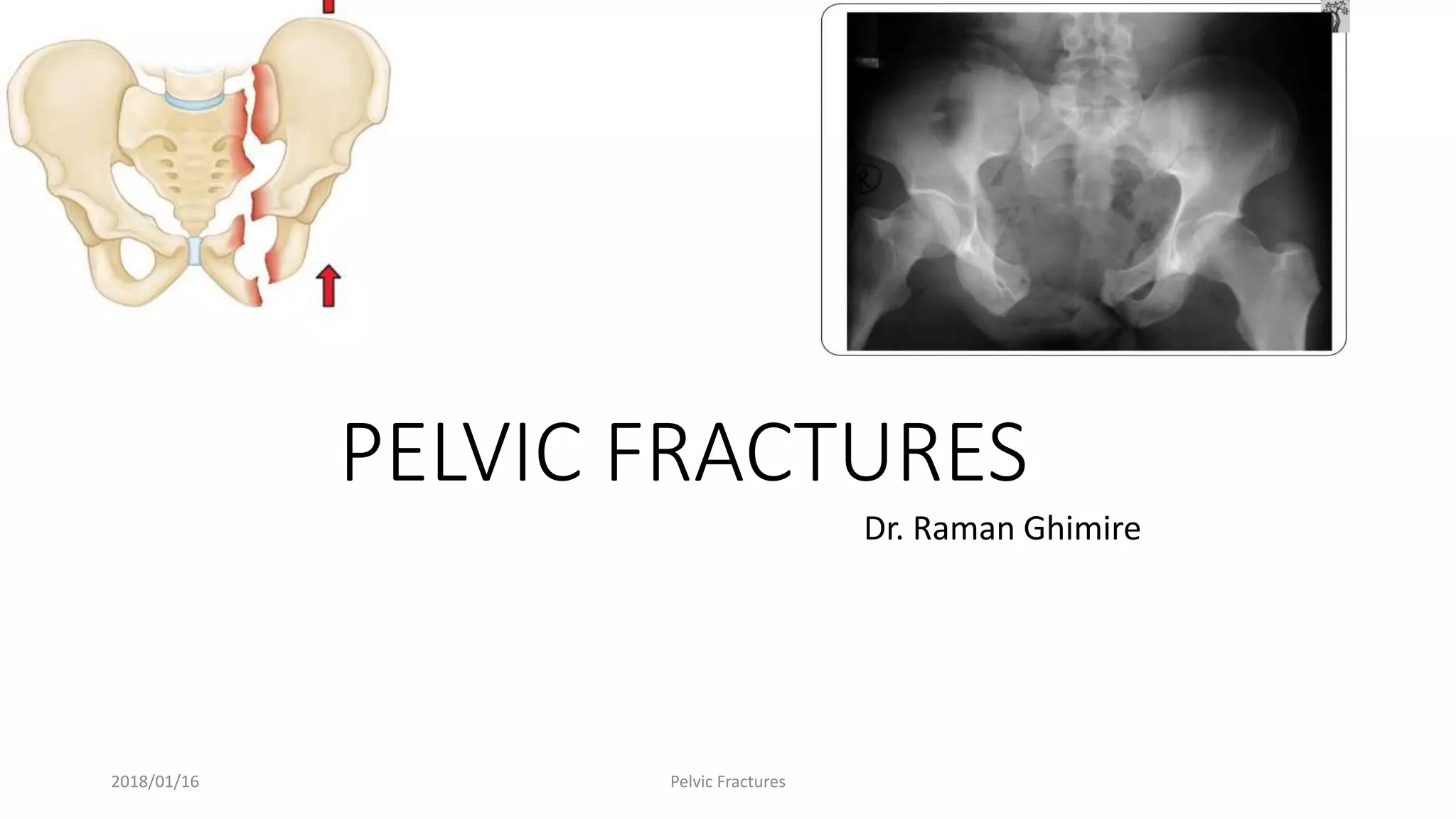
• Pelvic fracture is a disruption of the bony structure of the pelvis, including the hip
bone, sacrum and coccyx.
• Benign to life threatening
• Component of Polytrauma , associated injuries :
 Chest injuries (63%)
 Long bone fractures (50%)
 Head injury (40%)
 Solid organ injury (40%)
 Intestinal injuries (14%)
2018/01/16 Pelvic Fractures
Epidemiology
• Incidence : 23 per 100,000 persons per year
• Age : 15-28 years
• Male <35 years , Female >35 years
• 3 percent of skeletal injuries
• Open pelvic fractures: 2 – 4%
• Mortality:5 -16 %
(unstable pelvic fractures:8 %)
2018/01/16 Pelvic Fractures
Etiology
• High energy blunt trauma
 RTA: 80 - 84% of pelvic fractures
 Falls from height: 5 -12%
 Young people
 Abdominal and pelvic visceral injury
• Low energy mechanism
 Fall from standing height
 Old people
2018/01/16 Pelvic Fractures
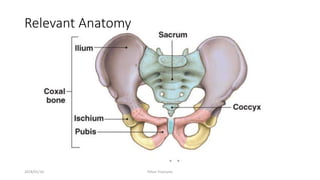
Relevant Anatomy
2018/01/16 Pelvic Fractures
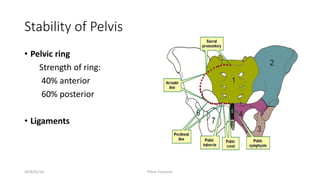
Stability of Pelvis
• Pelvic ring
Strength of ring:
40% anterior
60% posterior
• Ligaments
2018/01/16 Pelvic Fractures
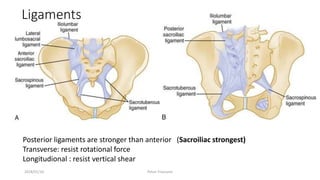
Ligaments
Posterior ligaments are stronger than anterior (Sacroiliac strongest)
Transverse: resist rotational force
Longitudional : resist vertical shear
2018/01/16 Pelvic Fractures
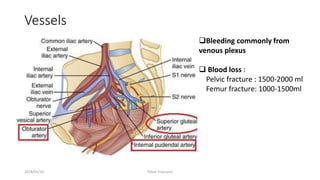
Vessels
Bleeding commonly from
venous plexus
 Blood loss :
Pelvic fracture : 1500-2000 ml
Femur fracture: 1000-1500ml
2018/01/16 Pelvic Fractures
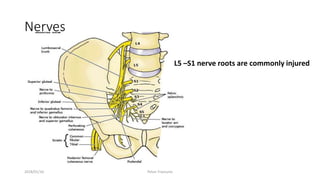
Nerves
L5 –S1 nerve roots are commonly injured
2018/01/16 Pelvic Fractures
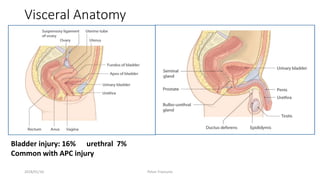
Visceral Anatomy
Bladder injury: 16% urethral 7%
Common with APC injury
2018/01/16 Pelvic Fractures
Classification
1. Young and Burgess Classification
2. Tile Classification
3. Apley ‘s Classification
4. Academy of Orthopedics/Orthopedic Trauma Association
classification system (AO/OTA) : Research
5. Denis zone of classification : sacral injury
6. Jones-Powell Classification : open pelvic fractures
2018/01/16 Pelvic Fractures
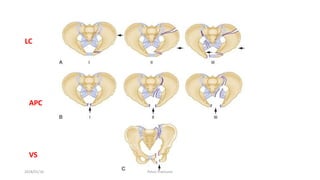
Young and Burgess Classification
(mechanism of injury)
• Lateral compression (LC)
• Anteroposterior compression (APC)
• Vertical shear (VS)
• Combined mechanism (CM)
2018/01/16 Pelvic Fractures
LC
APC
VS
2018/01/16 Pelvic Fractures
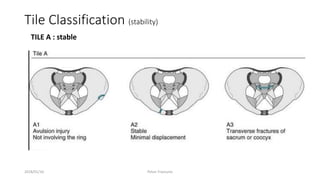
Tile Classification (stability)
TILE A : stable
2018/01/16 Pelvic Fractures
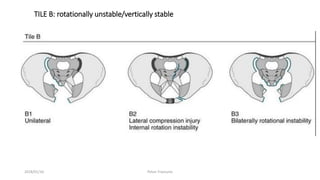
TILE B: rotationally unstable/vertically stable
2018/01/16 Pelvic Fractures
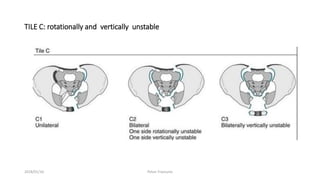
TILE C: rotationally and vertically unstable
2018/01/16 Pelvic Fractures
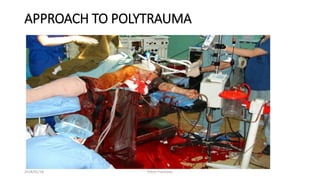
APPROACH TO POLYTRAUMA
2018/01/16 Pelvic Fractures
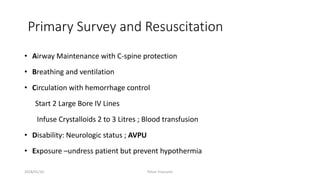
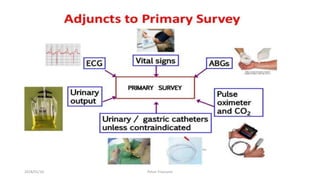
Primary Survey and Resuscitation
• Airway Maintenance with C-spine protection
• Breathing and ventilation
• Circulation with hemorrhage control
Start 2 Large Bore IV Lines
Infuse Crystalloids 2 to 3 Litres ; Blood transfusion
• Disability: Neurologic status ; AVPU
• Exposure –undress patient but prevent hypothermia
2018/01/16 Pelvic Fractures
Diagnostic tools
• CXR-AP
• X-ray C-spine- Lateral
• X-ray Pelvis-AP
• FAST scan
2018/01/16 Pelvic Fractures
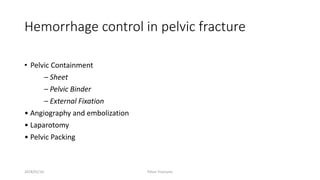
Hemorrhage control in pelvic fracture
• Pelvic Containment
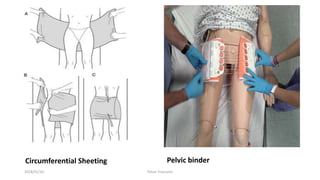
– Sheet
– Pelvic Binder
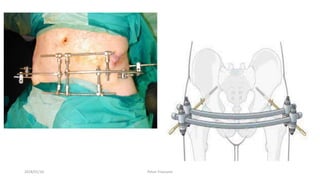
– External Fixation
• Angiography and embolization
• Laparotomy
• Pelvic Packing
2018/01/16 Pelvic Fractures
Circumferential Sheeting Pelvic binder
2018/01/16 Pelvic Fractures
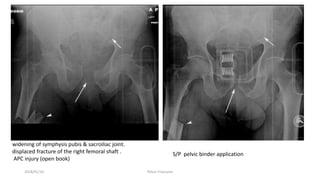
widening of symphysis pubis & sacroiliac joint.
displaced fracture of the right femoral shaft .
APC injury (open book)
S/P pelvic binder application
2018/01/16 Pelvic Fractures
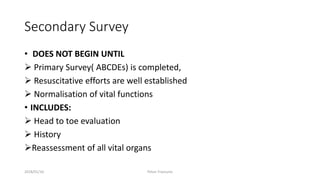
Secondary Survey
• DOES NOT BEGIN UNTIL
 Primary Survey( ABCDEs) is completed,
 Resuscitative efforts are well established
 Normalisation of vital functions
• INCLUDES:
 Head to toe evaluation
 History
Reassessment of all vital organs
2018/01/16 Pelvic Fractures
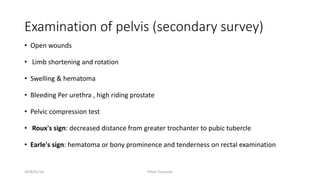
Examination of pelvis (secondary survey)
• Open wounds
• Limb shortening and rotation
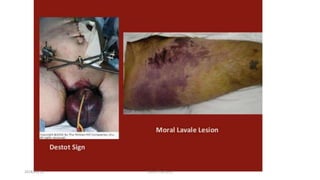
• Swelling & hematoma
• Bleeding Per urethra , high riding prostate
• Pelvic compression test
• Roux's sign: decreased distance from greater trochanter to pubic tubercle
• Earle's sign: hematoma or bony prominence and tenderness on rectal examination
2018/01/16 Pelvic Fractures
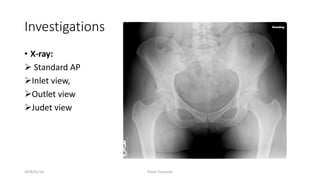
Investigations
• X-ray:
 Standard AP
Inlet view,
Outlet view
Judet view
2018/01/16 Pelvic Fractures
Radiographic signs of instability
• > 5 mm displacement of posterior sacroiliac complex
• Avulsion fractures of:
 ischial spine
 ischial tuberosity
 sacrum
 transverse process of 5th lumbar vertebrae
2018/01/16 Pelvic Fractures
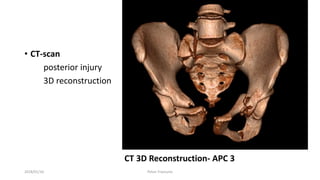
• CT-scan
posterior injury
3D reconstruction
CT 3D Reconstruction- APC 3
2018/01/16 Pelvic Fractures
• Hb/ PCV
• Retrograde urethrography
• cystography
• IV urogram
• Angiography
2018/01/16 Pelvic Fractures
Non Operative Management
• Pain management
• Protected weight bearing with crutch or walker
• Serial x-ray to look for instability
2018/01/16 Pelvic Fractures
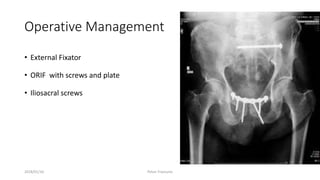
Operative Management
• External Fixator
• ORIF with screws and plate
• Iliosacral screws
2018/01/16 Pelvic Fractures
Complications
• Hemorrhage– shock
• Nerve injury
• Fat embolism
• Infection
• DVT
• Non Union
• Malunion
2018/01/16 Pelvic Fractures
Take Home Messages
• Tile and Burgess & Young Classifications are the most commonly used
classifications
• Follow ATLS protocol : ABCDE
• Systematic well-organized multidisciplinary approach needed for management.
• Ilium- Part of hip bone
Ileum-Part of small intestines
2018/01/16 Pelvic Fractures
MCQs
1.All of the following areas are commonly involved sites in pelvic fracture except:
A. Pubic rami
B. Alae of ilium
C. Acetabulum
D. Ischial tuberosities
2018/01/16 Pelvic Fractures
2. Which of the following is commonly injured with pelvic fracture :
A. urethra
B. bladder
C. prostate
D. rectum
2018/01/16 Pelvic Fractures
3 .Death 3 days after pelvic fracture is most likely to be due to:
A Haemorrhage
В Pulmonary embolism
С Fat embolism
D Respiratory distress
E Infection.
2018/01/16 Pelvic Fractures
REFERENCES
• Campbell's operative orthopaedics 13th edition
• Apley's System of Orthopaedics and Fractures, 9th Edition
• Rockwood and green's fractures in adults 8th edition
• Uptodate
• Medscape
2018/01/16 Pelvic Fractures
THANK YOU
2018/01/16 Pelvic Fractures

Pelvic fractures

  • 1.
    PELVIC FRACTURES Dr. RamanGhimire 2018/01/16 Pelvic Fractures
  • 2.
    Overview • Introduction • Epidemiology •Etiology • Relevant anatomy • Classification • Approach to Polytrauma • Complications • Take home messages • MCQs • References 2018/01/16 Pelvic Fractures
  • 3.
    Introduction • Pelvic fractureis a disruption of the bony structure of the pelvis, including the hip bone, sacrum and coccyx. • Benign to life threatening • Component of Polytrauma , associated injuries :  Chest injuries (63%)  Long bone fractures (50%)  Head injury (40%)  Solid organ injury (40%)  Intestinal injuries (14%) 2018/01/16 Pelvic Fractures
  • 4.
    Epidemiology • Incidence :23 per 100,000 persons per year • Age : 15-28 years • Male <35 years , Female >35 years • 3 percent of skeletal injuries • Open pelvic fractures: 2 – 4% • Mortality:5 -16 % (unstable pelvic fractures:8 %) 2018/01/16 Pelvic Fractures
  • 5.
    Etiology • High energyblunt trauma  RTA: 80 - 84% of pelvic fractures  Falls from height: 5 -12%  Young people  Abdominal and pelvic visceral injury • Low energy mechanism  Fall from standing height  Old people 2018/01/16 Pelvic Fractures
  • 6.
  • 7.
    Stability of Pelvis •Pelvic ring Strength of ring: 40% anterior 60% posterior • Ligaments 2018/01/16 Pelvic Fractures
  • 8.
    Ligaments Posterior ligaments arestronger than anterior (Sacroiliac strongest) Transverse: resist rotational force Longitudional : resist vertical shear 2018/01/16 Pelvic Fractures
  • 9.
    Vessels Bleeding commonly from venousplexus  Blood loss : Pelvic fracture : 1500-2000 ml Femur fracture: 1000-1500ml 2018/01/16 Pelvic Fractures
  • 10.
    Nerves L5 –S1 nerveroots are commonly injured 2018/01/16 Pelvic Fractures
  • 11.
    Visceral Anatomy Bladder injury:16% urethral 7% Common with APC injury 2018/01/16 Pelvic Fractures
  • 12.
    Classification 1. Young andBurgess Classification 2. Tile Classification 3. Apley ‘s Classification 4. Academy of Orthopedics/Orthopedic Trauma Association classification system (AO/OTA) : Research 5. Denis zone of classification : sacral injury 6. Jones-Powell Classification : open pelvic fractures 2018/01/16 Pelvic Fractures
  • 13.
    Young and BurgessClassification (mechanism of injury) • Lateral compression (LC) • Anteroposterior compression (APC) • Vertical shear (VS) • Combined mechanism (CM) 2018/01/16 Pelvic Fractures
  • 14.
  • 15.
    Tile Classification (stability) TILEA : stable 2018/01/16 Pelvic Fractures
  • 16.
    TILE B: rotationallyunstable/vertically stable 2018/01/16 Pelvic Fractures
  • 17.
    TILE C: rotationallyand vertically unstable 2018/01/16 Pelvic Fractures
  • 18.
  • 19.
    Primary Survey andResuscitation • Airway Maintenance with C-spine protection • Breathing and ventilation • Circulation with hemorrhage control Start 2 Large Bore IV Lines Infuse Crystalloids 2 to 3 Litres ; Blood transfusion • Disability: Neurologic status ; AVPU • Exposure –undress patient but prevent hypothermia 2018/01/16 Pelvic Fractures
  • 20.
  • 21.
    Diagnostic tools • CXR-AP •X-ray C-spine- Lateral • X-ray Pelvis-AP • FAST scan 2018/01/16 Pelvic Fractures
  • 22.
    Hemorrhage control inpelvic fracture • Pelvic Containment – Sheet – Pelvic Binder – External Fixation • Angiography and embolization • Laparotomy • Pelvic Packing 2018/01/16 Pelvic Fractures
  • 23.
    Circumferential Sheeting Pelvicbinder 2018/01/16 Pelvic Fractures
  • 24.
    2018/01/16 Pelvic Fractures wideningof symphysis pubis & sacroiliac joint. displaced fracture of the right femoral shaft . APC injury (open book) S/P pelvic binder application
  • 25.
  • 26.
    Secondary Survey • DOESNOT BEGIN UNTIL  Primary Survey( ABCDEs) is completed,  Resuscitative efforts are well established  Normalisation of vital functions • INCLUDES:  Head to toe evaluation  History Reassessment of all vital organs 2018/01/16 Pelvic Fractures
  • 27.
    Examination of pelvis(secondary survey) • Open wounds • Limb shortening and rotation • Swelling & hematoma • Bleeding Per urethra , high riding prostate • Pelvic compression test • Roux's sign: decreased distance from greater trochanter to pubic tubercle • Earle's sign: hematoma or bony prominence and tenderness on rectal examination 2018/01/16 Pelvic Fractures
  • 28.
  • 29.
    Investigations • X-ray:  StandardAP Inlet view, Outlet view Judet view 2018/01/16 Pelvic Fractures
  • 30.
  • 31.
  • 32.
    Radiographic signs ofinstability • > 5 mm displacement of posterior sacroiliac complex • Avulsion fractures of:  ischial spine  ischial tuberosity  sacrum  transverse process of 5th lumbar vertebrae 2018/01/16 Pelvic Fractures
  • 33.
    • CT-scan posterior injury 3Dreconstruction CT 3D Reconstruction- APC 3 2018/01/16 Pelvic Fractures
  • 34.
    • Hb/ PCV •Retrograde urethrography • cystography • IV urogram • Angiography 2018/01/16 Pelvic Fractures
  • 35.
    Non Operative Management •Pain management • Protected weight bearing with crutch or walker • Serial x-ray to look for instability 2018/01/16 Pelvic Fractures
  • 36.
    Operative Management • ExternalFixator • ORIF with screws and plate • Iliosacral screws 2018/01/16 Pelvic Fractures
  • 37.
    Complications • Hemorrhage– shock •Nerve injury • Fat embolism • Infection • DVT • Non Union • Malunion 2018/01/16 Pelvic Fractures
  • 38.
    Take Home Messages •Tile and Burgess & Young Classifications are the most commonly used classifications • Follow ATLS protocol : ABCDE • Systematic well-organized multidisciplinary approach needed for management. • Ilium- Part of hip bone Ileum-Part of small intestines 2018/01/16 Pelvic Fractures
  • 39.
    MCQs 1.All of thefollowing areas are commonly involved sites in pelvic fracture except: A. Pubic rami B. Alae of ilium C. Acetabulum D. Ischial tuberosities 2018/01/16 Pelvic Fractures
  • 40.
    2. Which ofthe following is commonly injured with pelvic fracture : A. urethra B. bladder C. prostate D. rectum 2018/01/16 Pelvic Fractures
  • 41.
    3 .Death 3days after pelvic fracture is most likely to be due to: A Haemorrhage В Pulmonary embolism С Fat embolism D Respiratory distress E Infection. 2018/01/16 Pelvic Fractures
  • 42.
    REFERENCES • Campbell's operativeorthopaedics 13th edition • Apley's System of Orthopaedics and Fractures, 9th Edition • Rockwood and green's fractures in adults 8th edition • Uptodate • Medscape 2018/01/16 Pelvic Fractures
  • 43.

Editor's Notes

  • #7 Transfer of weight from the upper axial skeleton to the lower appendicular components of the skeleton, especially during movement. Provides attachment for a number of muscles and ligaments used in locomotion.= Contains and protects the abdominopelvic and pelvic visera. Gap in symphysis < 5 mm  SI joint gap 2-4 mm
  • #8 a single break in the ring does not lead to instability, whereas for unstable injuries there are always injuries to at least two areas of the pelvis
  • #9 Transverse: lig of pubic symphysis, Ant SI lig,sacrospinous Longitudional :Post SI (long),sacrotuberous
  • #11 LS- S1 nerve roots are commonly injured .
  • #13 Apley Classification:1. Avulsions 2. Ring fractures 3. Acetabular fractures 4. Sacral / coccygeal fractures
  • #15 overall mortality for APC injuries is approximately 20%, whereas LC injuries are about 6.6%. The major cause of death in the LC fracture was head injury. APC deaths were secondary to both the visceral and pelvic injuries Vertical shear injuries have a high risk of hypovolemic shock
  • #19 Pelvic# presents as a part of polytauma since high energy trauma is a major cause Appraoch with ATLS protocol
  • #20 Consider C-spine injury in every polytrauma patient unless ruled out by invx. Tension pneumothorax diagnose clinically . A Alert • V Responds to vocal stimuli • P Responds to painful stimuli • U Unresponsive • GCS to be done in secondary survey
  • #28 Triad of urethral injury;  Blood at the urethral meatus. • Inability to void (or distended bladder). • Pelvic fracture with pelvic haematoma
  • #29 Destot’s sign: superficial hematoma above inguinal ligament or in scrotum or thigh Morel Lavale lesion;closed internal degloving injury which commonly occurs over greater trochanter
  • #31  Inlet view (X-Ray beam tilted 40o caudal) : shows anteroposterior displacement, rotational deformity, and crescent fractures Outlet view (X-Ray beam tilted 40o cranial) : shows vertical displacement and provides face view of the sacrum. Oblique:ilium and acetabulum
  • #32 Acetabulum
  • #40 D
  • #42 С Within first few hours after severe injuries death may occur due to hypovolaemia from haemorrhage and within 3 days from fat embolism. Pulmonary embolism usually occurs at about 3 weeks from injury. Respiratory distress is a part of fat embolism