Biochemistry Introduction of Macromolecules
WORD BREAKDOWN: macromolecule
WORD BREAKDOWN: macromolecule Macro Molecule Opposite of “micro” LARGE Molecule
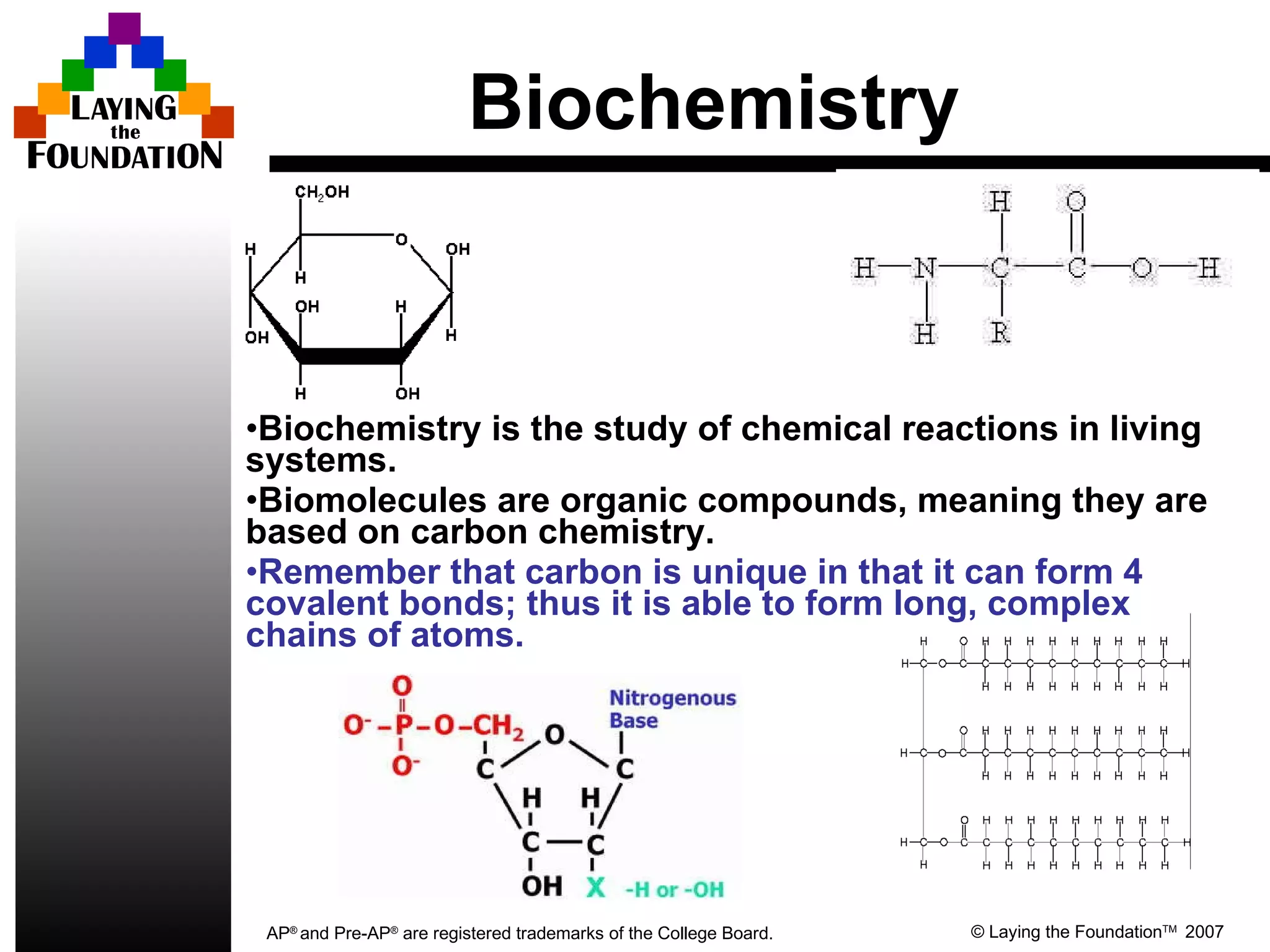
Biochemistry Biochemistry is the study of chemical reactions in living systems.  Biomolecules are organic compounds, meaning they are based on carbon chemistry.  Remember that carbon is unique in that it can form 4 covalent bonds; thus it is able to form long, complex chains of atoms.
Organic Substances Organic substances ,  macromolecules , or  biomolecules  make up all living things.  The four groups of substances we will learn are: carbohydrates lipids proteins nucleic acids
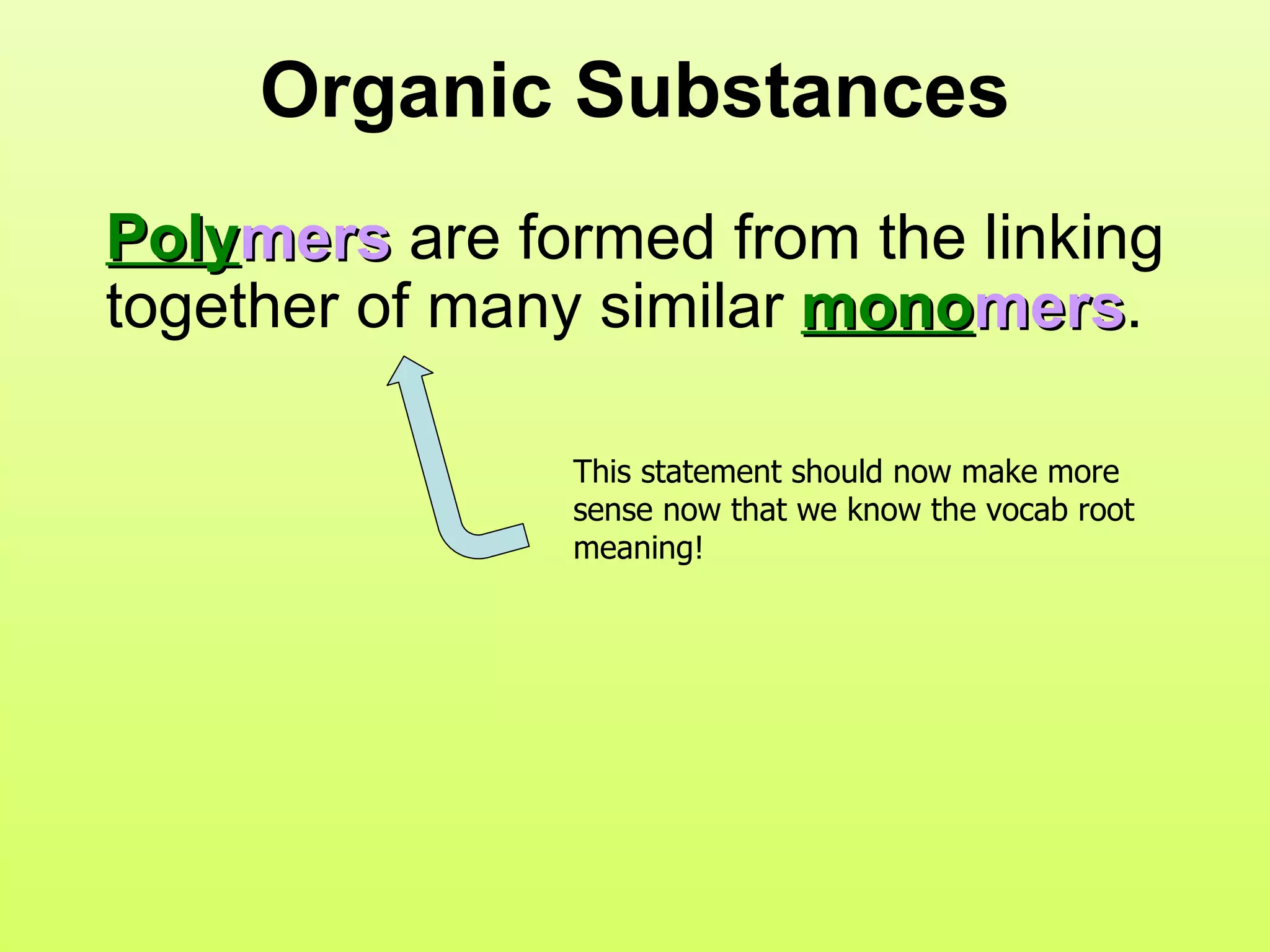
Organic Substances Poly mers  are formed from the linking together of many similar  mono mers .
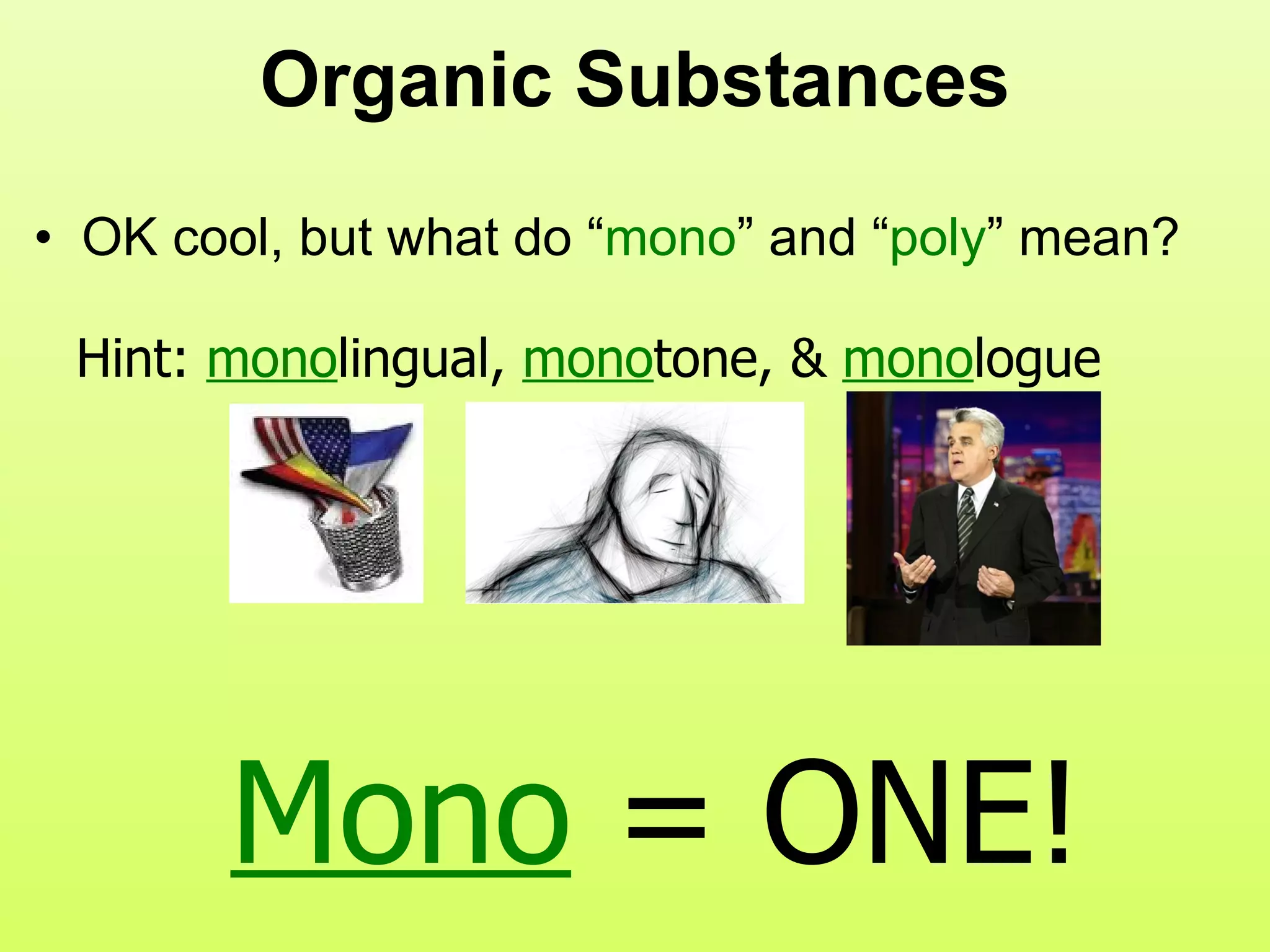
Organic Substances OK cool, but what do “ mono ” and “ poly ” mean? Hint:  mono lingual,  mono tone, &  mono logue Mono   = ONE!
Organic Substances What does “ poly ” mean? Hint:  poly morphic  and  poly theism Poly   = more than 1  OR many
Organic Substances Poly mers  are formed from the linking together of many similar  mono mers .  This statement should now make more sense now that we know the vocab root meaning!
Organic Substances Think of  biomolecules  as “giant molecules” formed from thousands or hundreds of thousands of smaller molecules. Mono mers (links) are the smaller units which are joined together to form  poly mers (bike chain)
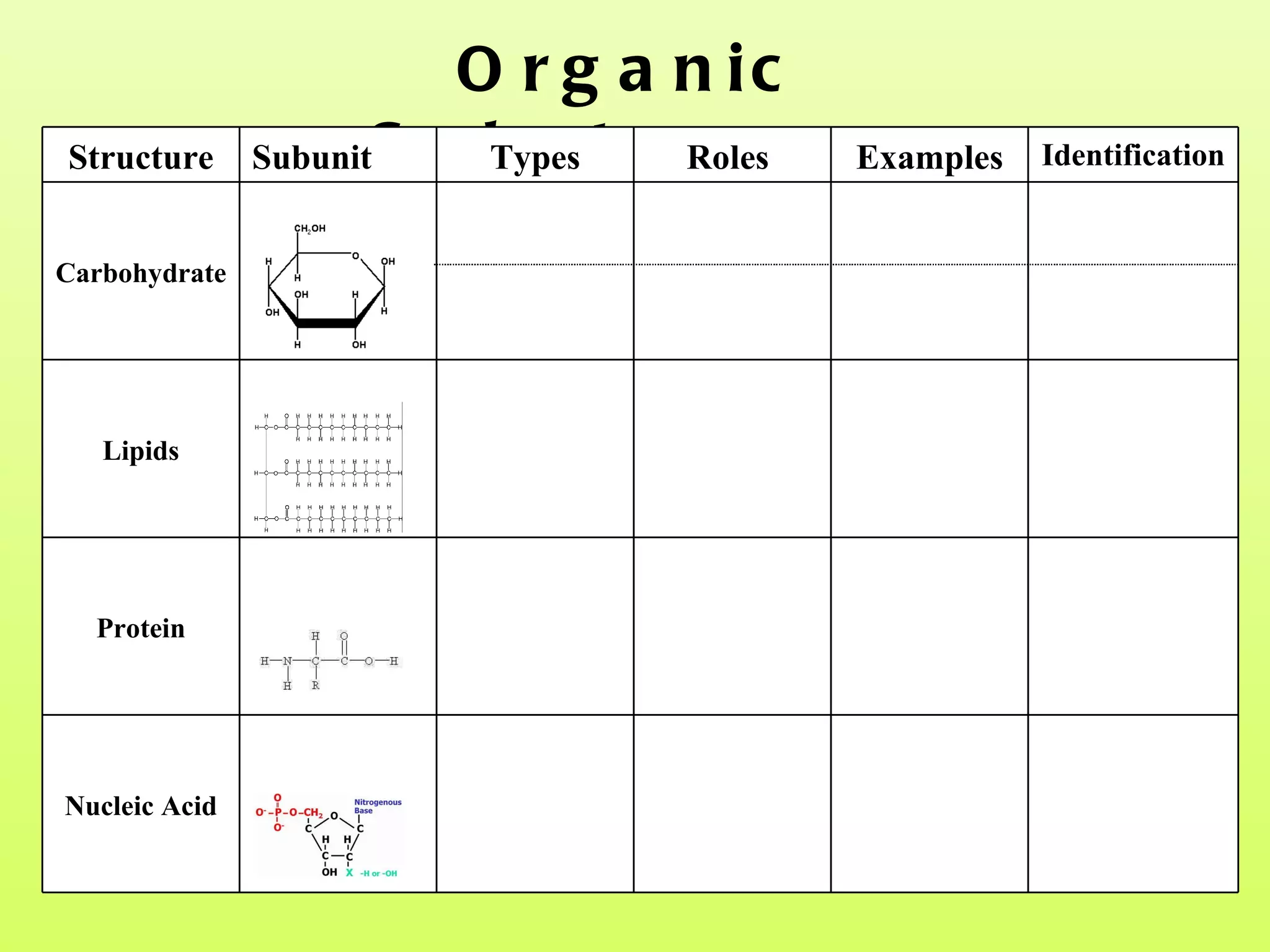
Organic Substances Structure Subunit Types Roles  Examples Identification Carbohydrate Lipids Protein Nucleic Acid
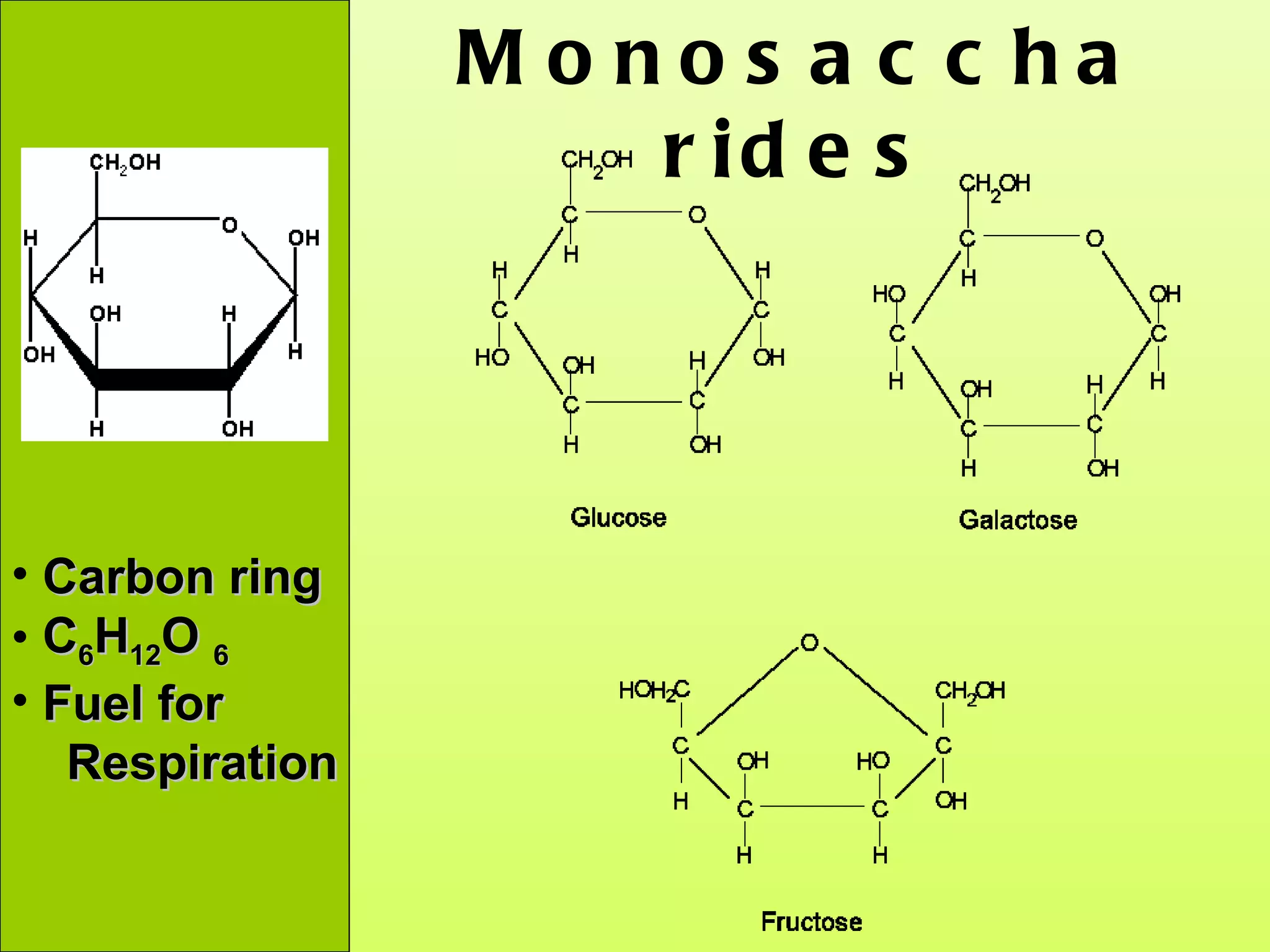
Carbon ring C 6 H 12 O  6 Carbohydrates Organic compounds that have the formula C n (H 2 O) n  or 1:2:1 http://www.wisc-online.com/objects/index_tj.asp?objid=AP13104
Carbon ring C 6 H 12 O  6 Fuel for  Respiration Monosaccharides
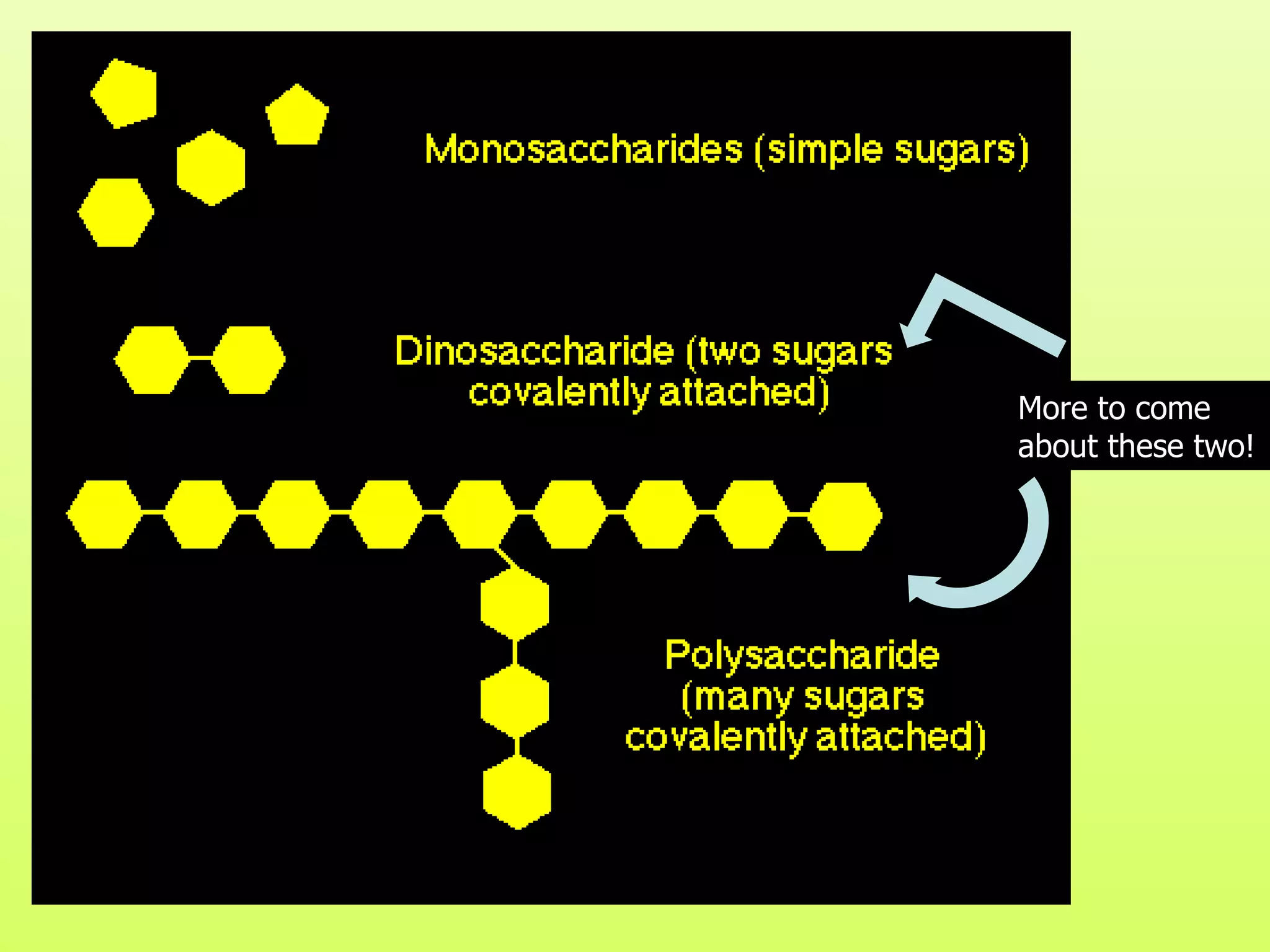
Carbon ring C 6 H 12 O  6 Polysaccharides Starch A storage molecule found in plants. Plants store sugars in the form of starch for later use. Starch Starch Starch
More to come about these two!
Organic Substances Monosaccharides ??? (coming soon) Quick Energy  ??? (coming soon) Glucose Fructose ??? (coming soon) Benedict’s Reagent ??? (coming soon) Structure Subunit Types Roles  Examples Identification Carbohydrate Monosaccharides Lipids Protein Nucleic Acid
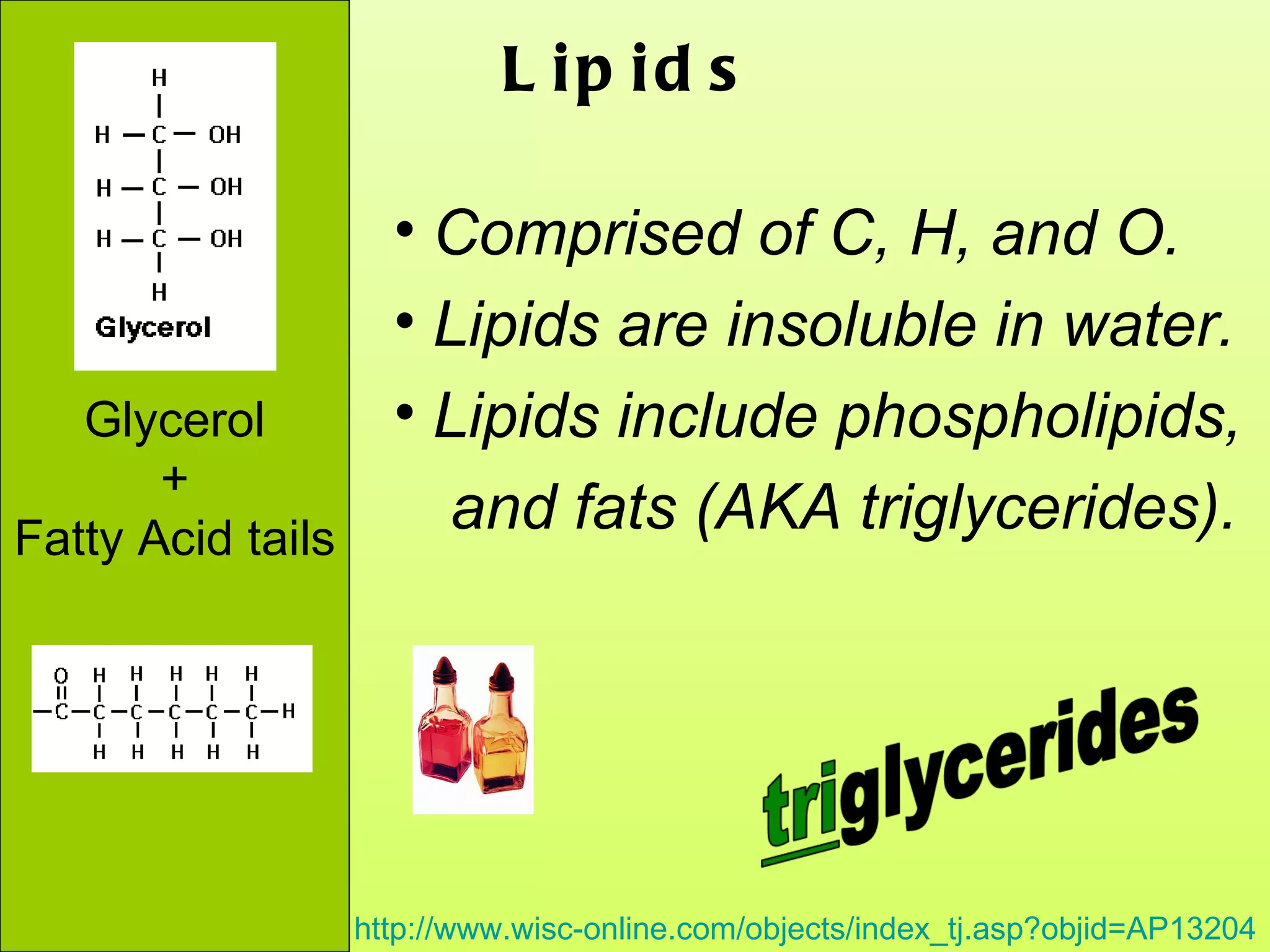
Glycerol + Fatty Acid tails Lipids Comprised of C, H, and O. Lipids are insoluble in water.  Lipids include phospholipids,  and fats (AKA triglycerides). http://www.wisc-online.com/objects/index_tj.asp?objid=AP13204
Glycerol + Fatty Acid tails Lipids Glycerol Fatty Acid tails
What do these all have in common? Which one is different? A B C D E F
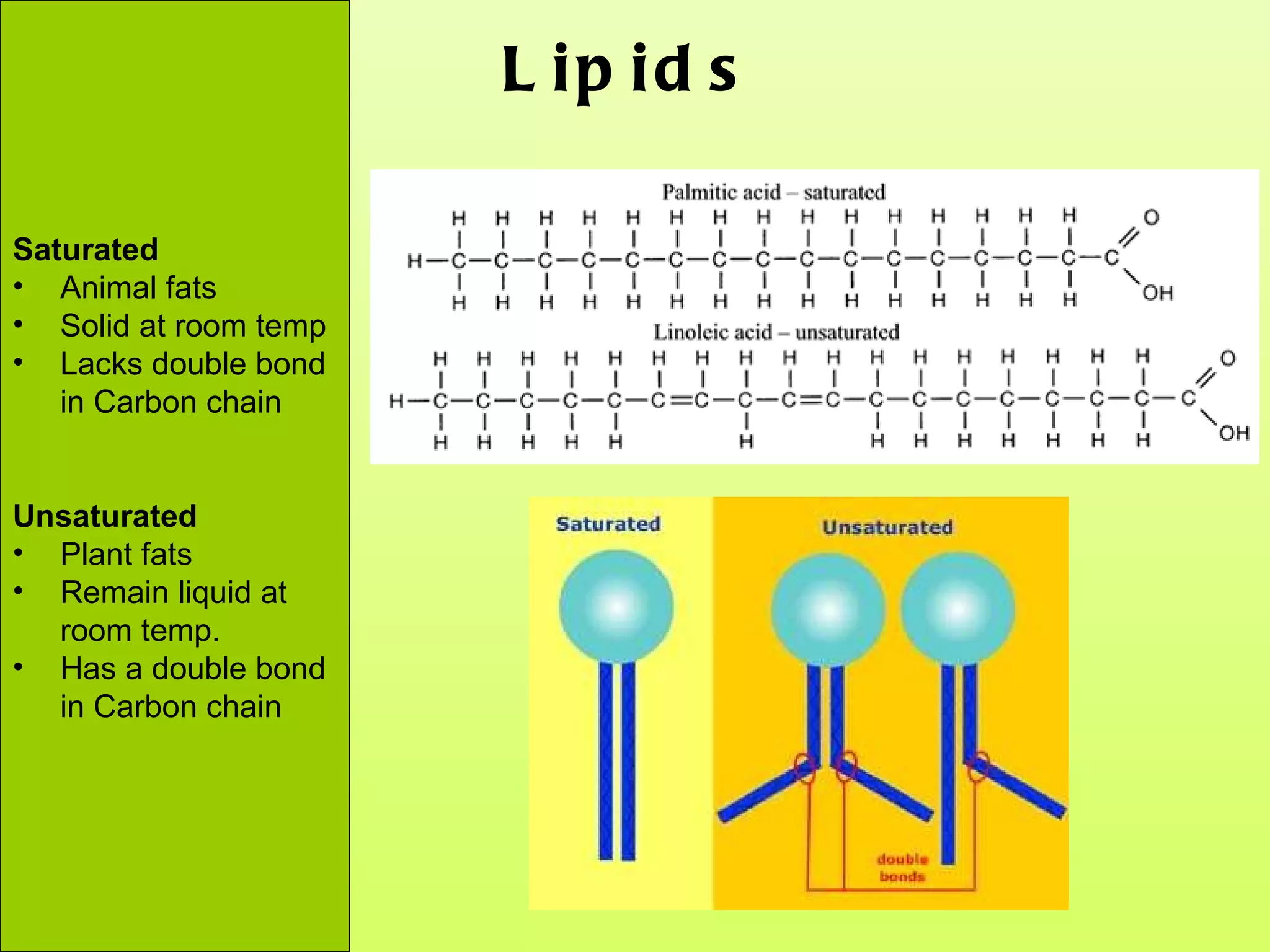
Saturated Animal fats Solid at room temp Lacks double bond in Carbon chain Unsaturated Plant fats Remain liquid at room temp. Has a double bond in Carbon chain Lipids
 
LIPIDS “ PHOSPHO”LIPID Cell Membrane
LIPIDS What are trans fats ? UNSATURATED TRANS FAT
LIPIDS Major Food Sources of  Trans  Fat for American Adults
Organic Substances Cholesterol Phospholipids Fats: Saturated Unsaturated Stored energy Insulation Cell Components Fats Oils  Waxes Sudan III Brown paper Glycerol + Fatty acids Structure Subunit Types Roles  Examples Identification Carbohydrate Lipids Protein Nucleic Acid
A central carbon atom  Is bonded to: Amino group Hydrogen atom Carboxyl group R group (varies) Proteins Proteins are macromolecules comprised of chains of amino acids. http://www.wisc-online.com/objects/index_tj.asp?objid=AP13304
Organic Substances Many types Biuret’s Reagent Structure Subunit Types Roles  Examples Identification Carbohydrate Lipids Protein Amino acids Nucleic Acid Meats Hormones Muscle Hair Nails Enzymes Blood Cells catalysts transport movement protection immune growth
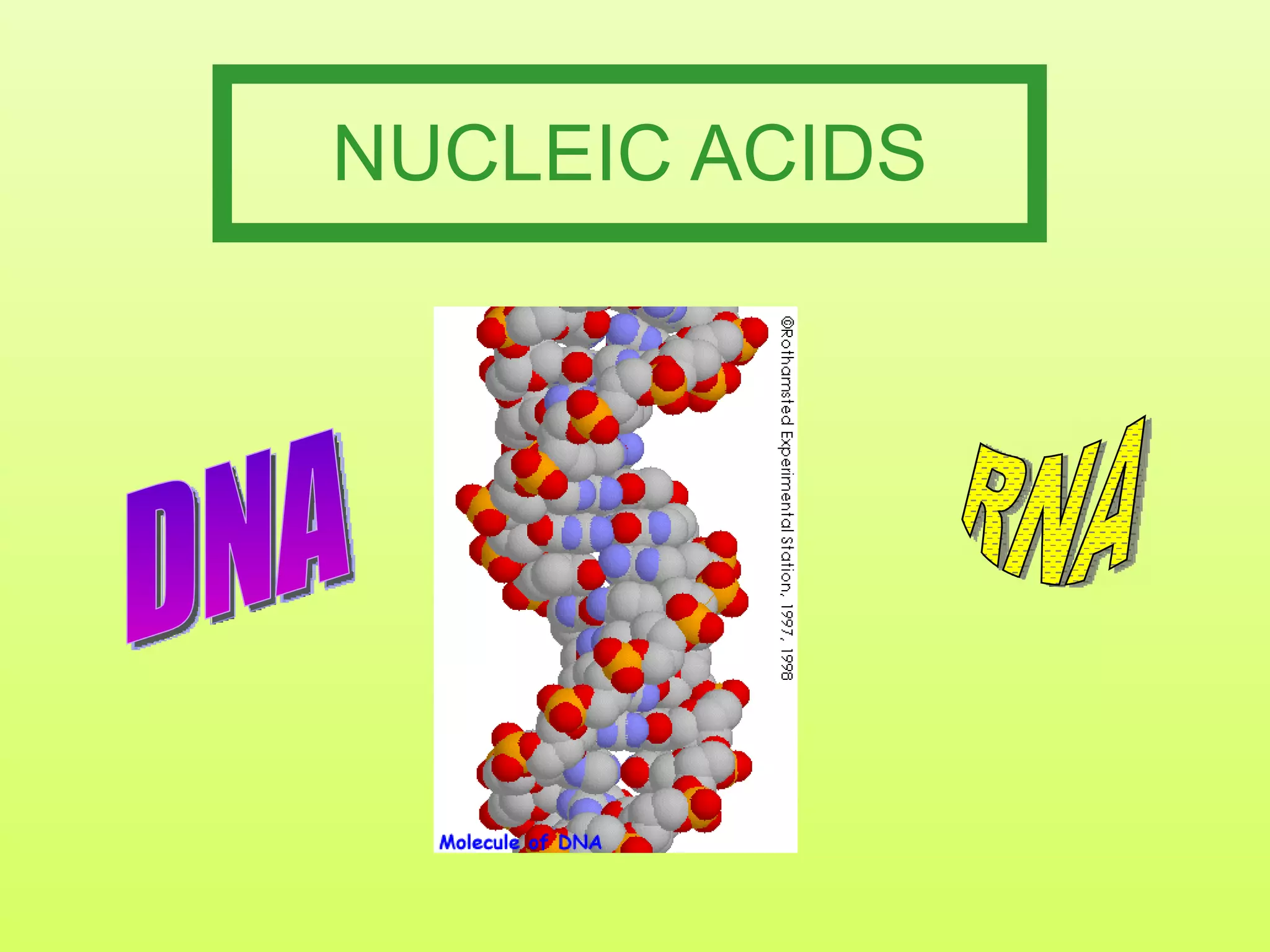
NUCLEIC ACIDS DNA RNA
NUCLEIC ACIDS Nucleic acids are the only macromolecules with the unique ability to  REPRODUCE  themselves and carry the code that directs all of the cell’s activities.
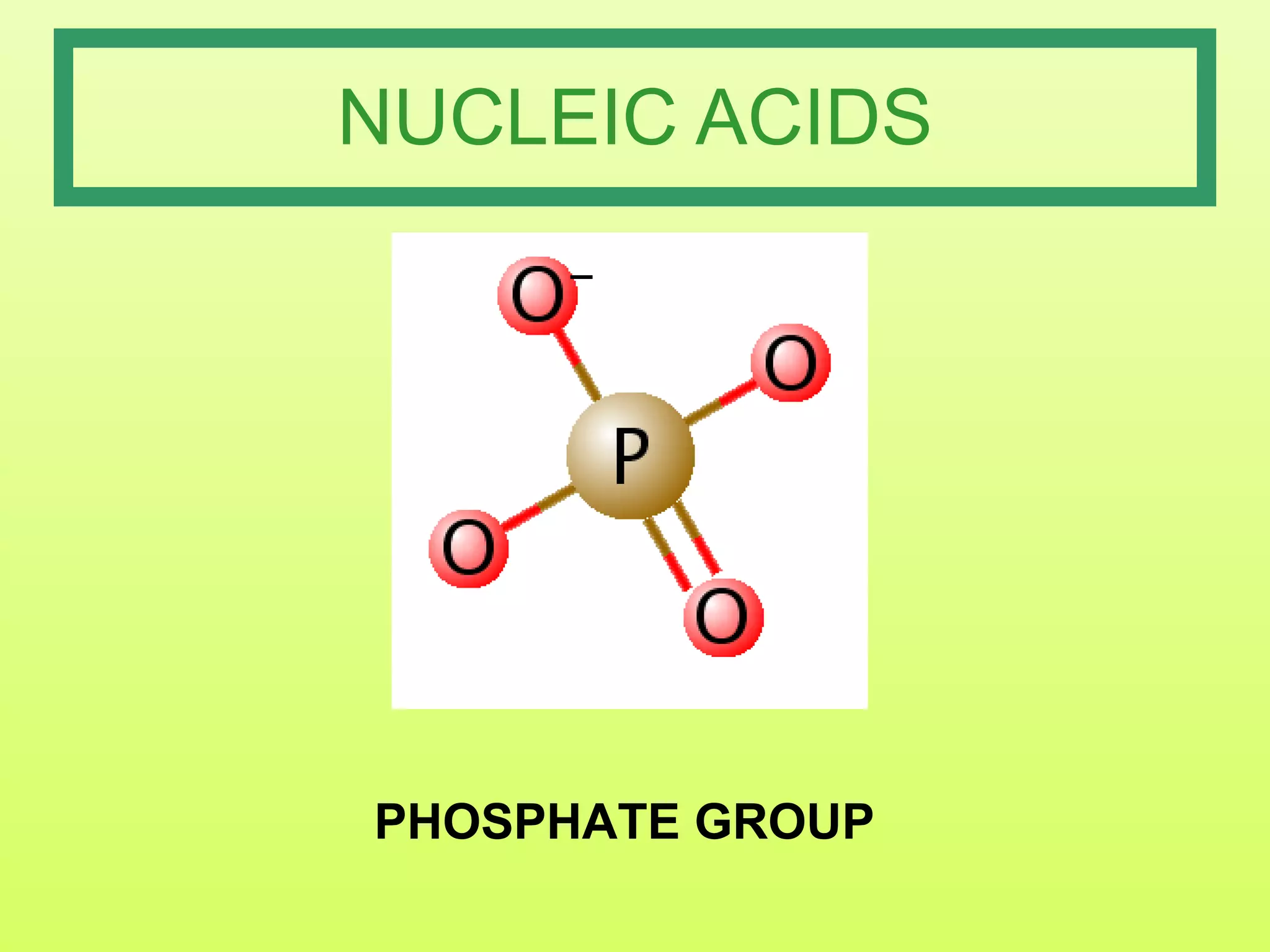
The subunits (monomers, building blocks) of nucleic acids are called NUCLEIC ACIDS NUCLEOTIDES. nitrogen base phosphate sugar (Pentose- 5 Carbon)
NUCLEIC ACIDS The  pentose  (5 carbon) sugar in a nucleotide is either ribose (RNA) or deoxyribose (DNA).
NUCLEIC ACIDS PHOSPHATE GROUP
NUCLEIC ACIDS The  NITROGEN BASES  fit into 2 families:   5 membered ring attached to a pyrimadine ring. ADENINE (A) & GUANINE (G) 6 membered rings of carbon and nitrogen atoms. CYTOSINE (C)  THYMINE (T) – DNA URACIL (U) - RNA
NUCLEIC ACIDS ATP ADENOSINE TRIPHOSPHATE An individual nucleotide that functions in energy transfer (acts like a battery) in the cell. adenine ribose triphosphate
Organic Substances Direct cell processes Protein Synthesis Cellular energy DNA  RNA ATP None     DNA  RNA ATP Nucleotides Structure Subunit Types Roles  Examples Identification Carbohydrate Lipids Protein Nucleic Acid

Biomolecules

  • 1.
  • 2.
  • 3.
    WORD BREAKDOWN: macromoleculeMacro Molecule Opposite of “micro” LARGE Molecule
  • 4.
    Biochemistry Biochemistry isthe study of chemical reactions in living systems. Biomolecules are organic compounds, meaning they are based on carbon chemistry. Remember that carbon is unique in that it can form 4 covalent bonds; thus it is able to form long, complex chains of atoms.
  • 5.
    Organic Substances Organicsubstances , macromolecules , or biomolecules make up all living things. The four groups of substances we will learn are: carbohydrates lipids proteins nucleic acids
  • 6.
    Organic Substances Polymers are formed from the linking together of many similar mono mers .
  • 7.
    Organic Substances OKcool, but what do “ mono ” and “ poly ” mean? Hint: mono lingual, mono tone, & mono logue Mono = ONE!
  • 8.
    Organic Substances Whatdoes “ poly ” mean? Hint: poly morphic and poly theism Poly = more than 1 OR many
  • 9.
    Organic Substances Polymers are formed from the linking together of many similar mono mers . This statement should now make more sense now that we know the vocab root meaning!
  • 10.
    Organic Substances Thinkof biomolecules as “giant molecules” formed from thousands or hundreds of thousands of smaller molecules. Mono mers (links) are the smaller units which are joined together to form poly mers (bike chain)
  • 11.
    Organic Substances StructureSubunit Types Roles Examples Identification Carbohydrate Lipids Protein Nucleic Acid
  • 12.
    Carbon ring C6 H 12 O 6 Carbohydrates Organic compounds that have the formula C n (H 2 O) n or 1:2:1 http://www.wisc-online.com/objects/index_tj.asp?objid=AP13104
  • 13.
    Carbon ring C6 H 12 O 6 Fuel for Respiration Monosaccharides
  • 14.
    Carbon ring C6 H 12 O 6 Polysaccharides Starch A storage molecule found in plants. Plants store sugars in the form of starch for later use. Starch Starch Starch
  • 15.
    More to comeabout these two!
  • 16.
    Organic Substances Monosaccharides??? (coming soon) Quick Energy ??? (coming soon) Glucose Fructose ??? (coming soon) Benedict’s Reagent ??? (coming soon) Structure Subunit Types Roles Examples Identification Carbohydrate Monosaccharides Lipids Protein Nucleic Acid
  • 17.
    Glycerol + FattyAcid tails Lipids Comprised of C, H, and O. Lipids are insoluble in water. Lipids include phospholipids, and fats (AKA triglycerides). http://www.wisc-online.com/objects/index_tj.asp?objid=AP13204
  • 18.
    Glycerol + FattyAcid tails Lipids Glycerol Fatty Acid tails
  • 19.
    What do theseall have in common? Which one is different? A B C D E F
  • 20.
    Saturated Animal fatsSolid at room temp Lacks double bond in Carbon chain Unsaturated Plant fats Remain liquid at room temp. Has a double bond in Carbon chain Lipids
  • 21.
  • 22.
  • 23.
    LIPIDS What aretrans fats ? UNSATURATED TRANS FAT
  • 24.
    LIPIDS Major FoodSources of Trans Fat for American Adults
  • 25.
    Organic Substances CholesterolPhospholipids Fats: Saturated Unsaturated Stored energy Insulation Cell Components Fats Oils Waxes Sudan III Brown paper Glycerol + Fatty acids Structure Subunit Types Roles Examples Identification Carbohydrate Lipids Protein Nucleic Acid
  • 26.
    A central carbonatom Is bonded to: Amino group Hydrogen atom Carboxyl group R group (varies) Proteins Proteins are macromolecules comprised of chains of amino acids. http://www.wisc-online.com/objects/index_tj.asp?objid=AP13304
  • 27.
    Organic Substances Manytypes Biuret’s Reagent Structure Subunit Types Roles Examples Identification Carbohydrate Lipids Protein Amino acids Nucleic Acid Meats Hormones Muscle Hair Nails Enzymes Blood Cells catalysts transport movement protection immune growth
  • 28.
  • 29.
    NUCLEIC ACIDS Nucleicacids are the only macromolecules with the unique ability to REPRODUCE themselves and carry the code that directs all of the cell’s activities.
  • 30.
    The subunits (monomers,building blocks) of nucleic acids are called NUCLEIC ACIDS NUCLEOTIDES. nitrogen base phosphate sugar (Pentose- 5 Carbon)
  • 31.
    NUCLEIC ACIDS The pentose (5 carbon) sugar in a nucleotide is either ribose (RNA) or deoxyribose (DNA).
  • 32.
  • 33.
    NUCLEIC ACIDS The NITROGEN BASES fit into 2 families: 5 membered ring attached to a pyrimadine ring. ADENINE (A) & GUANINE (G) 6 membered rings of carbon and nitrogen atoms. CYTOSINE (C) THYMINE (T) – DNA URACIL (U) - RNA
  • 34.
    NUCLEIC ACIDS ATPADENOSINE TRIPHOSPHATE An individual nucleotide that functions in energy transfer (acts like a battery) in the cell. adenine ribose triphosphate
  • 35.
    Organic Substances Directcell processes Protein Synthesis Cellular energy DNA RNA ATP None  DNA RNA ATP Nucleotides Structure Subunit Types Roles Examples Identification Carbohydrate Lipids Protein Nucleic Acid