Ch. 2 – The Chemistry of LifeSection 2-3Carbon CompoundsorA Brief Introduction to Organic Chemistry
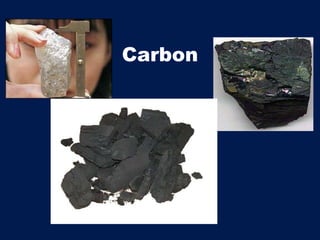
Carbon
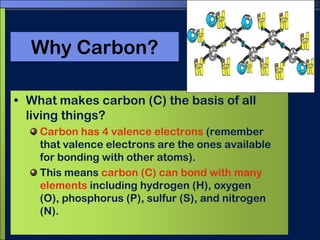
Why Carbon?What makes carbon (C) the basis of all living things?Carbon has 4 valence electrons (remember that valence electrons are the ones available for bonding with other atoms).This means carbon (C) can bond with many elements including hydrogen (H), oxygen (O), phosphorus (P), sulfur (S), and nitrogen (N).
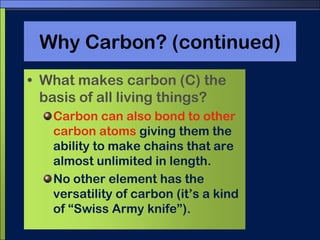
Why Carbon? (continued)What makes carbon (C) the basis of all living things?Carbon can also bond to other carbon atoms giving them the ability to make chains that are almost unlimited in length.No other element has the versatility of carbon (it’s a kind of “Swiss Army knife”).
Why Carbon? (continued)Carbon bonds are very stableCarbon bonds contain a lot of energy
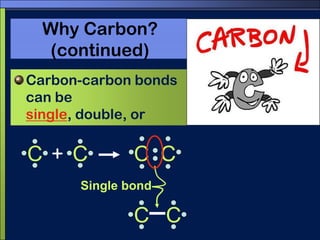
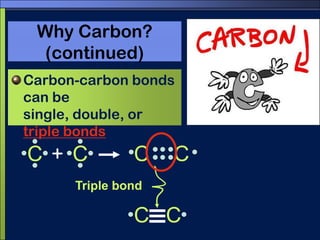
CCWhy Carbon? (continued)Carbon-carbon bonds can be single, double, or triple bonds CC+Single bondCC
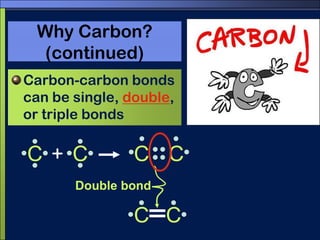
CCWhy Carbon? (continued)Carbon-carbon bonds can be single, double, or triple bonds CC+Double bondCC
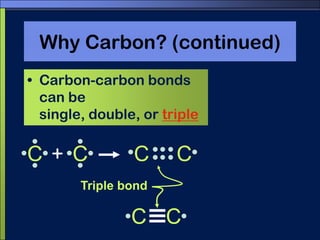
CCWhy Carbon? (continued)Carbon-carbon bonds can be single, double, or triple bondsCC+Triple bondCC
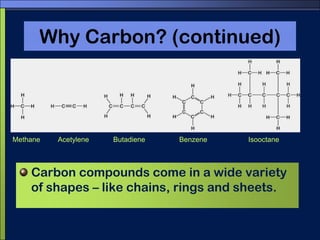
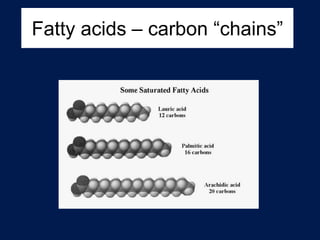
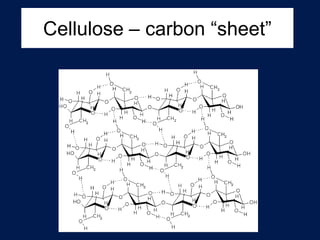
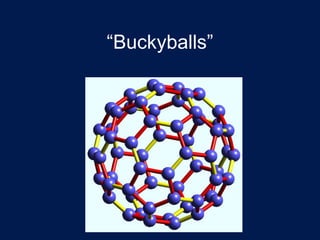
Why Carbon? (continued)AcetyleneButadieneBenzeneIsooctaneMethaneCarbon compounds come in a wide variety of shapes – like chains, rings and sheets.
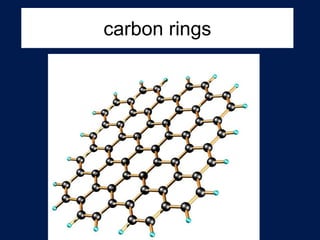
carbon rings
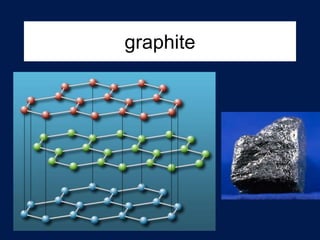
graphite
Fatty acids – carbon “chains”
Cellulose – carbon “sheet”
“Buckyballs”
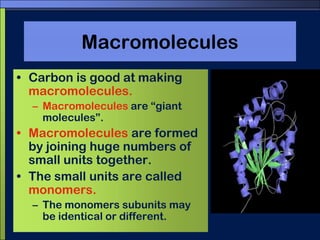
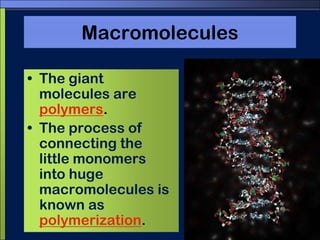
MacromoleculesCarbon is good at making macromolecules.Macromolecules are “giant molecules”. Macromolecules are formed by joining huge numbers of small units together.The small units are called monomers.The monomers subunits may be identical or different.
MacromoleculesThe giant molecules are polymers.The process of connecting the little monomers into huge macromolecules is known as polymerization.
Macromolecules (continued)There are four (4) main groups of organic macromolecules:CarbohydratesLipidsNucleic acidsProteins
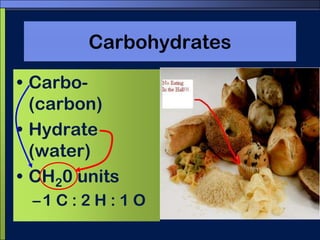
CarbohydratesCarbo- (carbon)Hydrate (water)CH20 units1 C : 2 H : 1 O
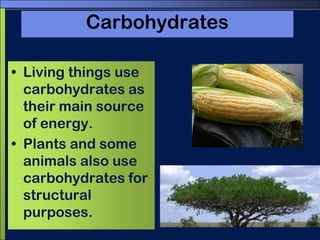
CarbohydratesLiving things use carbohydrates as their main source of energy.Plants and some animals also use carbohydrates for structural purposes.
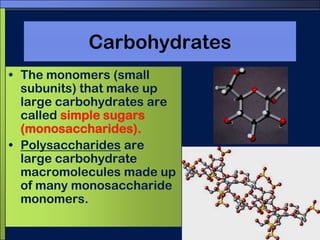
CarbohydratesThe monomers (small subunits) that make up large carbohydrates are called simple sugars (monosaccharides).Polysaccharides are large carbohydrate macromolecules made up of many monosaccharide monomers.
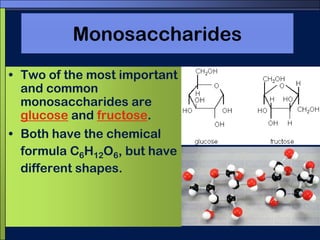
MonosaccharidesTwo of the most important and common monosaccharides are glucose and fructose. Both have the chemical formula C6H12O6, but have different shapes.
Macromolecules (continued)There are four (4) main groups of organic macromolecules:CarbohydratesLipidsNucleic acidsProteins
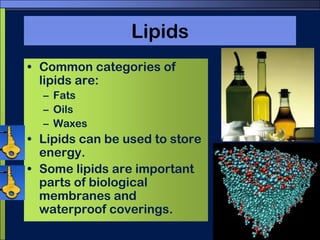
LipidsCommon categories of lipids are:FatsOilsWaxes	 Lipids can be used to store energy.Some lipids are important parts of biological membranes and waterproof coverings.
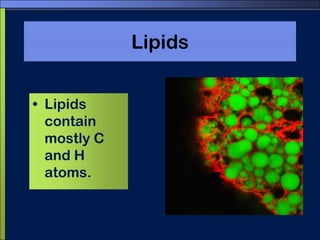
LipidsLipids contain mostly C and H atoms.
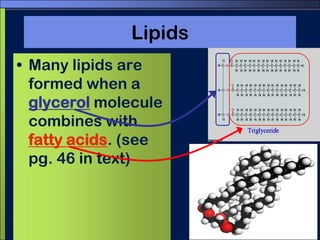
LipidsMany lipids are formed when a glycerol molecule combines with fatty acids. (see pg. 46 in text)
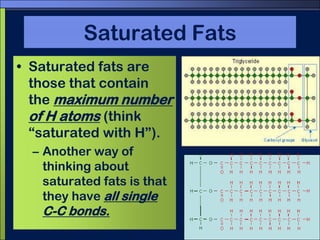
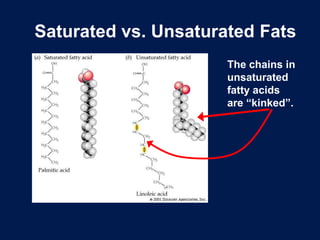
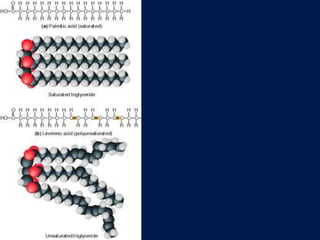
Saturated FatsSaturated fats are those that contain the maximum number of H atoms (think “saturated with H”).Another way of thinking about saturated fats is that they have all singleC-C bonds.
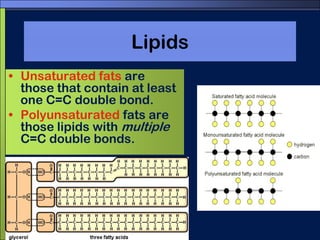
LipidsUnsaturated fats are those that contain at least one C=C double bond.Polyunsaturated fats are those lipids with multiple C=C double bonds.
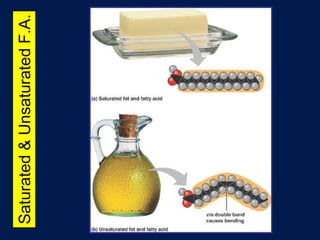
Saturated vs. Unsaturated FatsThe chains in unsaturated fatty acids are “kinked”.
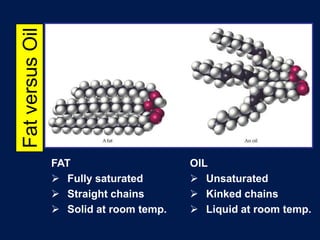
Fat versus OilFATFully saturated
Straight chains
Solid at room temp.OILUnsaturated
Kinked chains
Liquid at room temp. Are you pondering what I’m pondering?Why do you think saturated fats are solids at room temperature while unsaturated fats are liquids at room temperature?
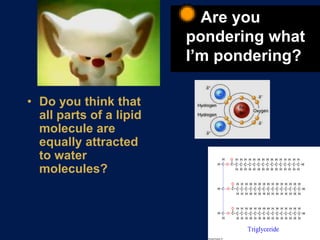
 Are you pondering what I’m pondering?Do you think that all parts of a lipid molecule are equally attracted to water molecules?
Macromolecules (continued)There are four (4) main groups of organic macromolecules:CarbohydratesLipidsNucleic acidsProteins
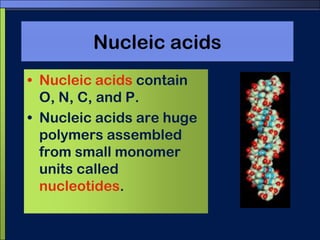
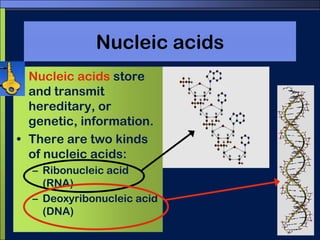
Nucleic acidsNucleic acids contain O, N, C, and P. Nucleic acids are huge polymers assembled from small monomer units called nucleotides.
Nucleic acidsNucleic acids store and transmit hereditary, or genetic, information.There are two kinds of nucleic acids:Ribonucleic acid (RNA)Deoxyribonucleic acid (DNA)
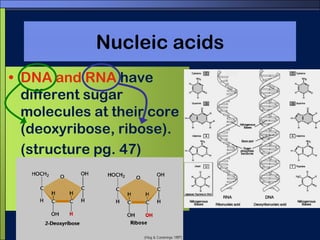
Nucleic acidsDNA and RNA have different sugar molecules at their core (deoxyribose, ribose). 	(structure pg. 47)
Macromolecules (continued)There are four (4) main groups of organic macromolecules:CarbohydratesLipidsNucleic acidsProteins
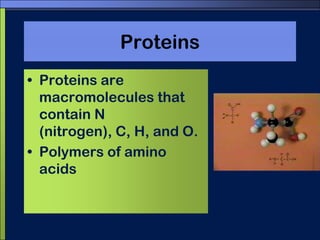
ProteinsProteins are macromolecules that contain N (nitrogen), C, H, and O. Polymers of amino acids
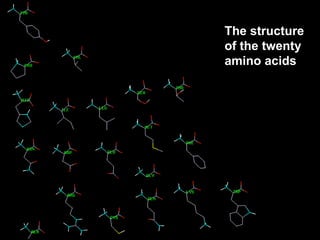
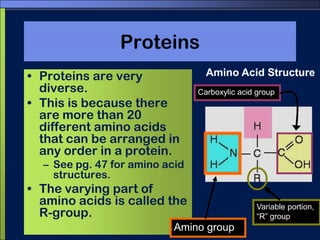
ProteinsAmino Acid StructureProteins are very diverse. This is because there are more than 20 different amino acids that can be arranged in any order in a protein.See pg. 47 for amino acid structures.The varying part of amino acids is called the R-group.Carboxylic acid groupVariable portion, “R” groupAmino group
The structure of the twenty amino acids
amino acids
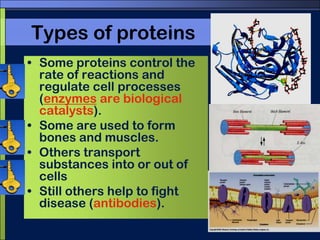
Types of proteinsSome proteins control the rate of reactions and regulate cell processes (enzymes are biological catalysts).Some are used to form bones and muscles.Others transport substances into or out of cellsStill others help to fight disease (antibodies).
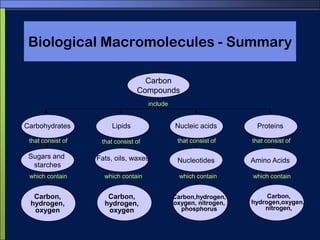
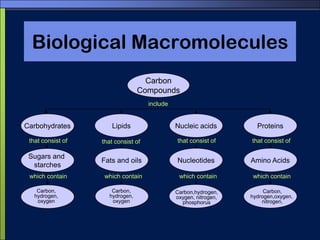
Biological Macromolecules - SummaryCarbonCompoundsincludeCarbohydratesLipidsNucleic acidsProteinsthat consist ofthat consist ofthat consist ofthat consist ofSugars and starchesFats, oils, waxesNucleotidesAmino Acidswhich containwhich containwhich containwhich containCarbon,hydrogen,oxygenCarbon,hydrogen,oxygenCarbon,hydrogen,oxygen, nitrogen,Carbon,hydrogen,oxygen, nitrogen,phosphorus
End 2-3
Why Carbon? (continued)CCCarbon-carbon bonds can be single, double, or triple bonds CC+Triple bondCC

2 3 pp09