BIOCHEMISTRY
     Lecture 1


           by
DR. ROMINA R. BARCARSE
 SCHOOL OF DENTISTRY
Introduction
• Biochemistry is the science concerned with
  the chemical basis of life.
• It is also the science concerned with the
  chemical constituents of living cells and with
  the reactions and processes they undergo.
• It is the application of the principles and
  methods of chemistry to the field of biology
  and physiology.
• It is the language of biology basic to the
  understanding of the different phenomena
  both in the biological and medical sciences.
• Biochemistry encompasses large areas of
  cell biology, molecular biology and molecular
  genetics.
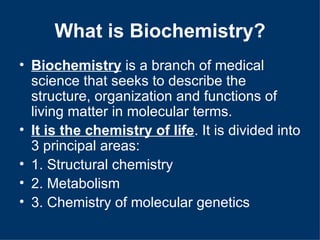
What is Biochemistry?
• Biochemistry is a branch of medical
  science that seeks to describe the
  structure, organization and functions of
  living matter in molecular terms.
• It is the chemistry of life. It is divided into
  3 principal areas:
• 1. Structural chemistry
• 2. Metabolism
• 3. Chemistry of molecular genetics
Roots of Biochemistry
• Karl Scheele – Swedish founder of biochemistry. He
  studied the chemical composition of matter in mid 1700.
• Schleiden & Schwann – formulated the cell theory in
  1840.
• Walter Flemming – discovered chromosomes in 1875
• Carl Newberg – a German scientist who coined the
  word biochemistry
• Hans Kreb – Proposed the Kreb cycle of the TCA in
  1937.
• Embden & Mayerhoff – described the glycolytic
  pathway in 1925.
• James Watson & Francis Crick – described the double
  helical structure of DNA in 1953
Roots of Biochemistry
• Edward & Hans Buchner – found that extracts
  from yeasts could bring about fermentation of
  sugar into ethanol in 1897
• Paul Boyer and J. Walker – discovered the
  “rotary engine” that generated ATP in 1997.
• Danish J. Skou- studied the “pump” that drives
  sodium and potassium across membranes
• Stanley Prusiner – discovered the organism
  that caused “mad cow disease.”
• Ruska, et.al. – discovered the electron
  microscope and provided a whole new level of
  insight into cellular structure.
A Knowledge of Biochemistry
is essential to All Life Processes
• The biochemistry of nucleic acids lies at the heart of Genetics;
  application of genetic engineering and cloning
• Physiology overlaps with biochemistry almost completely
• Immunology employs numerous biochemical
  techniques/approaches
• Pharmacology and pharmacy rest on sound knowledge of
  biochemistry in the creation of “designer drugs” or drug
  architecture
• Invention of new drugs in Pharmacy, Medicine, Agriculture
  and other fields
• Used in Environmental Science
• Importance in Biology (zoology & botany) and in microbiology
  for many scientists
• Biochemical approaches are employed in Pathology
• Poisons act on biochemical reactions and this is the subject
  matter in toxicology.
Biochemistry in Relation to
             Dentistry
The aims, attitudes and techniques of biochemistry are
    as relevant to dentistry as to medicine or to any
    aspect of biology.

3.   To understand the true nature of dental disease.
     All diseases have a biochemical basis.

5.   To give dental patients the necessary or
     appropriate dietary advice to prevent dental
     disease.

3.   Special relevance to dentists are areas of blood
     coagulation and effects of drugs and other injected
     substances on tissue and cells.
Relevance of Biochemistry
           to Dentistry
4. Understanding the physicochemical process of
  resorption and deposition of bone minerals and
  its matrix is essential to orthodontics
5.As for the future, methods to prevent or cure
  tooth decay are likely to involve a biochemical
  approach, like caries vaccine.
6. The role of flouride is now well established and
  its role to remineralize a carious lesion or
  chemically modifying a tooth, the enamel surface
  and its bacterial population offer scope for
  further investigation
Methods of Determining
        Biomolecular Structures
• Elemental analysis
• UV, visible, infrared, and NMR spectroscopy
• Mass Spectroscopy
• X-ray Crystallography
• Specific sequencing methods (e.g., for proteins
  and nucleic acids)
• Use of battery of enzymes of known specificity to
  degrade the biomolecule under study
• Use of acid or alkaline hydrolysis to degrade the
  biomolecule under study
Differences between Living and
        Non-Living Things
1. They are complicated and highly organized.
2. Each part of a living organism appears to have a
    specific purpose of function
3. They are able to extract energy from the
    environment
4. They are capable of reproducing themselves
    through generations
5. They exhibit common properties of living matter
What are Biomolecules?
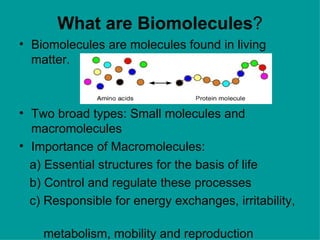
• Biomolecules are molecules found in living
  matter.


• Two broad types: Small molecules and
  macromolecules
• Importance of Macromolecules:
  a) Essential structures for the basis of life
  b) Control and regulate these processes
  c) Responsible for energy exchanges, irritability,

    metabolism, mobility and reproduction
What are the Primordial
         Biomolecules?
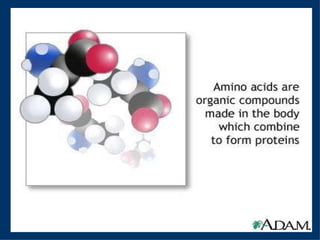
1. Amino Acids – glycine, alanine, serine
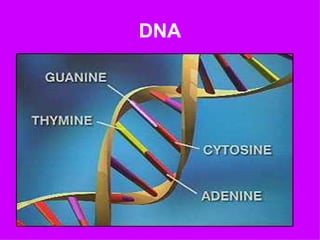
2. Nitrogenous bases – pyrimidines, purines
3. Sugars – glucose, galactose, mannose
4. Sugar alcohol - glycerol
5. Nitrogenous alcohol - choline
6. Fatty acids – palmitic acid, linoleic acid,
    linolenic acid, arachidonic acid
DNA
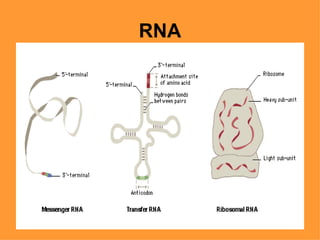
RNA
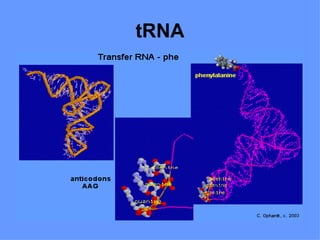
tRNA
Chemical Composition of Living
             Matter
• Water – 70-90% (free and bound water)
• Solids – 10-30%
• Inorganic substances – 1% (Na, K, Ca,
  Mg, NH4, Cl-, SO4, PO4-3, CO3-2, etc.
• Traces of Fe, I2, Cu, Mn, Co, Zn are also
  present in combination with organic
  radicals
• Rest- organic substances
Water
• This is the major component of the cell and
  is often referred to as an inert space filter in
  a living organism.
• It is a strong dipole and has a high dielectric
  constant.
• It is highly reactive with unusual properties
  different physically and chemically from
  other common liquids.
• Water and its ionization products H+ and OH-
  are important factors in determining the
  structure and biological properties of
  proteins, nucleic acids, lipids, and other cell
  components.
Properties of Water of Biological
          Importance
• It is a universal solvent
• It is an ideal biologic agent or medium for the
  ionization of substances and therefore
  hastens chemical reactions
• It has a high specific heat, that is, it takes up
  more heat to raise its temperature through
  1oC, thus allowing the body to store heat
  effectively without greatly raising its
  temperature.
• It possesses a high latent heat of
  evaporation
• It has the capacity to conduct heat readily
Water as an ideal biologic agent
• Water is a dipole, a molecule with chemical
  charge distributed asymmetrically about its
  structure.
• Hydrogen bonding enables water to dissolve
  many organic biomolecules that contain
  functional groups which can participate in
  hydrogen bonding.
• Hydrogen bonds account for the surface tension,
  viscosity, liquid state at room temperature, and
  solvent power of water.
• Compounds that contain O, N or S can serve as
  hydrogen bond donors or acceptors.
pH
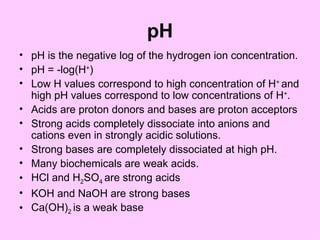
• pH is the negative log of the hydrogen ion concentration.
• pH = -log(H+)
• Low H values correspond to high concentration of H+ and
  high pH values correspond to low concentrations of H+.
• Acids are proton donors and bases are proton acceptors
• Strong acids completely dissociate into anions and
  cations even in strongly acidic solutions.
• Strong bases are completely dissociated at high pH.
• Many biochemicals are weak acids.
• HCl and H2SO4 are strong acids
• KOH and NaOH are strong bases
• Ca(OH)2 is a weak base
How to calculate for pH?
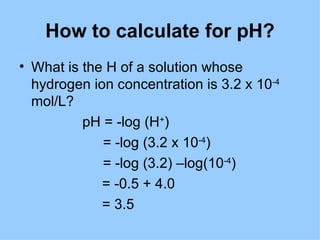
• What is the H of a solution whose
  hydrogen ion concentration is 3.2 x 10⁻⁴
  mol/L?
          pH = -log (H+)
             = -log (3.2 x 10⁻⁴)
             = -log (3.2) –log(10-4)
             = -0.5 + 4.0
             = 3.5
Solutions of Weak Acids and Their
   Salts Buffer Changes in pH
• Solutions of weak acids or bases and their
  conjugates exhibit buffering, the ability to
  resist a change in pH following addition of
  strong acid or base.
• Since many metabolic reactions are
  accompanied by the release or uptake of
  protons, most intracellular reactions are
  buffered.
Chemical Reactions Occurring in
    Living matter (In Vivo)
•   Oxidation
•   Reduction
•   Hydrolysis
•   Condensation
•   Tautomerism
Oxidation
• Oxidation is the process wherein most
  of the energy liberated by living matter
  is derived from the oxidation of organic
  substances such as carbohydrates,
  fats and proteins
• Two kinds of oxidation: anaerobic
  oxidation and aerobic oxidation
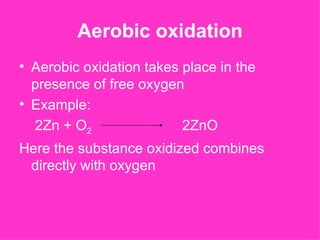
Aerobic oxidation
• Aerobic oxidation takes place in the
  presence of free oxygen
• Example:
  2Zn + O2                2ZnO
Here the substance oxidized combines
 directly with oxygen
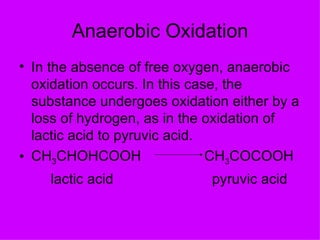
Anaerobic Oxidation
• In the absence of free oxygen, anaerobic
  oxidation occurs. In this case, the
  substance undergoes oxidation either by a
  loss of hydrogen, as in the oxidation of
  lactic acid to pyruvic acid.
• CH3CHOHCOOH                  CH3COCOOH
    lactic acid              pyruvic acid
Reduction
• Reduction is the reverse of oxidation. Hence,
  it may be brought about by either by loss of
  oxygen or by gain of hydrogen or electrons.
  It may be stated, therefore, that whenever
  oxidation occurs there is a simultaneous and
  corresponding reduction.
• All foods and organic substances have the
  property of taking up oxygen, hence they are
  reducing agents.
Hydrolysis
• Hydrolysis is the union of a substance
  with one or more molecules of water,
  forming an unstable “substance-water-
  complex” which is subsequently
  fragmented.
• Through hydrolysis, large molecules
  are broken down into smaller and
  simpler forms.
Condensation
• Condensation is the reaction wherein
  simple fragments unite with one
  another to form a more complex
  compound.
• The synthesis of complex substances
  like glycogen and tissue protein is
  accomplished through this process.
Tautomerism
• Tautomerism or isomeric
  transformation is the intramolecular
  rearrangement of atoms within a
  molecule leading to the formation of a
  new substance having distinctive
  properties of its own.
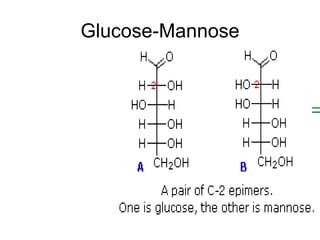
• Example: transformation of glucose
  into galactose; galactose into mannose
Glucose-Mannose
Diffusion
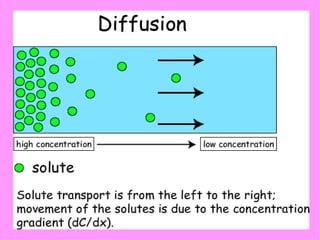
• Diffusion is the interpenetration of
  molecules between two substances.
  This occurs whenever the solute
  distributes itself uniformly into the
  solvent.
• Diffusion is influenced by: size of
  molecules, temperature, moelecular
  weight
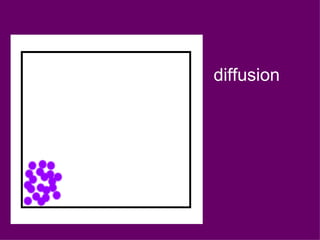
diffusion
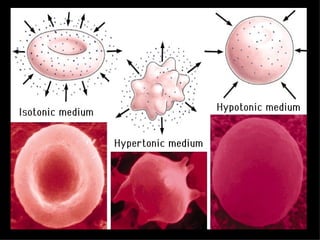
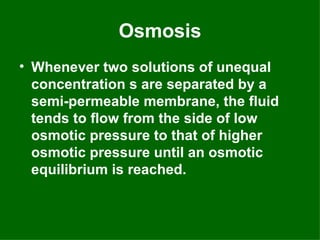
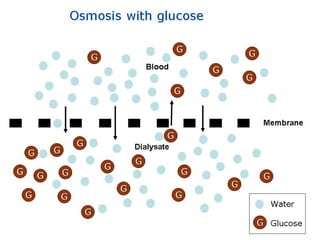
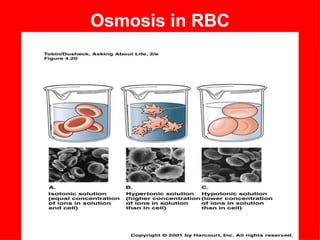
Osmosis
• Whenever two solutions of unequal
  concentration s are separated by a
  semi-permeable membrane, the fluid
  tends to flow from the side of low
  osmotic pressure to that of higher
  osmotic pressure until an osmotic
  equilibrium is reached.
Osmosis in RBC
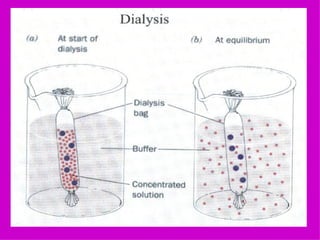
Dialysis
• When two different solutions are separated
  by a membrane which allows the passage of
  the crystalloids but not the colloids, dialysis
  occurs.
• If a mixture of crystalloids and colloids is
  placed in a dialysing bag (collodion or
  parchment) and immersed in distilled water
  the crystalloids pass out while the colloids
  are left behind.
• This is utilized in the purification of colloids
  from crystalloid impurities or vice versa.
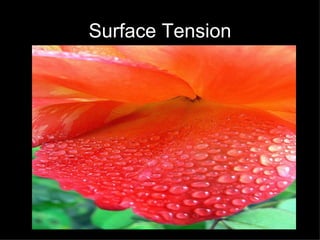
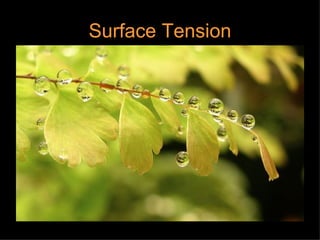
Surface Tension
Surface Tension
• Molecules in the interior of a
  homogenous liquid are attracted on all
  directions by surrounding molecules
  so they move freely on all directions.

• The force by which the molecules are
  held is called the “surface tension.”
Surface Tension
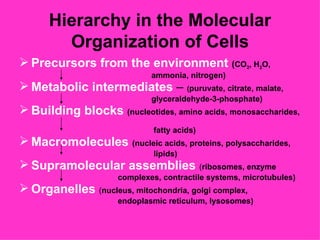
Hierarchy in the Molecular
        Organization of Cells
 Precursors from the environment (CO , H O,          2   2
                              ammonia, nitrogen)
 Metabolic intermediates – (puruvate, citrate, malate,
                              glyceraldehyde-3-phosphate)
 Building blocks (nucleotides, amino acids, monosaccharides,
                               fatty acids)
 Macromolecules (nucleic acids, proteins, polysaccharides,
                               lipids)
 Supramolecular assemblies (ribosomes, enzyme
                      complexes, contractile systems, microtubules)
 Organelles (nucleus, mitochondria, golgi complex,
                      endoplasmic reticulum, lysosomes)
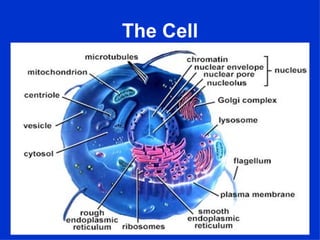
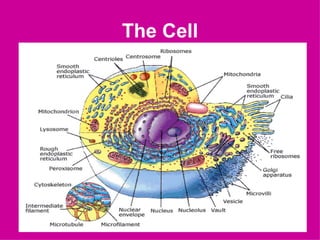
The Cell
The Cell
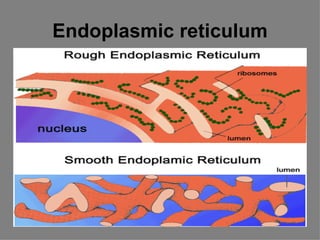
Endoplasmic reticulum
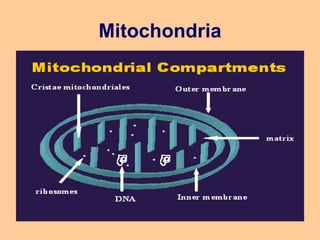
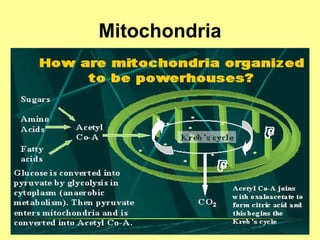
Mitochondria
Mitochondria
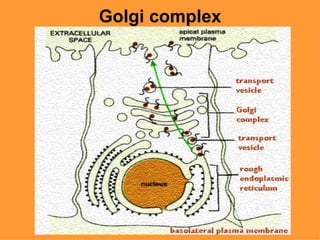
Golgi complex
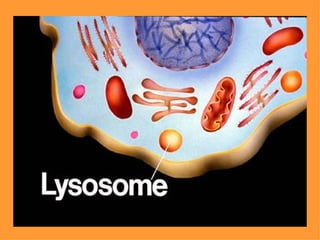
Lysosomes
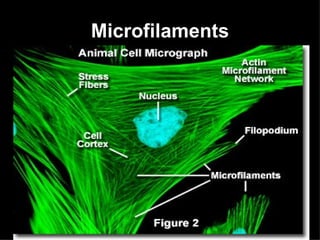
Microfilaments
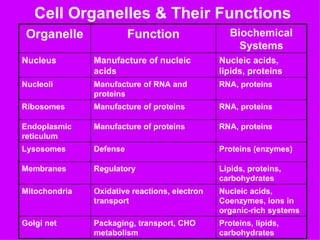
Cell Organelles & Their Functions
 Organelle               Function                 Biochemical
                                                    Systems
Nucleus        Manufacture of nucleic          Nucleic acids,
               acids                           lipids, proteins
Nucleoli       Manufacture of RNA and          RNA, proteins
               proteins
Ribosomes      Manufacture of proteins         RNA, proteins

Endoplasmic    Manufacture of proteins         RNA, proteins
reticulum
Lysosomes      Defense                         Proteins (enzymes)

Membranes      Regulatory                      Lipids, proteins,
                                               carbohydrates
Mitochondria   Oxidative reactions, electron   Nucleic acids,
               transport                       Coenzymes, ions in
                                               organic-rich systems
Golgi net      Packaging, transport, CHO       Proteins, lipids,
               metabolism                      carbohydrates
Next Meeting
•   Chemistry of carbohydrates
•   Functions
•   Classification
•   Structure of carbohydrates
•   Reactions and tests
•   Clinical Significance
•   Quiz on the First Lecture

Biochemistry lecture 1

  • 1.
    BIOCHEMISTRY Lecture 1 by DR. ROMINA R. BARCARSE SCHOOL OF DENTISTRY
  • 2.
    Introduction • Biochemistry isthe science concerned with the chemical basis of life. • It is also the science concerned with the chemical constituents of living cells and with the reactions and processes they undergo. • It is the application of the principles and methods of chemistry to the field of biology and physiology. • It is the language of biology basic to the understanding of the different phenomena both in the biological and medical sciences. • Biochemistry encompasses large areas of cell biology, molecular biology and molecular genetics.
  • 3.
    What is Biochemistry? •Biochemistry is a branch of medical science that seeks to describe the structure, organization and functions of living matter in molecular terms. • It is the chemistry of life. It is divided into 3 principal areas: • 1. Structural chemistry • 2. Metabolism • 3. Chemistry of molecular genetics
  • 4.
    Roots of Biochemistry •Karl Scheele – Swedish founder of biochemistry. He studied the chemical composition of matter in mid 1700. • Schleiden & Schwann – formulated the cell theory in 1840. • Walter Flemming – discovered chromosomes in 1875 • Carl Newberg – a German scientist who coined the word biochemistry • Hans Kreb – Proposed the Kreb cycle of the TCA in 1937. • Embden & Mayerhoff – described the glycolytic pathway in 1925. • James Watson & Francis Crick – described the double helical structure of DNA in 1953
  • 5.
    Roots of Biochemistry •Edward & Hans Buchner – found that extracts from yeasts could bring about fermentation of sugar into ethanol in 1897 • Paul Boyer and J. Walker – discovered the “rotary engine” that generated ATP in 1997. • Danish J. Skou- studied the “pump” that drives sodium and potassium across membranes • Stanley Prusiner – discovered the organism that caused “mad cow disease.” • Ruska, et.al. – discovered the electron microscope and provided a whole new level of insight into cellular structure.
  • 6.
    A Knowledge ofBiochemistry is essential to All Life Processes • The biochemistry of nucleic acids lies at the heart of Genetics; application of genetic engineering and cloning • Physiology overlaps with biochemistry almost completely • Immunology employs numerous biochemical techniques/approaches • Pharmacology and pharmacy rest on sound knowledge of biochemistry in the creation of “designer drugs” or drug architecture • Invention of new drugs in Pharmacy, Medicine, Agriculture and other fields • Used in Environmental Science • Importance in Biology (zoology & botany) and in microbiology for many scientists • Biochemical approaches are employed in Pathology • Poisons act on biochemical reactions and this is the subject matter in toxicology.
  • 7.
    Biochemistry in Relationto Dentistry The aims, attitudes and techniques of biochemistry are as relevant to dentistry as to medicine or to any aspect of biology. 3. To understand the true nature of dental disease. All diseases have a biochemical basis. 5. To give dental patients the necessary or appropriate dietary advice to prevent dental disease. 3. Special relevance to dentists are areas of blood coagulation and effects of drugs and other injected substances on tissue and cells.
  • 8.
    Relevance of Biochemistry to Dentistry 4. Understanding the physicochemical process of resorption and deposition of bone minerals and its matrix is essential to orthodontics 5.As for the future, methods to prevent or cure tooth decay are likely to involve a biochemical approach, like caries vaccine. 6. The role of flouride is now well established and its role to remineralize a carious lesion or chemically modifying a tooth, the enamel surface and its bacterial population offer scope for further investigation
  • 9.
    Methods of Determining Biomolecular Structures • Elemental analysis • UV, visible, infrared, and NMR spectroscopy • Mass Spectroscopy • X-ray Crystallography • Specific sequencing methods (e.g., for proteins and nucleic acids) • Use of battery of enzymes of known specificity to degrade the biomolecule under study • Use of acid or alkaline hydrolysis to degrade the biomolecule under study
  • 10.
    Differences between Livingand Non-Living Things 1. They are complicated and highly organized. 2. Each part of a living organism appears to have a specific purpose of function 3. They are able to extract energy from the environment 4. They are capable of reproducing themselves through generations 5. They exhibit common properties of living matter
  • 11.
    What are Biomolecules? •Biomolecules are molecules found in living matter. • Two broad types: Small molecules and macromolecules • Importance of Macromolecules: a) Essential structures for the basis of life b) Control and regulate these processes c) Responsible for energy exchanges, irritability, metabolism, mobility and reproduction
  • 12.
    What are thePrimordial Biomolecules? 1. Amino Acids – glycine, alanine, serine 2. Nitrogenous bases – pyrimidines, purines 3. Sugars – glucose, galactose, mannose 4. Sugar alcohol - glycerol 5. Nitrogenous alcohol - choline 6. Fatty acids – palmitic acid, linoleic acid, linolenic acid, arachidonic acid
  • 14.
  • 15.
  • 16.
  • 17.
    Chemical Composition ofLiving Matter • Water – 70-90% (free and bound water) • Solids – 10-30% • Inorganic substances – 1% (Na, K, Ca, Mg, NH4, Cl-, SO4, PO4-3, CO3-2, etc. • Traces of Fe, I2, Cu, Mn, Co, Zn are also present in combination with organic radicals • Rest- organic substances
  • 18.
    Water • This isthe major component of the cell and is often referred to as an inert space filter in a living organism. • It is a strong dipole and has a high dielectric constant. • It is highly reactive with unusual properties different physically and chemically from other common liquids. • Water and its ionization products H+ and OH- are important factors in determining the structure and biological properties of proteins, nucleic acids, lipids, and other cell components.
  • 19.
    Properties of Waterof Biological Importance • It is a universal solvent • It is an ideal biologic agent or medium for the ionization of substances and therefore hastens chemical reactions • It has a high specific heat, that is, it takes up more heat to raise its temperature through 1oC, thus allowing the body to store heat effectively without greatly raising its temperature. • It possesses a high latent heat of evaporation • It has the capacity to conduct heat readily
  • 20.
    Water as anideal biologic agent • Water is a dipole, a molecule with chemical charge distributed asymmetrically about its structure. • Hydrogen bonding enables water to dissolve many organic biomolecules that contain functional groups which can participate in hydrogen bonding. • Hydrogen bonds account for the surface tension, viscosity, liquid state at room temperature, and solvent power of water. • Compounds that contain O, N or S can serve as hydrogen bond donors or acceptors.
  • 21.
    pH • pH isthe negative log of the hydrogen ion concentration. • pH = -log(H+) • Low H values correspond to high concentration of H+ and high pH values correspond to low concentrations of H+. • Acids are proton donors and bases are proton acceptors • Strong acids completely dissociate into anions and cations even in strongly acidic solutions. • Strong bases are completely dissociated at high pH. • Many biochemicals are weak acids. • HCl and H2SO4 are strong acids • KOH and NaOH are strong bases • Ca(OH)2 is a weak base
  • 22.
    How to calculatefor pH? • What is the H of a solution whose hydrogen ion concentration is 3.2 x 10⁻⁴ mol/L? pH = -log (H+) = -log (3.2 x 10⁻⁴) = -log (3.2) –log(10-4) = -0.5 + 4.0 = 3.5
  • 23.
    Solutions of WeakAcids and Their Salts Buffer Changes in pH • Solutions of weak acids or bases and their conjugates exhibit buffering, the ability to resist a change in pH following addition of strong acid or base. • Since many metabolic reactions are accompanied by the release or uptake of protons, most intracellular reactions are buffered.
  • 24.
    Chemical Reactions Occurringin Living matter (In Vivo) • Oxidation • Reduction • Hydrolysis • Condensation • Tautomerism
  • 25.
    Oxidation • Oxidation isthe process wherein most of the energy liberated by living matter is derived from the oxidation of organic substances such as carbohydrates, fats and proteins • Two kinds of oxidation: anaerobic oxidation and aerobic oxidation
  • 26.
    Aerobic oxidation • Aerobicoxidation takes place in the presence of free oxygen • Example: 2Zn + O2 2ZnO Here the substance oxidized combines directly with oxygen
  • 27.
    Anaerobic Oxidation • Inthe absence of free oxygen, anaerobic oxidation occurs. In this case, the substance undergoes oxidation either by a loss of hydrogen, as in the oxidation of lactic acid to pyruvic acid. • CH3CHOHCOOH CH3COCOOH lactic acid pyruvic acid
  • 28.
    Reduction • Reduction isthe reverse of oxidation. Hence, it may be brought about by either by loss of oxygen or by gain of hydrogen or electrons. It may be stated, therefore, that whenever oxidation occurs there is a simultaneous and corresponding reduction. • All foods and organic substances have the property of taking up oxygen, hence they are reducing agents.
  • 29.
    Hydrolysis • Hydrolysis isthe union of a substance with one or more molecules of water, forming an unstable “substance-water- complex” which is subsequently fragmented. • Through hydrolysis, large molecules are broken down into smaller and simpler forms.
  • 30.
    Condensation • Condensation isthe reaction wherein simple fragments unite with one another to form a more complex compound. • The synthesis of complex substances like glycogen and tissue protein is accomplished through this process.
  • 31.
    Tautomerism • Tautomerism orisomeric transformation is the intramolecular rearrangement of atoms within a molecule leading to the formation of a new substance having distinctive properties of its own. • Example: transformation of glucose into galactose; galactose into mannose
  • 32.
  • 33.
    Diffusion • Diffusion isthe interpenetration of molecules between two substances. This occurs whenever the solute distributes itself uniformly into the solvent. • Diffusion is influenced by: size of molecules, temperature, moelecular weight
  • 35.
  • 36.
    Osmosis • Whenever twosolutions of unequal concentration s are separated by a semi-permeable membrane, the fluid tends to flow from the side of low osmotic pressure to that of higher osmotic pressure until an osmotic equilibrium is reached.
  • 38.
  • 40.
    Dialysis • When twodifferent solutions are separated by a membrane which allows the passage of the crystalloids but not the colloids, dialysis occurs. • If a mixture of crystalloids and colloids is placed in a dialysing bag (collodion or parchment) and immersed in distilled water the crystalloids pass out while the colloids are left behind. • This is utilized in the purification of colloids from crystalloid impurities or vice versa.
  • 42.
  • 43.
    Surface Tension • Moleculesin the interior of a homogenous liquid are attracted on all directions by surrounding molecules so they move freely on all directions. • The force by which the molecules are held is called the “surface tension.”
  • 44.
  • 45.
    Hierarchy in theMolecular Organization of Cells  Precursors from the environment (CO , H O, 2 2 ammonia, nitrogen)  Metabolic intermediates – (puruvate, citrate, malate, glyceraldehyde-3-phosphate)  Building blocks (nucleotides, amino acids, monosaccharides, fatty acids)  Macromolecules (nucleic acids, proteins, polysaccharides, lipids)  Supramolecular assemblies (ribosomes, enzyme complexes, contractile systems, microtubules)  Organelles (nucleus, mitochondria, golgi complex, endoplasmic reticulum, lysosomes)
  • 46.
  • 47.
  • 49.
  • 50.
  • 51.
  • 52.
  • 53.
  • 54.
  • 55.
    Cell Organelles &Their Functions Organelle Function Biochemical Systems Nucleus Manufacture of nucleic Nucleic acids, acids lipids, proteins Nucleoli Manufacture of RNA and RNA, proteins proteins Ribosomes Manufacture of proteins RNA, proteins Endoplasmic Manufacture of proteins RNA, proteins reticulum Lysosomes Defense Proteins (enzymes) Membranes Regulatory Lipids, proteins, carbohydrates Mitochondria Oxidative reactions, electron Nucleic acids, transport Coenzymes, ions in organic-rich systems Golgi net Packaging, transport, CHO Proteins, lipids, metabolism carbohydrates
  • 56.
    Next Meeting • Chemistry of carbohydrates • Functions • Classification • Structure of carbohydrates • Reactions and tests • Clinical Significance • Quiz on the First Lecture