Biochemistry Notes

      Unit 1
     Chapter 6
Chapter 6   Chemistry in Biology

    6.1 Atoms, Elements, and Compounds

     Elements
      An element is a pure substance that cannot
       be broken down


      Each element has a unique name and
       symbol.
Chapter 6   Chemistry in Biology

    6.1 Atoms, Elements, and Compounds

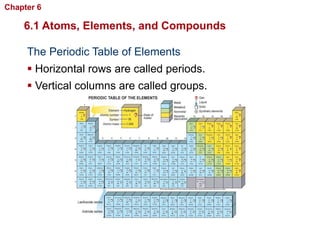
     The Periodic Table of Elements
      Horizontal rows are called periods.
      Vertical columns are called groups.
Chapter 6   Chemistry in Biology

    6.1 Atoms, Elements, and Compounds


      Chemistry = study of matter.
      Atoms are the building blocks of matter.
      Neutrons and protons are located at the
       nucleus of the atom.
      Protons are positively charged particles.
      Neutrons are particles that have no
       charge.
Chapter 6   Chemistry in Biology

    6.1 Atoms, Elements, and Compounds

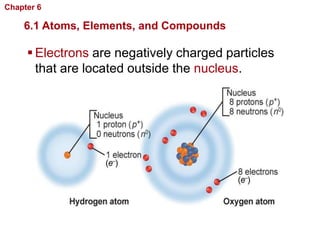
      Electrons are negatively charged particles
       that are located outside the nucleus.
6.1 Atoms, Elements, and Compounds


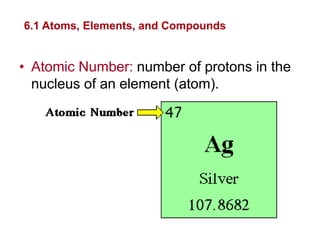
• Atomic Number: number of protons in the
  nucleus of an element (atom).
6.1 Atoms, Elements, and Compounds
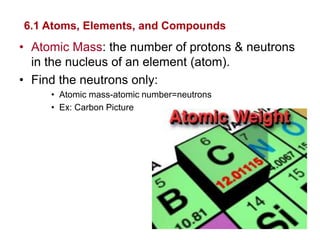
• Atomic Mass: the number of protons & neutrons
  in the nucleus of an element (atom).
• Find the neutrons only:
     • Atomic mass-atomic number=neutrons
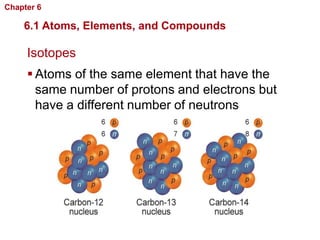
     • Ex: Carbon Picture
Chapter 6   Chemistry in Biology

    6.1 Atoms, Elements, and Compounds

     Isotopes
      Atoms of the same element that have the
       same number of protons and electrons but
       have a different number of neutrons
Chapter 6   Chemistry in Biology

    6.1 Atoms, Elements, and Compounds

     Compounds
      A pure substance formed when two or more
       different elements combine

      Compounds cannot be broken down into
       simpler compounds or elements by physical
       means, must be a chemical reaction
Chapter 6    Chemistry in Biology

    6.1 Atoms, Elements, and Compounds

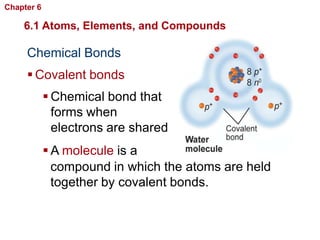
     Chemical Bonds
      Covalent bonds
             Chemical bond that
              forms when
              electrons are shared
             A molecule is a
              compound in which the atoms are held
              together by covalent bonds.
Chapter 6   Chemistry in Biology

    6.1 Atoms, Elements, and Compounds

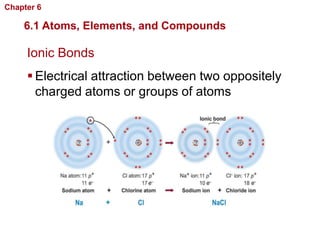
     Ionic Bonds
      Electrical attraction between two oppositely
       charged atoms or groups of atoms
Chapter 6   Chemistry in Biology

    6.3 Water and Solutions

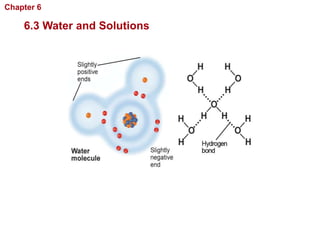
     Water’s Polarity
      Molecules that have an unequal distribution
       of charges are called polar molecules.
      Polarity is the property of having two
       opposite poles.
                  (Think of North & South Pole)
      A hydrogen bond is a bond involving a
       hydrogen atom and a fluorine, oxygen, or
       nitrogen atom.
Chapter 6   Chemistry in Biology

    6.3 Water and Solutions
Chapter 6   Chemistry in Biology

    6.1 Atoms, Elements, and Compounds

     van der Waals Forces
      When molecules come close together, the
       attractive forces between slightly positive
       and negative regions pull on the molecules
       and hold them together.
      The strength of the attraction depends on
       the size of the molecule, its shape, and its
       ability to attract electrons.
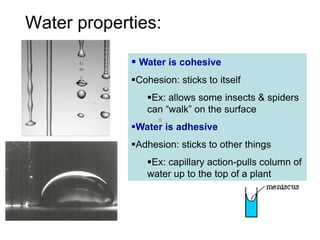
Water properties:

              Water is cohesive
             Cohesion: sticks to itself
                Ex: allows some insects & spiders
                can “walk” on the surface
             Water is adhesive
             Adhesion: sticks to other things
                Ex: capillary action-pulls column of
                water up to the top of a plant
Water is called “Universal solvent”:   Water properties:
dissolves many other substances due
to polarity
Differences in charges pulls/pushes
substances apart (Like a magnet
attracts or repels other magnets)
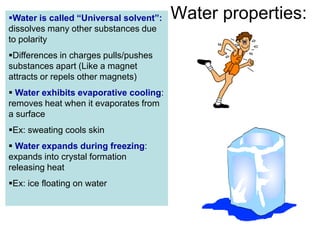
 Water exhibits evaporative cooling:
removes heat when it evaporates from
a surface
Ex: sweating cools skin
 Water expands during freezing:
expands into crystal formation
releasing heat
Ex: ice floating on water
Chapter 6   Chemistry in Biology

    6.3 Water and Solutions

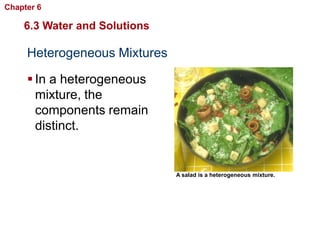
     Heterogeneous Mixtures

      In a heterogeneous
       mixture, the
       components remain
       distinct.


                                   A salad is a heterogeneous mixture.
Chapter 6   Chemistry in Biology

    6.3 Water and Solutions

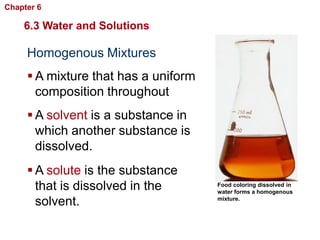
     Homogenous Mixtures
      A mixture that has a uniform
       composition throughout
      A solvent is a substance in
       which another substance is
       dissolved.
      A solute is the substance
       that is dissolved in the       Food coloring dissolved in
                                      water forms a homogenous

       solvent.                       mixture.
Chapter 6   Chemistry in Biology

    6.3 Water and Solutions

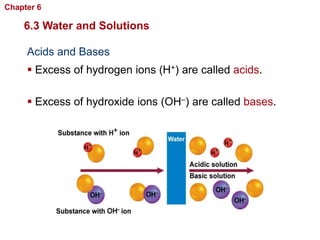
     Acids and Bases
      Excess of hydrogen ions (H+) are called acids.

      Excess of hydroxide ions (OH–) are called bases.
Chapter 6   Chemistry in Biology

    6.3 Water and Solutions
     pH and Buffers
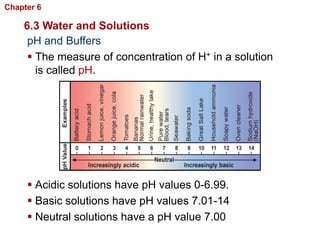
      The measure of concentration of H+ in a solution
       is called pH.


      Acidic solutions have pH values 0-6.99.
      Basic solutions have pH values 7.01-14
      Neutral solutions have a pH value 7.00
Chapter 6   Chemistry in Biology

    6.3 Water and Solutions

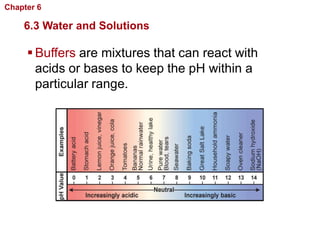
      Buffers are mixtures that can react with
       acids or bases to keep the pH within a
       particular range.
Chapter 6   Chemistry in Biology

    6.4 The Building Blocks of Life

     Organic Chemistry
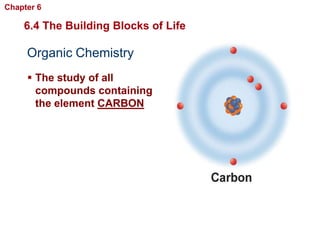
      The study of all
       compounds containing
       the element CARBON
Chapter 6   Chemistry in Biology

    6.4 The Building Blocks of Life


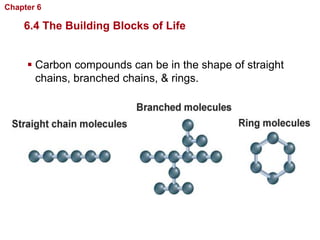
      Carbon compounds can be in the shape of straight
       chains, branched chains, & rings.
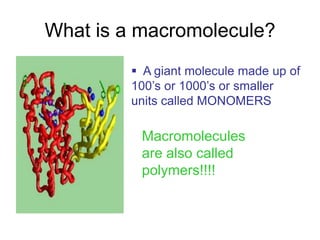
What is a macromolecule?
          A giant molecule made up of
         100’s or 1000’s or smaller
         units called MONOMERS

          Macromolecules
          are also called
          polymers!!!!
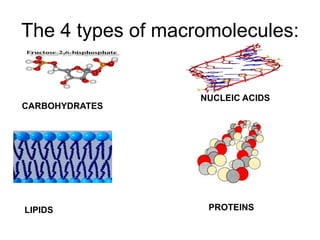
The 4 types of macromolecules:


                   NUCLEIC ACIDS
CARBOHYDRATES


LIPIDS              PROTEINS
Chapter 6   Chemistry in Biology

    6.4 The Building Blocks of Life

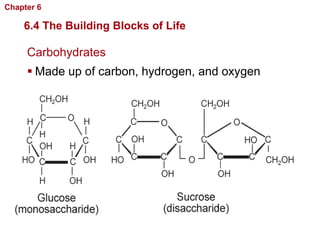
     Carbohydrates
      Made up of carbon, hydrogen, and oxygen
CARBOHYDRATES
               Used as main source of energy
              Building block: glucose (C6H12O6)

              Sugars: quick source of energy
             Monosaccharide-simple sugar, disaccharide-2,
             polysaccharide-many
Two types:   Ex: glucose, lactose, fructose, sucrose
             Starches: source of energy breaking down slower
             Ex: potatoes, pasta, bread, grains
Figure 2-13 A Starch

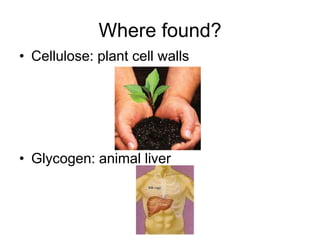
           Section 2-3   Where found?
    • Cellulose: plant cell walls


    • Glycogen: animal liver


Go to
Section:
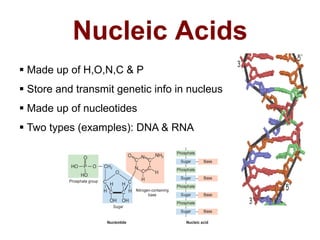
Nucleic Acids
 Made up of H,O,N,C & P
 Store and transmit genetic info in nucleus
 Made up of nucleotides
 Two types (examples): DNA & RNA
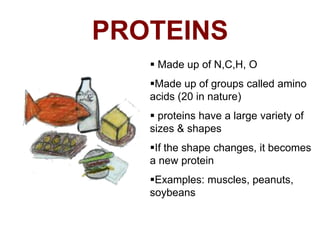
PROTEINS
    Made up of N,C,H, O
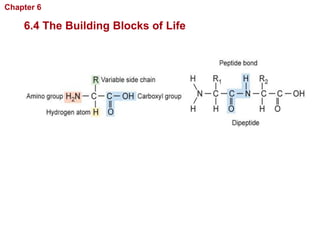
   Made up of groups called amino
   acids (20 in nature)
    proteins have a large variety of
   sizes & shapes
   If the shape changes, it becomes
   a new protein
   Examples: muscles, peanuts,
   soybeans
Chapter 6   Chemistry in Biology

    6.4 The Building Blocks of Life
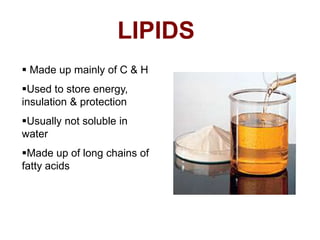
LIPIDS
 Made up mainly of C & H
Used to store energy,
insulation & protection
Usually not soluble in
water
Made up of long chains of
fatty acids
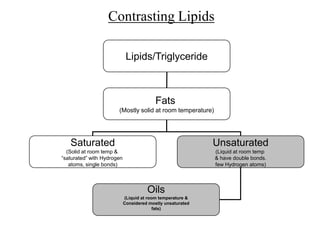
Contrasting Lipids

                             Lipids/Triglyceride


                                          Fats
                       (Mostly solid at room temperature)


   Saturated                                                Unsaturated
  (Solid at room temp &                                     (Liquid at room temp
“saturated” with Hydrogen                                   & have double bonds.
   atoms, single bonds)                                     few Hydrogen atoms)


                                      Oils
                            (Liquid at room temperature &
                            Considered mostly unsaturated
                                          fats)
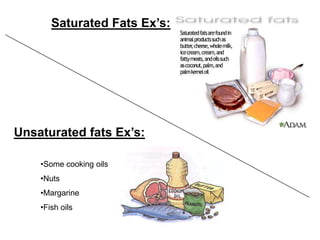
Saturated Fats Ex’s:


Unsaturated fats Ex’s:

    •Some cooking oils
    •Nuts
    •Margarine
    •Fish oils
Chapter 6   Chemistry in Biology

    6.2 Chemical Reactions

     Reactants and Products
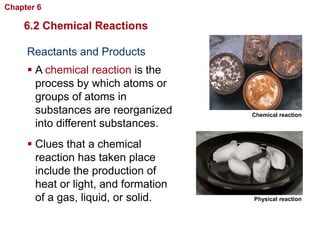
      A chemical reaction is the
       process by which atoms or
       groups of atoms in
       substances are reorganized     Chemical reaction
       into different substances.
      Clues that a chemical
       reaction has taken place
       include the production of
       heat or light, and formation
       of a gas, liquid, or solid.    Physical reaction
Chapter 6   Chemistry in Biology

    6.2 Chemical Reactions

     Chemical Equations
      Chemical formulas describe the substances in
       the reaction and arrows indicate the process of
       change.
      Reactants are the starting substances, on the
       left side of the arrow.
      Products are the substances formed, on the
       right side of the arrow.
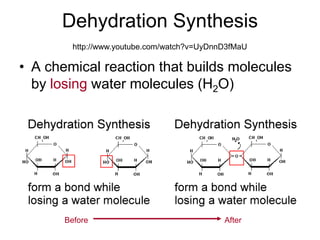
Dehydration Synthesis
         http://www.youtube.com/watch?v=UyDnnD3fMaU

• A chemical reaction that builds molecules
  by losing water molecules (H2O)


       Before                                After
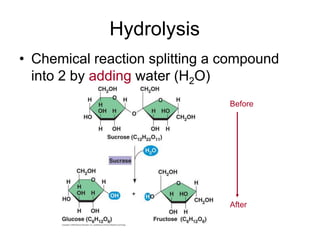
Hydrolysis
• Chemical reaction splitting a compound
  into 2 by adding water (H2O)
                                Before


                                After
Chapter 6   Chemistry in Biology

    6.2 Chemical Reactions

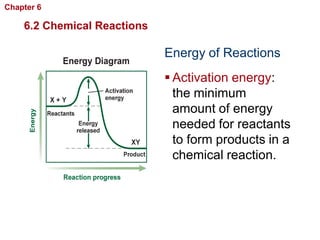
                                   Energy of Reactions
                                    Activation energy:
                                     the minimum
                                     amount of energy
                                     needed for reactants
                                     to form products in a
                                     chemical reaction.
Chapter 6   Chemistry in Biology

    6.2 Chemical Reactions


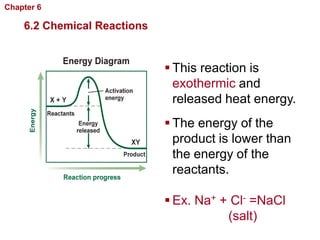
                                    This reaction is
                                     exothermic and
                                     released heat energy.
                                    The energy of the
                                     product is lower than
                                     the energy of the
                                     reactants.

                                    Ex. Na+ + Cl- =NaCl
                                              (salt)
Chapter 6   Chemistry in Biology

    6.2 Chemical Reactions


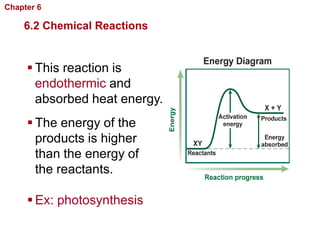
      This reaction is
       endothermic and
       absorbed heat energy.
      The energy of the
       products is higher
       than the energy of
       the reactants.

      Ex: photosynthesis
Chapter 6   Chemistry in Biology

    6.2 Chemical Reactions
 Enzymes
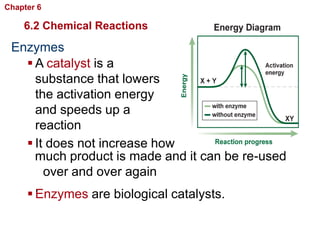
    A catalyst is a
     substance that lowers
     the activation energy
     and speeds up a
     reaction
    It does not increase how
     much product is made and it can be re-used
       over and over again
     .
    Enzymes are biological catalysts.
Chapter 6   Chemistry in Biology

    6.2 Chemical Reactions

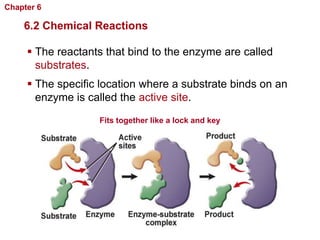
      The reactants that bind to the enzyme are called
       substrates.
      The specific location where a substrate binds on an
       enzyme is called the active site.
                        Fits together like a lock and key
Chapter 6   Chemistry in Biology

    6.2 Chemical Reactions


     The active site specifically is shaped to
      match the substrate and forms the enzyme-
      substrate complex, which helps bonds in the
      reactants to be broken and new bonds to
      form.
     Factors such as pH, temperature, and enzyme
      concentration

Biochemistry notes students

  • 1.
    Biochemistry Notes Unit 1 Chapter 6
  • 2.
    Chapter 6 Chemistry in Biology 6.1 Atoms, Elements, and Compounds Elements  An element is a pure substance that cannot be broken down  Each element has a unique name and symbol.
  • 3.
    Chapter 6 Chemistry in Biology 6.1 Atoms, Elements, and Compounds The Periodic Table of Elements  Horizontal rows are called periods.  Vertical columns are called groups.
  • 4.
    Chapter 6 Chemistry in Biology 6.1 Atoms, Elements, and Compounds  Chemistry = study of matter.  Atoms are the building blocks of matter.  Neutrons and protons are located at the nucleus of the atom.  Protons are positively charged particles.  Neutrons are particles that have no charge.
  • 5.
    Chapter 6 Chemistry in Biology 6.1 Atoms, Elements, and Compounds  Electrons are negatively charged particles that are located outside the nucleus.
  • 6.
    6.1 Atoms, Elements,and Compounds • Atomic Number: number of protons in the nucleus of an element (atom).
  • 7.
    6.1 Atoms, Elements,and Compounds • Atomic Mass: the number of protons & neutrons in the nucleus of an element (atom). • Find the neutrons only: • Atomic mass-atomic number=neutrons • Ex: Carbon Picture
  • 8.
    Chapter 6 Chemistry in Biology 6.1 Atoms, Elements, and Compounds Isotopes  Atoms of the same element that have the same number of protons and electrons but have a different number of neutrons
  • 9.
    Chapter 6 Chemistry in Biology 6.1 Atoms, Elements, and Compounds Compounds  A pure substance formed when two or more different elements combine  Compounds cannot be broken down into simpler compounds or elements by physical means, must be a chemical reaction
  • 10.
    Chapter 6 Chemistry in Biology 6.1 Atoms, Elements, and Compounds Chemical Bonds  Covalent bonds  Chemical bond that forms when electrons are shared  A molecule is a compound in which the atoms are held together by covalent bonds.
  • 11.
    Chapter 6 Chemistry in Biology 6.1 Atoms, Elements, and Compounds Ionic Bonds  Electrical attraction between two oppositely charged atoms or groups of atoms
  • 12.
    Chapter 6 Chemistry in Biology 6.3 Water and Solutions Water’s Polarity  Molecules that have an unequal distribution of charges are called polar molecules.  Polarity is the property of having two opposite poles. (Think of North & South Pole)  A hydrogen bond is a bond involving a hydrogen atom and a fluorine, oxygen, or nitrogen atom.
  • 13.
    Chapter 6 Chemistry in Biology 6.3 Water and Solutions
  • 14.
    Chapter 6 Chemistry in Biology 6.1 Atoms, Elements, and Compounds van der Waals Forces  When molecules come close together, the attractive forces between slightly positive and negative regions pull on the molecules and hold them together.  The strength of the attraction depends on the size of the molecule, its shape, and its ability to attract electrons.
  • 15.
    Water properties:  Water is cohesive Cohesion: sticks to itself Ex: allows some insects & spiders can “walk” on the surface Water is adhesive Adhesion: sticks to other things Ex: capillary action-pulls column of water up to the top of a plant
  • 16.
    Water is called“Universal solvent”: Water properties: dissolves many other substances due to polarity Differences in charges pulls/pushes substances apart (Like a magnet attracts or repels other magnets)  Water exhibits evaporative cooling: removes heat when it evaporates from a surface Ex: sweating cools skin  Water expands during freezing: expands into crystal formation releasing heat Ex: ice floating on water
  • 17.
    Chapter 6 Chemistry in Biology 6.3 Water and Solutions Heterogeneous Mixtures  In a heterogeneous mixture, the components remain distinct. A salad is a heterogeneous mixture.
  • 18.
    Chapter 6 Chemistry in Biology 6.3 Water and Solutions Homogenous Mixtures  A mixture that has a uniform composition throughout  A solvent is a substance in which another substance is dissolved.  A solute is the substance that is dissolved in the Food coloring dissolved in water forms a homogenous solvent. mixture.
  • 19.
    Chapter 6 Chemistry in Biology 6.3 Water and Solutions Acids and Bases  Excess of hydrogen ions (H+) are called acids.  Excess of hydroxide ions (OH–) are called bases.
  • 20.
    Chapter 6 Chemistry in Biology 6.3 Water and Solutions pH and Buffers  The measure of concentration of H+ in a solution is called pH.  Acidic solutions have pH values 0-6.99.  Basic solutions have pH values 7.01-14  Neutral solutions have a pH value 7.00
  • 21.
    Chapter 6 Chemistry in Biology 6.3 Water and Solutions  Buffers are mixtures that can react with acids or bases to keep the pH within a particular range.
  • 22.
    Chapter 6 Chemistry in Biology 6.4 The Building Blocks of Life Organic Chemistry  The study of all compounds containing the element CARBON
  • 23.
    Chapter 6 Chemistry in Biology 6.4 The Building Blocks of Life  Carbon compounds can be in the shape of straight chains, branched chains, & rings.
  • 24.
    What is amacromolecule?  A giant molecule made up of 100’s or 1000’s or smaller units called MONOMERS Macromolecules are also called polymers!!!!
  • 25.
    The 4 typesof macromolecules: NUCLEIC ACIDS CARBOHYDRATES LIPIDS PROTEINS
  • 26.
    Chapter 6 Chemistry in Biology 6.4 The Building Blocks of Life Carbohydrates  Made up of carbon, hydrogen, and oxygen
  • 27.
    CARBOHYDRATES  Used as main source of energy Building block: glucose (C6H12O6)  Sugars: quick source of energy Monosaccharide-simple sugar, disaccharide-2, polysaccharide-many Two types: Ex: glucose, lactose, fructose, sucrose Starches: source of energy breaking down slower Ex: potatoes, pasta, bread, grains
  • 28.
    Figure 2-13 AStarch Section 2-3 Where found? • Cellulose: plant cell walls • Glycogen: animal liver Go to Section:
  • 29.
    Nucleic Acids  Madeup of H,O,N,C & P  Store and transmit genetic info in nucleus  Made up of nucleotides  Two types (examples): DNA & RNA
  • 30.
    PROTEINS  Made up of N,C,H, O Made up of groups called amino acids (20 in nature)  proteins have a large variety of sizes & shapes If the shape changes, it becomes a new protein Examples: muscles, peanuts, soybeans
  • 31.
    Chapter 6 Chemistry in Biology 6.4 The Building Blocks of Life
  • 32.
    LIPIDS  Made upmainly of C & H Used to store energy, insulation & protection Usually not soluble in water Made up of long chains of fatty acids
  • 33.
    Contrasting Lipids Lipids/Triglyceride Fats (Mostly solid at room temperature) Saturated Unsaturated (Solid at room temp & (Liquid at room temp “saturated” with Hydrogen & have double bonds. atoms, single bonds) few Hydrogen atoms) Oils (Liquid at room temperature & Considered mostly unsaturated fats)
  • 34.
    Saturated Fats Ex’s: Unsaturatedfats Ex’s: •Some cooking oils •Nuts •Margarine •Fish oils
  • 35.
    Chapter 6 Chemistry in Biology 6.2 Chemical Reactions Reactants and Products  A chemical reaction is the process by which atoms or groups of atoms in substances are reorganized Chemical reaction into different substances.  Clues that a chemical reaction has taken place include the production of heat or light, and formation of a gas, liquid, or solid. Physical reaction
  • 36.
    Chapter 6 Chemistry in Biology 6.2 Chemical Reactions Chemical Equations  Chemical formulas describe the substances in the reaction and arrows indicate the process of change.  Reactants are the starting substances, on the left side of the arrow.  Products are the substances formed, on the right side of the arrow.
  • 37.
    Dehydration Synthesis http://www.youtube.com/watch?v=UyDnnD3fMaU • A chemical reaction that builds molecules by losing water molecules (H2O) Before After
  • 38.
    Hydrolysis • Chemical reactionsplitting a compound into 2 by adding water (H2O) Before After
  • 39.
    Chapter 6 Chemistry in Biology 6.2 Chemical Reactions Energy of Reactions  Activation energy: the minimum amount of energy needed for reactants to form products in a chemical reaction.
  • 40.
    Chapter 6 Chemistry in Biology 6.2 Chemical Reactions  This reaction is exothermic and released heat energy.  The energy of the product is lower than the energy of the reactants.  Ex. Na+ + Cl- =NaCl (salt)
  • 41.
    Chapter 6 Chemistry in Biology 6.2 Chemical Reactions  This reaction is endothermic and absorbed heat energy.  The energy of the products is higher than the energy of the reactants.  Ex: photosynthesis
  • 42.
    Chapter 6 Chemistry in Biology 6.2 Chemical Reactions Enzymes  A catalyst is a substance that lowers the activation energy and speeds up a reaction  It does not increase how much product is made and it can be re-used over and over again .  Enzymes are biological catalysts.
  • 43.
    Chapter 6 Chemistry in Biology 6.2 Chemical Reactions  The reactants that bind to the enzyme are called substrates.  The specific location where a substrate binds on an enzyme is called the active site. Fits together like a lock and key
  • 44.
    Chapter 6 Chemistry in Biology 6.2 Chemical Reactions  The active site specifically is shaped to match the substrate and forms the enzyme- substrate complex, which helps bonds in the reactants to be broken and new bonds to form.  Factors such as pH, temperature, and enzyme concentration