CEE320
Winter2006
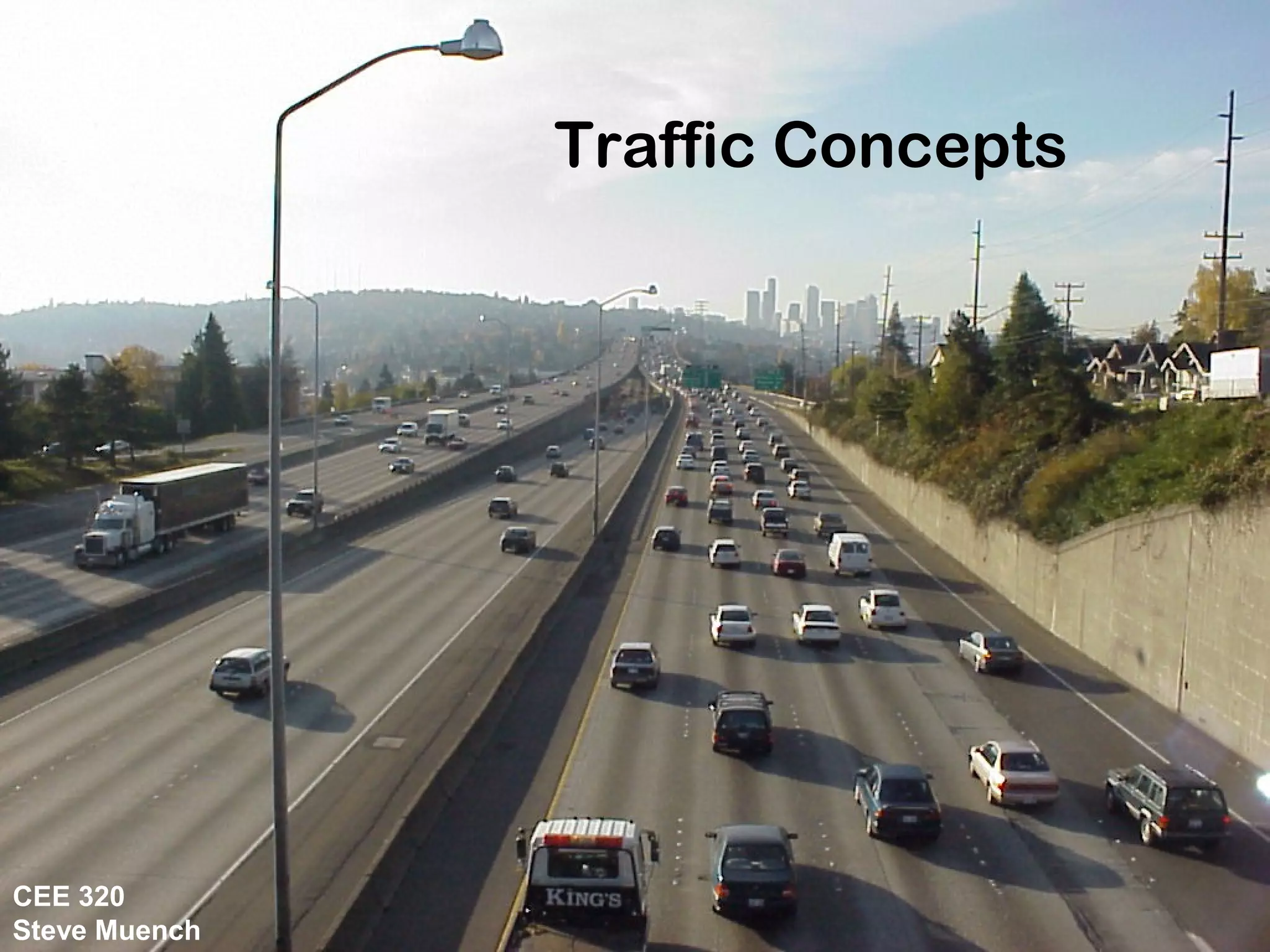
Traffic Concepts
CEE 320
Steve Muench
CEE320
Winter2006
Outline
1. Basic Concepts
a. Flow Rate
b. Spacing
c. Headway
d. Speed
e. Density
2. Relationships
3. Example
CEE320
Winter2006
Concepts
• Definitions
• Volume, Speed, Density relationships
• Speed
– Space mean speed
– Time mean speed
CEE320
Winter2006
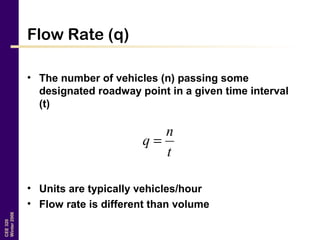
Flow Rate (q)
• The number of vehicles (n) passing some
designated roadway point in a given time interval
(t)
• Units are typically vehicles/hour
• Flow rate is different than volume
t
n
q =
CEE320
Winter2006
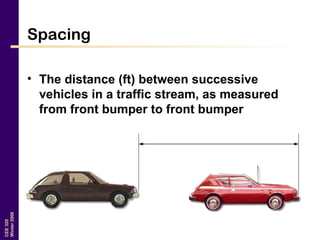
Spacing
• The distance (ft) between successive
vehicles in a traffic stream, as measured
from front bumper to front bumper
CEE320
Winter2006
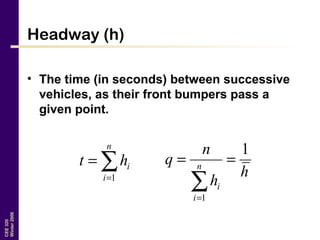
Headway (h)
• The time (in seconds) between successive
vehicles, as their front bumpers pass a
given point.
∑=
=
n
i
iht
1 h
h
n
q n
i
i
1
1
==
∑=
CEE320
Winter2006
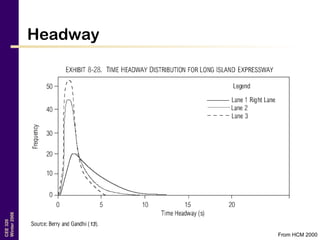
Headway
From HCM 2000
CEE320
Winter2006
Speed
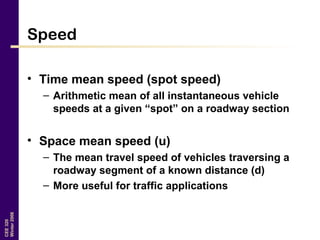
• Time mean speed (spot speed)
– Arithmetic mean of all instantaneous vehicle
speeds at a given “spot” on a roadway section
• Space mean speed (u)
– The mean travel speed of vehicles traversing a
roadway segment of a known distance (d)
– More useful for traffic applications
CEE320
Winter2006
Space Mean Speed
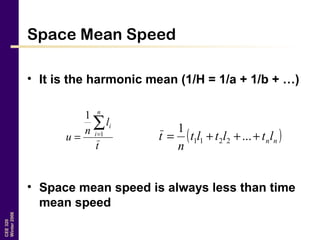
• It is the harmonic mean (1/H = 1/a + 1/b + …)
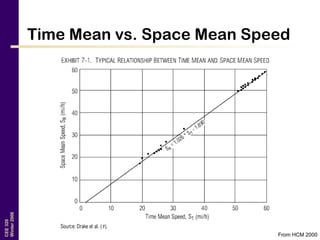
• Space mean speed is always less than time
mean speed
t
l
n
u
n
i
i∑=
= 1
1
( )nnltltlt
n
t +++= ...
1
2211
CEE320
Winter2006
Time Mean vs. Space Mean Speed
From HCM 2000
CEE320
Winter2006
Density (k)
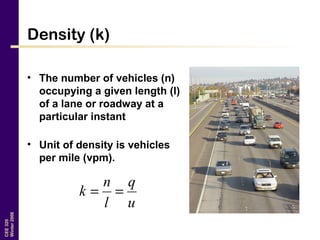
• The number of vehicles (n)
occupying a given length (l)
of a lane or roadway at a
particular instant
• Unit of density is vehicles
per mile (vpm).
u
q
l
n
k ==
CEE320
Winter2006
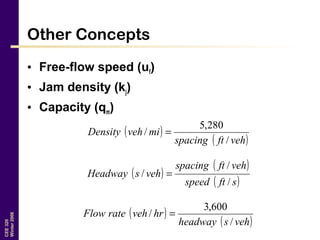
Other Concepts
• Free-flow speed (uf)
• Jam density (kj)
• Capacity (qm)
( )
( )vehftspacing
mivehDensity
/
280,5
/ =
( )
( )
( )sftspeed
vehftspacing
vehsHeadway
/
/
/ =
( )
( )vehsheadway
hrvehrateFlow
/
600,3
/ =
CEE320
Winter2006
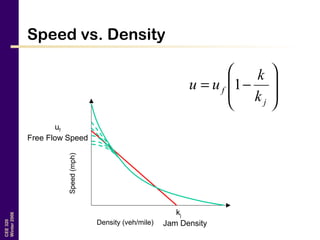
Speed vs. Density








−=
j
f
k
k
uu 1
Density (veh/mile)
Speed(mph)
kj
Jam Density
uf
Free Flow Speed
CEE320
Winter2006
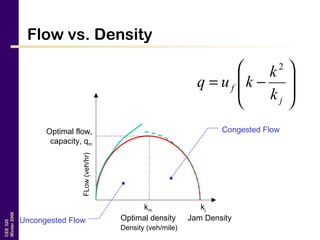
Flow vs. Density








−=
j
f
k
k
kuq
2
Density (veh/mile)
FLow(veh/hr)
kj
Jam Density
Optimal flow,
capacity, qm
km
Optimal densityUncongested Flow
Congested Flow
CEE320
Winter2006
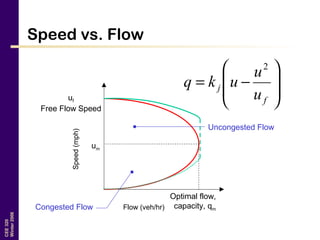
Speed vs. Flow








−=
f
j
u
u
ukq
2
Flow (veh/hr)
Speed(mph)
uf
Free Flow Speed
Optimal flow,
capacity, qm
Uncongested Flow
Congested Flow
um
CEE320
Winter2006
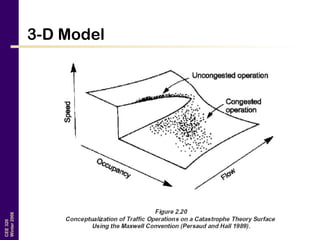
3-D Model
CEE320
Winter2006
Example
I-5 over the ship canal bridge has 4 lanes in each direction. The
northbound capacity is 8200 veh/hr/lane and the free-flow speed
is 65 mph. What is the maximum flow rate, maximum density,
jam density? If a one-hour vehicle count in the northbound
direction for the outside lane gives 7034 vehicles in a non-
congested condition, what is the estimated space mean speed
of these 7034 vehicles?
CEE320
Winter2006
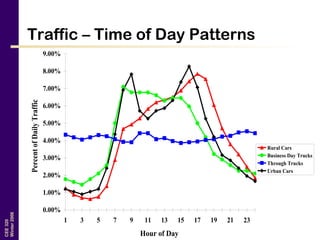
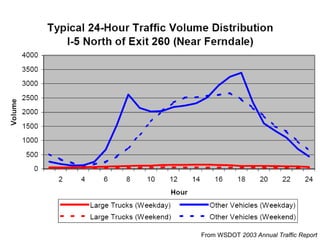
Traffic – Time of Day Patterns
0.00%
1.00%
2.00%
3.00%
4.00%
5.00%
6.00%
7.00%
8.00%
9.00%
1 3 5 7 9 11 13 15 17 19 21 23
Hour of Day
PercentofDailyTraffic
Rural Cars
Business Day Trucks
Through Trucks
Urban Cars
From WSDOT 2003 Annual Traffic Report
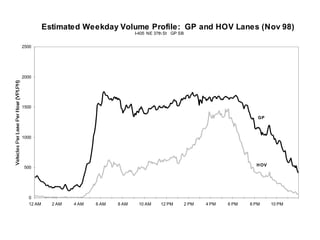
I-405 NE 37th St GP SB
0
500
1000
1500
2000
2500
12 AM 2 AM 4 AM 6 AM 8 AM 10 AM 12 PM 2 PM 4 PM 6 PM 8 PM 10 PM
Estimated Weekday Volume Profile: GP and HOV Lanes (Nov 98)
GP
HOV
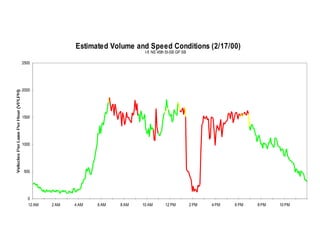
I-5 NE 45th St-SB GP SB
0
500
1000
1500
2000
2500
12 AM 2 AM 4 AM 6 AM 8 AM 10 AM 12 PM 2 PM 4 PM 6 PM 8 PM 10 PM
Estimated Volume and Speed Conditions (2/17/00)
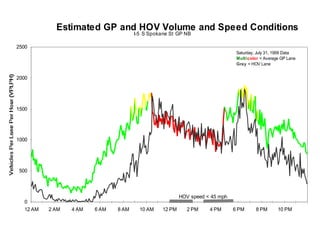
I-5 S Spokane St GP NB
0
500
1000
1500
2000
2500
12 AM 2 AM 4 AM 6 AM 8 AM 10 AM 12 PM 2 PM 4 PM 6 PM 8 PM 10 PM
Estimated GP and HOV Volume and Speed Conditions
HOV speed < 45 mph
Saturday, July 31, 1999 Data
Multicolor = Average GP Lane
Gray = HOV Lane
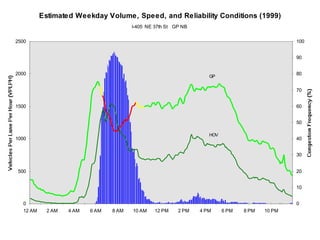
I-405 NE 37th St GP NB
0
500
1000
1500
2000
2500
12 AM 2 AM 4 AM 6 AM 8 AM 10 AM 12 PM 2 PM 4 PM 6 PM 8 PM 10 PM
0
10
20
30
40
50
60
70
80
90
100
Estimated Weekday Volume, Speed, and Reliability Conditions (1999)
GP
HOV
Time PMAM
0 2 4 6 8 10 12 2 4 6 8 10 12
Time PMAM
0 2 4 6 8 10 12 2 4 6 8 10 12
405
5
Montlake Blvd.
520
Arboretum
92ndAve.
B’vue. Way
148th Ave.
NE 60th St.
84th Ave.
Lk. Wash.
Uncongested, near
speed limit
Restricted movement
but near speed limit
More heavily congested,
45 - 55 mph
Extremely congested,
unstable flow
Westbound
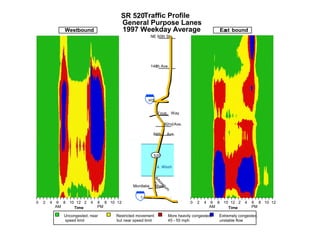
SR 520Traffic Profile
General Purpose Lanes
1997 Weekday Average East bound
CEE320
Winter2006
Primary References
• Mannering, F.L.; Kilareski, W.P. and Washburn, S.S. (2005).
Principles of Highway Engineering and Traffic Analysis, Third Edition.
Chapter 5
• Transportation Research Board. (2000). Highway Capacity Manual
2000. National Research Council, Washington, D.C.

Traffic Concepts (Transportation Engineering)

Editor's Notes

  • #6 AMC Pacer and AMC Gremlin
  • #10 A harmonic mean is just another way to describe a set of data In this case it is more descriptive for vehicle speeds Example party trick to show you are a knowledgeable engineer You are in a vehicle traveling a total of 10 miles. For the first 5 miles you travel at exactly 40 mph and for the next 5 miles you travel at exactly 60 mph. What is your average speed over the time you spent traveling that 10 miles? Intuitively, you were going at 40 mph for longer than you were going at 60 mph so your average velocity for the entire trip is going to be less than the arithmetic mean of 50 mph It’s 48 mph by harmonic mean distance = speed * time 5 miles at 40 mph = 7.5 minutes 5 miles at 60 mph = 5 minutes weighted average = (40(7.5) + 60(5))/(7.5 + 5) = 48 mph Example 5 vehicles over a given 1 mile section take 1.0, 1.2, 1.5, 0.75 and 1.0 minutes respectively Average travel time = 5.45/5 = 1.09 minutes = 0.0182 hours Therefore, average speed = 1 mile/0.0182 hours = 55.05 mph
  • #12 Occupancy is often used as a surrogate
  • #13 Occupancy often used as a surrogate to density because it’s easier to measure Density is difficult to measure because you have to essentially image a long stretch of road Occupancy and density are correlated by not perfectly
  • #16 Lots of measurements in the top part, a few in the queue part and a few in the congested part Segment 1 = top part = uncongested Segment 2 = straight part = queue discharge Segment 3 = bottom part = within a queue
  • #17 Occupancy is a surrogate for density since density is often difficult to measure
  • #18 Maximum flow rate, qm = 8200 veh/hr as given At maximum flow: dq/dk = uf(1-2km/kj) = 0 Since uf is not zero, 1-2km/kj = 0 Therefore km = kj/2 Similarly, um = uf/2 Therefore, um = 65/2 = 32.5 mph. Therefore, maximum density, km = qm/um = 8200/32.5 = 252.31 vehicles/mile kj = 2*km = 2*(252.31) = 504.62 veh/mile/lane Using the speed-flow relationship: q = kj(u – u2/uf) Solve for q = 7034 = 504.62(u – u2/65) 13.94 = u – u2/65 906.06 = 65u – u2 u2 – 65u + 906.06 = 0 u = 44.7 or 20.2 mph Choose 41.6 since this is the higher of the two and the observed flow is less than qm so we know we are not in the congested area of the curve
  • #19 Truck travel is driven by business needs. Passenger car travel is driven by personal needs. These are different. Thus, trucks often move at different times than cars.
  • #22 Just north of the SR 520 interchange This graph shows a good example of how HOV and GP volumes change over time on I-405 in the south end. An interesting aspect of I-405 is that usage stays high throughout the day. At this location (near Kennydale), the two GP lanes stay fairly full throughout the day.
  • #23 Effects of an incident around 2pm This picture shows the impact of a rendering truck accident on I-5 in Seattle. You can see the traditional morning congestion, and the afternoon congestion caused by the accident. You can really see the loss of facility capacity (and thus throughput), and the duration of the slow speeds,long after the accident has been cleared. This type of picture is an excellent tool for describing to decision makers and the general public why incident response is needed, as well as serving as an excellent tool for examining the effectiveness of those measure you do implement.
  • #24 In this case, we plotted two different lanes in order to show how HOV lanes work on weekends in Seattle. The number of legal “carpools” is high on weekends, but people don’t end to use those lanes unless the facility gets congested. This graphic illustrates how the GP lane and HOV lane volumes converge, once congestion occurs.
  • #25 This graphic compares HOV and GP lane performance. Only the GP lane is color coded and the congestion histogram applies only to the GP lane. At this location, we can see the effect persistent congestion has on GP volumes. It also shows very well, how GP congestion can help encourage HOV use. This site also shows how HOV lane volumes can be reasonably high (if not equal to GP lane volumes) even during the middle of the day.