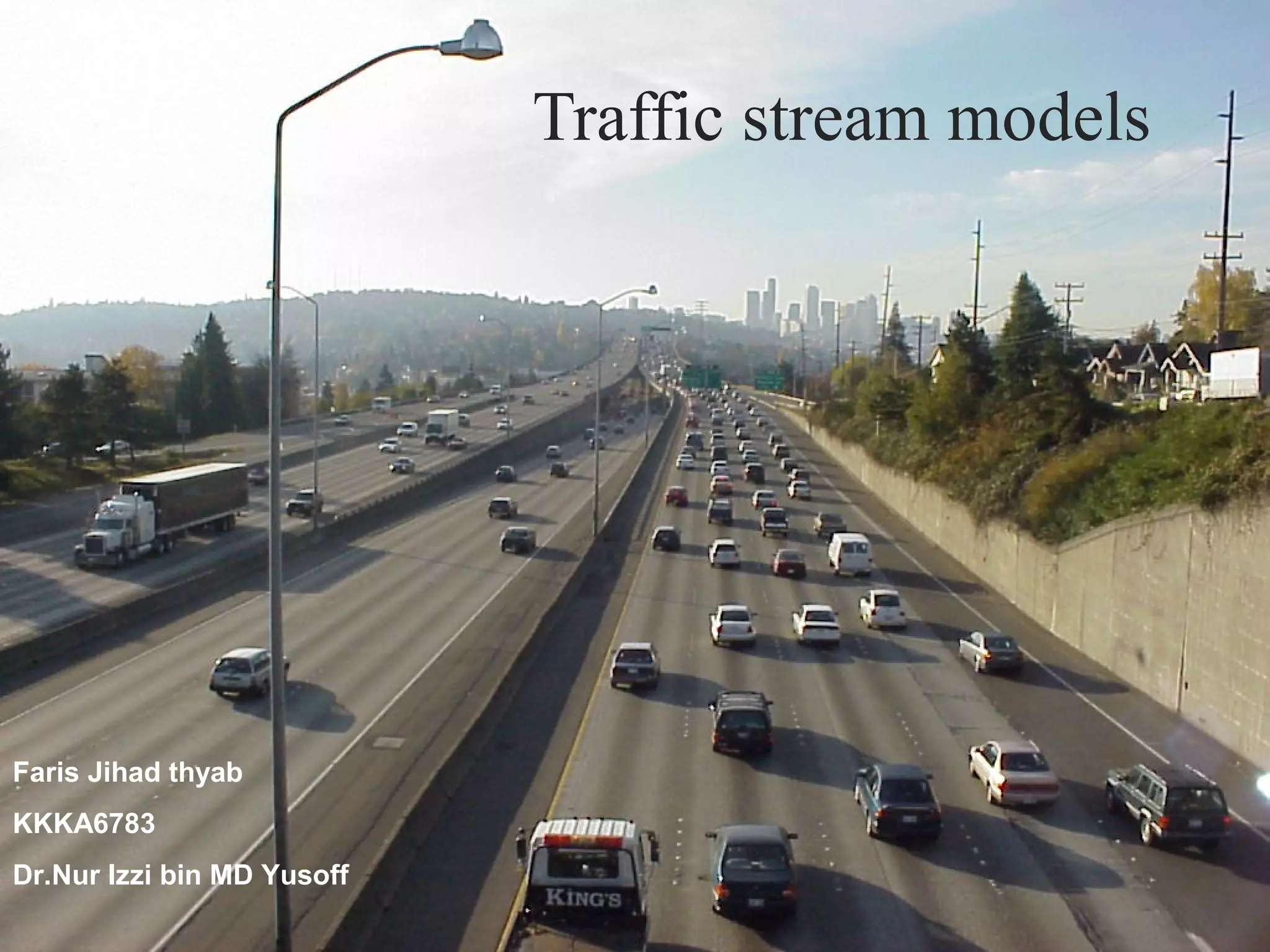
Traffic stream models
Faris Jihad thyab
KKKA6783
Dr.Nur Izzi bin MD Yusoff
Introduction
Traffic flow is the study of interactions between vehicles, drivers and
infrastructure (including highways, signage and traffic control devices)
Interest in modeling traffic flow has been around since the appearance of
traffic jams. Ideally, if we can correctly predict the behavior of vehicle
flow given an initial set of data, then, in theory, adjusting the flow in
crucial areas can maximize the overall throughput of traffic along a
stretch of road. This is of particular interest in regions of high traffic
density, which may be caused by high volume peak time traffic,
accidents or closure of one or more lanes of the road
Macroscopic and Microscopic
Model
In the traffic flow problem, there are two classes of models:
Macroscopic,
which is concerned with average behavior, such as traffic density,
average speed and module area, and a second class of models based on
individual behavior referred to as
Microscopic models.
The latter is classified into different types. The most famous one is the
Car- Following models ,where the driver adjusts his or her acceleration
according to the conditions in front
Car-Following Model
Assumptions :
Cars can not pass each other
A car in lane A1 can move and accelerate forward based on two
parameters :
•The headway distance between the current car and The one in front
•Their speed difference.
Conservation Law
When physical quantities remain the same during some process, these
quantities are said to be conserved. Putting this principle into a
mathematical representation will make it possible to predict the densities
and velocities patterns at future time.
The number of cars in a segment of a highway [ x1,x2] are our physical
quantities, and the process is to keep them fixed (i.e., the number of cars
coming in equals the number of cars going out of the segment)
Greenshield’s Model
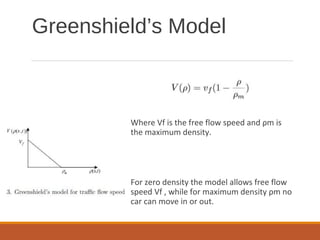
Where Vf is the free flow speed and ρm is
the maximum density.
For zero density the model allows free flow
speed Vf , while for maximum density ρm no
car can move in or out.
Outline
1. Basic Concepts
a. Flow Rate
b. Spacing
c. Headway
d. Speed
e. Density
f. Other concepts
2. Figures and graphs
3. Traffic flow During 24 hours
4. 3-D Model
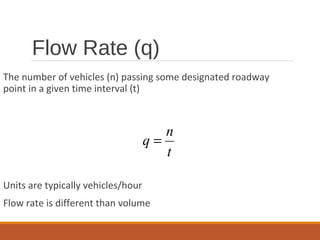
Flow Rate (q)
t
n
q =
The number of vehicles (n) passing some designated roadway
point in a given time interval (t)
Units are typically vehicles/hour
Flow rate is different than volume
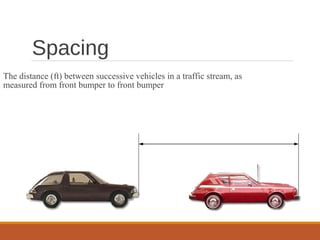
Spacing
The distance (ft) between successive vehicles in a traffic stream, as
measured from front bumper to front bumper
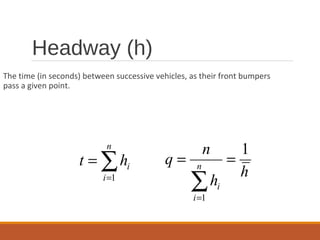
Headway (h)
∑=
=
n
i
iht
1
The time (in seconds) between successive vehicles, as their front bumpers
pass a given point.
h
h
n
q n
i
i
1
1
==
∑=
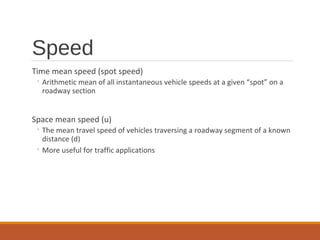
Speed
Time mean speed (spot speed)
◦ Arithmetic mean of all instantaneous vehicle speeds at a given “spot” on a
roadway section
Space mean speed (u)
◦ The mean travel speed of vehicles traversing a roadway segment of a known
distance (d)
◦ More useful for traffic applications
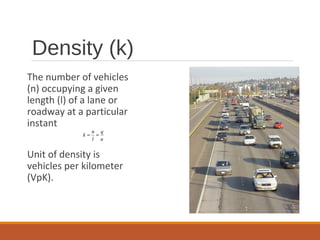
Density (k)
u
q
l
n
k ==
The number of vehicles
(n) occupying a given
length (l) of a lane or
roadway at a particular
instant
Unit of density is
vehicles per kilometer
(VpK).
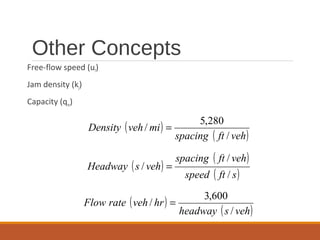
Other Concepts
Free-flow speed (uf)
Jam density (kj)
Capacity (qm)
( )
( )vehftspacing
mivehDensity
/
280,5
/ =
( )
( )
( )sftspeed
vehftspacing
vehsHeadway
/
/
/ =
( )
( )vehsheadway
hrvehrateFlow
/
600,3
/ =
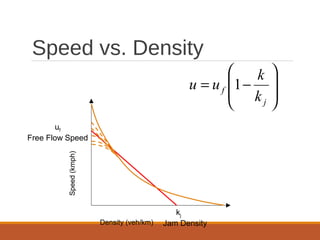
Speed vs. Density








−=
j
f
k
k
uu 1
Density (veh/km)
Speed(kmph)
kj
Jam Density
uf
Free Flow Speed
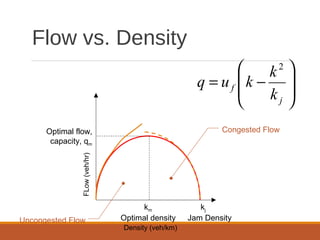
Flow vs. Density








−=
j
f
k
k
kuq
2
Density (veh/km)
FLow(veh/hr)
kj
Jam Density
Optimal flow,
capacity, qm
km
Optimal densityUncongested Flow
Congested Flow
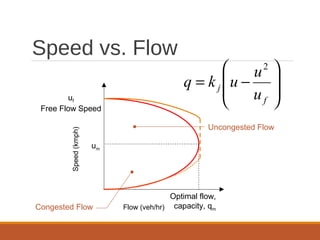
Speed vs. Flow








−=
f
j
u
u
ukq
2
Flow (veh/hr)
Speed(kmph)
uf
Free Flow Speed
Optimal flow,
capacity, qm
Uncongested Flow
Congested Flow
um
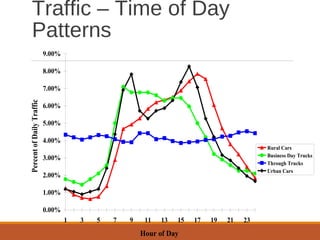
Traffic – Time of Day
Patterns
0.00%
1.00%
2.00%
3.00%
4.00%
5.00%
6.00%
7.00%
8.00%
9.00%
1 3 5 7 9 11 13 15 17 19 21 23
Hour of Day
PercentofDailyTraffic
Rural Cars
Business Day Trucks
Through Trucks
Urban Cars
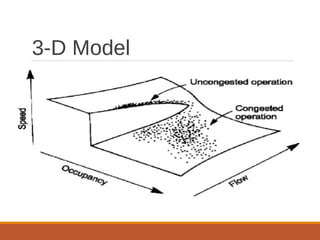
3-D Model
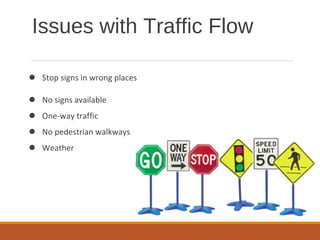
Issues with Traffic Flow
Stop signs in wrong places
No signs available
One-way traffic
No pedestrian walkways
Weather
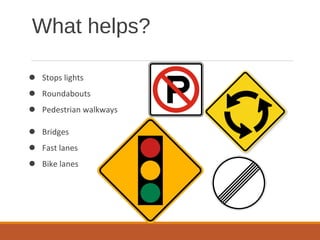
What helps?
Stops lights
Roundabouts
Pedestrian walkways
Bridges
Fast lanes
Bike lanes
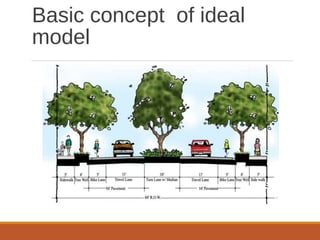
Basic concept of ideal
model
Primary References
Mannering, F.L.; Kilareski, W.P. and Washburn, S.S. (2005). Principles of
Highway Engineering and Traffic Analysis, Third Edition. Chapter 5
Transportation Research Board. (2000). Highway Capacity Manual 2000.
National Research Council, Washington, D.C.
Traffic stream models

Traffic stream models

  • 1.
    Traffic stream models FarisJihad thyab KKKA6783 Dr.Nur Izzi bin MD Yusoff
  • 2.
    Introduction Traffic flow isthe study of interactions between vehicles, drivers and infrastructure (including highways, signage and traffic control devices) Interest in modeling traffic flow has been around since the appearance of traffic jams. Ideally, if we can correctly predict the behavior of vehicle flow given an initial set of data, then, in theory, adjusting the flow in crucial areas can maximize the overall throughput of traffic along a stretch of road. This is of particular interest in regions of high traffic density, which may be caused by high volume peak time traffic, accidents or closure of one or more lanes of the road
  • 3.
    Macroscopic and Microscopic Model Inthe traffic flow problem, there are two classes of models: Macroscopic, which is concerned with average behavior, such as traffic density, average speed and module area, and a second class of models based on individual behavior referred to as Microscopic models. The latter is classified into different types. The most famous one is the Car- Following models ,where the driver adjusts his or her acceleration according to the conditions in front
  • 4.
    Car-Following Model Assumptions : Carscan not pass each other A car in lane A1 can move and accelerate forward based on two parameters : •The headway distance between the current car and The one in front •Their speed difference.
  • 5.
    Conservation Law When physicalquantities remain the same during some process, these quantities are said to be conserved. Putting this principle into a mathematical representation will make it possible to predict the densities and velocities patterns at future time. The number of cars in a segment of a highway [ x1,x2] are our physical quantities, and the process is to keep them fixed (i.e., the number of cars coming in equals the number of cars going out of the segment)
  • 6.
    Greenshield’s Model Where Vfis the free flow speed and ρm is the maximum density. For zero density the model allows free flow speed Vf , while for maximum density ρm no car can move in or out.
  • 7.
    Outline 1. Basic Concepts a.Flow Rate b. Spacing c. Headway d. Speed e. Density f. Other concepts 2. Figures and graphs 3. Traffic flow During 24 hours 4. 3-D Model
  • 8.
    Flow Rate (q) t n q= The number of vehicles (n) passing some designated roadway point in a given time interval (t) Units are typically vehicles/hour Flow rate is different than volume
  • 9.
    Spacing The distance (ft)between successive vehicles in a traffic stream, as measured from front bumper to front bumper
  • 10.
    Headway (h) ∑= = n i iht 1 The time(in seconds) between successive vehicles, as their front bumpers pass a given point. h h n q n i i 1 1 == ∑=
  • 11.
    Speed Time mean speed(spot speed) ◦ Arithmetic mean of all instantaneous vehicle speeds at a given “spot” on a roadway section Space mean speed (u) ◦ The mean travel speed of vehicles traversing a roadway segment of a known distance (d) ◦ More useful for traffic applications
  • 12.
    Density (k) u q l n k == Thenumber of vehicles (n) occupying a given length (l) of a lane or roadway at a particular instant Unit of density is vehicles per kilometer (VpK).
  • 13.
    Other Concepts Free-flow speed(uf) Jam density (kj) Capacity (qm) ( ) ( )vehftspacing mivehDensity / 280,5 / = ( ) ( ) ( )sftspeed vehftspacing vehsHeadway / / / = ( ) ( )vehsheadway hrvehrateFlow / 600,3 / =
  • 14.
    Speed vs. Density         −= j f k k uu1 Density (veh/km) Speed(kmph) kj Jam Density uf Free Flow Speed
  • 15.
    Flow vs. Density         −= j f k k kuq 2 Density(veh/km) FLow(veh/hr) kj Jam Density Optimal flow, capacity, qm km Optimal densityUncongested Flow Congested Flow
  • 16.
    Speed vs. Flow         −= f j u u ukq 2 Flow(veh/hr) Speed(kmph) uf Free Flow Speed Optimal flow, capacity, qm Uncongested Flow Congested Flow um
  • 17.
    Traffic – Timeof Day Patterns 0.00% 1.00% 2.00% 3.00% 4.00% 5.00% 6.00% 7.00% 8.00% 9.00% 1 3 5 7 9 11 13 15 17 19 21 23 Hour of Day PercentofDailyTraffic Rural Cars Business Day Trucks Through Trucks Urban Cars
  • 18.
  • 19.
    Issues with TrafficFlow Stop signs in wrong places No signs available One-way traffic No pedestrian walkways Weather
  • 20.
    What helps? Stops lights Roundabouts Pedestrianwalkways Bridges Fast lanes Bike lanes
  • 21.
    Basic concept ofideal model
  • 22.
    Primary References Mannering, F.L.;Kilareski, W.P. and Washburn, S.S. (2005). Principles of Highway Engineering and Traffic Analysis, Third Edition. Chapter 5 Transportation Research Board. (2000). Highway Capacity Manual 2000. National Research Council, Washington, D.C.

Editor's Notes

  • #10 AMC Pacer and AMC Gremlin
  • #13 Occupancy is often used as a surrogate
  • #14 Occupancy often used as a surrogate to density because it’s easier to measure Density is difficult to measure because you have to essentially image a long stretch of road Occupancy and density are correlated by not perfectly
  • #17 Lots of measurements in the top part, a few in the queue part and a few in the congested part Segment 1 = top part = uncongested Segment 2 = straight part = queue discharge Segment 3 = bottom part = within a queue
  • #18 Truck travel is driven by business needs. Passenger car travel is driven by personal needs. These are different. Thus, trucks often move at different times than cars.
  • #19 Occupancy is a surrogate for density since density is often difficult to measure