UNIT-II
Highway Geometric Design
1
• Geometric design of a highway deals with the
dimensions and layout of visible features of the
highway such as horizontal and vertical alignments,
sight distances and intersections.
• The geometrics of highway should be designed to
provide efficiency in traffic operations with maximum
safety at reasonable cost.
2
Introduction:
Geometric design of highways deals with
following elements:
a. Cross section elements
b. Sight distance consideration
c. Horizontal alignment details
d. Vertical alignment details
e. Intersection elements
3
a. Cross section elements
4
i. Pavement surface characteristics
ii. Width of Pavement or Carriageway
iii. Cross Slope or Camber
iv. Median or Traffic Separator
v. Kerbs
vi. Road Margins
vii.Width of Formation
5
i. Pavement surface characteristics:
The important surface characteristics of
the pavement are:
 Friction
 Unevenness
 Light reflecting characteristics
 Drainage of surface water
6
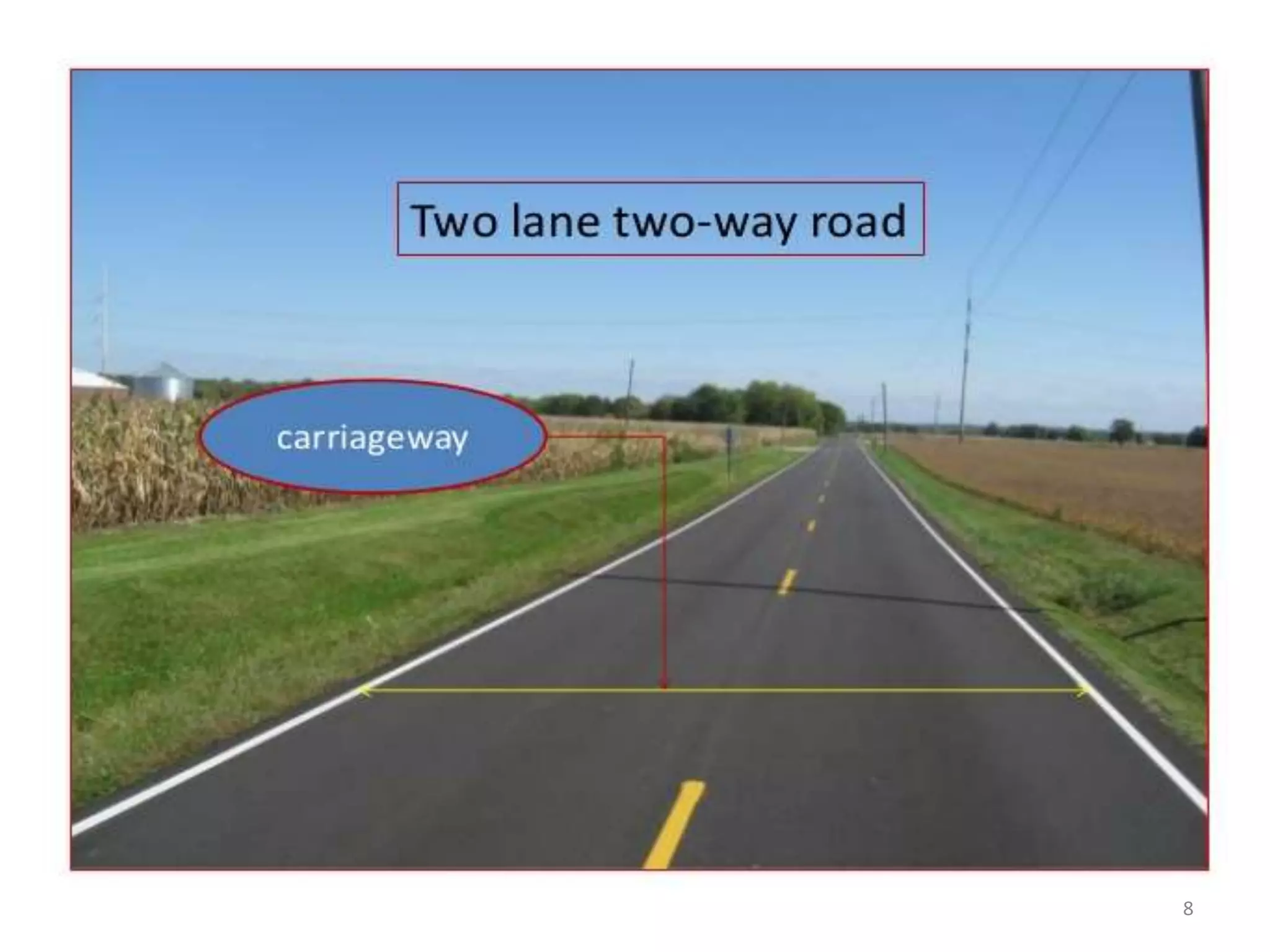
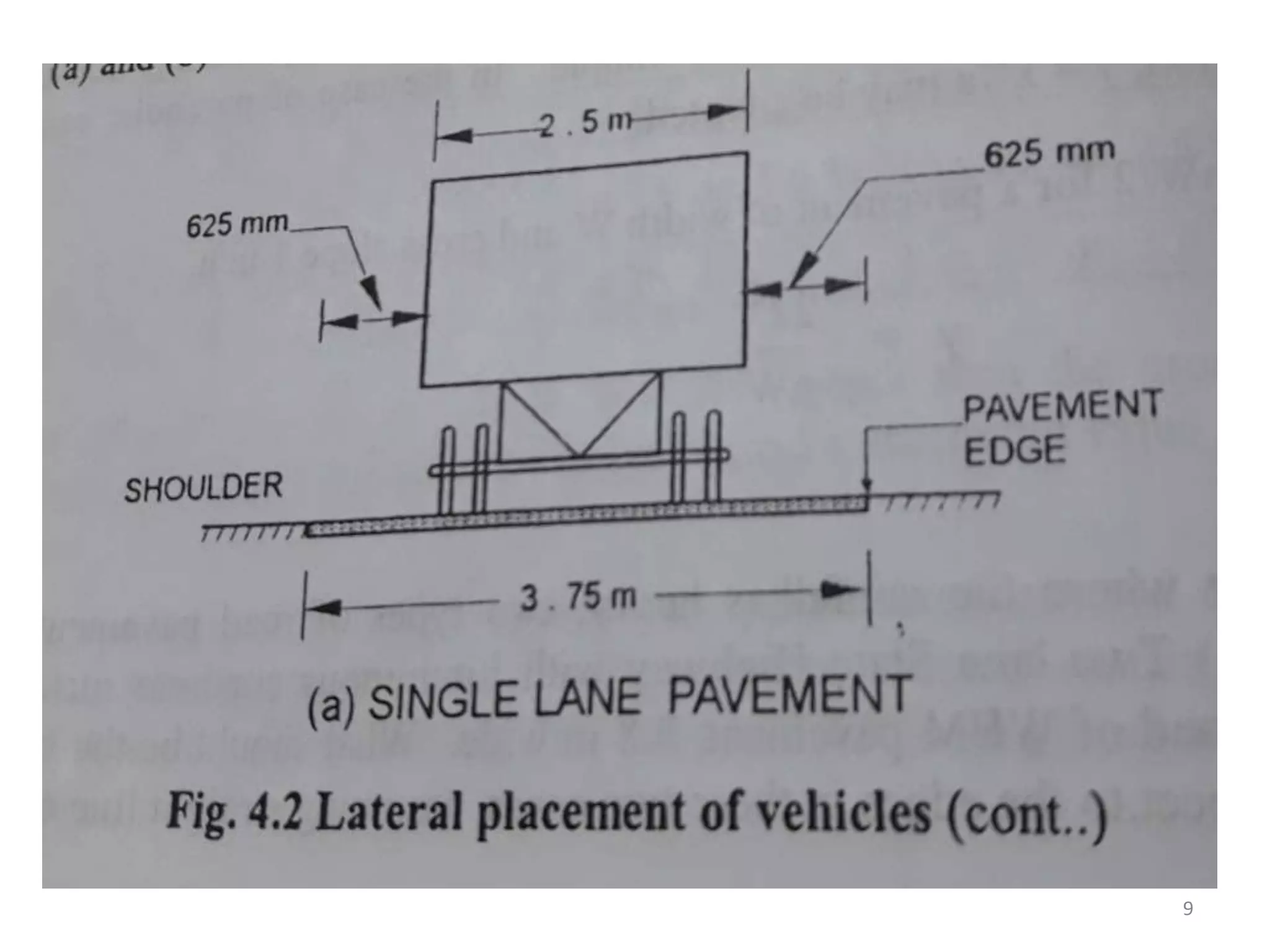
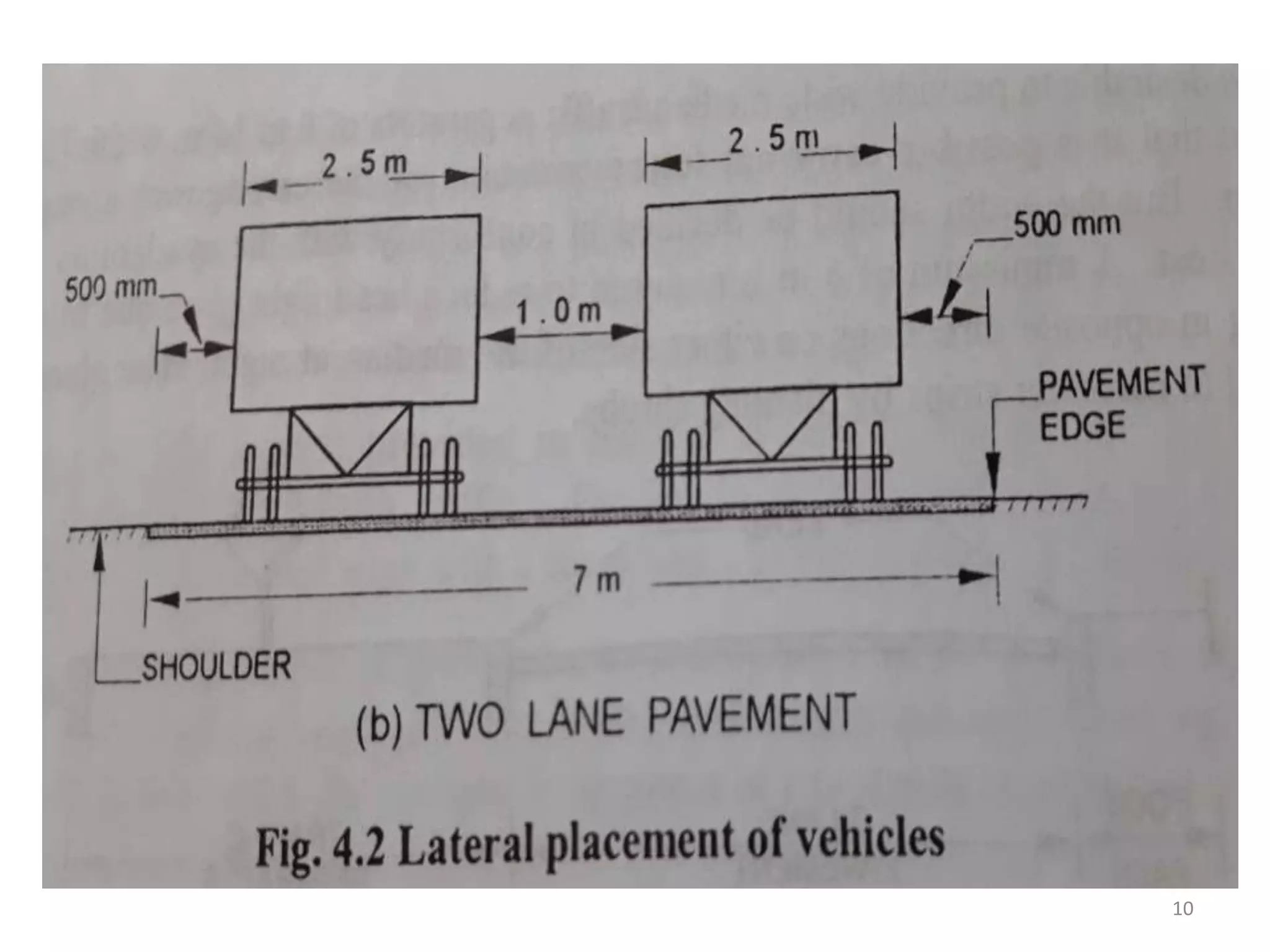
ii. Width of Pavement or Carriageway:
It is total width of road on which vehicles
are allowed to move.
• The width of pavement depends on width of
traffic lane and number of lanes.
• Width of lane is decided based on maximum
width of heavy commercial vehicle (HCV) which is
legally permitted to use the roadway.
7
8
9
10
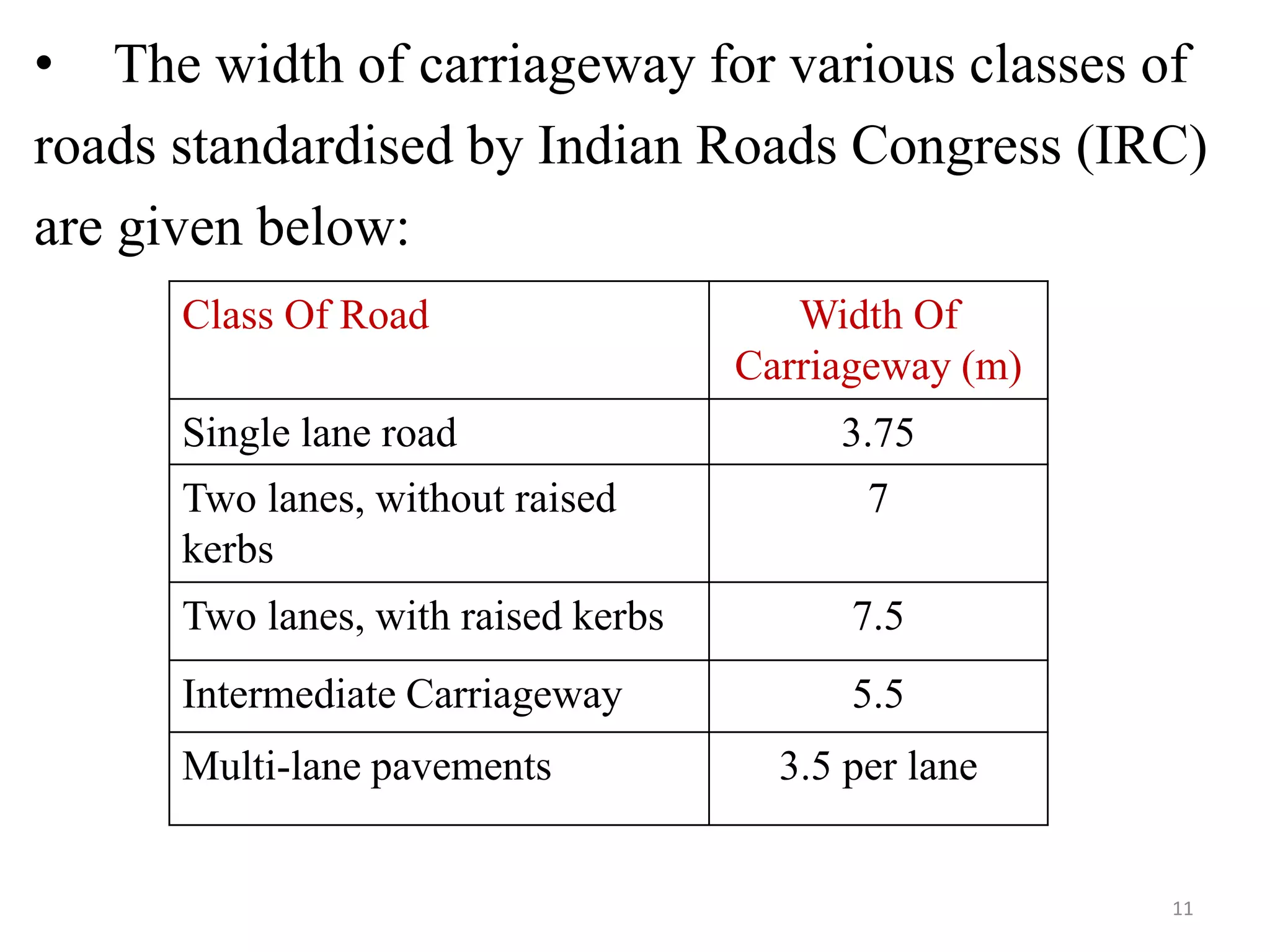
• The width of carriageway for various classes of
roads standardised by Indian Roads Congress (IRC)
are given below:
11
Class Of Road Width Of
Carriageway (m)
Single lane road 3.75
Two lanes, without raised
kerbs
7
Two lanes, with raised kerbs 7.5
Intermediate Carriageway 5.5
Multi-lane pavements 3.5 per lane
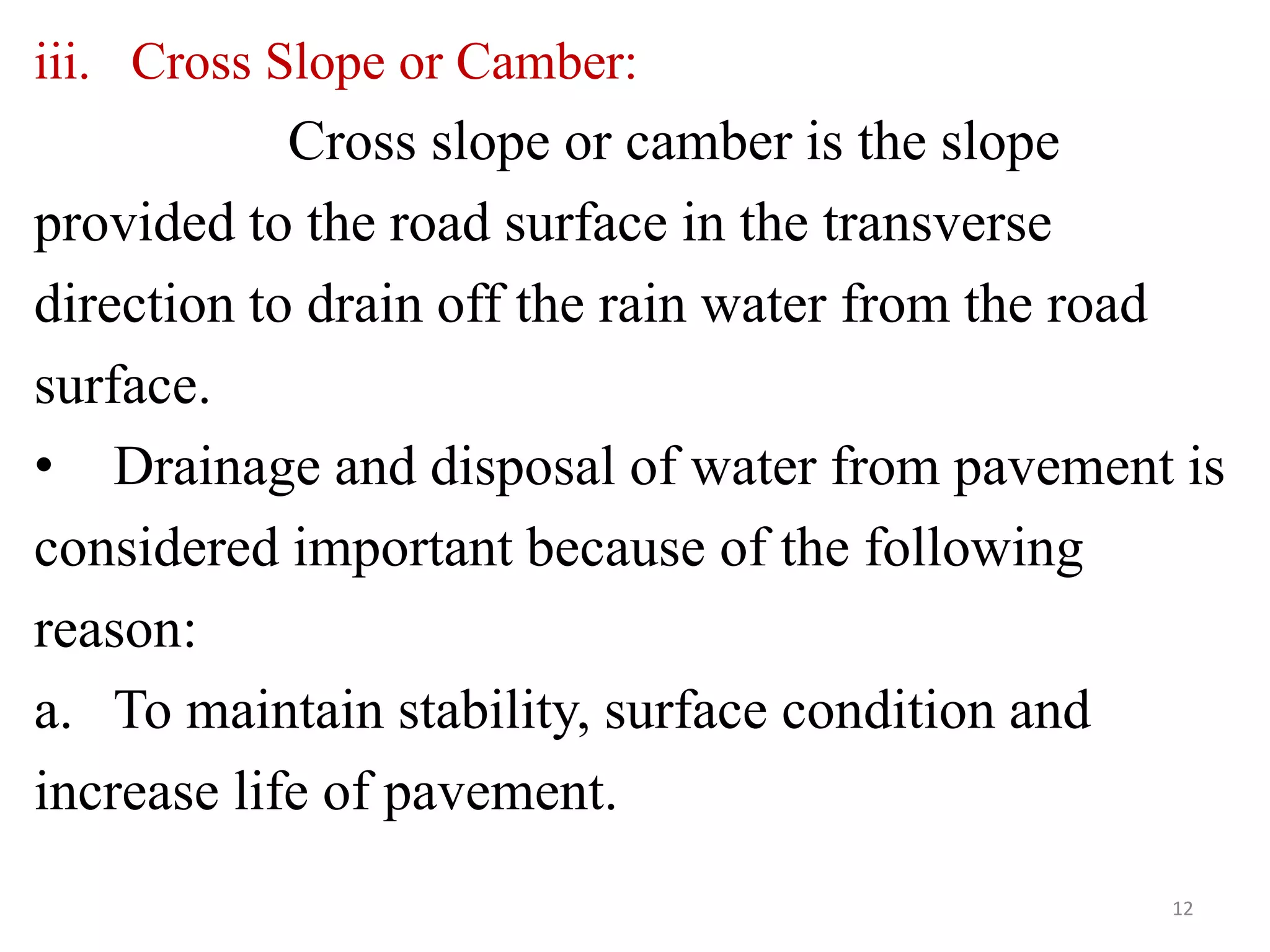
iii. Cross Slope or Camber:
Cross slope or camber is the slope
provided to the road surface in the transverse
direction to drain off the rain water from the road
surface.
• Drainage and disposal of water from pavement is
considered important because of the following
reason:
a. To maintain stability, surface condition and
increase life of pavement.
12
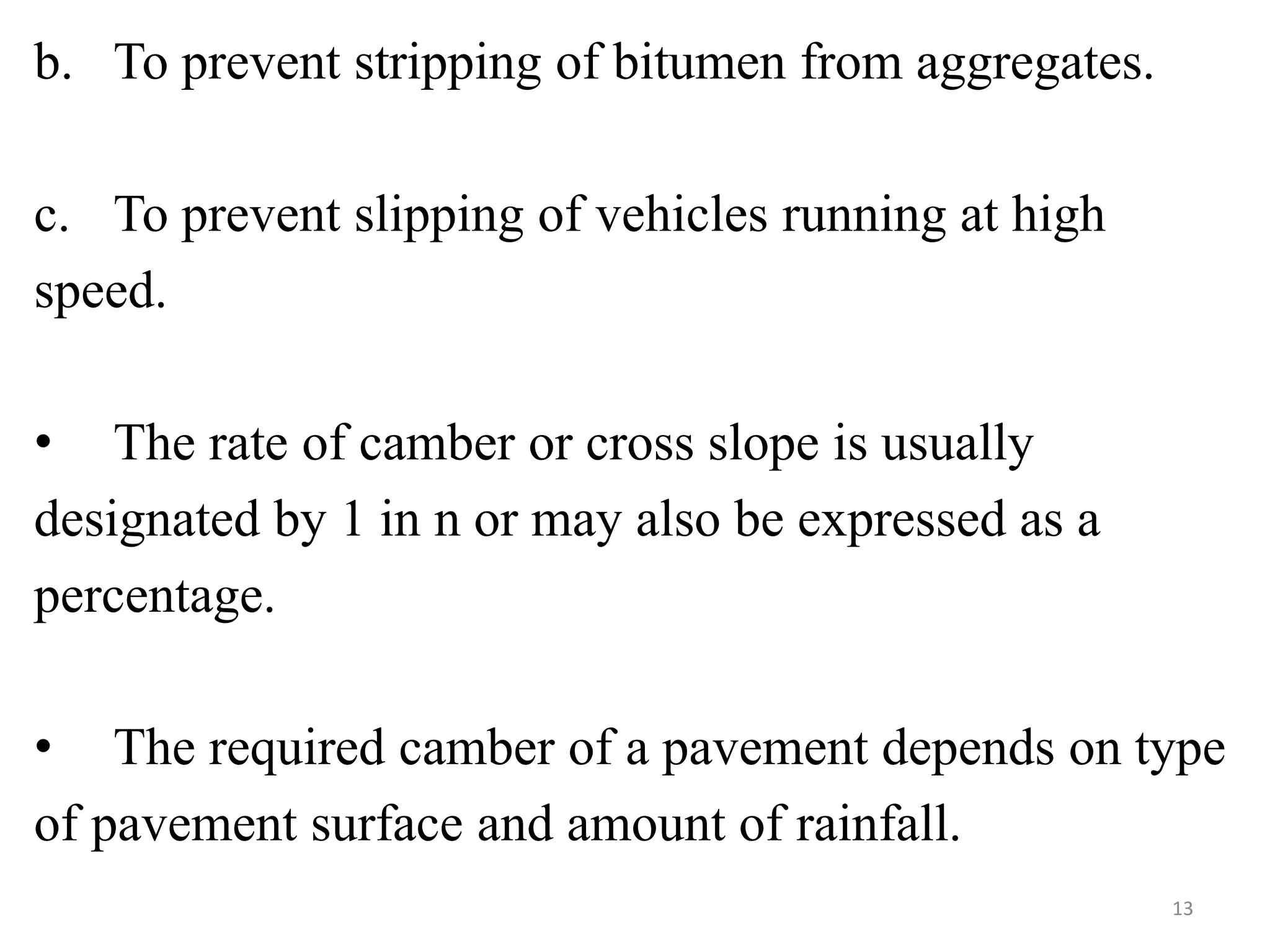
b. To prevent stripping of bitumen from aggregates.
c. To prevent slipping of vehicles running at high
speed.
• The rate of camber or cross slope is usually
designated by 1 in n or may also be expressed as a
percentage.
• The required camber of a pavement depends on type
of pavement surface and amount of rainfall.
13
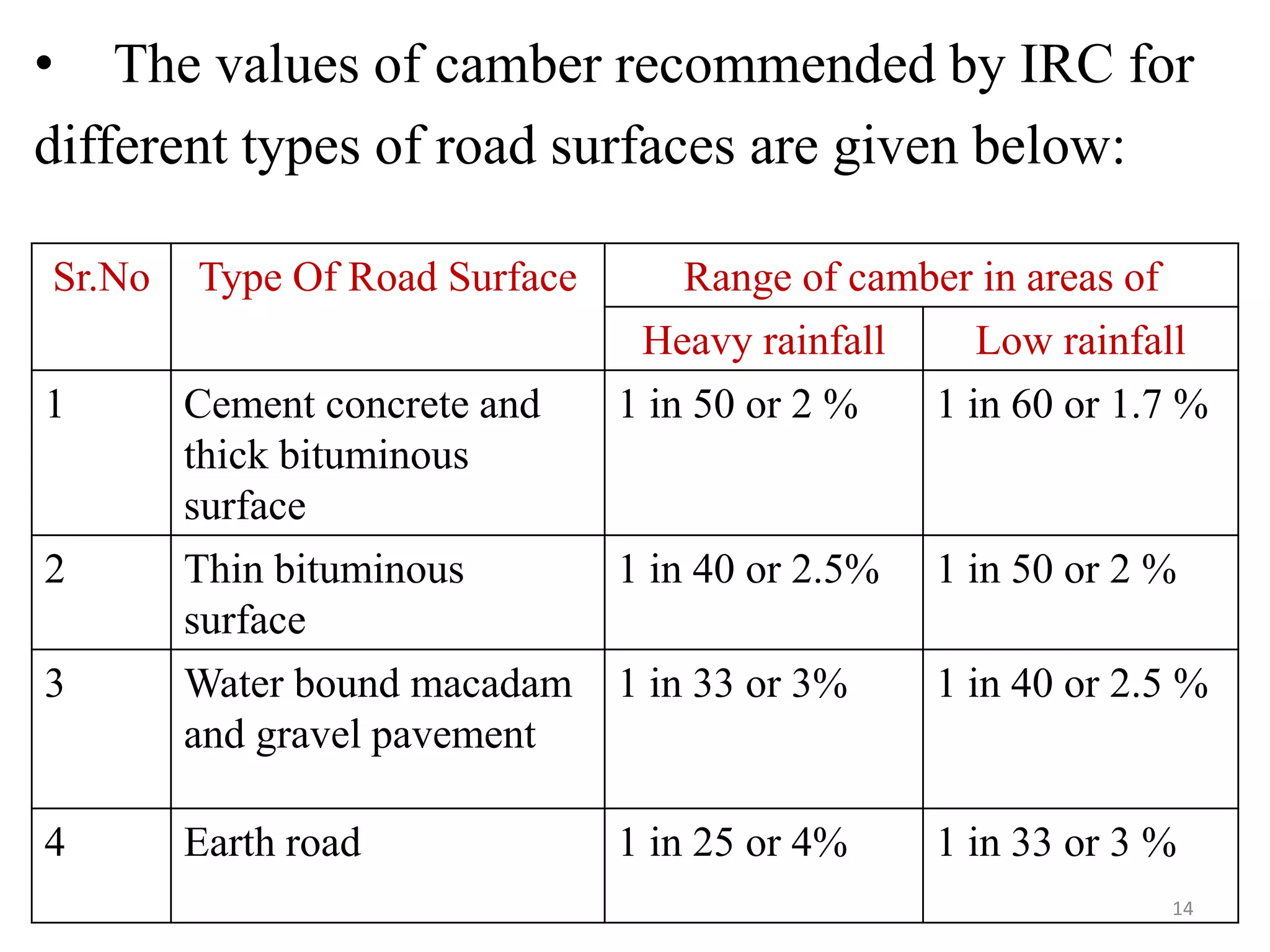
• The values of camber recommended by IRC for
different types of road surfaces are given below:
14
Sr.No Type Of Road Surface Range of camber in areas of
Heavy rainfall Low rainfall
1 Cement concrete and
thick bituminous
surface
1 in 50 or 2 % 1 in 60 or 1.7 %
2 Thin bituminous
surface
1 in 40 or 2.5% 1 in 50 or 2 %
3 Water bound macadam
and gravel pavement
1 in 33 or 3% 1 in 40 or 2.5 %
4 Earth road 1 in 25 or 4% 1 in 33 or 3 %
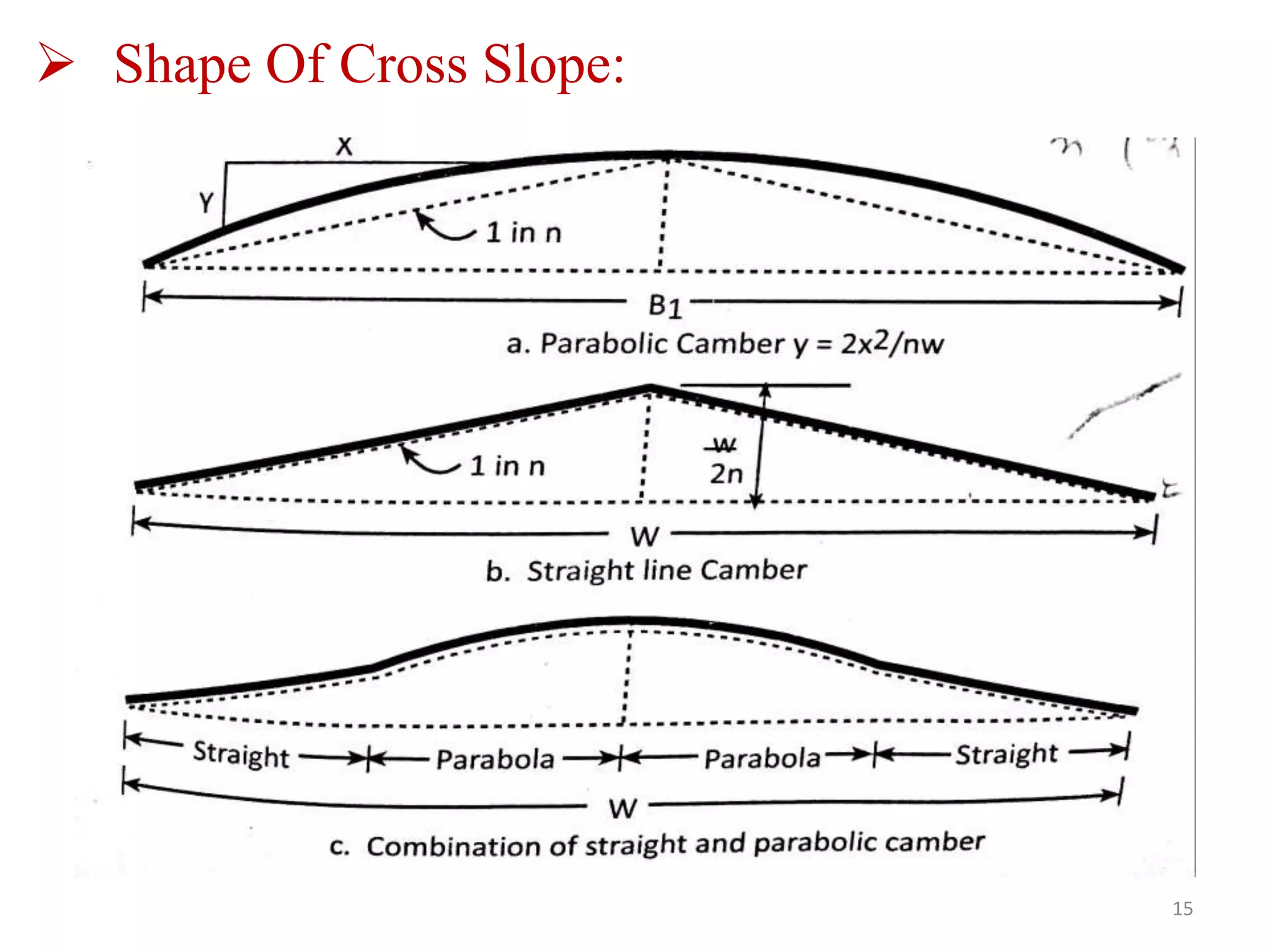
 Shape Of Cross Slope:
15
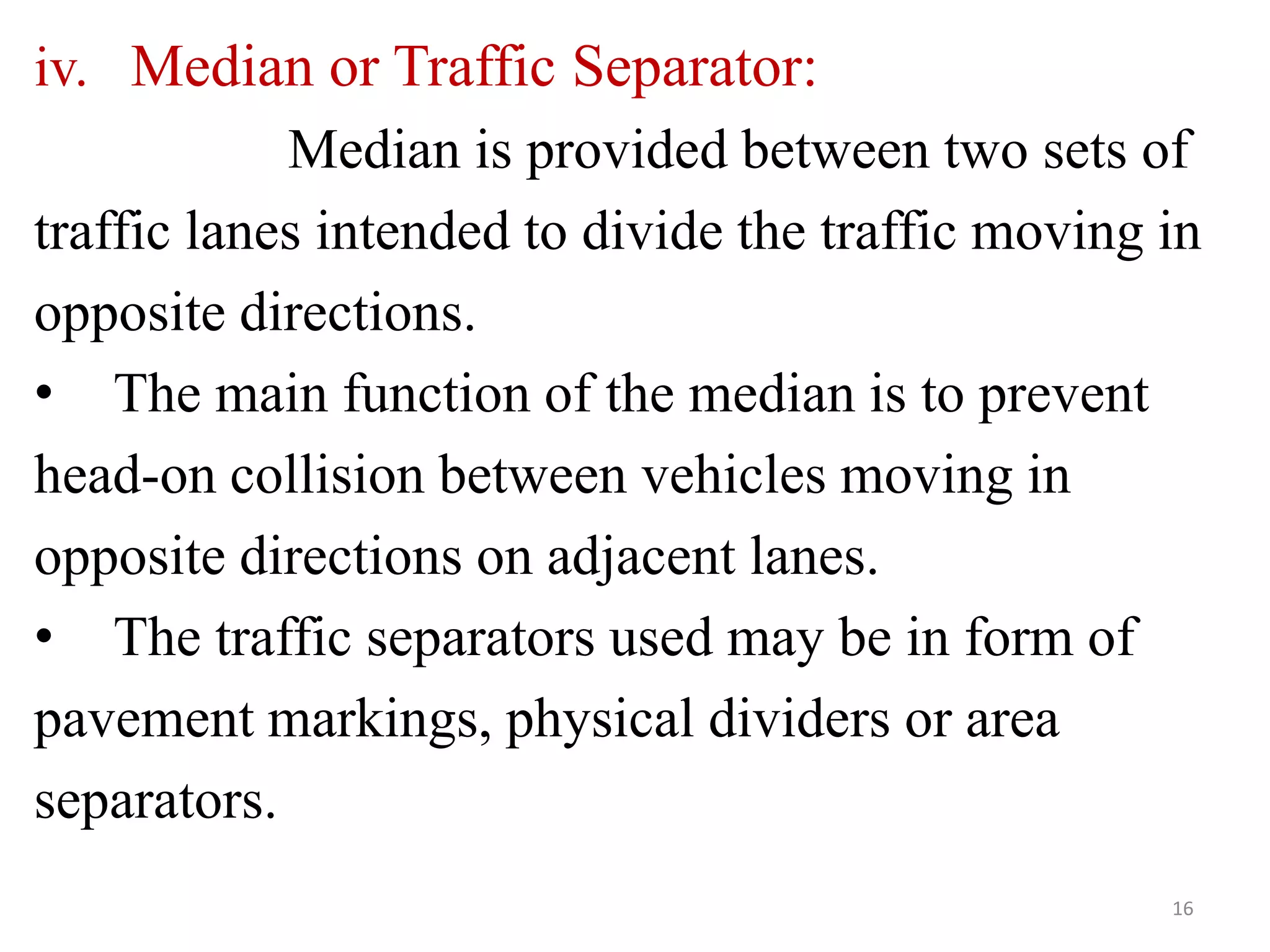
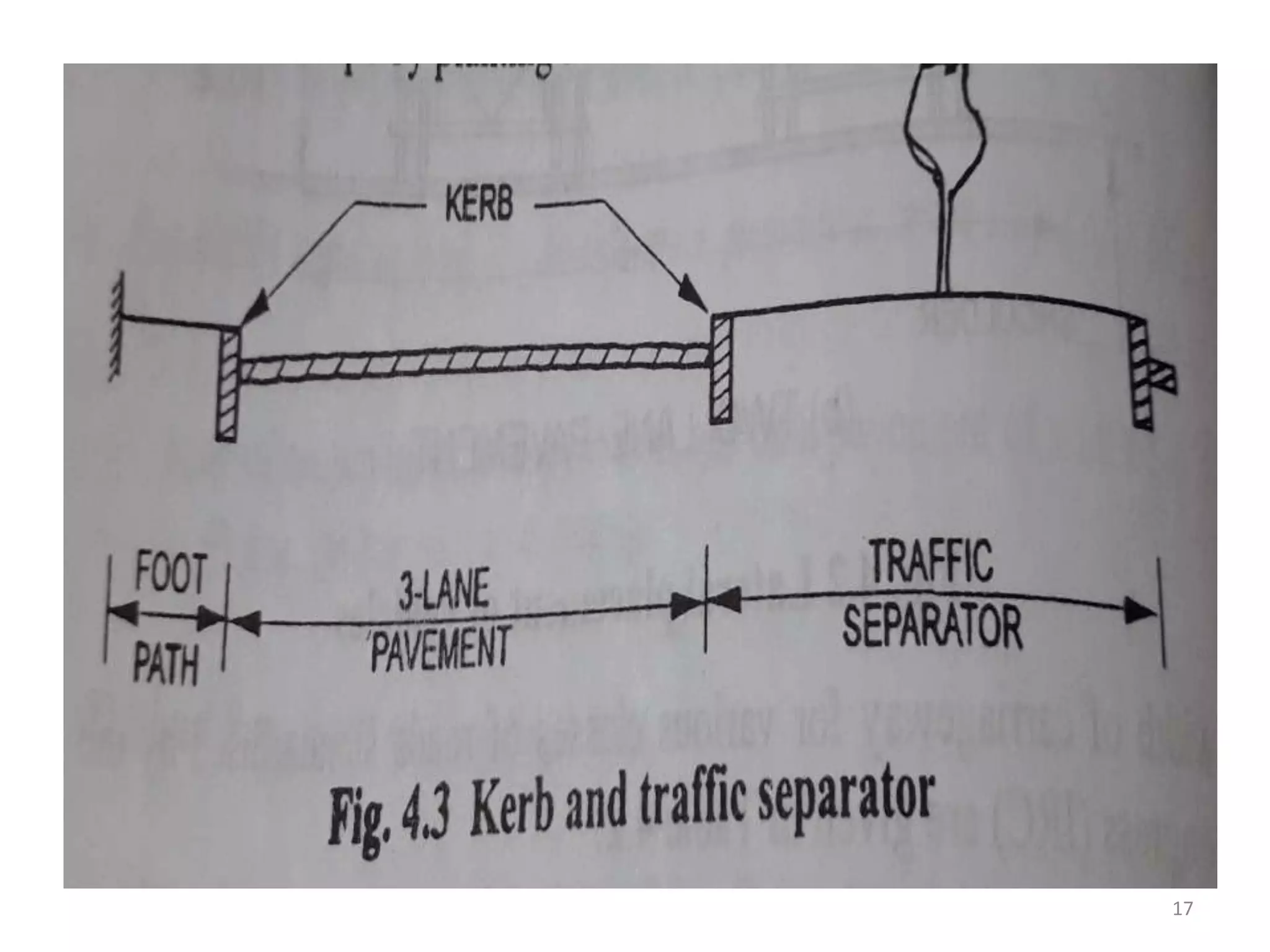
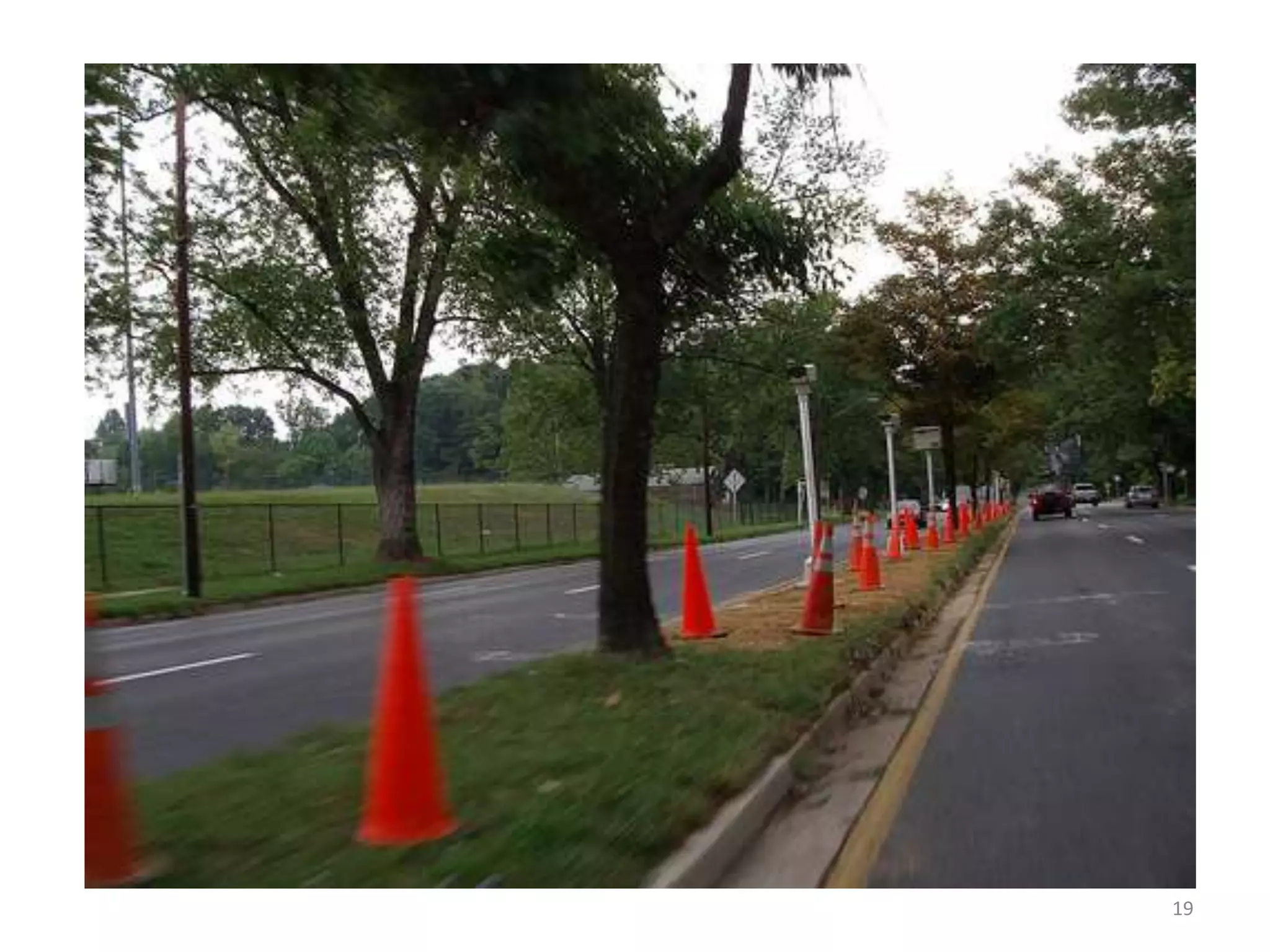
iv. Median or Traffic Separator:
Median is provided between two sets of
traffic lanes intended to divide the traffic moving in
opposite directions.
• The main function of the median is to prevent
head-on collision between vehicles moving in
opposite directions on adjacent lanes.
• The traffic separators used may be in form of
pavement markings, physical dividers or area
separators.
16
17
18
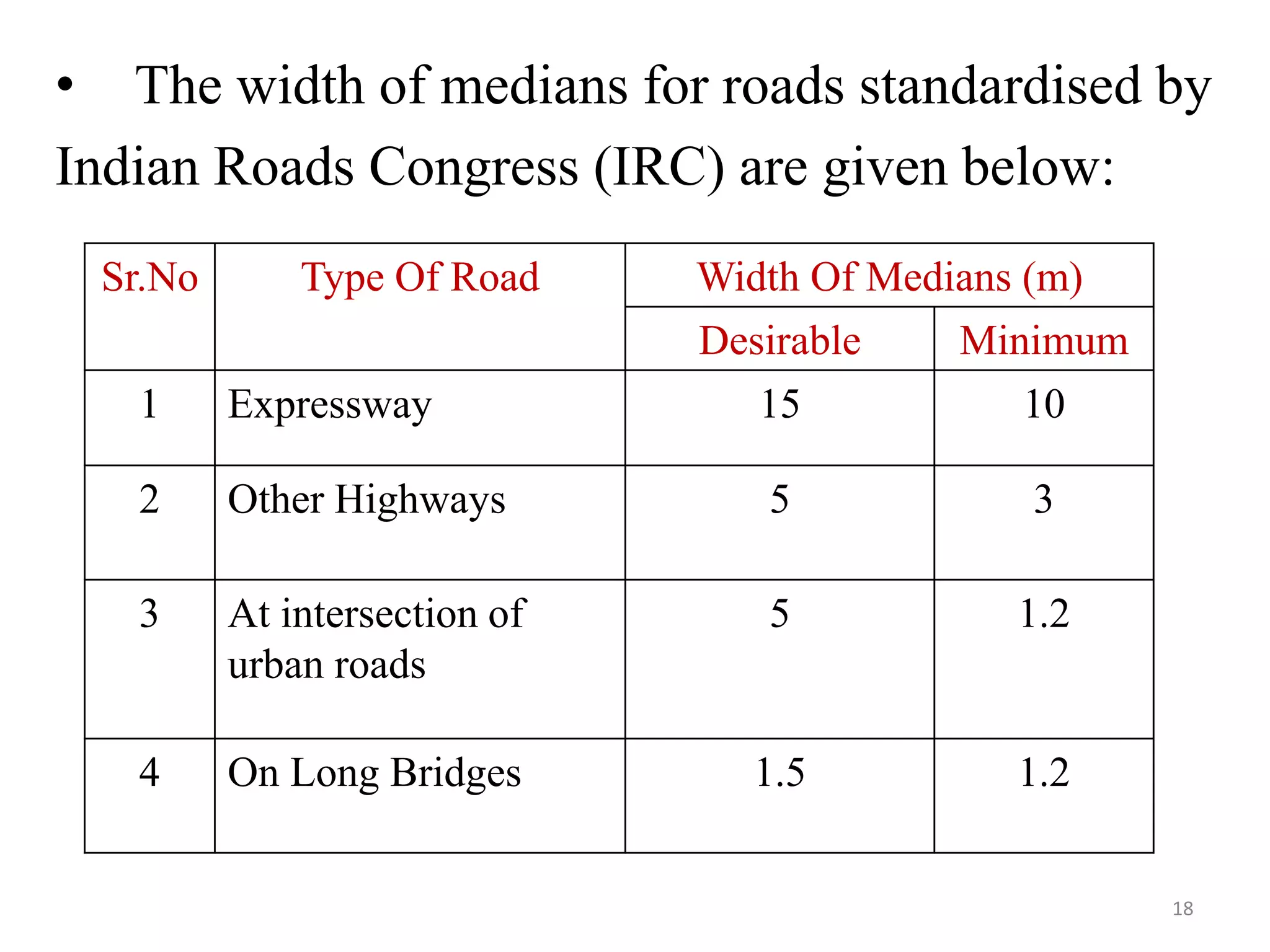
• The width of medians for roads standardised by
Indian Roads Congress (IRC) are given below:
Sr.No Type Of Road Width Of Medians (m)
Desirable Minimum
1 Expressway 15 10
2 Other Highways 5 3
3 At intersection of
urban roads
5 1.2
4 On Long Bridges 1.5 1.2
19
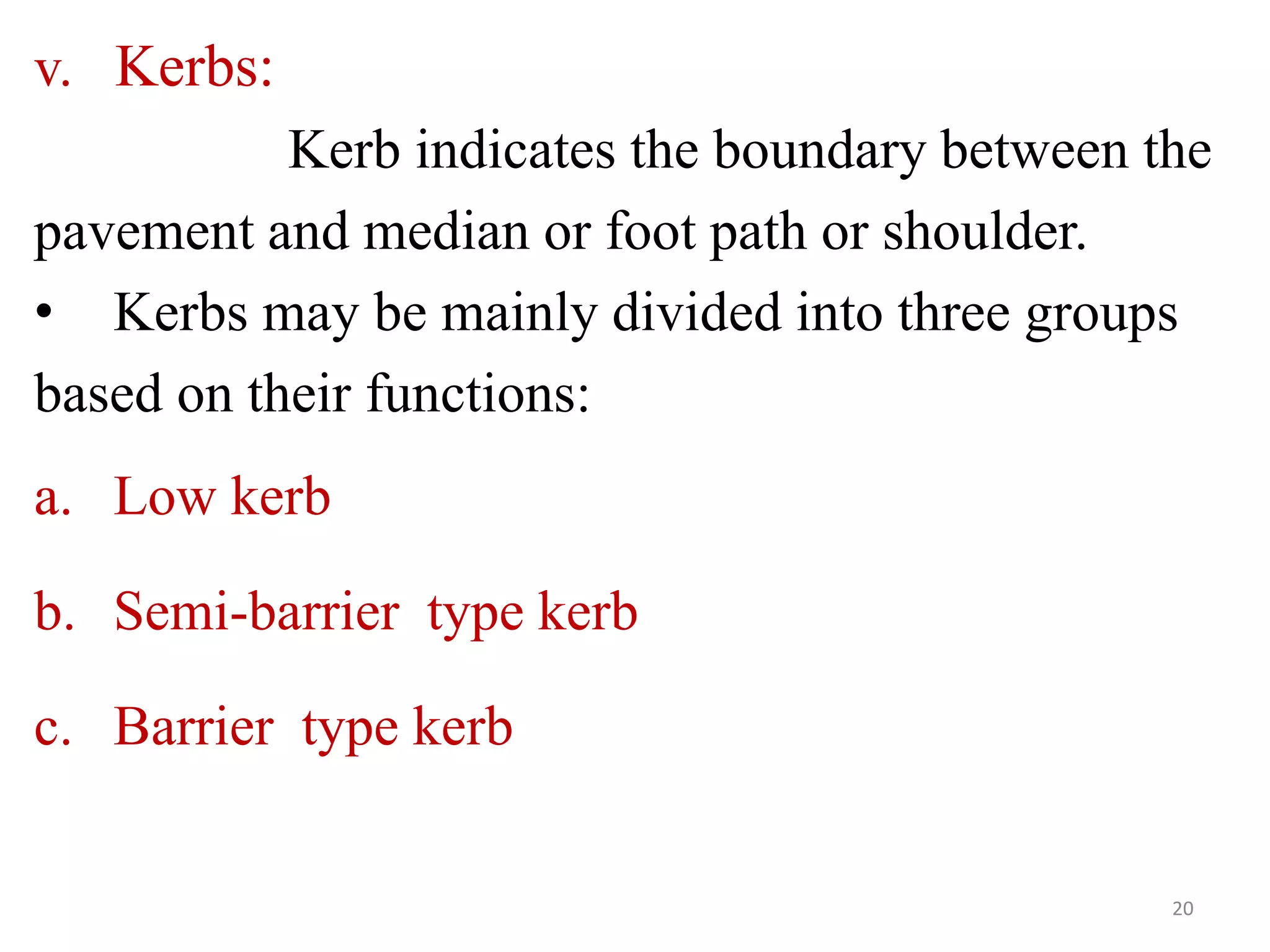
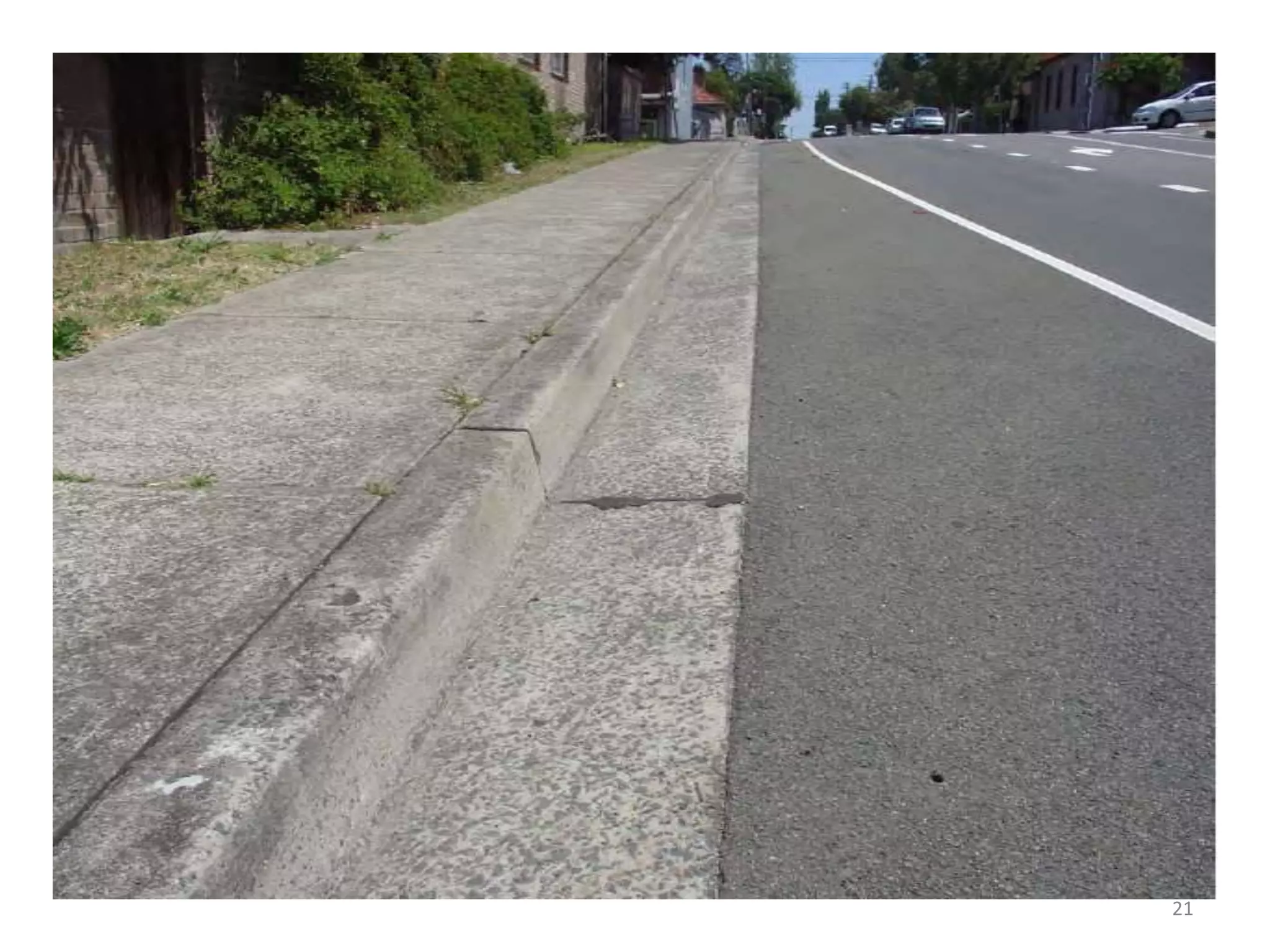
v. Kerbs:
Kerb indicates the boundary between the
pavement and median or foot path or shoulder.
• Kerbs may be mainly divided into three groups
based on their functions:
a. Low kerb
b. Semi-barrier type kerb
c. Barrier type kerb
20
21
vi. Road Margins:
The various elements included in the road
margins are:
a. Shoulder
b. Guard rail
c. Foot path
d. Drive way
e. Cycle track
f. Parking lane
g. Embankment slope.
22
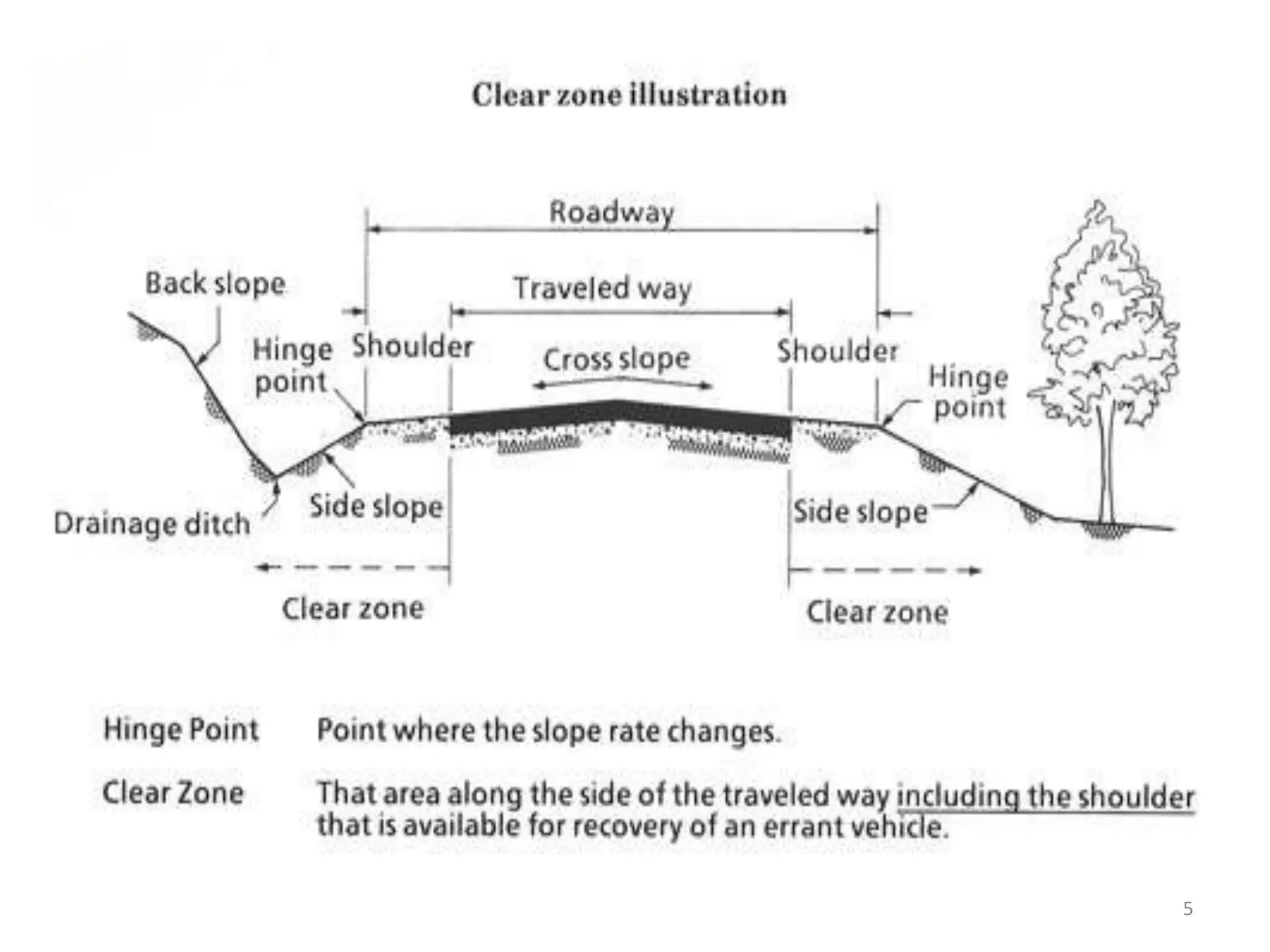
vii. Width of Formation or Roadway:
Width of formation or roadway is the
sum of widths of pavement or carriageway including
separators, if any and the shoulders.
• Width of roadway are standardised by the Indian
Roads Congress.
23
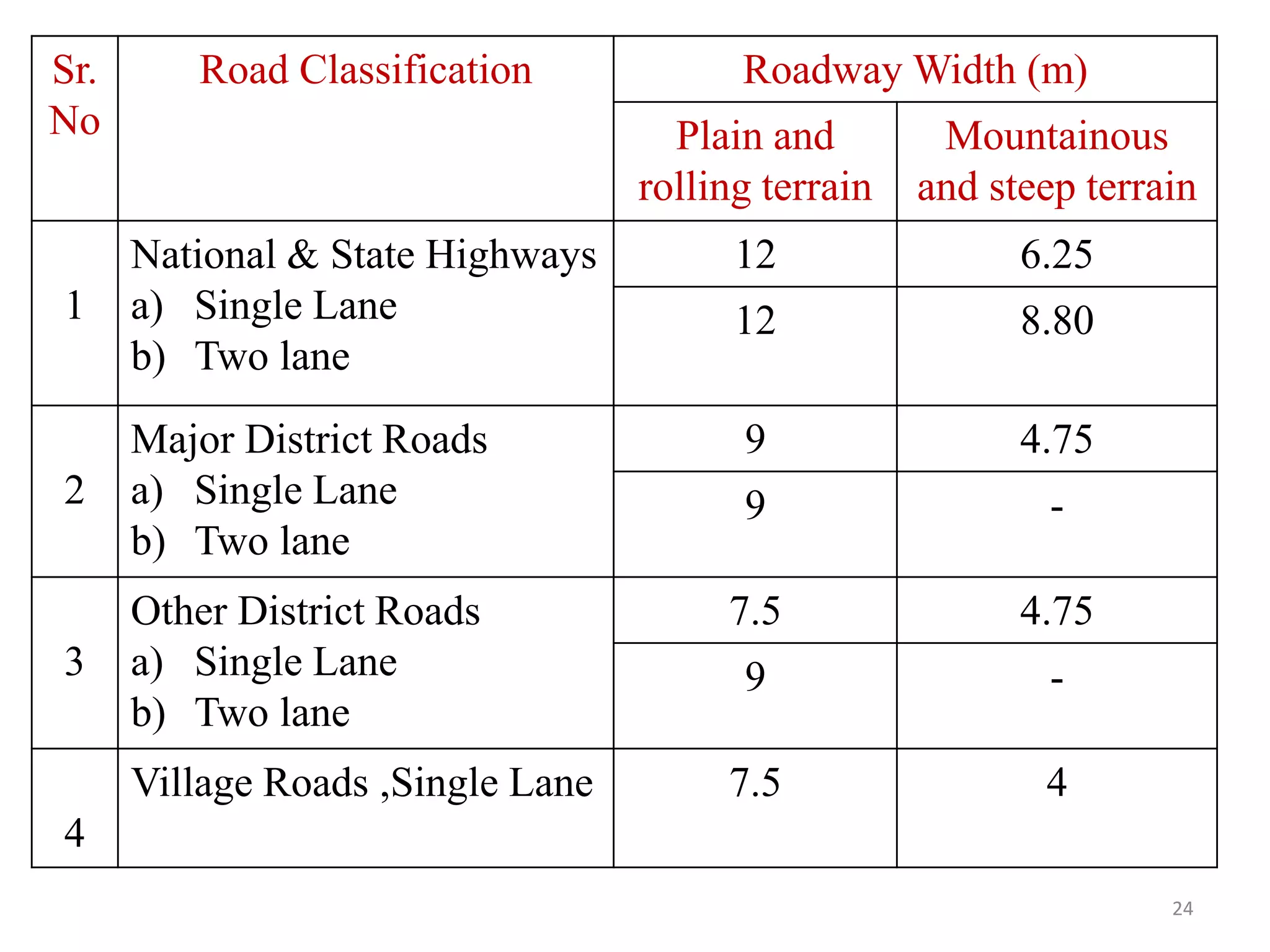
24
Sr.
No
Road Classification Roadway Width (m)
Plain and
rolling terrain
Mountainous
and steep terrain
1
National & State Highways
a) Single Lane
b) Two lane
12 6.25
12 8.80
2
Major District Roads
a) Single Lane
b) Two lane
9 4.75
9 -
3
Other District Roads
a) Single Lane
b) Two lane
7.5 4.75
9 -
4
Village Roads ,Single Lane 7.5 4
The minimum distance open to the vision of
the driver of a vehicle intending to overtake slow
vehicle ahead with safety against traffic of opposite
direction is known as minimum overtaking sight
distance or safe passing sight distance available.
25
Overtaking Sight Distance:
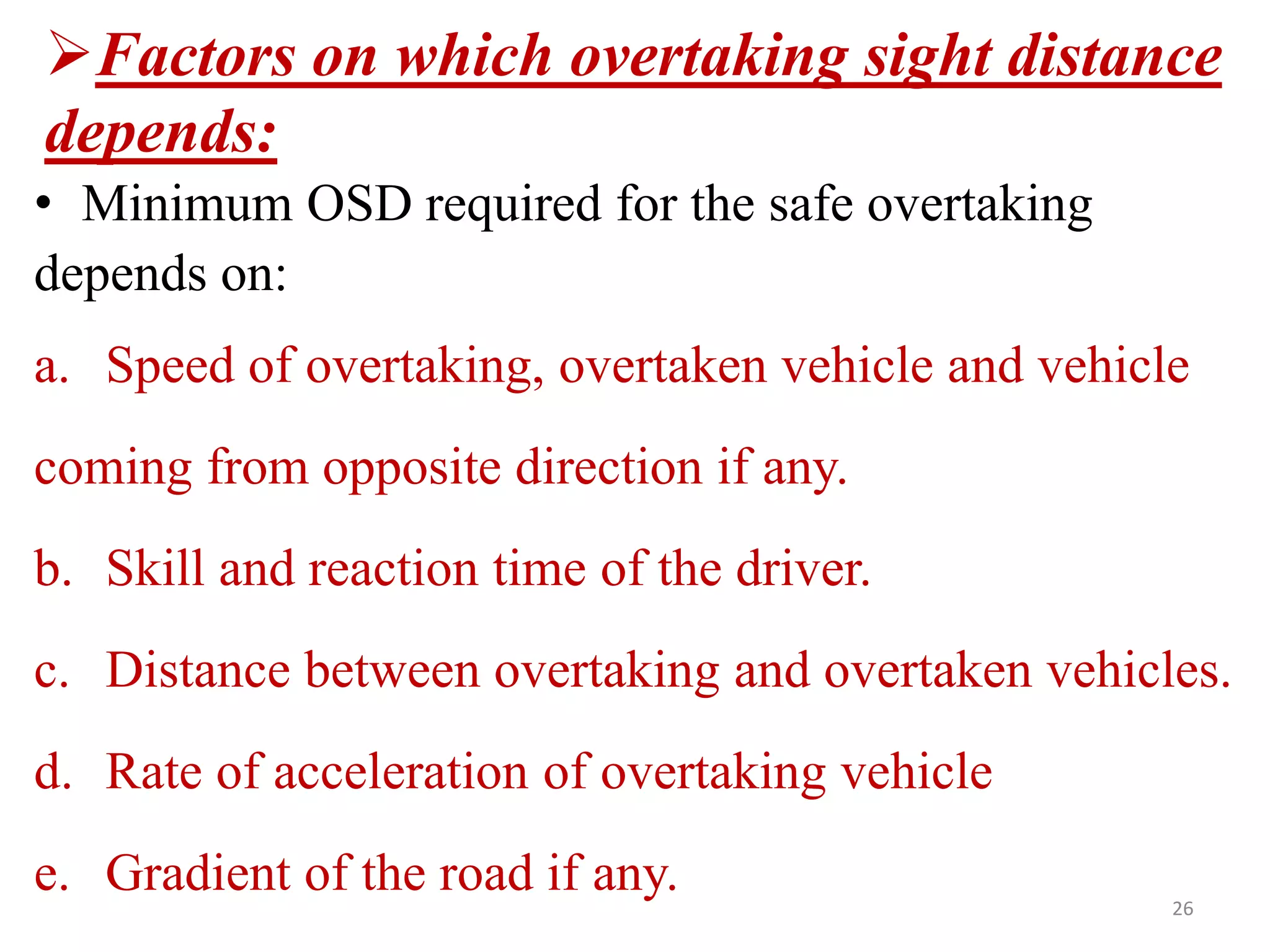
• Minimum OSD required for the safe overtaking
depends on:
a. Speed of overtaking, overtaken vehicle and vehicle
coming from opposite direction if any.
b. Skill and reaction time of the driver.
c. Distance between overtaking and overtaken vehicles.
d. Rate of acceleration of overtaking vehicle
e. Gradient of the road if any. 26
Factors on which overtaking sight distance
depends:
27
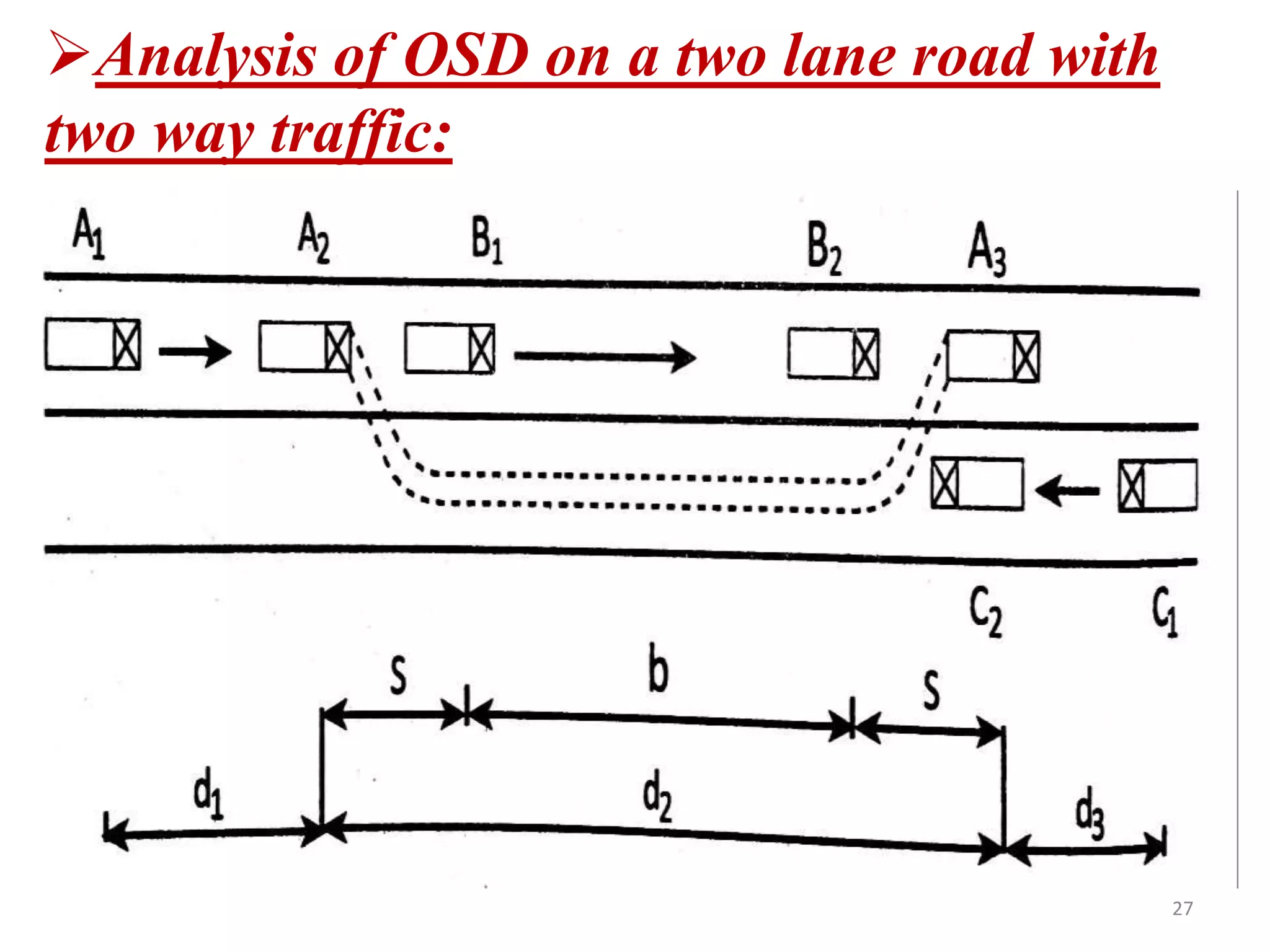
Analysis of OSD on a two lane road with
two way traffic:
28
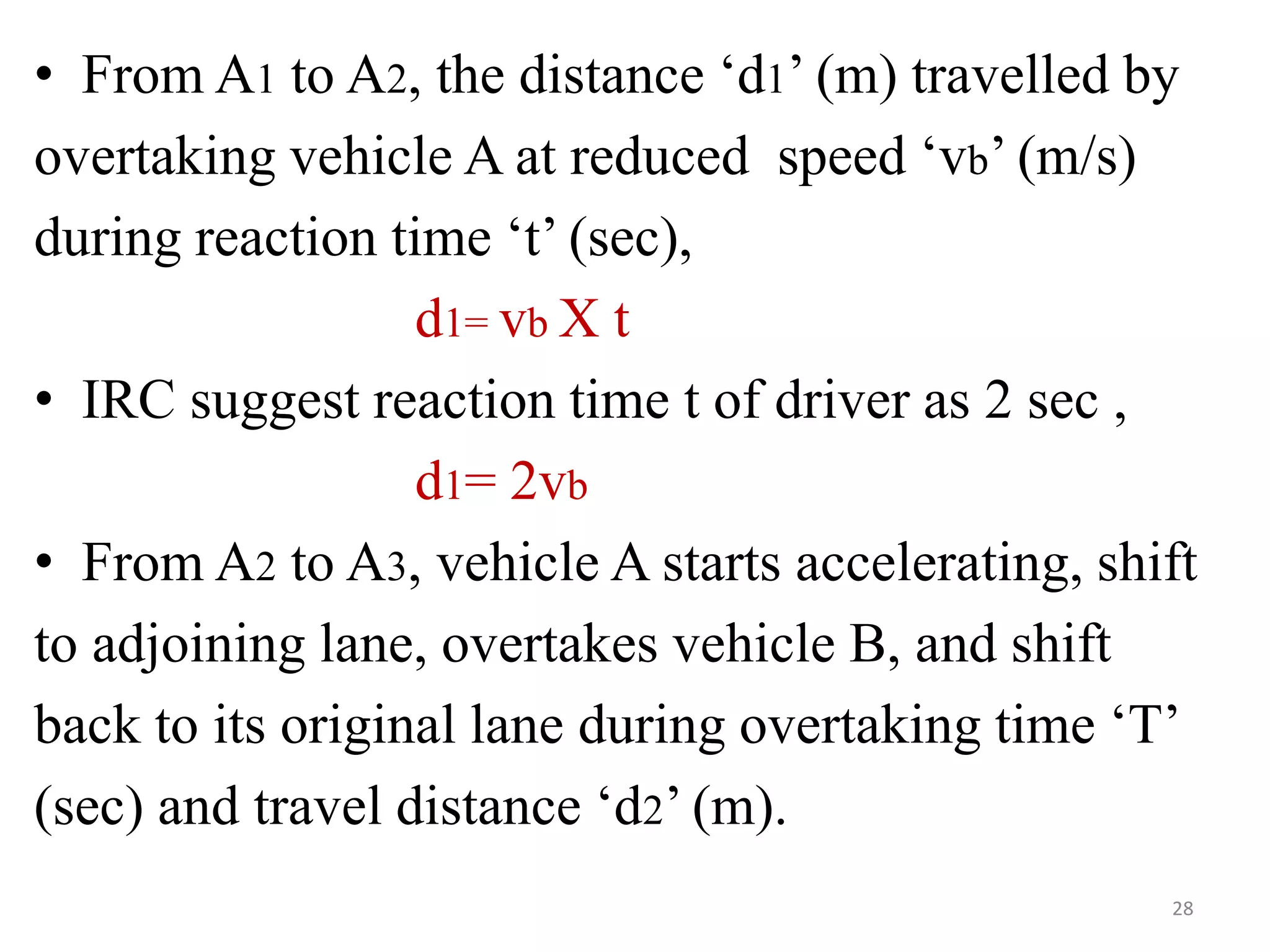
• From A1 to A2, the distance ‘d1’ (m) travelled by
overtaking vehicle A at reduced speed ‘vb’ (m/s)
during reaction time ‘t’ (sec),
d1= vb X t
• IRC suggest reaction time t of driver as 2 sec ,
d1= 2vb
• From A2 to A3, vehicle A starts accelerating, shift
to adjoining lane, overtakes vehicle B, and shift
back to its original lane during overtaking time ‘T’
(sec) and travel distance ‘d2’ (m).
29
• From A2 to A3, the distance ‘d2’ (m) is further
split into three parts viz;
d2= (s+b+s)
d2= (b+2s)
• The minimum spacing ‘s’ (m)between vehicles
depends on their speed and is given by empirical
formula,
s=(0.7vb + 6)
• The distance covered by the slow vehicle B
travelling at a speed of ‘vb’ (m/s) in time ‘T’ (sec) is,
b= vb X T
30
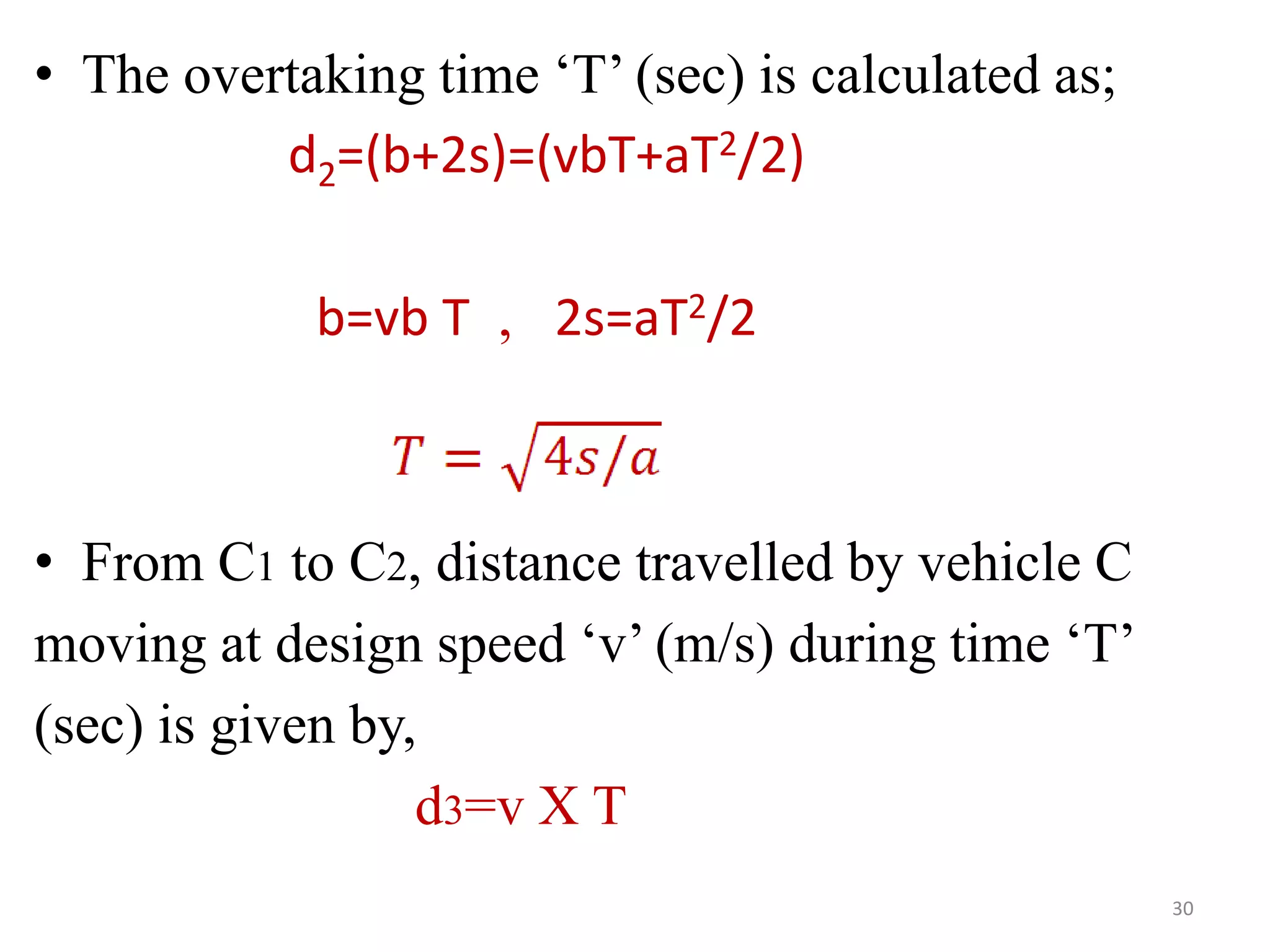
• The overtaking time ‘T’ (sec) is calculated as;
d2=(b+2s)=(vbT+aT2/2)
b=vb T , 2s=aT2/2
• From C1 to C2, distance travelled by vehicle C
moving at design speed ‘v’ (m/s) during time ‘T’
(sec) is given by,
d3=v X T
31
• Thus overtaking sight distance (OSD) is,
OSD=(d1+d2+d3)
OSD= (vb X t) + (vb X T +2s) +(v X T)
• If speed is in kmph,
OSD= (0.28Vb X t)+(0.28Vb X T+2s)+(0.28V X T)
• In case speed of overtaken vehicle is not given it
is assumed 16 kmph less than design speed of the
highway.
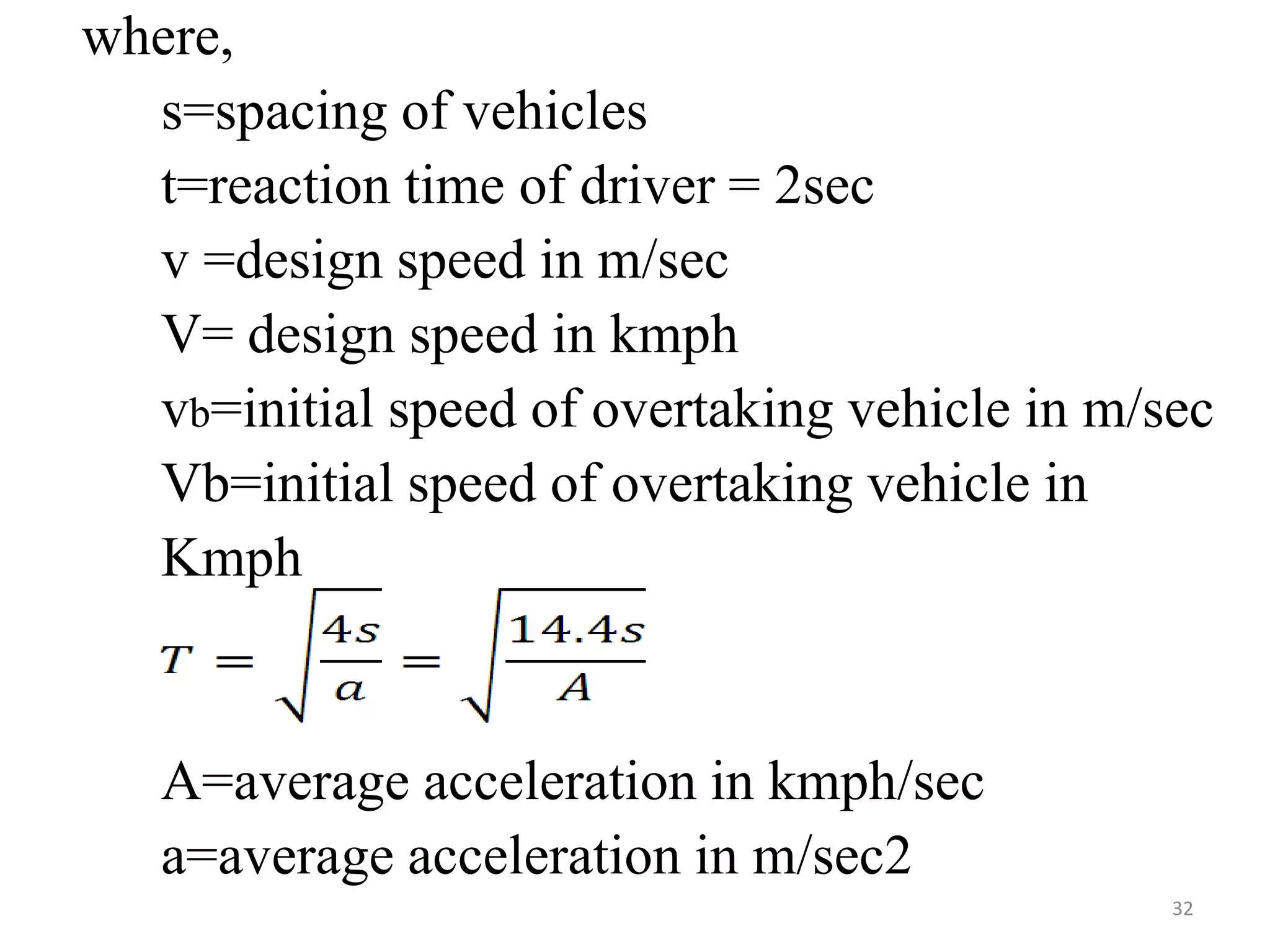
where,
s=spacing of vehicles
t=reaction time of driver = 2sec
v =design speed in m/sec
V= design speed in kmph
vb=initial speed of overtaking vehicle in m/sec
Vb=initial speed of overtaking vehicle in
Kmph
A=average acceleration in kmph/sec
a=average acceleration in m/sec2
32
33
Overtaking Zones:
• Overtaking opportunity for vehicles moving at
design speed should be given at frequent intervals
as possible.
• These zones which are meant for overtaking are
called overtaking zones.
• The minimum length of overtaking zone should
be three times safe overtaking sight distance
i.e.3OSD.
34
35
Design of Horizontal Alignment:
Various design elements to be considered
in the horizontal alignment are :
a. Design speed
b. Horizontal curve
c. Super elevation
d. Type and length of transition curves
e. Widening of pavement on curves
f. Set-back distance
36
a. Design speed
• The design speed is the main factor on which
geometric design elements depends.
• The design speed of roads depends upon
i) Class of the road
ii) Terrain
37
Classification of Terrain
Terrain Classification Cross Slope Of Country
in %
Plain 0-10
Rolling 10-25
Mountainous 25-60
Steep Greater than 60
38
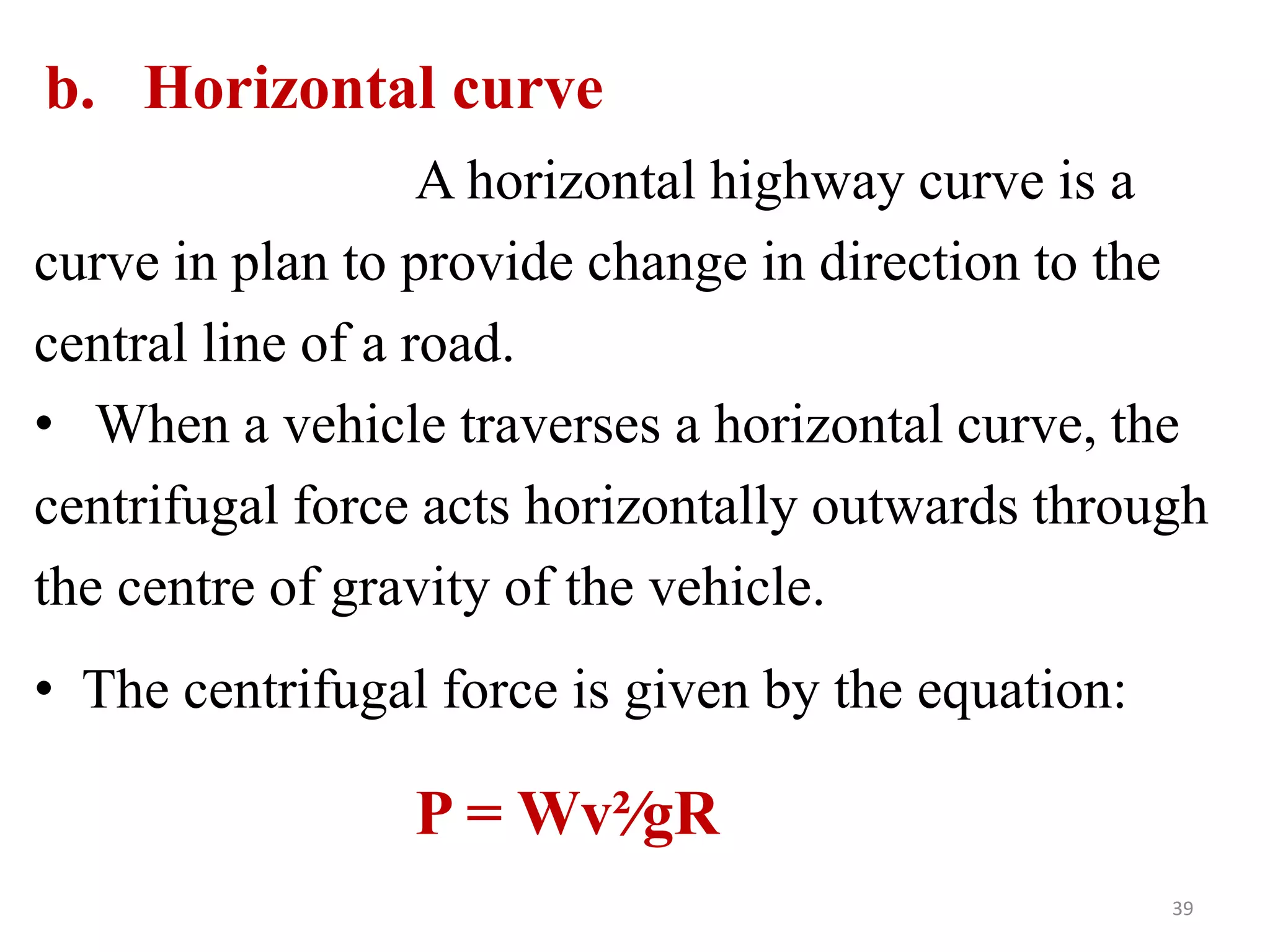
Design Speed On highways
39
b. Horizontal curve
A horizontal highway curve is a
curve in plan to provide change in direction to the
central line of a road.
• When a vehicle traverses a horizontal curve, the
centrifugal force acts horizontally outwards through
the centre of gravity of the vehicle.
• The centrifugal force is given by the equation:
P = Wv²∕gR
40
where,
P=centrifugal force in kg
W=Weight of the vehicle in kg
R=radius of the circular curve in m
v=speed of the vehicle in m/s
g=acceleration due to gravity=9.8 m/s2
• P/W is known as the centrifugal ratio or the
impact factor. The centrifugal ratio is thus equal to
v²∕gR.
• The centrifugal force acting on a vehicle
negotiating a horizontal curve has two effects:
i. Tendency to overturn the vehicle outwards
about the outer wheels
ii. Tendency to skid the vehicle laterally, outwards
41
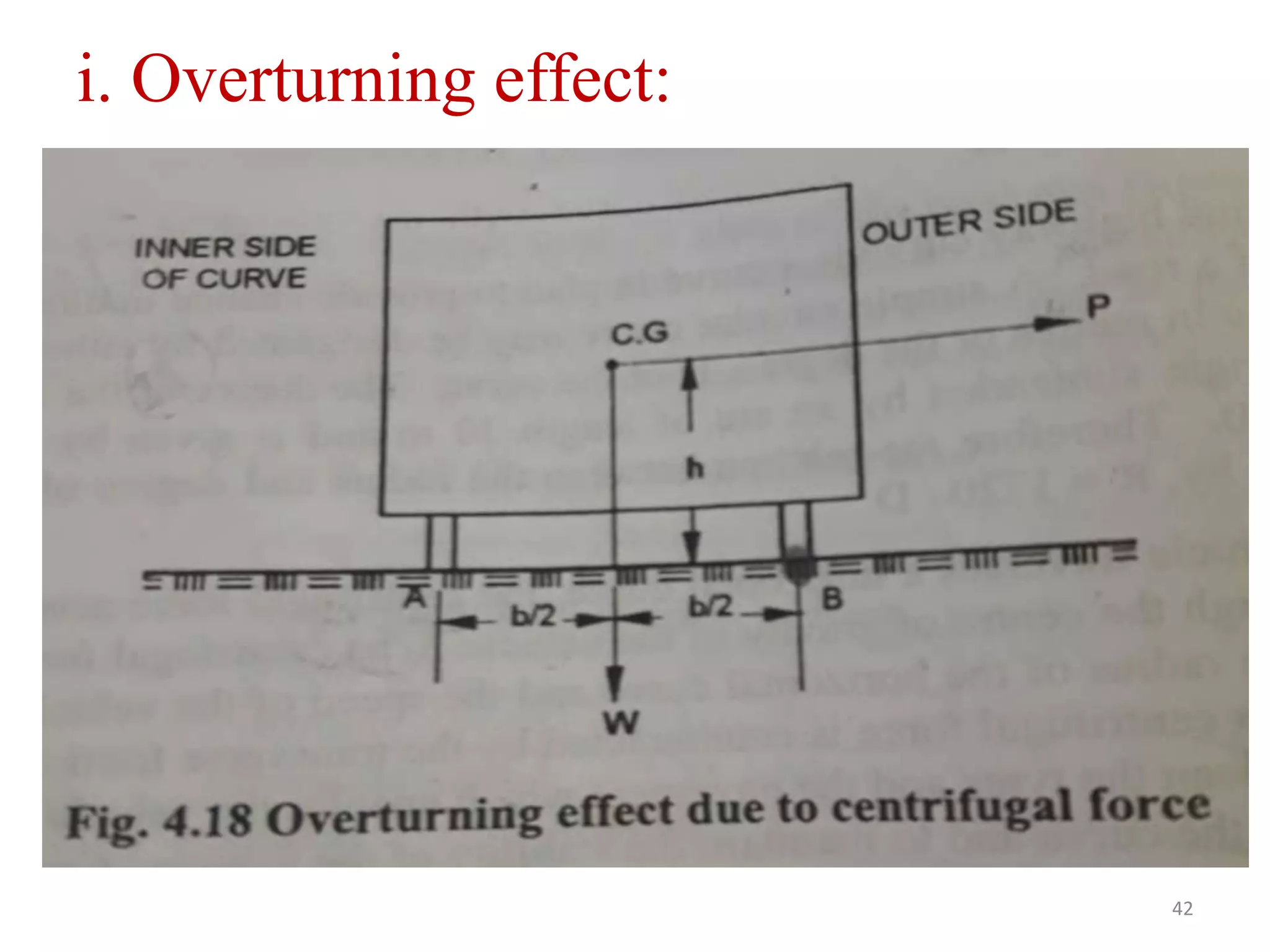
i. Overturning effect:
42
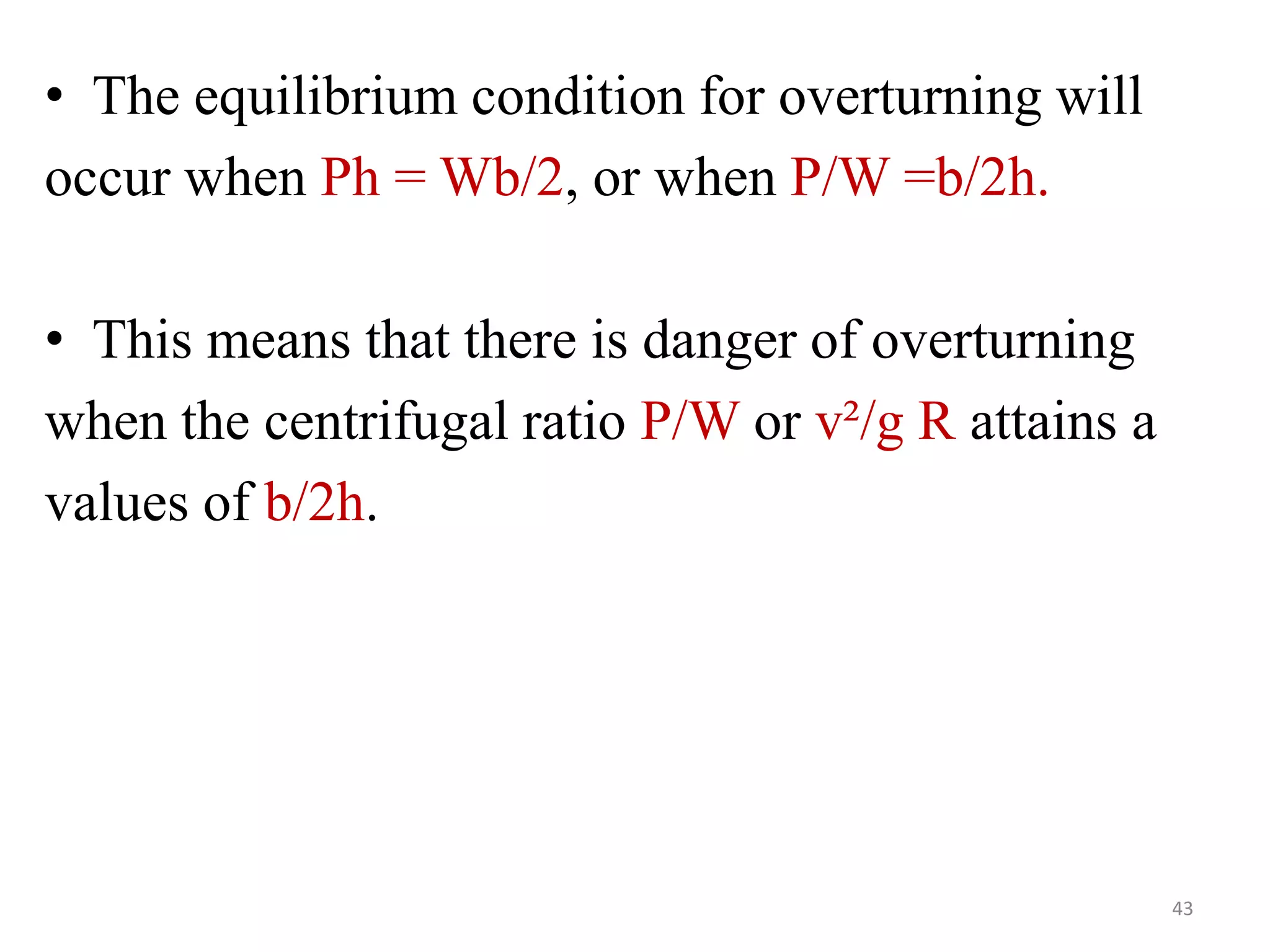
• The equilibrium condition for overturning will
occur when Ph = Wb/2, or when P/W =b/2h.
• This means that there is danger of overturning
when the centrifugal ratio P/W or v²/g R attains a
values of b/2h.
43
ii. Transverse skidding effect:
44
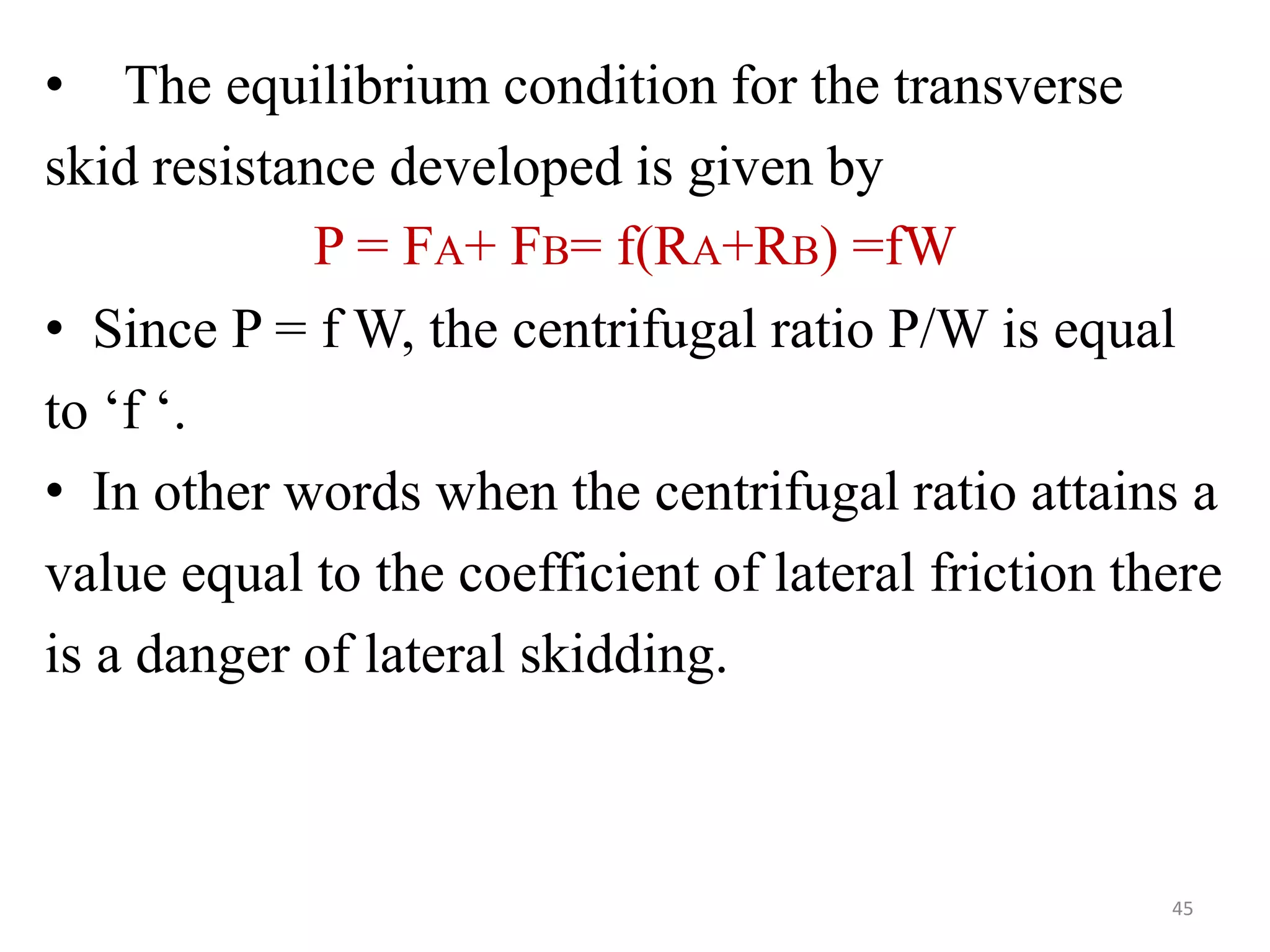
• The equilibrium condition for the transverse
skid resistance developed is given by
P = FA+ FB= f(RA+RB) =fW
• Since P = f W, the centrifugal ratio P/W is equal
to ‘f ‘.
• In other words when the centrifugal ratio attains a
value equal to the coefficient of lateral friction there
is a danger of lateral skidding.
45
• ‘f’ is less than ‘b/2h’,the vehicle would skid and
not overturn.
• ‘b/2h’ is lower than ‘f’, the vehicle would
overturn on the outer side before skidding.
• Thus the relative danger of lateral skidding and
overturning depends on whether f is lower or
higher than
46
47
c. Super elevation (e):
• In order to counteract the effect of centrifugal
force and to reduce the tendency of the vehicle to
overturn or skid, the outer edge of the pavement is
raised with respect to the inner edge, thus providing
a transverse slope throughout the length of the
horizontal curve.
• This transverse inclination to the pavement
surface is known as Super elevation or cant or
banking.
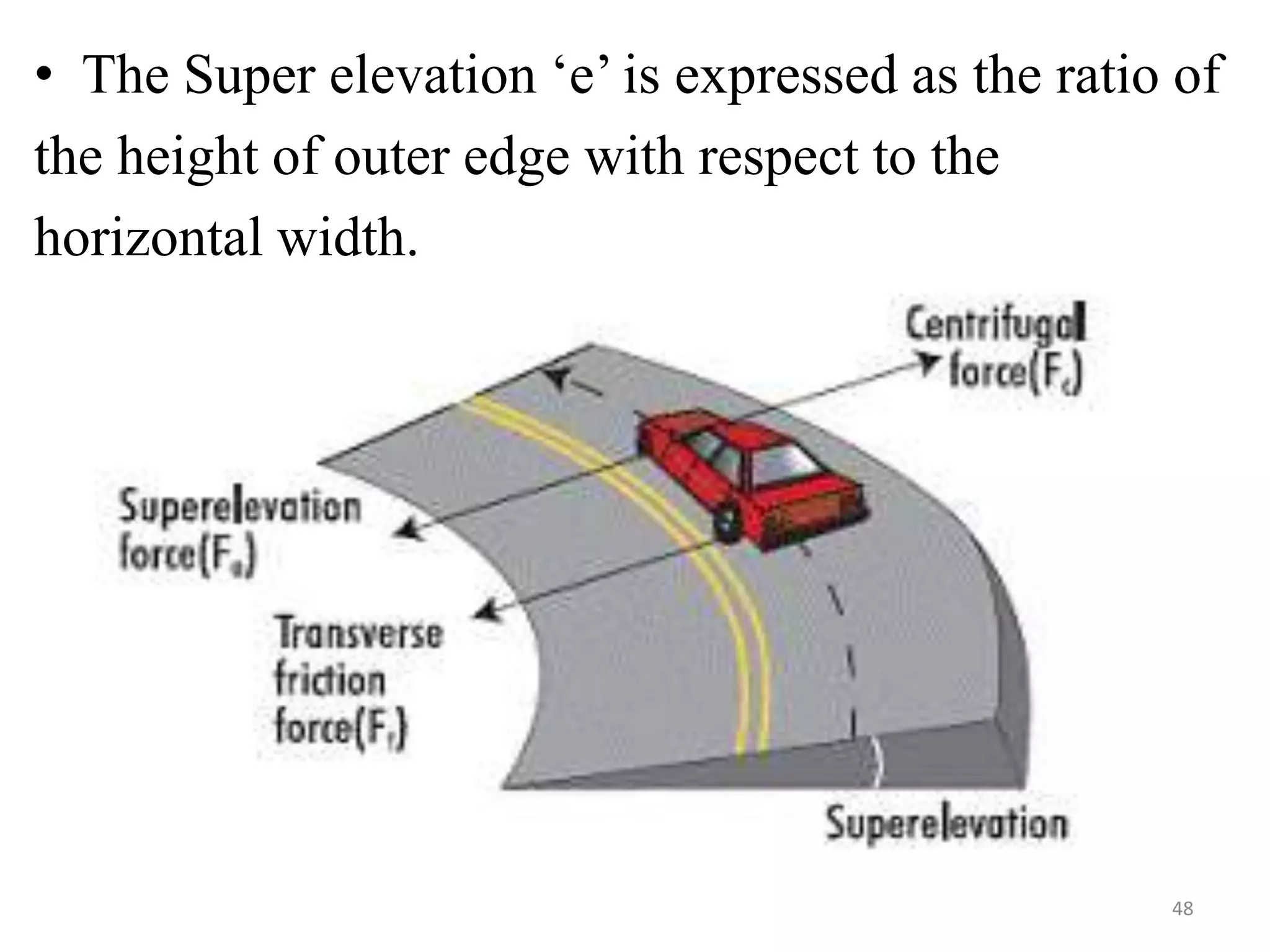
48
• The Super elevation ‘e’ is expressed as the ratio of
the height of outer edge with respect to the
horizontal width.
49
50
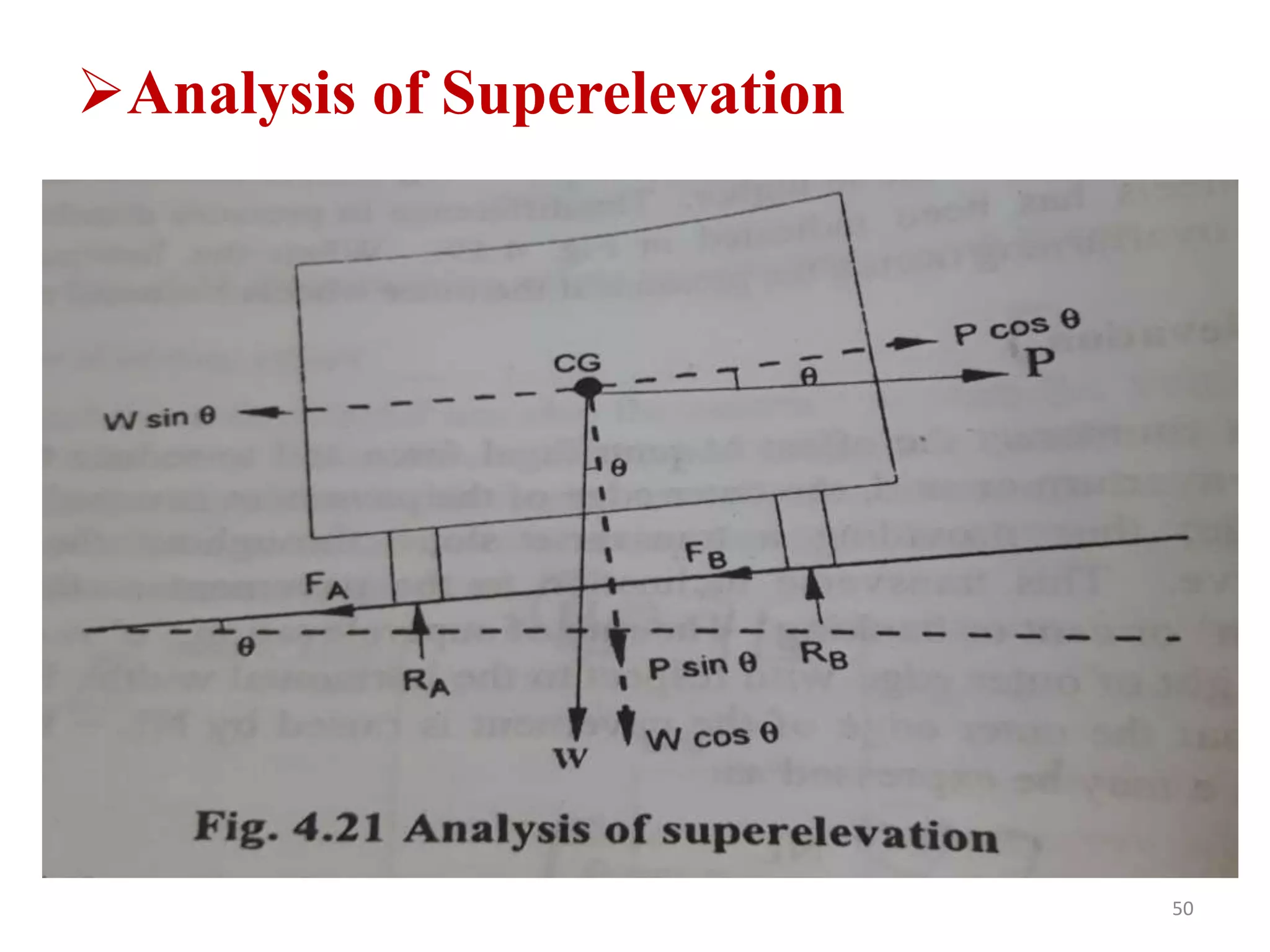
Analysis of Superelevation
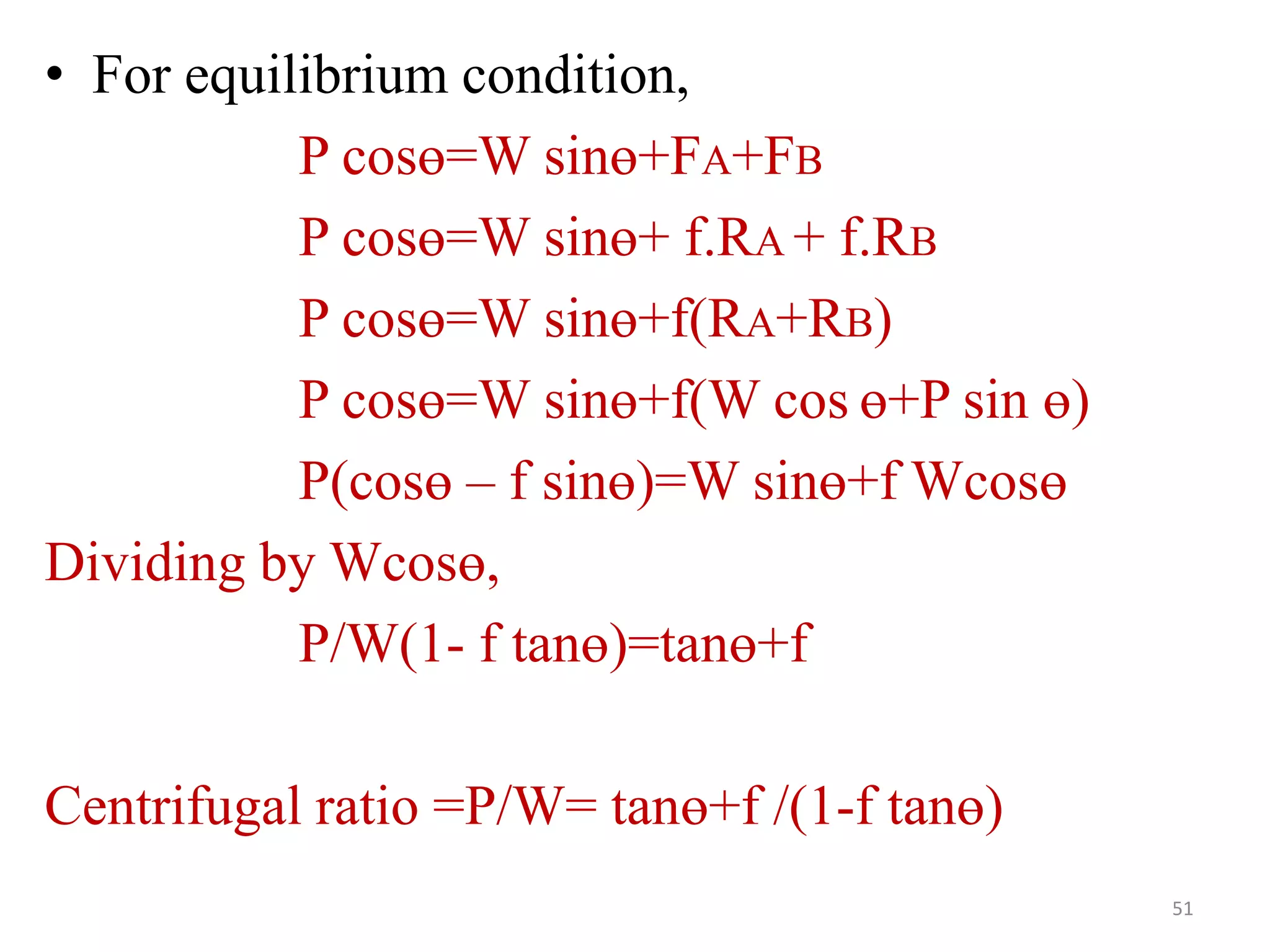
• For equilibrium condition,
P cosө=W sinө+FA+FB
P cosө=W sinө+ f.RA + f.RB
P cosө=W sinө+f(RA+RB)
P cosө=W sinө+f(W cos ө+P sin ө)
P(cosө – f sinө)=W sinө+f Wcosө
Dividing by Wcosө,
P/W(1- f tanө)=tanө+f
Centrifugal ratio =P/W= tanө+f /(1-f tanө)
51
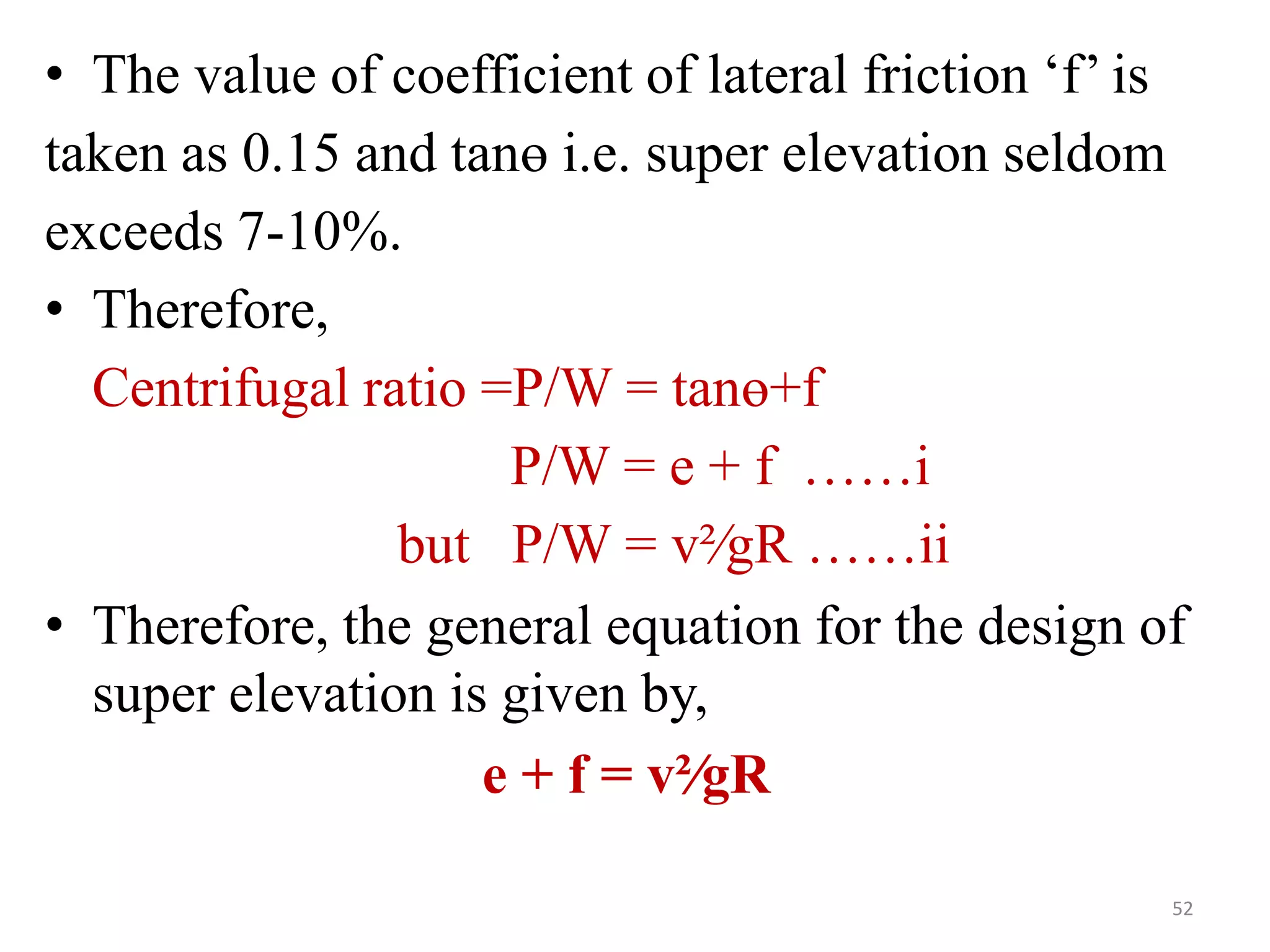
• The value of coefficient of lateral friction ‘f’ is
taken as 0.15 and tanө i.e. super elevation seldom
exceeds 7-10%.
• Therefore,
Centrifugal ratio =P/W = tanө+f
P/W = e + f ……i
but P/W = v²∕gR ……ii
• Therefore, the general equation for the design of
super elevation is given by,
e + f = v²∕gR
52
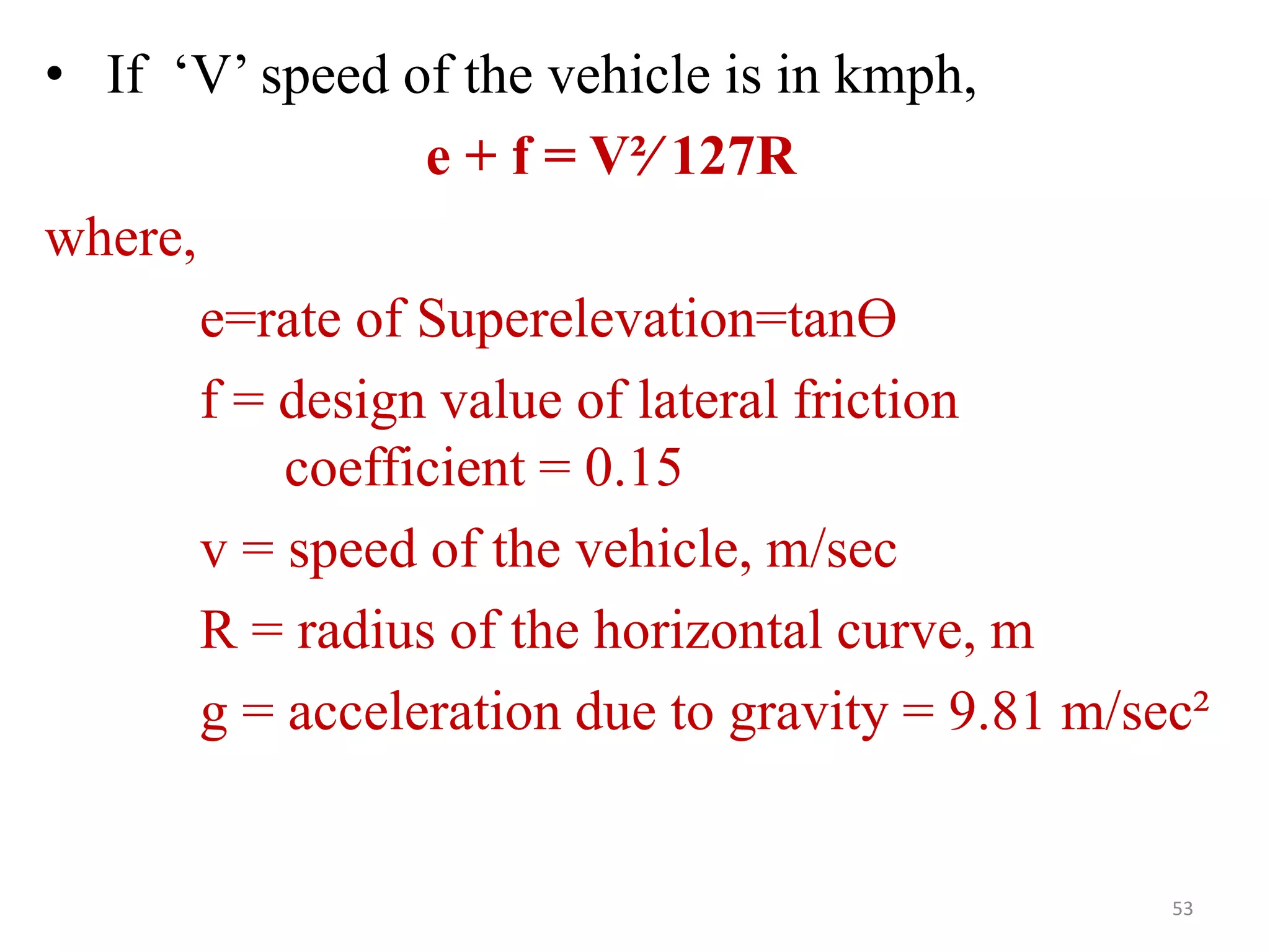
• If ‘V’ speed of the vehicle is in kmph,
e + f = V²∕ 127R
where,
e=rate of Superelevation=tanӨ
f = design value of lateral friction
coefficient = 0.15
v = speed of the vehicle, m/sec
R = radius of the horizontal curve, m
g = acceleration due to gravity = 9.81 m/sec²
53
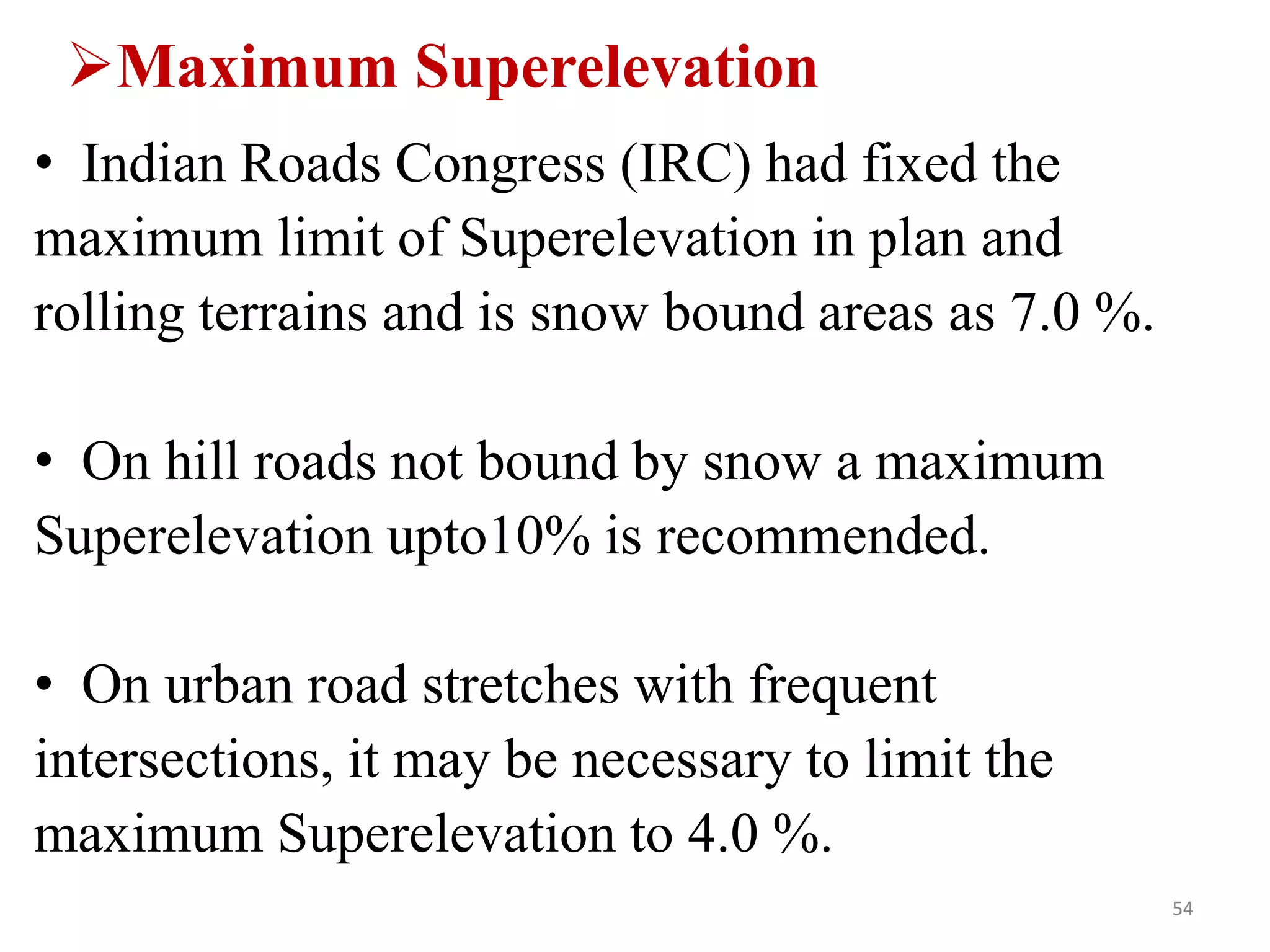
Maximum Superelevation
• Indian Roads Congress (IRC) had fixed the
maximum limit of Superelevation in plan and
rolling terrains and is snow bound areas as 7.0 %.
• On hill roads not bound by snow a maximum
Superelevation upto10% is recommended.
• On urban road stretches with frequent
intersections, it may be necessary to limit the
maximum Superelevation to 4.0 %.
54
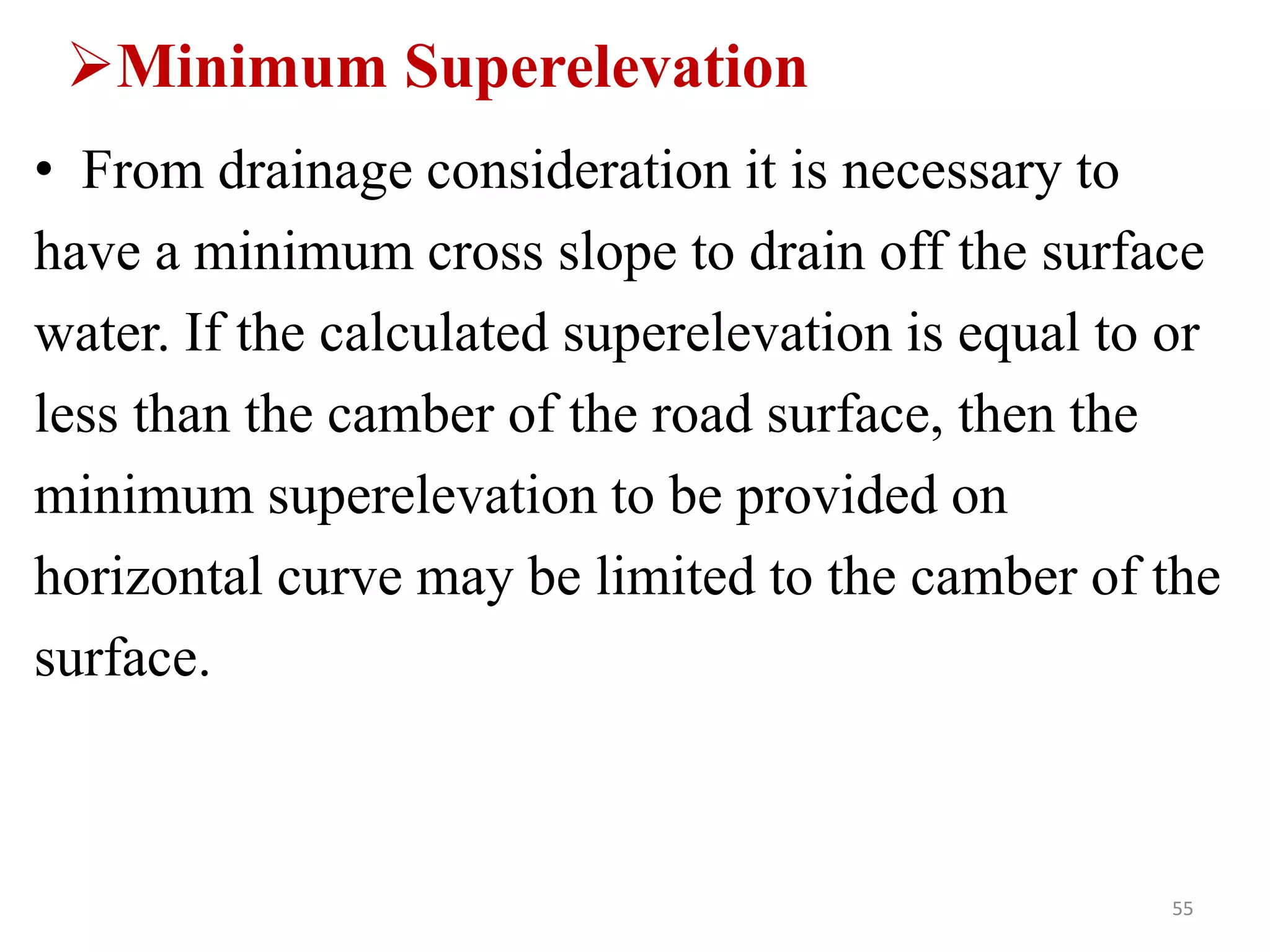
Minimum Superelevation
• From drainage consideration it is necessary to
have a minimum cross slope to drain off the surface
water. If the calculated superelevation is equal to or
less than the camber of the road surface, then the
minimum superelevation to be provided on
horizontal curve may be limited to the camber of the
surface.
55
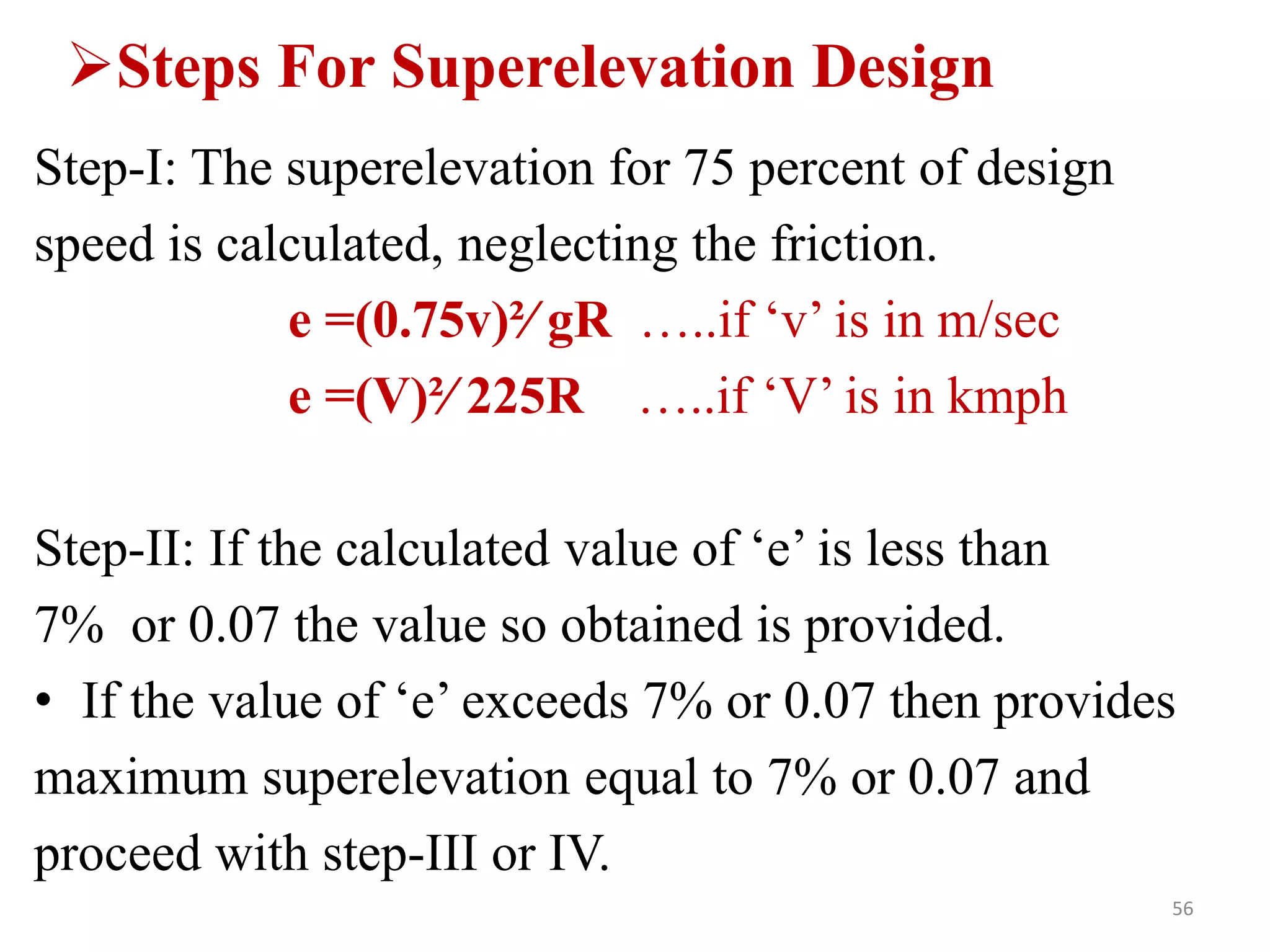
Steps For Superelevation Design
Step-I: The superelevation for 75 percent of design
speed is calculated, neglecting the friction.
e =(0.75v)²∕ gR …..if ‘v’ is in m/sec
e =(V)²∕ 225R …..if ‘V’ is in kmph
Step-II: If the calculated value of ‘e’ is less than
7% or 0.07 the value so obtained is provided.
• If the value of ‘e’ exceeds 7% or 0.07 then provides
maximum superelevation equal to 7% or 0.07 and
proceed with step-III or IV.
56
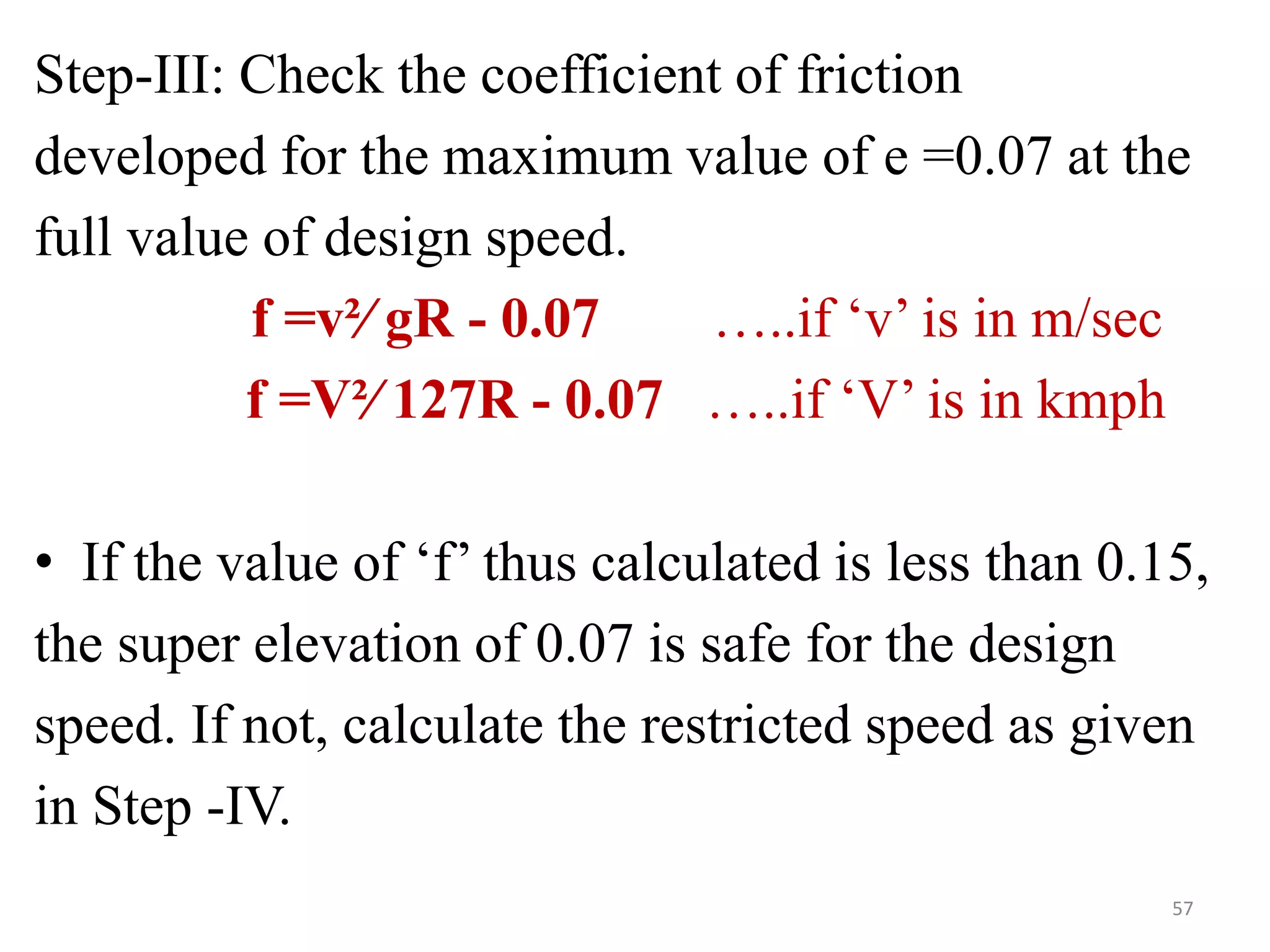
Step-III: Check the coefficient of friction
developed for the maximum value of e =0.07 at the
full value of design speed.
f =v²∕ gR - 0.07 …..if ‘v’ is in m/sec
f =V²∕ 127R - 0.07 …..if ‘V’ is in kmph
• If the value of ‘f’ thus calculated is less than 0.15,
the super elevation of 0.07 is safe for the design
speed. If not, calculate the restricted speed as given
in Step -IV.
57
Step-IV: The allowable speed at the curve is
calculated by considering the design coefficient of
lateral friction and the maximum superelevation.
e + f =0.07+0.15=va²∕ gR=Va²∕ 127R
e + f =0.22=va²∕ gR = Va²∕ 127R
• Safe allowable speed (va or Va) is calculated as:
58
• If the allowed speed, as calculated above is
higher than the design speed, then the design is
adequate and provides a superelevation of ‘e’ equal
to 0.07.
• If the allowable speed is less than the design
speed, the speed is limited to the allowed speed
calculated above and appropriate warning sign and
speed limit regulation sign are installed to restrict
and regulate the speed.
59
60
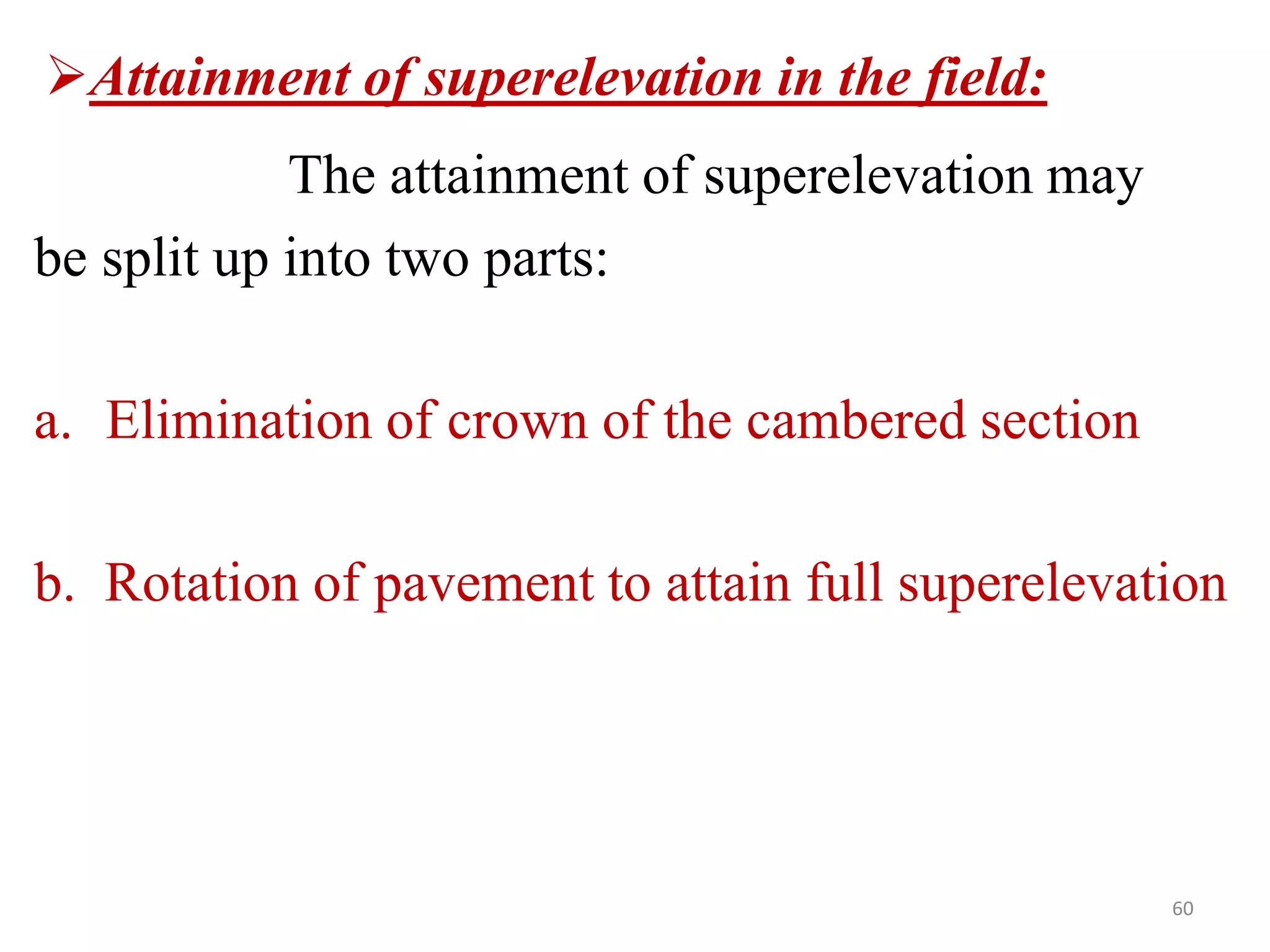
Attainment of superelevation in the field:
The attainment of superelevation may
be split up into two parts:
a. Elimination of crown of the cambered section
b. Rotation of pavement to attain full superelevation
61
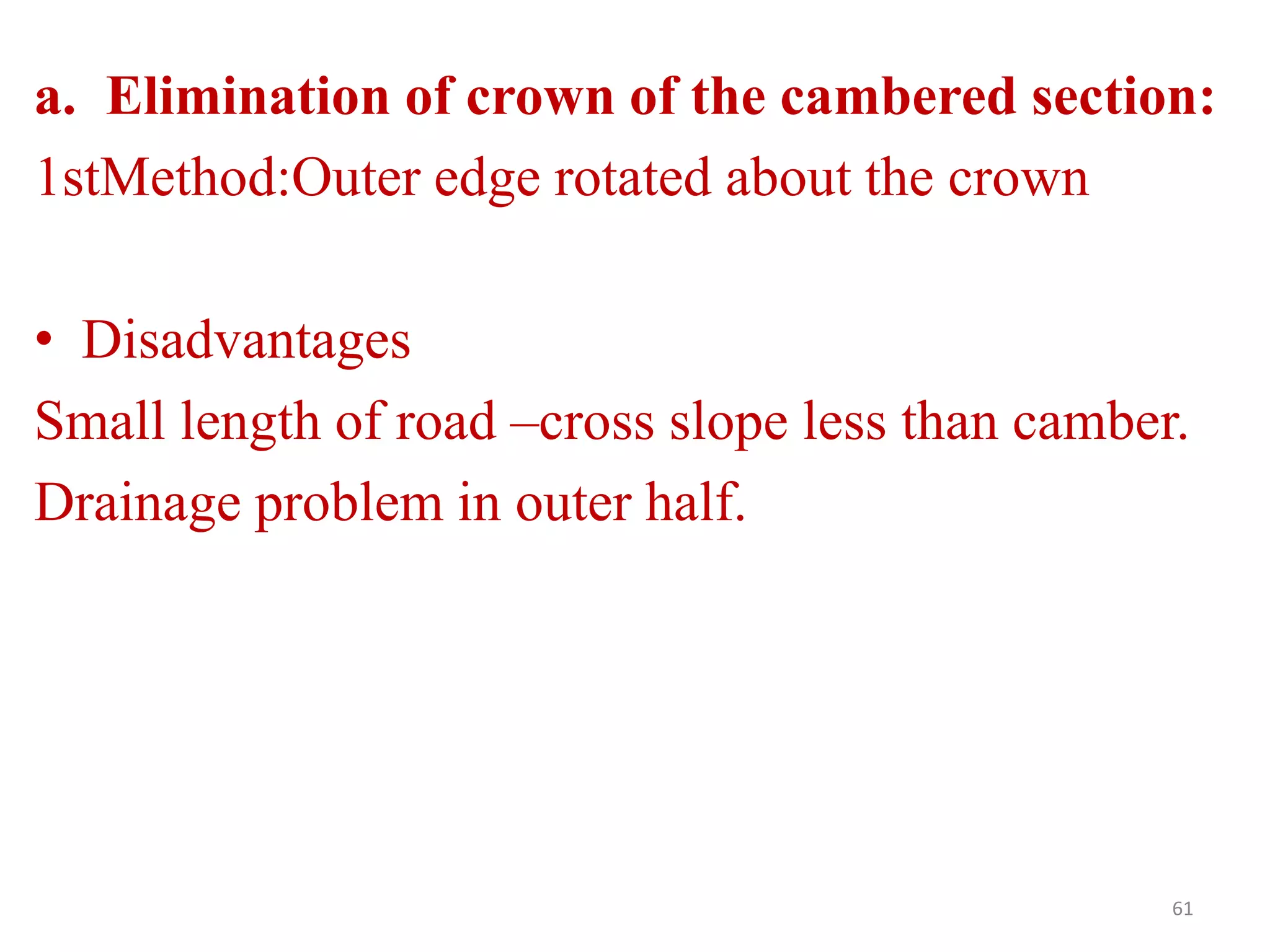
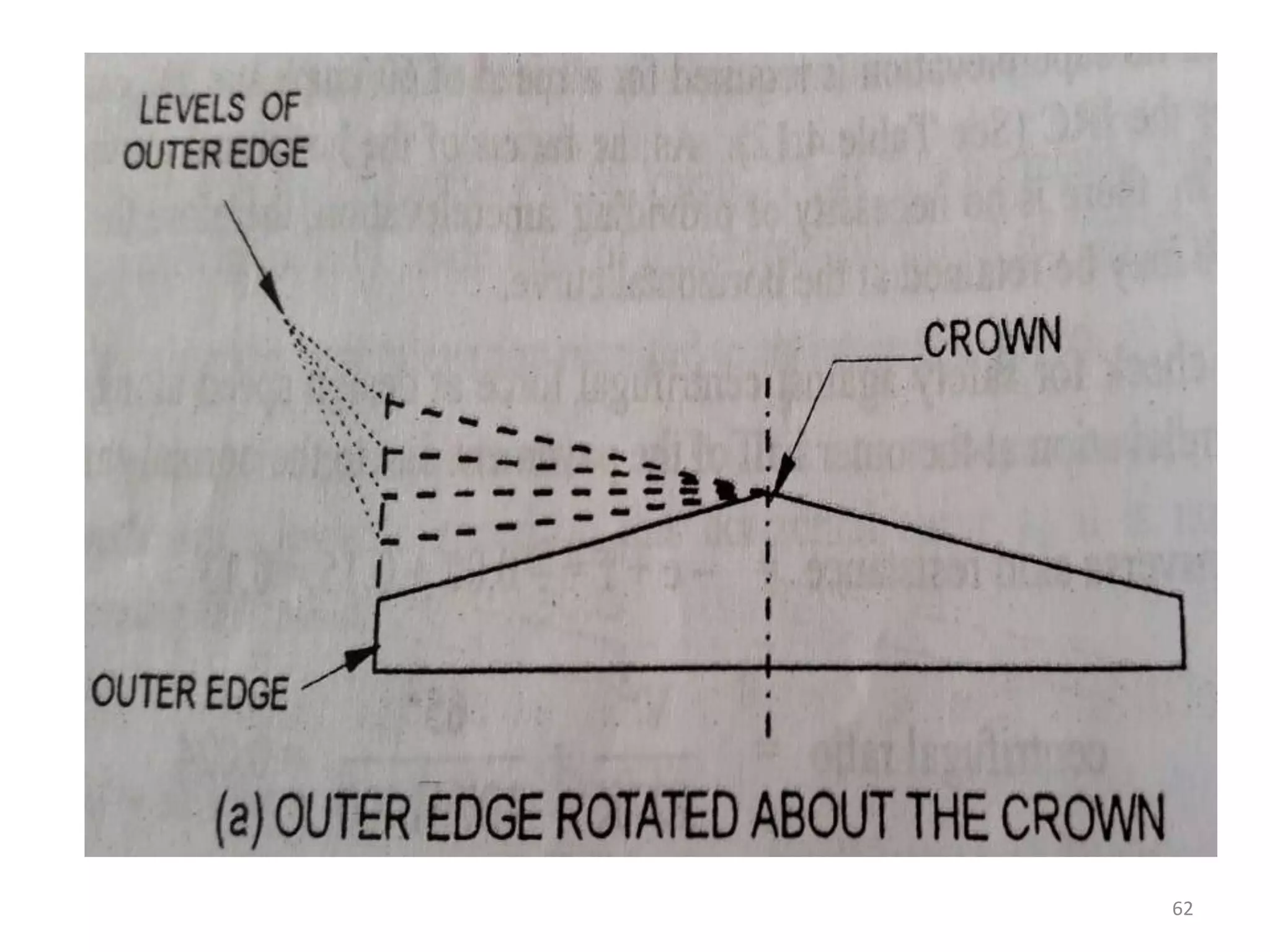
a. Elimination of crown of the cambered section:
1stMethod:Outer edge rotated about the crown
• Disadvantages
Small length of road –cross slope less than camber.
Drainage problem in outer half.
62
63
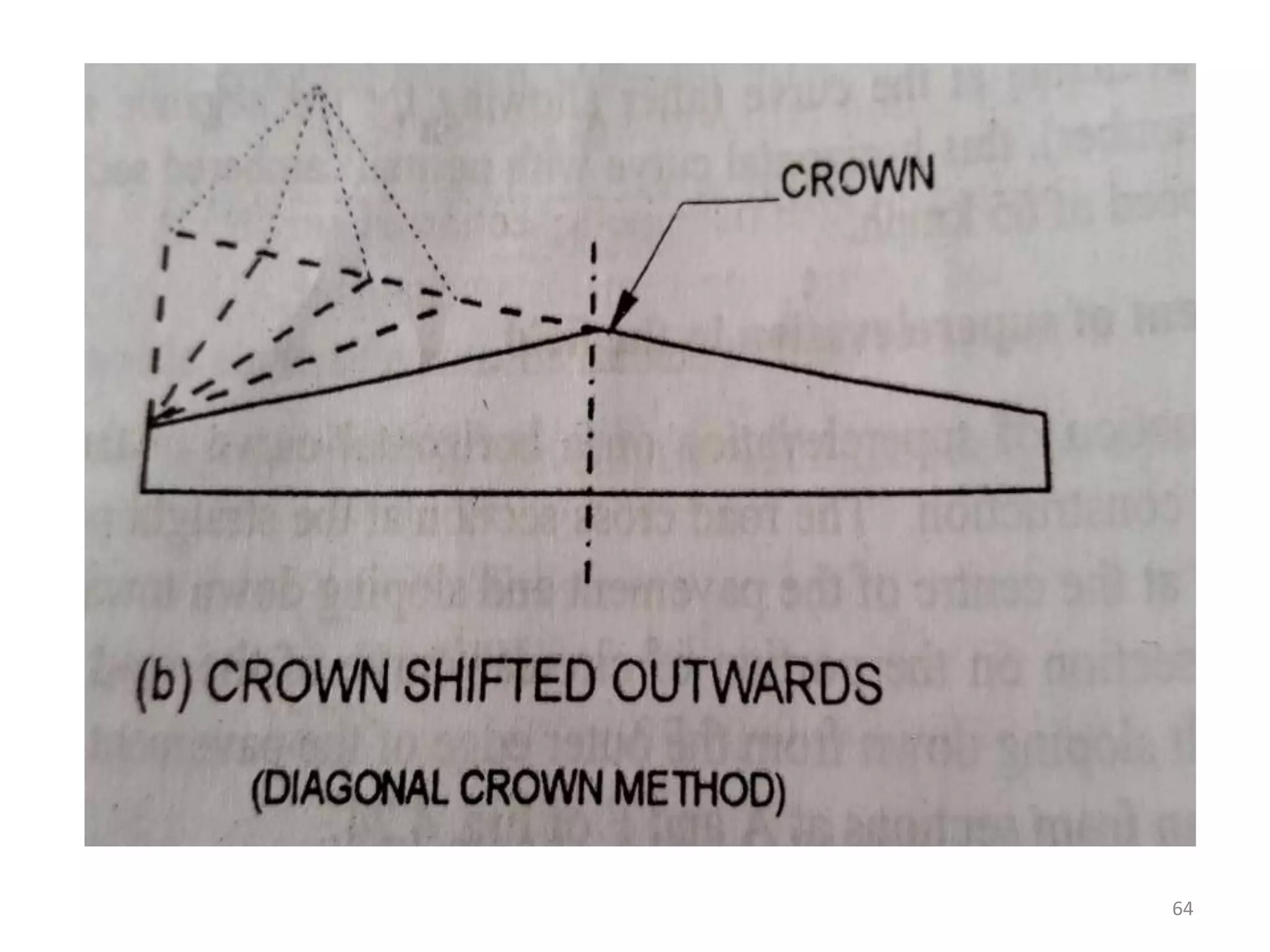
2ndMethod: Crown shifted outwards
• Disadvantages
Large negative superelevation on outer half.
Drivers have the tendency to run the vehicle along
shifted crown.
64
65
b. Rotation of pavement to attain full superelevation
1st Method: Rotation about the Centre line
66
Advantages
• Earthwork is balanced
• Vertical profile of the C/L remains unchanged
Disadvantages
• Drainage problem: depressing the inner edge
below the general level
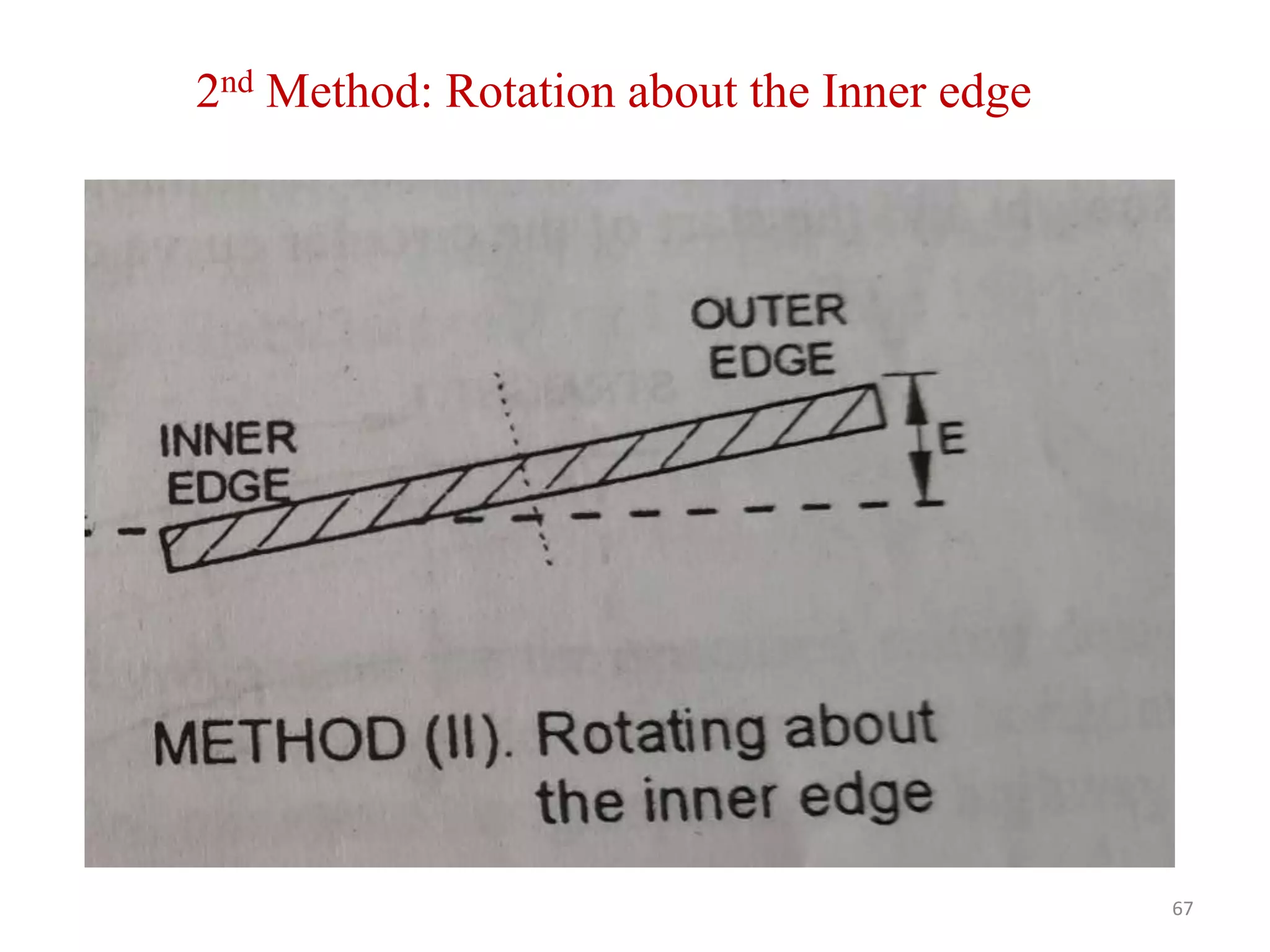
67
2nd Method: Rotation about the Inner edge
68
Advantages
•No drainage problem
Disadvantages
•Additional earth filling
•Centre line of the pavement is also raised (vertical
alignment of the road is changed)
69
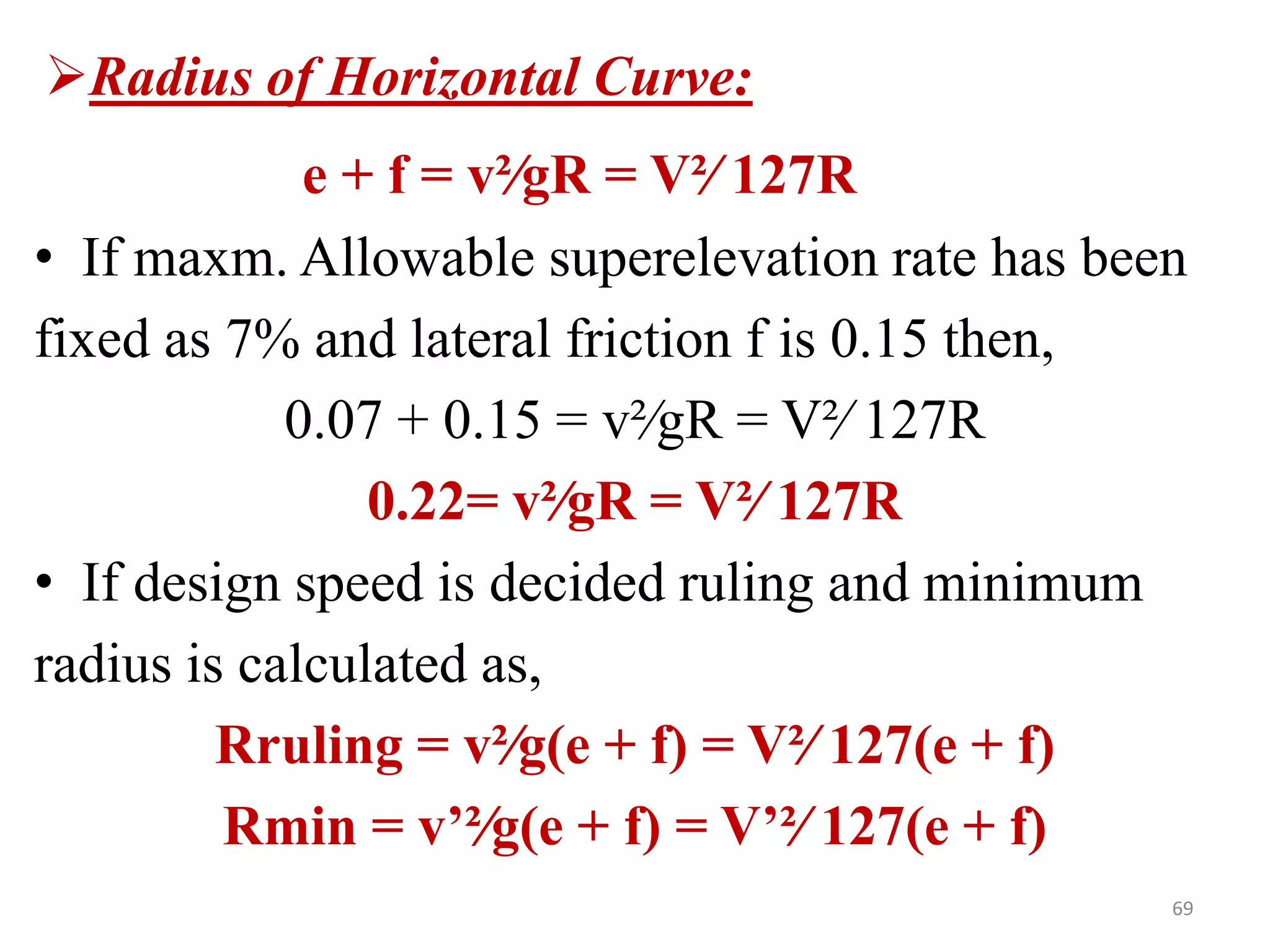
Radius of Horizontal Curve:
e + f = v²∕gR = V²∕ 127R
• If maxm. Allowable superelevation rate has been
fixed as 7% and lateral friction f is 0.15 then,
0.07 + 0.15 = v²∕gR = V²∕ 127R
0.22= v²∕gR = V²∕ 127R
• If design speed is decided ruling and minimum
radius is calculated as,
Rruling = v²∕g(e + f) = V²∕ 127(e + f)
Rmin = v’²∕g(e + f) = V’²∕ 127(e + f)
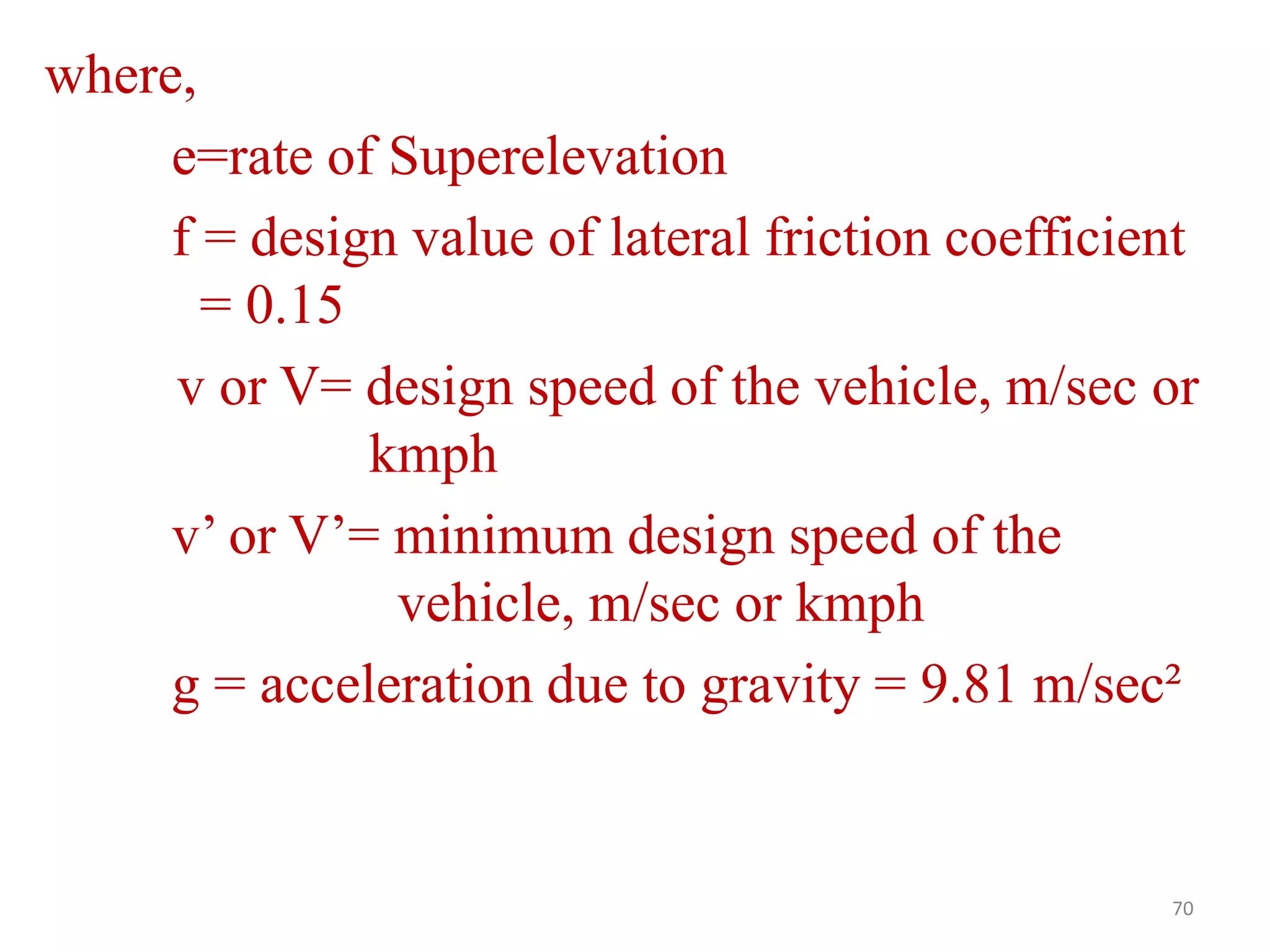
where,
e=rate of Superelevation
f = design value of lateral friction coefficient
= 0.15
v or V= design speed of the vehicle, m/sec or
kmph
v’ or V’= minimum design speed of the
vehicle, m/sec or kmph
g = acceleration due to gravity = 9.81 m/sec²
70
71
Widening of pavement on horizontal curves:
On horizontal curves, especially when they are
Less than 300m radii, it is common to widen the pavement
slightly more than the normal width.
• Widening is needed for the following reasons:
a. An automobile has a rigid wheel base and only the front
wheels can be turned, when this vehicle takes a turn to
negotiate a horizontal curve, the rear wheel do not follow
the same path as that of the front wheels. This phenomenon
is called off tracking.
72
b. While two vehicle cross or overtake at horizontal curve
there is psychological tendency to maintain a greater
clearance between the vehicle for safety.
c. For greater visibility at curve, the driver have tendency
not to follow the central path of the lane, but to use the
outer side at the beginning of the curve.
d. At higher speed superelevation and lateral friction
cannot counteract centrifugal force and skidding may
occur.
73
Analysis of extra widening on horizontal curves:
The extra widening of pavement on
horizontal curves is divided into two parts:
a. Mechanical widening/Off tracking
b. Psychological widening
74
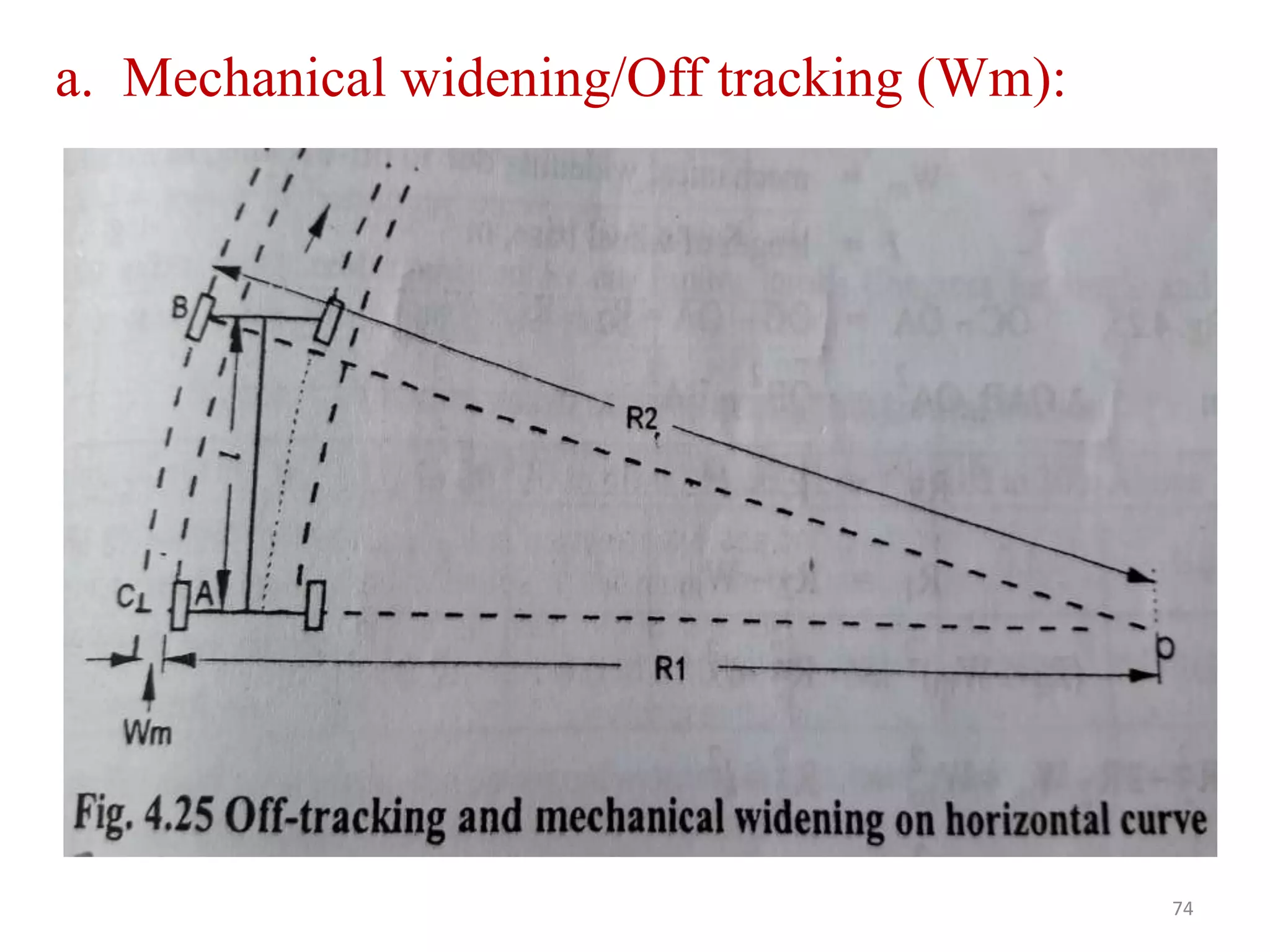
a. Mechanical widening/Off tracking (Wm):
75
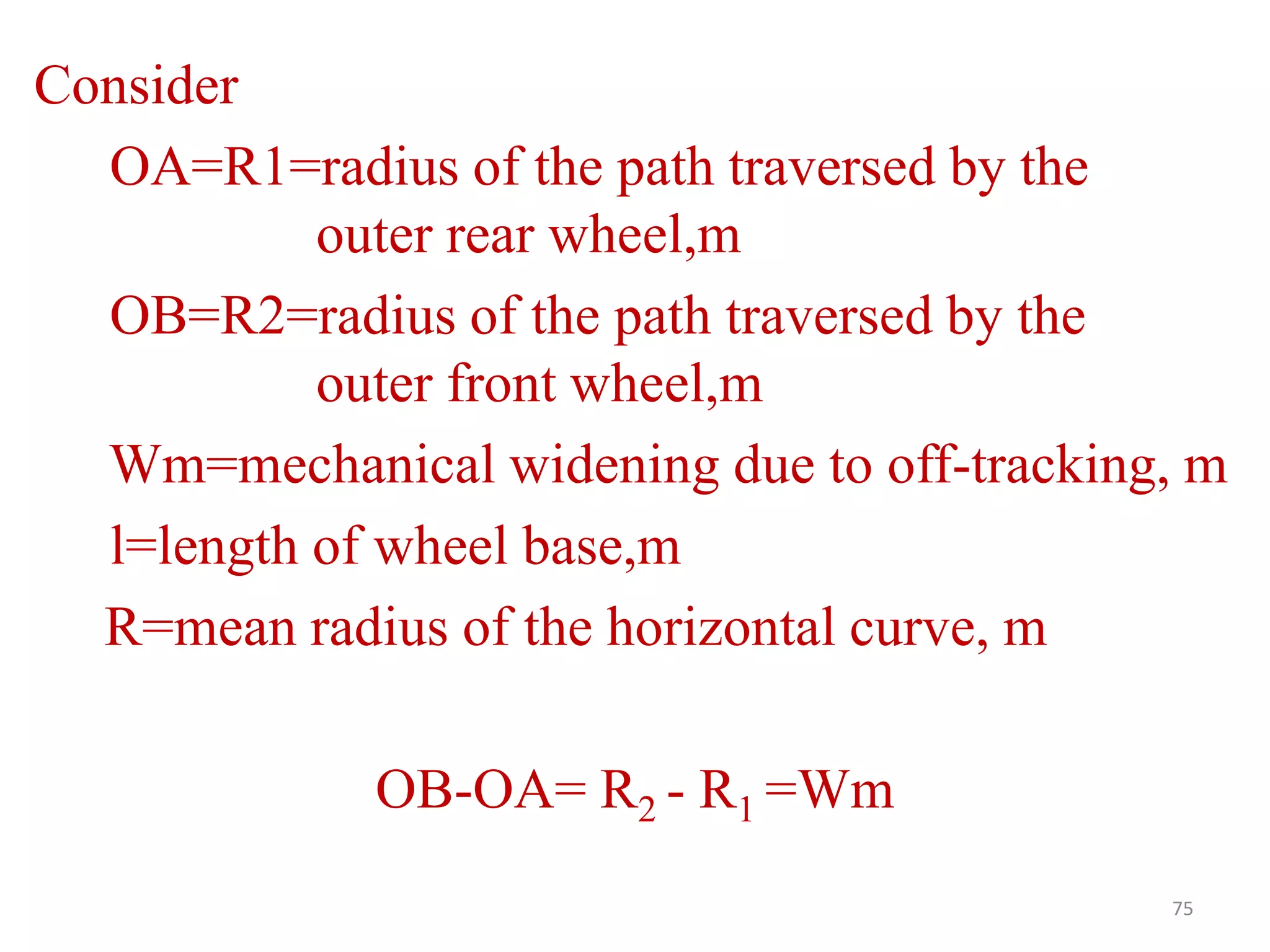
Consider
OA=R1=radius of the path traversed by the
outer rear wheel,m
OB=R2=radius of the path traversed by the
outer front wheel,m
Wm=mechanical widening due to off-tracking, m
l=length of wheel base,m
R=mean radius of the horizontal curve, m
OB-OA= R2 - R1 =Wm
76
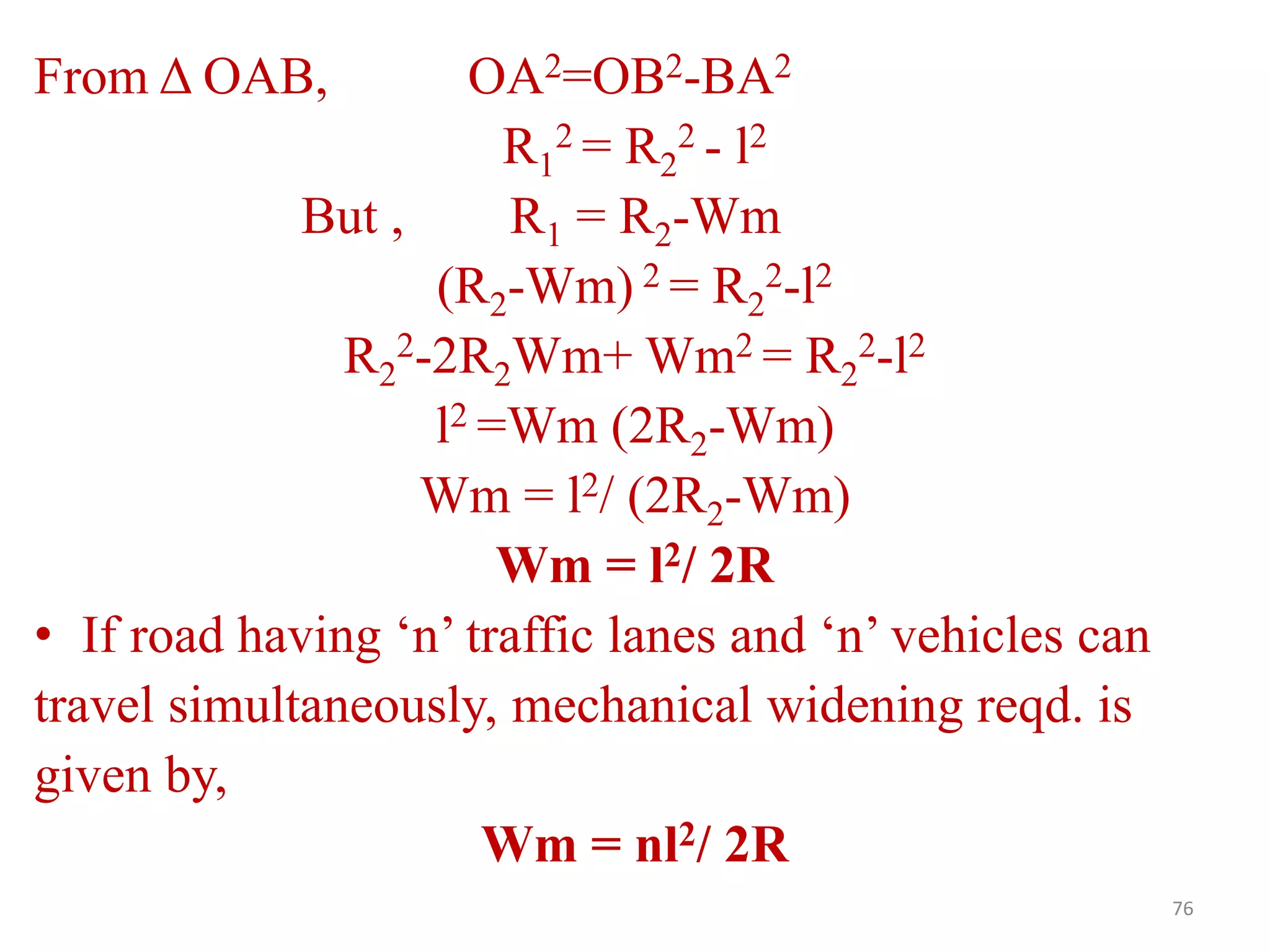
From Δ OAB, OA2=OB2-BA2
R1
2 = R2
2 - l2
But , R1 = R2-Wm
(R2-Wm) 2 = R2
2-l2
R2
2-2R2Wm+ Wm2 = R2
2-l2
l2 =Wm (2R2-Wm)
Wm = l2/ (2R2-Wm)
Wm = l2/ 2R
• If road having ‘n’ traffic lanes and ‘n’ vehicles can
travel simultaneously, mechanical widening reqd. is
given by,
Wm = nl2/ 2R
77
b. Psychological widening (Wps):
An empirical formula has been recommended
by IRC for deciding the additional psychological
widening.
• The psychological widening is given by the
formula:
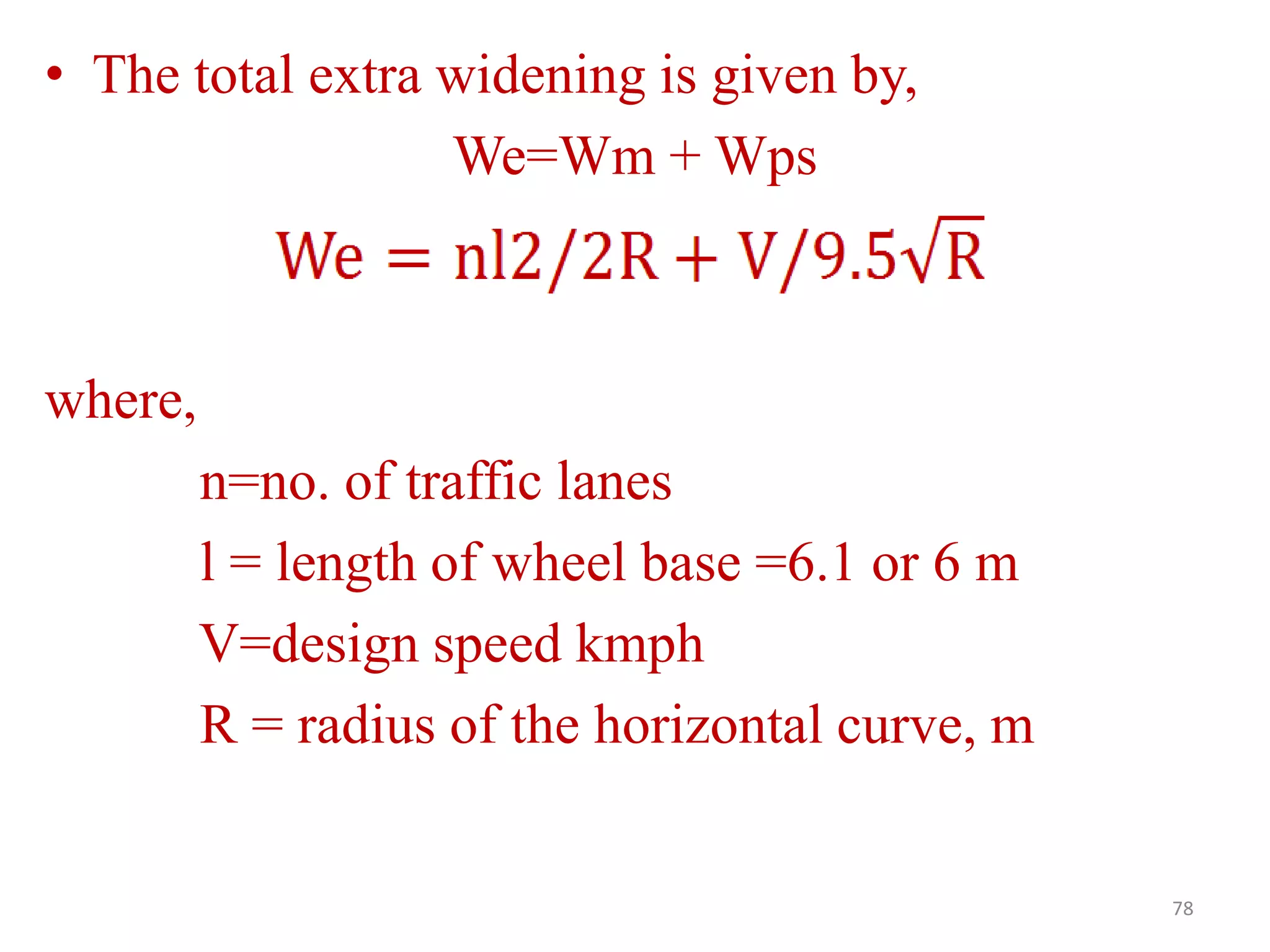
• The total extra widening is given by,
We=Wm + Wps
where,
n=no. of traffic lanes
l = length of wheel base =6.1 or 6 m
V=design speed kmph
R = radius of the horizontal curve, m
78
79
Horizontal Transition Curve:
A transition curve has a radius which
decreases from infinity at the tangent point to a
designed radius of the circular curve.
• The rate of change of radius of the transition curve
will depend on the shape of the curve adopted and
the equation of the curve.
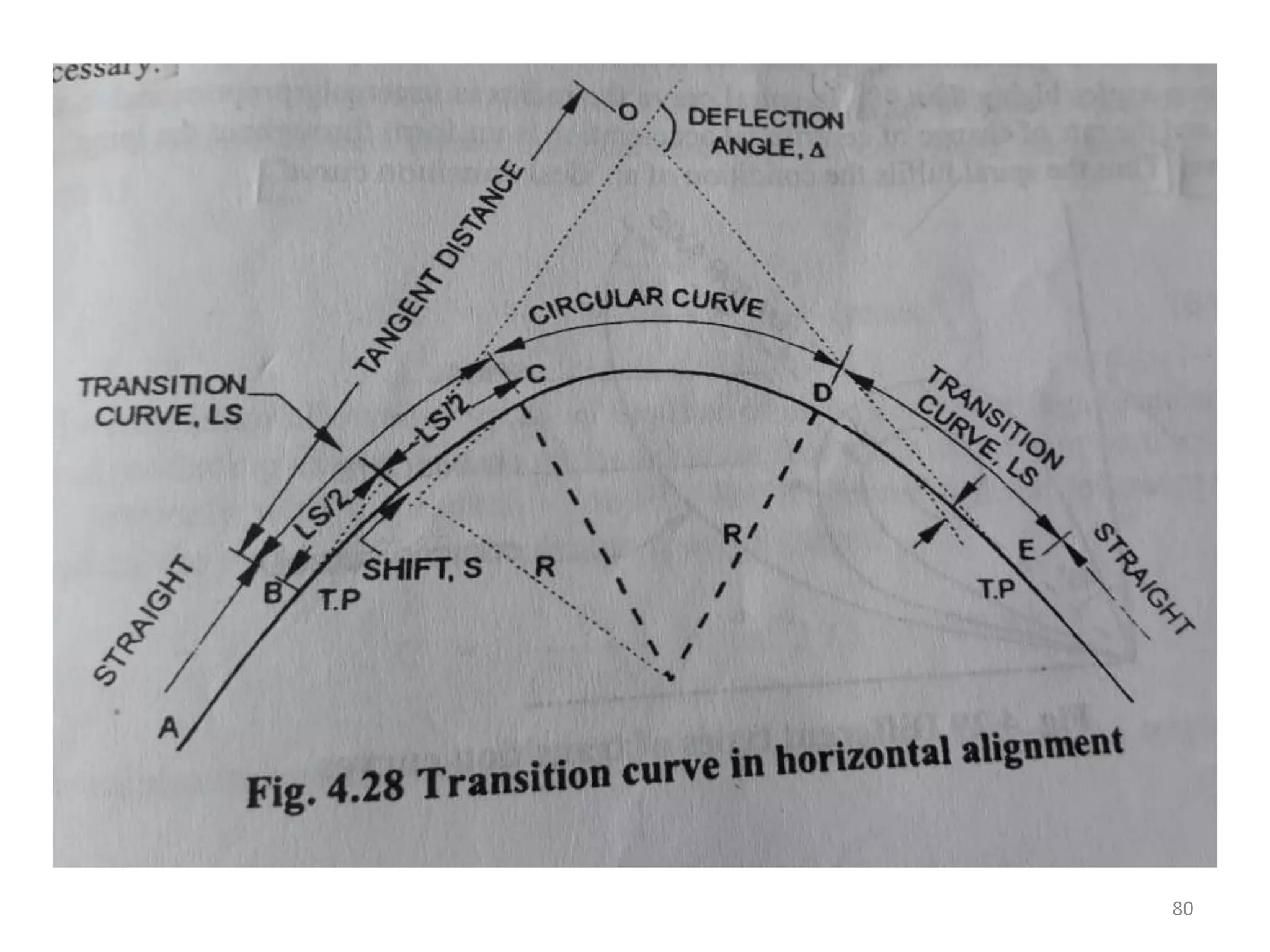
80
81
Objects of providing transition curve:
A transition curve which is introduced
between straight and a circular curve will help in:
a. Gradually introducing centrifugal force.
b. Gradually introducing designed superelevation.
c. Gradually introducing extra widening.
d. To enable the driver turn steering gradually for
his own comfort and safety.
82
Length of transition curve:
The length of transition curve is designed
to fulfill three conditions:
a. Rate of change of centrifugal acceleration to be
developed gradually
b. Rate of introduction of designed superelevation
c. Minimum length by IRC empirical formula
83
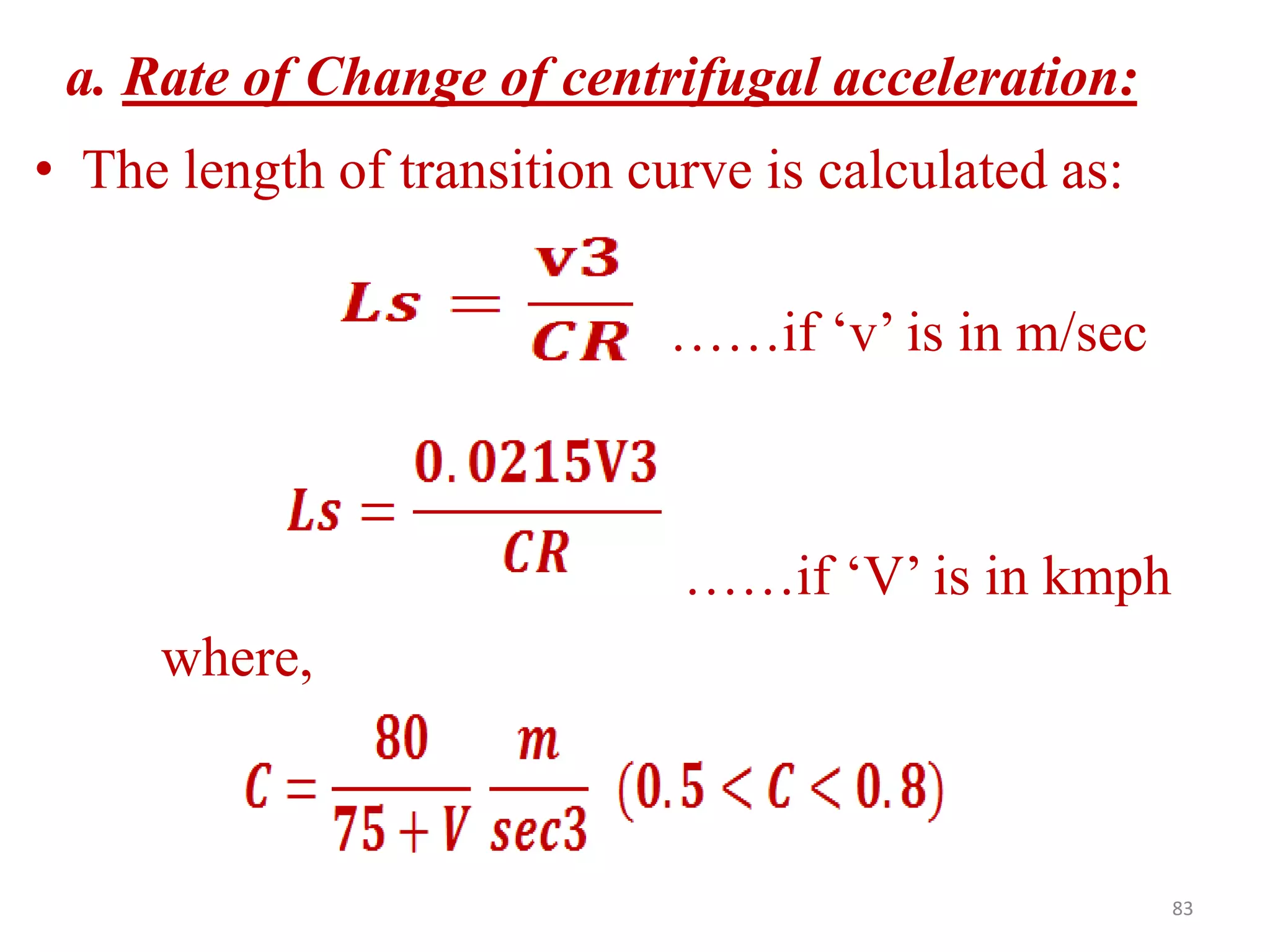
a. Rate of Change of centrifugal acceleration:
• The length of transition curve is calculated as:
……if ‘v’ is in m/sec
……if ‘V’ is in kmph
where,
84
where,
Ls=length of transition curve, m
C=allowable rate of change of centrifugal
acceleration
V = design speed in kmph
v = design speed in m/sec
R = radius of the circular curve, m
85
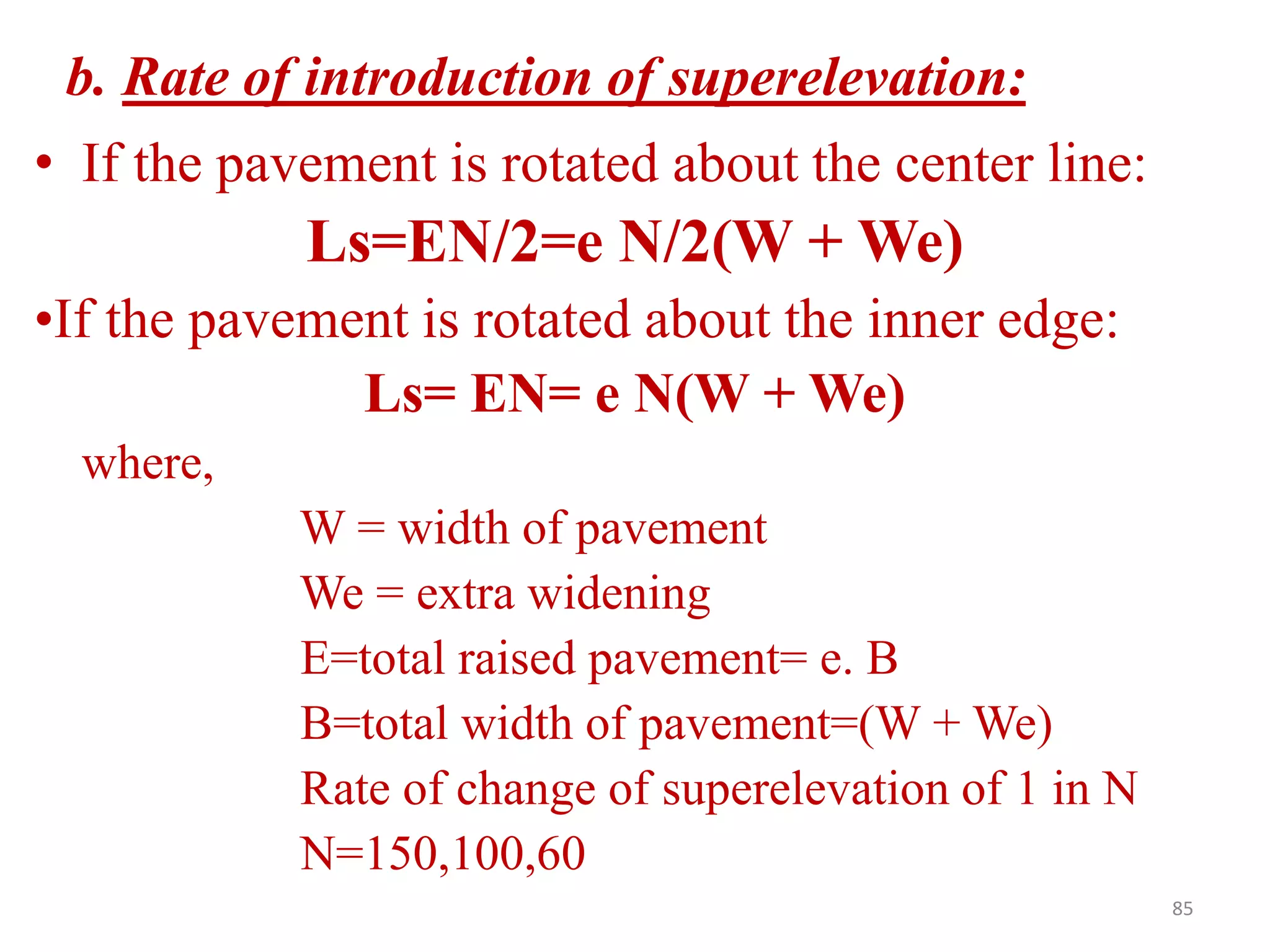
b. Rate of introduction of superelevation:
• If the pavement is rotated about the center line:
Ls=EN/2=e N/2(W + We)
•If the pavement is rotated about the inner edge:
Ls= EN= e N(W + We)
where,
W = width of pavement
We = extra widening
E=total raised pavement= e. B
B=total width of pavement=(W + We)
Rate of change of superelevation of 1 in N
N=150,100,60
86
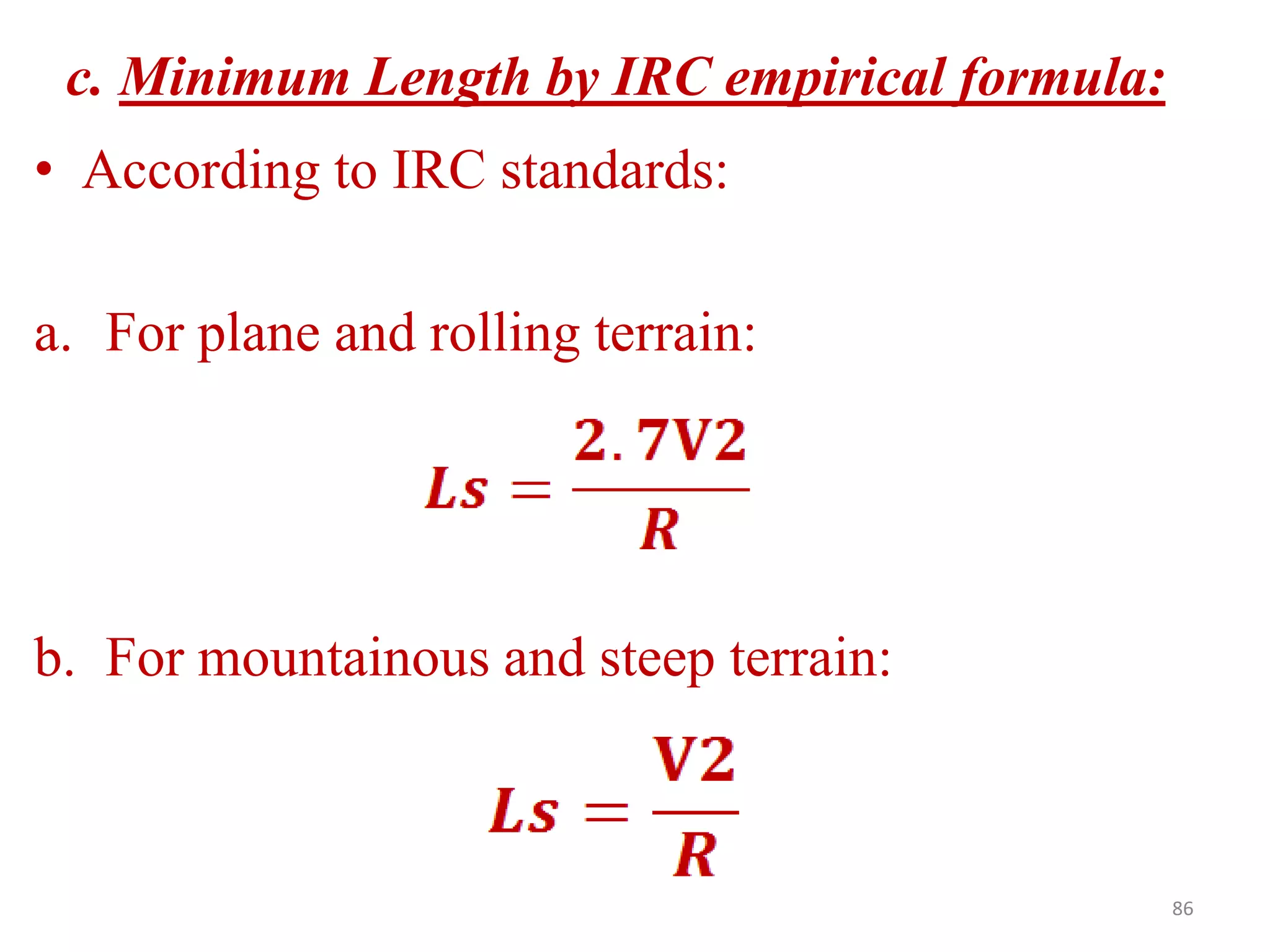
c. Minimum Length by IRC empirical formula:
• According to IRC standards:
a. For plane and rolling terrain:
b. For mountainous and steep terrain:
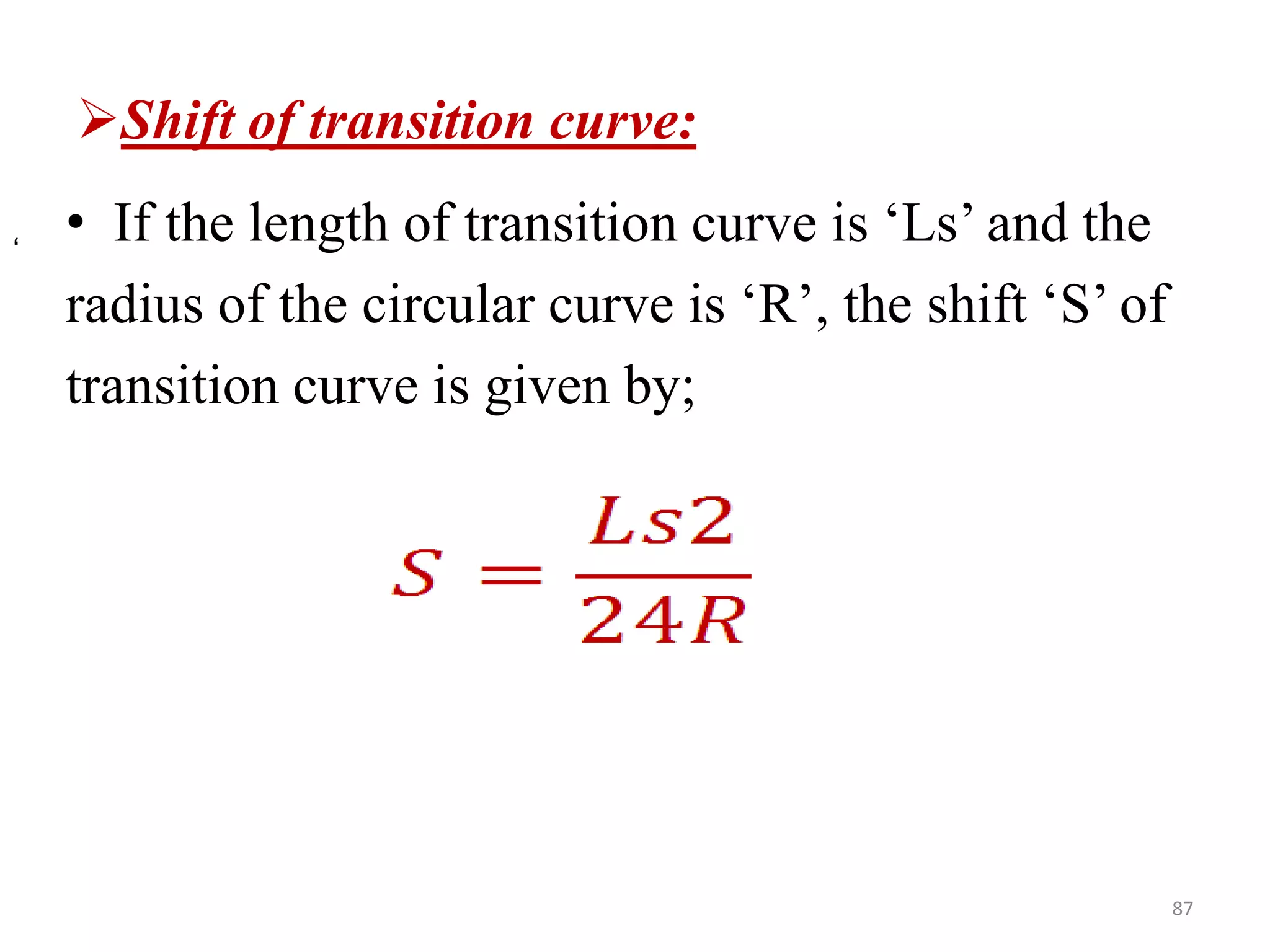
Shift of transition curve:
• If the length of transition curve is ‘Ls’ and the
radius of the circular curve is ‘R’, the shift ‘S’ of
transition curve is given by;
87
‘
Set Back Distance:
• Set back distance is the distance from centre of
horizontal curve to an obstruction on inner side
of the curve.
• Set back distance is required to provide
adequate sight distance on the horizontal curve.
• Obstruction to the sight distance on horizontal
curve may be buildings, trees, cut slopes on the
inner side of curve.
88
‘
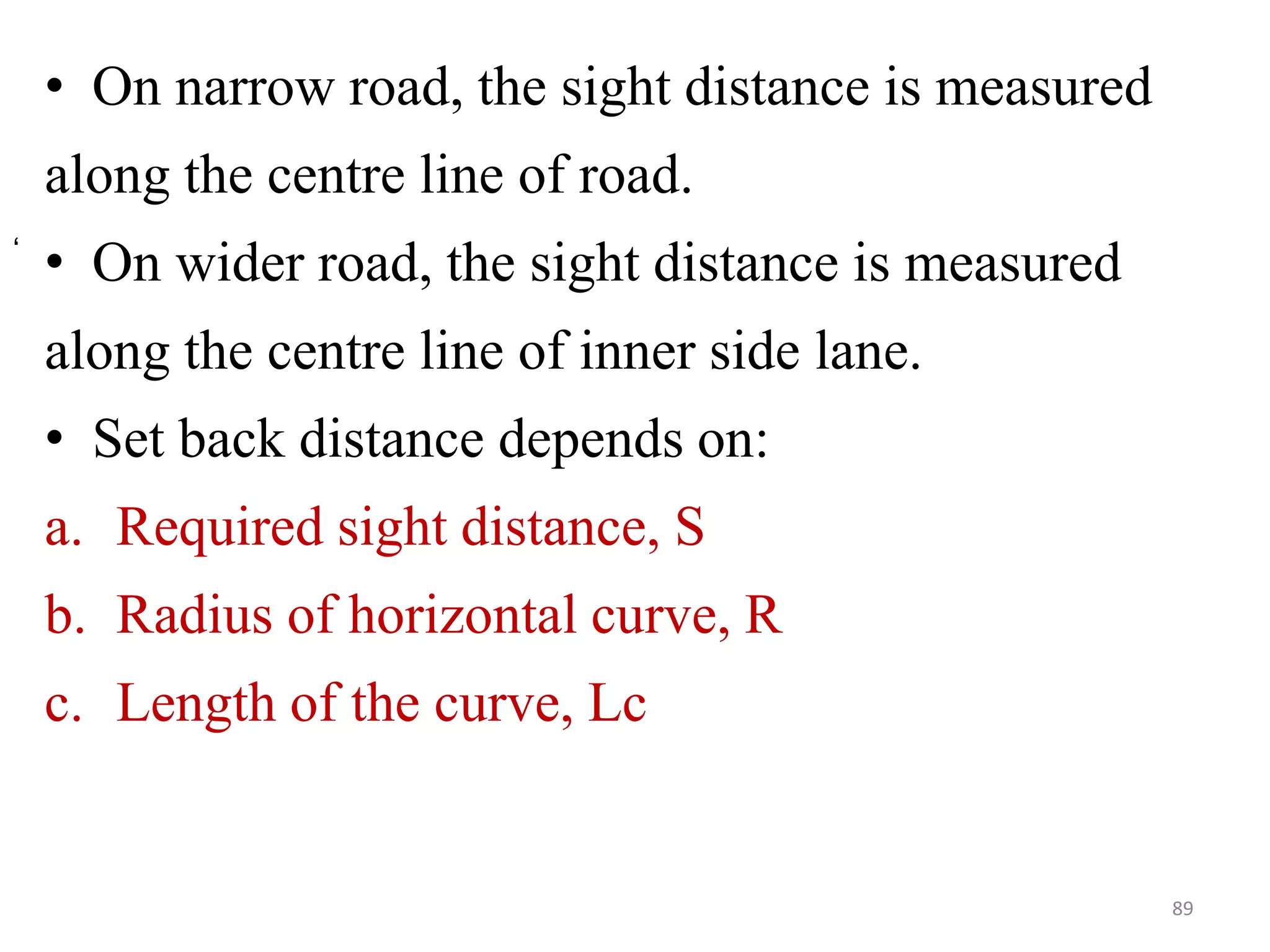
• On narrow road, the sight distance is measured
along the centre line of road.
• On wider road, the sight distance is measured
along the centre line of inner side lane.
• Set back distance depends on:
a. Required sight distance, S
b. Radius of horizontal curve, R
c. Length of the curve, Lc
89
‘
90
Analysis of Set back distance:
• Two cases are considered for the analysis:
a. When length of curve is more than Sight
distance (Lc>S)
b. When length of curve is less than Sight distance
(Lc<S)
91
‘
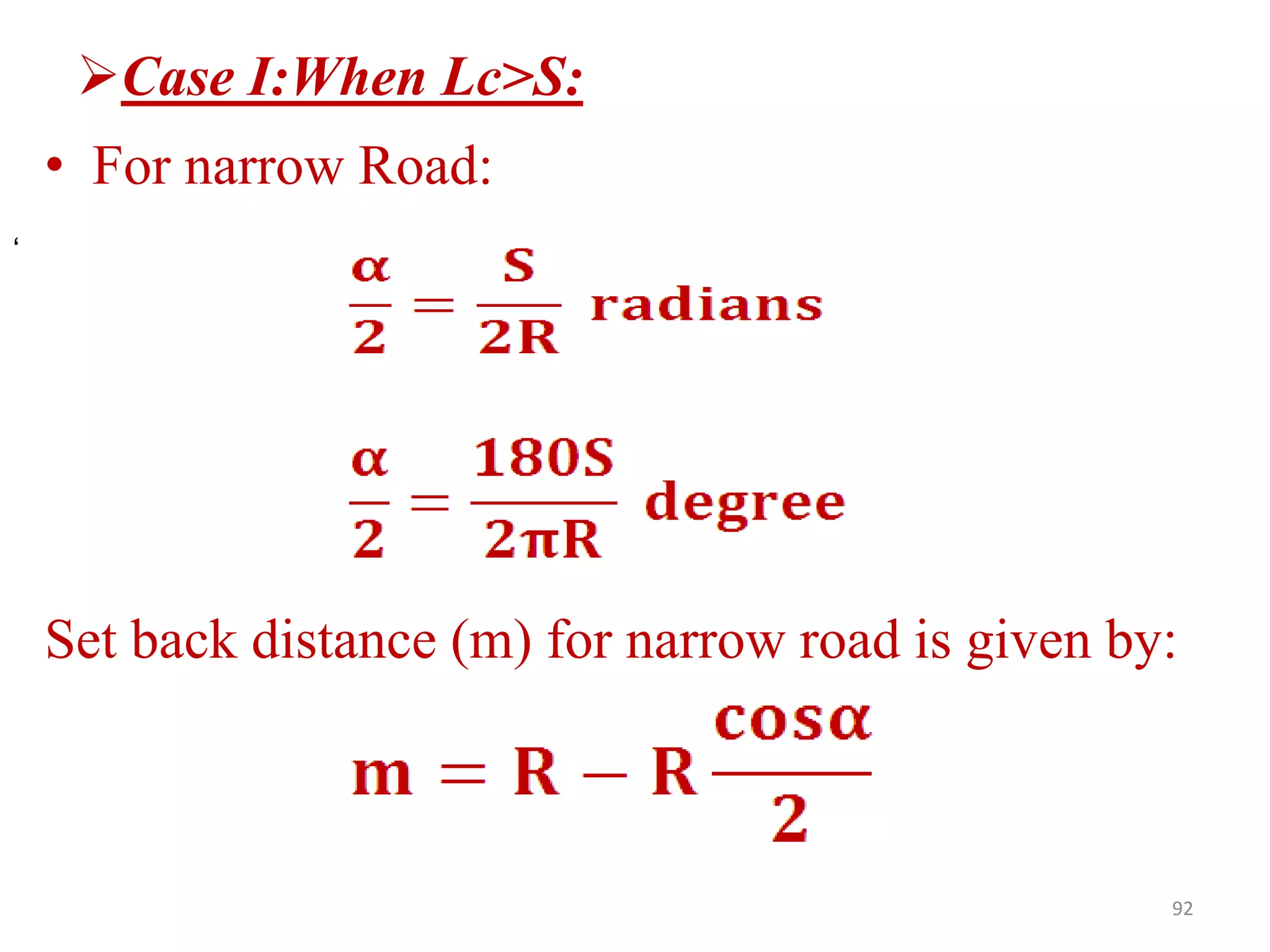
Case I:When Lc>S:
• For narrow Road:
Set back distance (m) for narrow road is given by:
92
‘
93
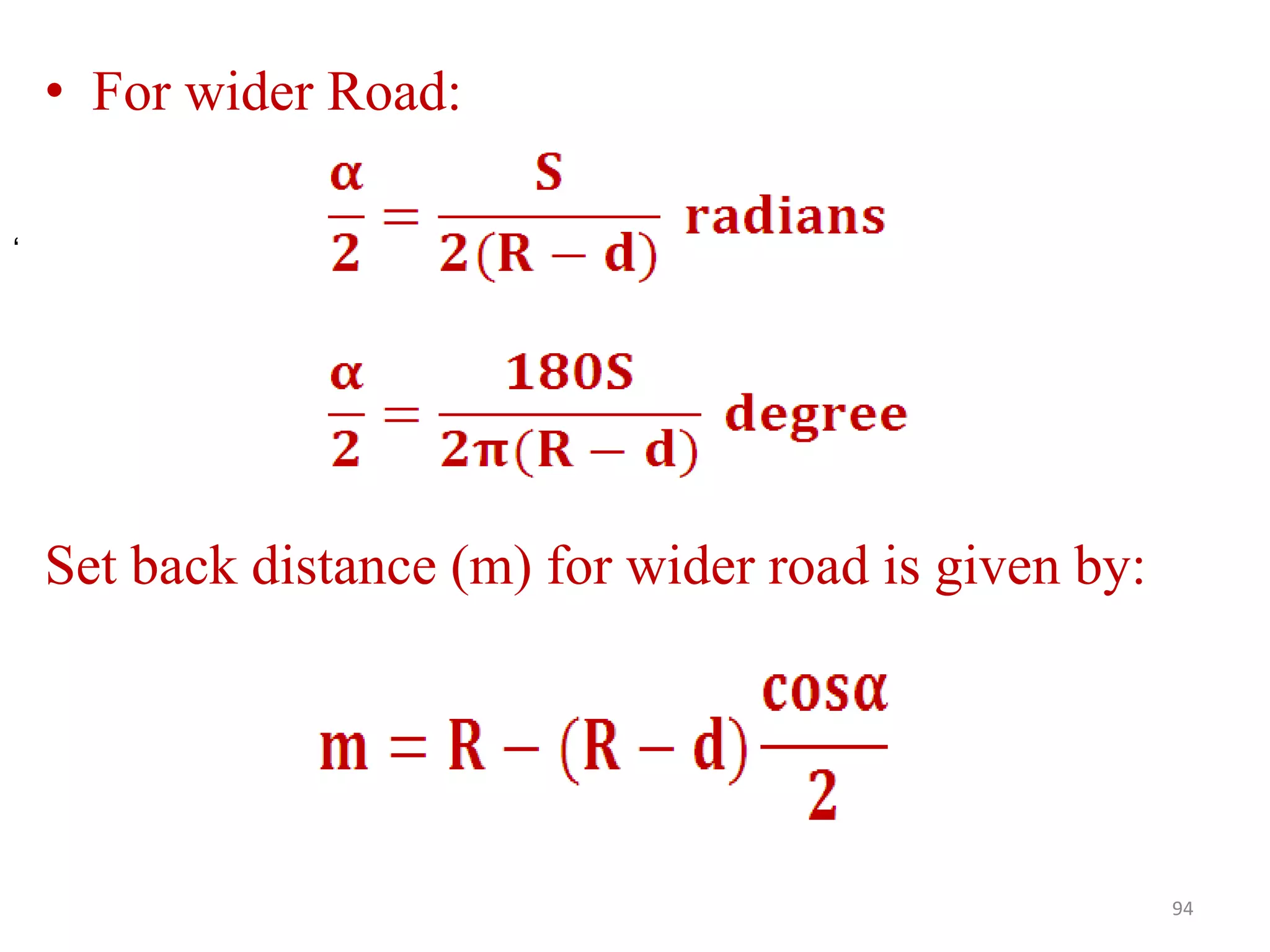
• For wider Road:
Set back distance (m) for wider road is given by:
94
‘
95
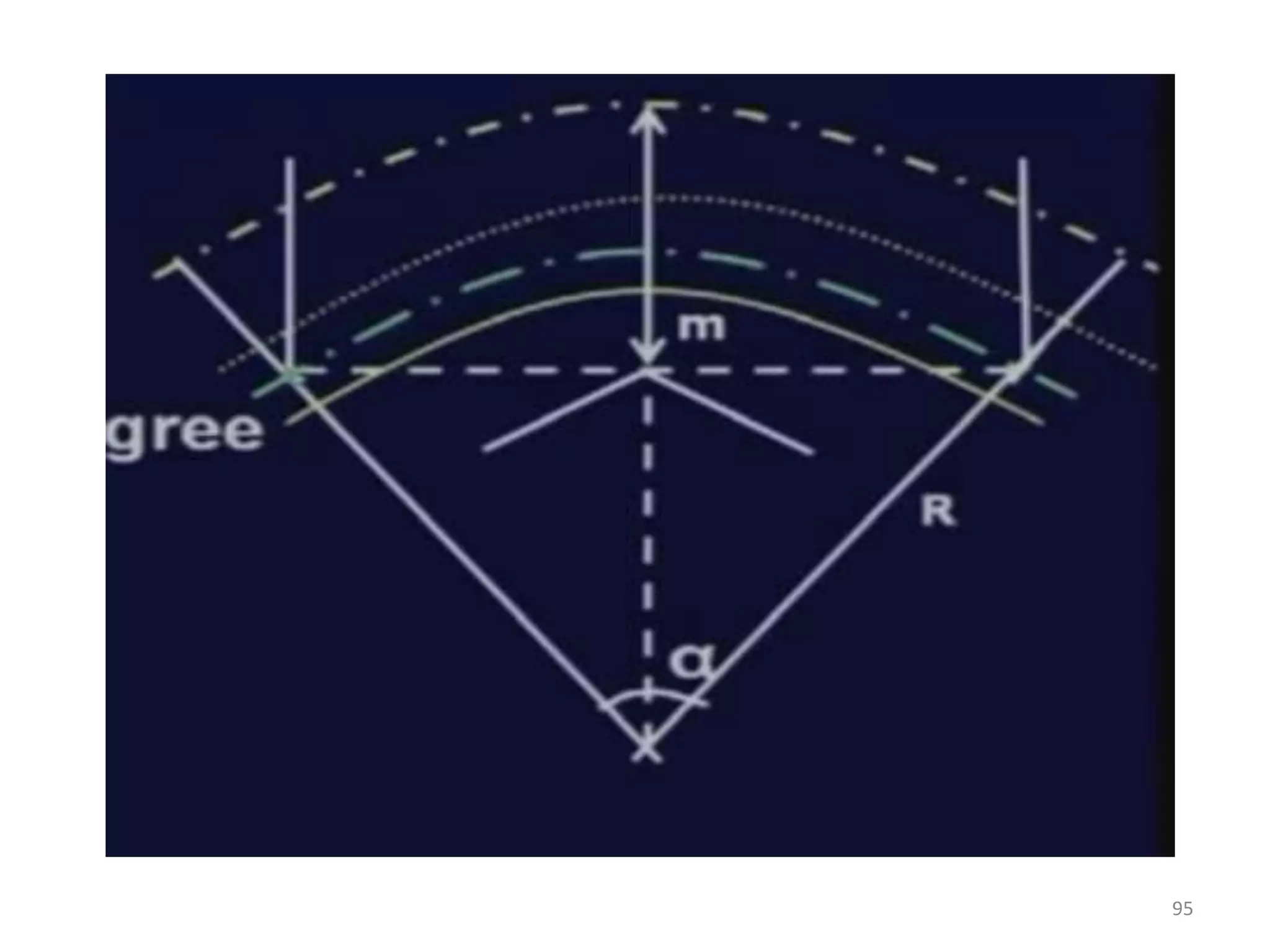
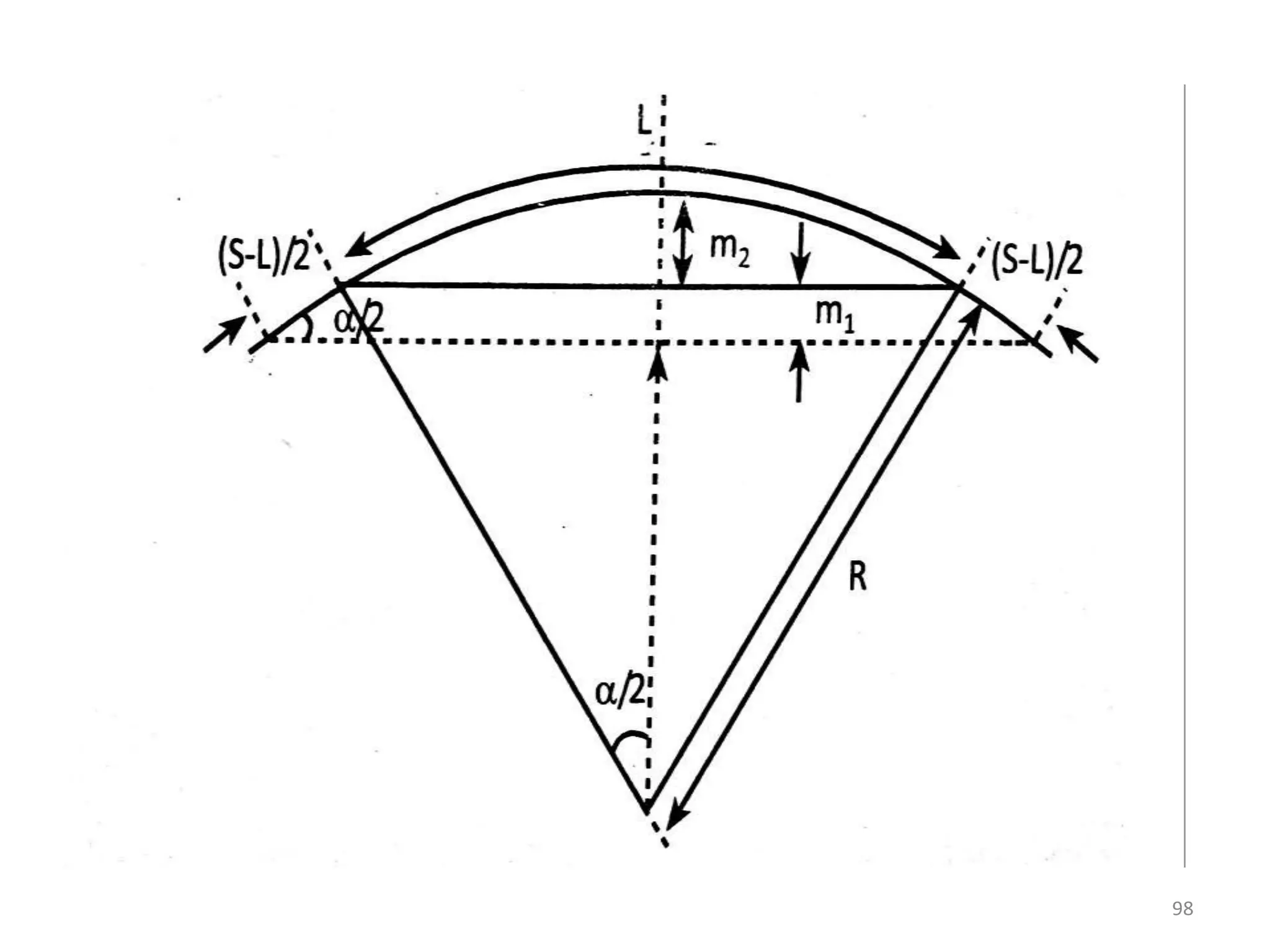
where,
α =angle subtended by the arc
m=set back distance, m
R=radius of curve, m
S=Sight Distance, m
d=distance between centre line of road
and centre line of inner lane
96
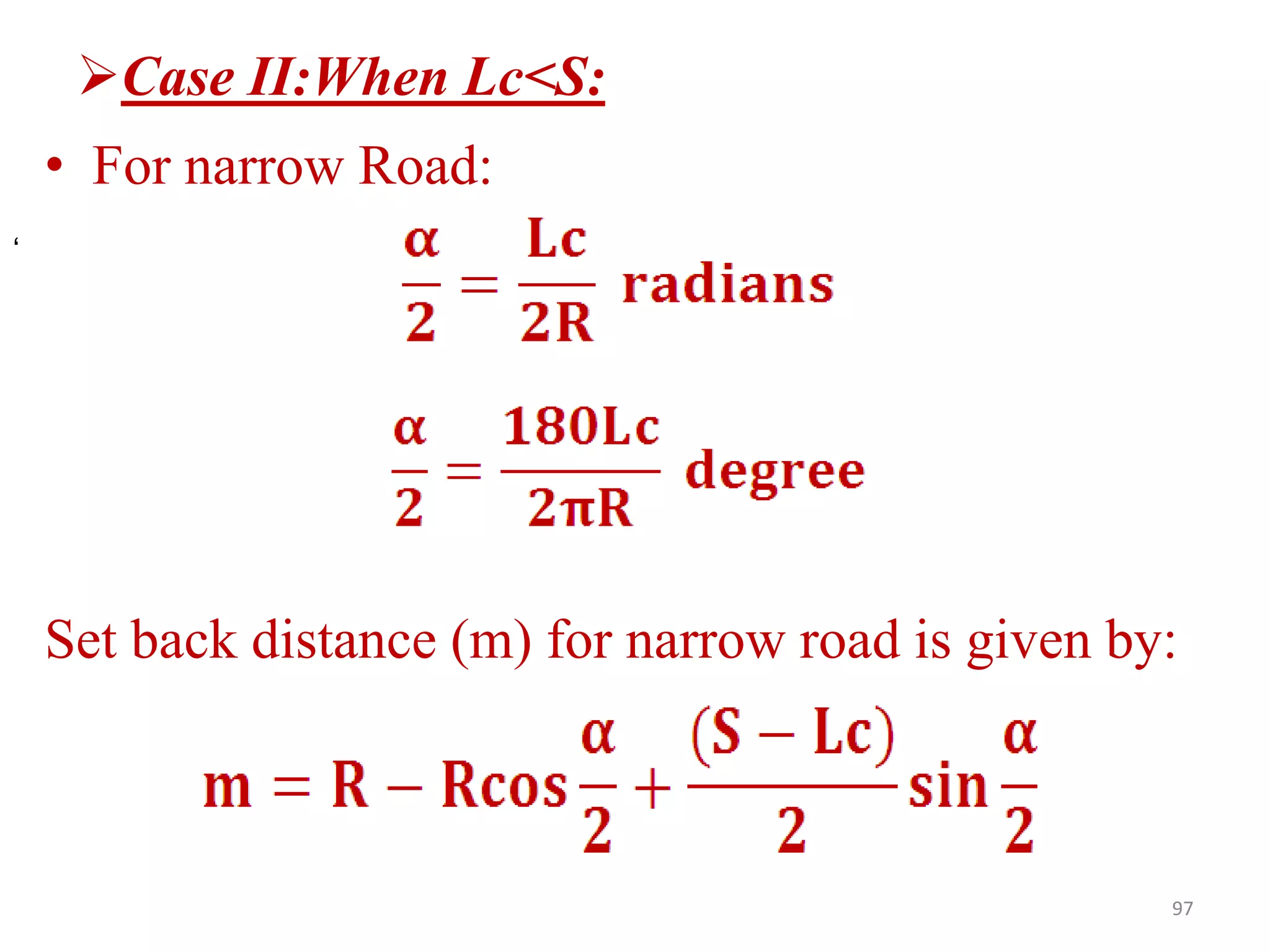
Case II:When Lc<S:
• For narrow Road:
Set back distance (m) for narrow road is given by:
97
‘
98
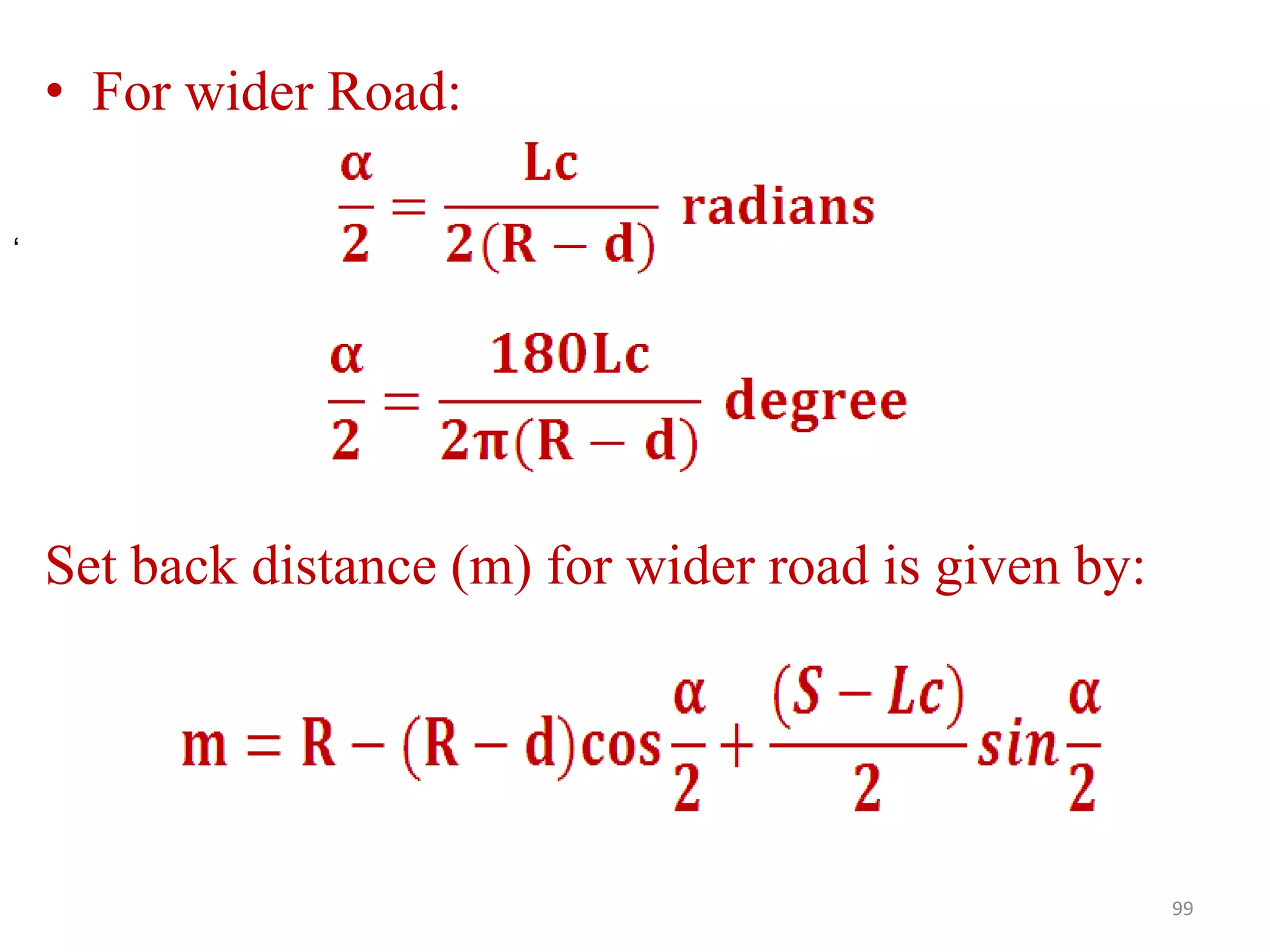
• For wider Road:
Set back distance (m) for wider road is given by:
99
‘
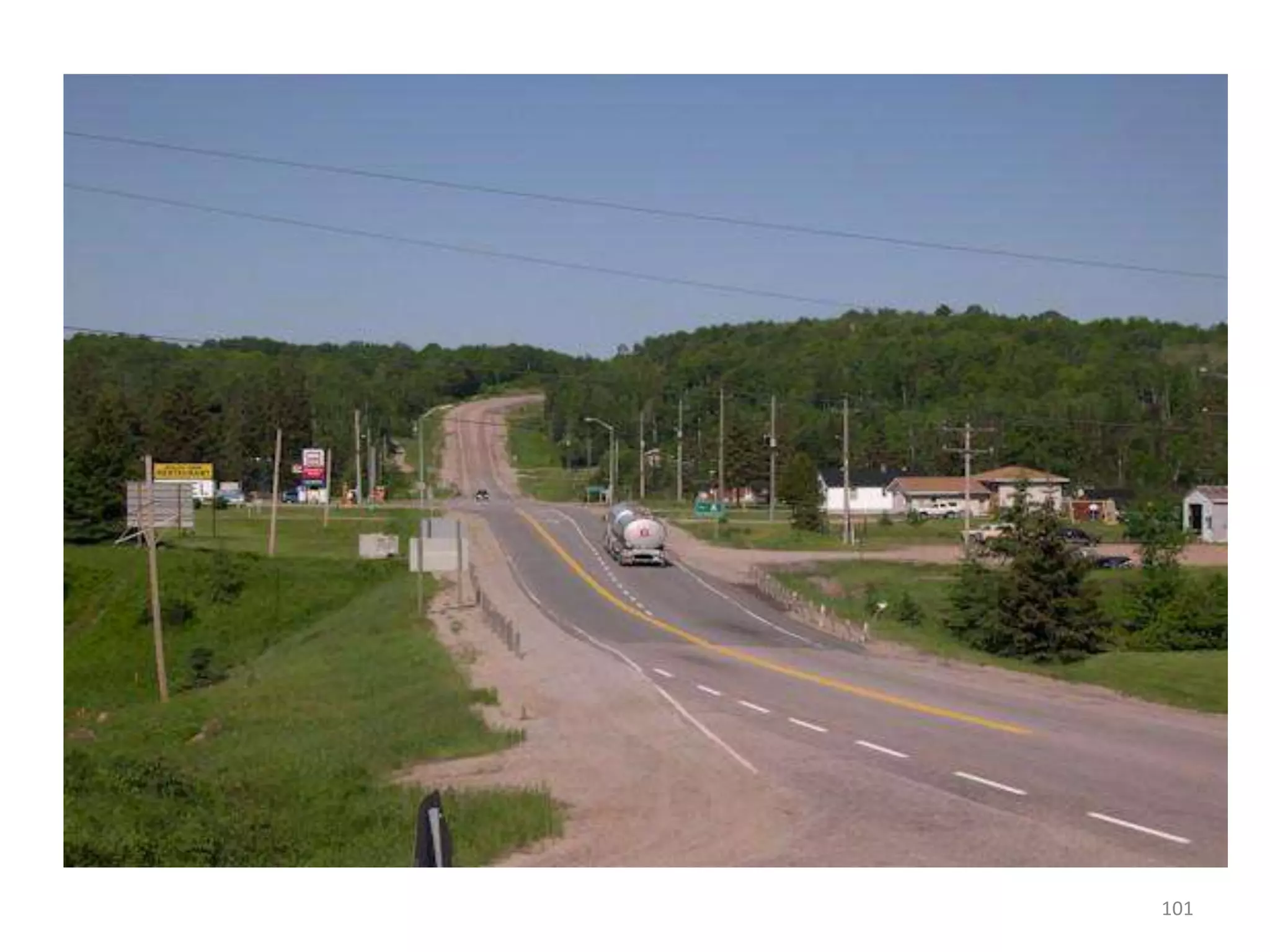
Vertical Alignment:
• The vertical alignment is the elevation or profile
of the centre line of the road.
• The vertical alignment consists of grades and
vertical curves.
• The vertical alignment of a highway influences:
i. Vehicle speed
ii. Acceleration and deceleration
iii. Sight distance
iv. Vehicle operation cost
v. Comfort while travelling at high speeds
100
‘
101
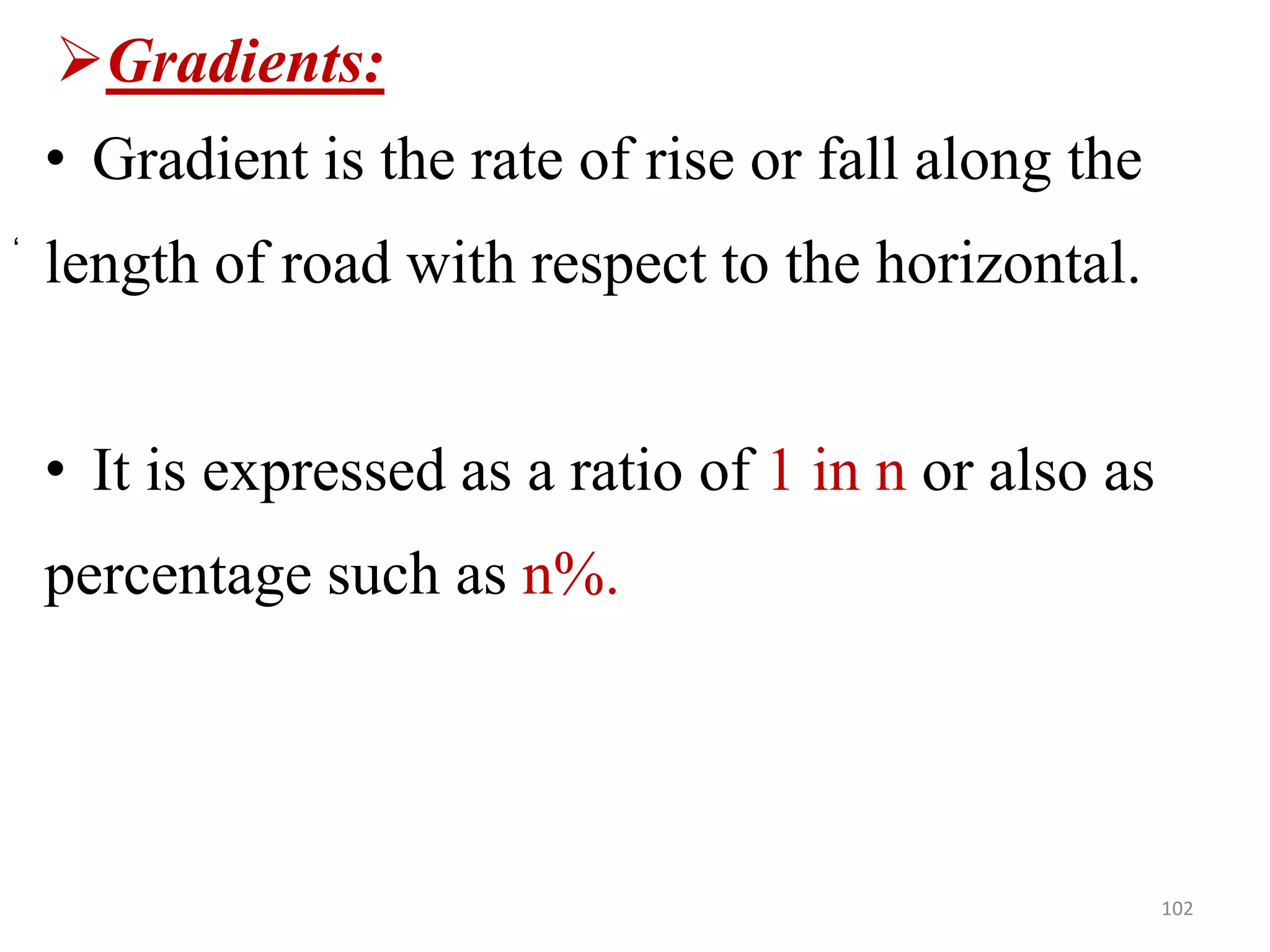
Gradients:
• Gradient is the rate of rise or fall along the
length of road with respect to the horizontal.
• It is expressed as a ratio of 1 in n or also as
percentage such as n%.
102
‘
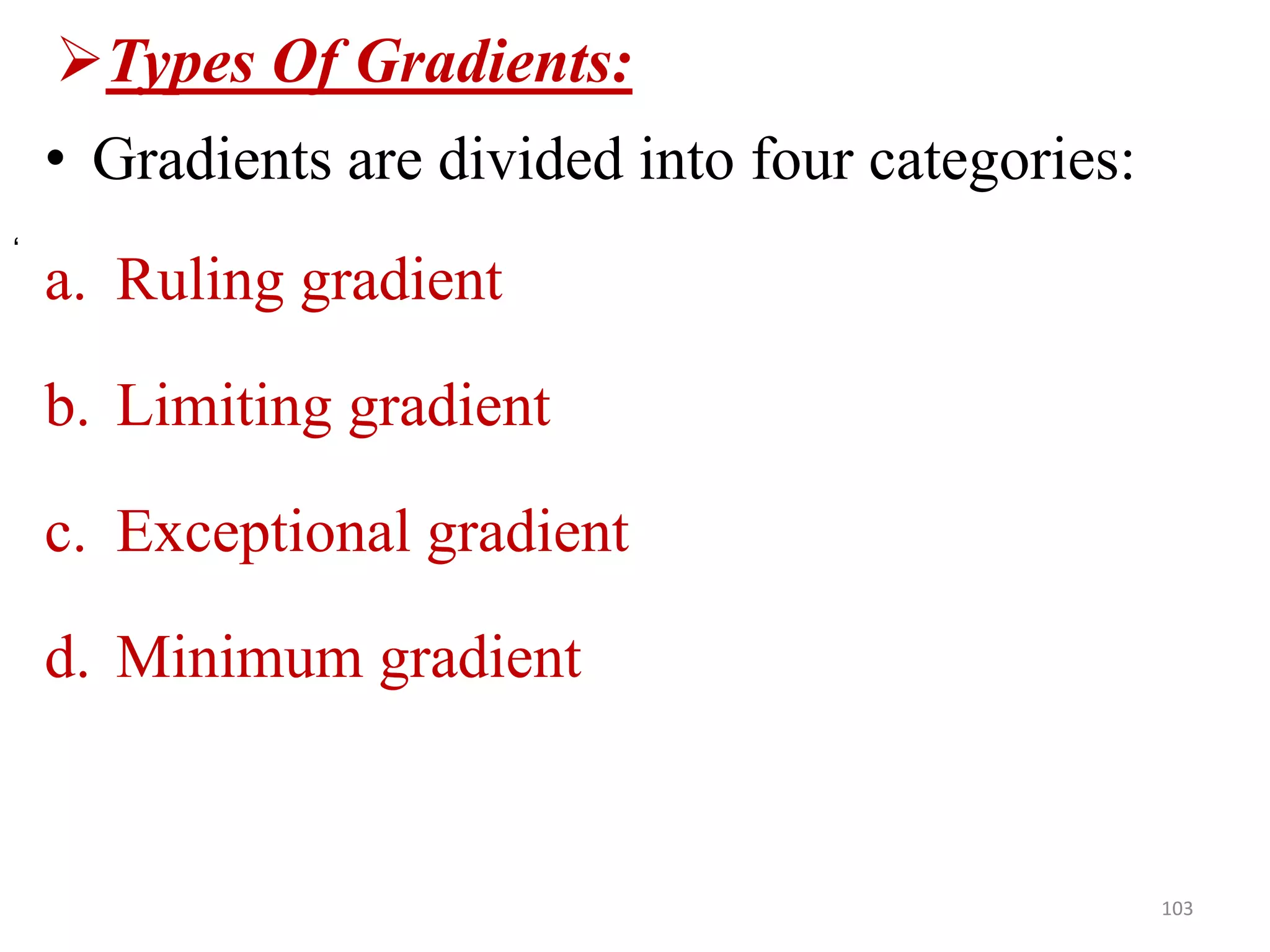
Types Of Gradients:
• Gradients are divided into four categories:
a. Ruling gradient
b. Limiting gradient
c. Exceptional gradient
d. Minimum gradient
103
‘
a. Ruling gradient:
• Ruling gradient is the maximum gradient within
which the designer attempts to design the vertical
profile of a road.
• Ruling gradient is also known as ‘Design
gradient’.
• For selection of ruling gradient factors such as
type of terrain, length of the grade, speed, pulling
power of vehicle etc are considered.
104
‘
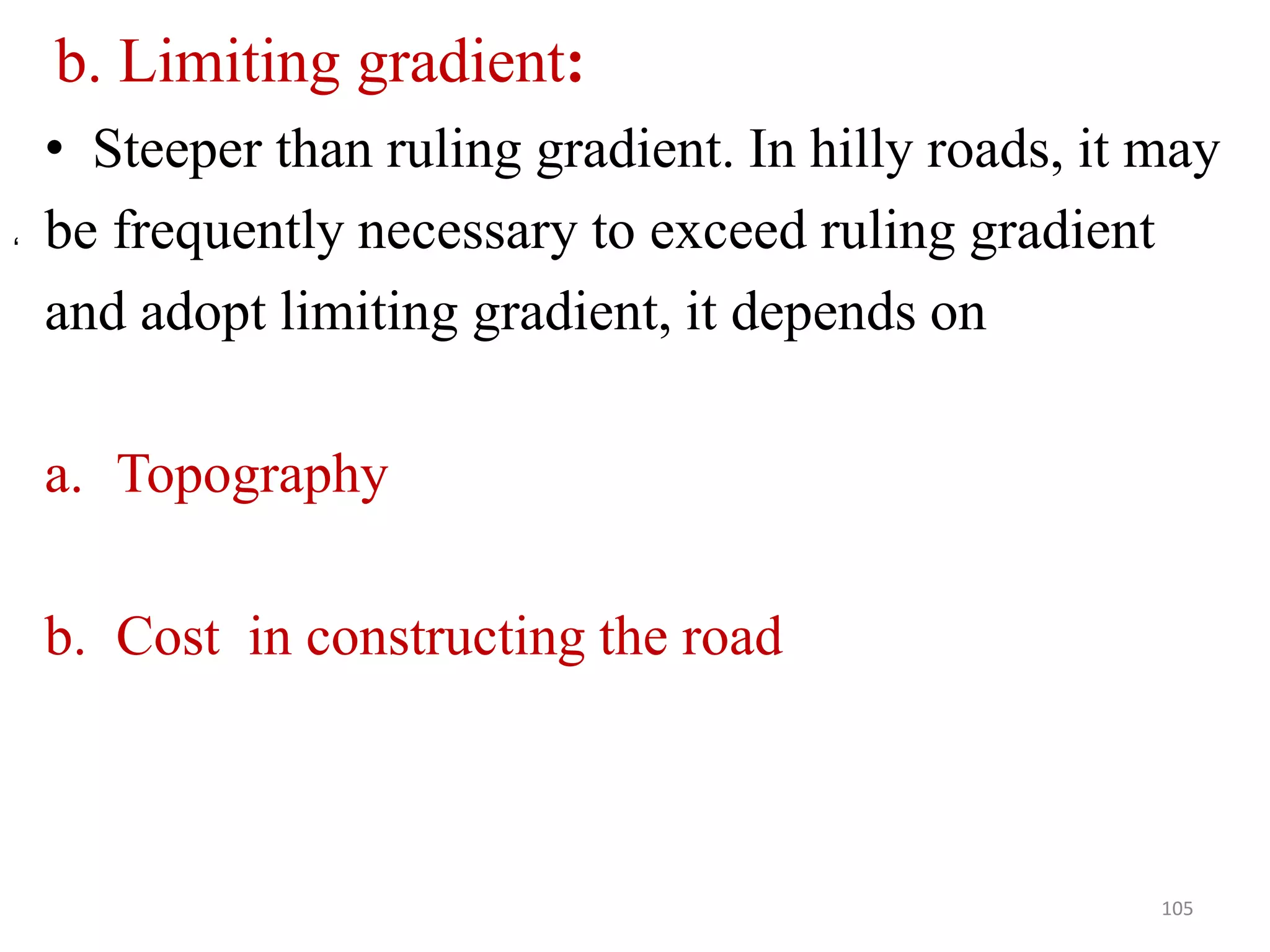
b. Limiting gradient:
• Steeper than ruling gradient. In hilly roads, it may
be frequently necessary to exceed ruling gradient
and adopt limiting gradient, it depends on
a. Topography
b. Cost in constructing the road
105
‘
• Exceptional gradient are very steeper gradients
given at unavoidable situations.
• They should be limited for short stretches not
exceeding about 100 m at a stretch.
106
c. Exceptional gradient:
107
‘
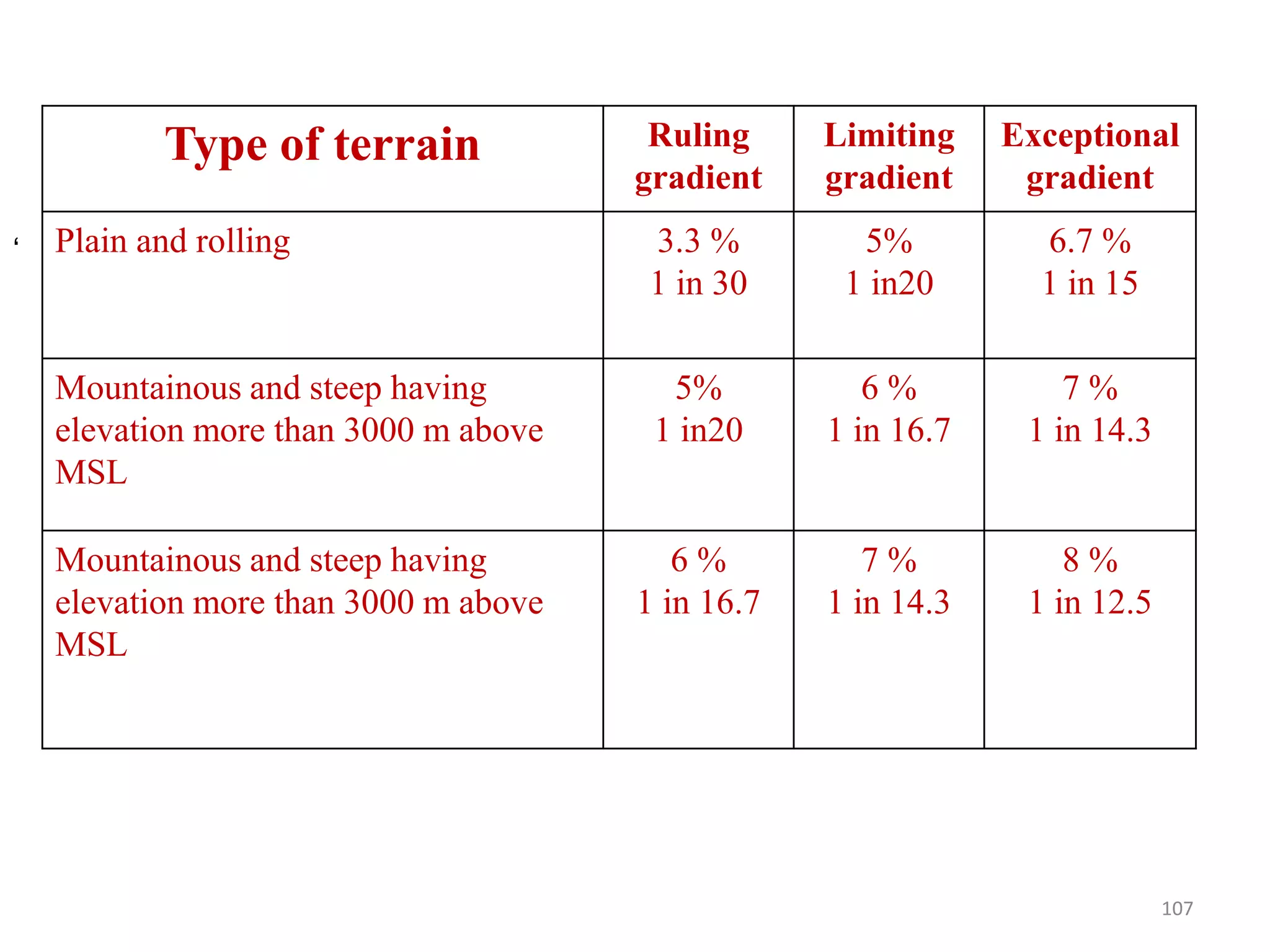
Type of terrain Ruling
gradient
Limiting
gradient
Exceptional
gradient
Plain and rolling 3.3 %
1 in 30
5%
1 in20
6.7 %
1 in 15
Mountainous and steep having
elevation more than 3000 m above
MSL
5%
1 in20
6 %
1 in 16.7
7 %
1 in 14.3
Mountainous and steep having
elevation more than 3000 m above
MSL
6 %
1 in 16.7
7 %
1 in 14.3
8 %
1 in 12.5
• This is important only at locations where surface
drainage is important.
• Camber will take care of the lateral drainage.
• But the longitudinal drainage along the side
drains require some slope for smooth flow of water.
108
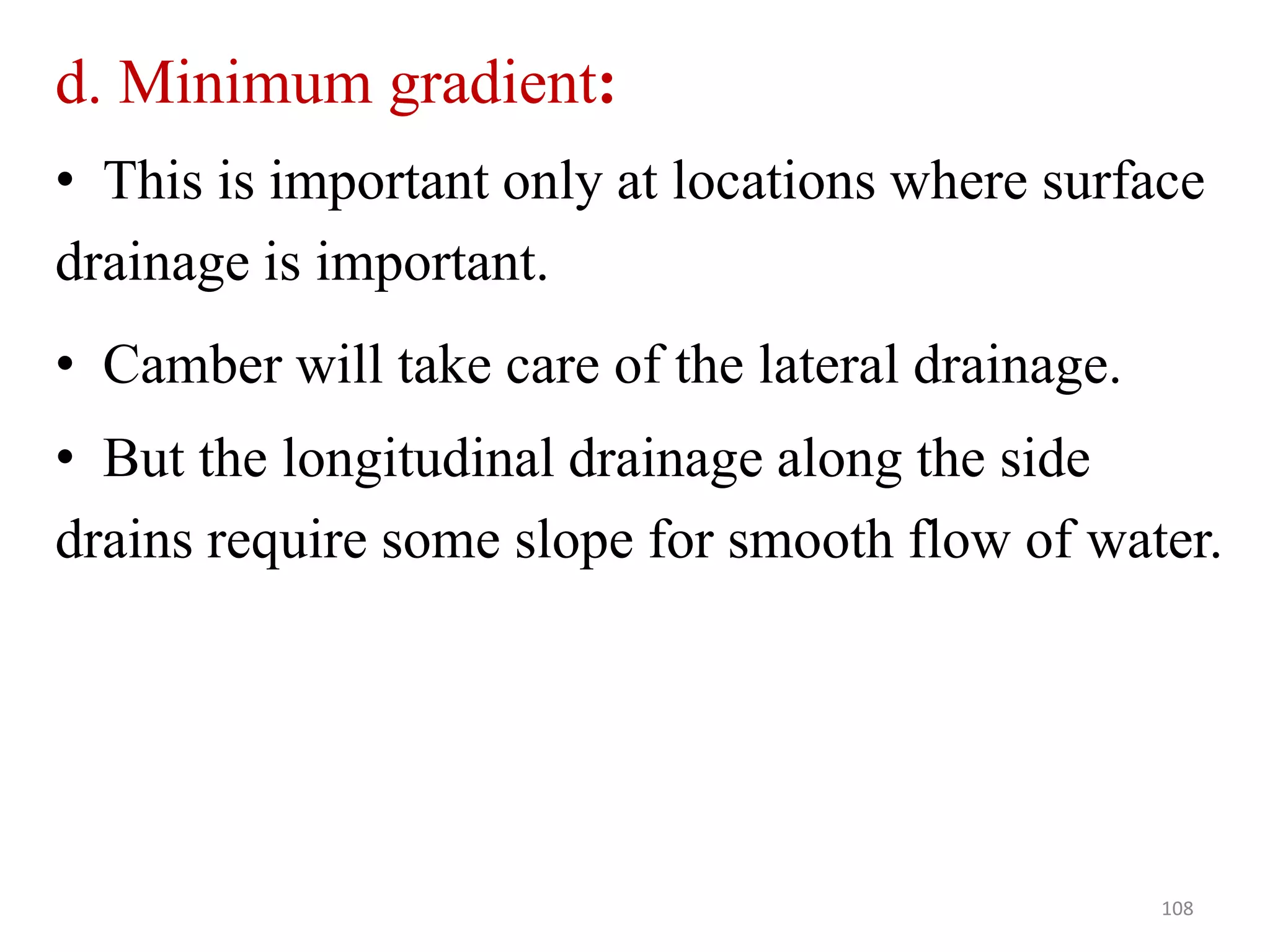
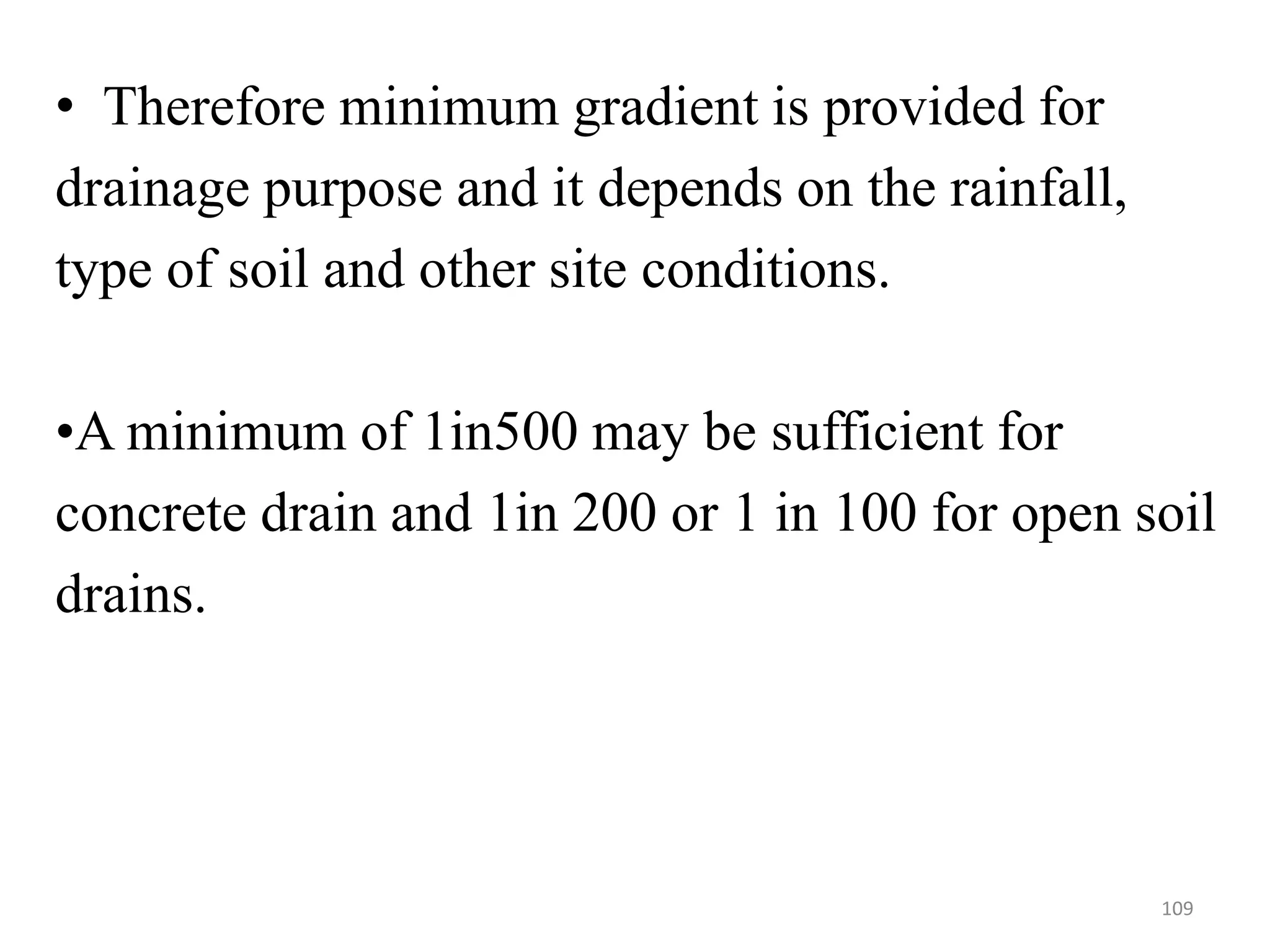
d. Minimum gradient:
• Therefore minimum gradient is provided for
drainage purpose and it depends on the rainfall,
type of soil and other site conditions.
•A minimum of 1in500 may be sufficient for
concrete drain and 1in 200 or 1 in 100 for open soil
drains.
109
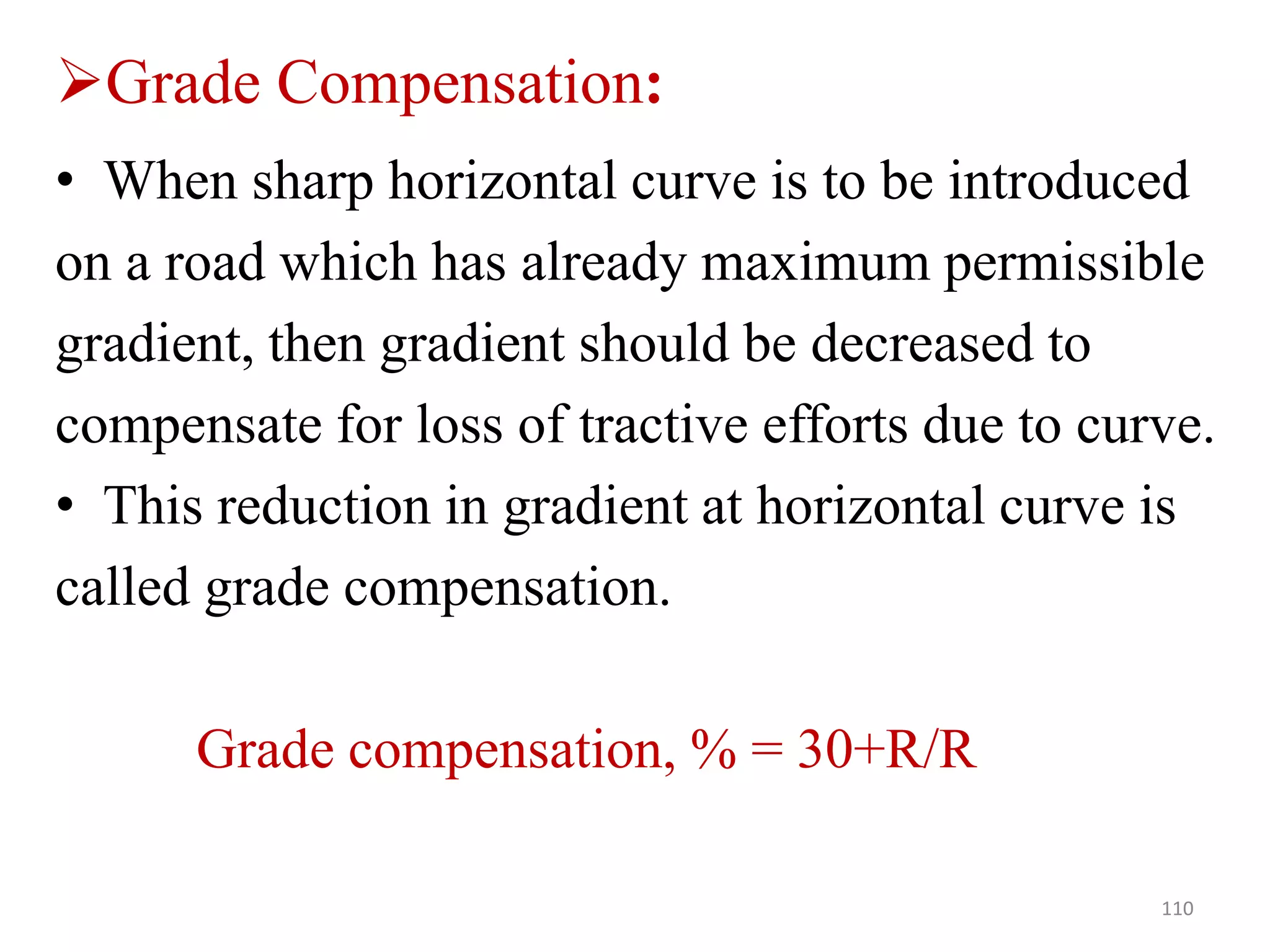
• When sharp horizontal curve is to be introduced
on a road which has already maximum permissible
gradient, then gradient should be decreased to
compensate for loss of tractive efforts due to curve.
• This reduction in gradient at horizontal curve is
called grade compensation.
Grade compensation, % = 30+R/R
110
Grade Compensation:
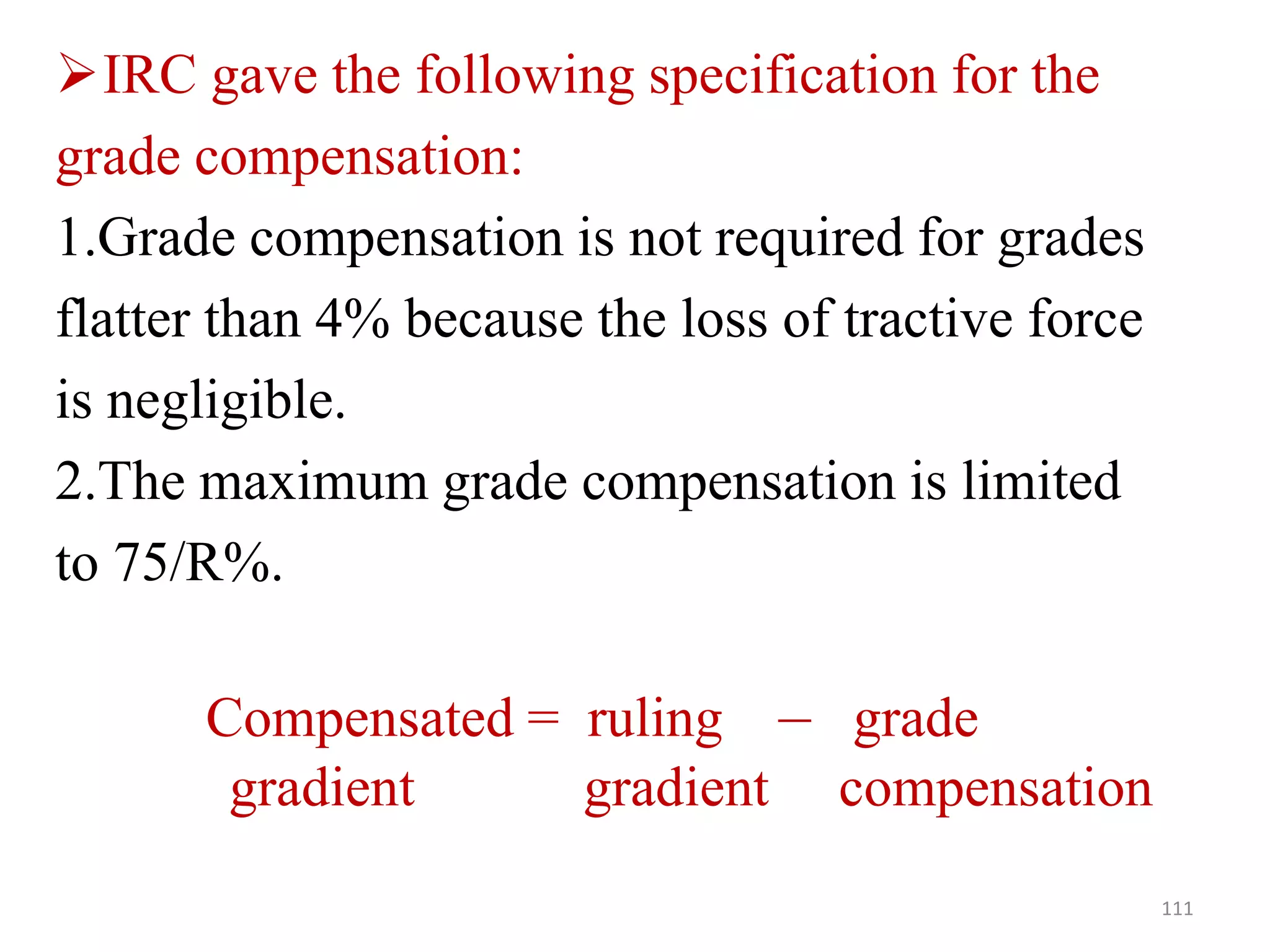
IRC gave the following specification for the
grade compensation:
1.Grade compensation is not required for grades
flatter than 4% because the loss of tractive force
is negligible.
2.The maximum grade compensation is limited
to 75/R%.
Compensated = ruling – grade
gradient gradient compensation
111
Vertical Curves:
• The vertical curves used in highway may be
classified into two categories:
a. Summit curves or crest curves
b. Valley curves or sag curves
112
‘
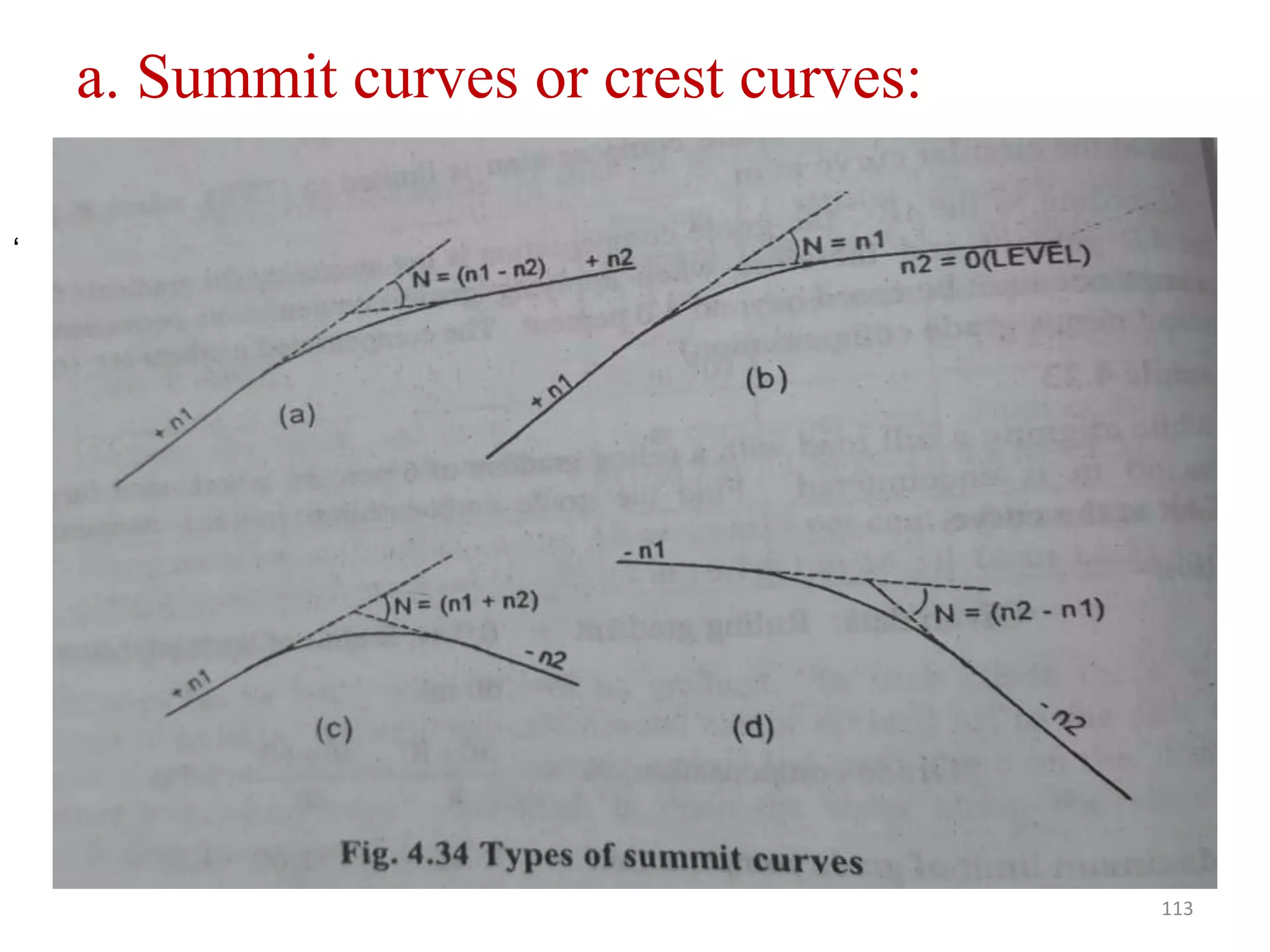
a. Summit curves or crest curves:
113
‘
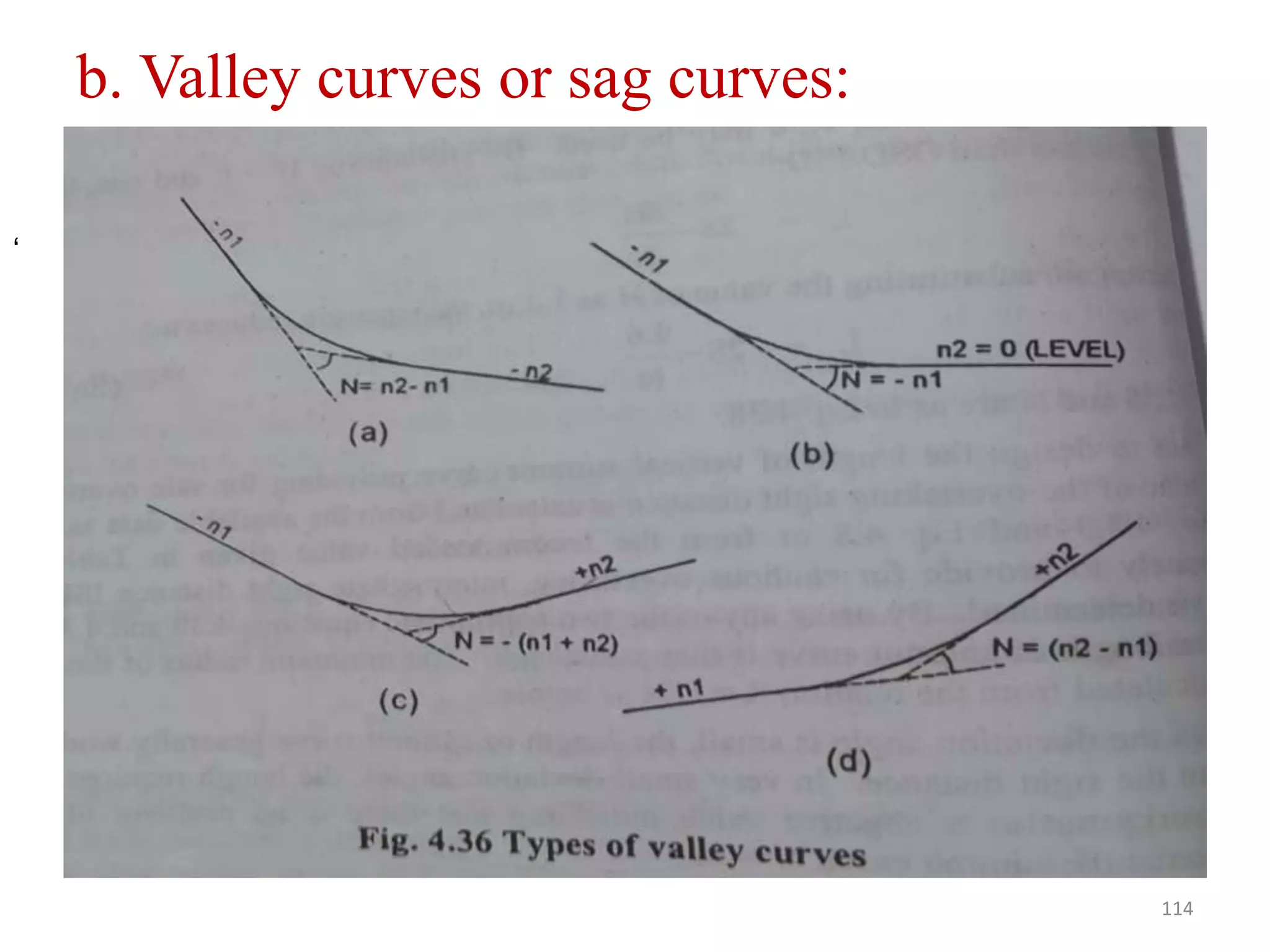
b. Valley curves or sag curves:
114
‘
Length of summit curve:
• While designing the length the parabolic summit
curves, it is necessary to consider SSD and OSD
Separately.
115
‘
• Length of summit curve for stopping sight
distance (SSD):
Two cases are considered in deciding the length:
a. When L>SSD
b. When L<SSD
116
‘
a. When L > SSD
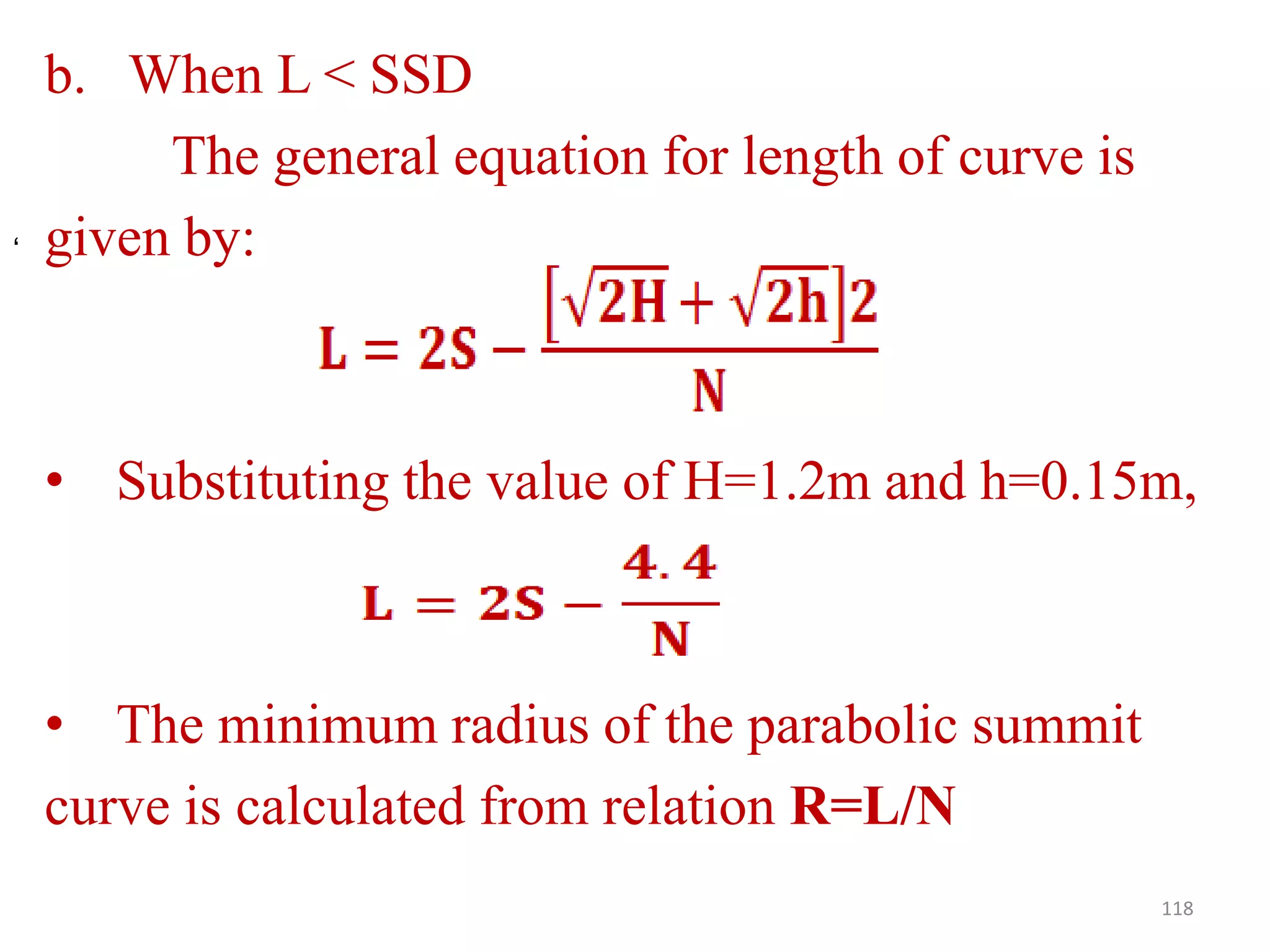
The general equation for length of curve is
given by:
• Substituting the value of H=1.2m and h=0.15m,
117
‘
b. When L < SSD
The general equation for length of curve is
given by:
• Substituting the value of H=1.2m and h=0.15m,
• The minimum radius of the parabolic summit
curve is calculated from relation R=L/N
118
‘
• Length of summit curve for overtaking sight
distance (OSD):
Two cases are considered in deciding the length:
a. When L > OSD
b. When L < OSD
119
‘
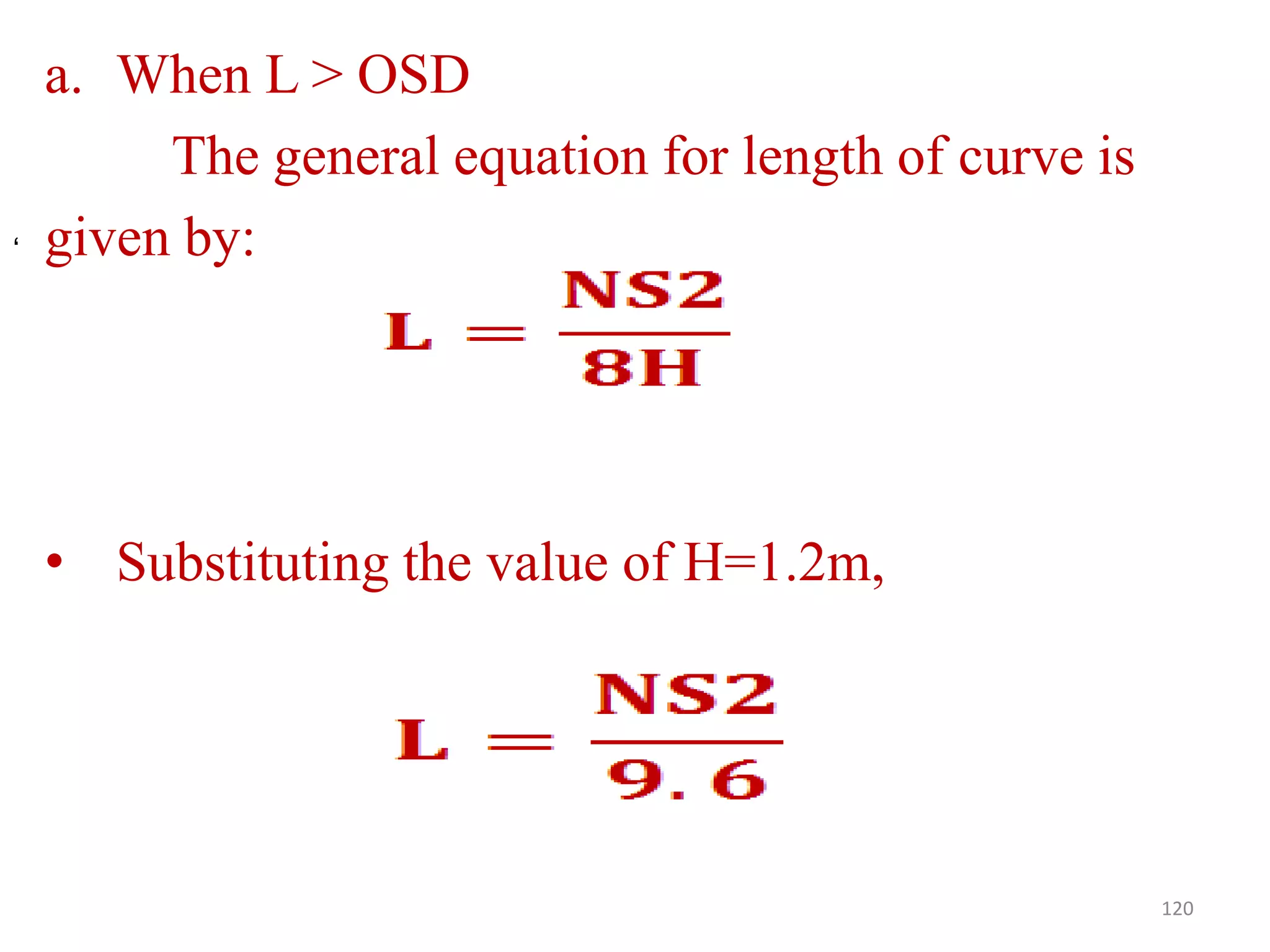
a. When L > OSD
The general equation for length of curve is
given by:
• Substituting the value of H=1.2m,
120
‘
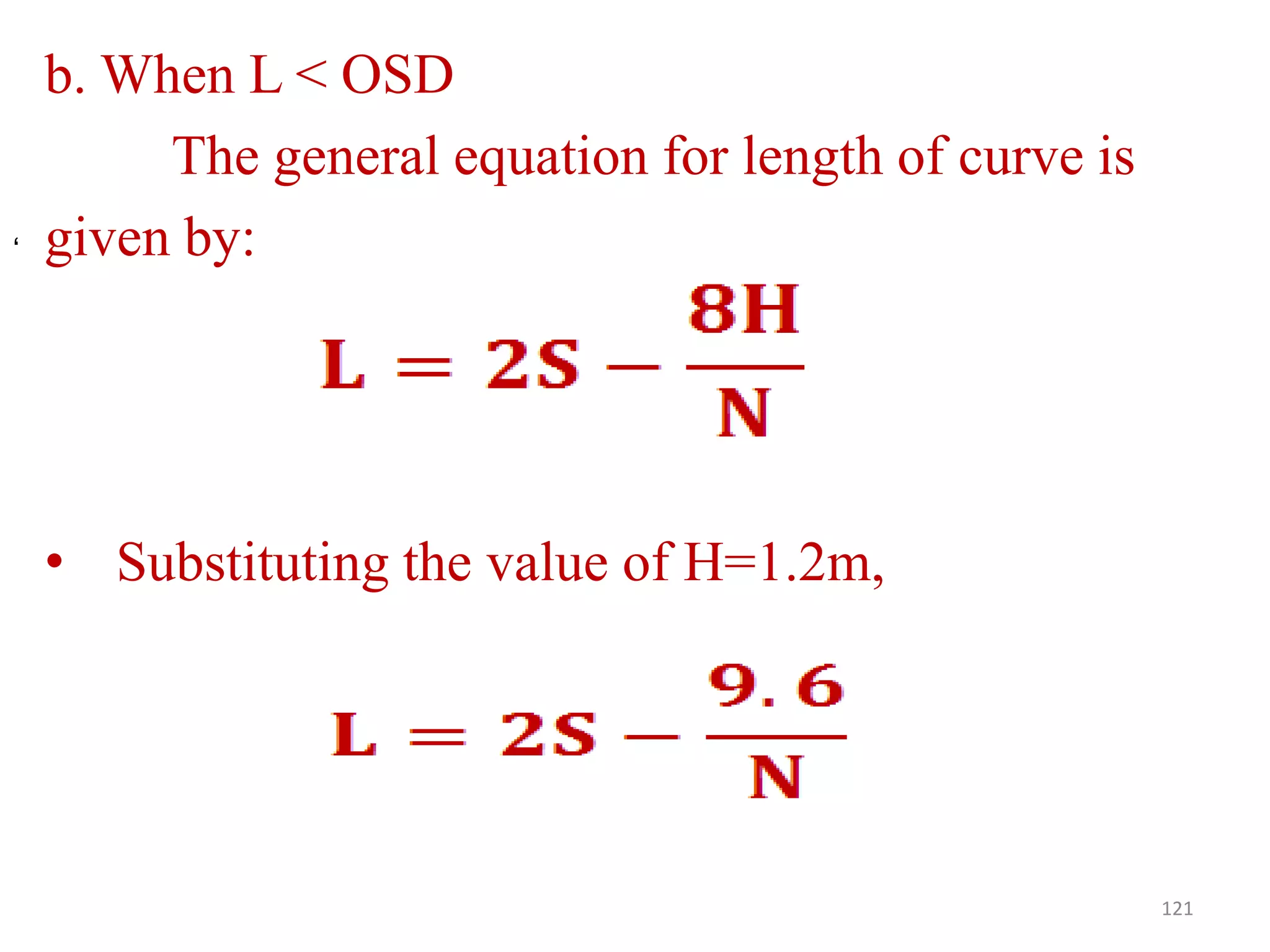
b. When L < OSD
The general equation for length of curve is
given by:
• Substituting the value of H=1.2m,
121
‘
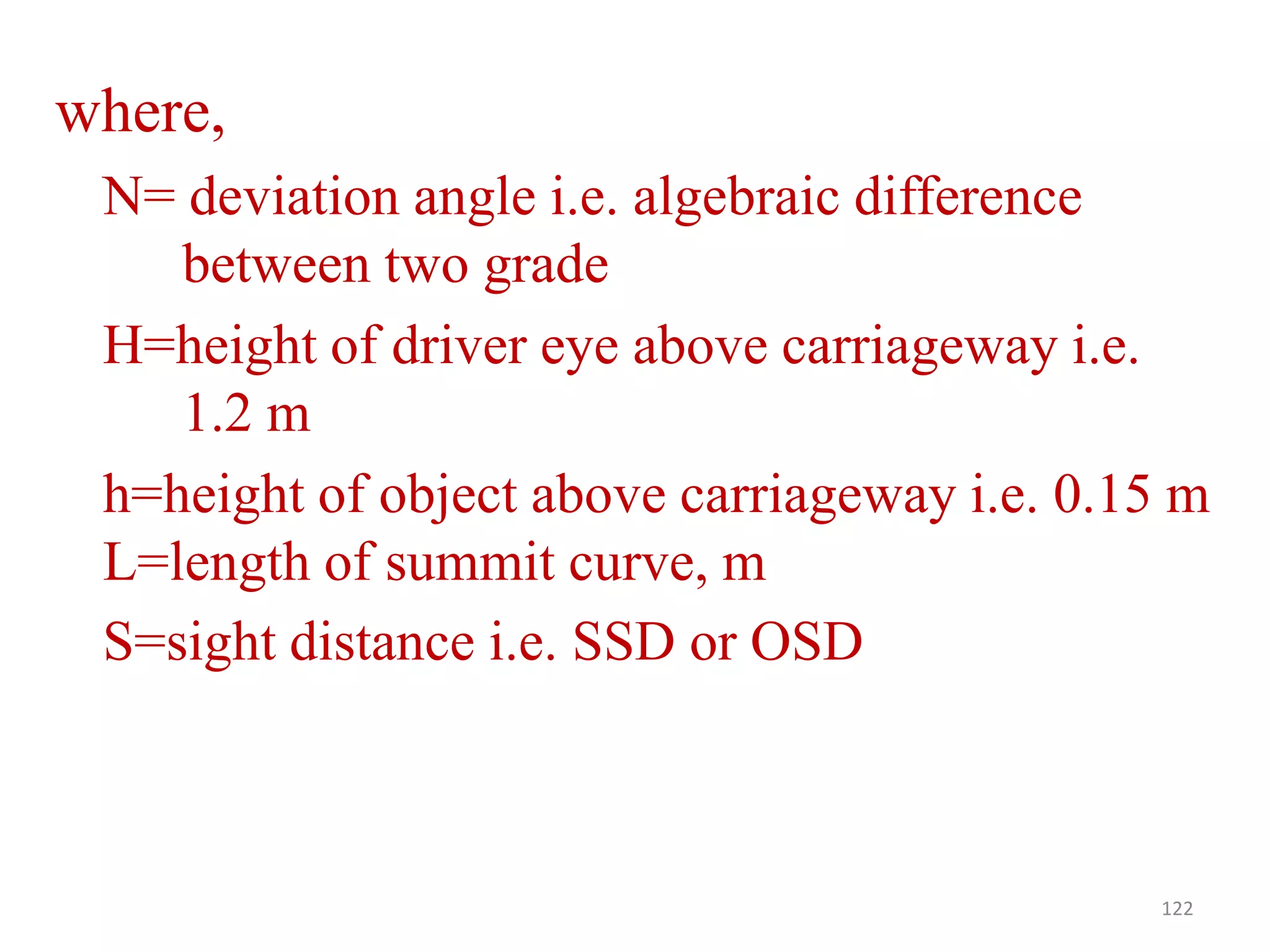
where,
N= deviation angle i.e. algebraic difference
between two grade
H=height of driver eye above carriageway i.e.
1.2 m
h=height of object above carriageway i.e. 0.15 m
L=length of summit curve, m
S=sight distance i.e. SSD or OSD
122
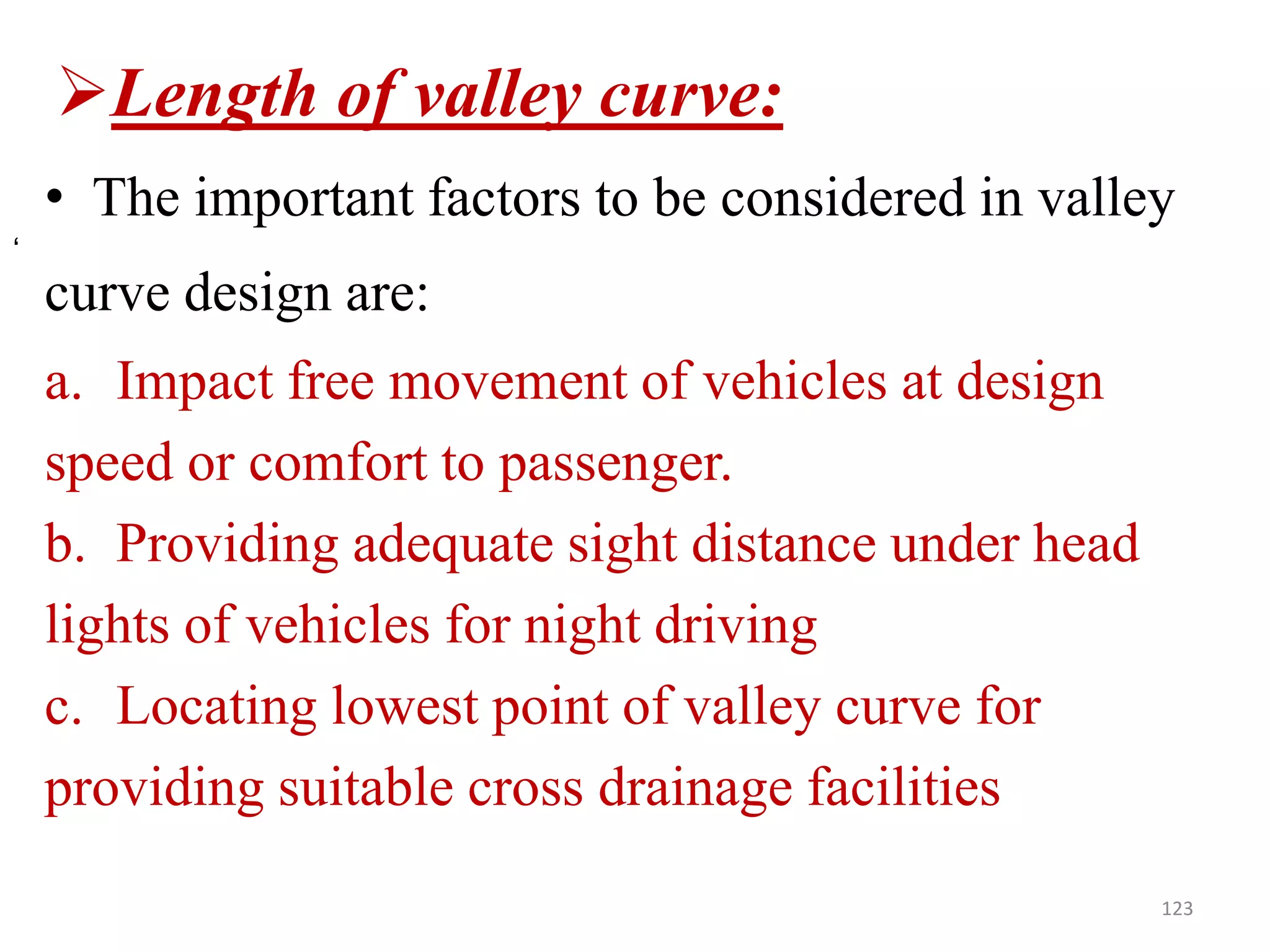
Length of valley curve:
• The important factors to be considered in valley
curve design are:
a. Impact free movement of vehicles at design
speed or comfort to passenger.
b. Providing adequate sight distance under head
lights of vehicles for night driving
c. Locating lowest point of valley curve for
providing suitable cross drainage facilities
123
‘
• The valley curve and its length are designed as a
transition curves to fulfill two criteria:
a. Allowable rate of change of centrifugal
Acceleration or comfort conditions
b. Required head light sight distance for night
driving
124
‘
a. Length of valley transition curve for comfort
condition:
Total length of valley curve is given by:
If ‘V’ is in kmph,
125
‘
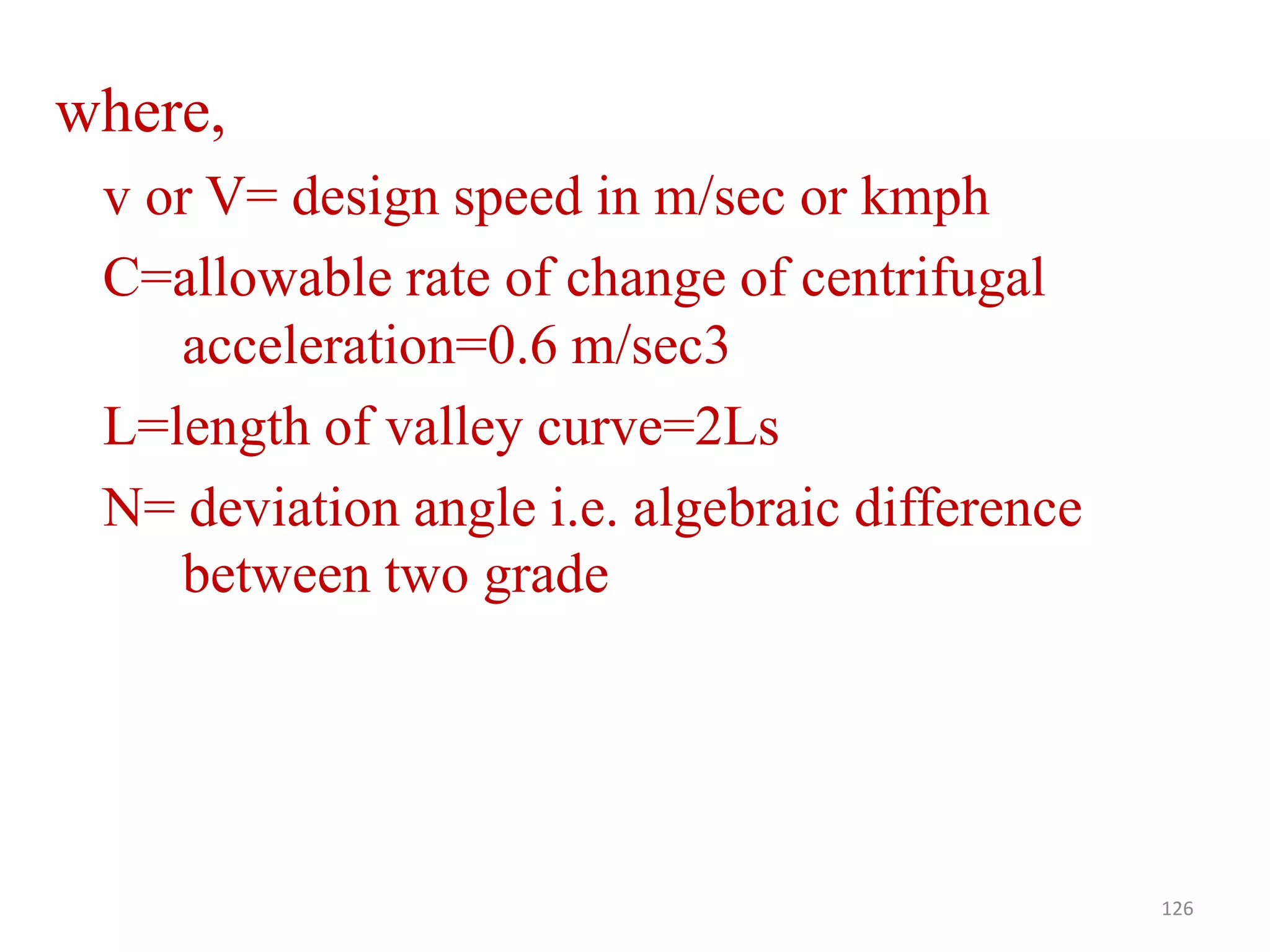
where,
v or V= design speed in m/sec or kmph
C=allowable rate of change of centrifugal
acceleration=0.6 m/sec3
L=length of valley curve=2Ls
N= deviation angle i.e. algebraic difference
between two grade
126
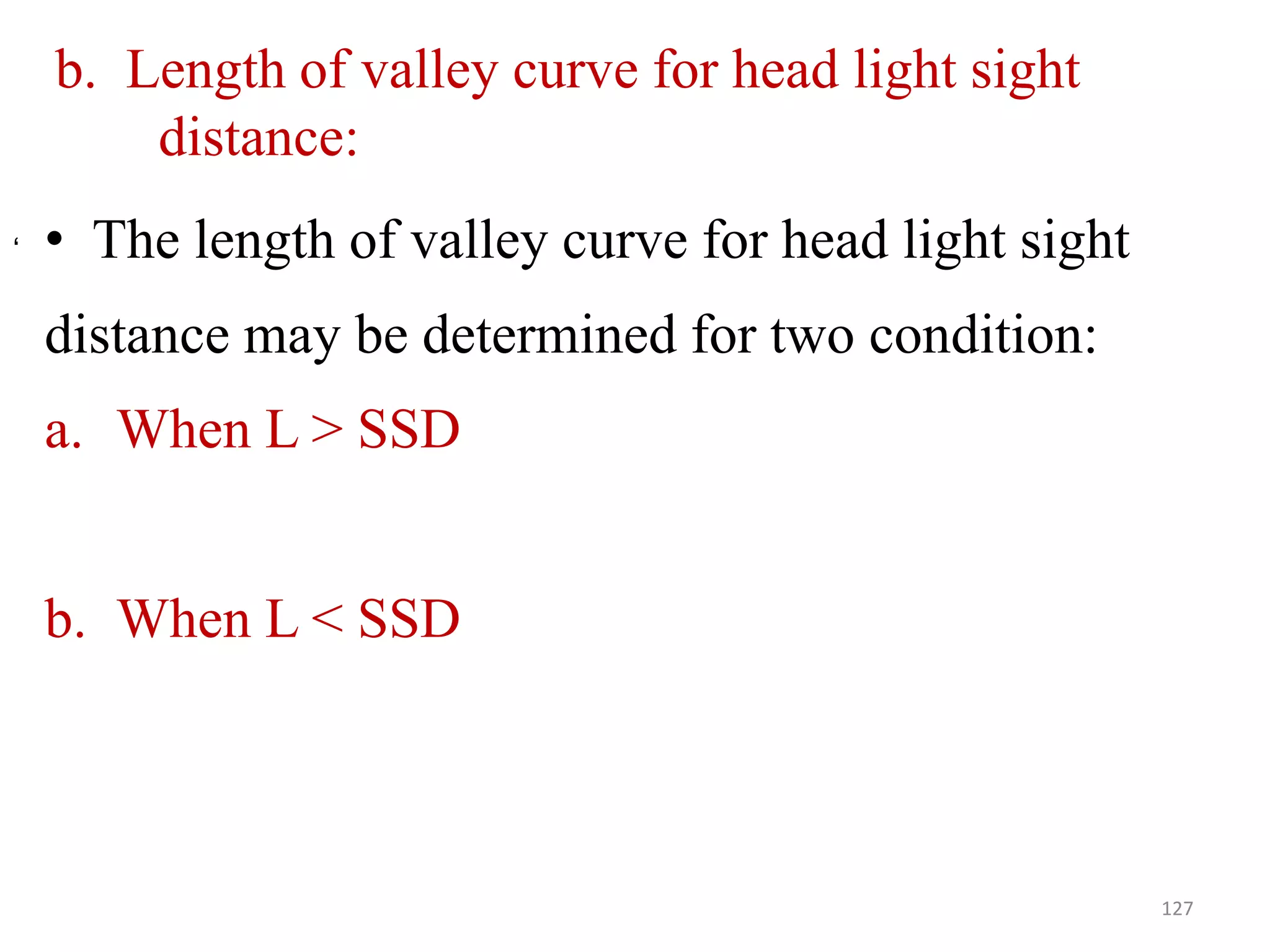
b. Length of valley curve for head light sight
distance:
• The length of valley curve for head light sight
distance may be determined for two condition:
a. When L > SSD
b. When L < SSD
127
‘
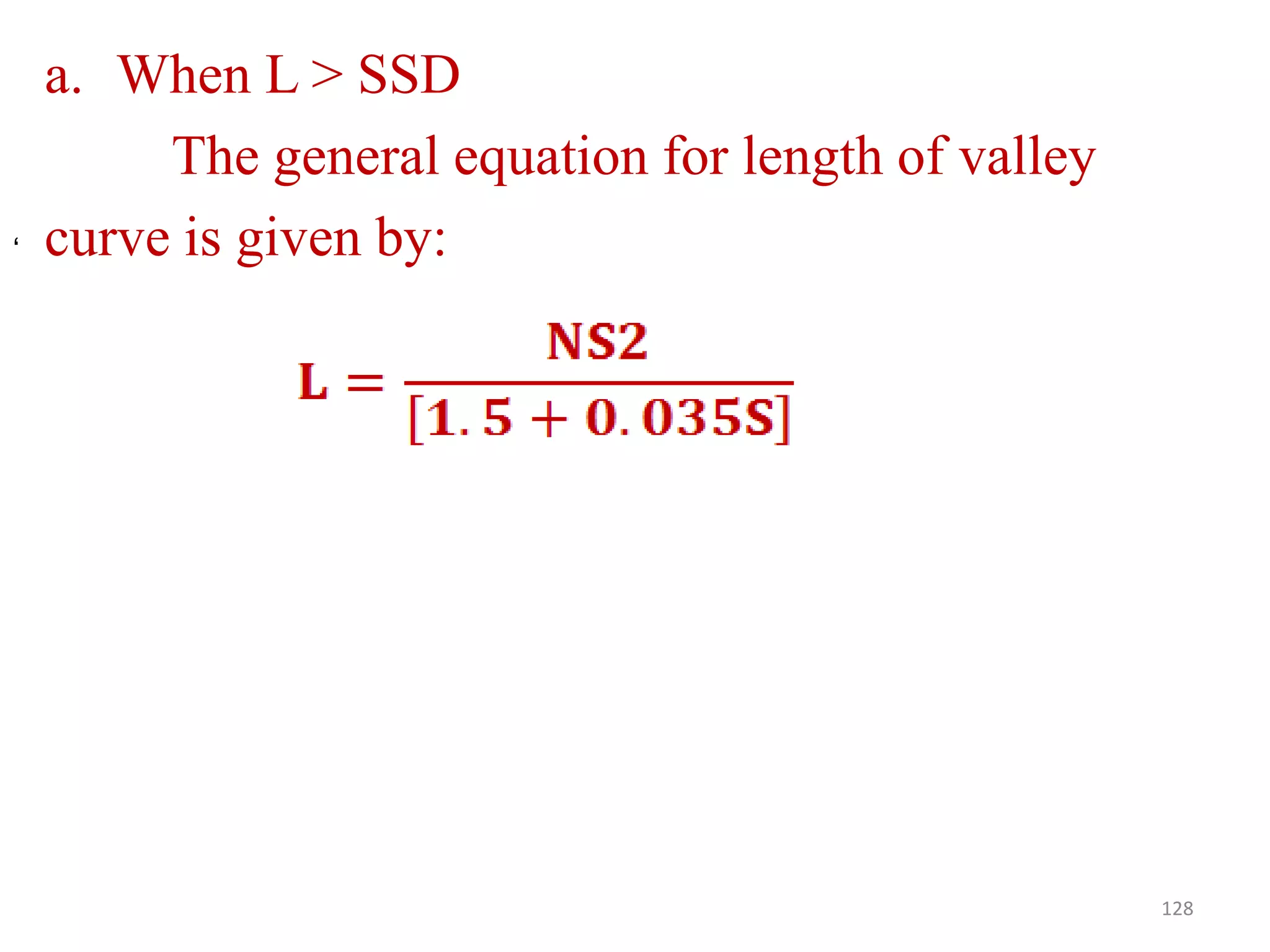
a. When L > SSD
The general equation for length of valley
curve is given by:
128
‘
b. When L < SSD
The general equation for length of valley
curve is given by:
where,
N= deviation angle i.e. algebraic difference
between two grade
L=total length of valley curve, m
S=SSD, m
129
‘

Geometric design of highway

  • 1.
  • 2.
    • Geometric designof a highway deals with the dimensions and layout of visible features of the highway such as horizontal and vertical alignments, sight distances and intersections. • The geometrics of highway should be designed to provide efficiency in traffic operations with maximum safety at reasonable cost. 2 Introduction:
  • 3.
    Geometric design ofhighways deals with following elements: a. Cross section elements b. Sight distance consideration c. Horizontal alignment details d. Vertical alignment details e. Intersection elements 3
  • 4.
    a. Cross sectionelements 4 i. Pavement surface characteristics ii. Width of Pavement or Carriageway iii. Cross Slope or Camber iv. Median or Traffic Separator v. Kerbs vi. Road Margins vii.Width of Formation
  • 5.
  • 6.
    i. Pavement surfacecharacteristics: The important surface characteristics of the pavement are:  Friction  Unevenness  Light reflecting characteristics  Drainage of surface water 6
  • 7.
    ii. Width ofPavement or Carriageway: It is total width of road on which vehicles are allowed to move. • The width of pavement depends on width of traffic lane and number of lanes. • Width of lane is decided based on maximum width of heavy commercial vehicle (HCV) which is legally permitted to use the roadway. 7
  • 8.
  • 9.
  • 10.
  • 11.
    • The widthof carriageway for various classes of roads standardised by Indian Roads Congress (IRC) are given below: 11 Class Of Road Width Of Carriageway (m) Single lane road 3.75 Two lanes, without raised kerbs 7 Two lanes, with raised kerbs 7.5 Intermediate Carriageway 5.5 Multi-lane pavements 3.5 per lane
  • 12.
    iii. Cross Slopeor Camber: Cross slope or camber is the slope provided to the road surface in the transverse direction to drain off the rain water from the road surface. • Drainage and disposal of water from pavement is considered important because of the following reason: a. To maintain stability, surface condition and increase life of pavement. 12
  • 13.
    b. To preventstripping of bitumen from aggregates. c. To prevent slipping of vehicles running at high speed. • The rate of camber or cross slope is usually designated by 1 in n or may also be expressed as a percentage. • The required camber of a pavement depends on type of pavement surface and amount of rainfall. 13
  • 14.
    • The valuesof camber recommended by IRC for different types of road surfaces are given below: 14 Sr.No Type Of Road Surface Range of camber in areas of Heavy rainfall Low rainfall 1 Cement concrete and thick bituminous surface 1 in 50 or 2 % 1 in 60 or 1.7 % 2 Thin bituminous surface 1 in 40 or 2.5% 1 in 50 or 2 % 3 Water bound macadam and gravel pavement 1 in 33 or 3% 1 in 40 or 2.5 % 4 Earth road 1 in 25 or 4% 1 in 33 or 3 %
  • 15.
     Shape OfCross Slope: 15
  • 16.
    iv. Median orTraffic Separator: Median is provided between two sets of traffic lanes intended to divide the traffic moving in opposite directions. • The main function of the median is to prevent head-on collision between vehicles moving in opposite directions on adjacent lanes. • The traffic separators used may be in form of pavement markings, physical dividers or area separators. 16
  • 17.
  • 18.
    18 • The widthof medians for roads standardised by Indian Roads Congress (IRC) are given below: Sr.No Type Of Road Width Of Medians (m) Desirable Minimum 1 Expressway 15 10 2 Other Highways 5 3 3 At intersection of urban roads 5 1.2 4 On Long Bridges 1.5 1.2
  • 19.
  • 20.
    v. Kerbs: Kerb indicatesthe boundary between the pavement and median or foot path or shoulder. • Kerbs may be mainly divided into three groups based on their functions: a. Low kerb b. Semi-barrier type kerb c. Barrier type kerb 20
  • 21.
  • 22.
    vi. Road Margins: Thevarious elements included in the road margins are: a. Shoulder b. Guard rail c. Foot path d. Drive way e. Cycle track f. Parking lane g. Embankment slope. 22
  • 23.
    vii. Width ofFormation or Roadway: Width of formation or roadway is the sum of widths of pavement or carriageway including separators, if any and the shoulders. • Width of roadway are standardised by the Indian Roads Congress. 23
  • 24.
    24 Sr. No Road Classification RoadwayWidth (m) Plain and rolling terrain Mountainous and steep terrain 1 National & State Highways a) Single Lane b) Two lane 12 6.25 12 8.80 2 Major District Roads a) Single Lane b) Two lane 9 4.75 9 - 3 Other District Roads a) Single Lane b) Two lane 7.5 4.75 9 - 4 Village Roads ,Single Lane 7.5 4
  • 25.
    The minimum distanceopen to the vision of the driver of a vehicle intending to overtake slow vehicle ahead with safety against traffic of opposite direction is known as minimum overtaking sight distance or safe passing sight distance available. 25 Overtaking Sight Distance:
  • 26.
    • Minimum OSDrequired for the safe overtaking depends on: a. Speed of overtaking, overtaken vehicle and vehicle coming from opposite direction if any. b. Skill and reaction time of the driver. c. Distance between overtaking and overtaken vehicles. d. Rate of acceleration of overtaking vehicle e. Gradient of the road if any. 26 Factors on which overtaking sight distance depends:
  • 27.
    27 Analysis of OSDon a two lane road with two way traffic:
  • 28.
    28 • From A1to A2, the distance ‘d1’ (m) travelled by overtaking vehicle A at reduced speed ‘vb’ (m/s) during reaction time ‘t’ (sec), d1= vb X t • IRC suggest reaction time t of driver as 2 sec , d1= 2vb • From A2 to A3, vehicle A starts accelerating, shift to adjoining lane, overtakes vehicle B, and shift back to its original lane during overtaking time ‘T’ (sec) and travel distance ‘d2’ (m).
  • 29.
    29 • From A2to A3, the distance ‘d2’ (m) is further split into three parts viz; d2= (s+b+s) d2= (b+2s) • The minimum spacing ‘s’ (m)between vehicles depends on their speed and is given by empirical formula, s=(0.7vb + 6) • The distance covered by the slow vehicle B travelling at a speed of ‘vb’ (m/s) in time ‘T’ (sec) is, b= vb X T
  • 30.
    30 • The overtakingtime ‘T’ (sec) is calculated as; d2=(b+2s)=(vbT+aT2/2) b=vb T , 2s=aT2/2 • From C1 to C2, distance travelled by vehicle C moving at design speed ‘v’ (m/s) during time ‘T’ (sec) is given by, d3=v X T
  • 31.
    31 • Thus overtakingsight distance (OSD) is, OSD=(d1+d2+d3) OSD= (vb X t) + (vb X T +2s) +(v X T) • If speed is in kmph, OSD= (0.28Vb X t)+(0.28Vb X T+2s)+(0.28V X T) • In case speed of overtaken vehicle is not given it is assumed 16 kmph less than design speed of the highway.
  • 32.
    where, s=spacing of vehicles t=reactiontime of driver = 2sec v =design speed in m/sec V= design speed in kmph vb=initial speed of overtaking vehicle in m/sec Vb=initial speed of overtaking vehicle in Kmph A=average acceleration in kmph/sec a=average acceleration in m/sec2 32
  • 33.
    33 Overtaking Zones: • Overtakingopportunity for vehicles moving at design speed should be given at frequent intervals as possible. • These zones which are meant for overtaking are called overtaking zones. • The minimum length of overtaking zone should be three times safe overtaking sight distance i.e.3OSD.
  • 34.
  • 35.
    35 Design of HorizontalAlignment: Various design elements to be considered in the horizontal alignment are : a. Design speed b. Horizontal curve c. Super elevation d. Type and length of transition curves e. Widening of pavement on curves f. Set-back distance
  • 36.
    36 a. Design speed •The design speed is the main factor on which geometric design elements depends. • The design speed of roads depends upon i) Class of the road ii) Terrain
  • 37.
    37 Classification of Terrain TerrainClassification Cross Slope Of Country in % Plain 0-10 Rolling 10-25 Mountainous 25-60 Steep Greater than 60
  • 38.
  • 39.
    39 b. Horizontal curve Ahorizontal highway curve is a curve in plan to provide change in direction to the central line of a road. • When a vehicle traverses a horizontal curve, the centrifugal force acts horizontally outwards through the centre of gravity of the vehicle. • The centrifugal force is given by the equation: P = Wv²∕gR
  • 40.
    40 where, P=centrifugal force inkg W=Weight of the vehicle in kg R=radius of the circular curve in m v=speed of the vehicle in m/s g=acceleration due to gravity=9.8 m/s2
  • 41.
    • P/W isknown as the centrifugal ratio or the impact factor. The centrifugal ratio is thus equal to v²∕gR. • The centrifugal force acting on a vehicle negotiating a horizontal curve has two effects: i. Tendency to overturn the vehicle outwards about the outer wheels ii. Tendency to skid the vehicle laterally, outwards 41
  • 42.
  • 43.
    • The equilibriumcondition for overturning will occur when Ph = Wb/2, or when P/W =b/2h. • This means that there is danger of overturning when the centrifugal ratio P/W or v²/g R attains a values of b/2h. 43
  • 44.
  • 45.
    • The equilibriumcondition for the transverse skid resistance developed is given by P = FA+ FB= f(RA+RB) =fW • Since P = f W, the centrifugal ratio P/W is equal to ‘f ‘. • In other words when the centrifugal ratio attains a value equal to the coefficient of lateral friction there is a danger of lateral skidding. 45
  • 46.
    • ‘f’ isless than ‘b/2h’,the vehicle would skid and not overturn. • ‘b/2h’ is lower than ‘f’, the vehicle would overturn on the outer side before skidding. • Thus the relative danger of lateral skidding and overturning depends on whether f is lower or higher than 46
  • 47.
    47 c. Super elevation(e): • In order to counteract the effect of centrifugal force and to reduce the tendency of the vehicle to overturn or skid, the outer edge of the pavement is raised with respect to the inner edge, thus providing a transverse slope throughout the length of the horizontal curve. • This transverse inclination to the pavement surface is known as Super elevation or cant or banking.
  • 48.
    48 • The Superelevation ‘e’ is expressed as the ratio of the height of outer edge with respect to the horizontal width.
  • 49.
  • 50.
  • 51.
    • For equilibriumcondition, P cosө=W sinө+FA+FB P cosө=W sinө+ f.RA + f.RB P cosө=W sinө+f(RA+RB) P cosө=W sinө+f(W cos ө+P sin ө) P(cosө – f sinө)=W sinө+f Wcosө Dividing by Wcosө, P/W(1- f tanө)=tanө+f Centrifugal ratio =P/W= tanө+f /(1-f tanө) 51
  • 52.
    • The valueof coefficient of lateral friction ‘f’ is taken as 0.15 and tanө i.e. super elevation seldom exceeds 7-10%. • Therefore, Centrifugal ratio =P/W = tanө+f P/W = e + f ……i but P/W = v²∕gR ……ii • Therefore, the general equation for the design of super elevation is given by, e + f = v²∕gR 52
  • 53.
    • If ‘V’speed of the vehicle is in kmph, e + f = V²∕ 127R where, e=rate of Superelevation=tanӨ f = design value of lateral friction coefficient = 0.15 v = speed of the vehicle, m/sec R = radius of the horizontal curve, m g = acceleration due to gravity = 9.81 m/sec² 53
  • 54.
    Maximum Superelevation • IndianRoads Congress (IRC) had fixed the maximum limit of Superelevation in plan and rolling terrains and is snow bound areas as 7.0 %. • On hill roads not bound by snow a maximum Superelevation upto10% is recommended. • On urban road stretches with frequent intersections, it may be necessary to limit the maximum Superelevation to 4.0 %. 54
  • 55.
    Minimum Superelevation • Fromdrainage consideration it is necessary to have a minimum cross slope to drain off the surface water. If the calculated superelevation is equal to or less than the camber of the road surface, then the minimum superelevation to be provided on horizontal curve may be limited to the camber of the surface. 55
  • 56.
    Steps For SuperelevationDesign Step-I: The superelevation for 75 percent of design speed is calculated, neglecting the friction. e =(0.75v)²∕ gR …..if ‘v’ is in m/sec e =(V)²∕ 225R …..if ‘V’ is in kmph Step-II: If the calculated value of ‘e’ is less than 7% or 0.07 the value so obtained is provided. • If the value of ‘e’ exceeds 7% or 0.07 then provides maximum superelevation equal to 7% or 0.07 and proceed with step-III or IV. 56
  • 57.
    Step-III: Check thecoefficient of friction developed for the maximum value of e =0.07 at the full value of design speed. f =v²∕ gR - 0.07 …..if ‘v’ is in m/sec f =V²∕ 127R - 0.07 …..if ‘V’ is in kmph • If the value of ‘f’ thus calculated is less than 0.15, the super elevation of 0.07 is safe for the design speed. If not, calculate the restricted speed as given in Step -IV. 57
  • 58.
    Step-IV: The allowablespeed at the curve is calculated by considering the design coefficient of lateral friction and the maximum superelevation. e + f =0.07+0.15=va²∕ gR=Va²∕ 127R e + f =0.22=va²∕ gR = Va²∕ 127R • Safe allowable speed (va or Va) is calculated as: 58
  • 59.
    • If theallowed speed, as calculated above is higher than the design speed, then the design is adequate and provides a superelevation of ‘e’ equal to 0.07. • If the allowable speed is less than the design speed, the speed is limited to the allowed speed calculated above and appropriate warning sign and speed limit regulation sign are installed to restrict and regulate the speed. 59
  • 60.
    60 Attainment of superelevationin the field: The attainment of superelevation may be split up into two parts: a. Elimination of crown of the cambered section b. Rotation of pavement to attain full superelevation
  • 61.
    61 a. Elimination ofcrown of the cambered section: 1stMethod:Outer edge rotated about the crown • Disadvantages Small length of road –cross slope less than camber. Drainage problem in outer half.
  • 62.
  • 63.
    63 2ndMethod: Crown shiftedoutwards • Disadvantages Large negative superelevation on outer half. Drivers have the tendency to run the vehicle along shifted crown.
  • 64.
  • 65.
    65 b. Rotation ofpavement to attain full superelevation 1st Method: Rotation about the Centre line
  • 66.
    66 Advantages • Earthwork isbalanced • Vertical profile of the C/L remains unchanged Disadvantages • Drainage problem: depressing the inner edge below the general level
  • 67.
    67 2nd Method: Rotationabout the Inner edge
  • 68.
    68 Advantages •No drainage problem Disadvantages •Additionalearth filling •Centre line of the pavement is also raised (vertical alignment of the road is changed)
  • 69.
    69 Radius of HorizontalCurve: e + f = v²∕gR = V²∕ 127R • If maxm. Allowable superelevation rate has been fixed as 7% and lateral friction f is 0.15 then, 0.07 + 0.15 = v²∕gR = V²∕ 127R 0.22= v²∕gR = V²∕ 127R • If design speed is decided ruling and minimum radius is calculated as, Rruling = v²∕g(e + f) = V²∕ 127(e + f) Rmin = v’²∕g(e + f) = V’²∕ 127(e + f)
  • 70.
    where, e=rate of Superelevation f= design value of lateral friction coefficient = 0.15 v or V= design speed of the vehicle, m/sec or kmph v’ or V’= minimum design speed of the vehicle, m/sec or kmph g = acceleration due to gravity = 9.81 m/sec² 70
  • 71.
    71 Widening of pavementon horizontal curves: On horizontal curves, especially when they are Less than 300m radii, it is common to widen the pavement slightly more than the normal width. • Widening is needed for the following reasons: a. An automobile has a rigid wheel base and only the front wheels can be turned, when this vehicle takes a turn to negotiate a horizontal curve, the rear wheel do not follow the same path as that of the front wheels. This phenomenon is called off tracking.
  • 72.
    72 b. While twovehicle cross or overtake at horizontal curve there is psychological tendency to maintain a greater clearance between the vehicle for safety. c. For greater visibility at curve, the driver have tendency not to follow the central path of the lane, but to use the outer side at the beginning of the curve. d. At higher speed superelevation and lateral friction cannot counteract centrifugal force and skidding may occur.
  • 73.
    73 Analysis of extrawidening on horizontal curves: The extra widening of pavement on horizontal curves is divided into two parts: a. Mechanical widening/Off tracking b. Psychological widening
  • 74.
  • 75.
    75 Consider OA=R1=radius of thepath traversed by the outer rear wheel,m OB=R2=radius of the path traversed by the outer front wheel,m Wm=mechanical widening due to off-tracking, m l=length of wheel base,m R=mean radius of the horizontal curve, m OB-OA= R2 - R1 =Wm
  • 76.
    76 From Δ OAB,OA2=OB2-BA2 R1 2 = R2 2 - l2 But , R1 = R2-Wm (R2-Wm) 2 = R2 2-l2 R2 2-2R2Wm+ Wm2 = R2 2-l2 l2 =Wm (2R2-Wm) Wm = l2/ (2R2-Wm) Wm = l2/ 2R • If road having ‘n’ traffic lanes and ‘n’ vehicles can travel simultaneously, mechanical widening reqd. is given by, Wm = nl2/ 2R
  • 77.
    77 b. Psychological widening(Wps): An empirical formula has been recommended by IRC for deciding the additional psychological widening. • The psychological widening is given by the formula:
  • 78.
    • The totalextra widening is given by, We=Wm + Wps where, n=no. of traffic lanes l = length of wheel base =6.1 or 6 m V=design speed kmph R = radius of the horizontal curve, m 78
  • 79.
    79 Horizontal Transition Curve: Atransition curve has a radius which decreases from infinity at the tangent point to a designed radius of the circular curve. • The rate of change of radius of the transition curve will depend on the shape of the curve adopted and the equation of the curve.
  • 80.
  • 81.
    81 Objects of providingtransition curve: A transition curve which is introduced between straight and a circular curve will help in: a. Gradually introducing centrifugal force. b. Gradually introducing designed superelevation. c. Gradually introducing extra widening. d. To enable the driver turn steering gradually for his own comfort and safety.
  • 82.
    82 Length of transitioncurve: The length of transition curve is designed to fulfill three conditions: a. Rate of change of centrifugal acceleration to be developed gradually b. Rate of introduction of designed superelevation c. Minimum length by IRC empirical formula
  • 83.
    83 a. Rate ofChange of centrifugal acceleration: • The length of transition curve is calculated as: ……if ‘v’ is in m/sec ……if ‘V’ is in kmph where,
  • 84.
    84 where, Ls=length of transitioncurve, m C=allowable rate of change of centrifugal acceleration V = design speed in kmph v = design speed in m/sec R = radius of the circular curve, m
  • 85.
    85 b. Rate ofintroduction of superelevation: • If the pavement is rotated about the center line: Ls=EN/2=e N/2(W + We) •If the pavement is rotated about the inner edge: Ls= EN= e N(W + We) where, W = width of pavement We = extra widening E=total raised pavement= e. B B=total width of pavement=(W + We) Rate of change of superelevation of 1 in N N=150,100,60
  • 86.
    86 c. Minimum Lengthby IRC empirical formula: • According to IRC standards: a. For plane and rolling terrain: b. For mountainous and steep terrain:
  • 87.
    Shift of transitioncurve: • If the length of transition curve is ‘Ls’ and the radius of the circular curve is ‘R’, the shift ‘S’ of transition curve is given by; 87 ‘
  • 88.
    Set Back Distance: •Set back distance is the distance from centre of horizontal curve to an obstruction on inner side of the curve. • Set back distance is required to provide adequate sight distance on the horizontal curve. • Obstruction to the sight distance on horizontal curve may be buildings, trees, cut slopes on the inner side of curve. 88 ‘
  • 89.
    • On narrowroad, the sight distance is measured along the centre line of road. • On wider road, the sight distance is measured along the centre line of inner side lane. • Set back distance depends on: a. Required sight distance, S b. Radius of horizontal curve, R c. Length of the curve, Lc 89 ‘
  • 90.
  • 91.
    Analysis of Setback distance: • Two cases are considered for the analysis: a. When length of curve is more than Sight distance (Lc>S) b. When length of curve is less than Sight distance (Lc<S) 91 ‘
  • 92.
    Case I:When Lc>S: •For narrow Road: Set back distance (m) for narrow road is given by: 92 ‘
  • 93.
  • 94.
    • For widerRoad: Set back distance (m) for wider road is given by: 94 ‘
  • 95.
  • 96.
    where, α =angle subtendedby the arc m=set back distance, m R=radius of curve, m S=Sight Distance, m d=distance between centre line of road and centre line of inner lane 96
  • 97.
    Case II:When Lc<S: •For narrow Road: Set back distance (m) for narrow road is given by: 97 ‘
  • 98.
  • 99.
    • For widerRoad: Set back distance (m) for wider road is given by: 99 ‘
  • 100.
    Vertical Alignment: • Thevertical alignment is the elevation or profile of the centre line of the road. • The vertical alignment consists of grades and vertical curves. • The vertical alignment of a highway influences: i. Vehicle speed ii. Acceleration and deceleration iii. Sight distance iv. Vehicle operation cost v. Comfort while travelling at high speeds 100 ‘
  • 101.
  • 102.
    Gradients: • Gradient isthe rate of rise or fall along the length of road with respect to the horizontal. • It is expressed as a ratio of 1 in n or also as percentage such as n%. 102 ‘
  • 103.
    Types Of Gradients: •Gradients are divided into four categories: a. Ruling gradient b. Limiting gradient c. Exceptional gradient d. Minimum gradient 103 ‘
  • 104.
    a. Ruling gradient: •Ruling gradient is the maximum gradient within which the designer attempts to design the vertical profile of a road. • Ruling gradient is also known as ‘Design gradient’. • For selection of ruling gradient factors such as type of terrain, length of the grade, speed, pulling power of vehicle etc are considered. 104 ‘
  • 105.
    b. Limiting gradient: •Steeper than ruling gradient. In hilly roads, it may be frequently necessary to exceed ruling gradient and adopt limiting gradient, it depends on a. Topography b. Cost in constructing the road 105 ‘
  • 106.
    • Exceptional gradientare very steeper gradients given at unavoidable situations. • They should be limited for short stretches not exceeding about 100 m at a stretch. 106 c. Exceptional gradient:
  • 107.
    107 ‘ Type of terrainRuling gradient Limiting gradient Exceptional gradient Plain and rolling 3.3 % 1 in 30 5% 1 in20 6.7 % 1 in 15 Mountainous and steep having elevation more than 3000 m above MSL 5% 1 in20 6 % 1 in 16.7 7 % 1 in 14.3 Mountainous and steep having elevation more than 3000 m above MSL 6 % 1 in 16.7 7 % 1 in 14.3 8 % 1 in 12.5
  • 108.
    • This isimportant only at locations where surface drainage is important. • Camber will take care of the lateral drainage. • But the longitudinal drainage along the side drains require some slope for smooth flow of water. 108 d. Minimum gradient:
  • 109.
    • Therefore minimumgradient is provided for drainage purpose and it depends on the rainfall, type of soil and other site conditions. •A minimum of 1in500 may be sufficient for concrete drain and 1in 200 or 1 in 100 for open soil drains. 109
  • 110.
    • When sharphorizontal curve is to be introduced on a road which has already maximum permissible gradient, then gradient should be decreased to compensate for loss of tractive efforts due to curve. • This reduction in gradient at horizontal curve is called grade compensation. Grade compensation, % = 30+R/R 110 Grade Compensation:
  • 111.
    IRC gave thefollowing specification for the grade compensation: 1.Grade compensation is not required for grades flatter than 4% because the loss of tractive force is negligible. 2.The maximum grade compensation is limited to 75/R%. Compensated = ruling – grade gradient gradient compensation 111
  • 112.
    Vertical Curves: • Thevertical curves used in highway may be classified into two categories: a. Summit curves or crest curves b. Valley curves or sag curves 112 ‘
  • 113.
    a. Summit curvesor crest curves: 113 ‘
  • 114.
    b. Valley curvesor sag curves: 114 ‘
  • 115.
    Length of summitcurve: • While designing the length the parabolic summit curves, it is necessary to consider SSD and OSD Separately. 115 ‘
  • 116.
    • Length ofsummit curve for stopping sight distance (SSD): Two cases are considered in deciding the length: a. When L>SSD b. When L<SSD 116 ‘
  • 117.
    a. When L> SSD The general equation for length of curve is given by: • Substituting the value of H=1.2m and h=0.15m, 117 ‘
  • 118.
    b. When L< SSD The general equation for length of curve is given by: • Substituting the value of H=1.2m and h=0.15m, • The minimum radius of the parabolic summit curve is calculated from relation R=L/N 118 ‘
  • 119.
    • Length ofsummit curve for overtaking sight distance (OSD): Two cases are considered in deciding the length: a. When L > OSD b. When L < OSD 119 ‘
  • 120.
    a. When L> OSD The general equation for length of curve is given by: • Substituting the value of H=1.2m, 120 ‘
  • 121.
    b. When L< OSD The general equation for length of curve is given by: • Substituting the value of H=1.2m, 121 ‘
  • 122.
    where, N= deviation anglei.e. algebraic difference between two grade H=height of driver eye above carriageway i.e. 1.2 m h=height of object above carriageway i.e. 0.15 m L=length of summit curve, m S=sight distance i.e. SSD or OSD 122
  • 123.
    Length of valleycurve: • The important factors to be considered in valley curve design are: a. Impact free movement of vehicles at design speed or comfort to passenger. b. Providing adequate sight distance under head lights of vehicles for night driving c. Locating lowest point of valley curve for providing suitable cross drainage facilities 123 ‘
  • 124.
    • The valleycurve and its length are designed as a transition curves to fulfill two criteria: a. Allowable rate of change of centrifugal Acceleration or comfort conditions b. Required head light sight distance for night driving 124 ‘
  • 125.
    a. Length ofvalley transition curve for comfort condition: Total length of valley curve is given by: If ‘V’ is in kmph, 125 ‘
  • 126.
    where, v or V=design speed in m/sec or kmph C=allowable rate of change of centrifugal acceleration=0.6 m/sec3 L=length of valley curve=2Ls N= deviation angle i.e. algebraic difference between two grade 126
  • 127.
    b. Length ofvalley curve for head light sight distance: • The length of valley curve for head light sight distance may be determined for two condition: a. When L > SSD b. When L < SSD 127 ‘
  • 128.
    a. When L> SSD The general equation for length of valley curve is given by: 128 ‘
  • 129.
    b. When L< SSD The general equation for length of valley curve is given by: where, N= deviation angle i.e. algebraic difference between two grade L=total length of valley curve, m S=SSD, m 129 ‘