Traffic Flow Characteristics
CIVL 4162/6162
(Traffic Engineering)
Lesson Objective
• Define microscopic traffic stream parameters
• Establish the relationship between traffic
stream parameters
• Calculate and compute parameters with given
data
Remainder
• Macroscopic traffic flow parameters
– Volume
• Rate of flow
• AADT
• AAWT
• ADT
• AWT
– Speed
– Density
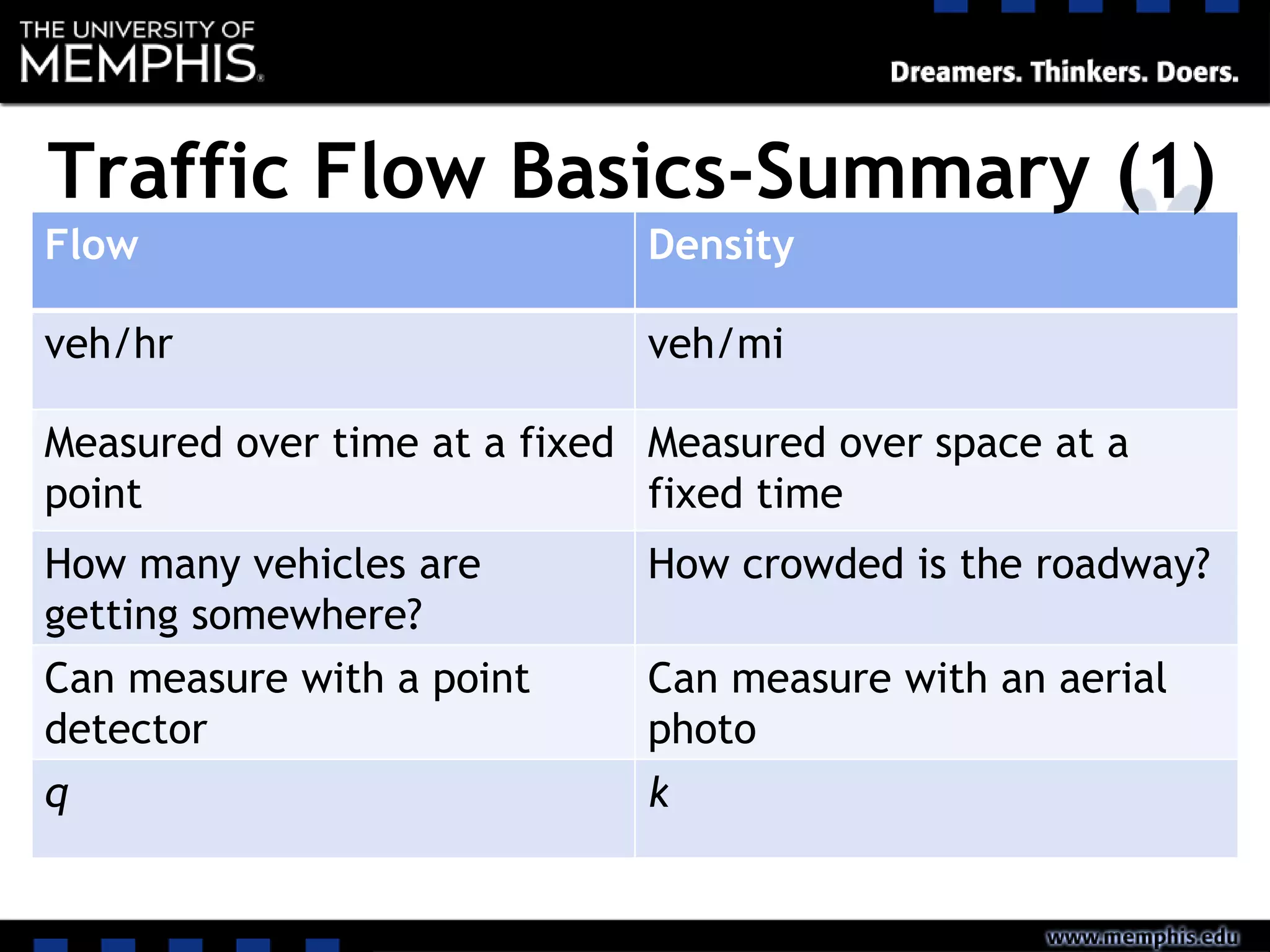
Flow Density
veh/hr veh/mi
Measured over time at a fixed
point
Measured over space at a
fixed time
How many vehicles are
getting somewhere?
How crowded is the roadway?
Can measure with a point
detector
Can measure with an aerial
photo
q k
Traffic Flow Basics-Summary (1)
Individual vehicle Traffic stream
Speed [L/T]
Flow [V/T]
Density [V/L]
Traffic Flow Basics-Summary (1)
Individual vehicle Traffic stream
Speed [L/T]
Flow [V/T]
Density [V/L]
Classify the quantities
Brackets describe units... L = Length,
T = time, V = vehicles
Traffic Flow Basics-Summary (3)
Individual vehicle Traffic stream
Speed [L/T]
Time Headway [T] Flow [V/T]
Density [V/L]
Let’s try to fill in the rest of the table.
Traffic Flow Basics-Summary (4)
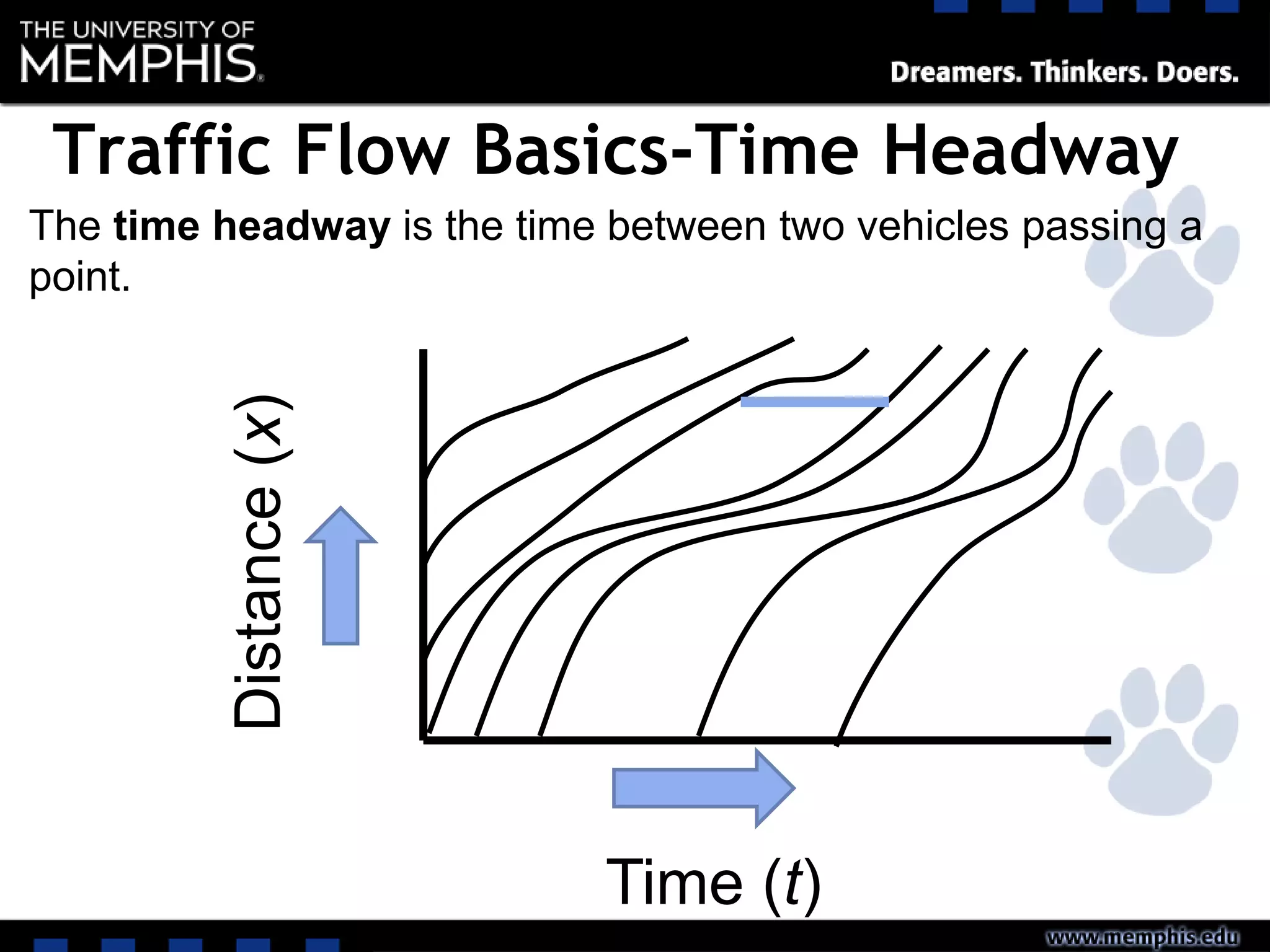
The time headway is the time between two vehicles passing a
point.
Time (t)
Distance(x)
Traffic Flow Basics-Time Headway
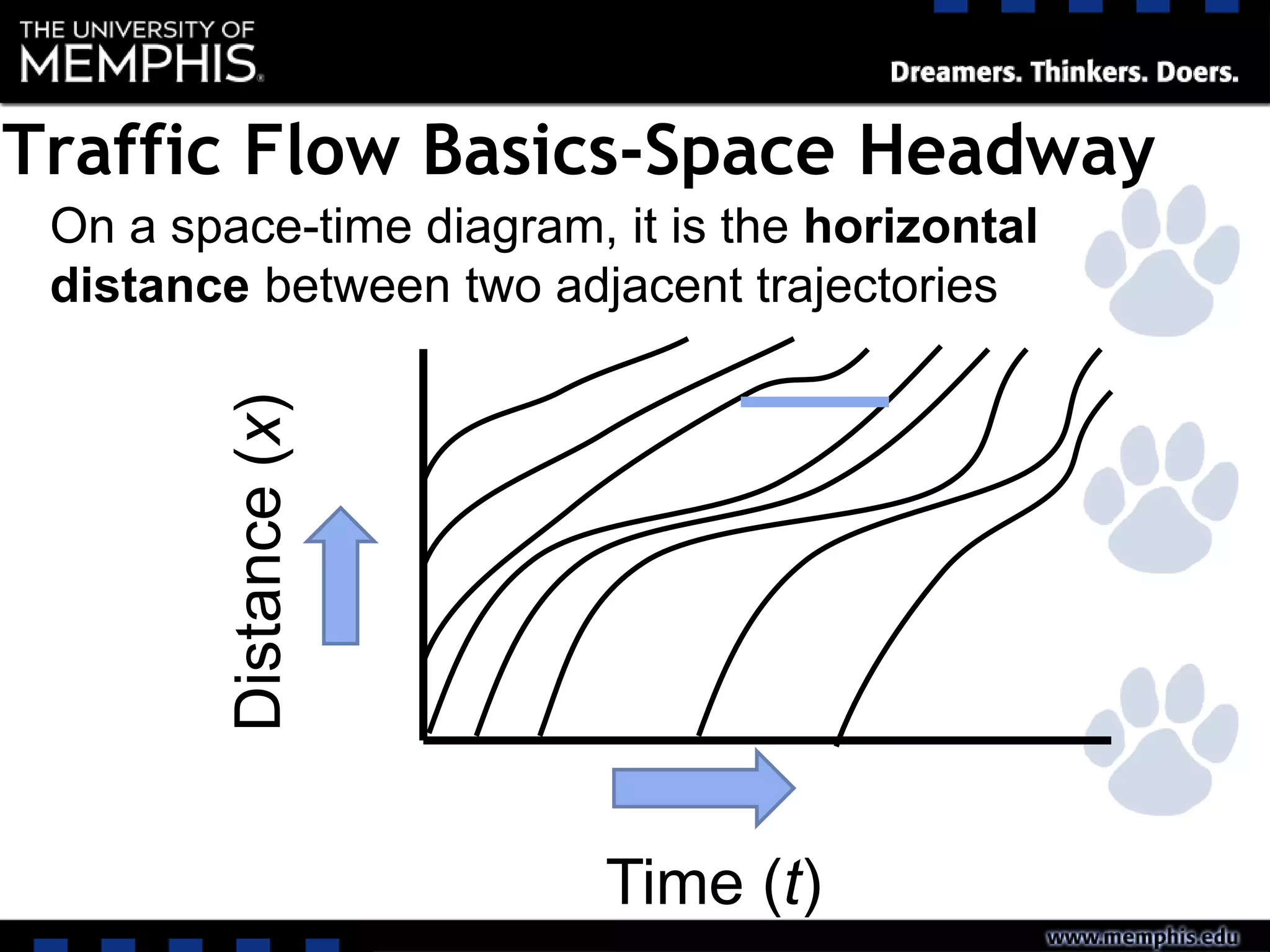
On a space-time diagram, it is the horizontal
distance between two adjacent trajectories
Time (t)
Distance(x)
Traffic Flow Basics-Space Headway
Individual vehicle Traffic stream
Speed [L/T]
Time Headway [T] Flow [V/T]
Space Headway [L] Density [V/L]
Let’s try to fill in the rest of the table.
Traffic Flow Basics-Summary (5)
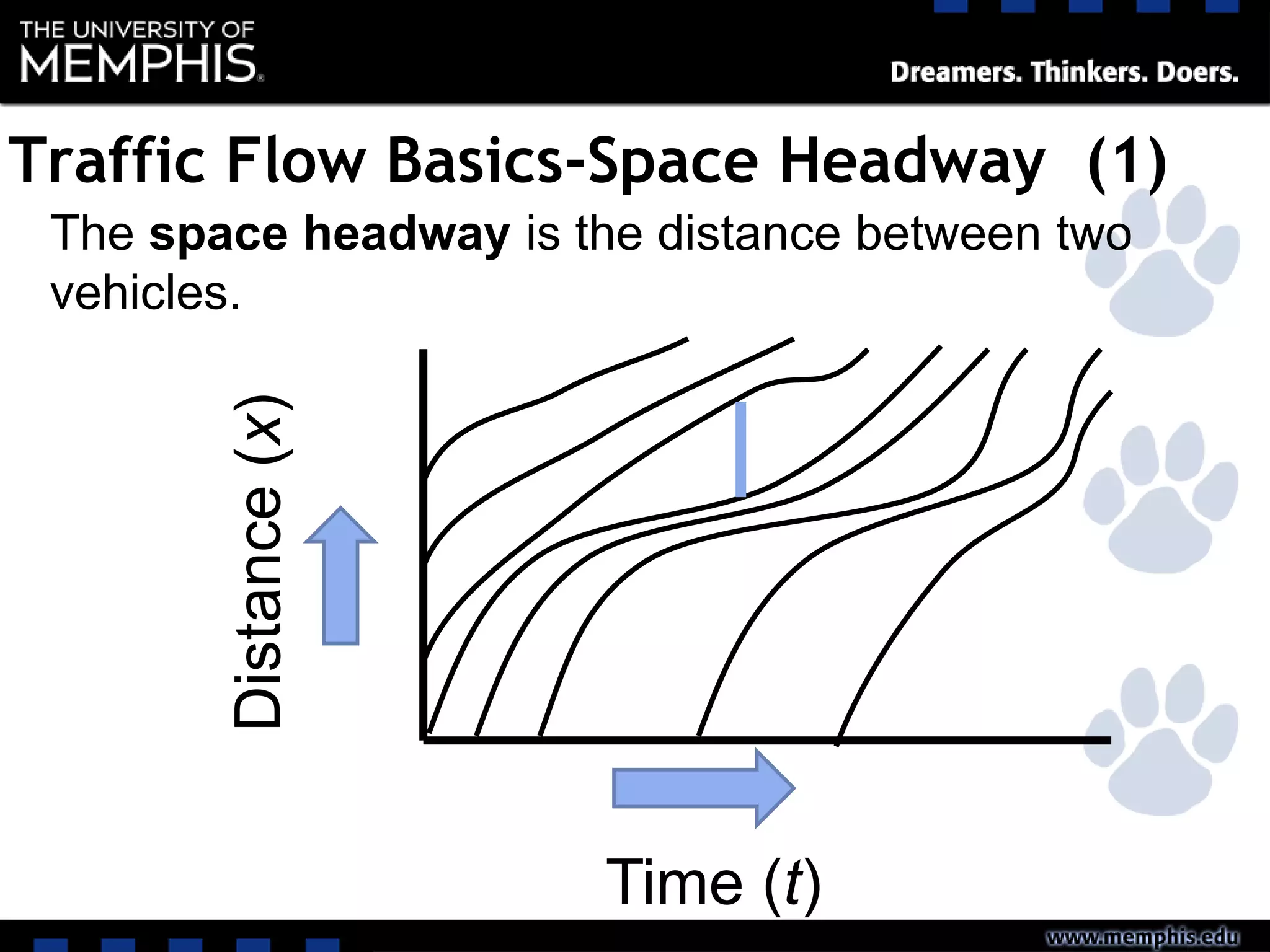
The space headway is the distance between two
vehicles.
Time (t)
Distance(x)
Traffic Flow Basics-Space Headway (1)
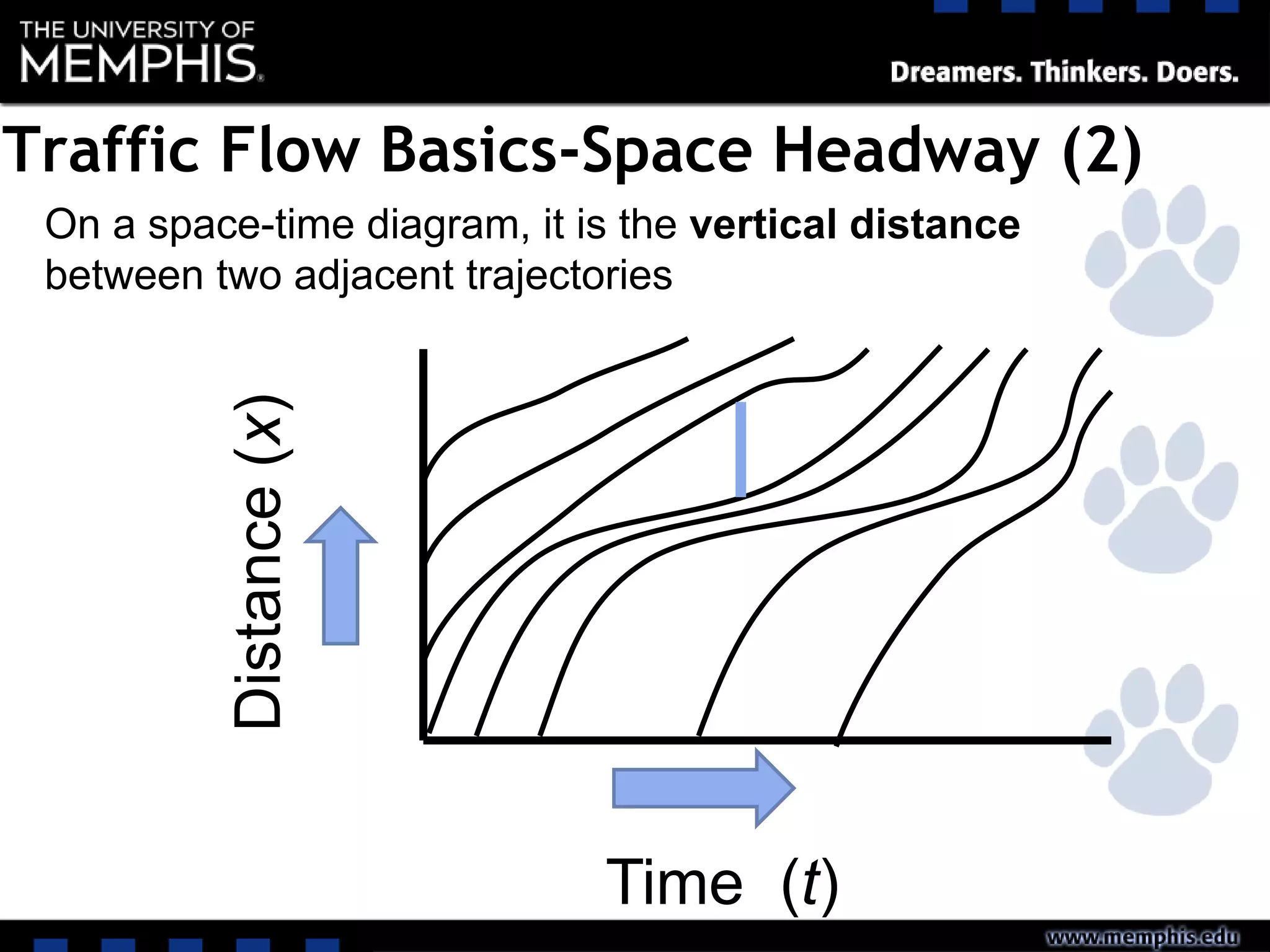
On a space-time diagram, it is the vertical distance
between two adjacent trajectories
Time (t)
Distance(x)
Traffic Flow Basics-Space Headway (2)
Individual vehicle Traffic stream
Speed [L/T] Average Speed
[L/T]
Time Headway [T] Flow [V/T]
Space Headway [L] Density [V/L]
Let’s try to fill in the rest of the table.
Traffic Flow Basics-Summary
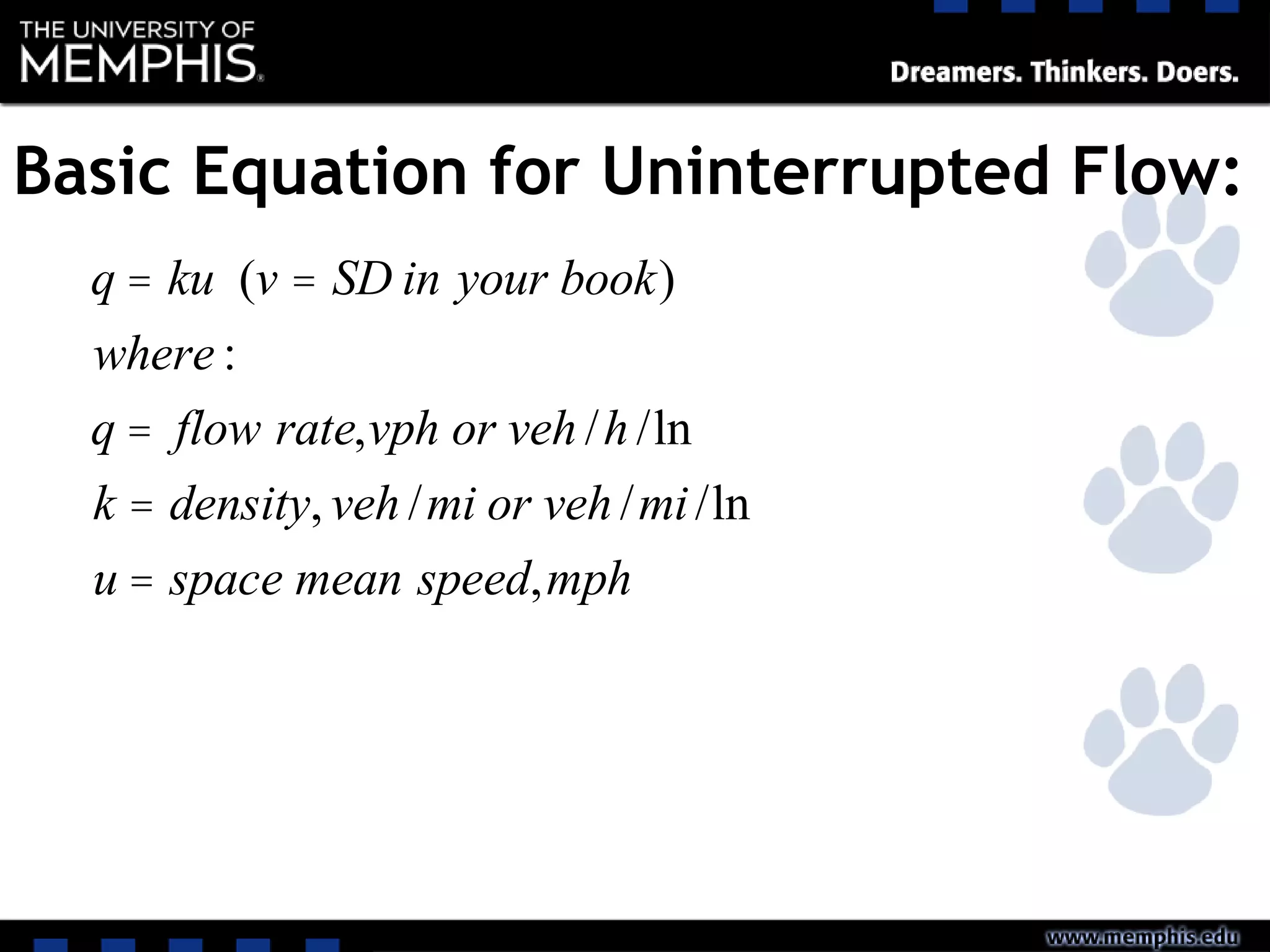
Basic Equation for Uninterrupted Flow:
q = ku (v = SD in your book)
where :
q = flow rate,vph or veh /h /ln
k = density, veh /mi or veh /mi/ln
u = space mean speed,mph
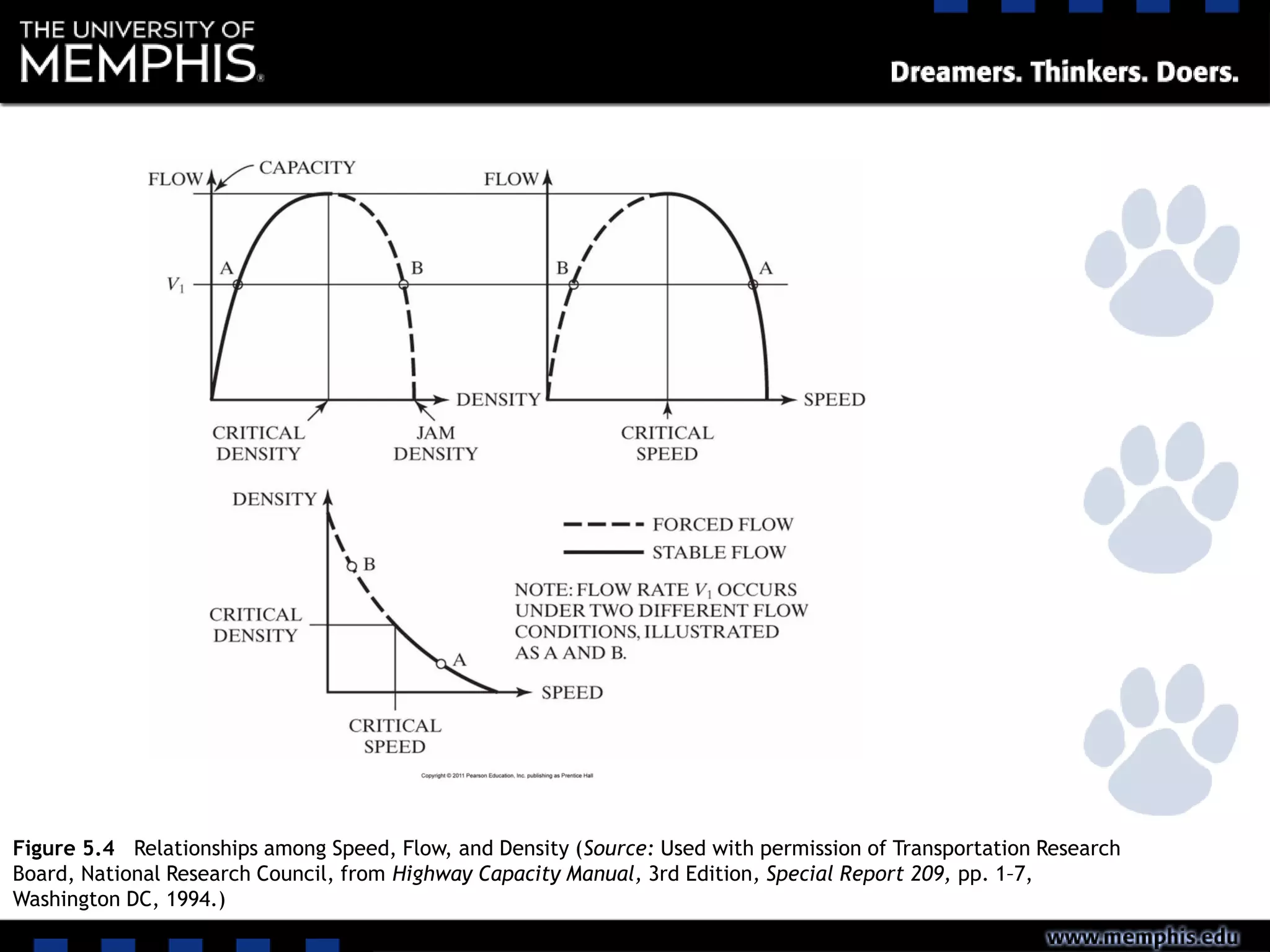
Figure 5.4 Relationships among Speed, Flow, and Density (Source: Used with permission of Transportation Research
Board, National Research Council, from Highway Capacity Manual, 3rd Edition, Special Report 209, pp. 1–7,
Washington DC, 1994.)
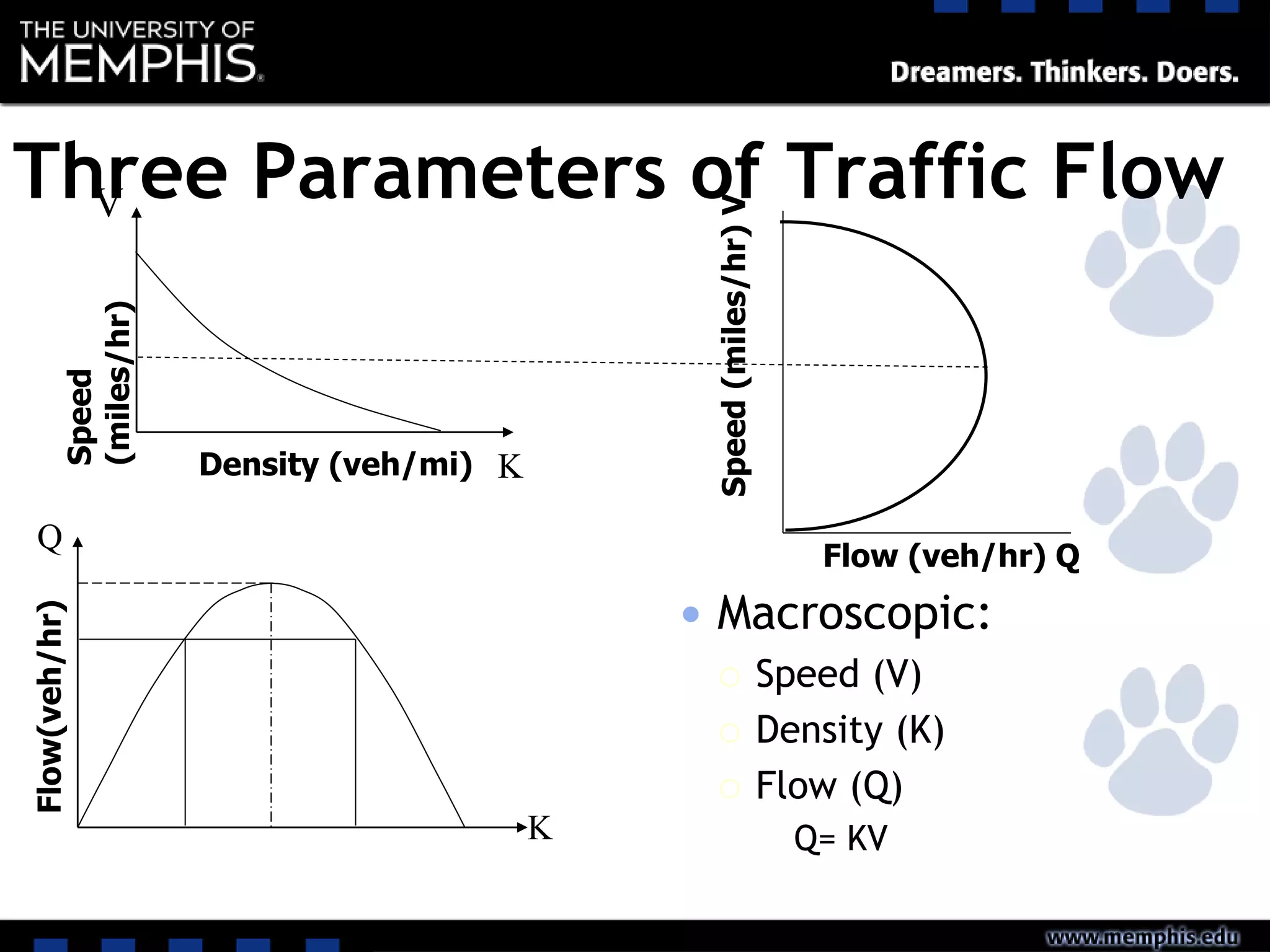
Three Parameters of Traffic Flow
 Macroscopic:
 Speed (V)
 Density (K)
 Flow (Q)
 Q= KV
Q
K
K
V
Flow (veh/hr) Q
Speed(miles/hr)V
Density (veh/mi)
Speed
(miles/hr)
Flow(veh/hr)
Spacing
• Spacing is defined as the distance between
successive vehicles in a traffic lane; measured
from common reference
– Front bumper or
– Front wheels
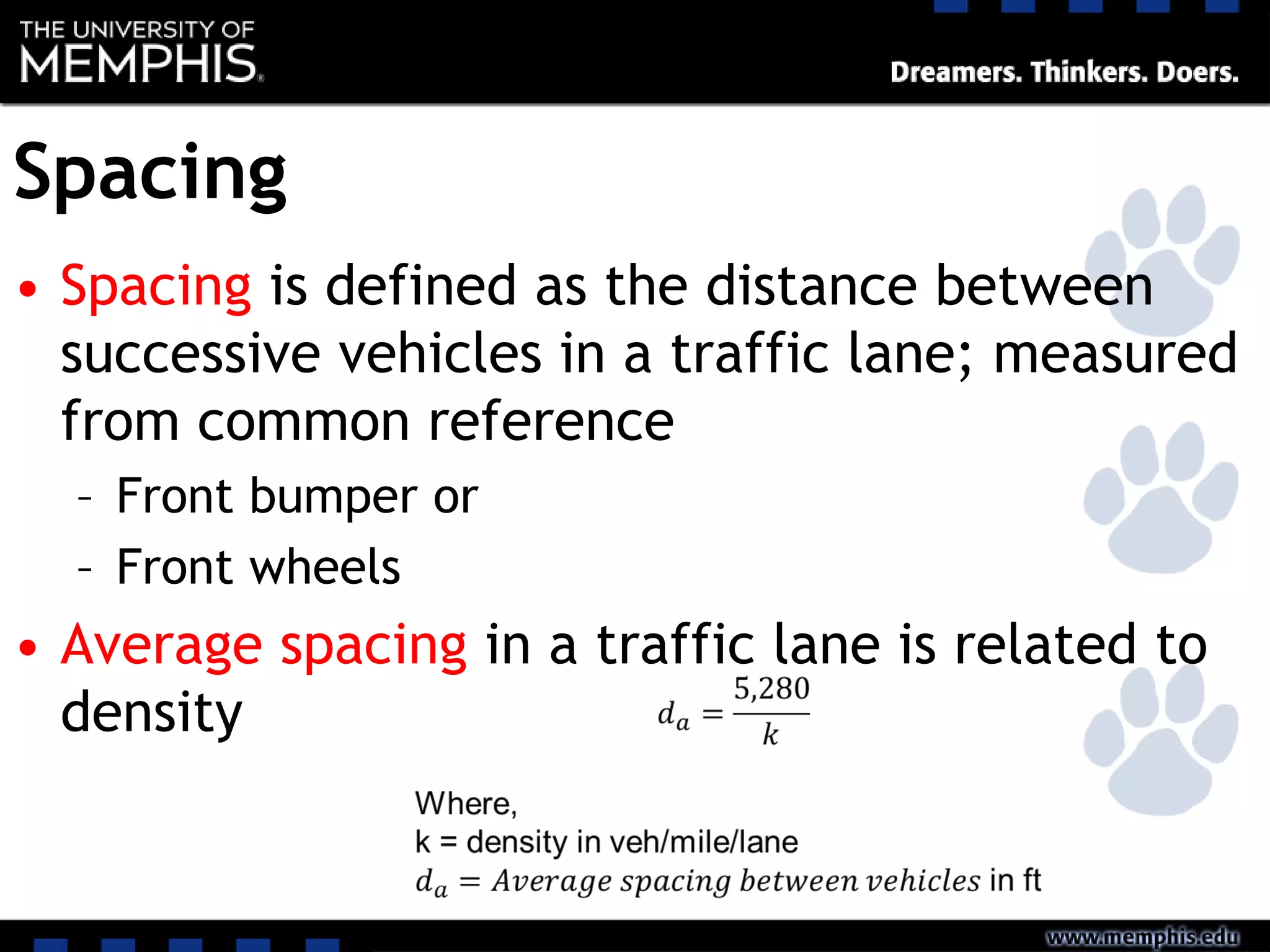
• Average spacing in a traffic lane is related to
density
Headway
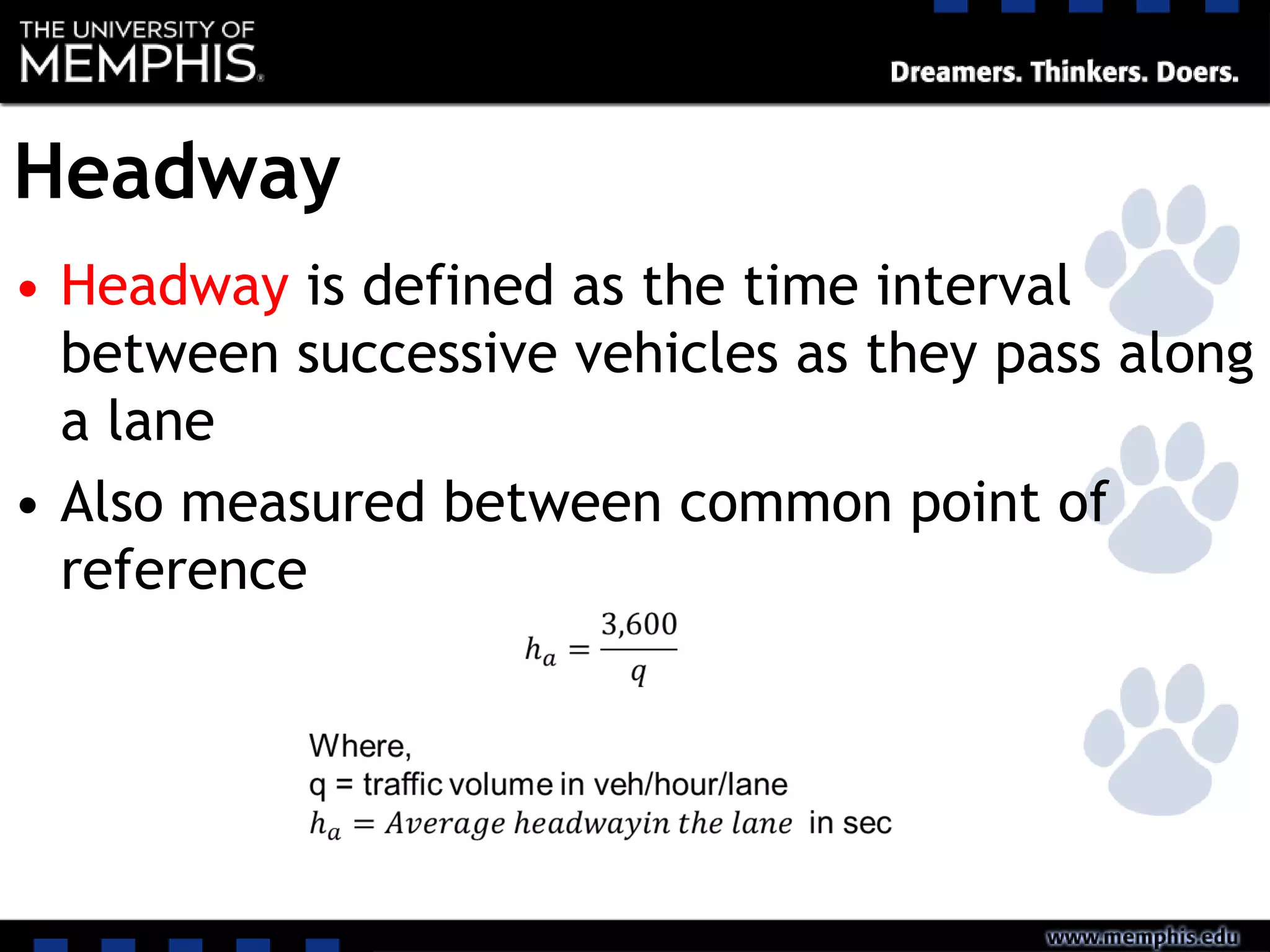
• Headway is defined as the time interval
between successive vehicles as they pass along
a lane
• Also measured between common point of
reference
Example
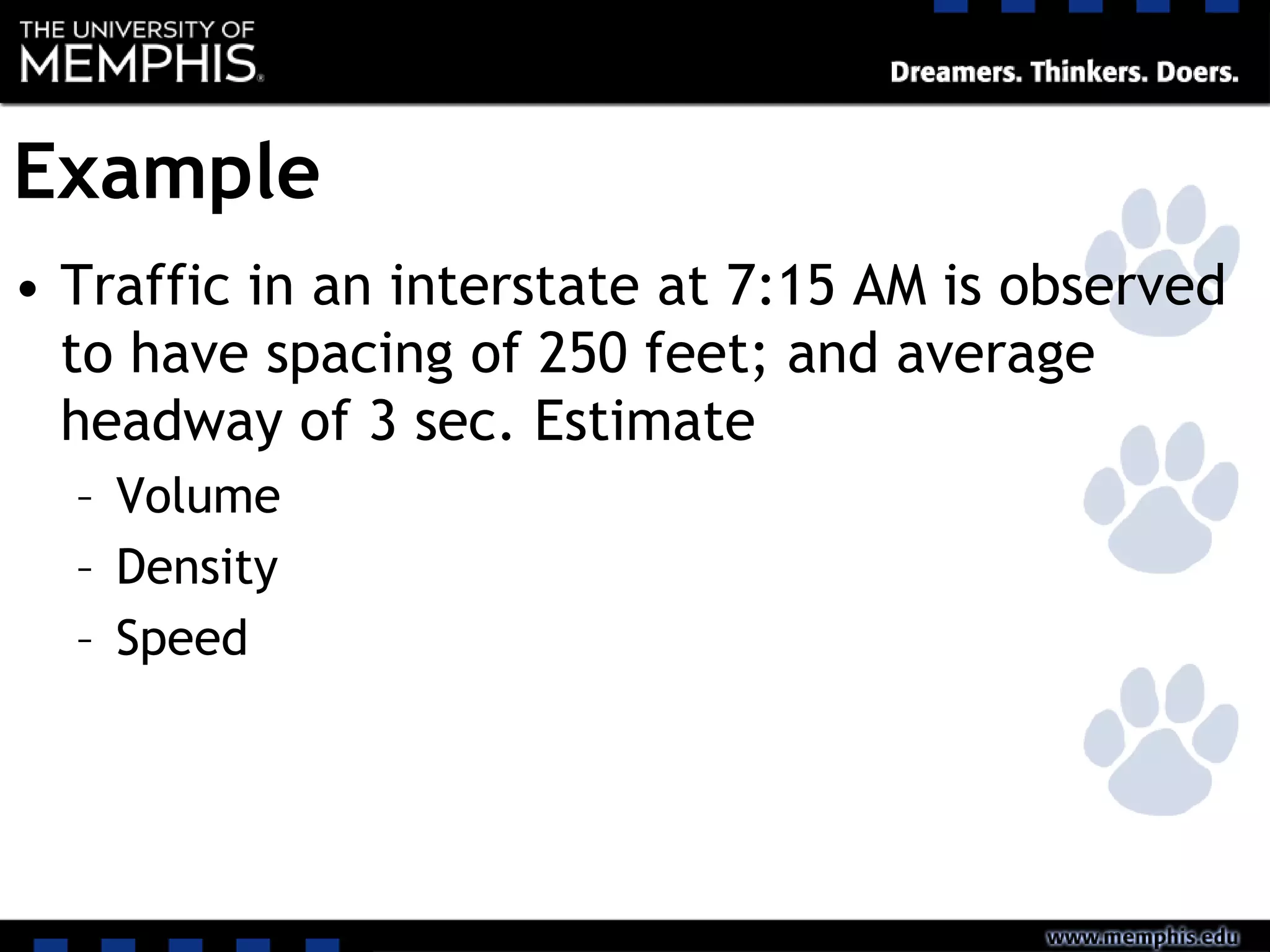
• Traffic in an interstate at 7:15 AM is observed
to have spacing of 250 feet; and average
headway of 3 sec. Estimate
– Volume
– Density
– Speed
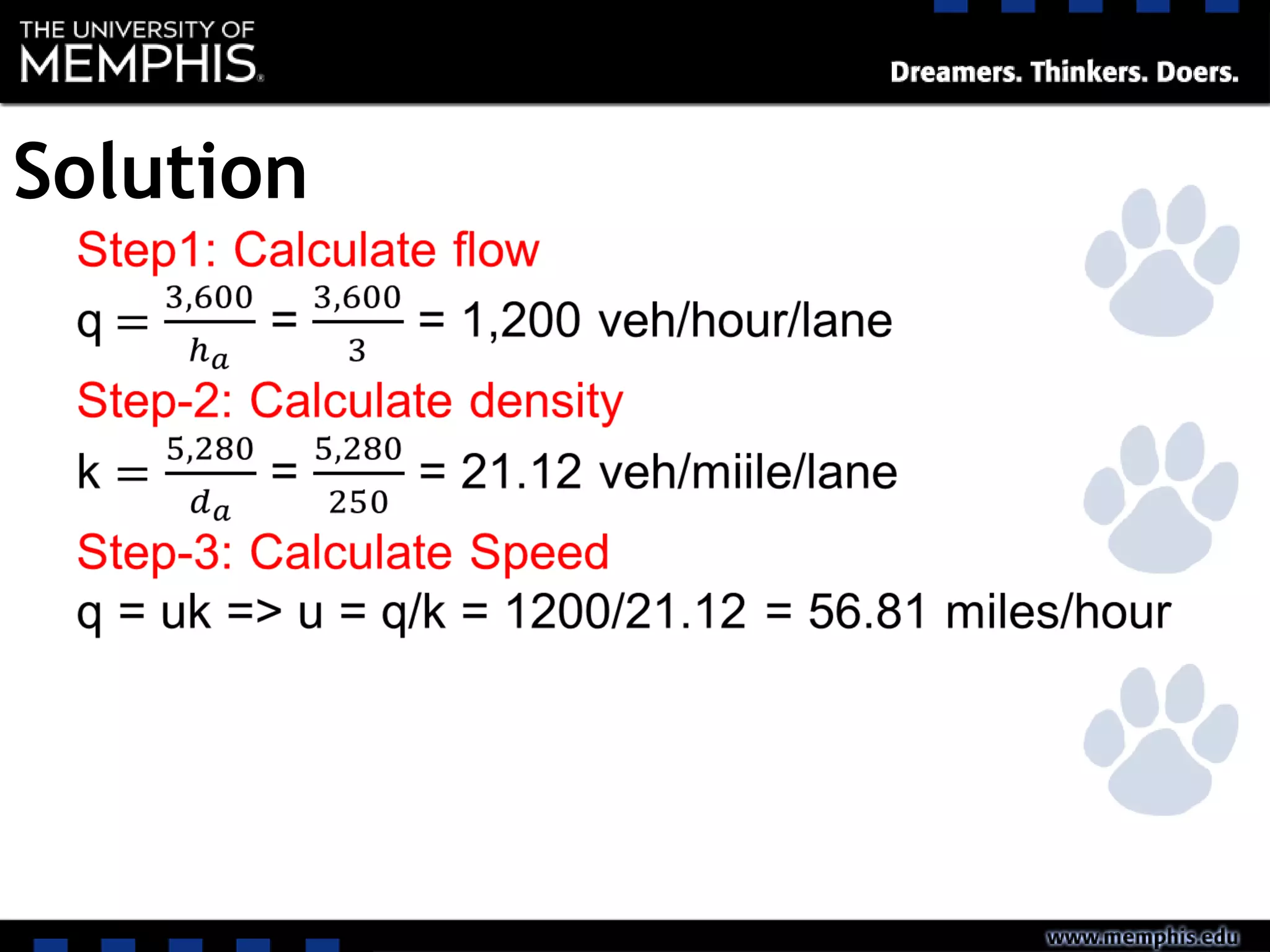
Solution
Example
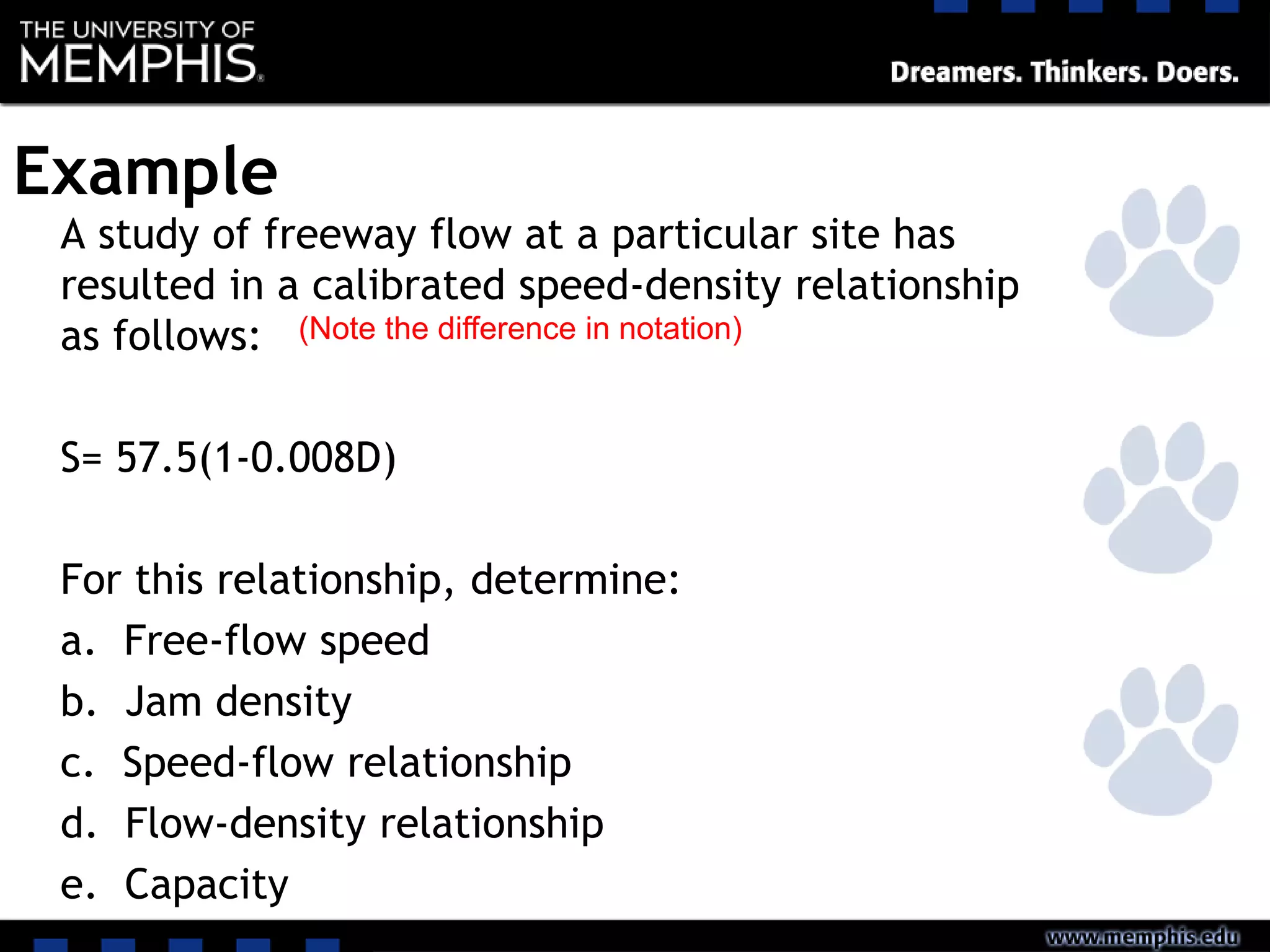
A study of freeway flow at a particular site has
resulted in a calibrated speed-density relationship
as follows:
S= 57.5(1-0.008D)
For this relationship, determine:
a. Free-flow speed
b. Jam density
c. Speed-flow relationship
d. Flow-density relationship
e. Capacity
(Note the difference in notation)

L2 Microscopic Traffic Flow Parameters

  • 1.
    Traffic Flow Characteristics CIVL4162/6162 (Traffic Engineering)
  • 2.
    Lesson Objective • Definemicroscopic traffic stream parameters • Establish the relationship between traffic stream parameters • Calculate and compute parameters with given data
  • 3.
    Remainder • Macroscopic trafficflow parameters – Volume • Rate of flow • AADT • AAWT • ADT • AWT – Speed – Density
  • 4.
    Flow Density veh/hr veh/mi Measuredover time at a fixed point Measured over space at a fixed time How many vehicles are getting somewhere? How crowded is the roadway? Can measure with a point detector Can measure with an aerial photo q k Traffic Flow Basics-Summary (1)
  • 5.
    Individual vehicle Trafficstream Speed [L/T] Flow [V/T] Density [V/L] Traffic Flow Basics-Summary (1)
  • 6.
    Individual vehicle Trafficstream Speed [L/T] Flow [V/T] Density [V/L] Classify the quantities Brackets describe units... L = Length, T = time, V = vehicles Traffic Flow Basics-Summary (3)
  • 7.
    Individual vehicle Trafficstream Speed [L/T] Time Headway [T] Flow [V/T] Density [V/L] Let’s try to fill in the rest of the table. Traffic Flow Basics-Summary (4)
  • 8.
    The time headwayis the time between two vehicles passing a point. Time (t) Distance(x) Traffic Flow Basics-Time Headway
  • 9.
    On a space-timediagram, it is the horizontal distance between two adjacent trajectories Time (t) Distance(x) Traffic Flow Basics-Space Headway
  • 10.
    Individual vehicle Trafficstream Speed [L/T] Time Headway [T] Flow [V/T] Space Headway [L] Density [V/L] Let’s try to fill in the rest of the table. Traffic Flow Basics-Summary (5)
  • 11.
    The space headwayis the distance between two vehicles. Time (t) Distance(x) Traffic Flow Basics-Space Headway (1)
  • 12.
    On a space-timediagram, it is the vertical distance between two adjacent trajectories Time (t) Distance(x) Traffic Flow Basics-Space Headway (2)
  • 13.
    Individual vehicle Trafficstream Speed [L/T] Average Speed [L/T] Time Headway [T] Flow [V/T] Space Headway [L] Density [V/L] Let’s try to fill in the rest of the table. Traffic Flow Basics-Summary
  • 14.
    Basic Equation forUninterrupted Flow: q = ku (v = SD in your book) where : q = flow rate,vph or veh /h /ln k = density, veh /mi or veh /mi/ln u = space mean speed,mph
  • 15.
    Figure 5.4 Relationshipsamong Speed, Flow, and Density (Source: Used with permission of Transportation Research Board, National Research Council, from Highway Capacity Manual, 3rd Edition, Special Report 209, pp. 1–7, Washington DC, 1994.)
  • 16.
    Three Parameters ofTraffic Flow  Macroscopic:  Speed (V)  Density (K)  Flow (Q)  Q= KV Q K K V Flow (veh/hr) Q Speed(miles/hr)V Density (veh/mi) Speed (miles/hr) Flow(veh/hr)
  • 17.
    Spacing • Spacing isdefined as the distance between successive vehicles in a traffic lane; measured from common reference – Front bumper or – Front wheels • Average spacing in a traffic lane is related to density
  • 18.
    Headway • Headway isdefined as the time interval between successive vehicles as they pass along a lane • Also measured between common point of reference
  • 19.
    Example • Traffic inan interstate at 7:15 AM is observed to have spacing of 250 feet; and average headway of 3 sec. Estimate – Volume – Density – Speed
  • 20.
  • 21.
    Example A study offreeway flow at a particular site has resulted in a calibrated speed-density relationship as follows: S= 57.5(1-0.008D) For this relationship, determine: a. Free-flow speed b. Jam density c. Speed-flow relationship d. Flow-density relationship e. Capacity (Note the difference in notation)