AHSANULLAH UNIVERSITY OF SCIENCE & TECHNOLOGY

DEPARTMENT OF CIVIL ENGINEERING

TRAFFIC VOLUNE STUDY
TRANSPORTATION ENGINEERING SESSIONAL II
COURSE NO. CE 452
GROUP NO : 3
SECTION : B
YEAR/SEMESTER : 4/2
COURSE TEACHERS:
MR. MUDASSER SERAJ
LECTURER, AUST
Presentation outline

►Definition ►Objective

►Scope ►Methodology ►Data collection

Reconnaissance Survey ►Data analysis ► Conclusion

►Limitations
Definition
Traffic volume study is the procedure to
determine mainly the volume of traffic moving
on the roads at a particular section during a
particular time.
Definitions(continues)
Service flow rate: The maximum hourly rate of a
roadway section during a given period under
prevailing roadway condition.

LOS: “Qualitative measures that characterize
operational conditions within a traffic stream and
their perception by motorists and passengers.”
(Highway capacity manual, 1994)
Definitions(continues)
ADT: Average daily traffic is the volume of traffic
counted on the roadway(two way) over a given
time period (greater than one day but less than
one year) divided by the number of days in that
time period.
AADT: Average annual daily traffic is obtained by
adding daily traffic counts over one year divided by
365 days.
Definitions(continues)
Directional Distribution: Directional distribution
refers to the percentage of traffic flow in one direction
during a particular time of day. This factor is
particularly important in the case of commuter roads,
where maximum flow occurs in one direction in the
morning and the other in the evening. This also needs
to be considered for efficient geometric design
Definitions(continues)
 PCE: PCE means passenger car equivalent to express various
types and characteristics vehicles to a common type usually
the passenger car. One car is considered to one unit.
 Volume/flow: The total number of vehicles that pass over a
given point or section of a lane or roadway during a given
time interval. It may be expressed in terms of
annual, daily, hourly, or sub-hourly periods; usually in vph or
vpd. Volume is an actual number of vehicles observed or
predicted to passing a point during a given interval.
Objectives
The objectives of carrying out traffic volume study are
designing, improving traffic system, planning,
management etc.
 Design purpose: Structural and geometric design of
pavements, bridge, and other highway facilities;
intersection design including minimum turning path,
channelization, flaring, traffic control devices viz.
traffic signs, markings, signals based on approach
volume and turning proportions etc.
PURPOSES
Improvement purposes: To allocate limited
maintenance budget rationally; to improve
the roadway operating condition; to examine
the existing operating/service condition; to
determine the type of improvement measure
need to be taken etc.
Planning Purposes: Accurate information on
the amount of traffic on the roads is vital for
the planning of both road maintenance and
improvement policies
PURPOSES(continues)
Dynamic Traffic Management Purposes: Up to
date and continuous flow/congestion information is
essential for optimizing; Network productivity by providing
information to the road user etc.
PURPOSES(continues)
Other Purposes:
 Estimation of highway usage
 Measurement of current demand of a facility

 Estimation of trends
 Economic feasibility evaluation
 Computation of accident rates etc.
Scope Of Traffic Volume Studies:
Magnitudes,
classifications
and the time
and directional
split of
vehicular flows

Proportions of
vehicles

Scope

Flow
fluctuation on
different
approaches at a
junction

Hourly, daily,
yearly and
seasonal
variation of
vehicular flows
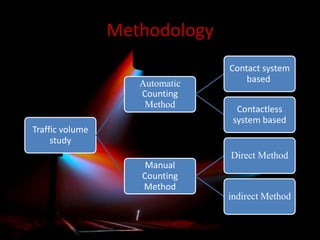
Methodology
Automatic
Counting
Method
Traffic volume
study

Contact system
based
Contactless
system based

Direct Method
Manual
Counting
Method
indirect Method
Manual Counting Method: Direct method
Data is counted by using hand tally and manual
counters/enumerators.
 Advantages: By this method traffic volume as well as
vehicle classification and turning proportions can be
obtained. Data can be used immediately after
collection.
 Disadvantages: This method is not practicable for long
duration count and when flow is high. Error is common
especially when volume is high. Count cannot be cross
checked. Count cannot be done in bad weather.
Mechanical Counting Boards
Mechanical count boards
consist of counters
mounted on a board that
record each direction of
travel. Common counts
include pedestrian,
bicycle, vehicle
classification, and traffic
volume counts.
Electronic Counting Boards
Electronic counting boards
are battery-operated,
lighter, more compact, and
easier to handle. They
have an internal clock that
automatically separates
the data by time interval.
Instruments used in Direct method

Hand Counter

Instrument to Measure
Distance
Example of data collection in tally method.
Direct method

A Typical Data Sheet of Manual Method
Manual Counting Method: Indirect
Method
In this method, data is collected using video camera. Video is
captured for long time and data is collected later by
rewinding.
 Advantages: Besides traffic volume, several traffic
parameters can be obtained from recorded film. Data can
be cross checked and quality can be ensured. This method
is applicable when volume is high. It is suitable for non-lane
based traffic operation.
 Disadvantages: A suitable elevated place is required for
filming operation. Data cannot be used immediately after
collection.
Manual Counting Method: Indirect Method

Video cameras are mounted
to record the traffic condition
on a road.
Automatic counting method:
In this method, vehicles are counted automatically
without any human involvement.
Contact system based (pneumatic, mechanical,
magnetic or piezoelectric method)
Contactless system based (electrical/optical,
ultrasound/infrared radar, micro wave, CCTV/video
image processing method etc.)
• Advantages: This method is suitable for long
duration or continuous count. Count is not affected
by bad weather condition.
• Disadvantages: It requires strict lane discipline. Non
motorized vehicles are hard to detect
Equipment used for Automatic counting
method: Contact system

Motion sensors

Pneumatic Road Tube
Counter
Equipment used for Automatic
counting method: Contactless system

Vehicle numbers are recorder using ultrasound, light beam or other
infrared technology.
Data collection
Data: May, 2012
Group no: 3
Group Member: 7
Location: Russel square
Method: Manual counting method (Direct)
Equipment: Stop watch; Data sheet.
Weather: Partly cloudy
Data collection

Survey location and our group position
Reconnaissance Survey
The number of private
car is predominant in this
road; second most available
vehicle along this road is Rickshaw.
There is a foot over bridge
used by Square Hospital.
There are a number of
commercial buildings, shops,
on both side of the road
Reconnaissance survey
►Abrupt movement of
Pedestrian.
► Traffic flow at intersections
are controlled by police.
Bar chart of vehicle composition
300

281

250
200
150
100
77

50
0

11

0

22

41

32
Vehicle composition of traffic stream
in percentage.

Light vehicle 64%
Bus(3%)
NMV 9%
Auto rickshaw
18%
Bus 3%

Motorcycle
5%

Light Vehicle(64%)
NMV(9%)

Motorcycle(5%)
Autorickshaw(18%)
Service flow rate
Type of
vehicle

Number

PCE

Converted
number

Light Vehicle

281

1

281

Autorickshaw

77

0.5

39

Bus

11

3

33

Motorcycle

22

0.1

3

NMV

41

0.5

21

Truck

0

0.75

0

Total

377

Traffic flow(10.20 AM-10.40 AM)=377 PCU
Service flow rate(11.00 AM-12.00 PM)=377*3=1131 PCU/hr
PCU/hr VS. Time Graph
1200
1000

PCU/hr

800
600

From Panthapath to
Russell Square

400

From Russell Square to
Panthapath
Average

200
0
Time
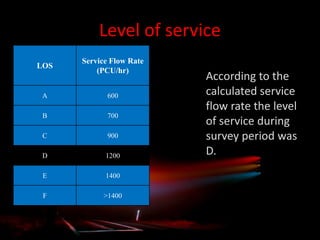
Level of service
LOS

Service Flow Rate
(PCU/hr)

A

600

B

700

C

900

D

1200

E

1400

F

>1400

According to the
calculated service
flow rate the level
of service during
survey period was
D.
Directional distribution
Direction

PCU/ Average Directional 100
hr PCU/hr Distribution

Time
9:00 AM10:00 AM 860
10:00
From PanthaPath AM-11:00
900
to Russell Square
AM
11:00
AM-12:00
1131
AM
9:00 AM10:00 AM 726
10:00
From Russell
AM-11:00
Square To
856
AM
Panthapath
11:00
AM-12:00
837
AM

80
963

54%

60
40

20
0
807

46%
ADT, AADT
Estimate 24-hr volume using the hourly expansion
factors
= {(860+726) * 18.8 + (900+856)*17.11 +
(1131+837)*18.52}/6 = 16052
Adjust the 24-hr volume for Thursday to an average
volume for the week using the daily
expansion factors
Total weekly volume = 16052 *7.012
= 112557
ADT, AADT(continues)
Average 24-hr volume (or Average Daily Traffic, ADT)
= 112557/7
= 16080
Since the data were collected in May, using the monthly
expansion factors for May
Annual Average Daily Traffic (AADT)
= 16080*1.395
= 22432
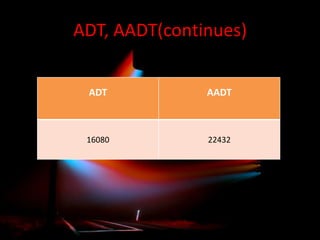
So, obtained value of Average Daily Traffic,(ADT) is 16080
PCU/day and Annual
Average Daily Traffic,(AADT) is 22432 PCU/day.
ADT, AADT(continues)
ADT

AADT

16080

22432
ADT, AADT (continues)
ADT

AADT

Panthapath to
Russell Square

17,534

24,460

Russell Square to
Panthapath

14,623

20,400

Direction
% ADT

Flow Fluctuation Curve
8
7
6
5
4
3
2
1
0

From Panthapath
to Russell square
From Russell
Square to
Panthapath
Average

9.00-10.00

10.00-11.00

11.00-12.00
Conclusion
Vehicle composition :
 Light vehicles (Car, Jeep, etc.) occupied 64% of total
vehicle.
 Percentage of Auto rickshaw is relatively high.
 Percentage of Public transport is very low.
Conclusion(continues)
Level of Service:
• The LOS of the road is D
• The road was constructed to serve as a
Collector road.
• Collector road should have a LOS C.
Conclusion(continues)
Directional Distribution: Directional distribution was
found nearly equal (54% and 46%) in both side of the
road. So it can be said that the geometric design of the
road is adequate for present traffic.
Flow Fluctuation Curve: From the flow fluctuation
curve it is seen that the vehicle movement is nearly
uniform in that road. %ADT is highest for Panthapath
to Russel Square direction at 11.00-12.00.
Conclusion(continues)
Recommendation:
• NMV should not be allowed
• Amount of public transport should be increased.
• To increase the LOS necessary steps should be taken
to prevent the entrance of NMV, stop road side
parking, prevent pedestrian crossing; introduce
optimum traffic signal system.
• Construct foot over bridges at necessary point for
pedestrian crossing.
Limitations
 Short count was taken (20 min)
 Now a days automatic counting method based on
CCTV/Video image processing is reliable and
popular. But due to resource constraint it was not
possible.
 Limited and unskilled enumerators.

Traffic volume study

  • 1.
    AHSANULLAH UNIVERSITY OFSCIENCE & TECHNOLOGY DEPARTMENT OF CIVIL ENGINEERING TRAFFIC VOLUNE STUDY TRANSPORTATION ENGINEERING SESSIONAL II COURSE NO. CE 452 GROUP NO : 3 SECTION : B YEAR/SEMESTER : 4/2 COURSE TEACHERS: MR. MUDASSER SERAJ LECTURER, AUST
  • 2.
    Presentation outline ►Definition ►Objective ►Scope►Methodology ►Data collection Reconnaissance Survey ►Data analysis ► Conclusion ►Limitations
  • 3.
    Definition Traffic volume studyis the procedure to determine mainly the volume of traffic moving on the roads at a particular section during a particular time.
  • 4.
    Definitions(continues) Service flow rate:The maximum hourly rate of a roadway section during a given period under prevailing roadway condition. LOS: “Qualitative measures that characterize operational conditions within a traffic stream and their perception by motorists and passengers.” (Highway capacity manual, 1994)
  • 5.
    Definitions(continues) ADT: Average dailytraffic is the volume of traffic counted on the roadway(two way) over a given time period (greater than one day but less than one year) divided by the number of days in that time period. AADT: Average annual daily traffic is obtained by adding daily traffic counts over one year divided by 365 days.
  • 6.
    Definitions(continues) Directional Distribution: Directionaldistribution refers to the percentage of traffic flow in one direction during a particular time of day. This factor is particularly important in the case of commuter roads, where maximum flow occurs in one direction in the morning and the other in the evening. This also needs to be considered for efficient geometric design
  • 7.
    Definitions(continues)  PCE: PCEmeans passenger car equivalent to express various types and characteristics vehicles to a common type usually the passenger car. One car is considered to one unit.  Volume/flow: The total number of vehicles that pass over a given point or section of a lane or roadway during a given time interval. It may be expressed in terms of annual, daily, hourly, or sub-hourly periods; usually in vph or vpd. Volume is an actual number of vehicles observed or predicted to passing a point during a given interval.
  • 8.
    Objectives The objectives ofcarrying out traffic volume study are designing, improving traffic system, planning, management etc.  Design purpose: Structural and geometric design of pavements, bridge, and other highway facilities; intersection design including minimum turning path, channelization, flaring, traffic control devices viz. traffic signs, markings, signals based on approach volume and turning proportions etc.
  • 9.
    PURPOSES Improvement purposes: Toallocate limited maintenance budget rationally; to improve the roadway operating condition; to examine the existing operating/service condition; to determine the type of improvement measure need to be taken etc. Planning Purposes: Accurate information on the amount of traffic on the roads is vital for the planning of both road maintenance and improvement policies
  • 10.
    PURPOSES(continues) Dynamic Traffic ManagementPurposes: Up to date and continuous flow/congestion information is essential for optimizing; Network productivity by providing information to the road user etc.
  • 11.
    PURPOSES(continues) Other Purposes:  Estimationof highway usage  Measurement of current demand of a facility  Estimation of trends  Economic feasibility evaluation  Computation of accident rates etc.
  • 12.
    Scope Of TrafficVolume Studies: Magnitudes, classifications and the time and directional split of vehicular flows Proportions of vehicles Scope Flow fluctuation on different approaches at a junction Hourly, daily, yearly and seasonal variation of vehicular flows
  • 13.
  • 14.
    Manual Counting Method:Direct method Data is counted by using hand tally and manual counters/enumerators.  Advantages: By this method traffic volume as well as vehicle classification and turning proportions can be obtained. Data can be used immediately after collection.  Disadvantages: This method is not practicable for long duration count and when flow is high. Error is common especially when volume is high. Count cannot be cross checked. Count cannot be done in bad weather.
  • 15.
    Mechanical Counting Boards Mechanicalcount boards consist of counters mounted on a board that record each direction of travel. Common counts include pedestrian, bicycle, vehicle classification, and traffic volume counts.
  • 16.
    Electronic Counting Boards Electroniccounting boards are battery-operated, lighter, more compact, and easier to handle. They have an internal clock that automatically separates the data by time interval.
  • 17.
    Instruments used inDirect method Hand Counter Instrument to Measure Distance
  • 18.
    Example of datacollection in tally method.
  • 19.
    Direct method A TypicalData Sheet of Manual Method
  • 20.
    Manual Counting Method:Indirect Method In this method, data is collected using video camera. Video is captured for long time and data is collected later by rewinding.  Advantages: Besides traffic volume, several traffic parameters can be obtained from recorded film. Data can be cross checked and quality can be ensured. This method is applicable when volume is high. It is suitable for non-lane based traffic operation.  Disadvantages: A suitable elevated place is required for filming operation. Data cannot be used immediately after collection.
  • 21.
    Manual Counting Method:Indirect Method Video cameras are mounted to record the traffic condition on a road.
  • 22.
    Automatic counting method: Inthis method, vehicles are counted automatically without any human involvement. Contact system based (pneumatic, mechanical, magnetic or piezoelectric method) Contactless system based (electrical/optical, ultrasound/infrared radar, micro wave, CCTV/video image processing method etc.) • Advantages: This method is suitable for long duration or continuous count. Count is not affected by bad weather condition. • Disadvantages: It requires strict lane discipline. Non motorized vehicles are hard to detect
  • 23.
    Equipment used forAutomatic counting method: Contact system Motion sensors Pneumatic Road Tube Counter
  • 24.
    Equipment used forAutomatic counting method: Contactless system Vehicle numbers are recorder using ultrasound, light beam or other infrared technology.
  • 25.
    Data collection Data: May,2012 Group no: 3 Group Member: 7 Location: Russel square Method: Manual counting method (Direct) Equipment: Stop watch; Data sheet. Weather: Partly cloudy
  • 26.
    Data collection Survey locationand our group position
  • 27.
    Reconnaissance Survey The numberof private car is predominant in this road; second most available vehicle along this road is Rickshaw. There is a foot over bridge used by Square Hospital. There are a number of commercial buildings, shops, on both side of the road
  • 28.
    Reconnaissance survey ►Abrupt movementof Pedestrian. ► Traffic flow at intersections are controlled by police.
  • 29.
    Bar chart ofvehicle composition 300 281 250 200 150 100 77 50 0 11 0 22 41 32
  • 30.
    Vehicle composition oftraffic stream in percentage. Light vehicle 64% Bus(3%) NMV 9% Auto rickshaw 18% Bus 3% Motorcycle 5% Light Vehicle(64%) NMV(9%) Motorcycle(5%) Autorickshaw(18%)
  • 31.
    Service flow rate Typeof vehicle Number PCE Converted number Light Vehicle 281 1 281 Autorickshaw 77 0.5 39 Bus 11 3 33 Motorcycle 22 0.1 3 NMV 41 0.5 21 Truck 0 0.75 0 Total 377 Traffic flow(10.20 AM-10.40 AM)=377 PCU Service flow rate(11.00 AM-12.00 PM)=377*3=1131 PCU/hr
  • 32.
    PCU/hr VS. TimeGraph 1200 1000 PCU/hr 800 600 From Panthapath to Russell Square 400 From Russell Square to Panthapath Average 200 0 Time
  • 33.
    Level of service LOS ServiceFlow Rate (PCU/hr) A 600 B 700 C 900 D 1200 E 1400 F >1400 According to the calculated service flow rate the level of service during survey period was D.
  • 34.
    Directional distribution Direction PCU/ AverageDirectional 100 hr PCU/hr Distribution Time 9:00 AM10:00 AM 860 10:00 From PanthaPath AM-11:00 900 to Russell Square AM 11:00 AM-12:00 1131 AM 9:00 AM10:00 AM 726 10:00 From Russell AM-11:00 Square To 856 AM Panthapath 11:00 AM-12:00 837 AM 80 963 54% 60 40 20 0 807 46%
  • 35.
    ADT, AADT Estimate 24-hrvolume using the hourly expansion factors = {(860+726) * 18.8 + (900+856)*17.11 + (1131+837)*18.52}/6 = 16052 Adjust the 24-hr volume for Thursday to an average volume for the week using the daily expansion factors Total weekly volume = 16052 *7.012 = 112557
  • 36.
    ADT, AADT(continues) Average 24-hrvolume (or Average Daily Traffic, ADT) = 112557/7 = 16080 Since the data were collected in May, using the monthly expansion factors for May Annual Average Daily Traffic (AADT) = 16080*1.395 = 22432 So, obtained value of Average Daily Traffic,(ADT) is 16080 PCU/day and Annual Average Daily Traffic,(AADT) is 22432 PCU/day.
  • 37.
  • 38.
    ADT, AADT (continues) ADT AADT Panthapathto Russell Square 17,534 24,460 Russell Square to Panthapath 14,623 20,400 Direction
  • 39.
    % ADT Flow FluctuationCurve 8 7 6 5 4 3 2 1 0 From Panthapath to Russell square From Russell Square to Panthapath Average 9.00-10.00 10.00-11.00 11.00-12.00
  • 40.
    Conclusion Vehicle composition : Light vehicles (Car, Jeep, etc.) occupied 64% of total vehicle.  Percentage of Auto rickshaw is relatively high.  Percentage of Public transport is very low.
  • 41.
    Conclusion(continues) Level of Service: •The LOS of the road is D • The road was constructed to serve as a Collector road. • Collector road should have a LOS C.
  • 42.
    Conclusion(continues) Directional Distribution: Directionaldistribution was found nearly equal (54% and 46%) in both side of the road. So it can be said that the geometric design of the road is adequate for present traffic. Flow Fluctuation Curve: From the flow fluctuation curve it is seen that the vehicle movement is nearly uniform in that road. %ADT is highest for Panthapath to Russel Square direction at 11.00-12.00.
  • 43.
    Conclusion(continues) Recommendation: • NMV shouldnot be allowed • Amount of public transport should be increased. • To increase the LOS necessary steps should be taken to prevent the entrance of NMV, stop road side parking, prevent pedestrian crossing; introduce optimum traffic signal system. • Construct foot over bridges at necessary point for pedestrian crossing.
  • 44.
    Limitations  Short countwas taken (20 min)  Now a days automatic counting method based on CCTV/Video image processing is reliable and popular. But due to resource constraint it was not possible.  Limited and unskilled enumerators.

Editor's Notes

  • #23 The word piezoelectricity means electricity resulting from pressure.