Traffic Flow
Fundamental Parameters& Diagrams
Centre for Transportation Research (CTR)
Department of Civil Engineering
NATIONAL INSTITUTE OF TECHNOLOGY CALICUT
NITC P.O., CALICUT – 673601
M.V.L.R. Anjaneyulu
mvlr@nitc.ac.in
2.
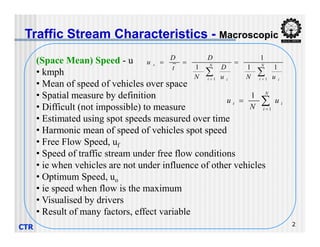
(Space Mean) Speed- u
• kmph
• Mean of speed of vehicles over space
• Spatial measure by definition
• Difficult (not impossible) to measure
• Estimated using spot speeds measured over time
Traffic Stream Characteristics - Macroscopic
N
i
i
t u
N
u
1
1
N
i i
N
i i
s
u
N
u
D
N
D
t
D
u
1
1
1
1
1
1
CTR 2
• Estimated using spot speeds measured over time
• Harmonic mean of speed of vehicles spot speed
• Free Flow Speed, uf
• Speed of traffic stream under free flow conditions
• ie when vehicles are not under influence of other vehicles
• Optimum Speed, uo
• ie speed when flow is the maximum
• Visualised by drivers
• Result of many factors, effect variable
3.
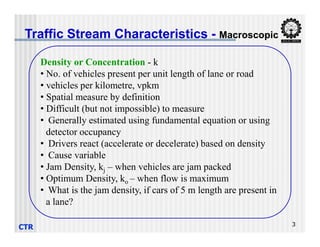
Density or Concentration- k
• No. of vehicles present per unit length of lane or road
• vehicles per kilometre, vpkm
• Spatial measure by definition
• Difficult (but not impossible) to measure
• Generally estimated using fundamental equation or using
Traffic Stream Characteristics - Macroscopic
CTR 3
• Generally estimated using fundamental equation or using
detector occupancy
• Drivers react (accelerate or decelerate) based on density
• Cause variable
• Jam Density, kj – when vehicles are jam packed
• Optimum Density, ko – when flow is maximum
• What is the jam density, if cars of 5 m length are present in
a lane?
4.
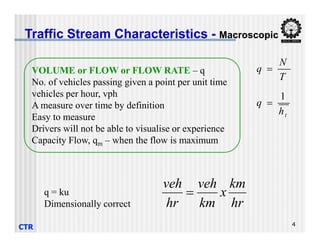
VOLUME or FLOWor FLOW RATE – q
No. of vehicles passing given a point per unit time
vehicles per hour, vph
A measure over time by definition
Easy to measure
Drivers will not be able to visualise or experience
Traffic Stream Characteristics - Macroscopic
T
N
q
t
h
q
1
CTR 4
Drivers will not be able to visualise or experience
Capacity Flow, qm – when the flow is maximum
hr
km
x
km
veh
hr
veh
q = ku
Dimensionally correct
5.
Traffic Stream Characteristics- Microscopic
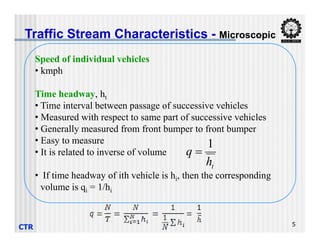
Speed of individual vehicles
• kmph
Time headway, ht
• Time interval between passage of successive vehicles
• Measured with respect to same part of successive vehicles
• Generally measured from front bumper to front bumper
CTR 5
• Generally measured from front bumper to front bumper
• Easy to measure
• It is related to inverse of volume
• If time headway of ith vehicle is hi, then the corresponding
volume is qi = 1/hi
t
h
q
1
6.
Traffic Stream Characteristics- Microscopic
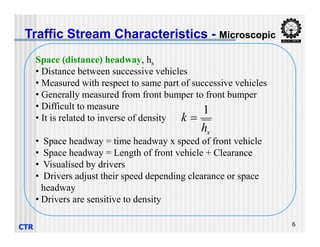
Space (distance) headway, hs
• Distance between successive vehicles
• Measured with respect to same part of successive vehicles
• Generally measured from front bumper to front bumper
• Difficult to measure
• It is related to inverse of density
h
k
1
CTR 6
• Space headway = time headway x speed of front vehicle
• Space headway = Length of front vehicle + Clearance
• Visualised by drivers
• Drivers adjust their speed depending clearance or space
headway
• Drivers are sensitive to density
s
h
k
V No SpotSpeed, u 1/u
1 22.5 0.044
2 24.3 0.0411
3 23.2 0.043
4 21.4 0.047
5 25.7 0.0389
6 24.1 0.0415
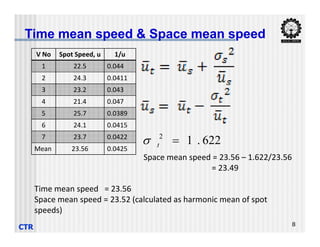
Time mean speed & Space mean speed
CTR 8
6 24.1 0.0415
7 23.7 0.0422
Mean 23.56 0.0425
Time mean speed = 23.56
Space mean speed = 23.52 (calculated as harmonic mean of spot
speeds)
622
.
1
2
t
Space mean speed = 23.56 – 1.622/23.56
= 23.49
9.
A
C
D
60 m
11 m/sec
P
0m
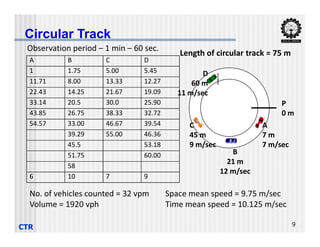
Length of circular track = 75 m
Observation period – 1 min – 60 sec.
A B C D
1 1.75 5.00 5.45
11.71 8.00 13.33 12.27
22.43 14.25 21.67 19.09
33.14 20.5 30.0 25.90
43.85 26.75 38.33 32.72
54.57 33.00 46.67 39.54
Circular Track
CTR 9
A
7 m
7 m/sec
B
21 m
12 m/sec
C
45 m
9 m/sec
54.57 33.00 46.67 39.54
39.29 55.00 46.36
45.5 53.18
51.75 60.00
58
6 10 7 9
No. of vehicles counted = 32 vpm
Volume = 1920 vph
Space mean speed = 9.75 m/sec
Time mean speed = 10.125 m/sec
10.
A
7 m
7 m/sec
B
21m
12 m/sec
C
45 m
9 m/sec
D
60 m
11 m/sec
P
0 m
Q
75 m
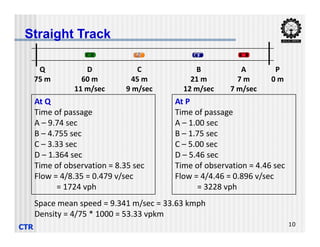
At P
Time of passage
A – 1.00 sec
At Q
Time of passage
A – 9.74 sec
Straight Track
CTR 10
A – 1.00 sec
B – 1.75 sec
C – 5.00 sec
D – 5.46 sec
Time of observation = 4.46 sec
Flow = 4/4.46 = 0.896 v/sec
= 3228 vph
A – 9.74 sec
B – 4.755 sec
C – 3.33 sec
D – 1.364 sec
Time of observation = 8.35 sec
Flow = 4/8.35 = 0.479 v/sec
= 1724 vph
Space mean speed = 9.341 m/sec = 33.63 kmph
Density = 4/75 * 1000 = 53.33 vpkm
11.
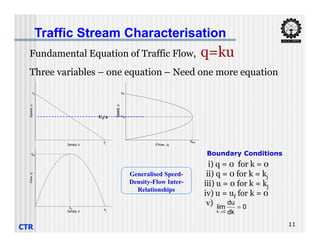
Traffic Stream Characterisation
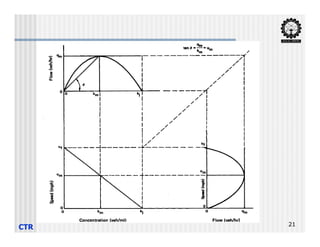
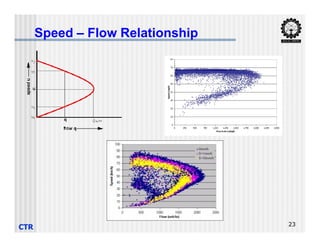
FundamentalEquation of Traffic Flow, q=ku
Three variables – one equation – Need one more equation
Speed,
u
u
f
Speed,
u
uf
uo
Uf/2
CTR 11
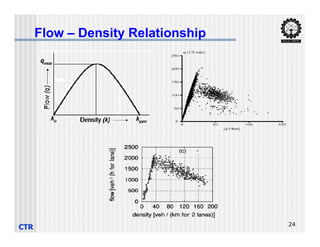
Generalised Speed-
Density-Flow Inter-
Relationships
Density, k
k
j Flow, q
qm
Density, k
Flow,
q
kj
qm
ko
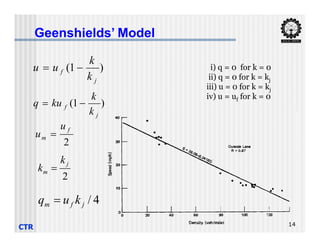
i) q = 0 for k = 0
ii) q = 0 for k = kj
iii) u = 0 for k = kj
iv) u = uf for k = 0
v) lim
k
du
dk
0
0
Boundary Conditions
Traffic Stream Charcterisation
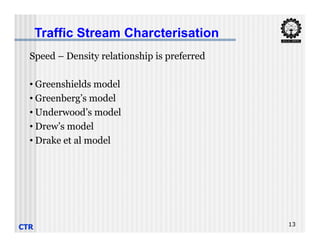
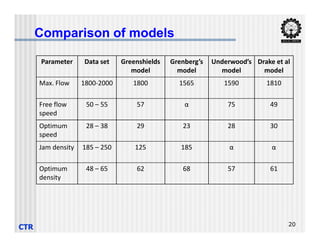
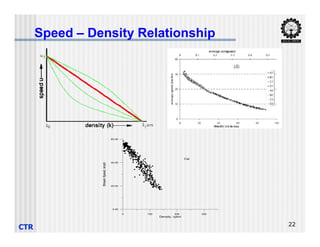
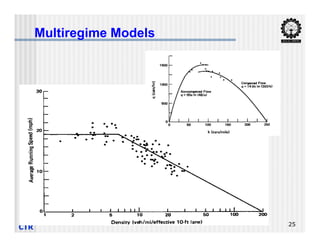
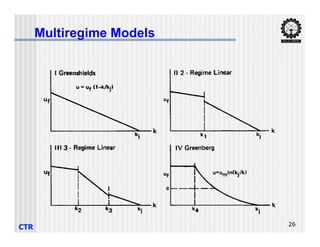
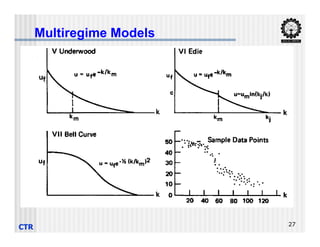
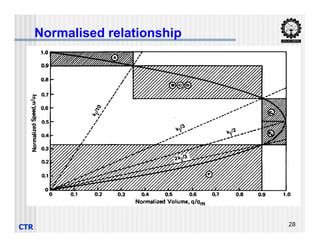
Speed– Density relationship is preferred
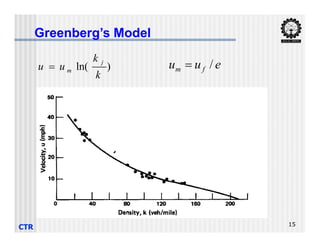
• Greenshields model
• Greenberg’s model
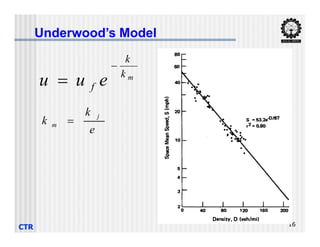
• Underwood’s model
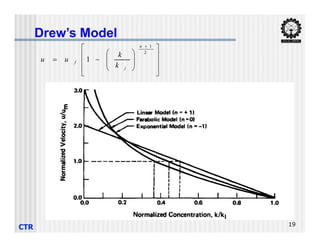
• Drew’s model
CTR 13
• Drew’s model
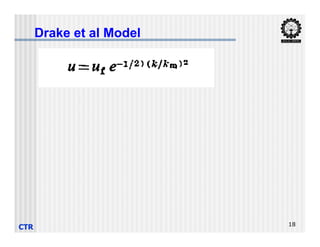
• Drake et al model
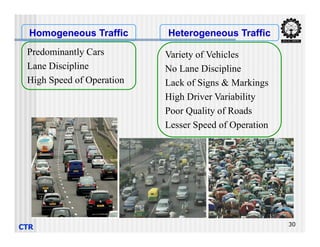
Predominantly Cars
Lane Discipline
HighSpeed of Operation
Variety of Vehicles
No Lane Discipline
Lack of Signs & Markings
High Driver Variability
Poor Quality of Roads
Lesser Speed of Operation
Homogeneous Traffic Heterogeneous Traffic
CTR 30
Lesser Speed of Operation
31.
Traffic Stream Charcterisation
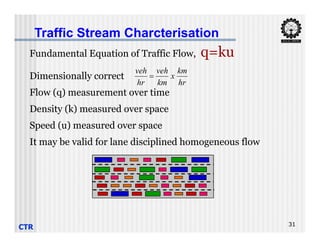
FundamentalEquation of Traffic Flow, q=ku
Dimensionally correct
Flow (q) measurement over time
Density (k) measured over space
Speed (u) measured over space
hr
km
x
km
veh
hr
veh
CTR 31
Speed (u) measured over space
It may be valid for lane disciplined homogeneous flow
32.
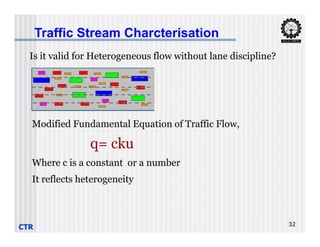
Is it validfor Heterogeneous flow without lane discipline?
Modified Fundamental Equation of Traffic Flow,
Traffic Stream Charcterisation
CTR 32
Modified Fundamental Equation of Traffic Flow,
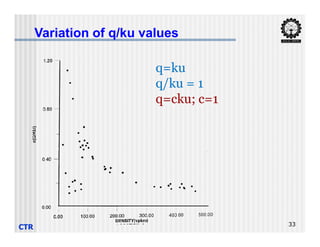
q= cku
Where c is a constant or a number
It reflects heterogeneity
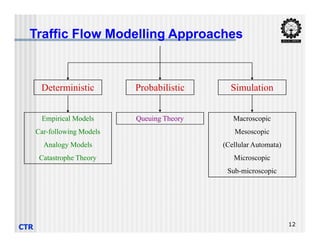
• Essential fordesign of traffic control measures
• Assessment of traffic control strategies
• Design of new transportation facilities
• Forecasting the traffic conditions
• Evaluating design of new transportation facilities
• Describe the interaction of vehicles with their drivers and
Traffic flow models
CTR 34
• Describe the interaction of vehicles with their drivers and
the infrastructure



![Rotary_Roundabout_Sams_03.12.14 [Compatibility Mode].pdf](https://cdn.slidesharecdn.com/ss_thumbnails/rotaryroundaboutsams03-250423055821-6dd85e6b-thumbnail.jpg?width=640&height=640&fit=bounds)
![Origin-Destn Survey [Compatibility Mode].pdf](https://cdn.slidesharecdn.com/ss_thumbnails/o-dsurveycompatibilitymode-250423053753-1b143592-thumbnail.jpg?width=640&height=640&fit=bounds)


