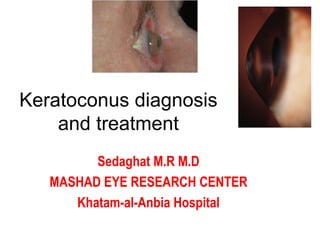
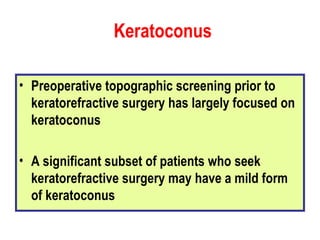
Keratoconus diagnosis and treatment Sedaghat M.R M.D MASHAD EYE RESEARCH CENTER Khatam-al-Anbia Hospital
Keratoconus   Preoperative topographic screening prior to keratorefractive surgery has largely focused on keratoconus A significant subset of patients who seek keratorefractive surgery may have a mild form of keratoconus
Keratoconus prevalence(1) Prevalence of clinically significant KCN is  1 in 3000 With more widespread use of topography is more common than previously thought Up to 8% of myopes  presenting for refractive surgery have suggestive topographic analysis
In refractive  surgeon clinic overall : 8% 1-2% by excluding these: Instability of refraction Reduced BSCVA Myopia>-10D Astigmatism>2D 10-20% in patients: With high Astigmatism  especially  if oblique Keratoconus prevalence(2)
Keratoconus prevalence(3) Incidence of KCN in general population: 0.05% Incidence in persons considering refractive surgery: 6% to 12% Incidence of form-fruste KCN or suspect as high as 17% of patient seeking refractive surgery
Incidence of keratoconus   0.03% – 0.05 % for keratoconus   6 % - 17% for form fruste keratoconus?
Important etiologic factors Eye rubbing (prevalence among KCN patients ranges from 33% to 66%) Contact lens wear (corneal micro trauma)  Vigorous eye rubbing has frequently been observed in patients with Down's syndrome & may explain the high incidence of associated corneal hydrops
SYMPTOMS Symptoms are highly variable and depend on the stage of the progression of the disorder Progressive visual blurring and /or distortion Early in the disease there may be no symptoms and may be noted simply because the patient cannot refracted to a clear 20/20 corrected vision
Early  in the course of the disease , VA may be normal even in symptomatic patients Contrast sensitivity measurement may detect visual dysfunction before VA loss SYMPTOMS
High irregular astigmatism with a scissoring reflex on retinoscopy is typical in established keratoconus Irregular corneal astigmatism is confirmed when keratometry is performed and the central mires can not be superimposed SIGNS OF KCN
SIGNS OF KCN External signs : Munson” sign Rizzuti phenomenon Slit-lamp findings: Stromal thining Posterior stress lines(vogt,s striae) Iron ring ( fleischer ring ) Scarring - epithelial or  subepithelial  Retroillumination signs: Scissoring on retinoscopy Oil droplet sign (charleaux”)
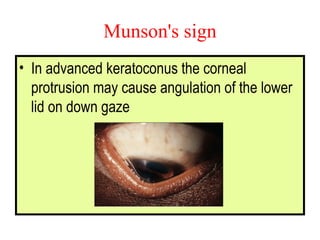
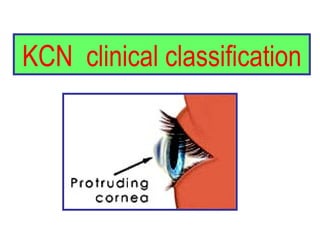
Munson's sign In advanced keratoconus the corneal protrusion may cause angulation of the lower lid on down gaze
Rizzuti phenomenon Sharply focused beam of light near the nasal limbus ,produced by lateral illumination of the cornea in patients with advanced keratoconus
Slit lamp examination   An eccentrically located ectatic protrusion of the cornea  The apex is usually inferior to pupillary axis: Round or nipple – central cone , smaller diameter  Larger oval or sagging cone may extend to the limbus
SIGNS OF KCN Qualititative criteria for diagnosis of KCN include: Corneal thining Vogt,s striae Fleischer ring Scissoring of retinoscopic reflex
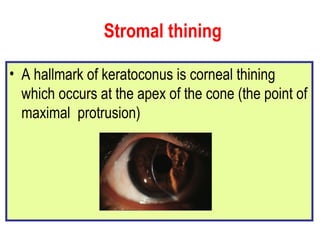
Stromal thining   A hallmark of keratoconus is corneal thining which occurs at the apex of the cone (the point of maximal  protrusion)
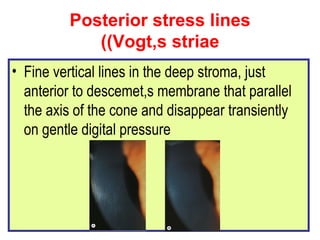
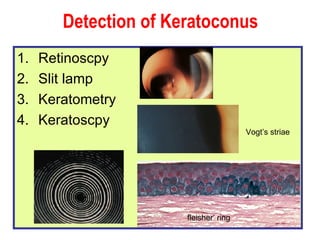
Posterior stress lines (Vogt,s striae) Fine vertical lines in the deep stroma, just anterior to descemet,s membrane that parallel the axis of the cone and disappear transiently on gentle digital pressure
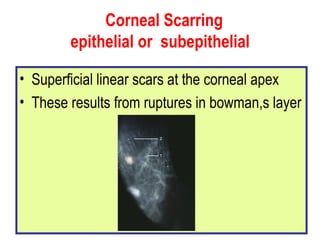
Corneal Scarring  epithelial or  subepithelial Superficial linear scars at the corneal apex These results from ruptures in bowman,s layer
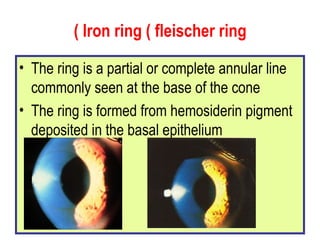
Iron ring ( fleischer ring ) The ring is a partial or complete annular line commonly seen at the base of the cone  The ring is formed from hemosiderin pigment deposited in the basal epithelium
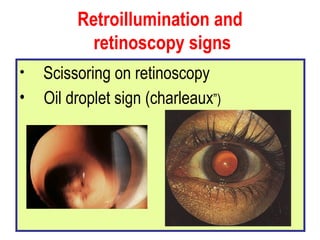
Retroillumination and  retinoscopy signs Scissoring on retinoscopy Oil droplet sign (charleaux ”)
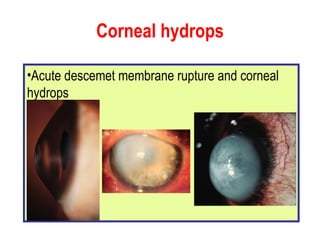
Corneal hydrops Acute descemet membrane rupture and corneal hydrops
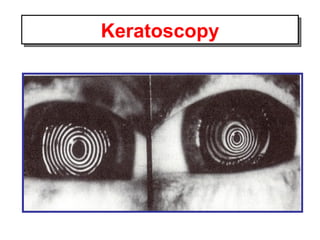
Detection of Keratoconus Retinoscpy Slit lamp  Keratometry Keratoscpy Vogt’s striae fleisher’ ring
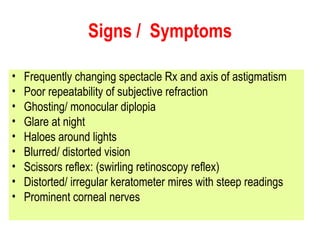
Signs /  Symptoms Frequently changing spectacle Rx and axis of astigmatism Poor repeatability of subjective refraction Ghosting/ monocular diplopia Glare at night Haloes around lights Blurred/ distorted vision Scissors reflex: (swirling retinoscopy reflex) Distorted/ irregular keratometer mires with steep readings Prominent corneal nerves
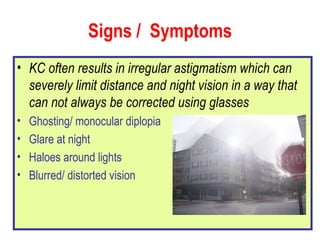
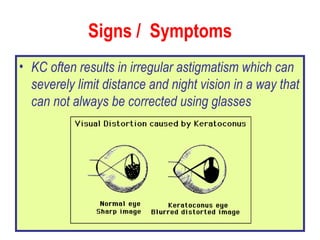
Signs /  Symptoms KC often results in irregular astigmatism which can severely limit distance and night vision in a way that can not always be corrected using glasses Ghosting/ monocular diplopia Glare at night Haloes around lights Blurred/ distorted vision
Signs /  Symptoms KC often results in irregular astigmatism which can severely limit distance and night vision in a way that can not always be corrected using glasses
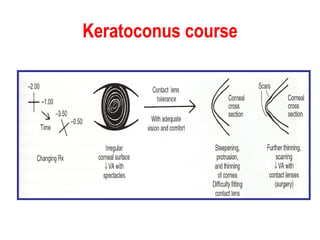
Keratoconus course Keratoconus ,classically, has its onset at puberty and is progressive until the third to fourth decade of life, when it usually arrests (80%) It may ,however, commence later in life and progress or arrest at any age (20%)
Keratoconus course
Evaluation and diagnosis of keratoconus History and family history   Follow up evaluation   Slit  -lamp exams Keratoscopy- Keratometry Corneal thickness - pachymetry Topography - Orbscan –Pentacam
Keratoscopy
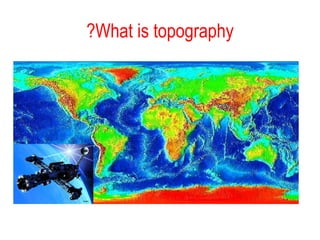
What is topography?
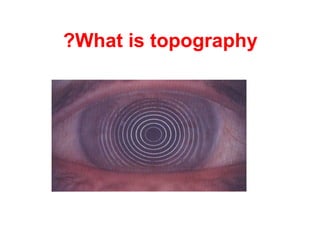
What is topography?
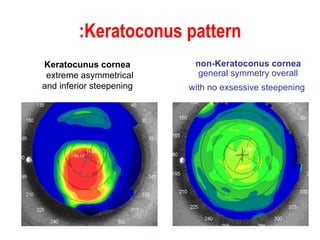
Keratoconus pattern: non-Keratoconus cornea  general symmetry overall with no exsessive steepening   Keratocunus cornea    extreme asymmetrical and inferior steepening
KCN  clinical classification
KCN  clinical classification Clinical keratoconus Early  or subclinical keratoconus Keratoconus suspect
Clinical keratoconus Clinical slit-lamp signs of keratoconus Scissoring of retinoscopic reflex with fully dilated  pupil KCN topographic pattern
Early or subclinical keratoconus No clinical slit-lamp findings Scissoring of retinoscopic reflex with fully dilated pupil KCN topographic pattern
Keratoconus suspect No clinical slit-lamp findings No scissoring of retinoscopic reflex with fully dilated pupil KCN  topographic pattern
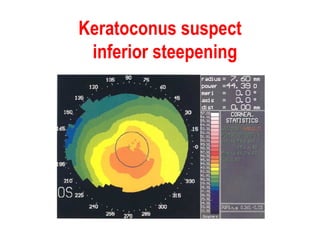
Keratoconus suspect inferior steepening
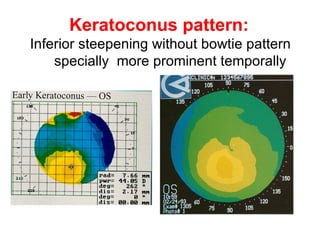
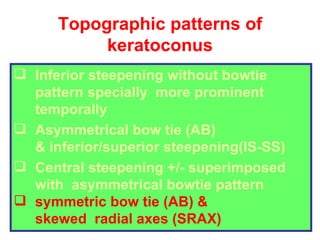
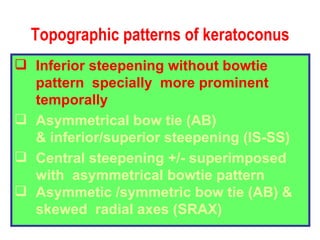
Topographic patterns of keratoconus Inferior steepening without bowtie pattern  specially  more prominent temporally Asymmetrical bow tie (AB) & inferior/superior steepening (IS-SS) Central steepening +/- superimposed with  asymmetrical bowtie pattern Asymmetic /symmetric bow tie (AB) &  skewed  radial axes (SRAX)
Keratoconus pattern:   Inferior steepening without bowtie pattern   specially  more prominent temporally
Topographic patterns of keratoconus Inferior steepening without bowtie pattern specially  more prominent temporally Asymmetrical bow tie (AB) & inferior steepening (IS) Central steepening +/- superimposed with  asymmetrical bowtie pattern Asymmetic /symmetric bow tie (AB) &  skewed  radial axes (SRAX)
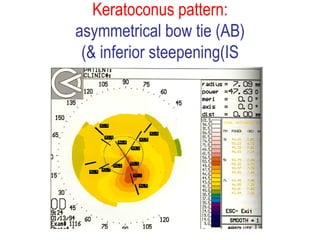
Keratoconus pattern: asymmetrical bow tie (AB) & inferior steepening(IS)
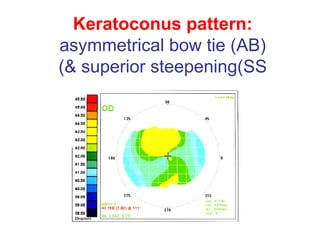
Topographic patterns of keratoconus Inferior steepening without bowtie pattern  specially  more prominent temporally Asymmetrical bow tie (AB) & superior steepening (SS) Central steepening +/- superimposed with  asymmetrical bowtie pattern Asymmetic /symmetric bow tie (AB) &  skewed  radial axes (SRAX)
Keratoconus pattern: asymmetrical bow tie (AB) & superior steepening(SS)
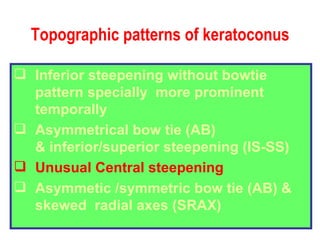
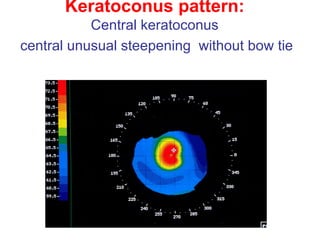
Topographic patterns of keratoconus Inferior steepening without bowtie pattern specially  more prominent temporally Asymmetrical bow tie (AB) & inferior/superior steepening (IS-SS) Unusual Central steepening   Asymmetic /symmetric bow tie (AB) &  skewed  radial axes (SRAX)
Keratoconus pattern: Central keratoconus  central unusual steepening  without bow tie
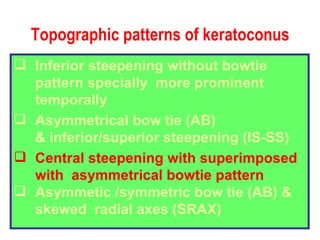
Topographic patterns of keratoconus Inferior steepening without bowtie pattern specially  more prominent temporally Asymmetrical bow tie (AB) & inferior/superior steepening (IS-SS) Central steepening with superimposed with  asymmetrical bowtie pattern Asymmetic /symmetric bow tie (AB) &  skewed  radial axes (SRAX)
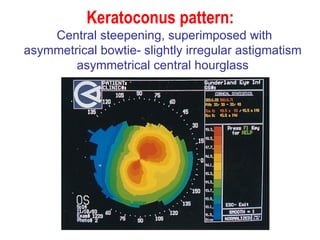
Keratoconus pattern:   Central steepening, superimposed with  asymmetrical bowtie- slightly irregular astigmatism asymmetrical central hourglass
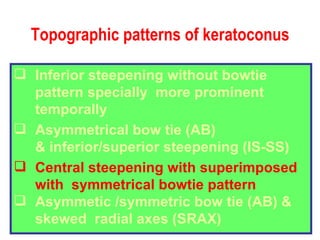
Topographic patterns of keratoconus Inferior steepening without bowtie pattern specially  more prominent temporally Asymmetrical bow tie (AB) & inferior/superior steepening (IS-SS) Central steepening with superimposed with  symmetrical bowtie pattern Asymmetic /symmetric bow tie (AB) &  skewed  radial axes (SRAX)
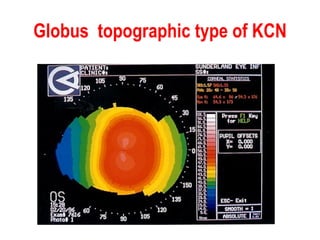
Globus  topographic type of KCN
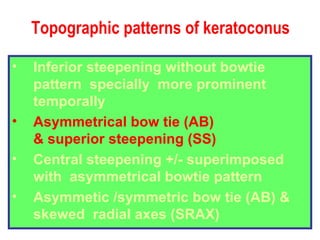
Topographic patterns of keratoconus Inferior steepening without bowtie pattern specially  more prominent temporally Asymmetrical bow tie (AB) & inferior/superior steepening(IS-SS) Central steepening +/- superimposed with  asymmetrical bowtie pattern Asymmetic /symmetric bow tie (AB) &  skewed  radial axes (SRAX)
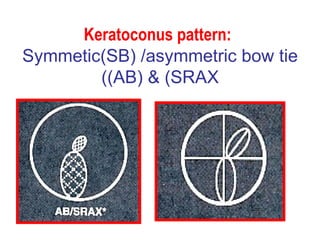
Keratoconus pattern:   Symmetic(SB) /asymmetric bow tie (AB) & (SRAX)
Topographic patterns of keratoconus Inferior steepening without bowtie pattern  specially  more prominent temporally Asymmetrical bow tie (AB) & inferior/superior steepening(IS-SS) Central steepening +/- superimposed with  asymmetrical bowtie pattern Asymmetric bow tie (AB) &  skewed  radial axes (SRAX)
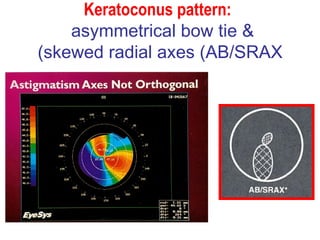
Keratoconus pattern:   asymmetrical bow tie &  skewed radial axes (AB/SRAX)
Topographic patterns of keratoconus Inferior steepening without bowtie pattern specially  more prominent temporally Asymmetrical bow tie (AB) & inferior/superior steepening(IS-SS) Central steepening +/- superimposed with  asymmetrical bowtie pattern symmetric bow tie (AB) &  skewed  radial axes (SRAX)
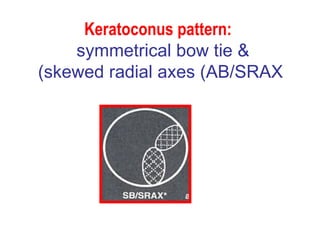
Keratoconus pattern:   symmetrical bow tie &  skewed radial axes (AB/SRAX)
Classification Keratoconus can be classified by cone shape , central keratometric reading or progression  The simplest classification systems are based on keratometric reading or shape
Classification Based on severity of curvature Mild :  <45 D in both meridians Moderate :  45-52 D in both meridians Severe :  >52 D in both meridians Advanced :  >62 D in both meridians
Classification Based on shape of cone Nipple  small diameter (5 mm); round shape; easiest to fit with contact lenses Oval  large diameter (>5 mm); often displaced inferiorly; more difficult to fit with lenses, most common by topography Globus  largest diameter (>6 mm); 75% of cornea affected; most difficult to fit with lenses
KCN treatment Stopping progression of ectasia: Corneal cross- linking Improving vision by : Glasses Contact lenses surgery
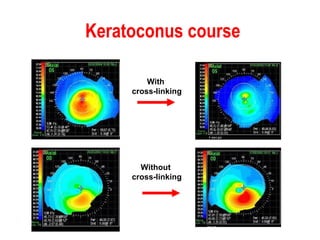
COLLAGEN CROSS LINKING Collagen cross linking has recently been proposed as a method for stopping the progression of keratoconus and is used with or without the use of corneal ring or intraocular lens  This involves applying riboflavin  ( vitamin drops )  to the cornea and then blasting it with Ultraviolet light
Keratoconus course   With  cross-linking Without  cross-linking
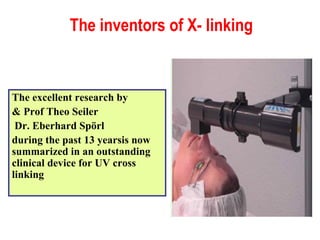
The inventors of X- linking The excellent research by Prof Theo Seiler & Dr. Eberhard Spörl  during the past 13 yearsis now summarized in an outstanding clinical device for UV cross linking
 
 
eligible to cross - linking The diagnosis of keratoconus must be confirmed based on clinical examination findings and corneal topography (mapping) There must be evidence of progression of the keratoconus occurring over the last 12 months:  changes in contact lens prescription, spectacle prescription  measurements of corneal shape (keratometry or topography)
NOT eligible to cross - linking Age less than 16 or older than 35 to 40 years  Pregnancy or breastfeeding  Past history of Herpes Simplex Keratitis  Cornea is too thin (less than 400 microns)  Other corneal disease or scarring is present  There is a known allergy to Riboflavin
X - Linking and eye? X-linking of human collagen is a physiologic  process, stiffening of connective tissue : ( diabetes and aging ) diabetes is a protection factor against KCN
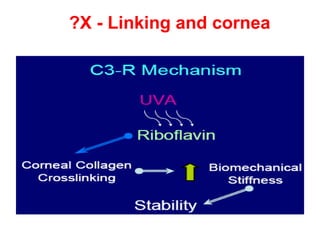
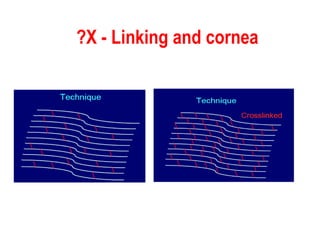
X - Linking and cornea?
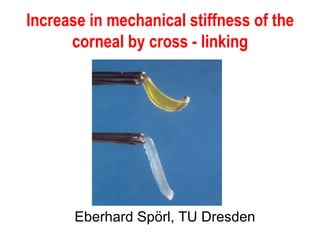
Collagen cross linking (CCL) Collagen cross-linking in the cornea using riboflavin (B 2 ) - UVA treatment leads to a  significant increase in mechanical stiffness of the corneal Sp örl  et al  Opthalmologe 1997 Increased rigidity by more than 300% Young ’ s modulus increased by 4.5 x
Increase in mechanical stiffness of the corneal by cross - linking Eberhard Spörl, TU Dresden
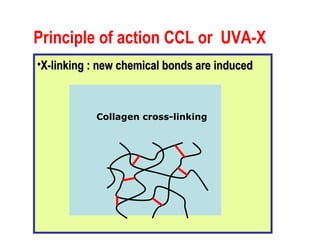
Principle of action CCL or  UVA-X   X-linking : new chemical bonds are   induced Collagen cross-linking
X - Linking and cornea?
X-linking
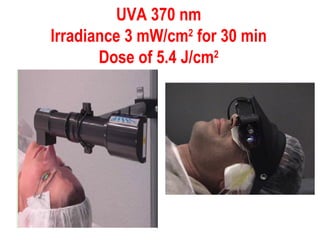
UVA 370 nm Irradiance 3 mW/cm 2  for 30 min Dose of 5.4 J/cm 2
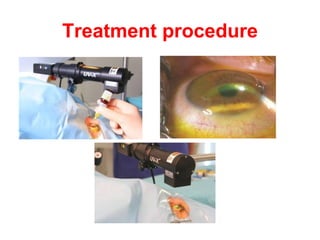
Treatment procedure
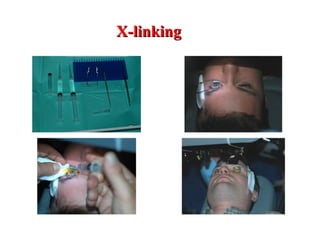
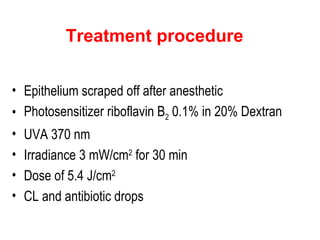
Treatment procedure Epithelium scraped off after anesthetic Photosensitizer riboflavin B 2  0.1% in 20% Dextran UVA 370 nm Irradiance 3 mW/cm 2  for 30 min Dose of 5.4 J/cm 2 CL and antibiotic drops
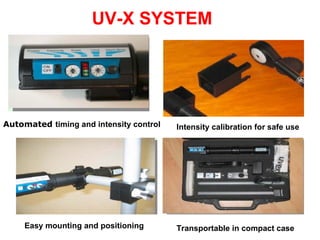
UV-X SYSTEM Automated   timing and intensity control Intensity calibration for safe use Easy mounting and positioning Transportable in compact case
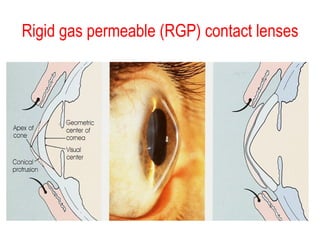
Treatment: improving of vision The first line of treatment is to fit rigid gas permeable (RGP) contact lenses Because this type of contact is not flexible, it creates a smooth, evenly shaped surface to see through However, because of the cornea's irregular shape, these lenses can be very challenging to fit This process often requires a great deal of time and patience When vision deteriorates to the point that contact lenses no longer provide satisfactory vision,  corneal transplant  may be necessary to replace the diseased cornea with a healthy one
Rigid gas permeable (RGP) contact lenses
Referral criteria for corneal graft  In 15% to 20% of the keratoconic population, a corneal transplant is eventually required  The patient should be referred for transplant if any of the following generally accepted referral criteria are met:  contact lens intolerance especially with recurrent abrasions inability to fit the patient with a contact lens (frequent lens loss)  decreased vision (scarring) which prevents the patient from doing necessary visual tasks a large cone with progressive thinning in the periphery  danger of perforation( extremely rare in keratoconus)
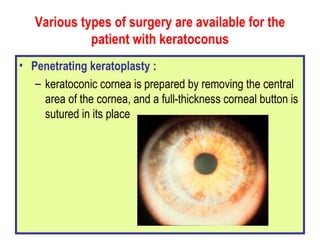
Various types of surgery are available for the patient with keratoconus Penetrating keratoplasty :   keratoconic cornea is prepared by removing the central area of the cornea, and a full - thickness corneal button is sutured in its place
Various types of surgery are available for the patient with keratoconus Penetrating keratoplasty :   Generally, the second eye is not grafted until the first eye is successfully rehabilitated success rate  PK of is 90% to 95% Keratoconus patients  are younger than the majority who are grafted for other reasons Contact lenses are often required after this procedure for best visual correction Patients can have LASIK or PRK on their transplants and become relatively independent of glasses or contact lenses
Various types of surgery are available for the patient with keratoconus Lamellar keratoplasty  (partial corneal transplant) : The cornea is removed to the depth of posterior stroma, and the donor button is sutured in place This technique is technically difficult, and visual acuity is inferior to that obtained after penetrating keratoplasty  This technique requires less recovery time, and poses less chance for corneal graft rejection or failure  Its disadvantages include vascularization and haziness of the graft
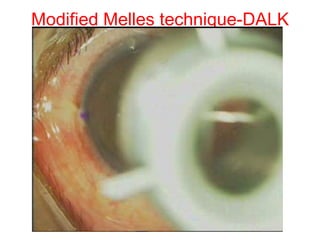
Modified Melles technique-DALK
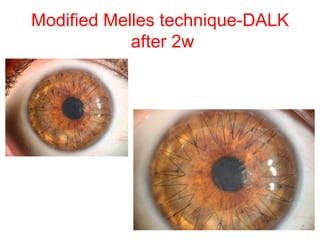
Modified Melles technique-DALK after 2w
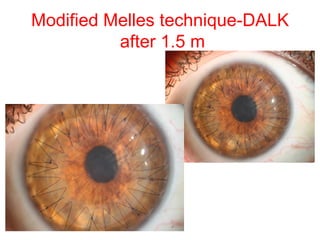
Modified Melles technique-DALK after 1.5 m
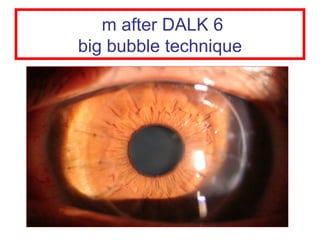
6 m after DALK  big bubble technique
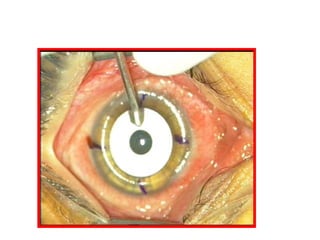
INTACS –FERRARA ring A method for flattening the cornea that is too steep and making a patient more contact lens tolerant is the insertion of  ring into the cornea This procedure is good for patients: contact lens intolerant  to avoid a corneal transplant  K readings are not in excess of  58 Diopters
INTACS –FERRARA ring It is also useful for individuals with keratoconus who want to improve their present vision with or without contact lenses This technique involves the insertion of two arc like plastic segments into the middle of the cornea to flatten the cornea
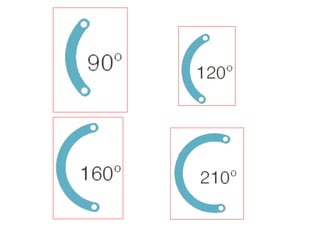
Ring segments , acrylic Perspex CQ (Mediphacos) with an inner radius of curvature of 2.5 mm, thickness from 150 to 350 mic, and arc length 150 degree Optical correction is achieved with  central corneal flattening, which is directly proportional to the ring thickness Ring segment thickness and arc lengths were selected according to a previously described Ferrara nomogram   FERRARA ring
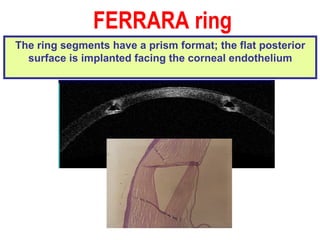
The ring segments have a prism format; the flat posterior surface is implanted facing the corneal endothelium FERRARA ring
The FICRS implantation technique is relatively easy for a corneal surgeon, but attention must be paid to some important details including : correct tunnel construction, starting at 80% depth of corneal thickness at the location of the radial incision ring segment centration based on central corneal reflex correct selection of ring segment position in the flat corneal meridian FERRARA ring
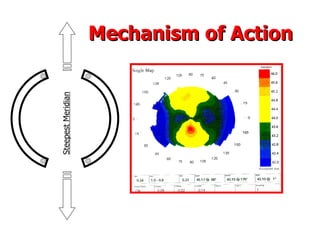
Mechanism of Action Steepest Meridian
 
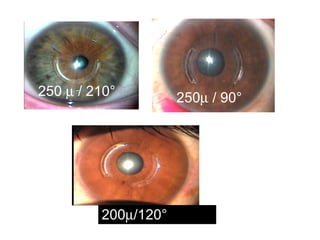
250    / 210° 250   / 90° 200  /120°
 
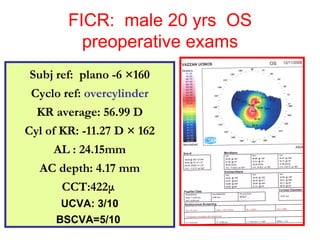
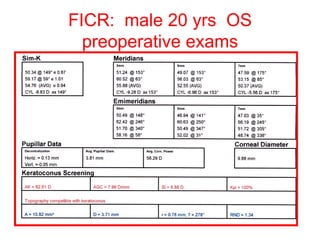
FICR:  male 20 yrs  OS preoperative exams Subj ref:  plano -6  × 160 Cyclo ref:  overcylinder KR average: 56.99 D Cyl of KR: -11.27 D  ×  162 AL : 24.15mm AC depth: 4.17 mm CCT:422 μ  UCVA: 3/10 BSCVA=5/10
FICR:  male 20 yrs  OS preoperative exams
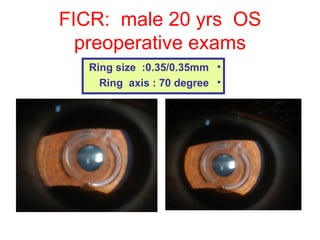
FICR:  male 20 yrs  OS preoperative exams Ring size  :0.35/0.35mm Ring  axis : 70 degree
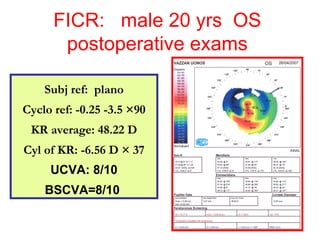
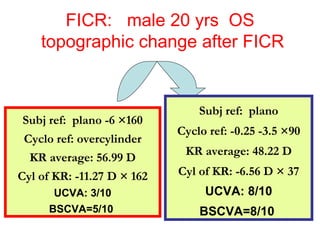
FICR:  male 20 yrs  OS postoperative exams Subj ref:  plano Cyclo ref: -0.25 -3.5  × 90 KR average: 48.22 D Cyl of KR: -6.56 D  ×  37 UCVA: 8/10 BSCVA=8/10
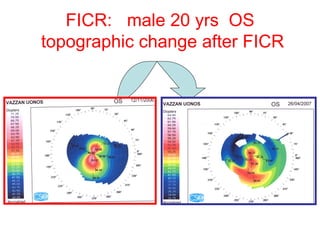
FICR:  male 20 yrs  OS topographic change after FICR
FICR:  male 20 yrs  OS topographic change after FICR   Subj ref:  plano Cyclo ref: -0.25 -3.5  × 90 KR average: 48.22 D Cyl of KR: -6.56 D  ×  37 UCVA: 8/10 BSCVA=8/10   Subj ref:  plano -6  × 160 Cyclo ref: overcylinder KR average: 56.99 D Cyl of KR: -11.27 D  ×  162 UCVA: 3/10 BSCVA=5/10
PHAKIC INTRAOCULAR LENSES Patients who are extremely nearsighted more than  -8 to -10D might benefit from phakic intraocular lenses Currently there are two type of these lenses approved by the FDA –the Verisyse / Artisan and the Visian ICL This will be an exciting new opportunity for a select number of patients with keratoconus who could potentially improve their vision without the need for corneal surgery
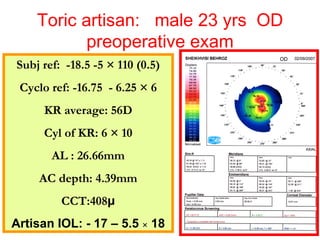
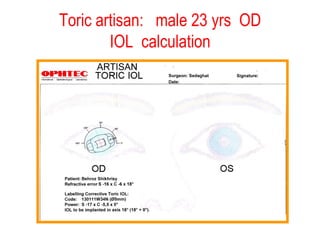
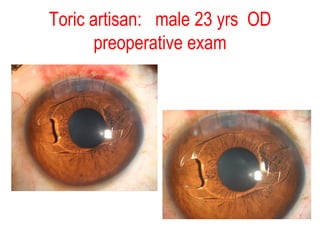
Toric artisan:  male 23 yrs  OD preoperative exam Subj ref:  -18.5 -5  ×  110 (0.5) Cyclo ref: -16.75  - 6.25  ×  6 KR average: 56D Cyl of KR: 6  ×  10 AL : 26.66mm AC depth: 4.39mm CCT:408 μ Artisan IOL: - 17 – 5.5  ×  18
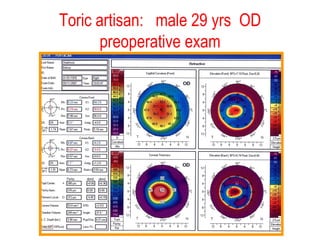
Toric artisan:  male 29 yrs  OD preoperative exam
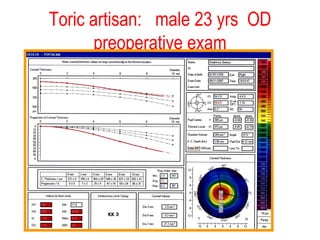
Toric artisan:  male 23 yrs  OD preoperative exam
Toric artisan:  male 23 yrs  OD IOL  calculation
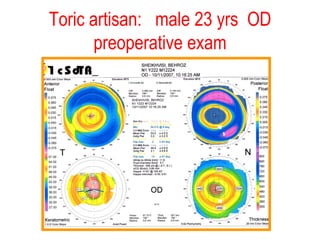
Toric artisan:  male 23 yrs  OD preoperative exam
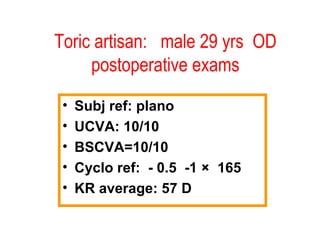
Toric artisan:  male 29 yrs  OD postoperative exams Subj ref: plano UCVA: 10/10 BSCVA=10/10  Cyclo ref:  - 0.5  -1  ×   165 KR average: 57 D

keratoconus

  • 1.
    Keratoconus diagnosis andtreatment Sedaghat M.R M.D MASHAD EYE RESEARCH CENTER Khatam-al-Anbia Hospital
  • 2.
    Keratoconus Preoperative topographic screening prior to keratorefractive surgery has largely focused on keratoconus A significant subset of patients who seek keratorefractive surgery may have a mild form of keratoconus
  • 3.
    Keratoconus prevalence(1) Prevalenceof clinically significant KCN is 1 in 3000 With more widespread use of topography is more common than previously thought Up to 8% of myopes presenting for refractive surgery have suggestive topographic analysis
  • 4.
    In refractive surgeon clinic overall : 8% 1-2% by excluding these: Instability of refraction Reduced BSCVA Myopia>-10D Astigmatism>2D 10-20% in patients: With high Astigmatism especially if oblique Keratoconus prevalence(2)
  • 5.
    Keratoconus prevalence(3) Incidenceof KCN in general population: 0.05% Incidence in persons considering refractive surgery: 6% to 12% Incidence of form-fruste KCN or suspect as high as 17% of patient seeking refractive surgery
  • 6.
    Incidence of keratoconus 0.03% – 0.05 % for keratoconus 6 % - 17% for form fruste keratoconus?
  • 7.
    Important etiologic factorsEye rubbing (prevalence among KCN patients ranges from 33% to 66%) Contact lens wear (corneal micro trauma) Vigorous eye rubbing has frequently been observed in patients with Down's syndrome & may explain the high incidence of associated corneal hydrops
  • 8.
    SYMPTOMS Symptoms arehighly variable and depend on the stage of the progression of the disorder Progressive visual blurring and /or distortion Early in the disease there may be no symptoms and may be noted simply because the patient cannot refracted to a clear 20/20 corrected vision
  • 9.
    Early inthe course of the disease , VA may be normal even in symptomatic patients Contrast sensitivity measurement may detect visual dysfunction before VA loss SYMPTOMS
  • 10.
    High irregular astigmatismwith a scissoring reflex on retinoscopy is typical in established keratoconus Irregular corneal astigmatism is confirmed when keratometry is performed and the central mires can not be superimposed SIGNS OF KCN
  • 11.
    SIGNS OF KCNExternal signs : Munson” sign Rizzuti phenomenon Slit-lamp findings: Stromal thining Posterior stress lines(vogt,s striae) Iron ring ( fleischer ring ) Scarring - epithelial or subepithelial Retroillumination signs: Scissoring on retinoscopy Oil droplet sign (charleaux”)
  • 12.
    Munson's sign Inadvanced keratoconus the corneal protrusion may cause angulation of the lower lid on down gaze
  • 13.
    Rizzuti phenomenon Sharplyfocused beam of light near the nasal limbus ,produced by lateral illumination of the cornea in patients with advanced keratoconus
  • 14.
    Slit lamp examination An eccentrically located ectatic protrusion of the cornea The apex is usually inferior to pupillary axis: Round or nipple – central cone , smaller diameter Larger oval or sagging cone may extend to the limbus
  • 15.
    SIGNS OF KCNQualititative criteria for diagnosis of KCN include: Corneal thining Vogt,s striae Fleischer ring Scissoring of retinoscopic reflex
  • 16.
    Stromal thining A hallmark of keratoconus is corneal thining which occurs at the apex of the cone (the point of maximal protrusion)
  • 17.
    Posterior stress lines(Vogt,s striae) Fine vertical lines in the deep stroma, just anterior to descemet,s membrane that parallel the axis of the cone and disappear transiently on gentle digital pressure
  • 18.
    Corneal Scarring epithelial or subepithelial Superficial linear scars at the corneal apex These results from ruptures in bowman,s layer
  • 19.
    Iron ring (fleischer ring ) The ring is a partial or complete annular line commonly seen at the base of the cone The ring is formed from hemosiderin pigment deposited in the basal epithelium
  • 20.
    Retroillumination and retinoscopy signs Scissoring on retinoscopy Oil droplet sign (charleaux ”)
  • 21.
    Corneal hydrops Acutedescemet membrane rupture and corneal hydrops
  • 22.
    Detection of KeratoconusRetinoscpy Slit lamp Keratometry Keratoscpy Vogt’s striae fleisher’ ring
  • 23.
    Signs / Symptoms Frequently changing spectacle Rx and axis of astigmatism Poor repeatability of subjective refraction Ghosting/ monocular diplopia Glare at night Haloes around lights Blurred/ distorted vision Scissors reflex: (swirling retinoscopy reflex) Distorted/ irregular keratometer mires with steep readings Prominent corneal nerves
  • 24.
    Signs / Symptoms KC often results in irregular astigmatism which can severely limit distance and night vision in a way that can not always be corrected using glasses Ghosting/ monocular diplopia Glare at night Haloes around lights Blurred/ distorted vision
  • 25.
    Signs / Symptoms KC often results in irregular astigmatism which can severely limit distance and night vision in a way that can not always be corrected using glasses
  • 26.
    Keratoconus course Keratoconus,classically, has its onset at puberty and is progressive until the third to fourth decade of life, when it usually arrests (80%) It may ,however, commence later in life and progress or arrest at any age (20%)
  • 27.
  • 28.
    Evaluation and diagnosisof keratoconus History and family history Follow up evaluation Slit -lamp exams Keratoscopy- Keratometry Corneal thickness - pachymetry Topography - Orbscan –Pentacam
  • 29.
  • 30.
  • 31.
  • 32.
    Keratoconus pattern: non-Keratoconuscornea general symmetry overall with no exsessive steepening Keratocunus cornea extreme asymmetrical and inferior steepening
  • 33.
    KCN clinicalclassification
  • 34.
    KCN clinicalclassification Clinical keratoconus Early or subclinical keratoconus Keratoconus suspect
  • 35.
    Clinical keratoconus Clinicalslit-lamp signs of keratoconus Scissoring of retinoscopic reflex with fully dilated pupil KCN topographic pattern
  • 36.
    Early or subclinicalkeratoconus No clinical slit-lamp findings Scissoring of retinoscopic reflex with fully dilated pupil KCN topographic pattern
  • 37.
    Keratoconus suspect Noclinical slit-lamp findings No scissoring of retinoscopic reflex with fully dilated pupil KCN topographic pattern
  • 38.
  • 39.
    Topographic patterns ofkeratoconus Inferior steepening without bowtie pattern specially more prominent temporally Asymmetrical bow tie (AB) & inferior/superior steepening (IS-SS) Central steepening +/- superimposed with asymmetrical bowtie pattern Asymmetic /symmetric bow tie (AB) & skewed radial axes (SRAX)
  • 40.
    Keratoconus pattern: Inferior steepening without bowtie pattern specially more prominent temporally
  • 41.
    Topographic patterns ofkeratoconus Inferior steepening without bowtie pattern specially more prominent temporally Asymmetrical bow tie (AB) & inferior steepening (IS) Central steepening +/- superimposed with asymmetrical bowtie pattern Asymmetic /symmetric bow tie (AB) & skewed radial axes (SRAX)
  • 42.
    Keratoconus pattern: asymmetricalbow tie (AB) & inferior steepening(IS)
  • 43.
    Topographic patterns ofkeratoconus Inferior steepening without bowtie pattern specially more prominent temporally Asymmetrical bow tie (AB) & superior steepening (SS) Central steepening +/- superimposed with asymmetrical bowtie pattern Asymmetic /symmetric bow tie (AB) & skewed radial axes (SRAX)
  • 44.
    Keratoconus pattern: asymmetricalbow tie (AB) & superior steepening(SS)
  • 45.
    Topographic patterns ofkeratoconus Inferior steepening without bowtie pattern specially more prominent temporally Asymmetrical bow tie (AB) & inferior/superior steepening (IS-SS) Unusual Central steepening Asymmetic /symmetric bow tie (AB) & skewed radial axes (SRAX)
  • 46.
    Keratoconus pattern: Centralkeratoconus central unusual steepening without bow tie
  • 47.
    Topographic patterns ofkeratoconus Inferior steepening without bowtie pattern specially more prominent temporally Asymmetrical bow tie (AB) & inferior/superior steepening (IS-SS) Central steepening with superimposed with asymmetrical bowtie pattern Asymmetic /symmetric bow tie (AB) & skewed radial axes (SRAX)
  • 48.
    Keratoconus pattern: Central steepening, superimposed with asymmetrical bowtie- slightly irregular astigmatism asymmetrical central hourglass
  • 49.
    Topographic patterns ofkeratoconus Inferior steepening without bowtie pattern specially more prominent temporally Asymmetrical bow tie (AB) & inferior/superior steepening (IS-SS) Central steepening with superimposed with symmetrical bowtie pattern Asymmetic /symmetric bow tie (AB) & skewed radial axes (SRAX)
  • 50.
    Globus topographictype of KCN
  • 51.
    Topographic patterns ofkeratoconus Inferior steepening without bowtie pattern specially more prominent temporally Asymmetrical bow tie (AB) & inferior/superior steepening(IS-SS) Central steepening +/- superimposed with asymmetrical bowtie pattern Asymmetic /symmetric bow tie (AB) & skewed radial axes (SRAX)
  • 52.
    Keratoconus pattern: Symmetic(SB) /asymmetric bow tie (AB) & (SRAX)
  • 53.
    Topographic patterns ofkeratoconus Inferior steepening without bowtie pattern specially more prominent temporally Asymmetrical bow tie (AB) & inferior/superior steepening(IS-SS) Central steepening +/- superimposed with asymmetrical bowtie pattern Asymmetric bow tie (AB) & skewed radial axes (SRAX)
  • 54.
    Keratoconus pattern: asymmetrical bow tie & skewed radial axes (AB/SRAX)
  • 55.
    Topographic patterns ofkeratoconus Inferior steepening without bowtie pattern specially more prominent temporally Asymmetrical bow tie (AB) & inferior/superior steepening(IS-SS) Central steepening +/- superimposed with asymmetrical bowtie pattern symmetric bow tie (AB) & skewed radial axes (SRAX)
  • 56.
    Keratoconus pattern: symmetrical bow tie & skewed radial axes (AB/SRAX)
  • 57.
    Classification Keratoconus canbe classified by cone shape , central keratometric reading or progression The simplest classification systems are based on keratometric reading or shape
  • 58.
    Classification Based onseverity of curvature Mild : <45 D in both meridians Moderate : 45-52 D in both meridians Severe : >52 D in both meridians Advanced : >62 D in both meridians
  • 59.
    Classification Based onshape of cone Nipple small diameter (5 mm); round shape; easiest to fit with contact lenses Oval large diameter (>5 mm); often displaced inferiorly; more difficult to fit with lenses, most common by topography Globus largest diameter (>6 mm); 75% of cornea affected; most difficult to fit with lenses
  • 60.
    KCN treatment Stoppingprogression of ectasia: Corneal cross- linking Improving vision by : Glasses Contact lenses surgery
  • 61.
    COLLAGEN CROSS LINKINGCollagen cross linking has recently been proposed as a method for stopping the progression of keratoconus and is used with or without the use of corneal ring or intraocular lens This involves applying riboflavin ( vitamin drops ) to the cornea and then blasting it with Ultraviolet light
  • 62.
    Keratoconus course With cross-linking Without cross-linking
  • 63.
    The inventors ofX- linking The excellent research by Prof Theo Seiler & Dr. Eberhard Spörl during the past 13 yearsis now summarized in an outstanding clinical device for UV cross linking
  • 64.
  • 65.
  • 66.
    eligible to cross- linking The diagnosis of keratoconus must be confirmed based on clinical examination findings and corneal topography (mapping) There must be evidence of progression of the keratoconus occurring over the last 12 months: changes in contact lens prescription, spectacle prescription measurements of corneal shape (keratometry or topography)
  • 67.
    NOT eligible tocross - linking Age less than 16 or older than 35 to 40 years Pregnancy or breastfeeding Past history of Herpes Simplex Keratitis Cornea is too thin (less than 400 microns) Other corneal disease or scarring is present There is a known allergy to Riboflavin
  • 68.
    X - Linkingand eye? X-linking of human collagen is a physiologic process, stiffening of connective tissue : ( diabetes and aging ) diabetes is a protection factor against KCN
  • 69.
    X - Linkingand cornea?
  • 70.
    Collagen cross linking(CCL) Collagen cross-linking in the cornea using riboflavin (B 2 ) - UVA treatment leads to a significant increase in mechanical stiffness of the corneal Sp örl et al Opthalmologe 1997 Increased rigidity by more than 300% Young ’ s modulus increased by 4.5 x
  • 71.
    Increase in mechanicalstiffness of the corneal by cross - linking Eberhard Spörl, TU Dresden
  • 72.
    Principle of actionCCL or UVA-X X-linking : new chemical bonds are induced Collagen cross-linking
  • 73.
    X - Linkingand cornea?
  • 74.
  • 75.
    UVA 370 nmIrradiance 3 mW/cm 2 for 30 min Dose of 5.4 J/cm 2
  • 76.
  • 77.
    Treatment procedure Epitheliumscraped off after anesthetic Photosensitizer riboflavin B 2 0.1% in 20% Dextran UVA 370 nm Irradiance 3 mW/cm 2 for 30 min Dose of 5.4 J/cm 2 CL and antibiotic drops
  • 78.
    UV-X SYSTEM Automated timing and intensity control Intensity calibration for safe use Easy mounting and positioning Transportable in compact case
  • 79.
    Treatment: improving ofvision The first line of treatment is to fit rigid gas permeable (RGP) contact lenses Because this type of contact is not flexible, it creates a smooth, evenly shaped surface to see through However, because of the cornea's irregular shape, these lenses can be very challenging to fit This process often requires a great deal of time and patience When vision deteriorates to the point that contact lenses no longer provide satisfactory vision, corneal transplant may be necessary to replace the diseased cornea with a healthy one
  • 80.
    Rigid gas permeable(RGP) contact lenses
  • 81.
    Referral criteria forcorneal graft In 15% to 20% of the keratoconic population, a corneal transplant is eventually required The patient should be referred for transplant if any of the following generally accepted referral criteria are met: contact lens intolerance especially with recurrent abrasions inability to fit the patient with a contact lens (frequent lens loss) decreased vision (scarring) which prevents the patient from doing necessary visual tasks a large cone with progressive thinning in the periphery danger of perforation( extremely rare in keratoconus)
  • 82.
    Various types ofsurgery are available for the patient with keratoconus Penetrating keratoplasty : keratoconic cornea is prepared by removing the central area of the cornea, and a full - thickness corneal button is sutured in its place
  • 83.
    Various types ofsurgery are available for the patient with keratoconus Penetrating keratoplasty : Generally, the second eye is not grafted until the first eye is successfully rehabilitated success rate PK of is 90% to 95% Keratoconus patients are younger than the majority who are grafted for other reasons Contact lenses are often required after this procedure for best visual correction Patients can have LASIK or PRK on their transplants and become relatively independent of glasses or contact lenses
  • 84.
    Various types ofsurgery are available for the patient with keratoconus Lamellar keratoplasty (partial corneal transplant) : The cornea is removed to the depth of posterior stroma, and the donor button is sutured in place This technique is technically difficult, and visual acuity is inferior to that obtained after penetrating keratoplasty This technique requires less recovery time, and poses less chance for corneal graft rejection or failure Its disadvantages include vascularization and haziness of the graft
  • 85.
  • 86.
  • 87.
  • 88.
    6 m afterDALK big bubble technique
  • 89.
    INTACS –FERRARA ringA method for flattening the cornea that is too steep and making a patient more contact lens tolerant is the insertion of  ring into the cornea This procedure is good for patients: contact lens intolerant to avoid a corneal transplant K readings are not in excess of  58 Diopters
  • 90.
    INTACS –FERRARA ringIt is also useful for individuals with keratoconus who want to improve their present vision with or without contact lenses This technique involves the insertion of two arc like plastic segments into the middle of the cornea to flatten the cornea
  • 91.
    Ring segments ,acrylic Perspex CQ (Mediphacos) with an inner radius of curvature of 2.5 mm, thickness from 150 to 350 mic, and arc length 150 degree Optical correction is achieved with central corneal flattening, which is directly proportional to the ring thickness Ring segment thickness and arc lengths were selected according to a previously described Ferrara nomogram FERRARA ring
  • 92.
    The ring segmentshave a prism format; the flat posterior surface is implanted facing the corneal endothelium FERRARA ring
  • 93.
    The FICRS implantationtechnique is relatively easy for a corneal surgeon, but attention must be paid to some important details including : correct tunnel construction, starting at 80% depth of corneal thickness at the location of the radial incision ring segment centration based on central corneal reflex correct selection of ring segment position in the flat corneal meridian FERRARA ring
  • 94.
    Mechanism of ActionSteepest Meridian
  • 95.
  • 96.
    250  / 210° 250  / 90° 200  /120°
  • 97.
  • 98.
    FICR: male20 yrs OS preoperative exams Subj ref: plano -6 × 160 Cyclo ref: overcylinder KR average: 56.99 D Cyl of KR: -11.27 D × 162 AL : 24.15mm AC depth: 4.17 mm CCT:422 μ UCVA: 3/10 BSCVA=5/10
  • 99.
    FICR: male20 yrs OS preoperative exams
  • 100.
    FICR: male20 yrs OS preoperative exams Ring size :0.35/0.35mm Ring axis : 70 degree
  • 101.
    FICR: male20 yrs OS postoperative exams Subj ref: plano Cyclo ref: -0.25 -3.5 × 90 KR average: 48.22 D Cyl of KR: -6.56 D × 37 UCVA: 8/10 BSCVA=8/10
  • 102.
    FICR: male20 yrs OS topographic change after FICR
  • 103.
    FICR: male20 yrs OS topographic change after FICR Subj ref: plano Cyclo ref: -0.25 -3.5 × 90 KR average: 48.22 D Cyl of KR: -6.56 D × 37 UCVA: 8/10 BSCVA=8/10 Subj ref: plano -6 × 160 Cyclo ref: overcylinder KR average: 56.99 D Cyl of KR: -11.27 D × 162 UCVA: 3/10 BSCVA=5/10
  • 104.
    PHAKIC INTRAOCULAR LENSESPatients who are extremely nearsighted more than -8 to -10D might benefit from phakic intraocular lenses Currently there are two type of these lenses approved by the FDA –the Verisyse / Artisan and the Visian ICL This will be an exciting new opportunity for a select number of patients with keratoconus who could potentially improve their vision without the need for corneal surgery
  • 105.
    Toric artisan: male 23 yrs OD preoperative exam Subj ref: -18.5 -5 × 110 (0.5) Cyclo ref: -16.75 - 6.25 × 6 KR average: 56D Cyl of KR: 6 × 10 AL : 26.66mm AC depth: 4.39mm CCT:408 μ Artisan IOL: - 17 – 5.5 × 18
  • 106.
    Toric artisan: male 29 yrs OD preoperative exam
  • 107.
    Toric artisan: male 23 yrs OD preoperative exam
  • 108.
    Toric artisan: male 23 yrs OD preoperative exam
  • 109.
    Toric artisan: male 23 yrs OD IOL calculation
  • 110.
    Toric artisan: male 23 yrs OD preoperative exam
  • 111.
    Toric artisan: male 29 yrs OD postoperative exams Subj ref: plano UCVA: 10/10 BSCVA=10/10 Cyclo ref: - 0.5 -1 × 165 KR average: 57 D