ECTATIC CONDITIONS OF CORNEA

SATISH REDDY A.N
CORNEAL ECTASIAS
1. Keratoconus

2. Keratoglobus

3. Keratotorus
(Pellucid marginal degeneration)
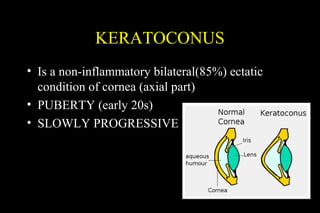
KERATOCONUS
• Is a non-inflammatory bilateral(85%) ectatic
condition of cornea (axial part)
• PUBERTY (early 20s)
• SLOWLY PROGRESSIVE
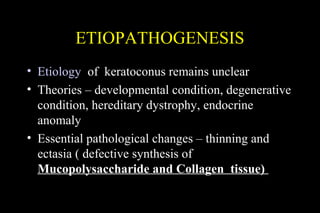
ETIOPATHOGENESIS
• Etiology of keratoconus remains unclear
• Theories – developmental condition, degenerative
condition, hereditary dystrophy, endocrine
anomaly
• Essential pathological changes – thinning and
ectasia ( defective synthesis of
Mucopolysaccharide and Collagen tissue)
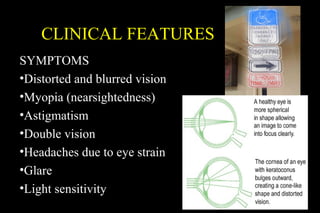
CLINICAL FEATURES
SYMPTOMS
•Distorted and blurred vision
•Myopia (nearsightedness)
•Astigmatism
•Double vision
•Headaches due to eye strain
•Glare
•Light sensitivity
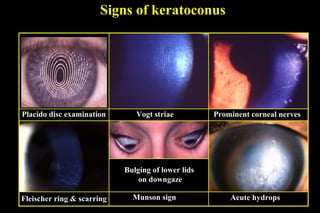
Signs of keratoconus

Placido disc examination

Vogt striae

Prominent corneal nerves

Bulging of lower lids
on downgaze
Fleischer ring & scarring

Munson sign

Acute hydrops
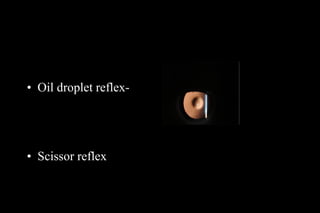
• Oil droplet reflex-

• Scissor reflex
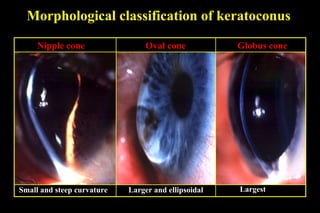
Morphological classification of keratoconus
Nipple cone

Oval cone

Small and steep curvature

Larger and ellipsoidal

Globus cone

Largest
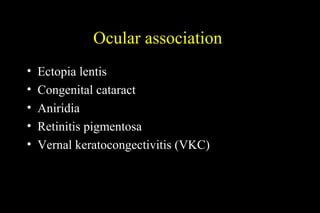
Ocular association
•
•
•
•
•

Ectopia lentis
Congenital cataract
Aniridia
Retinitis pigmentosa
Vernal keratocongectivitis (VKC)
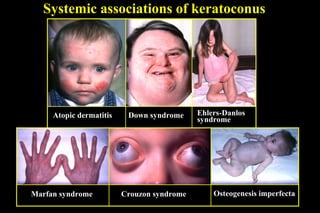
Systemic associations of keratoconus

Atopic dermatitis

Marfan syndrome

Down syndrome

Crouzon syndrome

Ehlers-Danlos
syndrome

Osteogenesis imperfecta
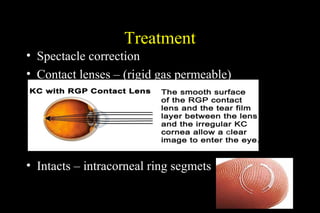
Treatment
• Spectacle correction
• Contact lenses – (rigid gas permeable)

• Intacts – intracorneal ring segmets
• Cornecollagen cross linkingal – may slow the
progression of disease
• Keratoplasty – (required in later stages )
DALK-deep anterior lamellar keratoplasty
PK-penetrating keratoplasty
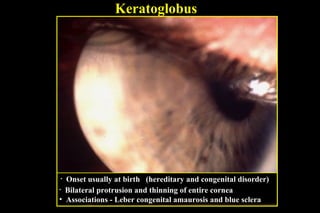
Keratoglobus

Onset usually at birth (hereditary and congenital disorder)
• Bilateral protrusion and thinning of entire cornea
• Associations - Leber congenital amaurosis and blue sclera
•
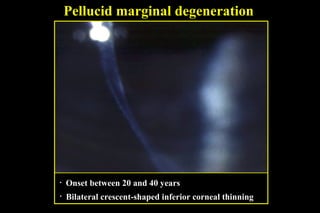
Pellucid marginal degeneration

•

Onset between 20 and 40 years

•

Bilateral crescent-shaped inferior corneal thinning
Corneal ectasias

Corneal ectasias