Intermittent Exotropia
Dr. Ashraful Huq
FCPS
Consultant
Bangladesh Eye Trust Hospital
Dhaka, Bangladesh
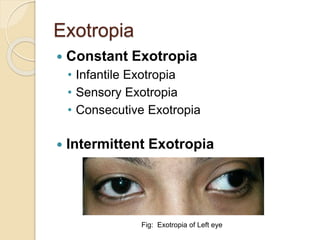
Exotropia
 Constant Exotropia
• Infantile Exotropia
• Sensory Exotropia
• Consecutive Exotropia
 Intermittent Exotropia
Fig: Exotropia of Left eye
Intermittent Exotropia
• Outward drifting of either eye
• Interspersed with periods of good
alignment
Fig: Intermittent Exotropia
 Most common form of divergent
strabismus
 Onset before 5 years of age
 Manifest during –
• Visual inattention
• Fatigue
• Illness
• Daydreaming
• Drowsiness upon awakening
Causes
 Imbalance between active
convergence and divergence
 Abnormal orbital anatomy
 Abnormalities of extraocular muscle
proprioception
Symptoms
 Asymptomatic
 Transient diplopia
 Asthenopic symptoms
 Reflex closure of one eye in bright
sunlight
Evaluation
 History
 Visual acuity
 Measurement of deviation
 Ocular motility
 Slit lamp examination
 Fundoscopy
 Stereoacuity
Cover test in Intermittent Exotropia
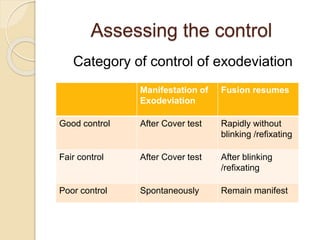
Assessing the control
Category of control of exodeviation
Manifestation of
Exodeviation
Fusion resumes
Good control After Cover test Rapidly without
blinking /refixating
Fair control After Cover test After blinking
/refixating
Poor control Spontaneously Remain manifest
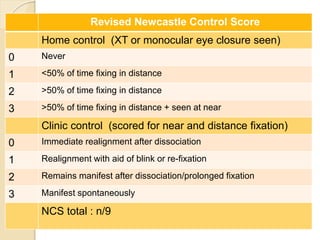
Revised Newcastle Control Score
Home control (XT or monocular eye closure seen)
0 Never
1 <50% of time fixing in distance
2 >50% of time fixing in distance
3 >50% of time fixing in distance + seen at near
Clinic control (scored for near and distance fixation)
0 Immediate realignment after dissociation
1 Realignment with aid of blink or re-fixation
2 Remains manifest after dissociation/prolonged fixation
3 Manifest spontaneously
NCS total : n/9
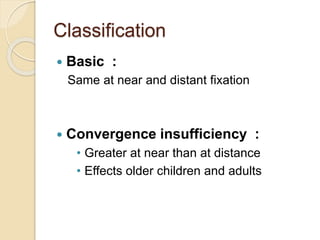
Classification
 Basic :
Same at near and distant fixation
 Convergence insufficiency :
• Greater at near than at distance
• Effects older children and adults
 Divergence excess :
Greater at distance fixation than at near
Types-
• Simulated divergence excess
• True divergence excess
Treatment
 Two types-
• Non-surgical
• Surgical
Non-surgical Treatment
 Spectacle Correction
 Overcorrecting minus lens therapy
 Part-time patching of dominant eye
 Active orthoptic treatment
 Base-in prisms
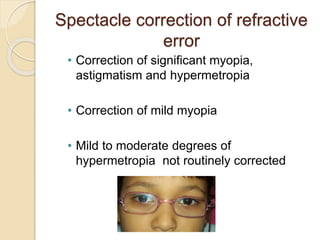
Spectacle correction of refractive
error
• Correction of significant myopia,
astigmatism and hypermetropia
• Correction of mild myopia
• Mild to moderate degrees of
hypermetropia not routinely corrected
Overcorrecting minus lens
therapy
• Stimulates accommodative convergence
& control exodeviation
• Usually 2-4 D beyond refractive error
correction
• Advantage –
Promotes fusion & delay surgery
• Disadvantage –
Asthenopia
Part-time patching of dominant
eye
• Converts intermittent exotropia to phoria
• Done 4 – 6 hours/day
• Advantage – Delays surgical intervention
• Disadvantage - Prevents fusion &
accelerate progression
Active orthoptic treatments
• Consist of antisuppression therapy
• Fusional convergence training
• Should be used as supplement to surgery
Prism therapy
• Base-in prism used
• Promotes bifoveal stimulation
• Disadvantage – Causes reduction in
fusional vergence amplitude
Indications of Surgical
Treatment
• Gradual loss of fusional control
• Increased frequency of manifest phase
• Increase size of the basic deviation
• Development of suppression
• Decrease of Stereoacuity
Surgery
• Bilateral lateral rectus recession
• Unilateral lateral rectus recession with
ipsilateral medial rectus resection
• Unilateral lateral rectus recession
Fig: (A) Intermittent Exotropia before surgery (B) 3 months after
surgery
Lateral rectus recession
Exotropia (PD) LR recession(mm each eye)
20 4.5
25 5.0
30 6.0
35 6.5
40 7.0
45 7.5
50 8.0
LR recession and MR resection
Exotropia (PD) LR recession (mm) MR resection (mm)
20 4.0 3.0
25 5.0 4.0
30 5.5 4.0
35 6.5 4.5
40 7.0 4.5
50 8.0 4.5
Post-operative complications
 Over Correction :
 Persistant esotropia 3-4 weeks after
surgery
 Treatment -
• Correction of refractive error
• Part-time alternate patching
• Base-out prisms
• Botulinum toxin injection
• Reoperation
Post-operative complication
 Under Correction :
• Observation
• Orthoptic exercise
• Prism therapy
• Reoperation
Take Home Message
• Intermittent Exotropia is difficult to
diagnose
• Proper evaluation required
• Timely treatment necessary
• Follow-up must be done to record
progression
• Goal is to restore alignment and
preserve Binocular Single Vision
Intermittent exotropia

Intermittent exotropia

  • 1.
    Intermittent Exotropia Dr. AshrafulHuq FCPS Consultant Bangladesh Eye Trust Hospital Dhaka, Bangladesh
  • 2.
    Exotropia  Constant Exotropia •Infantile Exotropia • Sensory Exotropia • Consecutive Exotropia  Intermittent Exotropia Fig: Exotropia of Left eye
  • 3.
    Intermittent Exotropia • Outwarddrifting of either eye • Interspersed with periods of good alignment Fig: Intermittent Exotropia
  • 4.
     Most commonform of divergent strabismus  Onset before 5 years of age  Manifest during – • Visual inattention • Fatigue • Illness • Daydreaming • Drowsiness upon awakening
  • 5.
    Causes  Imbalance betweenactive convergence and divergence  Abnormal orbital anatomy  Abnormalities of extraocular muscle proprioception
  • 6.
    Symptoms  Asymptomatic  Transientdiplopia  Asthenopic symptoms  Reflex closure of one eye in bright sunlight
  • 7.
    Evaluation  History  Visualacuity  Measurement of deviation  Ocular motility  Slit lamp examination  Fundoscopy  Stereoacuity
  • 8.
    Cover test inIntermittent Exotropia
  • 9.
    Assessing the control Categoryof control of exodeviation Manifestation of Exodeviation Fusion resumes Good control After Cover test Rapidly without blinking /refixating Fair control After Cover test After blinking /refixating Poor control Spontaneously Remain manifest
  • 10.
    Revised Newcastle ControlScore Home control (XT or monocular eye closure seen) 0 Never 1 <50% of time fixing in distance 2 >50% of time fixing in distance 3 >50% of time fixing in distance + seen at near Clinic control (scored for near and distance fixation) 0 Immediate realignment after dissociation 1 Realignment with aid of blink or re-fixation 2 Remains manifest after dissociation/prolonged fixation 3 Manifest spontaneously NCS total : n/9
  • 11.
    Classification  Basic : Sameat near and distant fixation  Convergence insufficiency : • Greater at near than at distance • Effects older children and adults
  • 12.
     Divergence excess: Greater at distance fixation than at near Types- • Simulated divergence excess • True divergence excess
  • 13.
    Treatment  Two types- •Non-surgical • Surgical
  • 14.
    Non-surgical Treatment  SpectacleCorrection  Overcorrecting minus lens therapy  Part-time patching of dominant eye  Active orthoptic treatment  Base-in prisms
  • 15.
    Spectacle correction ofrefractive error • Correction of significant myopia, astigmatism and hypermetropia • Correction of mild myopia • Mild to moderate degrees of hypermetropia not routinely corrected
  • 16.
    Overcorrecting minus lens therapy •Stimulates accommodative convergence & control exodeviation • Usually 2-4 D beyond refractive error correction • Advantage – Promotes fusion & delay surgery • Disadvantage – Asthenopia
  • 17.
    Part-time patching ofdominant eye • Converts intermittent exotropia to phoria • Done 4 – 6 hours/day • Advantage – Delays surgical intervention • Disadvantage - Prevents fusion & accelerate progression
  • 18.
    Active orthoptic treatments •Consist of antisuppression therapy • Fusional convergence training • Should be used as supplement to surgery
  • 19.
    Prism therapy • Base-inprism used • Promotes bifoveal stimulation • Disadvantage – Causes reduction in fusional vergence amplitude
  • 20.
    Indications of Surgical Treatment •Gradual loss of fusional control • Increased frequency of manifest phase • Increase size of the basic deviation • Development of suppression • Decrease of Stereoacuity
  • 21.
    Surgery • Bilateral lateralrectus recession • Unilateral lateral rectus recession with ipsilateral medial rectus resection • Unilateral lateral rectus recession
  • 22.
    Fig: (A) IntermittentExotropia before surgery (B) 3 months after surgery
  • 23.
    Lateral rectus recession Exotropia(PD) LR recession(mm each eye) 20 4.5 25 5.0 30 6.0 35 6.5 40 7.0 45 7.5 50 8.0
  • 24.
    LR recession andMR resection Exotropia (PD) LR recession (mm) MR resection (mm) 20 4.0 3.0 25 5.0 4.0 30 5.5 4.0 35 6.5 4.5 40 7.0 4.5 50 8.0 4.5
  • 25.
    Post-operative complications  OverCorrection :  Persistant esotropia 3-4 weeks after surgery  Treatment - • Correction of refractive error • Part-time alternate patching • Base-out prisms • Botulinum toxin injection • Reoperation
  • 26.
    Post-operative complication  UnderCorrection : • Observation • Orthoptic exercise • Prism therapy • Reoperation
  • 27.
    Take Home Message •Intermittent Exotropia is difficult to diagnose • Proper evaluation required • Timely treatment necessary • Follow-up must be done to record progression • Goal is to restore alignment and preserve Binocular Single Vision