ISRA SCHOOL OF OPTOMETRY
3RD YEAR BsVs
ZAMEER SADHAYO
 Keratoconus is a condition in which
cornea assumes a conical shape because of
thinning and protrusion. Cellular
infiltration and vascularization do not
occur. It is usually b/l and, although it
involves central two-thirds of cornea, apex
of cone is usually centered just below
visual axis. This results in mild to marked
impairment of visual function.
 They are keratoconus,
, , and
.
 first three disorders may actually represent variations
in phenotypic expression of same pathogenetic
mechanism.
 Corneal thinning is a hallmark of these ectatic
diseases. area of maximal thinning, relative to
location of maximal corneal protrusion, is helpful
in differentiating these conditions.
• PMD is a b / l , non-inflammatory,
peripheral corneal thinning disorder
characterized by a peripheral band of
thinning of the inferior cornea. The cornea
in and adjacent to the thinned area is
ectatic.The etiology of PMD has not been
clearly established, but collagen
abnormalities, as seen in KC, have been
reported. Patients usually are aged 20–40
years at the time of clinical presentation
• It is a generalized thinning of cornea .
thinning is marked at limbus,
extending circumferentially for 360°; this
makes it different from the globus
morphological pattern of the KC.• The
whole cornea protrudes, in contrast to
the regional thinning seen in KC and the
inferior paralimbal thinning in PMD.
• Forme Fruste Keratoconus (FFKC) is a
subclinical disease and is not a variant of KC.
Although clinicians use many other terms
such as mild KC, early KC, and subclinical
KC, their exact meanings and applications
are less certain. These terms are not
universally accepted.
• The diagnosis of KC is a clinical one that is
aided by topography, while the diagnosis of
FFKC is topographic.
• FFKC is a completely normal cornea
with neither clinical nor topographical
risk factors, but this cornea is able to
develop KC when treated by laser.
• The fellow eye may be keratoconic or
there may be a family history of KC
• FFKC is an abnormal cornea. Corneal
topography or corneal hysteresis or
both are abnormal; i.e., there are risk
factors but the case is still not a
clinically obvious KC.
A
KERATOCONUS
B
PMD
C
KERATOGLOBUS
D
POST
KERATOCONUS
• KC occurs with increased frequency with
systemic and ocular conditions:
1. Systemic disorders:
• Down’s syndrome, Turner syndrome, Ehlers-
Dunlos syndrome, Marfan syndrome,atopy,
osteogenesis imperfecta, and mitral valve
prolapse.
2. Ocular associations:
• Vernal disease, retinitis pigmentosa, blue
sclera, aniridia, and ectopia lentis
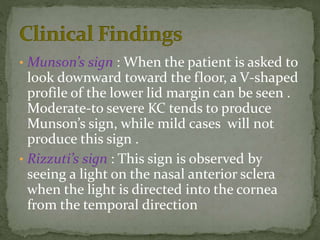
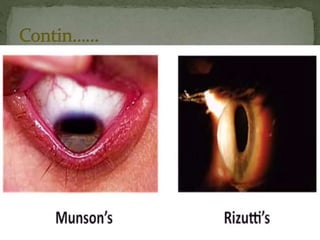
• Munson’s sign : When the patient is asked to
look downward toward the floor, a V-shaped
profile of the lower lid margin can be seen .
Moderate-to severe KC tends to produce
Munson’s sign, while mild cases will not
produce this sign .
• Rizzuti’s sign : This sign is observed by
seeing a light on the nasal anterior sclera
when the light is directed into the cornea
from the temporal direction
• scissoring effect of the retinal reflex
seen with retinoscopy is highly
diagnostic of KC (and of all forms of
irregular astigmatism). It is best seen
when the pupils are dilated. Unlike
Munson’s sign, scissoring effect is
considered to be sensitive to even mild
forms of KC
• Focal thinning :
• focal thinning occurs at the cone apex,which
is usually located inferior to the center of
cornea; in pellucid marginal degeneration
(PMD), this focal thinning is located in the
lower third of the cornea.
• Fleischer’s ring :
• It is due to accumulation of ferritin particles
in corneal basal epithelial cells. It encircles
the base of the cone.
 As cornea continues to thin and bulge
out,“stretch marks” may develop in form of
thin,bright lines located deep in the stroma
adjacent to Descemets’ membrane called
Vogt’s striae . Vogt’s striae are a sign of
corneal stretching
and protrusion. When cornea is depressed,
Vogt’s striae often disappear. These striae are
sometimes called stress lines.
• Anterior stromal scars may develop due to
continuous protrusion of the cornea.
These scars may be small or large .
• The size and location of the scars
determines its impact on visual function.
• If stretching becomes excessive, the
cornea may eventually tear in the
Descemets’ membrane leading
to fluid accumulation within the stroma
and therefore to hydrops cornea .
This intense stromal edema often results
in an acutely blurred vision since the
tears often occur centrally.
• When the endothelium migrates to
cover the tear,edema resolves and a
posterior scar may form.
• Tears can occur in corneal periphery
which may have minimal impact on
vision
Keratoconus
Keratoconus
Keratoconus
Keratoconus
Keratoconus
Keratoconus

Keratoconus

  • 1.
    ISRA SCHOOL OFOPTOMETRY 3RD YEAR BsVs ZAMEER SADHAYO
  • 2.
     Keratoconus isa condition in which cornea assumes a conical shape because of thinning and protrusion. Cellular infiltration and vascularization do not occur. It is usually b/l and, although it involves central two-thirds of cornea, apex of cone is usually centered just below visual axis. This results in mild to marked impairment of visual function.
  • 3.
     They arekeratoconus, , , and .  first three disorders may actually represent variations in phenotypic expression of same pathogenetic mechanism.  Corneal thinning is a hallmark of these ectatic diseases. area of maximal thinning, relative to location of maximal corneal protrusion, is helpful in differentiating these conditions.
  • 4.
    • PMD isa b / l , non-inflammatory, peripheral corneal thinning disorder characterized by a peripheral band of thinning of the inferior cornea. The cornea in and adjacent to the thinned area is ectatic.The etiology of PMD has not been clearly established, but collagen abnormalities, as seen in KC, have been reported. Patients usually are aged 20–40 years at the time of clinical presentation
  • 6.
    • It isa generalized thinning of cornea . thinning is marked at limbus, extending circumferentially for 360°; this makes it different from the globus morphological pattern of the KC.• The whole cornea protrudes, in contrast to the regional thinning seen in KC and the inferior paralimbal thinning in PMD.
  • 8.
    • Forme FrusteKeratoconus (FFKC) is a subclinical disease and is not a variant of KC. Although clinicians use many other terms such as mild KC, early KC, and subclinical KC, their exact meanings and applications are less certain. These terms are not universally accepted. • The diagnosis of KC is a clinical one that is aided by topography, while the diagnosis of FFKC is topographic.
  • 9.
    • FFKC isa completely normal cornea with neither clinical nor topographical risk factors, but this cornea is able to develop KC when treated by laser. • The fellow eye may be keratoconic or there may be a family history of KC
  • 10.
    • FFKC isan abnormal cornea. Corneal topography or corneal hysteresis or both are abnormal; i.e., there are risk factors but the case is still not a clinically obvious KC.
  • 11.
  • 13.
    • KC occurswith increased frequency with systemic and ocular conditions: 1. Systemic disorders: • Down’s syndrome, Turner syndrome, Ehlers- Dunlos syndrome, Marfan syndrome,atopy, osteogenesis imperfecta, and mitral valve prolapse. 2. Ocular associations: • Vernal disease, retinitis pigmentosa, blue sclera, aniridia, and ectopia lentis
  • 14.
    • Munson’s sign: When the patient is asked to look downward toward the floor, a V-shaped profile of the lower lid margin can be seen . Moderate-to severe KC tends to produce Munson’s sign, while mild cases will not produce this sign . • Rizzuti’s sign : This sign is observed by seeing a light on the nasal anterior sclera when the light is directed into the cornea from the temporal direction
  • 16.
    • scissoring effectof the retinal reflex seen with retinoscopy is highly diagnostic of KC (and of all forms of irregular astigmatism). It is best seen when the pupils are dilated. Unlike Munson’s sign, scissoring effect is considered to be sensitive to even mild forms of KC
  • 18.
    • Focal thinning: • focal thinning occurs at the cone apex,which is usually located inferior to the center of cornea; in pellucid marginal degeneration (PMD), this focal thinning is located in the lower third of the cornea. • Fleischer’s ring : • It is due to accumulation of ferritin particles in corneal basal epithelial cells. It encircles the base of the cone.
  • 19.
     As corneacontinues to thin and bulge out,“stretch marks” may develop in form of thin,bright lines located deep in the stroma adjacent to Descemets’ membrane called Vogt’s striae . Vogt’s striae are a sign of corneal stretching and protrusion. When cornea is depressed, Vogt’s striae often disappear. These striae are sometimes called stress lines.
  • 20.
    • Anterior stromalscars may develop due to continuous protrusion of the cornea. These scars may be small or large . • The size and location of the scars determines its impact on visual function. • If stretching becomes excessive, the cornea may eventually tear in the Descemets’ membrane leading to fluid accumulation within the stroma and therefore to hydrops cornea .
  • 21.
    This intense stromaledema often results in an acutely blurred vision since the tears often occur centrally. • When the endothelium migrates to cover the tear,edema resolves and a posterior scar may form. • Tears can occur in corneal periphery which may have minimal impact on vision