MAXILLARY ANESTHESIA
Seminar on -
Presented by –
Hemam Shankar Singh
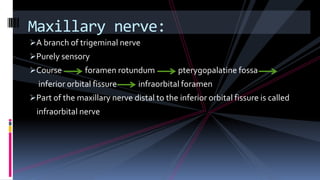
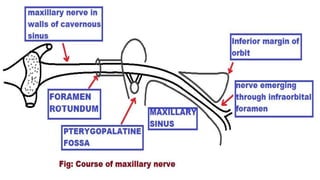
A branch of trigeminal nerve
Purely sensory
Course foramen rotundum pterygopalatine fossa
inferior orbital fissure infraorbital foramen
Part of the maxillary nerve distal to the inferior orbital fissure is called
infraorbital nerve
Maxillary nerve:
A. Branch in middle cranial fossa:
before entering foramen rotundum gives off meningeal
branch to dura materof the middle cranial fossa
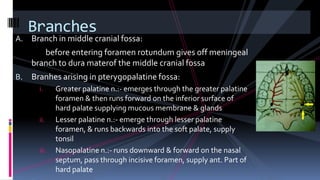
B. Branhes arising in pterygopalatine fossa:
i. Greater palatine n.:- emerges through the greater palatine
foramen & then runs forward on the inferior surface of
hard palate supplying mucous membrane & glands
ii. Lesser palatine n.:- emerge through lesser palatine
foramen, & runs backwards into the soft palate, supply
tonsil
iii. Nasopalatine n.:- runs downward & forward on the nasal
septum, pass through incisive foramen, supply ant. Part of
hard palate
Branches
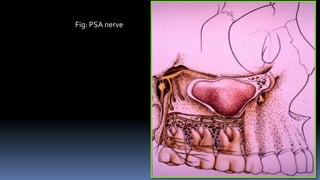
iv. Posterior superior alveolar(PSA) n.:- runs down on the posterior surface of the
maxilla it lie in the wall of maxillary sinus where it supplies. It supply sensory
innervation to—
-buccal gingiva in maxillary molar region
-mucous membrane of the sinus
-alveoli, PDL, & pulpal tissue of the maxillary 3rd, 2nd & 1st molar with
exception (in 28%of patients) of mesiobuccal root of the 1st molar
C. Branch in infraorbital groove & canal
i. Middle superior alveolar (MSA) n.:- arise within the canal, provide sensory
innervation to two maxillary premolars & mesiobuccal root of maxillary 1st molar
(28%), periodontal tissues, buccal soft tissue, & bone of the premolar region
ii. Anterior superior alveolar (ASA) n.:- arise from infraorbital n. provide pulpal
innervation to C.I. & L.I., & canine, to periodontal tissue, buccal bone, & mucous
membrane of these teeth
Contd.
1. Local Infiltration
2. Field Block
3. Nerve Block
Techniques of Maxillary Anesthesia
I. Supraperiosteal (infiltration)
II. Periodontal ligament (PDL, intraligamentary)
III. Intraseptal injection
IV. Posterior superior alveolar nerve block
V. Middle superior alveolar nerve block
VI. Anterior superior alveolar nerve block
VII. Greater (anterior) palatine nerve block
VIII. Nasopalatine nerve block
IX. Maxillary (second division) nerve block
X. Anterior meddle superior alveolar nerve block
XI. Palatal approach-anterior superior alveolar n block
Maxillary Injection Techniques
Nerves anesthetized– terminal branch of dental plexus
Areas anesthetized
Entire region innervated by the large terminal branches of this plexus
Indications
1. Pulpal anesthesia of maxillary teeth when treatment is limited to 1 or 2
teeth
2. Soft tissue anesthesia when indicated for surgical procedure
Contraindications
1. Infection or acute inflammation
2. Dense bone covering the apices of teeth
Supraperiosteal Injection
Advantages
1. High success rate (>95%)
2. Easy & usually entirely atraumatic
Disadvantages
Not recommended for larger areas because of multiple injection
Alternatives– PDL, IO, regional block
Anatomical landmark:
Mucobuccal fold
Crown of the tooth
Root contour of the tooth
Supraperiosteal Injection
Technique
1. Lift the lip, pulling the tissue taut
2. Hold the syringe parallel to the long axis of the tooth
3. Insert the needle at the height of the mucobuccal fold over the target tooth
4. Advance the needle until its bevel is at or above the apical region of the
tooth
5. Aspirate, if –ve , deposit 0.6 ml slowly over 20 seconds
Sighs & symptoms
1. Subjective: feeling of numbness in the area of administration
2. Objective: no pain during therapy
Supraperiosteal Injection
Safety features
1. Minimal risk of intravascular administration
2. Slowness of injection, aspiration
Precautions
should not be used for larger areas
Complications
pain on needle insertion with the tip against periosteum
Supraperiosteal Injection
Fig: PSA nerve
NervesAnesthetized-
Posterior superior alveolar and its branches
AreasAnesthetized-
1) Pulps of the maxillary 3rd , 2nd and 1st molars
2) Buccal periodontium and bone overlying these
teeth
Anatomical Landmarks-
1. Mucobuccal fold and its concavity
2. Zygomatic process of the maxilla
3. Infratemporal surface of the maxilla
4. Anterior border and coronoid process of the ramus
of the mandible
5. Maxillary tuberosity
Posterior superior alveolar(PSA) nerve block
Indications –
1. When treatment involves two or more maxillary molars
2. When supraperiosteal injection is contraindicated (e.g. with infection or
acute inflammation)
3. When supraperiosteal injection has proved ineffective
Contraindications-
When the risk of hematoma is too high ( as in hemophilic), in which case a
supraperiosteal or PDL is recommended.
Advantages-
1. Atraumatic
2. High success rate
3. Less number of injections
4. Minimize amount of local used
Posterior superior alveolar(PSA) nerve block
Disadvantages-
1. Risk of hematoma
2. Does not anesthetize first molar completely
3. No bony landmarks during insertion
4. Second injection necessary for 1st maxillary molar in 28% of patients
Positive Aspiration-
Approximately 3.1%
Posterior superior alveolar(PSA) nerve block
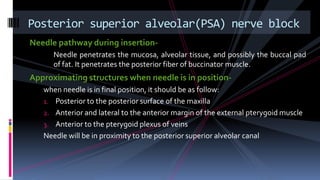
Needle pathway during insertion-
Needle penetrates the mucosa, alveolar tissue, and possibly the buccal pad
of fat. It penetrates the posterior fiber of buccinator muscle.
Approximating structures when needle is in position-
when needle is in final position, it should be as follow:
1. Posterior to the posterior surface of the maxilla
2. Anterior and lateral to the anterior margin of the external pterygoid muscle
3. Anterior to the pterygoid plexus of veins
Needle will be in proximity to the posterior superior alveolar canal
Posterior superior alveolar(PSA) nerve block
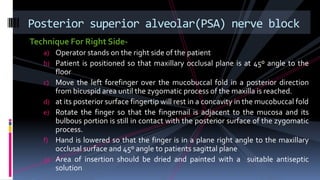
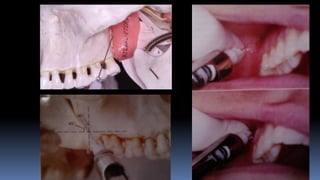
Technique For Right Side-
a) Operator stands on the right side of the patient
b) Patient is positioned so that maxillary occlusal plane is at 45º angle to the
floor
c) Move the left forefinger over the mucobuccal fold in a posterior direction
from bicuspid area until the zygomatic process of the maxilla is reached.
d) at its posterior surface fingertip will rest in a concavity in the mucobuccal fold
e) Rotate the finger so that the fingernail is adjacent to the mucosa and its
bulbous portion is still in contact with the posterior surface of the zygomatic
process.
f) Hand is lowered so that the finger is in a plane right angle to the maxillary
occlusal surface and 45º angle to patients sagittal plane
g) Area of insertion should be dried and painted with a suitable antiseptic
solution
Posterior superior alveolar(PSA) nerve block
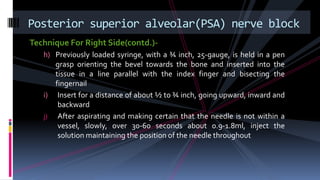
Technique For Right Side(contd.)-
h) Previously loaded syringe, with a ¾ inch, 25-gauge, is held in a pen
grasp orienting the bevel towards the bone and inserted into the
tissue in a line parallel with the index finger and bisecting the
fingernail
i) Insert for a distance of about ½ to ¾ inch, going upward, inward and
backward
j) After aspirating and making certain that the needle is not within a
vessel, slowly, over 30-60 seconds about 0.9-1.8ml, inject the
solution maintaining the position of the needle throughout
Posterior superior alveolar(PSA) nerve block
Signs and symptoms-
1. Subjective : none
2. Objective : Instrumentation is necessary to demonstrate absence of pain
Safety Measures-
1. Slow injection, repeated aspiration
Precaution-
The depth of the needle penetration should be checked;
overinsertion increases the risk of hematoma
Posterior superior alveolar(PSA) nerve block
Failures of Anesthesia-
1. Needle too lateral
2. Needle too high
3. Needle too far posterior
Complications-
1. Hematoma
2. Mandibular anesthesia
Posterior superior alveolar(PSA) nerve block
Nerves anaesthetized
MSA & terminal branch
Areas anaesthetized
1. Pulps of maxillary 1st & 2nd premolar & mesiobuccal root of 1st
molar(28%)
2. Buccal periodontal tissues & bone of these teeth
Anatomical landmarks
Mucobuccal fold above the maxillary 2nd premolar
Advantages– minimizes no. of injection & volume of solution
Middle Superior Alveolar Nerve Block
Indications
1. When infraorbital n. block fails to provide pulpal anaesthesia distal to
maxillary canine
2. Dental procedures involving both maxillary premolars
Contraindications
-infection or inflammation in the area of injection
-where the MSA n. in absent
Alternatives
1. Local infiltration, PDL, IO injections
2. Infraorbital n. block
Middle Superior Alveolar Nerve Block
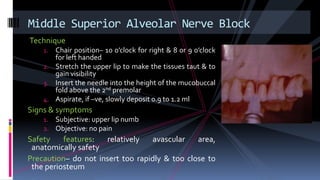
Technique
1. Chair position– 10 0’clock for right & 8 or 9 0’clock
for left handed
2. Stretch the upper lip to make the tissues taut & to
gain visibility
3. Insert the needle into the height of the mucobuccal
fold above the 2nd premolar
4. Aspirate, if –ve, slowly deposit 0.9 to 1.2 ml
Signs & symptoms
1. Subjective: upper lip numb
2. Objective: no pain
Safety features: relatively avascular area,
anatomically safety
Precaution– do not insert too rapidly & too close to
the periosteum
Middle Superior Alveolar Nerve Block
-- also called infraorbital n. block
Nerves anaesthetized
1. ASA nerve
2. MSA nerve
3. Infraorbital nerve – inferior palpebral
-- lateral nasal
-- superior labial
Areas anaesthetized
1. Pulps of maxillary C.I. through canine on the injected side
2. Pulps of maxillary premolars(72% of patients) & mesiobuccal root of the
molar
Anterior superior alveolar(ASA) nerve block
3. Buccal(labial) periodontium and bone of these teeth
4. Lower eyelid, lateral aspect of the nose, upper lip
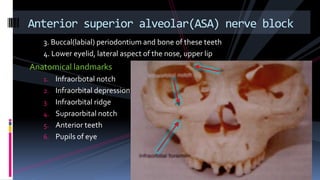
Anatomical landmarks
1. Infraorbotal notch
2. Infraorbital depression
3. Infraorbital ridge
4. Supraorbital notch
5. Anterior teeth
6. Pupils of eye
Anterior superior alveolar(ASA) nerve block
Needle pathway during insertion
1. Bicuspid approach: it passes through the mucosa & areolar tissue, and during
insertion should pass beneath & lateral to the external maxillary artery &
anterior facial vein
2. C.I. approach: it pass through mucosa & areolar tissue & beneath the
angular head of the levator labii superioris m., proceeds anteriorly to the
origin of levator anguli oris m. & beneath external maxillary artery &
anterior facial vein
Approximating structures when the needle is in position
When in final position at the orifice of infraorbital canal, it should be
a) Beneath infraorbital head of levator labii superioris m.
b) Above the origin of levator anguli oris m.
Anterior superior alveolar(ASA) nerve block
Technique
— Patient seated comfortably in the chair & tilted so that the maxillary plane is
at a 45º angle to the floor
— Patient is ask to look directly forward as the supraorbital & infraorbital
notchs are palpated
— Imaginary straight line drawn vertically through these landmarks will pass
through pupils of the eye, the infraorbital foramen, bicuspid teeth, mental
foramen
— Palpating finger should be moved downward about 0.5cm from th
infraorbital notch, where a shallow depression will be felt
— For block on right side– thumb of the operator left hand is placed over the
previously located infraorbital foramen, lip retracted with index finger
exposing the mucolabial fold
Anterior superior alveolar(ASA) nerve block
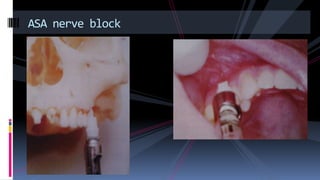
– A 1 5/8-inch, 25-gauge needle is inserted with either one of the two
direction, while for first– inserted in a line parallel with supraorbital notch,
pupil of eye, infraorbital notch, & 2nd bicuspid tooth
– insert about 5mm from the labial plate to pass over the canine fossa
– Thumb which is in placed should be used tto maneuver the needle into a
position so that it contacts the bone at the entrance to the foramen
– 2nd direction—insertion bisects the crown of the C.I. from the mesioincisal
angle to distogingival angle
– Needle inserted about 5mm from the mucobuccal fold
– Needle should gently contact the boundary of the foramen
– Approx. 2ml of solution is deposited & the thumb is held until the injection is
completed
– It is necessary to allow for midline or overlapping innervation by infiltration
over the apex of the oppositeC.I.
ASA nerve block
ASA nerve block
Indications
1. Dental procedures involving more than two maxillary teeth & their overlying
buccal tissue
2. Inflammation & infection (which C/I the supraperiosteal injection)
3. When supraperiosteal injections have been ineffective because of dense
cortical bone
Contraindications
1. Discrete treatment areas (supraperiosteal preferred)
2. Hemostasis of localized area (infiltration indicated)
Advantages
1. Comparatively simple technique
2. Coparatively safe, minimized volume of solution & number of needle
punctures necessary to achieved anaesthesia
ASA nerve block
Steps in atraumatic administration of palatal anesthesia
1. Provide adequate topical anesthesia at site of needle penetration--- by
allowing topical anesthetic to remain in contact with soft tissues for atleast
2 minutes
2. Use pressure anesthesia at site both before & during needle insertion &
deposition of solution--- by applying considerable pressure to the tissues
adjacent to the injection site with a firm object
3. Maintain control over the needle--- with a firm hand rest
4. Slow deposition--- density of the palatal soft tissues & firm adherence to the
underlying bone. Rapid deposition tears the palatal soft tissues & leads to
both pain on injection & localised soreness when anesthetic action is
terminated
Palatal anesthesia
Nerves anesthetized
Greater palatine nerve
Areas anesthetized
Posterior portion of the hard palate & its overlying tissues
Anteriorly as far as the 1st premolar & medially to the midline
Indications
1. When palatal soft tissue anesthesia is necessary for restorative therapy on
more than 2 teeth
2. Pain control during periodontal or oral surgical procedures involving the
palatal soft & hard tissues
Greater palatine nerve block
Contraindications
1. Inflammation or infection at the injection site
2. Smaller areas of therapy
Advantages
1. Minimizes needle penetration
2. Minimizes volume of solution
3. Minimizes patients discomfort
Disadvantage
1. No hemostasis except in the immediate area of injection
2. Potentially traumatic
Greater palatine nerve block
Alternatives
1. Local infiltration in specific regions
2. Maxillary n. block
Technique
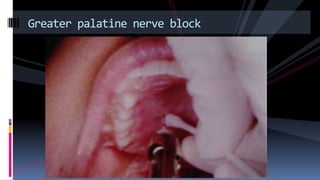
1. Greater palatine n. emerge from greater palatine foramen & course forward
in a groove parallel to maxillary molar teeth
2. This foramen is situated between 2nd & 3rd maxillary molars about 1cm from
the palatal gingival margin towards the midline
3. Insertion is approach from the opposite side with an 1-inch, 27-gauge
needle, which is kept as near to a right angle as possible with the curvature
of the palatal bone
4. Needle should be inserted slowly
Greater palatine nerve block
5. 0.25-0.5ml of anesthetic solution is injected slowly
6. When bicuspid has to be anesthetized, it is advantageous to insert the
needle & deposit the solution palatal curvature opposite the bicuspid
7. Procedure–
a) For right nerve block a right handed administrator should sit facing the patient at 7
or 8 o’clock position
b) For left nerve block a right handed administrator should sit facing the same
direction as the patient at 11 o’clock position
c) Then ask the patient to open wide, extend the neck & turn head left or right for
improved visibility
d) Then the foramen is located as follow:
Cotton swap is placed at the junction of the alveolar process & the hard palate starting
from 1st molar & palpate posteriorly by pressing firmly into the tissue till it falls into a
depression (foramen)
Greater palatine nerve block
e) Apply topical anesthesia for 2 min & apply considerable pressure at the area of
foramen with the swap in the left hand (if right handed), then note ischemia at
the injection site
f) Apply pressure for 30 seconds then direct the syringe
g) Continue to apply pressure anesthesia throughout the deposition
h) Slowly advance the needle until palatine bone is gently contacted
i) Depth of penetration is usually less than 10 mm
Signs & symptoms
1. Subjective: numbness in the posterior portion of the palate
2. Objective: no pain during dental therapy
Safety features
1. Contact with bone
2. Aspiration
Greater palatine nerve block
Precautions
Do not enter the foramen
Failures of anesthesia
1. Not technically difficult
2. Deposited too far anterior to the foramen
3. Anesthesia in the area of 1st premolar may prove inadequate because of
overlapping from nasopalatine n.
Complications
1. Ischemia & necrosis of the soft tissue when highly concentrated
vasoconstricting solution used for hemostasis over a prolonged period
(norepinephrine)
2. Hematoma is possible, but rare because of density & firm adherence
Greater palatine nerve block
Nerves anesthetized
Nasopalatine n.
Areas anesthetized
Anterior portion of hard palate, hard & soft tissue, from the mesial of the
right 1st premolar to mesial of left 1st premolar
Indications
1. To supplement the block of ASA & MSA n.
2. To augment analgesia of six maxillary incisors
3. To complete anesthesia of the nasal septum
Anatomical landmark
Central incisor teeth & incisive papilla
Nasopalatine nerve block
Contraindications
1. Inflammation or infection at the injection site
2. Smaller area of therapy
Advantages
1. Minimized needle penetration & volume of solution
2. Minimal patient discomfort from multiple needle penetration
Disadvantages
1. No hemostasis except in the immediate area of injection
2. Potentially most traumatic intraoral injection
Alternatives
1. Local infiltration in specific regions
2. Maxillary n. block
Nasopalatine nerve block
Technique
Two types of technique– 1. single penetration
2. multiple penetration
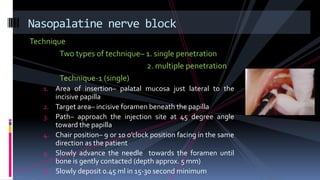
Technique-1 (single)
1. Area of insertion– palatal mucosa just lateral to the
incisive papilla
2. Target area– incisive foramen beneath the papilla
3. Path– approach the injection site at 45 degree angle
toward the papilla
4. Chair position– 9 or 10 o’clock position facing in the same
direction as the patient
5. Slowly advance the needle towards the foramen until
bone is gently contacted (depth approx. 5 mm)
6. Slowly deposit 0.45 ml in 15-30 second minimum
Nasopalatine nerve block
Signs & symptoms
1. Subjective: numbness in anterior portion of the palate
2. Objective: no pain during procedure
Safety features
1. Contact with the bone
2. Aspiration
Precautions
1. Do not directly into the papilla
2. Do not deposit too rapidly
3. Do not deposit too much solution
4. If needle penetration is more than 5 mm then the floor of the nose is
entered & infection may result
Nasopalatine nerve block
Complications
1. Hematoma
2. Necrosis of soft tissue
Technique-2 (multiple)
1. Areas of insertion–
a) labial frenum in the midline between maxillary two C.I.
b) Interdental papilla between maxillary two C.I.
2. Path–
a) First injection: infiltration into the labial frenum
b) Second injection: needle held at a right angle to the interdental papilla
c) Third injection: needle held at a 45 degree angle to the incisive papilla
Nasopalatine nerve block
3. Procedure
a) 1st injection: retract the upper lip to stretch tissues &
improve visibility. Gently insert in the frenum & deposit
0.3 ml in approx. 15 seconds
b) 2nd injection: at 11 or 12 o’clock position, tilting the
patients head in the right, & needle at right angle to
interdental papilla needle is inserted into the papilla just
above the level of crestal bone. Aspirate when ischemia is
noted in the incisive papilla or needle tip become visible
just beneath the tissue surface
c) 3rd injection: same as single penetration
Signs & symptoms
1. Subjective: numbness in the upper lip & anterior
portion of the hard palate
2. Objective: no pain therapy
Safety features
1. Aspiration
2. Contact with bone
Nasopalatine nerve block
Advantage– entirely or relatively atraumatic
Disadvantage
1. Requires multiple injection
2. Difficult to stabilized the syringe
Complications
1. Necrosis of soft tissue
2. Tender of interdental papilla for several days
Nasopalatine nerve block
Nerves anesthetized– maxillary division of the trigeminal nerve
Areas anesthetized
1. Pulpal anesthesia of maxillary teeth on the side of block
2. Buccal periodontium bone overlying these teeth
3. Soft tissues & bone of the hard palate & part of soft palate, medially to the
miidline
4. Skin of the lower eyelid, side of the nose, cheek & upper lip
Landmarks
Mucobuccal fold at the distal aspect of the maxillary 2nd molar
Maxillary tuberosity
Zygomatic process of maxilla
Greater palatine foramen, junction of maxillary alveolar process & palatine bone
Maxillary nerve block
Indications
1. Pain control before extensive oral surgical, periodontal, or restorative
procedures requiring anesthesia of the entire maxillary division
2. Inflammation or infection
3. Diagnostic or therapeutic procedures for neuralgia or tics of the 2nd division
of trigeminal nerve
Contraindication
1. Inexperience administrator
2. Pediatric patient
3. Uncooperative patients
4. Inflammation or infection
5. When hemorrhage is risky e.g. hemophilliac
Maxillary nerve block
Advantages
1. Atraumatic injection via high tuberosity approach
2. High success rate (>95%)
3. Minimize no. of needle penetration & volume of local anesthesia
4. Neither high tuberosity nor greater palatine canal approach usually is
traumatic
Disadvantage
1. Risk of hematoma
2. Lack of hemostasis
Maxillary nerve block
Alternatives
1. PSA nerve block
2. ASA nerve block
3. GP nerve block
4. Nasopalatine nerve block
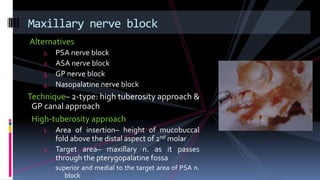
Technique– 2-type: high tuberosity approach &
GP canal approach
High-tuberosity approach
1. Area of insertion– height of mucobuccal
fold above the distal aspect of 2nd molar
2. Target area– maxillary n. as it passes
through the pterygopalatine fossa
superior and medial to the target area of PSA n.
block
Maxillary nerve block
3. Procedure: chair position 10 o’clock for left side & 8 o’clock for right side
--Place the needle into the height of mucobuccal fold over the maxillary 2nd
molar
--Advance the needle slowly in an upward, inward, & backward direction
also to the depth of 30 mm. At this depth the needle tip should lie in the
pterygopalatine fossa
--Aspirate. If –ve, deposit 1.8 ml slowly (>60 seconds)
Greater palatine canal approach
1. Area of insertion– palatal soft tissue directly over the GP foramen
2. Target area– maxillary n as it passes through the pterygopalatine fossa: the
needle passes through the GP canal to reach the pterygopalatine fossa
3. Chair position– 7 or 8 o’clock for right side & 10 or 11 o’clock for left side
Maxillary nerve block
4. Locate the foramen as stated earlier
5. Direct the syringe into the mouth the opposite side with
the needle approaching injection site at a right angle
6. Very slowly advance the needle into the GP canal to a
depth of 30 mm.
7. Aspirate & if –ve slowly deposit 1.8 ml of solution
Signs & symptoms
1. Subjective: pressure behind the upper jaw on the side
being injected; this usually subsides rapidly, progressing
to tingling & numbness of the lower eyelid, side of the
nose, & upper lip
2. Subjective: sensation of numbness in the teeth & buccal
& palatal soft tissues on the side of injection
3. Objective: no pain
Maxillary nerve block
Precautions
1. Pain on insertion of injection; primarily GP approach
2. Overinsertion
3. Resistance to needle insertion in the GP approach
Complications
1. Hematoma develops rapidly if the maxillary artery is punctured
2. Penetration of the orbit may occur during a GP approach if the needle goes
too far
3. Complications produced by injection of LA
a. Volume displacement of the orbital structures, producing periorbital swelling &
proptosis
b. Diplopia (VI cranial n), Mydriasis,
c. Penetration nasal cavity complaining of anesthetic solution running down the
throat
Maxillary nerve block
Nerves anesthetized
1. ASA nerve
2. MSA nerve
3. Subdural dental nerve plexus of the ASA & MSA n
Areas anesthetized
1. Pulpal anesthesia of maxillary C.I. canines & premolars
2. Buccal attached gingiva of these same teeth
3. Attached palatal tissues from midline to free gingival margin on the
associated teeth
Anterior middle superior alveolar nerve block
Indications
1. Is easier to perform with a CCLAD system
2. Dental procedures involving the maxillary anterior teeth or soft tissues are
to be performed
3. Multiple maxillary teeth anesthesia
4. Scaling & root planing of anterior teeth
5. Facial approach supraperiosteal injection
Contraindications
1. Thin palatal tissues
2. Who cannot tolerate a 3-4 min administration time
3. Procedure requiring more than 90 min
Anterior middle superior alveolar nerve block
Advantages
1. Provides anesthesia of multiple teeth with single injection
2. Minimizes volume of anesthesia & no. of puncture
3. Allows effective soft tissue & pulpal anesthesia for periodontal scaling 7 root
planing
4. Allows accurate smile line assessment
5. Eliminates postoperative inconvenience of numbness to the upper lip &
muscle of facial expression
6. Can be perform comfortably with a CCLAD
Disadvantages
1. Requires a slow administration time ( 0.5 ml/min)
2. Can cause operator fatigue with a manual syringe
3. May need supplemental anesthesia for C.I. & L.I.
Anterior middle superior alveolar nerve block
4. May cause excessive ischemia if administered rapidly
5. Use of LA containing epinephrine with a conc. of 1:50,000 is contraindicated
Alternatives
1. Multiple supraperiosteal or PDL injections
2. ASA & MSA n block
3. Maxillary n block
Technique
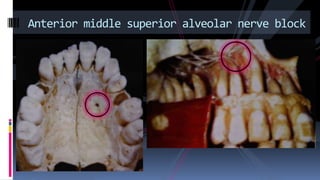
1. Area of insertion: on the hard palate about halfway along an imaginary line
connecting the midpalatal suture to free gingival margin; the location of the
line is at the contact point between the 2nd 1st premolars
2. Target area: palatal bone at injection site
3. Chair position: 9 or 10 o’clock, patient in supine position
Anterior middle superior alveolar nerve block
4. Needle 45 degree angle with a tangent to the palate
5. A prepuncture technique can be utilized. Apply the bevel of the needle
toward the palatal tissue. Place a sterile cotton applicator on top of the
needle tip. Apply light pressure & initiate delivery of LA to the surface of the
epithelium.
6. An “anesthetic pathway technique” can be utilized. Very slowly advance the
needle tip into the tissue, rotation allows efficient penetration. Advance the
needle 1 to 2 mm every 4 to 6 seconds while administrating solution.
7. Ensure that the needle contact is maintained with bony surface of the bone
8. Aspirate. Solution is delivered at 0.5 ml of approx. 1.4 to 1.8 ml
9. Advice the patient that he/she will experience a sensation of firm pressure
Anterior middle superior alveolar nerve block
Signs & symptoms
1. Subjective: (1) A sensation of firmness & numbness is immediately
experienced on the palatal tissues. (2) Numbness of the teeth & associated
soft tissues extends from C.I. to 2nd premolar on one side of injection
2. Objective: (1) blanching of soft tissues on palatal & facial attached gingiva
fromC.I. to premolar region. (2) no pain. (3) no anesthesia of the face &
upper lip.
Safety features
1. Contact with the bone
2. Aspiration
3. Slow insertion & administration
4. Less anesthetic than necessary for a traditional facial approach
Anterior middle superior alveolar nerve block
Precautions
1. Against pain– (i) extremely slow insertion, (ii) slow administration during
insertion with simultaneous administration
2. Against tissue damage– (i) when using 4% LA, reduce the volume (ii) avoid
excessive ischemia
Complications
1. Palatal ulcer at injection site
2. Unexpected contact with the nasopalatine n
3. Density of injection site causing squirk-back of anesthetic & bitter taste
Anterior middle superior alveolar nerve block
Nerves anesthetized
1. Nasopalatine n
2. Anterior branch of ASA
Areas anesthetized
1. Pulps of the maxillary C.I., L.I. & canines
2. Facial periodontal tissue associated with these same teeth
3. Palatal periodontal tissues associated with these same teeth
Alternatives
1. Supraperiosteal or PDL
2. ASA (bilateral) n block
3. Maxillary (bilateral) n block
Palatal approach-anterior superior alveolar
Indications
1. Procedures involving the maxillary anterior teeth & soft tissues are to be
performed
2. Bilateral anesthesia of maxillary anterior is desired in single injection
3. Scaling & root planing of anterior
4. Anterior cosmetic procedure
Cotraindications
1. With extremely long canine roots
2. Who cannot tolerate 3-4 min administration time
3. Procedures requiring more than 90 min
Palatal approach-anterior superior alveolar
Advantages
1. Provides bilateral maxillary anesthesia from a single injection
2. Minimizes no. of punctures & volume of solution
3. Eliminates postoperative inconvenience of numbness to the upper lip &
muscles of facial expression
Disadvantages
1. Requires slow administration
2. May need supplemental anesthesia for canine
3. May cause excessive ischemia if administered too rapidly
4. Use of LA containing epinephrine is contraindicated
Palatal approach-anterior superior alveolar
Technique
1. Area of insertion: just lateral to the incisive papilla
in the papillary groove
2. Target area: nasopalatine foramen
3. Chair position: 9 or 10 o’clock
4. Initial orientation of bevel is “face down” toward
the epithelium holding the needle at approx. a 45
degree angle with a tangent to the palate
5. A prepuncture technique and “anesthetic pathway
technique” can be utilized as in AMSA n block
6. Ensure that the needle is in contact with the inner
bony wall of the canal
7. Anesthetic is delivered at a rate of 0.5 ml during the
injection for a final dosage of approx. 1.4 to 1.8 ml
Palatal approach-anterior superior alveolar
Signs & symptoms
1. Subjective: (i) a sensation of firmness & anesthesia is immediately
experienced in the anterior palate. (ii) numbness of teeth associated soft
tissues extends from right to left canine
2. Objective: ischemia of soft tissues of the palatal & facial attach gingiva, no
pain, no anesthesia of the face & upper lip
Safety features
1. Contact with the bone
2. Aspiration
3. Slow insertion
4. Slow administration
5. Less anesthetic than necessary for a traditional facial approach
Palatal approach-anterior superior alveolar
Complications
1. Palatal ulcer at injection site developing 1 to 2 days postoperative
2. Unexpected nerve contact of the nasopalatine nerve
3. Density of injection site causing squirk-back of anesthetic and bitter taste.
Palatal approach-anterior superior alveolar
Maxillary anesthesia: its technique

Maxillary anesthesia: its technique

  • 1.
    MAXILLARY ANESTHESIA Seminar on- Presented by – Hemam Shankar Singh
  • 2.
    A branch oftrigeminal nerve Purely sensory Course foramen rotundum pterygopalatine fossa inferior orbital fissure infraorbital foramen Part of the maxillary nerve distal to the inferior orbital fissure is called infraorbital nerve Maxillary nerve:
  • 4.
    A. Branch inmiddle cranial fossa: before entering foramen rotundum gives off meningeal branch to dura materof the middle cranial fossa B. Branhes arising in pterygopalatine fossa: i. Greater palatine n.:- emerges through the greater palatine foramen & then runs forward on the inferior surface of hard palate supplying mucous membrane & glands ii. Lesser palatine n.:- emerge through lesser palatine foramen, & runs backwards into the soft palate, supply tonsil iii. Nasopalatine n.:- runs downward & forward on the nasal septum, pass through incisive foramen, supply ant. Part of hard palate Branches
  • 5.
    iv. Posterior superioralveolar(PSA) n.:- runs down on the posterior surface of the maxilla it lie in the wall of maxillary sinus where it supplies. It supply sensory innervation to— -buccal gingiva in maxillary molar region -mucous membrane of the sinus -alveoli, PDL, & pulpal tissue of the maxillary 3rd, 2nd & 1st molar with exception (in 28%of patients) of mesiobuccal root of the 1st molar C. Branch in infraorbital groove & canal i. Middle superior alveolar (MSA) n.:- arise within the canal, provide sensory innervation to two maxillary premolars & mesiobuccal root of maxillary 1st molar (28%), periodontal tissues, buccal soft tissue, & bone of the premolar region ii. Anterior superior alveolar (ASA) n.:- arise from infraorbital n. provide pulpal innervation to C.I. & L.I., & canine, to periodontal tissue, buccal bone, & mucous membrane of these teeth Contd.
  • 6.
    1. Local Infiltration 2.Field Block 3. Nerve Block Techniques of Maxillary Anesthesia
  • 7.
    I. Supraperiosteal (infiltration) II.Periodontal ligament (PDL, intraligamentary) III. Intraseptal injection IV. Posterior superior alveolar nerve block V. Middle superior alveolar nerve block VI. Anterior superior alveolar nerve block VII. Greater (anterior) palatine nerve block VIII. Nasopalatine nerve block IX. Maxillary (second division) nerve block X. Anterior meddle superior alveolar nerve block XI. Palatal approach-anterior superior alveolar n block Maxillary Injection Techniques
  • 8.
    Nerves anesthetized– terminalbranch of dental plexus Areas anesthetized Entire region innervated by the large terminal branches of this plexus Indications 1. Pulpal anesthesia of maxillary teeth when treatment is limited to 1 or 2 teeth 2. Soft tissue anesthesia when indicated for surgical procedure Contraindications 1. Infection or acute inflammation 2. Dense bone covering the apices of teeth Supraperiosteal Injection
  • 9.
    Advantages 1. High successrate (>95%) 2. Easy & usually entirely atraumatic Disadvantages Not recommended for larger areas because of multiple injection Alternatives– PDL, IO, regional block Anatomical landmark: Mucobuccal fold Crown of the tooth Root contour of the tooth Supraperiosteal Injection
  • 10.
    Technique 1. Lift thelip, pulling the tissue taut 2. Hold the syringe parallel to the long axis of the tooth 3. Insert the needle at the height of the mucobuccal fold over the target tooth 4. Advance the needle until its bevel is at or above the apical region of the tooth 5. Aspirate, if –ve , deposit 0.6 ml slowly over 20 seconds Sighs & symptoms 1. Subjective: feeling of numbness in the area of administration 2. Objective: no pain during therapy Supraperiosteal Injection
  • 11.
    Safety features 1. Minimalrisk of intravascular administration 2. Slowness of injection, aspiration Precautions should not be used for larger areas Complications pain on needle insertion with the tip against periosteum Supraperiosteal Injection
  • 12.
  • 13.
    NervesAnesthetized- Posterior superior alveolarand its branches AreasAnesthetized- 1) Pulps of the maxillary 3rd , 2nd and 1st molars 2) Buccal periodontium and bone overlying these teeth Anatomical Landmarks- 1. Mucobuccal fold and its concavity 2. Zygomatic process of the maxilla 3. Infratemporal surface of the maxilla 4. Anterior border and coronoid process of the ramus of the mandible 5. Maxillary tuberosity Posterior superior alveolar(PSA) nerve block
  • 14.
    Indications – 1. Whentreatment involves two or more maxillary molars 2. When supraperiosteal injection is contraindicated (e.g. with infection or acute inflammation) 3. When supraperiosteal injection has proved ineffective Contraindications- When the risk of hematoma is too high ( as in hemophilic), in which case a supraperiosteal or PDL is recommended. Advantages- 1. Atraumatic 2. High success rate 3. Less number of injections 4. Minimize amount of local used Posterior superior alveolar(PSA) nerve block
  • 15.
    Disadvantages- 1. Risk ofhematoma 2. Does not anesthetize first molar completely 3. No bony landmarks during insertion 4. Second injection necessary for 1st maxillary molar in 28% of patients Positive Aspiration- Approximately 3.1% Posterior superior alveolar(PSA) nerve block
  • 16.
    Needle pathway duringinsertion- Needle penetrates the mucosa, alveolar tissue, and possibly the buccal pad of fat. It penetrates the posterior fiber of buccinator muscle. Approximating structures when needle is in position- when needle is in final position, it should be as follow: 1. Posterior to the posterior surface of the maxilla 2. Anterior and lateral to the anterior margin of the external pterygoid muscle 3. Anterior to the pterygoid plexus of veins Needle will be in proximity to the posterior superior alveolar canal Posterior superior alveolar(PSA) nerve block
  • 17.
    Technique For RightSide- a) Operator stands on the right side of the patient b) Patient is positioned so that maxillary occlusal plane is at 45º angle to the floor c) Move the left forefinger over the mucobuccal fold in a posterior direction from bicuspid area until the zygomatic process of the maxilla is reached. d) at its posterior surface fingertip will rest in a concavity in the mucobuccal fold e) Rotate the finger so that the fingernail is adjacent to the mucosa and its bulbous portion is still in contact with the posterior surface of the zygomatic process. f) Hand is lowered so that the finger is in a plane right angle to the maxillary occlusal surface and 45º angle to patients sagittal plane g) Area of insertion should be dried and painted with a suitable antiseptic solution Posterior superior alveolar(PSA) nerve block
  • 18.
    Technique For RightSide(contd.)- h) Previously loaded syringe, with a ¾ inch, 25-gauge, is held in a pen grasp orienting the bevel towards the bone and inserted into the tissue in a line parallel with the index finger and bisecting the fingernail i) Insert for a distance of about ½ to ¾ inch, going upward, inward and backward j) After aspirating and making certain that the needle is not within a vessel, slowly, over 30-60 seconds about 0.9-1.8ml, inject the solution maintaining the position of the needle throughout Posterior superior alveolar(PSA) nerve block
  • 20.
    Signs and symptoms- 1.Subjective : none 2. Objective : Instrumentation is necessary to demonstrate absence of pain Safety Measures- 1. Slow injection, repeated aspiration Precaution- The depth of the needle penetration should be checked; overinsertion increases the risk of hematoma Posterior superior alveolar(PSA) nerve block
  • 21.
    Failures of Anesthesia- 1.Needle too lateral 2. Needle too high 3. Needle too far posterior Complications- 1. Hematoma 2. Mandibular anesthesia Posterior superior alveolar(PSA) nerve block
  • 22.
    Nerves anaesthetized MSA &terminal branch Areas anaesthetized 1. Pulps of maxillary 1st & 2nd premolar & mesiobuccal root of 1st molar(28%) 2. Buccal periodontal tissues & bone of these teeth Anatomical landmarks Mucobuccal fold above the maxillary 2nd premolar Advantages– minimizes no. of injection & volume of solution Middle Superior Alveolar Nerve Block
  • 23.
    Indications 1. When infraorbitaln. block fails to provide pulpal anaesthesia distal to maxillary canine 2. Dental procedures involving both maxillary premolars Contraindications -infection or inflammation in the area of injection -where the MSA n. in absent Alternatives 1. Local infiltration, PDL, IO injections 2. Infraorbital n. block Middle Superior Alveolar Nerve Block
  • 24.
    Technique 1. Chair position–10 0’clock for right & 8 or 9 0’clock for left handed 2. Stretch the upper lip to make the tissues taut & to gain visibility 3. Insert the needle into the height of the mucobuccal fold above the 2nd premolar 4. Aspirate, if –ve, slowly deposit 0.9 to 1.2 ml Signs & symptoms 1. Subjective: upper lip numb 2. Objective: no pain Safety features: relatively avascular area, anatomically safety Precaution– do not insert too rapidly & too close to the periosteum Middle Superior Alveolar Nerve Block
  • 25.
    -- also calledinfraorbital n. block Nerves anaesthetized 1. ASA nerve 2. MSA nerve 3. Infraorbital nerve – inferior palpebral -- lateral nasal -- superior labial Areas anaesthetized 1. Pulps of maxillary C.I. through canine on the injected side 2. Pulps of maxillary premolars(72% of patients) & mesiobuccal root of the molar Anterior superior alveolar(ASA) nerve block
  • 26.
    3. Buccal(labial) periodontiumand bone of these teeth 4. Lower eyelid, lateral aspect of the nose, upper lip Anatomical landmarks 1. Infraorbotal notch 2. Infraorbital depression 3. Infraorbital ridge 4. Supraorbital notch 5. Anterior teeth 6. Pupils of eye Anterior superior alveolar(ASA) nerve block
  • 27.
    Needle pathway duringinsertion 1. Bicuspid approach: it passes through the mucosa & areolar tissue, and during insertion should pass beneath & lateral to the external maxillary artery & anterior facial vein 2. C.I. approach: it pass through mucosa & areolar tissue & beneath the angular head of the levator labii superioris m., proceeds anteriorly to the origin of levator anguli oris m. & beneath external maxillary artery & anterior facial vein Approximating structures when the needle is in position When in final position at the orifice of infraorbital canal, it should be a) Beneath infraorbital head of levator labii superioris m. b) Above the origin of levator anguli oris m. Anterior superior alveolar(ASA) nerve block
  • 28.
    Technique — Patient seatedcomfortably in the chair & tilted so that the maxillary plane is at a 45º angle to the floor — Patient is ask to look directly forward as the supraorbital & infraorbital notchs are palpated — Imaginary straight line drawn vertically through these landmarks will pass through pupils of the eye, the infraorbital foramen, bicuspid teeth, mental foramen — Palpating finger should be moved downward about 0.5cm from th infraorbital notch, where a shallow depression will be felt — For block on right side– thumb of the operator left hand is placed over the previously located infraorbital foramen, lip retracted with index finger exposing the mucolabial fold Anterior superior alveolar(ASA) nerve block
  • 29.
    – A 15/8-inch, 25-gauge needle is inserted with either one of the two direction, while for first– inserted in a line parallel with supraorbital notch, pupil of eye, infraorbital notch, & 2nd bicuspid tooth – insert about 5mm from the labial plate to pass over the canine fossa – Thumb which is in placed should be used tto maneuver the needle into a position so that it contacts the bone at the entrance to the foramen – 2nd direction—insertion bisects the crown of the C.I. from the mesioincisal angle to distogingival angle – Needle inserted about 5mm from the mucobuccal fold – Needle should gently contact the boundary of the foramen – Approx. 2ml of solution is deposited & the thumb is held until the injection is completed – It is necessary to allow for midline or overlapping innervation by infiltration over the apex of the oppositeC.I. ASA nerve block
  • 30.
  • 31.
    Indications 1. Dental proceduresinvolving more than two maxillary teeth & their overlying buccal tissue 2. Inflammation & infection (which C/I the supraperiosteal injection) 3. When supraperiosteal injections have been ineffective because of dense cortical bone Contraindications 1. Discrete treatment areas (supraperiosteal preferred) 2. Hemostasis of localized area (infiltration indicated) Advantages 1. Comparatively simple technique 2. Coparatively safe, minimized volume of solution & number of needle punctures necessary to achieved anaesthesia ASA nerve block
  • 32.
    Steps in atraumaticadministration of palatal anesthesia 1. Provide adequate topical anesthesia at site of needle penetration--- by allowing topical anesthetic to remain in contact with soft tissues for atleast 2 minutes 2. Use pressure anesthesia at site both before & during needle insertion & deposition of solution--- by applying considerable pressure to the tissues adjacent to the injection site with a firm object 3. Maintain control over the needle--- with a firm hand rest 4. Slow deposition--- density of the palatal soft tissues & firm adherence to the underlying bone. Rapid deposition tears the palatal soft tissues & leads to both pain on injection & localised soreness when anesthetic action is terminated Palatal anesthesia
  • 33.
    Nerves anesthetized Greater palatinenerve Areas anesthetized Posterior portion of the hard palate & its overlying tissues Anteriorly as far as the 1st premolar & medially to the midline Indications 1. When palatal soft tissue anesthesia is necessary for restorative therapy on more than 2 teeth 2. Pain control during periodontal or oral surgical procedures involving the palatal soft & hard tissues Greater palatine nerve block
  • 34.
    Contraindications 1. Inflammation orinfection at the injection site 2. Smaller areas of therapy Advantages 1. Minimizes needle penetration 2. Minimizes volume of solution 3. Minimizes patients discomfort Disadvantage 1. No hemostasis except in the immediate area of injection 2. Potentially traumatic Greater palatine nerve block
  • 35.
    Alternatives 1. Local infiltrationin specific regions 2. Maxillary n. block Technique 1. Greater palatine n. emerge from greater palatine foramen & course forward in a groove parallel to maxillary molar teeth 2. This foramen is situated between 2nd & 3rd maxillary molars about 1cm from the palatal gingival margin towards the midline 3. Insertion is approach from the opposite side with an 1-inch, 27-gauge needle, which is kept as near to a right angle as possible with the curvature of the palatal bone 4. Needle should be inserted slowly Greater palatine nerve block
  • 36.
    5. 0.25-0.5ml ofanesthetic solution is injected slowly 6. When bicuspid has to be anesthetized, it is advantageous to insert the needle & deposit the solution palatal curvature opposite the bicuspid 7. Procedure– a) For right nerve block a right handed administrator should sit facing the patient at 7 or 8 o’clock position b) For left nerve block a right handed administrator should sit facing the same direction as the patient at 11 o’clock position c) Then ask the patient to open wide, extend the neck & turn head left or right for improved visibility d) Then the foramen is located as follow: Cotton swap is placed at the junction of the alveolar process & the hard palate starting from 1st molar & palpate posteriorly by pressing firmly into the tissue till it falls into a depression (foramen) Greater palatine nerve block
  • 37.
    e) Apply topicalanesthesia for 2 min & apply considerable pressure at the area of foramen with the swap in the left hand (if right handed), then note ischemia at the injection site f) Apply pressure for 30 seconds then direct the syringe g) Continue to apply pressure anesthesia throughout the deposition h) Slowly advance the needle until palatine bone is gently contacted i) Depth of penetration is usually less than 10 mm Signs & symptoms 1. Subjective: numbness in the posterior portion of the palate 2. Objective: no pain during dental therapy Safety features 1. Contact with bone 2. Aspiration Greater palatine nerve block
  • 38.
  • 39.
    Precautions Do not enterthe foramen Failures of anesthesia 1. Not technically difficult 2. Deposited too far anterior to the foramen 3. Anesthesia in the area of 1st premolar may prove inadequate because of overlapping from nasopalatine n. Complications 1. Ischemia & necrosis of the soft tissue when highly concentrated vasoconstricting solution used for hemostasis over a prolonged period (norepinephrine) 2. Hematoma is possible, but rare because of density & firm adherence Greater palatine nerve block
  • 40.
    Nerves anesthetized Nasopalatine n. Areasanesthetized Anterior portion of hard palate, hard & soft tissue, from the mesial of the right 1st premolar to mesial of left 1st premolar Indications 1. To supplement the block of ASA & MSA n. 2. To augment analgesia of six maxillary incisors 3. To complete anesthesia of the nasal septum Anatomical landmark Central incisor teeth & incisive papilla Nasopalatine nerve block
  • 41.
    Contraindications 1. Inflammation orinfection at the injection site 2. Smaller area of therapy Advantages 1. Minimized needle penetration & volume of solution 2. Minimal patient discomfort from multiple needle penetration Disadvantages 1. No hemostasis except in the immediate area of injection 2. Potentially most traumatic intraoral injection Alternatives 1. Local infiltration in specific regions 2. Maxillary n. block Nasopalatine nerve block
  • 42.
    Technique Two types oftechnique– 1. single penetration 2. multiple penetration Technique-1 (single) 1. Area of insertion– palatal mucosa just lateral to the incisive papilla 2. Target area– incisive foramen beneath the papilla 3. Path– approach the injection site at 45 degree angle toward the papilla 4. Chair position– 9 or 10 o’clock position facing in the same direction as the patient 5. Slowly advance the needle towards the foramen until bone is gently contacted (depth approx. 5 mm) 6. Slowly deposit 0.45 ml in 15-30 second minimum Nasopalatine nerve block
  • 43.
    Signs & symptoms 1.Subjective: numbness in anterior portion of the palate 2. Objective: no pain during procedure Safety features 1. Contact with the bone 2. Aspiration Precautions 1. Do not directly into the papilla 2. Do not deposit too rapidly 3. Do not deposit too much solution 4. If needle penetration is more than 5 mm then the floor of the nose is entered & infection may result Nasopalatine nerve block
  • 44.
    Complications 1. Hematoma 2. Necrosisof soft tissue Technique-2 (multiple) 1. Areas of insertion– a) labial frenum in the midline between maxillary two C.I. b) Interdental papilla between maxillary two C.I. 2. Path– a) First injection: infiltration into the labial frenum b) Second injection: needle held at a right angle to the interdental papilla c) Third injection: needle held at a 45 degree angle to the incisive papilla Nasopalatine nerve block
  • 45.
    3. Procedure a) 1stinjection: retract the upper lip to stretch tissues & improve visibility. Gently insert in the frenum & deposit 0.3 ml in approx. 15 seconds b) 2nd injection: at 11 or 12 o’clock position, tilting the patients head in the right, & needle at right angle to interdental papilla needle is inserted into the papilla just above the level of crestal bone. Aspirate when ischemia is noted in the incisive papilla or needle tip become visible just beneath the tissue surface c) 3rd injection: same as single penetration Signs & symptoms 1. Subjective: numbness in the upper lip & anterior portion of the hard palate 2. Objective: no pain therapy Safety features 1. Aspiration 2. Contact with bone Nasopalatine nerve block
  • 46.
    Advantage– entirely orrelatively atraumatic Disadvantage 1. Requires multiple injection 2. Difficult to stabilized the syringe Complications 1. Necrosis of soft tissue 2. Tender of interdental papilla for several days Nasopalatine nerve block
  • 47.
    Nerves anesthetized– maxillarydivision of the trigeminal nerve Areas anesthetized 1. Pulpal anesthesia of maxillary teeth on the side of block 2. Buccal periodontium bone overlying these teeth 3. Soft tissues & bone of the hard palate & part of soft palate, medially to the miidline 4. Skin of the lower eyelid, side of the nose, cheek & upper lip Landmarks Mucobuccal fold at the distal aspect of the maxillary 2nd molar Maxillary tuberosity Zygomatic process of maxilla Greater palatine foramen, junction of maxillary alveolar process & palatine bone Maxillary nerve block
  • 48.
    Indications 1. Pain controlbefore extensive oral surgical, periodontal, or restorative procedures requiring anesthesia of the entire maxillary division 2. Inflammation or infection 3. Diagnostic or therapeutic procedures for neuralgia or tics of the 2nd division of trigeminal nerve Contraindication 1. Inexperience administrator 2. Pediatric patient 3. Uncooperative patients 4. Inflammation or infection 5. When hemorrhage is risky e.g. hemophilliac Maxillary nerve block
  • 49.
    Advantages 1. Atraumatic injectionvia high tuberosity approach 2. High success rate (>95%) 3. Minimize no. of needle penetration & volume of local anesthesia 4. Neither high tuberosity nor greater palatine canal approach usually is traumatic Disadvantage 1. Risk of hematoma 2. Lack of hemostasis Maxillary nerve block
  • 50.
    Alternatives 1. PSA nerveblock 2. ASA nerve block 3. GP nerve block 4. Nasopalatine nerve block Technique– 2-type: high tuberosity approach & GP canal approach High-tuberosity approach 1. Area of insertion– height of mucobuccal fold above the distal aspect of 2nd molar 2. Target area– maxillary n. as it passes through the pterygopalatine fossa superior and medial to the target area of PSA n. block Maxillary nerve block
  • 51.
    3. Procedure: chairposition 10 o’clock for left side & 8 o’clock for right side --Place the needle into the height of mucobuccal fold over the maxillary 2nd molar --Advance the needle slowly in an upward, inward, & backward direction also to the depth of 30 mm. At this depth the needle tip should lie in the pterygopalatine fossa --Aspirate. If –ve, deposit 1.8 ml slowly (>60 seconds) Greater palatine canal approach 1. Area of insertion– palatal soft tissue directly over the GP foramen 2. Target area– maxillary n as it passes through the pterygopalatine fossa: the needle passes through the GP canal to reach the pterygopalatine fossa 3. Chair position– 7 or 8 o’clock for right side & 10 or 11 o’clock for left side Maxillary nerve block
  • 52.
    4. Locate theforamen as stated earlier 5. Direct the syringe into the mouth the opposite side with the needle approaching injection site at a right angle 6. Very slowly advance the needle into the GP canal to a depth of 30 mm. 7. Aspirate & if –ve slowly deposit 1.8 ml of solution Signs & symptoms 1. Subjective: pressure behind the upper jaw on the side being injected; this usually subsides rapidly, progressing to tingling & numbness of the lower eyelid, side of the nose, & upper lip 2. Subjective: sensation of numbness in the teeth & buccal & palatal soft tissues on the side of injection 3. Objective: no pain Maxillary nerve block
  • 53.
    Precautions 1. Pain oninsertion of injection; primarily GP approach 2. Overinsertion 3. Resistance to needle insertion in the GP approach Complications 1. Hematoma develops rapidly if the maxillary artery is punctured 2. Penetration of the orbit may occur during a GP approach if the needle goes too far 3. Complications produced by injection of LA a. Volume displacement of the orbital structures, producing periorbital swelling & proptosis b. Diplopia (VI cranial n), Mydriasis, c. Penetration nasal cavity complaining of anesthetic solution running down the throat Maxillary nerve block
  • 54.
    Nerves anesthetized 1. ASAnerve 2. MSA nerve 3. Subdural dental nerve plexus of the ASA & MSA n Areas anesthetized 1. Pulpal anesthesia of maxillary C.I. canines & premolars 2. Buccal attached gingiva of these same teeth 3. Attached palatal tissues from midline to free gingival margin on the associated teeth Anterior middle superior alveolar nerve block
  • 55.
    Indications 1. Is easierto perform with a CCLAD system 2. Dental procedures involving the maxillary anterior teeth or soft tissues are to be performed 3. Multiple maxillary teeth anesthesia 4. Scaling & root planing of anterior teeth 5. Facial approach supraperiosteal injection Contraindications 1. Thin palatal tissues 2. Who cannot tolerate a 3-4 min administration time 3. Procedure requiring more than 90 min Anterior middle superior alveolar nerve block
  • 56.
    Advantages 1. Provides anesthesiaof multiple teeth with single injection 2. Minimizes volume of anesthesia & no. of puncture 3. Allows effective soft tissue & pulpal anesthesia for periodontal scaling 7 root planing 4. Allows accurate smile line assessment 5. Eliminates postoperative inconvenience of numbness to the upper lip & muscle of facial expression 6. Can be perform comfortably with a CCLAD Disadvantages 1. Requires a slow administration time ( 0.5 ml/min) 2. Can cause operator fatigue with a manual syringe 3. May need supplemental anesthesia for C.I. & L.I. Anterior middle superior alveolar nerve block
  • 57.
    4. May causeexcessive ischemia if administered rapidly 5. Use of LA containing epinephrine with a conc. of 1:50,000 is contraindicated Alternatives 1. Multiple supraperiosteal or PDL injections 2. ASA & MSA n block 3. Maxillary n block Technique 1. Area of insertion: on the hard palate about halfway along an imaginary line connecting the midpalatal suture to free gingival margin; the location of the line is at the contact point between the 2nd 1st premolars 2. Target area: palatal bone at injection site 3. Chair position: 9 or 10 o’clock, patient in supine position Anterior middle superior alveolar nerve block
  • 58.
    4. Needle 45degree angle with a tangent to the palate 5. A prepuncture technique can be utilized. Apply the bevel of the needle toward the palatal tissue. Place a sterile cotton applicator on top of the needle tip. Apply light pressure & initiate delivery of LA to the surface of the epithelium. 6. An “anesthetic pathway technique” can be utilized. Very slowly advance the needle tip into the tissue, rotation allows efficient penetration. Advance the needle 1 to 2 mm every 4 to 6 seconds while administrating solution. 7. Ensure that the needle contact is maintained with bony surface of the bone 8. Aspirate. Solution is delivered at 0.5 ml of approx. 1.4 to 1.8 ml 9. Advice the patient that he/she will experience a sensation of firm pressure Anterior middle superior alveolar nerve block
  • 59.
    Anterior middle superioralveolar nerve block
  • 60.
    Signs & symptoms 1.Subjective: (1) A sensation of firmness & numbness is immediately experienced on the palatal tissues. (2) Numbness of the teeth & associated soft tissues extends from C.I. to 2nd premolar on one side of injection 2. Objective: (1) blanching of soft tissues on palatal & facial attached gingiva fromC.I. to premolar region. (2) no pain. (3) no anesthesia of the face & upper lip. Safety features 1. Contact with the bone 2. Aspiration 3. Slow insertion & administration 4. Less anesthetic than necessary for a traditional facial approach Anterior middle superior alveolar nerve block
  • 61.
    Precautions 1. Against pain–(i) extremely slow insertion, (ii) slow administration during insertion with simultaneous administration 2. Against tissue damage– (i) when using 4% LA, reduce the volume (ii) avoid excessive ischemia Complications 1. Palatal ulcer at injection site 2. Unexpected contact with the nasopalatine n 3. Density of injection site causing squirk-back of anesthetic & bitter taste Anterior middle superior alveolar nerve block
  • 62.
    Nerves anesthetized 1. Nasopalatinen 2. Anterior branch of ASA Areas anesthetized 1. Pulps of the maxillary C.I., L.I. & canines 2. Facial periodontal tissue associated with these same teeth 3. Palatal periodontal tissues associated with these same teeth Alternatives 1. Supraperiosteal or PDL 2. ASA (bilateral) n block 3. Maxillary (bilateral) n block Palatal approach-anterior superior alveolar
  • 63.
    Indications 1. Procedures involvingthe maxillary anterior teeth & soft tissues are to be performed 2. Bilateral anesthesia of maxillary anterior is desired in single injection 3. Scaling & root planing of anterior 4. Anterior cosmetic procedure Cotraindications 1. With extremely long canine roots 2. Who cannot tolerate 3-4 min administration time 3. Procedures requiring more than 90 min Palatal approach-anterior superior alveolar
  • 64.
    Advantages 1. Provides bilateralmaxillary anesthesia from a single injection 2. Minimizes no. of punctures & volume of solution 3. Eliminates postoperative inconvenience of numbness to the upper lip & muscles of facial expression Disadvantages 1. Requires slow administration 2. May need supplemental anesthesia for canine 3. May cause excessive ischemia if administered too rapidly 4. Use of LA containing epinephrine is contraindicated Palatal approach-anterior superior alveolar
  • 65.
    Technique 1. Area ofinsertion: just lateral to the incisive papilla in the papillary groove 2. Target area: nasopalatine foramen 3. Chair position: 9 or 10 o’clock 4. Initial orientation of bevel is “face down” toward the epithelium holding the needle at approx. a 45 degree angle with a tangent to the palate 5. A prepuncture technique and “anesthetic pathway technique” can be utilized as in AMSA n block 6. Ensure that the needle is in contact with the inner bony wall of the canal 7. Anesthetic is delivered at a rate of 0.5 ml during the injection for a final dosage of approx. 1.4 to 1.8 ml Palatal approach-anterior superior alveolar
  • 66.
    Signs & symptoms 1.Subjective: (i) a sensation of firmness & anesthesia is immediately experienced in the anterior palate. (ii) numbness of teeth associated soft tissues extends from right to left canine 2. Objective: ischemia of soft tissues of the palatal & facial attach gingiva, no pain, no anesthesia of the face & upper lip Safety features 1. Contact with the bone 2. Aspiration 3. Slow insertion 4. Slow administration 5. Less anesthetic than necessary for a traditional facial approach Palatal approach-anterior superior alveolar
  • 67.
    Complications 1. Palatal ulcerat injection site developing 1 to 2 days postoperative 2. Unexpected nerve contact of the nasopalatine nerve 3. Density of injection site causing squirk-back of anesthetic and bitter taste. Palatal approach-anterior superior alveolar