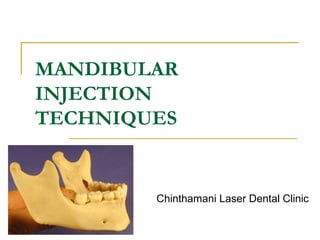
MANDIBULAR
INJECTION
TECHNIQUES

Chinthamani Laser Dental Clinic
INFERIOR ALVEOLAR NERVE BLOCK
OTHER COMMEN NAME: MANDIBULAR BLOCK
NERVES ANESTHETISED:
1.Inferioralveolar
2.Incisive
3.Mental
4.Lingual
AREAS ANESTHETISED:
1.Mandibular teeth
2.Body of the mandible
3.Buccal mucoperiosteum
4.Ant 2/3 tongue & floor of oral cavity
5.Lingual soft tissues &periosteum
INDICATIONS:
1.Multiple mand teeth in 1 quadrant
2.Buccal soft tissue anesthesia
3.Lingual soft tissue anesthesia
CONTRAINDICATIONS:
1.Infection
2.Very young child
ADVANTAGES:


Wide area of Anesthesia

DISADVANTAGES:








Wide area of anesthesia
Inadequate anesthesia
+ve aspiration(10% to 15%)
Intra oral landmarks
Lingual & lower lipanesthesia
Partial anesthesia-bifid an &bifid mand canals
+VE ASPIRATION:10% TO 15%
ALTERNATIVES:









Mental nerve block
Incisive nerve block
Supra periosteal injection
Gow gates mand n block
5.vazirani-akinosi mand n block
PDL injection
Intra osseous injection
Intra septal injection
TECHNIQUES





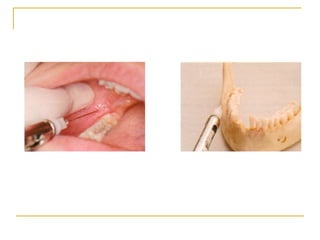
25 gauge long needle
area of insertion
target area
landmarks






Coronoid notch
Pterygomandibular raphae
Occlusal plane

Orientation of needle bevel
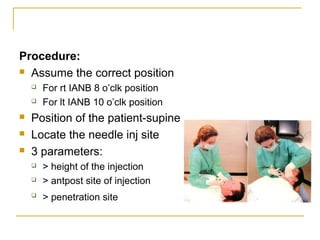
Procedure:
 Assume the correct position







For rt IANB 8 o’clk position
For lt IANB 10 o’clk position

Position of the patient-supine
Locate the needle inj site
3 parameters:




> height of the injection
> antpost site of injection
> penetration site
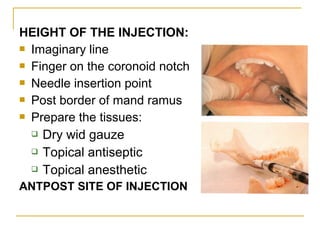
HEIGHT OF THE INJECTION:
 Imaginary line
 Finger on the coronoid notch
 Needle insertion point
 Post border of mand ramus
 Prepare the tissues:
 Dry wid gauze
 Topical antiseptic
 Topical anesthetic
ANTPOST SITE OF INJECTION
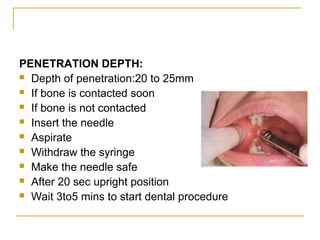
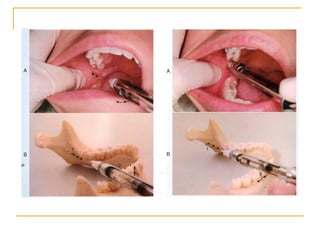
PENETRATION DEPTH:
 Depth of penetration:20 to 25mm
 If bone is contacted soon
 If bone is not contacted
 Insert the needle
 Aspirate
 Withdraw the syringe
 Make the needle safe
 After 20 sec upright position
 Wait 3to5 mins to start dental procedure
SIGNS AND SYMPTOMS:




Subjective: Tingling and numbness of the lower lip.
Subjective: Tingling and numbness of the tongue.
Objective: No pain.

SAFETY FEATURE:


Contacting bone & preventing over insertion.

PRECAUTIONS:



Do not deposit la if bone is not contacted.
Avoid pain.
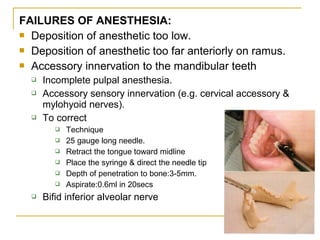
FAILURES OF ANESTHESIA:
 Deposition of anesthetic too low.
 Deposition of anesthetic too far anteriorly on ramus.
 Accessory innervation to the mandibular teeth





Incomplete pulpal anesthesia.
Accessory sensory innervation (e.g. cervical accessory &
mylohyoid nerves).
To correct









Technique
25 gauge long needle.
Retract the tongue toward midline
Place the syringe & direct the needle tip
Depth of penetration to bone:3-5mm.
Aspirate:0.6ml in 20secs

Bifid inferior alveolar nerve
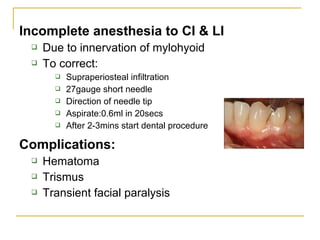
Incomplete anesthesia to CI & LI



Due to innervation of mylohyoid
To correct:






Supraperiosteal infiltration
27gauge short needle
Direction of needle tip
Aspirate:0.6ml in 20secs
After 2-3mins start dental procedure

Complications:




Hematoma
Trismus
Transient facial paralysis
INDIRECT MANDIBULAR TECHNIQUE OR
FISCHER 1-2-3 TECHNIQUE


Needle position:









Landmarks:
Technique:






1st position: Long buccal nerve anesthetised from the opp
side
2nd position: Lingual nerve anesthetised from the same
side
3rd position: Inferior alveolar nerve is anesthetised from the
opp side

1st position
2nd position
3rd position

Signs and symptoms
BUCCAL NERVE BLOCK









Other common name: Long buccal n block or
buccinator n block
Nerves anesthetised: Buccal
Areas anesthetised: Soft tissues & periosteum
buccal to mand molars
Indication: Buccal softtissue anesthesia
Contraindication: Infection
Advantages:
 High success rate
 Technically easy




Disadvantage: Pain
+ve aspiration:0.7%
Alternatives:







Buccal infiltration
Gow gates mand n block
Vazirani-akinosi mand n block
PDL injection
Intra osseous injection
Intraseptal injection
Techniques







25 gauge long needle
Area of insertion
Target area
Landmarks
Orientation of needle bevel
Procedure
 Assume the correct position
 Position of pt:supine
 Prepare the tissues for penetration
 Direct the syringe & advance the needle.
Depth of penetration:2-4mm
 Aspirate
 Withdraw the syringe
 Wait 1min & start dental procedure
SIGNS AND SYMPTOMS:


Safety Feature:





Precautions:





Pain on insertion from striking unanesthetised periosteum
LA soln not being retained at inj site

Failures of anesthesia:




Min +ve aspiration
Prevent over insertion

Rare

Complications:


Hematoma
MANDIBULAR NERVE BLOCK THE
GOW-GATES TECHNIQUE
OTHER COMMON NAME:THIRD DIVISION N
BLOCK,V3 NERVE BLOCK.
 Nerves anesthetised:








Inferior alveolar n
Mental
Incisive
Lingual
Mylohyoid
Auriculotemporal
Buccal


Areas anesthetised:









Indications:







Mand teeth midline
Buccal mucoperiosteum
Ant 2/3 tongue &floor oral cavity
Lingual soft tissues
Body of mandible
Skin over zygoma
Multiple procedures
Buccal soft tissue anesthesia
Lingual soft tissue anesthesia
When conventional IANB unsuccessful

Contraindications:


Trismus patient & rest same as IANB
ADVANTAGES:
 Only one injection
 High success rate (>95%)
 Min aspiration rate
 Few post inj complications
 Successful even if bifid IAN’S & mand n’s
present
DISADVANTAGES:
 Lingual and lower lip anesthesia
 Time of onset longer 5min
+VE ASPIRATION:2%
ALTERNATIVES:


IANB & buccal n block



Vazirani-akinosi closed mouth mand block



Incisive n block



Mental n block



Buccal n block



Supra periosteal injection



Intra osseous technique



PDL inj technique
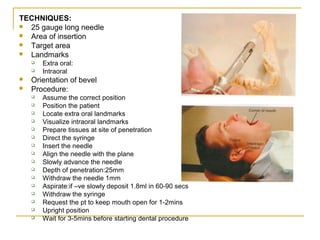
TECHNIQUES:

25 gauge long needle

Area of insertion

Target area

Landmarks






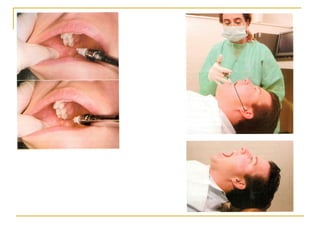
Extra oral:
Intraoral

Orientation of bevel
Procedure:

















Assume the correct position
Position the patient
Locate extra oral landmarks
Visualize intraoral landmarks
Prepare tissues at site of penetration
Direct the syringe
Insert the needle
Align the needle with the plane
Slowly advance the needle
Depth of penetration:25mm
Withdraw the needle 1mm
Aspirate:if –ve slowly deposit 1.8ml in 60-90 secs
Withdraw the syringe
Request the pt to keep mouth open for 1-2mins
Upright position
Wait for 3-5mins before starting dental procedure
SIGNS AND SYMPTOMS:SAME AS IANB


Safety feature:
 Very low +ve aspiration rate
 Needle contacting bone & preventing over insertion



Precautions:
 Do not deposit if bone is not contacted



Failures of anesthesia:
 Too little volume
 Anatomical difficulties



Complications:
 Hematoma
 Trismus
 Temporary paralysis of cranial nerves iii, iv & vi.
THANK
YOU

Email.id:chinthamanidental@gmail.com
044-43800059 , 92 83 786 776
www.chinthamanilaserdentalclinic.com

Mandibular Injection Technique

  • 1.
  • 2.
    INFERIOR ALVEOLAR NERVEBLOCK OTHER COMMEN NAME: MANDIBULAR BLOCK NERVES ANESTHETISED: 1.Inferioralveolar 2.Incisive 3.Mental 4.Lingual AREAS ANESTHETISED: 1.Mandibular teeth 2.Body of the mandible 3.Buccal mucoperiosteum 4.Ant 2/3 tongue & floor of oral cavity 5.Lingual soft tissues &periosteum
  • 3.
    INDICATIONS: 1.Multiple mand teethin 1 quadrant 2.Buccal soft tissue anesthesia 3.Lingual soft tissue anesthesia CONTRAINDICATIONS: 1.Infection 2.Very young child
  • 4.
    ADVANTAGES:  Wide area ofAnesthesia DISADVANTAGES:        Wide area of anesthesia Inadequate anesthesia +ve aspiration(10% to 15%) Intra oral landmarks Lingual & lower lipanesthesia Partial anesthesia-bifid an &bifid mand canals +VE ASPIRATION:10% TO 15%
  • 5.
    ALTERNATIVES:         Mental nerve block Incisivenerve block Supra periosteal injection Gow gates mand n block 5.vazirani-akinosi mand n block PDL injection Intra osseous injection Intra septal injection
  • 6.
    TECHNIQUES     25 gauge longneedle area of insertion target area landmarks     Coronoid notch Pterygomandibular raphae Occlusal plane Orientation of needle bevel
  • 7.
    Procedure:  Assume thecorrect position      For rt IANB 8 o’clk position For lt IANB 10 o’clk position Position of the patient-supine Locate the needle inj site 3 parameters:    > height of the injection > antpost site of injection > penetration site
  • 8.
    HEIGHT OF THEINJECTION:  Imaginary line  Finger on the coronoid notch  Needle insertion point  Post border of mand ramus  Prepare the tissues:  Dry wid gauze  Topical antiseptic  Topical anesthetic ANTPOST SITE OF INJECTION
  • 9.
    PENETRATION DEPTH:  Depthof penetration:20 to 25mm  If bone is contacted soon  If bone is not contacted  Insert the needle  Aspirate  Withdraw the syringe  Make the needle safe  After 20 sec upright position  Wait 3to5 mins to start dental procedure
  • 11.
    SIGNS AND SYMPTOMS:    Subjective:Tingling and numbness of the lower lip. Subjective: Tingling and numbness of the tongue. Objective: No pain. SAFETY FEATURE:  Contacting bone & preventing over insertion. PRECAUTIONS:   Do not deposit la if bone is not contacted. Avoid pain.
  • 12.
    FAILURES OF ANESTHESIA: Deposition of anesthetic too low.  Deposition of anesthetic too far anteriorly on ramus.  Accessory innervation to the mandibular teeth    Incomplete pulpal anesthesia. Accessory sensory innervation (e.g. cervical accessory & mylohyoid nerves). To correct        Technique 25 gauge long needle. Retract the tongue toward midline Place the syringe & direct the needle tip Depth of penetration to bone:3-5mm. Aspirate:0.6ml in 20secs Bifid inferior alveolar nerve
  • 13.
    Incomplete anesthesia toCI & LI   Due to innervation of mylohyoid To correct:      Supraperiosteal infiltration 27gauge short needle Direction of needle tip Aspirate:0.6ml in 20secs After 2-3mins start dental procedure Complications:    Hematoma Trismus Transient facial paralysis
  • 14.
    INDIRECT MANDIBULAR TECHNIQUEOR FISCHER 1-2-3 TECHNIQUE  Needle position:      Landmarks: Technique:     1st position: Long buccal nerve anesthetised from the opp side 2nd position: Lingual nerve anesthetised from the same side 3rd position: Inferior alveolar nerve is anesthetised from the opp side 1st position 2nd position 3rd position Signs and symptoms
  • 15.
    BUCCAL NERVE BLOCK       Othercommon name: Long buccal n block or buccinator n block Nerves anesthetised: Buccal Areas anesthetised: Soft tissues & periosteum buccal to mand molars Indication: Buccal softtissue anesthesia Contraindication: Infection Advantages:  High success rate  Technically easy
  • 16.
       Disadvantage: Pain +ve aspiration:0.7% Alternatives:       Buccalinfiltration Gow gates mand n block Vazirani-akinosi mand n block PDL injection Intra osseous injection Intraseptal injection
  • 17.
    Techniques       25 gauge longneedle Area of insertion Target area Landmarks Orientation of needle bevel Procedure  Assume the correct position  Position of pt:supine  Prepare the tissues for penetration  Direct the syringe & advance the needle. Depth of penetration:2-4mm  Aspirate  Withdraw the syringe  Wait 1min & start dental procedure
  • 19.
    SIGNS AND SYMPTOMS:  SafetyFeature:    Precautions:    Pain on insertion from striking unanesthetised periosteum LA soln not being retained at inj site Failures of anesthesia:   Min +ve aspiration Prevent over insertion Rare Complications:  Hematoma
  • 20.
    MANDIBULAR NERVE BLOCKTHE GOW-GATES TECHNIQUE OTHER COMMON NAME:THIRD DIVISION N BLOCK,V3 NERVE BLOCK.  Nerves anesthetised:        Inferior alveolar n Mental Incisive Lingual Mylohyoid Auriculotemporal Buccal
  • 21.
     Areas anesthetised:        Indications:      Mand teethmidline Buccal mucoperiosteum Ant 2/3 tongue &floor oral cavity Lingual soft tissues Body of mandible Skin over zygoma Multiple procedures Buccal soft tissue anesthesia Lingual soft tissue anesthesia When conventional IANB unsuccessful Contraindications:  Trismus patient & rest same as IANB
  • 22.
    ADVANTAGES:  Only oneinjection  High success rate (>95%)  Min aspiration rate  Few post inj complications  Successful even if bifid IAN’S & mand n’s present DISADVANTAGES:  Lingual and lower lip anesthesia  Time of onset longer 5min
  • 23.
    +VE ASPIRATION:2% ALTERNATIVES:  IANB &buccal n block  Vazirani-akinosi closed mouth mand block  Incisive n block  Mental n block  Buccal n block  Supra periosteal injection  Intra osseous technique  PDL inj technique
  • 24.
    TECHNIQUES:  25 gauge longneedle  Area of insertion  Target area  Landmarks     Extra oral: Intraoral Orientation of bevel Procedure:                 Assume the correct position Position the patient Locate extra oral landmarks Visualize intraoral landmarks Prepare tissues at site of penetration Direct the syringe Insert the needle Align the needle with the plane Slowly advance the needle Depth of penetration:25mm Withdraw the needle 1mm Aspirate:if –ve slowly deposit 1.8ml in 60-90 secs Withdraw the syringe Request the pt to keep mouth open for 1-2mins Upright position Wait for 3-5mins before starting dental procedure
  • 26.
    SIGNS AND SYMPTOMS:SAMEAS IANB  Safety feature:  Very low +ve aspiration rate  Needle contacting bone & preventing over insertion  Precautions:  Do not deposit if bone is not contacted  Failures of anesthesia:  Too little volume  Anatomical difficulties  Complications:  Hematoma  Trismus  Temporary paralysis of cranial nerves iii, iv & vi.
  • 27.
    THANK YOU Email.id:chinthamanidental@gmail.com 044-43800059 , 9283 786 776 www.chinthamanilaserdentalclinic.com