Posterior superiorPosterior superior
alveolar (PSA)alveolar (PSA)
nerve blocknerve block
Chirag M A
3rd
year BDS
Posterior superior alveolarPosterior superior alveolar
(PSA) nerve block(PSA) nerve block
โ€ขThe posterior superior alveolar nerve block is a most
commonly used nerve block, although it is a highly successful
technique (>95%)
โ€ขThe PSA nerve block is effective for the maxillary 3rd
, 2nd
and
1st
molar except the mesio buccal root of maxillary 1st
molar
(doesnโ€™t anesthetize in 28%of patients), which is supplied by
middle superior alveolar nerve.
โ€ขTherefore the second injection, usually supraperiosteal, is
indicated after PSA nerve block when effective Anesthesia of
1st
molar is not developed.
โ€ข The risk of a potential complication must be consideredThe risk of a potential complication must be considered
whenever the PSA block is used .whenever the PSA block is used .
โ€ข Insertion of the needle too far distally may lead to aInsertion of the needle too far distally may lead to a
temporarily unesthetic hematoma.temporarily unesthetic hematoma.
โ€ข When the PSA is to be administered, one must alwaysWhen the PSA is to be administered, one must always
consider the patients skull size in determining the depthconsider the patients skull size in determining the depth
of soft tissue penetration.of soft tissue penetration.
โ€ข In order to decrease the risk of hematoma formation afterIn order to decrease the risk of hematoma formation after
PSA nerve block,PSA nerve block, SHORT DENTAL NEEDLESSHORT DENTAL NEEDLES havehave
been recommended.been recommended.
โ€ข The average depth of soft tissue penetration is 16mm, theThe average depth of soft tissue penetration is 16mm, the
short needle (=20mm) can be successfully and safely used.short needle (=20mm) can be successfully and safely used.
Other common names:Other common names:
Tuberosity block and Zygomatic blockTuberosity block and Zygomatic block
Nerves anesthetized:
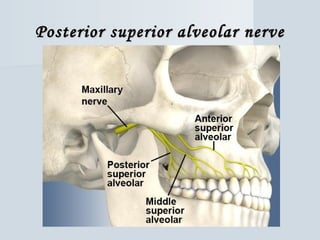
Posterior superior alveolar nerves and its branches
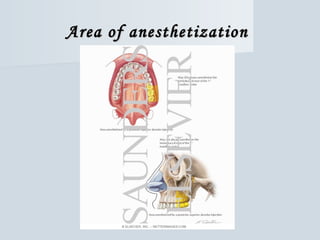
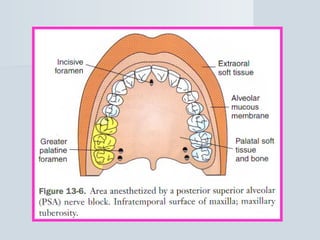
Area anesthetized:
1) Pulps of maxillary 3rd, 2nd and 1st molars (entire tooth
= 72%; mesio buccal root of maxillary 1st molar not
anesthetized = 28%)
2) Buccal periodontium and bone overlying these teeth
Contraindications:
1. When the risk of hemorrhage is too great (as with a
hemophiliac), in which case a supraperiosteal injection or
PDL injection is recommended
Indications:
1.When treatment involving two or more maxillary1.When treatment involving two or more maxillary
molarsmolars
2.When supraperiosteal injection is contraindicated like2.When supraperiosteal injection is contraindicated like
infections and acute inflammationsinfections and acute inflammations
3.When supraperiosteal injection has proved ineffective3.When supraperiosteal injection has proved ineffective
Advantages:
1. Atraumatic
2. High success rate (>95%)
3. Minimum number of injections, 1 injection compared
with 3 infiltrations
4. Minimizes the total volume of local anesthetic solution
administered
Disadvantages:
1. Risk of hematoma
2. Technique somewhat arbitrary
3. Second injection necessary for treatment of the mesio
buccal root of maxillary 1st
molar in 28% of patients
Posterior superior alveolar nervePosterior superior alveolar nerve
Area of anesthetizationArea of anesthetization
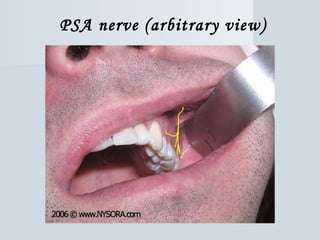
PSA nerve (arbitrary view)
PSA nerve blockPSA nerve block
TechniquesTechniques
TechniqueTechnique ๏ƒ ๏ƒ  PSA Nerve BlockPSA Nerve Block
1) 25 gauge1) 25 gauge shortshort needle is recommendedneedle is recommended
2) Insert needle at the height of the2) Insert needle at the height of the mucobuccal foldmucobuccal fold above theabove the
maxillarymaxillary 22ndnd
molarmolar
3) Target area is the PSA nerve which is3) Target area is the PSA nerve which is posteriorposterior,, superiorsuperior andand
medialmedial to the posterior border of the maxillato the posterior border of the maxilla
4) Landmarks: mucobuccal fold, maxillary tuberosity and4) Landmarks: mucobuccal fold, maxillary tuberosity and
zygomatic process of maxillazygomatic process of maxilla
5) Have patient open their mouth5) Have patient open their mouth half wayhalf way which makes morewhich makes more
roomroom
6)6) RetractRetract the patientโ€™s cheek with mirrorthe patientโ€™s cheek with mirror
7) Pull the tissues at the injection site7) Pull the tissues at the injection site tauttaut
8) Orient bevel8) Orient bevel towardtoward bonebone
9) Insert needle at height of mucobuccal fold over the9) Insert needle at height of mucobuccal fold over the 22ndnd
maxillary molarmaxillary molar
10) Advance needle10) Advance needle upwardupward,, inwardinward andand backwardbackward directiondirection
11) Odd feeling of having no resistance whatsoever11) Odd feeling of having no resistance whatsoever
12) Penetrating to an average depth of12) Penetrating to an average depth of 1616 mm is adequate andmm is adequate and
10-1410-14mm adequate for smaller skulled patientsmm adequate for smaller skulled patients
13)13) Aspirate in two planes by rotating bevel one quarter turnAspirate in two planes by rotating bevel one quarter turn
14) Deposit 0.9-1.8ml of anesthetic solution14) Deposit 0.9-1.8ml of anesthetic solution
15)15) WaitWait 33 toto 55 minutes to start treatmentminutes to start treatment
Note:Note: Goal is to deposit LA close to PSA nerve. Advance the needle inGoal is to deposit LA close to PSA nerve. Advance the needle in
one movement, not three separate movements; usually atraumatic toone movement, not three separate movements; usually atraumatic to
most patients. For left PSA nerve block, administrator should be at 10โ€™omost patients. For left PSA nerve block, administrator should be at 10โ€™o
clock position and for right PSA nerve block administrator should be atclock position and for right PSA nerve block administrator should be at
8โ€™o clock position8โ€™o clock position
Signs and symptoms:
1. Absence of pain during treatment
2. Use of electrical pulp testing with no response from tooth
with maximal EPT output
Safety features:
1. Slow injection
2. No anatomic safety features to prevent over insertion of
the needle; therefore careful observation is necessary
Precautions: The depth of needle penetration should be
correct: over insertion, increases the risk of hematoma and
too shallow might still provide adequate Anesthesia
Failure of Anesthesia:
1. Needle too lateral. To correct: redirect the tip medially
2. Needle not high enough. To correct: redirect the needle tip
superiorly
3. Needle too far posterior. To correct: withdraw the needle to
the proper depth
Complications:
1. Hematoma: commonly produced by inserting the needle too
far posteriorly into pterygoid plexus of veins.
2. Mandibular anesthesia: The mandibular division of the 5th
cranial nerve is located lateral to the PSA nerve. Deposition
of LA lateral to the desired location may produce varying
degrees of mandibular anesthesia.
Thank youThank you

Posterior superior alveolar (psa) nerve block

  • 1.
    Posterior superiorPosterior superior alveolar(PSA)alveolar (PSA) nerve blocknerve block Chirag M A 3rd year BDS
  • 2.
    Posterior superior alveolarPosteriorsuperior alveolar (PSA) nerve block(PSA) nerve block โ€ขThe posterior superior alveolar nerve block is a most commonly used nerve block, although it is a highly successful technique (>95%) โ€ขThe PSA nerve block is effective for the maxillary 3rd , 2nd and 1st molar except the mesio buccal root of maxillary 1st molar (doesnโ€™t anesthetize in 28%of patients), which is supplied by middle superior alveolar nerve. โ€ขTherefore the second injection, usually supraperiosteal, is indicated after PSA nerve block when effective Anesthesia of 1st molar is not developed.
  • 3.
    โ€ข The riskof a potential complication must be consideredThe risk of a potential complication must be considered whenever the PSA block is used .whenever the PSA block is used . โ€ข Insertion of the needle too far distally may lead to aInsertion of the needle too far distally may lead to a temporarily unesthetic hematoma.temporarily unesthetic hematoma. โ€ข When the PSA is to be administered, one must alwaysWhen the PSA is to be administered, one must always consider the patients skull size in determining the depthconsider the patients skull size in determining the depth of soft tissue penetration.of soft tissue penetration. โ€ข In order to decrease the risk of hematoma formation afterIn order to decrease the risk of hematoma formation after PSA nerve block,PSA nerve block, SHORT DENTAL NEEDLESSHORT DENTAL NEEDLES havehave been recommended.been recommended. โ€ข The average depth of soft tissue penetration is 16mm, theThe average depth of soft tissue penetration is 16mm, the short needle (=20mm) can be successfully and safely used.short needle (=20mm) can be successfully and safely used.
  • 4.
    Other common names:Othercommon names: Tuberosity block and Zygomatic blockTuberosity block and Zygomatic block Nerves anesthetized: Posterior superior alveolar nerves and its branches Area anesthetized: 1) Pulps of maxillary 3rd, 2nd and 1st molars (entire tooth = 72%; mesio buccal root of maxillary 1st molar not anesthetized = 28%) 2) Buccal periodontium and bone overlying these teeth
  • 5.
    Contraindications: 1. When therisk of hemorrhage is too great (as with a hemophiliac), in which case a supraperiosteal injection or PDL injection is recommended Indications: 1.When treatment involving two or more maxillary1.When treatment involving two or more maxillary molarsmolars 2.When supraperiosteal injection is contraindicated like2.When supraperiosteal injection is contraindicated like infections and acute inflammationsinfections and acute inflammations 3.When supraperiosteal injection has proved ineffective3.When supraperiosteal injection has proved ineffective
  • 6.
    Advantages: 1. Atraumatic 2. Highsuccess rate (>95%) 3. Minimum number of injections, 1 injection compared with 3 infiltrations 4. Minimizes the total volume of local anesthetic solution administered Disadvantages: 1. Risk of hematoma 2. Technique somewhat arbitrary 3. Second injection necessary for treatment of the mesio buccal root of maxillary 1st molar in 28% of patients
  • 7.
    Posterior superior alveolarnervePosterior superior alveolar nerve
  • 8.
    Area of anesthetizationAreaof anesthetization
  • 10.
  • 11.
    PSA nerve blockPSAnerve block TechniquesTechniques
  • 12.
    TechniqueTechnique ๏ƒ ๏ƒ  PSANerve BlockPSA Nerve Block 1) 25 gauge1) 25 gauge shortshort needle is recommendedneedle is recommended 2) Insert needle at the height of the2) Insert needle at the height of the mucobuccal foldmucobuccal fold above theabove the maxillarymaxillary 22ndnd molarmolar 3) Target area is the PSA nerve which is3) Target area is the PSA nerve which is posteriorposterior,, superiorsuperior andand medialmedial to the posterior border of the maxillato the posterior border of the maxilla 4) Landmarks: mucobuccal fold, maxillary tuberosity and4) Landmarks: mucobuccal fold, maxillary tuberosity and zygomatic process of maxillazygomatic process of maxilla 5) Have patient open their mouth5) Have patient open their mouth half wayhalf way which makes morewhich makes more roomroom 6)6) RetractRetract the patientโ€™s cheek with mirrorthe patientโ€™s cheek with mirror 7) Pull the tissues at the injection site7) Pull the tissues at the injection site tauttaut
  • 13.
    8) Orient bevel8)Orient bevel towardtoward bonebone 9) Insert needle at height of mucobuccal fold over the9) Insert needle at height of mucobuccal fold over the 22ndnd maxillary molarmaxillary molar 10) Advance needle10) Advance needle upwardupward,, inwardinward andand backwardbackward directiondirection 11) Odd feeling of having no resistance whatsoever11) Odd feeling of having no resistance whatsoever 12) Penetrating to an average depth of12) Penetrating to an average depth of 1616 mm is adequate andmm is adequate and 10-1410-14mm adequate for smaller skulled patientsmm adequate for smaller skulled patients 13)13) Aspirate in two planes by rotating bevel one quarter turnAspirate in two planes by rotating bevel one quarter turn 14) Deposit 0.9-1.8ml of anesthetic solution14) Deposit 0.9-1.8ml of anesthetic solution 15)15) WaitWait 33 toto 55 minutes to start treatmentminutes to start treatment Note:Note: Goal is to deposit LA close to PSA nerve. Advance the needle inGoal is to deposit LA close to PSA nerve. Advance the needle in one movement, not three separate movements; usually atraumatic toone movement, not three separate movements; usually atraumatic to most patients. For left PSA nerve block, administrator should be at 10โ€™omost patients. For left PSA nerve block, administrator should be at 10โ€™o clock position and for right PSA nerve block administrator should be atclock position and for right PSA nerve block administrator should be at 8โ€™o clock position8โ€™o clock position
  • 14.
    Signs and symptoms: 1.Absence of pain during treatment 2. Use of electrical pulp testing with no response from tooth with maximal EPT output Safety features: 1. Slow injection 2. No anatomic safety features to prevent over insertion of the needle; therefore careful observation is necessary Precautions: The depth of needle penetration should be correct: over insertion, increases the risk of hematoma and too shallow might still provide adequate Anesthesia
  • 15.
    Failure of Anesthesia: 1.Needle too lateral. To correct: redirect the tip medially 2. Needle not high enough. To correct: redirect the needle tip superiorly 3. Needle too far posterior. To correct: withdraw the needle to the proper depth Complications: 1. Hematoma: commonly produced by inserting the needle too far posteriorly into pterygoid plexus of veins. 2. Mandibular anesthesia: The mandibular division of the 5th cranial nerve is located lateral to the PSA nerve. Deposition of LA lateral to the desired location may produce varying degrees of mandibular anesthesia.
  • 16.