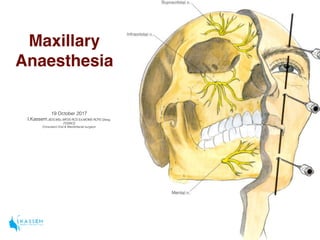
Maxillary
Anaesthesia
19 October 2017
I.Kassem,BDS,MSc,MFDS RCS Ed,MOMS RCPS Glasg,
FDSRCS
Consultant Oral & Maxillofacial surgeon
Techniques of Maxillary Anesthesia
Local Infiltration
Field Block
Nerve Block
Maxillary Injection Techniques
Supraperiosteal
Periodontal ligament
Intraseptal injection
Posterior superior alveolar nerve block
Middle superior alveolar nerve block
Maxillary Injection Techniques
Anterior superior alveolar nerve block
Maxillary (second division) nerve block
Greater (anterior) palatine nerve block
Nasopalatine nerve block
Indications
Pulpal anesthesia of one or two maxillary
teeth
Soft tissue anesthesia when indicated
Hemostasis
Contraindications
Infection or acute inflammation in the area
Dense bone covering apices of teeth
Advantages
High success rate (>95%)
Technically easy injection
Usually entirely atraumatic
Areas Anesthetized
Entire area innervated by the large terminal
nerve branches:
Tooth pulp and root area
Buccal periosteum
Mucous membrane and connective
tissue
Disadvantages
Not suitable for large areas
Multiple needle insertions
Large volumes of anethetic solution
Percent Positive Aspiration:
Negligible, but possible (<1%)
Alternatives
Periodontal ligament injection
Regional nerve block
Technique
Apply topical
Landmarks - mucobuccal fold
long axis of tooth
Insert needle at height of mucobuccal fold
Target area - apex of tooth
Aspirate, deposit approx. 0.6-1 ml solution
Signs and Symptoms
Numbness
Absence of pain during dental therapy
Safety Feature
Minimum opportunity for intravascular
administration
Failures of Anesthesia
Inadequate needle penetration
- not adjacent to tooth apex
Needle too far from bone
Posterior Superior Alveolar Nerve
Block
Nerve Anesthetized:
Posterior Superior Alveolar Nerve (PSA)
- for maxillary molars and buccal
tissue
Indications for PSA Block
First or second maxillary molar
Supraperiosteal injection is contraindicated
Contraindication
Risk of hemorrhage is too great
(eg. hemophelia, coumadin)
Advantages
Atraumatic
High success rate
Less number of injections
Minimize amount of local used
Disadvantages
Risk of hematoma
Does not anesthetize first molar
completely
No bony landmarks
Positive Aspiration
Approximately 3.1%
Landmarks
Mucobuccal fold
Maxillary tuberosity
Zygomatic process of maxilla
Area of Insertion
Mucobuccal fold above maxillary second
molar
Technique
25 gauge, long needle
Position patient and identify landmarks
Advance needle upward, inward and
backward
Aspirate, inject 1.8 ml of solution
Failures of Anesthesia
Needle too lateral
Needle not deep enough
Needle too far superior
Complications
Hematoma
Mandibular anesthesia
Infraorbital nerve
ASA
MSA
PSA
1. PSA Block
1. Anesthetize the pulps and periodontal ligaments
of the maxillary molars, corresponding buccal
alveolar bone and gingival tissue and posterior
portion of the maxillary sinus. Mesiobuccal root 6
can be innervates by middle superior alveolar
nerve !
Technique - between 1st and 2nd molar at a
height of insertion of mucobuccal fold, angle at
45° superiorly and medially
2. MSA Block
1. Anesthetize the maxillary premolars,
corresponding buccal alveolar bone and gingival
tissue
2. Used if the infraorbital block fails to anesthetize
premolars
Technique - between 1st and 2nd premolar at a
height of insertion of mucobuccal fold
3. ASA Block
1. Anesthetize the canine, incisors, corresponding
buccal alveolar bone and gingival tissue
Technique - the area of lateral incisor at a height of
insertion of mucobuccal fold
4. Infraorbital Nerve Block
1. Combinate ASA and MSA block
2. Anesthetize the maxillary premolars, canine,
incisors, corresponding buccal alveolar bone and
gingiva, also the terminal branches of infraorbital
nerve (lower eyelid, external nose tissue, upper
lip, the anterior aspect of the maxillary sinus)
Technique - palpate infraorbital foramen
→ retract the upper lip → inject to area of 3/4
→ contact bone in infraorbital region
→ inject 0,9 -1,2ml
5. Greater Palatine Nerve Block
1. Anesthetize all palatal mucosa of the side
injected and lingual gingivae posterior to the
maxillary canines and corresponding bone
Technique - on the hard palate between the 2nd
and 3rd molars approximately 1cm medially, inject
cca 0,3 - 0,5ml
6. Nasopalatine Nerve Block
1. Anesthetize the soft and hard tissue of the
maxillary anterior six teeth - from canine one side
to canine other side
Technique - approximately 1,5 cm posterior to the
alveolar crest between the central incisors -
posterior to the incisive papilla; depth less than
10mm and inject 0,3 - 0,5 ml
Maxillary local aethesia

Maxillary local aethesia