1
LOCAL
ANAESTHESIA
R.PRADUSHA
I MDS
2
CONTENTS
 INTRODUCTION
 COMPOSITION
 CLASSIFICATION
 MECHANISM OF ACTION
 THEORIES OF LA
 ARMAMENTARIUM
3
 TECHNIQUES OF LA
a. MAXILLARY TECHNIQUES
b. MANDIBULAR TECHNIQUES
 COMPLICATIONS
a. LOCAL COMPLICATIONS
b. SYSTEMIC COMPLICATIONS
 CONCLUSION
 REFERENCES
CONTENTS
4
o Transient reversible loss of sensation in a circumscribed area of the body
caused by
depression of excitation in nerve endings or
inhibition of conduction process in peripheral nerves.
LOCAL ANAESTHESIA
LOCAL ANAESTHETIC
o It is the agent or drug which causes local anaesthesia.
Stanley F.Malamed;Hand book of Local Anesthesia;6th
edition;page
no-2
5
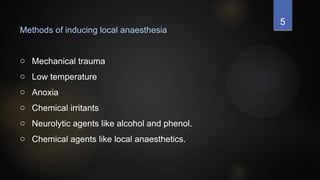
Methods of inducing local anaesthesia
o Mechanical trauma
o Low temperature
o Anoxia
o Chemical irritants
o Neurolytic agents like alcohol and phenol.
o Chemical agents like local anaesthetics.
6
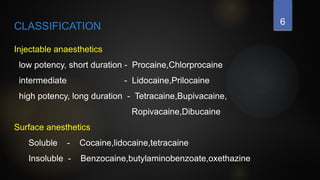
CLASSIFICATION
Injectable anaesthetics
low potency, short duration - Procaine,Chlorprocaine
intermediate - Lidocaine,Prilocaine
high potency, long duration - Tetracaine,Bupivacaine,
Ropivacaine,Dibucaine
Surface anesthetics
Soluble - Cocaine,lidocaine,tetracaine
Insoluble - Benzocaine,butylaminobenzoate,oxethazine
7
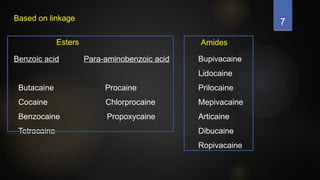
Based on linkage
Esters
Benzoic acid Para-aminobenzoic acid
Butacaine Procaine
Cocaine Chlorprocaine
Benzocaine Propoxycaine
Tetracaine
Amides
Bupivacaine
Lidocaine
Prilocaine
Mepivacaine
Articaine
Dibucaine
Ropivacaine
8
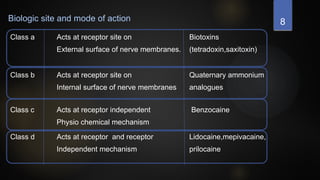
Class a Acts at receptor site on
External surface of nerve membranes.
Biotoxins
(tetradoxin,saxitoxin)
Class b Acts at receptor site on
Internal surface of nerve membranes
Quaternary ammonium
analogues
Class c Acts at receptor independent
Physio chemical mechanism
Benzocaine
Class d Acts at receptor and receptor
Independent mechanism
Lidocaine,mepivacaine,
prilocaine
Biologic site and mode of action
9
Theories for mechanism of action of local anaesthetics
• Membrane expansion theory
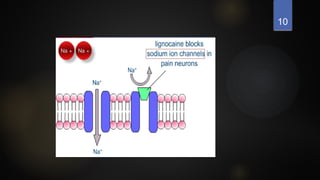
• Specific receptor theory
• Acetyl choline theory
• Calcium displacement theory
• Surface charge theory
• Electrical potential theory
10
11
COMPOSITION
lidocaine Hcl2% - Local anaesthetic drug
Sodium chloride 0.1% - for isotonicity of solution
Sterile water - to maintain volume
Epinephrine 1:1,00,000 - Vasopressor
Sodium metabisulphate - antioxidant
Methyl paraben (1mg/ml) - bacteriostatic
Thymol - fungicide
12
Armamentarium
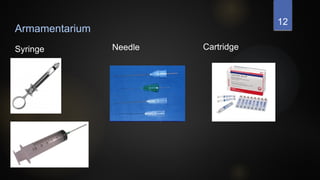
Syringe Needle Cartridge
13
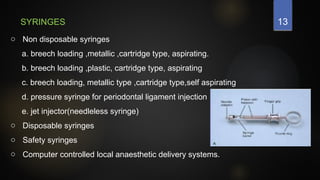
SYRINGES
o Non disposable syringes
a. breech loading ,metallic ,cartridge type, aspirating.
b. breech loading ,plastic, cartridge type, aspirating
c. breech loading, metallic type ,cartridge type,self aspirating
d. pressure syringe for periodontal ligament injection
e. jet injector(needleless syringe)
o Disposable syringes
o Safety syringes
o Computer controlled local anaesthetic delivery systems.
14
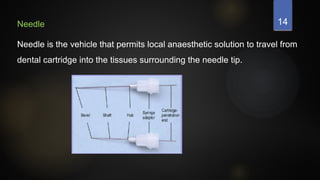
Needle
Needle is the vehicle that permits local anaesthetic solution to travel from
dental cartridge into the tissues surrounding the needle tip.
15
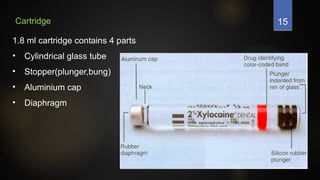
Cartridge
1.8 ml cartridge contains 4 parts
• Cylindrical glass tube
• Stopper(plunger,bung)
• Aluminium cap
• Diaphragm
16
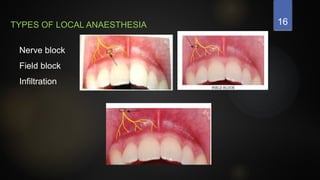
TYPES OF LOCAL ANAESTHESIA
Nerve block
Field block
Infiltration
17
Techniques of anaesthesia
• Supraperiosteal( infiltration)
• Periodontal ligament injection
• Intraseptal injection
• Intra crestal
• Intra osseous
18
Techniques of maxillary anaesthesia
• Posterior superior alveolar nerve block
• Middle superior alveolar nerve block
• Anterior superior alveolar nerve block
• Maxillary nerve block
• Greater palatine nerve block
• Nasopalatine nerve block
• Anterior middle superior alveolar nerve block
19
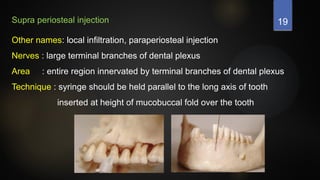
Supra periosteal injection
Other names: local infiltration, paraperiosteal injection
Nerves : large terminal branches of dental plexus
Area : entire region innervated by terminal branches of dental plexus
Technique : syringe should be held parallel to the long axis of tooth
inserted at height of mucobuccal fold over the tooth
20
Deposition: 0.6ml over 20 seconds
Wait period:3 to 5 mins.
Indications
• Pulpal anaesthesia of maxillary teeth when limited to one or two teeth
• Soft tissue anaesthesia for surgical procedures in a circumscribed
area.
Contra indications
• Acute inflammation
• Dense bone covering the apices of the teeth.
21
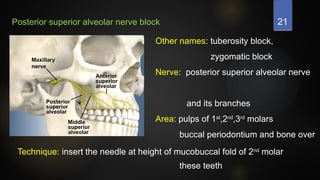
Posterior superior alveolar nerve block
Other names: tuberosity block,
zygomatic block
Nerve: posterior superior alveolar nerve
and its branches
Area: pulps of 1st
,2nd
,3rd
molars
buccal periodontium and bone over
these teeth
Technique: insert the needle at height of mucobuccal fold of 2nd
molar
22
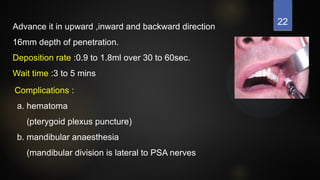
Advance it in upward ,inward and backward direction
16mm depth of penetration.
Deposition rate :0.9 to 1.8ml over 30 to 60sec.
Wait time :3 to 5 mins
Complications :
a. hematoma
(pterygoid plexus puncture)
b. mandibular anaesthesia
(mandibular division is lateral to PSA nerves
23
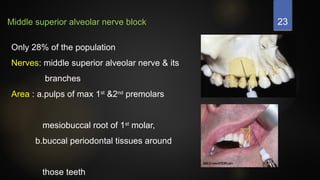
Middle superior alveolar nerve block
Only 28% of the population
Nerves: middle superior alveolar nerve & its
branches
Area : a.pulps of max 1st
&2nd
premolars
mesiobuccal root of 1st
molar,
b.buccal periodontal tissues around
those teeth
24
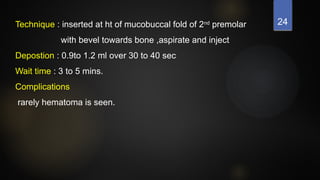
Technique : inserted at ht of mucobuccal fold of 2nd
premolar
with bevel towards bone ,aspirate and inject
Depostion : 0.9to 1.2 ml over 30 to 40 sec
Wait time : 3 to 5 mins.
Complications
rarely hematoma is seen.
25
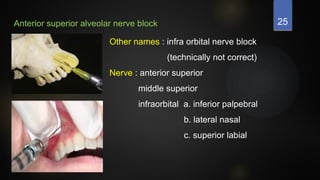
Anterior superior alveolar nerve block
Other names : infra orbital nerve block
(technically not correct)
Nerve : anterior superior
middle superior
infraorbital a. inferior palpebral
b. lateral nasal
c. superior labial
26
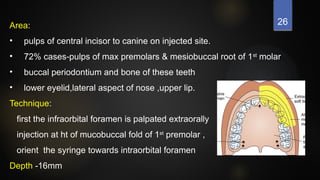
Area:
• pulps of central incisor to canine on injected site.
• 72% cases-pulps of max premolars & mesiobuccal root of 1st
molar
• buccal periodontium and bone of these teeth
• lower eyelid,lateral aspect of nose ,upper lip.
Technique:
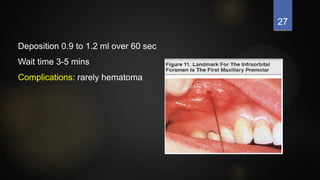
first the infraorbital foramen is palpated extraorally
injection at ht of mucobuccal fold of 1st
premolar ,
orient the syringe towards intraorbital foramen
Depth -16mm
27
Deposition 0.9 to 1.2 ml over 60 sec
Wait time 3-5 mins
Complications: rarely hematoma
28
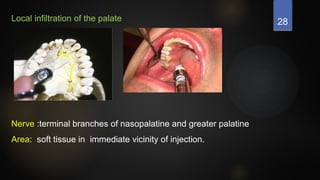
Local infiltration of the palate
Nerve :terminal branches of nasopalatine and greater palatine
Area: soft tissue in immediate vicinity of injection.
29
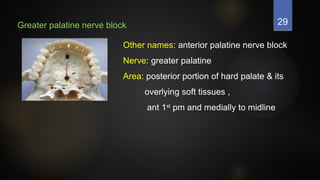
Greater palatine nerve block
Other names: anterior palatine nerve block
Nerve: greater palatine
Area: posterior portion of hard palate & its
overlying soft tissues ,
ant 1st
pm and medially to midline
30
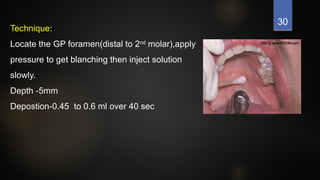
Technique:
Locate the GP foramen(distal to 2nd
molar),apply
pressure to get blanching then inject solution
slowly.
Depth -5mm
Depostion-0.45 to 0.6 ml over 40 sec
31
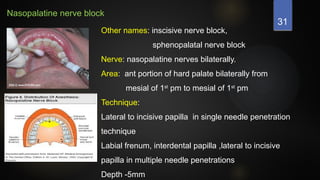
Nasopalatine nerve block
Other names: inscisive nerve block,
sphenopalatal nerve block
Nerve: nasopalatine nerves bilaterally.
Area: ant portion of hard palate bilaterally from
mesial of 1st
pm to mesial of 1st
pm
Technique:
Lateral to incisive papilla in single needle penetration
technique
Labial frenum, interdental papilla ,lateral to incisive
papilla in multiple needle penetrations
Depth -5mm
32
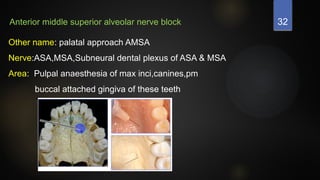
Anterior middle superior alveolar nerve block
Other name: palatal approach AMSA
Nerve:ASA,MSA,Subneural dental plexus of ASA & MSA
Area: Pulpal anaesthesia of max inci,canines,pm
buccal attached gingiva of these teeth
33
Maxillary nerve block
Nerve :maxillary nerve
Area: pulpal anaesthesia of max teeth on one side.
buccal periodontium and bone overlying these teeth
soft tissues and bone of hardpalate and part of soft palate.
Technique:
a. High tuberosity approach
b. Greater palatine canal approach
34
a.High tuberosity approach
Distal to mucobuccal fold of max 2nd
molar, insert needle as in PSA
block.(upward,inward,backward).
Advance the needle to depth of 30mm-should lie in pterygopalatine
fossa.
b. Greater palatine approach
greater palatine foramen is located and needle is advance to 30mm.
Complications :
Hematoma (if max artery during high tuberosity approach)
Penetration of orbit (during greater palatine approach)
35
• Inferior alveolar nerve block
• Buccal nerve block
• Mandibular nerve block-Gow-gates technique
Vazirani Akinosi closed mouth
• Mental nerve block
• Incisive nerve block
Mandibular techniques of local anaesthesia
36
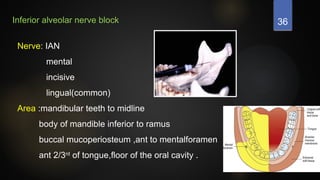
Inferior alveolar nerve block
Nerve: IAN
mental
incisive
lingual(common)
Area :mandibular teeth to midline
body of mandible inferior to ramus
buccal mucoperiosteum ,ant to mentalforamen
ant 2/3rd
of tongue,floor of the oral cavity .
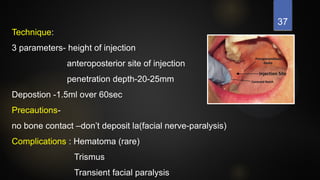
37
Technique:
3 parameters- height of injection
anteroposterior site of injection
penetration depth-20-25mm
Depostion -1.5ml over 60sec
Precautions-
no bone contact –don’t deposit la(facial nerve-paralysis)
Complications : Hematoma (rare)
Trismus
Transient facial paralysis
38
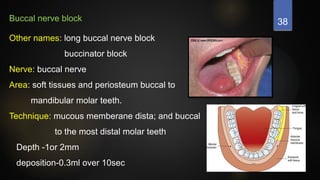
Buccal nerve block
Other names: long buccal nerve block
buccinator block
Nerve: buccal nerve
Area: soft tissues and periosteum buccal to
mandibular molar teeth.
Technique: mucous memberane dista; and buccal
to the most distal molar teeth
Depth -1or 2mm
deposition-0.3ml over 10sec
39
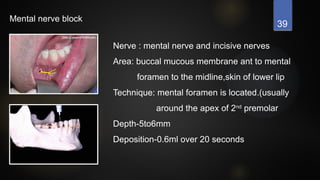
Mental nerve block
Nerve : mental nerve and incisive nerves
Area: buccal mucous membrane ant to mental
foramen to the midline,skin of lower lip
Technique: mental foramen is located.(usually
around the apex of 2nd
premolar
Depth-5to6mm
Deposition-0.6ml over 20 seconds
40
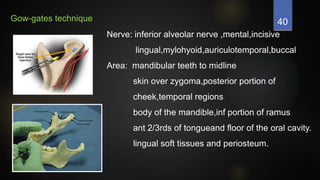
Gow-gates technique
Nerve: inferior alveolar nerve ,mental,incisive
lingual,mylohyoid,auriculotemporal,buccal
Area: mandibular teeth to midline
skin over zygoma,posterior portion of
cheek,temporal regions
body of the mandible,inf portion of ramus
ant 2/3rds of tongueand floor of the oral cavity.
lingual soft tissues and periosteum.
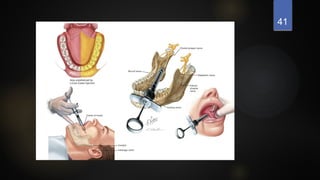
41
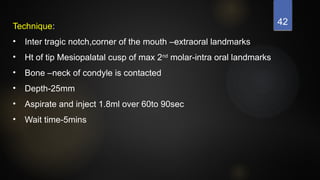
42
Technique:
• Inter tragic notch,corner of the mouth –extraoral landmarks
• Ht of tip Mesiopalatal cusp of max 2nd
molar-intra oral landmarks
• Bone –neck of condyle is contacted
• Depth-25mm
• Aspirate and inject 1.8ml over 60to 90sec
• Wait time-5mins
43
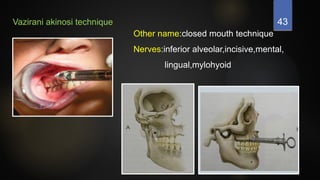
Vazirani akinosi technique
Other name:closed mouth technique
Nerves:inferior alveolar,incisive,mental,
lingual,mylohyoid
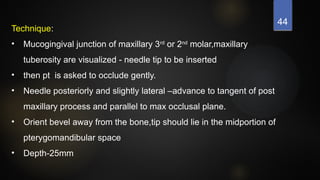
44
Technique:
• Mucogingival junction of maxillary 3rd
or 2nd
molar,maxillary
tuberosity are visualized - needle tip to be inserted
• then pt is asked to occlude gently.
• Needle posteriorly and slightly lateral –advance to tangent of post
maxillary process and parallel to max occlusal plane.
• Orient bevel away from the bone,tip should lie in the midportion of
pterygomandibular space
• Depth-25mm
45
Complications
a. Local complications
 Needle breakage
 Prolonged anesthesia or paresthesia
 Facial nerve paralysis
 Trismus
 Soft tissue injury
 Hematoma
 Pain on injection
 Burning on injection
 Infection
 Edema
 Sloughing of tissues
 Post anesthetic intraoral lesions
46
b. Systemic complications
Adverse drug reactions
i.Toxicity caused by direct extension of usual pharmacological effects of the drug
a) side effects
b) overdose reactions
c) local toxic effects
ii.Toxicity caused by alteration in the recipient of the drug
d) Hepatic dysfunction,heart failure,renal dysfunction
e) Emotional disturbances,genetic abberations
f) idiosyncracy
47
iii.Toxicity caused by allergic responces to the drug
Generally ester group of local anesthestic solutions cause
allergic drug reactions.
MANAGEMENT
• Basic emergency management:A-B-C-D Approach
• Allergy:medical history questinare
• Emergency dental care
protocol 1-no t/t of an invasive nature
protocol 2-use general anesthesia
protocol 3-histamine blockers
protocol 4-electronic dental anesthesia/hypnosis
48
Recent advances
• EMLA
• Dentipatch(lidocaine transoral delivery system)
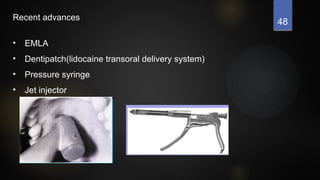
• Pressure syringe
• Jet injector
49
Conclusion
With identification of anatomic nerve landmarks and by using proper
techniques can produce local anaesthesia which will be used for
certain treatment procedures.
50
References
• Stanley F.Malamed- Hand Book of Local Anaesthesia,6th
Edition

3.local anesthesia in dentistry pptx presentation

  • 1.
  • 2.
    2 CONTENTS  INTRODUCTION  COMPOSITION CLASSIFICATION  MECHANISM OF ACTION  THEORIES OF LA  ARMAMENTARIUM
  • 3.
    3  TECHNIQUES OFLA a. MAXILLARY TECHNIQUES b. MANDIBULAR TECHNIQUES  COMPLICATIONS a. LOCAL COMPLICATIONS b. SYSTEMIC COMPLICATIONS  CONCLUSION  REFERENCES CONTENTS
  • 4.
    4 o Transient reversibleloss of sensation in a circumscribed area of the body caused by depression of excitation in nerve endings or inhibition of conduction process in peripheral nerves. LOCAL ANAESTHESIA LOCAL ANAESTHETIC o It is the agent or drug which causes local anaesthesia. Stanley F.Malamed;Hand book of Local Anesthesia;6th edition;page no-2
  • 5.
    5 Methods of inducinglocal anaesthesia o Mechanical trauma o Low temperature o Anoxia o Chemical irritants o Neurolytic agents like alcohol and phenol. o Chemical agents like local anaesthetics.
  • 6.
    6 CLASSIFICATION Injectable anaesthetics low potency,short duration - Procaine,Chlorprocaine intermediate - Lidocaine,Prilocaine high potency, long duration - Tetracaine,Bupivacaine, Ropivacaine,Dibucaine Surface anesthetics Soluble - Cocaine,lidocaine,tetracaine Insoluble - Benzocaine,butylaminobenzoate,oxethazine
  • 7.
    7 Based on linkage Esters Benzoicacid Para-aminobenzoic acid Butacaine Procaine Cocaine Chlorprocaine Benzocaine Propoxycaine Tetracaine Amides Bupivacaine Lidocaine Prilocaine Mepivacaine Articaine Dibucaine Ropivacaine
  • 8.
    8 Class a Actsat receptor site on External surface of nerve membranes. Biotoxins (tetradoxin,saxitoxin) Class b Acts at receptor site on Internal surface of nerve membranes Quaternary ammonium analogues Class c Acts at receptor independent Physio chemical mechanism Benzocaine Class d Acts at receptor and receptor Independent mechanism Lidocaine,mepivacaine, prilocaine Biologic site and mode of action
  • 9.
    9 Theories for mechanismof action of local anaesthetics • Membrane expansion theory • Specific receptor theory • Acetyl choline theory • Calcium displacement theory • Surface charge theory • Electrical potential theory
  • 10.
  • 11.
    11 COMPOSITION lidocaine Hcl2% -Local anaesthetic drug Sodium chloride 0.1% - for isotonicity of solution Sterile water - to maintain volume Epinephrine 1:1,00,000 - Vasopressor Sodium metabisulphate - antioxidant Methyl paraben (1mg/ml) - bacteriostatic Thymol - fungicide
  • 12.
  • 13.
    13 SYRINGES o Non disposablesyringes a. breech loading ,metallic ,cartridge type, aspirating. b. breech loading ,plastic, cartridge type, aspirating c. breech loading, metallic type ,cartridge type,self aspirating d. pressure syringe for periodontal ligament injection e. jet injector(needleless syringe) o Disposable syringes o Safety syringes o Computer controlled local anaesthetic delivery systems.
  • 14.
    14 Needle Needle is thevehicle that permits local anaesthetic solution to travel from dental cartridge into the tissues surrounding the needle tip.
  • 15.
    15 Cartridge 1.8 ml cartridgecontains 4 parts • Cylindrical glass tube • Stopper(plunger,bung) • Aluminium cap • Diaphragm
  • 16.
    16 TYPES OF LOCALANAESTHESIA Nerve block Field block Infiltration
  • 17.
    17 Techniques of anaesthesia •Supraperiosteal( infiltration) • Periodontal ligament injection • Intraseptal injection • Intra crestal • Intra osseous
  • 18.
    18 Techniques of maxillaryanaesthesia • Posterior superior alveolar nerve block • Middle superior alveolar nerve block • Anterior superior alveolar nerve block • Maxillary nerve block • Greater palatine nerve block • Nasopalatine nerve block • Anterior middle superior alveolar nerve block
  • 19.
    19 Supra periosteal injection Othernames: local infiltration, paraperiosteal injection Nerves : large terminal branches of dental plexus Area : entire region innervated by terminal branches of dental plexus Technique : syringe should be held parallel to the long axis of tooth inserted at height of mucobuccal fold over the tooth
  • 20.
    20 Deposition: 0.6ml over20 seconds Wait period:3 to 5 mins. Indications • Pulpal anaesthesia of maxillary teeth when limited to one or two teeth • Soft tissue anaesthesia for surgical procedures in a circumscribed area. Contra indications • Acute inflammation • Dense bone covering the apices of the teeth.
  • 21.
    21 Posterior superior alveolarnerve block Other names: tuberosity block, zygomatic block Nerve: posterior superior alveolar nerve and its branches Area: pulps of 1st ,2nd ,3rd molars buccal periodontium and bone over these teeth Technique: insert the needle at height of mucobuccal fold of 2nd molar
  • 22.
    22 Advance it inupward ,inward and backward direction 16mm depth of penetration. Deposition rate :0.9 to 1.8ml over 30 to 60sec. Wait time :3 to 5 mins Complications : a. hematoma (pterygoid plexus puncture) b. mandibular anaesthesia (mandibular division is lateral to PSA nerves
  • 23.
    23 Middle superior alveolarnerve block Only 28% of the population Nerves: middle superior alveolar nerve & its branches Area : a.pulps of max 1st &2nd premolars mesiobuccal root of 1st molar, b.buccal periodontal tissues around those teeth
  • 24.
    24 Technique : insertedat ht of mucobuccal fold of 2nd premolar with bevel towards bone ,aspirate and inject Depostion : 0.9to 1.2 ml over 30 to 40 sec Wait time : 3 to 5 mins. Complications rarely hematoma is seen.
  • 25.
    25 Anterior superior alveolarnerve block Other names : infra orbital nerve block (technically not correct) Nerve : anterior superior middle superior infraorbital a. inferior palpebral b. lateral nasal c. superior labial
  • 26.
    26 Area: • pulps ofcentral incisor to canine on injected site. • 72% cases-pulps of max premolars & mesiobuccal root of 1st molar • buccal periodontium and bone of these teeth • lower eyelid,lateral aspect of nose ,upper lip. Technique: first the infraorbital foramen is palpated extraorally injection at ht of mucobuccal fold of 1st premolar , orient the syringe towards intraorbital foramen Depth -16mm
  • 27.
    27 Deposition 0.9 to1.2 ml over 60 sec Wait time 3-5 mins Complications: rarely hematoma
  • 28.
    28 Local infiltration ofthe palate Nerve :terminal branches of nasopalatine and greater palatine Area: soft tissue in immediate vicinity of injection.
  • 29.
    29 Greater palatine nerveblock Other names: anterior palatine nerve block Nerve: greater palatine Area: posterior portion of hard palate & its overlying soft tissues , ant 1st pm and medially to midline
  • 30.
    30 Technique: Locate the GPforamen(distal to 2nd molar),apply pressure to get blanching then inject solution slowly. Depth -5mm Depostion-0.45 to 0.6 ml over 40 sec
  • 31.
    31 Nasopalatine nerve block Othernames: inscisive nerve block, sphenopalatal nerve block Nerve: nasopalatine nerves bilaterally. Area: ant portion of hard palate bilaterally from mesial of 1st pm to mesial of 1st pm Technique: Lateral to incisive papilla in single needle penetration technique Labial frenum, interdental papilla ,lateral to incisive papilla in multiple needle penetrations Depth -5mm
  • 32.
    32 Anterior middle superioralveolar nerve block Other name: palatal approach AMSA Nerve:ASA,MSA,Subneural dental plexus of ASA & MSA Area: Pulpal anaesthesia of max inci,canines,pm buccal attached gingiva of these teeth
  • 33.
    33 Maxillary nerve block Nerve:maxillary nerve Area: pulpal anaesthesia of max teeth on one side. buccal periodontium and bone overlying these teeth soft tissues and bone of hardpalate and part of soft palate. Technique: a. High tuberosity approach b. Greater palatine canal approach
  • 34.
    34 a.High tuberosity approach Distalto mucobuccal fold of max 2nd molar, insert needle as in PSA block.(upward,inward,backward). Advance the needle to depth of 30mm-should lie in pterygopalatine fossa. b. Greater palatine approach greater palatine foramen is located and needle is advance to 30mm. Complications : Hematoma (if max artery during high tuberosity approach) Penetration of orbit (during greater palatine approach)
  • 35.
    35 • Inferior alveolarnerve block • Buccal nerve block • Mandibular nerve block-Gow-gates technique Vazirani Akinosi closed mouth • Mental nerve block • Incisive nerve block Mandibular techniques of local anaesthesia
  • 36.
    36 Inferior alveolar nerveblock Nerve: IAN mental incisive lingual(common) Area :mandibular teeth to midline body of mandible inferior to ramus buccal mucoperiosteum ,ant to mentalforamen ant 2/3rd of tongue,floor of the oral cavity .
  • 37.
    37 Technique: 3 parameters- heightof injection anteroposterior site of injection penetration depth-20-25mm Depostion -1.5ml over 60sec Precautions- no bone contact –don’t deposit la(facial nerve-paralysis) Complications : Hematoma (rare) Trismus Transient facial paralysis
  • 38.
    38 Buccal nerve block Othernames: long buccal nerve block buccinator block Nerve: buccal nerve Area: soft tissues and periosteum buccal to mandibular molar teeth. Technique: mucous memberane dista; and buccal to the most distal molar teeth Depth -1or 2mm deposition-0.3ml over 10sec
  • 39.
    39 Mental nerve block Nerve: mental nerve and incisive nerves Area: buccal mucous membrane ant to mental foramen to the midline,skin of lower lip Technique: mental foramen is located.(usually around the apex of 2nd premolar Depth-5to6mm Deposition-0.6ml over 20 seconds
  • 40.
    40 Gow-gates technique Nerve: inferioralveolar nerve ,mental,incisive lingual,mylohyoid,auriculotemporal,buccal Area: mandibular teeth to midline skin over zygoma,posterior portion of cheek,temporal regions body of the mandible,inf portion of ramus ant 2/3rds of tongueand floor of the oral cavity. lingual soft tissues and periosteum.
  • 41.
  • 42.
    42 Technique: • Inter tragicnotch,corner of the mouth –extraoral landmarks • Ht of tip Mesiopalatal cusp of max 2nd molar-intra oral landmarks • Bone –neck of condyle is contacted • Depth-25mm • Aspirate and inject 1.8ml over 60to 90sec • Wait time-5mins
  • 43.
    43 Vazirani akinosi technique Othername:closed mouth technique Nerves:inferior alveolar,incisive,mental, lingual,mylohyoid
  • 44.
    44 Technique: • Mucogingival junctionof maxillary 3rd or 2nd molar,maxillary tuberosity are visualized - needle tip to be inserted • then pt is asked to occlude gently. • Needle posteriorly and slightly lateral –advance to tangent of post maxillary process and parallel to max occlusal plane. • Orient bevel away from the bone,tip should lie in the midportion of pterygomandibular space • Depth-25mm
  • 45.
    45 Complications a. Local complications Needle breakage  Prolonged anesthesia or paresthesia  Facial nerve paralysis  Trismus  Soft tissue injury  Hematoma  Pain on injection  Burning on injection  Infection  Edema  Sloughing of tissues  Post anesthetic intraoral lesions
  • 46.
    46 b. Systemic complications Adversedrug reactions i.Toxicity caused by direct extension of usual pharmacological effects of the drug a) side effects b) overdose reactions c) local toxic effects ii.Toxicity caused by alteration in the recipient of the drug d) Hepatic dysfunction,heart failure,renal dysfunction e) Emotional disturbances,genetic abberations f) idiosyncracy
  • 47.
    47 iii.Toxicity caused byallergic responces to the drug Generally ester group of local anesthestic solutions cause allergic drug reactions. MANAGEMENT • Basic emergency management:A-B-C-D Approach • Allergy:medical history questinare • Emergency dental care protocol 1-no t/t of an invasive nature protocol 2-use general anesthesia protocol 3-histamine blockers protocol 4-electronic dental anesthesia/hypnosis
  • 48.
    48 Recent advances • EMLA •Dentipatch(lidocaine transoral delivery system) • Pressure syringe • Jet injector
  • 49.
    49 Conclusion With identification ofanatomic nerve landmarks and by using proper techniques can produce local anaesthesia which will be used for certain treatment procedures.
  • 50.
    50 References • Stanley F.Malamed-Hand Book of Local Anaesthesia,6th Edition

Editor's Notes

  • #4 It differs from general anesthesia in way that it produces loss of sensation without loss of consciousness
  • #5 But Only substances that induce a transient completely reversible state of anaesthesia have application in clinical practice.
  • #6 Based on the type of form
  • #9 La molecule s bind to specific receptors on Na channels,external surface or internal axioplasmic surface –dec na intake-nerve conduction is interuptted
  • #17 Supraperiosteal( infiltration)- limited treatment protocols. Periodontal ligament injection-as an adjunct to other techniques Intraseptal injection-primarily for periodontal ligament surgeries Intra crestal-for single tooth when other techniques have failed Intra osseous-for single teeth when other techniques have failed
  • #26 Infraorbital notch-convex –concavity
  • #37 Deepest portion –pterygomandibular raphae,6-10mm above occlusal plane. Needle insertion point -3/4ap distance from coronoid notch to deepeset portion