MAXILLARY INJECTION
TECHNIQUES
SOORAJ SURESH
REG NO:180020610
CONTENTS
 INTRODUCTION
 PSA
 MSA
 ASA
 GREATERPALATINE BLOCK
 NASOPALATINE BLOCK
 ANTERIOR MIDDLE SUPERIOR BLOCK
 MAXILLARY BLOCK
 CONCLUSION
 REFERRENCE
INTRODUCTION
 Numerous injection techniques are available to provide clinically adequate
anesthesia of the teeth and soft and hard tissues in the maxilla. Selection of
the specific technique to be used is determined, in large part, by the nature
of the treatment to be provided.
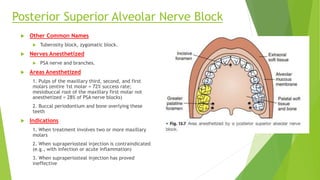
Posterior Superior Alveolar Nerve Block
 Other Common Names
 Tuberosity block, zygomatic block.
 Nerves Anesthetized
 PSA nerve and branches.
 Areas Anesthetized
1. Pulps of the maxillary third, second, and first
molars (entire 1st molar = 72% success rate;
mesiobuccal root of the maxillary first molar not
anesthetized = 28% of PSA nerve blocks)
2. Buccal periodontium and bone overlying these
teeth
 Indications
1. When treatment involves two or more maxillary
molars
2. When supraperiosteal injection is contraindicated
(e.g., with infection or acute inflammation)
3. When supraperiosteal injection has proved
ineffective
 Contraindication
 When the risk of hemorrhage is too great (as with a hemophiliac;
patients taking drugs that can increase bleeding such as coumadin
or clopidogrel (Plavix)), in which case a supraperiosteal or PDL
injection is recommended.
 Technique
1. A 27-gauge short needle is recommended.
2. Area of insertion: height of the mucobuccal fold above the
maxillary second molar.
3. Target area: PSA nerve—posterior, superior, and medial to the
posterior border of the maxilla .
4. Landmarks:
1. a. Mucobuccal fold.
2. b. Maxillary tuberosity.
3. c. Zygomatic process of the maxilla.
5. Orientation of the bevel: toward bone during the injection. If
bone is accidentally touched, the sensation is less unpleasant.
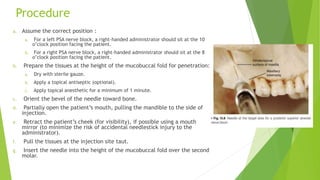
Procedure
a. Assume the correct position :
a. For a left PSA nerve block, a right-handed administrator should sit at the 10
o’clock position facing the patient.
b. For a right PSA nerve block, a right-handed administrator should sit at the 8
o’clock position facing the patient.
b. Prepare the tissues at the height of the mucobuccal fold for penetration:
a. Dry with sterile gauze.
b. Apply a topical antiseptic (optional).
c. Apply topical anesthetic for a minimum of 1 minute.
c. Orient the bevel of the needle toward bone.
d. Partially open the patient’s mouth, pulling the mandible to the side of
injection.
e. Retract the patient’s cheek (for visibility), if possible using a mouth
mirror (to minimize the risk of accidental needlestick injury to the
administrator).
f. Pull the tissues at the injection site taut.
g. Insert the needle into the height of the mucobuccal fold over the second
molar.
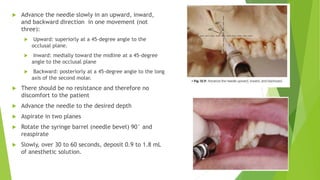
 Advance the needle slowly in an upward, inward,
and backward direction in one movement (not
three):
 Upward: superiorly at a 45-degree angle to the
occlusal plane.
 Inward: medially toward the midline at a 45-degree
angle to the occlusal plane
 Backward: posteriorly at a 45-degree angle to the long
axis of the second molar.
 There should be no resistance and therefore no
discomfort to the patient
 Advance the needle to the desired depth
 Aspirate in two planes
 Rotate the syringe barrel (needle bevel) 90° and
reaspirate
 Slowly, over 30 to 60 seconds, deposit 0.9 to 1.8 mL
of anesthetic solution.
 Signs and symptoms
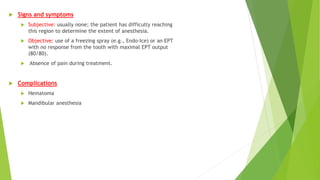
 Subjective: usually none; the patient has difficulty reaching
this region to determine the extent of anesthesia.
 Objective: use of a freezing spray (e.g., Endo-Ice) or an EPT
with no response from the tooth with maximal EPT output
(80/80).
 Absence of pain during treatment.
 Complications
 Hematoma
 Mandibular anesthesia
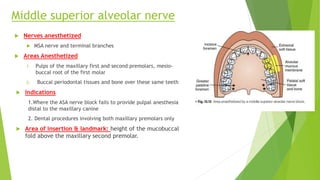
Middle superior alveolar nerve
 Nerves anesthetized
 MSA nerve and terminal branches
 Areas Anesthetized
1. Pulps of the maxillary first and second premolars, mesio-
buccal root of the first molar
2. Buccal periodontal tissues and bone over these same teeth
 Indications
1.Where the ASA nerve block fails to provide pulpal anesthesia
distal to the maxillary canine
2. Dental procedures involving both maxillary premolars only
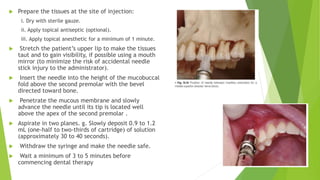
 Area of insertion & landmark: height of the mucobuccal
fold above the maxillary second premolar.
 Prepare the tissues at the site of injection:
i. Dry with sterile gauze.
ii. Apply topical antiseptic (optional).
iii. Apply topical anesthetic for a minimum of 1 minute.
 Stretch the patient’s upper lip to make the tissues
taut and to gain visibility, if possible using a mouth
mirror (to minimize the risk of accidental needle
stick injury to the administrator).
 Insert the needle into the height of the mucobuccal
fold above the second premolar with the bevel
directed toward bone.
 Penetrate the mucous membrane and slowly
advance the needle until its tip is located well
above the apex of the second premolar .
 Aspirate in two planes. g. Slowly deposit 0.9 to 1.2
mL (one-half to two-thirds of cartridge) of solution
(approximately 30 to 40 seconds).
 Withdraw the syringe and make the needle safe.
 Wait a minimum of 3 to 5 minutes before
commencing dental therapy
 Signs and Symptoms
1. Subjective: upper lip numb
2. Objective: use of a freezing spray (e.g., Endo-Ice) or an EPT with no response from
the tooth with maximal EPT output (80/80)
3. Absence of pain during treatment.
 Complications
 A hematoma may develop at the site of injection. Apply pressure with sterile gauze
over the site of swelling and discoloration for a minimum of 60 seconds.
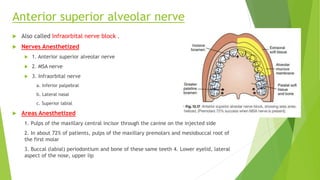
Anterior superior alveolar nerve
 Also called Infraorbital nerve block .
 Nerves Anesthetized
 1. Anterior superior alveolar nerve
 2. MSA nerve
 3. Infraorbital nerve
a. Inferior palpebral
b. Lateral nasal
c. Superior labial
 Areas Anesthetized
1. Pulps of the maxillary central incisor through the canine on the injected side
2. In about 72% of patients, pulps of the maxillary premolars and mesiobuccal root of
the first molar
3. Buccal (labial) periodontium and bone of these same teeth 4. Lower eyelid, lateral
aspect of the nose, upper lip
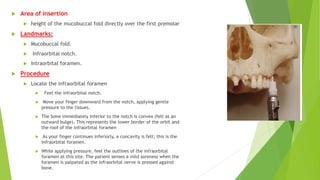
 Area of insertion
 height of the mucobuccal fold directly over the first premolar
 Landmarks:
 Mucobuccal fold.
 Infraorbital notch.
 Intraorbital foramen.
 Procedure
 Locate the infraorbital foramen
 Feel the infraorbital notch.
 Move your finger downward from the notch, applying gentle
pressure to the tissues.
 The bone immediately inferior to the notch is convex (felt as an
outward bulge). This represents the lower border of the orbit and
the roof of the infraorbital foramen
 As your finger continues inferiorly, a concavity is felt; this is the
infraorbital foramen.
 While applying pressure, feel the outlines of the infraorbital
foramen at this site. The patient senses a mild soreness when the
foramen is palpated as the infraorbital nerve is pressed against
bone.
 Insert the needle into the height of the mucobuccal fold over the
first premolar with the bevel facing bone
 Orient the syringe toward the infraorbital foramen. The needle
should be held parallel to the long axis of the tooth as it is
advanced, to avoid premature contact with bone
 Advance the needle slowly until bone is gently contacted
 The point of contact should be the upper rim of the infraorbital
foramen
 Slowly deposit 0.9 to 1.2 mL (over 30 to 40 seconds). Little or no
swelling should be visible as the solution is deposited. If the needle
tip is properly inserted at the opening of the foramen, solution is
directed toward the foramen.
 Signs and Symptoms
 Subjective: tingling and numbness of the lower eyelid, side of the nose,
and upper lip indicate anesthesia of the infraorbital nerve, not the ASA
or MSA nerve (soft tissue anesthesia develops almost instantly as the
anesthetic is being administered).
 Subjective and objective: numbness in the teeth and soft
tissues along the distribution of the ASA and MSA nerves
(developing within 3 to 5 minutes if pressure is maintained
over the injection site).
 Objective: use of a freezing spray (e.g., Endo-Ice) or an EPT
with no response from the tooth with maximal EPT output
(80/80). Absence of pain during treatment.
 Complications
 Hematoma (rare) may develop across the lower eyelid and the
tissues between it and the infraorbital foramen
Greater Palatine Nerve Block
 Areas Anesthetized
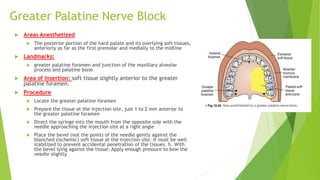
 The posterior portion of the hard palate and its overlying soft tissues,
anteriorly as far as the first premolar and medially to the midline
 Landmarks:
 greater palatine foramen and junction of the maxillary alveolar
process and palatine bone.
 Area of insertion: soft tissue slightly anterior to the greater
palatine foramen.
 Procedure
 Locate the greater palatine foramen
 Prepare the tissue at the injection site, just 1 to 2 mm anterior to
the greater palatine foramen
 Direct the syringe into the mouth from the opposite side with the
needle approaching the injection site at a right angle
 Place the bevel (not the point) of the needle gently against the
blanched (ischemic) soft tissue at the injection site. It must be well
stabilized to prevent accidental penetration of the tissues. h. With
the bevel lying against the tissue: Apply enough pressure to bow the
needle slightly
 Deposit a small volume of anesthetic. The solution is
forced against the mucous membrane, and a droplet
forms
 Continue to deposit small volumes of anesthetic. As the
tissue is entered, a slight increase in resistance to the
deposition of solution may be noted; this is entirely
normal in the greater palatine nerve block.
 If negative, slowly deposit (30 second minimum) not more
than one-fourth to one-third of a cartridge (0.45 to 0.6
mL)
 Complications
 Hematoma
 Ischemia and necrosis of soft tissues when highly
concentrated vasoconstrictor solution is used
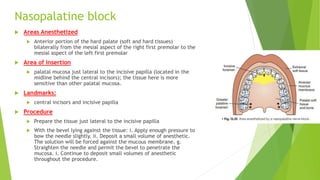
Nasopalatine block
 Areas Anesthetized
 Anterior portion of the hard palate (soft and hard tissues)
bilaterally from the mesial aspect of the right first premolar to the
mesial aspect of the left first premolar
 Area of insertion
 palatal mucosa just lateral to the incisive papilla (located in the
midline behind the central incisors); the tissue here is more
sensitive than other palatal mucosa.
 Landmarks:
 central incisors and incisive papilla
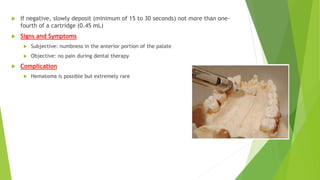
 Procedure
 Prepare the tissue just lateral to the incisive papilla
 With the bevel lying against the tissue: i. Apply enough pressure to
bow the needle slightly. ii. Deposit a small volume of anesthetic.
The solution will be forced against the mucous membrane. g.
Straighten the needle and permit the bevel to penetrate the
mucosa. i. Continue to deposit small volumes of anesthetic
throughout the procedure.
 If negative, slowly deposit (minimum of 15 to 30 seconds) not more than one-
fourth of a cartridge (0.45 mL)
 Signs and Symptoms
 Subjective: numbness in the anterior portion of the palate
 Objective: no pain during dental therapy
 Complication
 Hematoma is possible but extremely rare
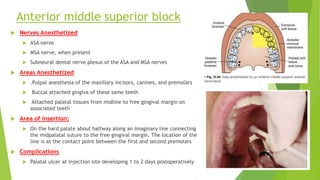
Anterior middle superior block
 Nerves Anesthetized
 ASA nerve
 MSA nerve, when present
 Subneural dental nerve plexus of the ASA and MSA nerves
 Areas Anesthetized
 .Pulpal anesthesia of the maxillary incisors, canines, and premolars
 Buccal attached gingiva of these same teeth
 Attached palatal tissues from midline to free gingival margin on
associated teeth
 Area of insertion:
 On the hard palate about halfway along an imaginary line connecting
the midpalatal suture to the free gingival margin. The location of the
line is at the contact point between the first and second premolars
 Complications
 Palatal ulcer at injection site developing 1 to 2 days postoperatively
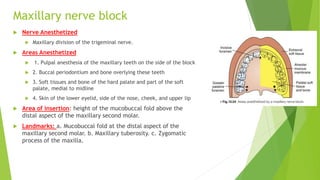
Maxillary nerve block
 Nerve Anesthetized
 Maxillary division of the trigeminal nerve.
 Areas Anesthetized
 1. Pulpal anesthesia of the maxillary teeth on the side of the block
 2. Buccal periodontium and bone overlying these teeth
 3. Soft tissues and bone of the hard palate and part of the soft
palate, medial to midline
 4. Skin of the lower eyelid, side of the nose, cheek, and upper lip
 Area of insertion: height of the mucobuccal fold above the
distal aspect of the maxillary second molar.
 Landmarks: a. Mucobuccal fold at the distal aspect of the
maxillary second molar. b. Maxillary tuberosity. c. Zygomatic
process of the maxilla.
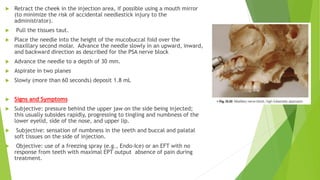
 Retract the cheek in the injection area, if possible using a mouth mirror
(to minimize the risk of accidental needlestick injury to the
administrator).
 Pull the tissues taut.
 Place the needle into the height of the mucobuccal fold over the
maxillary second molar. Advance the needle slowly in an upward, inward,
and backward direction as described for the PSA nerve block
 Advance the needle to a depth of 30 mm.
 Aspirate in two planes
 Slowly (more than 60 seconds) deposit 1.8 mL
 Signs and Symptoms
 Subjective: pressure behind the upper jaw on the side being injected;
this usually subsides rapidly, progressing to tingling and numbness of the
lower eyelid, side of the nose, and upper lip.
 Subjective: sensation of numbness in the teeth and buccal and palatal
soft tissues on the side of injection.
 Objective: use of a freezing spray (e.g., Endo-Ice) or an EFT with no
response from teeth with maximal EPT output absence of pain during
treatment.
 Complications
 Hematoma develops rapidly if the maxillary artery is punctured
 Penetration of the orbit
 Penetration of the nasal cavity
CONCLUSION
 Several general methods of obtaining pain control with local anesthetics are
available. The site of deposition of the drug relative to the area of operative
intervention determines the type of injection administered.
REFERENCE
 HANDBOOK OF LOCAL ANESTHESIA – STANLEY MALAMED 7TH EDITION

omfs maxillary inj tech.pptx

  • 1.
  • 2.
    CONTENTS  INTRODUCTION  PSA MSA  ASA  GREATERPALATINE BLOCK  NASOPALATINE BLOCK  ANTERIOR MIDDLE SUPERIOR BLOCK  MAXILLARY BLOCK  CONCLUSION  REFERRENCE
  • 3.
    INTRODUCTION  Numerous injectiontechniques are available to provide clinically adequate anesthesia of the teeth and soft and hard tissues in the maxilla. Selection of the specific technique to be used is determined, in large part, by the nature of the treatment to be provided.
  • 4.
    Posterior Superior AlveolarNerve Block  Other Common Names  Tuberosity block, zygomatic block.  Nerves Anesthetized  PSA nerve and branches.  Areas Anesthetized 1. Pulps of the maxillary third, second, and first molars (entire 1st molar = 72% success rate; mesiobuccal root of the maxillary first molar not anesthetized = 28% of PSA nerve blocks) 2. Buccal periodontium and bone overlying these teeth  Indications 1. When treatment involves two or more maxillary molars 2. When supraperiosteal injection is contraindicated (e.g., with infection or acute inflammation) 3. When supraperiosteal injection has proved ineffective
  • 5.
     Contraindication  Whenthe risk of hemorrhage is too great (as with a hemophiliac; patients taking drugs that can increase bleeding such as coumadin or clopidogrel (Plavix)), in which case a supraperiosteal or PDL injection is recommended.  Technique 1. A 27-gauge short needle is recommended. 2. Area of insertion: height of the mucobuccal fold above the maxillary second molar. 3. Target area: PSA nerve—posterior, superior, and medial to the posterior border of the maxilla . 4. Landmarks: 1. a. Mucobuccal fold. 2. b. Maxillary tuberosity. 3. c. Zygomatic process of the maxilla. 5. Orientation of the bevel: toward bone during the injection. If bone is accidentally touched, the sensation is less unpleasant.
  • 6.
    Procedure a. Assume thecorrect position : a. For a left PSA nerve block, a right-handed administrator should sit at the 10 o’clock position facing the patient. b. For a right PSA nerve block, a right-handed administrator should sit at the 8 o’clock position facing the patient. b. Prepare the tissues at the height of the mucobuccal fold for penetration: a. Dry with sterile gauze. b. Apply a topical antiseptic (optional). c. Apply topical anesthetic for a minimum of 1 minute. c. Orient the bevel of the needle toward bone. d. Partially open the patient’s mouth, pulling the mandible to the side of injection. e. Retract the patient’s cheek (for visibility), if possible using a mouth mirror (to minimize the risk of accidental needlestick injury to the administrator). f. Pull the tissues at the injection site taut. g. Insert the needle into the height of the mucobuccal fold over the second molar.
  • 7.
     Advance theneedle slowly in an upward, inward, and backward direction in one movement (not three):  Upward: superiorly at a 45-degree angle to the occlusal plane.  Inward: medially toward the midline at a 45-degree angle to the occlusal plane  Backward: posteriorly at a 45-degree angle to the long axis of the second molar.  There should be no resistance and therefore no discomfort to the patient  Advance the needle to the desired depth  Aspirate in two planes  Rotate the syringe barrel (needle bevel) 90° and reaspirate  Slowly, over 30 to 60 seconds, deposit 0.9 to 1.8 mL of anesthetic solution.
  • 8.
     Signs andsymptoms  Subjective: usually none; the patient has difficulty reaching this region to determine the extent of anesthesia.  Objective: use of a freezing spray (e.g., Endo-Ice) or an EPT with no response from the tooth with maximal EPT output (80/80).  Absence of pain during treatment.  Complications  Hematoma  Mandibular anesthesia
  • 9.
    Middle superior alveolarnerve  Nerves anesthetized  MSA nerve and terminal branches  Areas Anesthetized 1. Pulps of the maxillary first and second premolars, mesio- buccal root of the first molar 2. Buccal periodontal tissues and bone over these same teeth  Indications 1.Where the ASA nerve block fails to provide pulpal anesthesia distal to the maxillary canine 2. Dental procedures involving both maxillary premolars only  Area of insertion & landmark: height of the mucobuccal fold above the maxillary second premolar.
  • 10.
     Prepare thetissues at the site of injection: i. Dry with sterile gauze. ii. Apply topical antiseptic (optional). iii. Apply topical anesthetic for a minimum of 1 minute.  Stretch the patient’s upper lip to make the tissues taut and to gain visibility, if possible using a mouth mirror (to minimize the risk of accidental needle stick injury to the administrator).  Insert the needle into the height of the mucobuccal fold above the second premolar with the bevel directed toward bone.  Penetrate the mucous membrane and slowly advance the needle until its tip is located well above the apex of the second premolar .  Aspirate in two planes. g. Slowly deposit 0.9 to 1.2 mL (one-half to two-thirds of cartridge) of solution (approximately 30 to 40 seconds).  Withdraw the syringe and make the needle safe.  Wait a minimum of 3 to 5 minutes before commencing dental therapy
  • 11.
     Signs andSymptoms 1. Subjective: upper lip numb 2. Objective: use of a freezing spray (e.g., Endo-Ice) or an EPT with no response from the tooth with maximal EPT output (80/80) 3. Absence of pain during treatment.  Complications  A hematoma may develop at the site of injection. Apply pressure with sterile gauze over the site of swelling and discoloration for a minimum of 60 seconds.
  • 12.
    Anterior superior alveolarnerve  Also called Infraorbital nerve block .  Nerves Anesthetized  1. Anterior superior alveolar nerve  2. MSA nerve  3. Infraorbital nerve a. Inferior palpebral b. Lateral nasal c. Superior labial  Areas Anesthetized 1. Pulps of the maxillary central incisor through the canine on the injected side 2. In about 72% of patients, pulps of the maxillary premolars and mesiobuccal root of the first molar 3. Buccal (labial) periodontium and bone of these same teeth 4. Lower eyelid, lateral aspect of the nose, upper lip
  • 13.
     Area ofinsertion  height of the mucobuccal fold directly over the first premolar  Landmarks:  Mucobuccal fold.  Infraorbital notch.  Intraorbital foramen.  Procedure  Locate the infraorbital foramen  Feel the infraorbital notch.  Move your finger downward from the notch, applying gentle pressure to the tissues.  The bone immediately inferior to the notch is convex (felt as an outward bulge). This represents the lower border of the orbit and the roof of the infraorbital foramen  As your finger continues inferiorly, a concavity is felt; this is the infraorbital foramen.  While applying pressure, feel the outlines of the infraorbital foramen at this site. The patient senses a mild soreness when the foramen is palpated as the infraorbital nerve is pressed against bone.
  • 14.
     Insert theneedle into the height of the mucobuccal fold over the first premolar with the bevel facing bone  Orient the syringe toward the infraorbital foramen. The needle should be held parallel to the long axis of the tooth as it is advanced, to avoid premature contact with bone  Advance the needle slowly until bone is gently contacted  The point of contact should be the upper rim of the infraorbital foramen  Slowly deposit 0.9 to 1.2 mL (over 30 to 40 seconds). Little or no swelling should be visible as the solution is deposited. If the needle tip is properly inserted at the opening of the foramen, solution is directed toward the foramen.  Signs and Symptoms  Subjective: tingling and numbness of the lower eyelid, side of the nose, and upper lip indicate anesthesia of the infraorbital nerve, not the ASA or MSA nerve (soft tissue anesthesia develops almost instantly as the anesthetic is being administered).
  • 15.
     Subjective andobjective: numbness in the teeth and soft tissues along the distribution of the ASA and MSA nerves (developing within 3 to 5 minutes if pressure is maintained over the injection site).  Objective: use of a freezing spray (e.g., Endo-Ice) or an EPT with no response from the tooth with maximal EPT output (80/80). Absence of pain during treatment.  Complications  Hematoma (rare) may develop across the lower eyelid and the tissues between it and the infraorbital foramen
  • 16.
    Greater Palatine NerveBlock  Areas Anesthetized  The posterior portion of the hard palate and its overlying soft tissues, anteriorly as far as the first premolar and medially to the midline  Landmarks:  greater palatine foramen and junction of the maxillary alveolar process and palatine bone.  Area of insertion: soft tissue slightly anterior to the greater palatine foramen.  Procedure  Locate the greater palatine foramen  Prepare the tissue at the injection site, just 1 to 2 mm anterior to the greater palatine foramen  Direct the syringe into the mouth from the opposite side with the needle approaching the injection site at a right angle  Place the bevel (not the point) of the needle gently against the blanched (ischemic) soft tissue at the injection site. It must be well stabilized to prevent accidental penetration of the tissues. h. With the bevel lying against the tissue: Apply enough pressure to bow the needle slightly
  • 17.
     Deposit asmall volume of anesthetic. The solution is forced against the mucous membrane, and a droplet forms  Continue to deposit small volumes of anesthetic. As the tissue is entered, a slight increase in resistance to the deposition of solution may be noted; this is entirely normal in the greater palatine nerve block.  If negative, slowly deposit (30 second minimum) not more than one-fourth to one-third of a cartridge (0.45 to 0.6 mL)  Complications  Hematoma  Ischemia and necrosis of soft tissues when highly concentrated vasoconstrictor solution is used
  • 18.
    Nasopalatine block  AreasAnesthetized  Anterior portion of the hard palate (soft and hard tissues) bilaterally from the mesial aspect of the right first premolar to the mesial aspect of the left first premolar  Area of insertion  palatal mucosa just lateral to the incisive papilla (located in the midline behind the central incisors); the tissue here is more sensitive than other palatal mucosa.  Landmarks:  central incisors and incisive papilla  Procedure  Prepare the tissue just lateral to the incisive papilla  With the bevel lying against the tissue: i. Apply enough pressure to bow the needle slightly. ii. Deposit a small volume of anesthetic. The solution will be forced against the mucous membrane. g. Straighten the needle and permit the bevel to penetrate the mucosa. i. Continue to deposit small volumes of anesthetic throughout the procedure.
  • 19.
     If negative,slowly deposit (minimum of 15 to 30 seconds) not more than one- fourth of a cartridge (0.45 mL)  Signs and Symptoms  Subjective: numbness in the anterior portion of the palate  Objective: no pain during dental therapy  Complication  Hematoma is possible but extremely rare
  • 20.
    Anterior middle superiorblock  Nerves Anesthetized  ASA nerve  MSA nerve, when present  Subneural dental nerve plexus of the ASA and MSA nerves  Areas Anesthetized  .Pulpal anesthesia of the maxillary incisors, canines, and premolars  Buccal attached gingiva of these same teeth  Attached palatal tissues from midline to free gingival margin on associated teeth  Area of insertion:  On the hard palate about halfway along an imaginary line connecting the midpalatal suture to the free gingival margin. The location of the line is at the contact point between the first and second premolars  Complications  Palatal ulcer at injection site developing 1 to 2 days postoperatively
  • 21.
    Maxillary nerve block Nerve Anesthetized  Maxillary division of the trigeminal nerve.  Areas Anesthetized  1. Pulpal anesthesia of the maxillary teeth on the side of the block  2. Buccal periodontium and bone overlying these teeth  3. Soft tissues and bone of the hard palate and part of the soft palate, medial to midline  4. Skin of the lower eyelid, side of the nose, cheek, and upper lip  Area of insertion: height of the mucobuccal fold above the distal aspect of the maxillary second molar.  Landmarks: a. Mucobuccal fold at the distal aspect of the maxillary second molar. b. Maxillary tuberosity. c. Zygomatic process of the maxilla.
  • 22.
     Retract thecheek in the injection area, if possible using a mouth mirror (to minimize the risk of accidental needlestick injury to the administrator).  Pull the tissues taut.  Place the needle into the height of the mucobuccal fold over the maxillary second molar. Advance the needle slowly in an upward, inward, and backward direction as described for the PSA nerve block  Advance the needle to a depth of 30 mm.  Aspirate in two planes  Slowly (more than 60 seconds) deposit 1.8 mL  Signs and Symptoms  Subjective: pressure behind the upper jaw on the side being injected; this usually subsides rapidly, progressing to tingling and numbness of the lower eyelid, side of the nose, and upper lip.  Subjective: sensation of numbness in the teeth and buccal and palatal soft tissues on the side of injection.  Objective: use of a freezing spray (e.g., Endo-Ice) or an EFT with no response from teeth with maximal EPT output absence of pain during treatment.
  • 23.
     Complications  Hematomadevelops rapidly if the maxillary artery is punctured  Penetration of the orbit  Penetration of the nasal cavity
  • 24.
    CONCLUSION  Several generalmethods of obtaining pain control with local anesthetics are available. The site of deposition of the drug relative to the area of operative intervention determines the type of injection administered.
  • 25.
    REFERENCE  HANDBOOK OFLOCAL ANESTHESIA – STANLEY MALAMED 7TH EDITION