Presented by--
Hemam Shankar Singh
An amalgam is a special type of alloy that
contains mercury as one of its constituents.
1. As permanent filling material for
 Class I and class II cavities, and
 Class V cavities where esthetics is not important
2. In combination with retentive pins to restore a
crown
3. For making dies
4. In retrograde root canal fillings
5. As a core material
1. Silver
2. Tin
3. Copper
4. Zinc
5. Platinum
6. Palladium
7. Indium
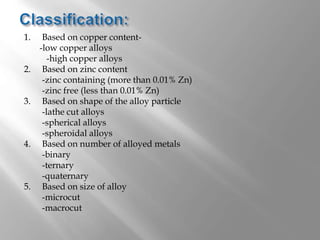
1. Based on copper content-
-low copper alloys
-high copper alloys
2. Based on zinc content
-zinc containing (more than 0.01% Zn)
-zinc free (less than 0.01% Zn)
3. Based on shape of the alloy particle
-lathe cut alloys
-spherical alloys
-spheroidal alloys
4. Based on number of alloyed metals
-binary
-ternary
-quaternary
5. Based on size of alloy
-microcut
-macrocut
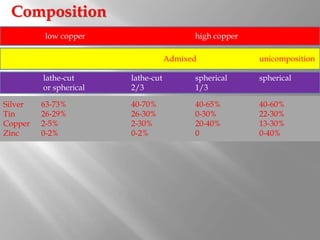
low copper high copper
lathe-cut lathe-cut spherical spherical
or spherical 2/3 1/3
Admixed unicomposition
Silver 63-73% 40-70% 40-65% 40-60%
Tin 26-29% 26-30% 0-30% 22-30%
Copper 2-5% 2-30% 20-40% 13-30%
Zinc 0-2% 0-2% 0 0-40%
Composition
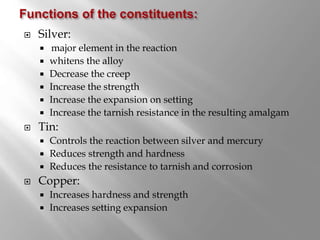
 Silver:
 major element in the reaction
 whitens the alloy
 Decrease the creep
 Increase the strength
 Increase the expansion on setting
 Increase the tarnish resistance in the resulting amalgam
 Tin:
 Controls the reaction between silver and mercury
 Reduces strength and hardness
 Reduces the resistance to tarnish and corrosion
 Copper:
 Increases hardness and strength
 Increases setting expansion
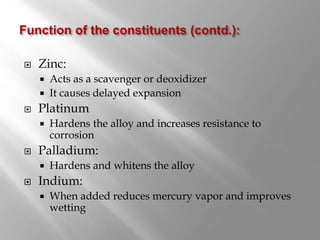
 Zinc:
 Acts as a scavenger or deoxidizer
 It causes delayed expansion
 Platinum
 Hardens the alloy and increases resistance to
corrosion
 Palladium:
 Hardens and whitens the alloy
 Indium:
 When added reduces mercury vapor and improves
wetting
1. Microleakage
 Dental amalgam has the ability of self sealing to
microleakage
 This may be caused by corrosion products that form in
the interface between the tooth and the restoration,
sealing the interface and thereby preventing
microleakage
 The space between the alloy and the tooth permits
microleakage of electrolyte, and a classic concentration
cell (crevice corrosion) process results.
 The common corrosion products found with traditional
amalgam alloys are oxides and chlorides of tin
2. Dimensional stability
• According to ADA Specification No. 1 amalgam can neither
contract nor expand more than 20µm/cm at 37ºC between 5
minutes to 24hrs.
• Severe contraction can lead to microleakage and to secondary
caries
• Excessive expansion can produce pressure on the pulp and
postoperative sensitivity
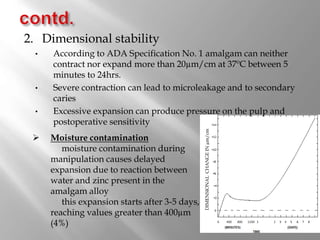
 Moisture contamination
moisture contamination during
manipulation causes delayed
expansion due to reaction between
water and zinc present in the
amalgam alloy
this expansion starts after 3-5 days,
reaching values greater than 400µm
(4%)
DIMENSIONALCHANGEINµm/cm
3. Strength
i. Effect of trituration
undertrituration or overtrituration decreases the strength for
both low and high copper amalgams as it affects the reaction
between the matrix phase and the alloy particles
ii. Effect of mercury content
sufficient Hg should be mixed with the alloy to wet each particle
of the alloy
increase in mercury content above approximately 54-55%
markedly reduced the strength
low mercury content may result in a rough, pitted surface that
may lead to corrosion
iii. Effect of condensation
» lathe-cut alloy
greater the condensation pressure, higher the compressive
strength
higher condensation pressure are required to minimized
porosity and to express mercury from lathe-cut amalgam
» spherical alloy
condensation with light pressure produces adequate
strength
iv. Effect of porosity
• Voids and porosity are possible factors influencing the
compressive strength of hardened amalgam
• It is related to number of factors including plasticity of the
mix amalgam
• Plasticity decreases over time from the end of trituration
• Undertrituration also decreases plasticity
• Decrease plasticity causes greater porosity resulting in
lower strength of the amalgam
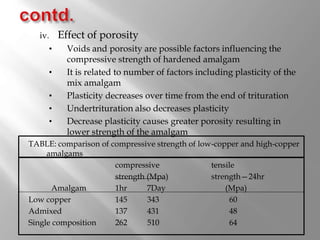
TABLE: comparison of compressive strength of low-copper and high-copper
amalgams
compressive tensile
strength (Mpa) strength—24hr
Amalgam 1hr 7Day (Mpa)
Low copper 145 343 60
Admixed 137 431 48
Single composition 262 510 64
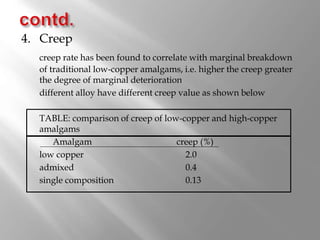
4. Creep
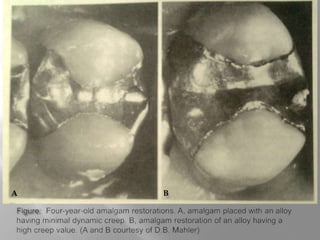
creep rate has been found to correlate with marginal breakdown
of traditional low-copper amalgams, i.e. higher the creep greater
the degree of marginal deterioration
different alloy have different creep value as shown below
TABLE: comparison of creep of low-copper and high-copper
amalgams
Amalgam creep (%)
low copper 2.0
admixed 0.4
single composition 0.13
A B
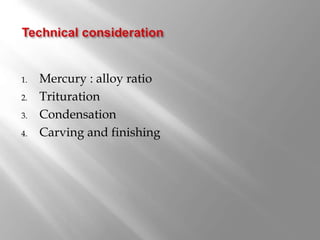
1. Mercury : alloy ratio
2. Trituration
3. Condensation
4. Carving and finishing
Mercury : alloy ratio
 Up until the early 1960s it was necessary to use an amount of
mercury considerably in excess of that desirable in the final
restoration to achieve smooth, plastic amalgam mixes.
 because of deleterious effects of an excessive mercury content
procedures were employed to reduce the amount of mercury
left in the restoration to an acceptable level.
 So, in 1959 a new technique was introduced known as
minimal mercury technique , or Eames technique in recognition of
the dentist who developed the concept.
 According to Eames technique mercury should be 50% by
weight or in 1:1 ratio.
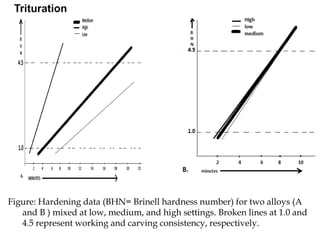
Figure: Hardening data (BHN= Brinell hardness number) for two alloys (A
and B ) mixed at low, medium, and high settings. Broken lines at 1.0 and
4.5 represent working and carving consistency, respectively.
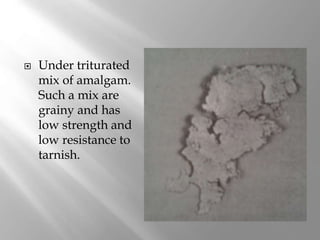
 Under triturated
mix of amalgam.
Such a mix are
grainy and has
low strength and
low resistance to
tarnish.
 Aims
 To adapt it to the cavity wall
 Remove excess Hg
 Reduce voids
 Proper condensation increases the
strength and decreases the creep of the
amalgam.
 Failure to use a matrix can result in a
poorly condensed and weak
restoration.
 Mixed materials is packed in
increments.
 Condensation is started at the centre,
and the condenser point is stepped
sequentially towards the cavity walls
 Carving and burnishing is done to reproduce the tooth
anatomy and to get a smooth surface respectively
 Carving should not be started until the amalgam is
hard enough to offer resistance to carving instrument
 A scrapping or ringing sound should be heard when it
is carved
 Polishing is also required as it minimizes corrosion and
prevents adherence of plaque
 Final polishing should be delayed at least 24hrs after
condensation
 Mercury is absorbed through
 skin, lungs or GIT, most commonly by lungs i.e. vapor phase
 Penetration into the tooth from the restoration
 The threshold limit value of mercury in the air is
0.05mg of Hg/m³ of air, this is the vapor level to which
the average worker can be safely exposed for 8hrs a
day and 5days per week
 Increase in exposure causes toxicity which may
associate with signs and symptoms
 The lowest level of total blood Hg at which the earliest
nonspecific symptoms occur is 35ng/mL
 Weakness, fatigue, anorexia, weight loss, insomnia,
irritability, shyness, dizziness, and tremors in the
extremities are the recognizable symptoms of chronic
Hg poisoning
 Mercury should be kept in an unbreakable container that are
tightly sealed
 Spills and leak should be cleaned up immediately by
approved methods
 Water spray and high-volume evacuation should be used when
removing an old amalgam restoration or finishing a new
one
 Glasses and disposable face mask should be worn to reduce
hazards associated with flying particles and the inhalation
of amalgam dust
 Amalgamators that completely enclose the arms and
amalgam capsule during trituration should be used
 Since mercury vaporizes at room temperature, operatories
should be well ventilated to minimize the mercury level in the
air
 Use of gloves is a must
1. Reasonably easy to insert
2. Not overly technique sensitive
3. Maintains anatomic form well
4. Has adequate resistance to fracture
5. After a period of time prevents marginal
leakage
6. Have reasonably long service life
7. Cheaper than other alternative posterior
restorative material like cast gold alloys
1. Color does not match tooth structure
2. More brittle and can fracture if incorrectly
placed
3. They are subject to corrosion and galvanic
shock
4. Show marginal breakdown
5. Do not bond to tooth structure
6. Risk of Hg toxicity
silver amalgam

silver amalgam

  • 1.
  • 2.
    An amalgam isa special type of alloy that contains mercury as one of its constituents.
  • 3.
    1. As permanentfilling material for  Class I and class II cavities, and  Class V cavities where esthetics is not important 2. In combination with retentive pins to restore a crown 3. For making dies 4. In retrograde root canal fillings 5. As a core material
  • 4.
    1. Silver 2. Tin 3.Copper 4. Zinc 5. Platinum 6. Palladium 7. Indium
  • 5.
    1. Based oncopper content- -low copper alloys -high copper alloys 2. Based on zinc content -zinc containing (more than 0.01% Zn) -zinc free (less than 0.01% Zn) 3. Based on shape of the alloy particle -lathe cut alloys -spherical alloys -spheroidal alloys 4. Based on number of alloyed metals -binary -ternary -quaternary 5. Based on size of alloy -microcut -macrocut
  • 6.
    low copper highcopper lathe-cut lathe-cut spherical spherical or spherical 2/3 1/3 Admixed unicomposition Silver 63-73% 40-70% 40-65% 40-60% Tin 26-29% 26-30% 0-30% 22-30% Copper 2-5% 2-30% 20-40% 13-30% Zinc 0-2% 0-2% 0 0-40% Composition
  • 7.
     Silver:  majorelement in the reaction  whitens the alloy  Decrease the creep  Increase the strength  Increase the expansion on setting  Increase the tarnish resistance in the resulting amalgam  Tin:  Controls the reaction between silver and mercury  Reduces strength and hardness  Reduces the resistance to tarnish and corrosion  Copper:  Increases hardness and strength  Increases setting expansion
  • 8.
     Zinc:  Actsas a scavenger or deoxidizer  It causes delayed expansion  Platinum  Hardens the alloy and increases resistance to corrosion  Palladium:  Hardens and whitens the alloy  Indium:  When added reduces mercury vapor and improves wetting
  • 9.
    1. Microleakage  Dentalamalgam has the ability of self sealing to microleakage  This may be caused by corrosion products that form in the interface between the tooth and the restoration, sealing the interface and thereby preventing microleakage  The space between the alloy and the tooth permits microleakage of electrolyte, and a classic concentration cell (crevice corrosion) process results.  The common corrosion products found with traditional amalgam alloys are oxides and chlorides of tin
  • 10.
    2. Dimensional stability •According to ADA Specification No. 1 amalgam can neither contract nor expand more than 20µm/cm at 37ºC between 5 minutes to 24hrs. • Severe contraction can lead to microleakage and to secondary caries • Excessive expansion can produce pressure on the pulp and postoperative sensitivity  Moisture contamination moisture contamination during manipulation causes delayed expansion due to reaction between water and zinc present in the amalgam alloy this expansion starts after 3-5 days, reaching values greater than 400µm (4%) DIMENSIONALCHANGEINµm/cm
  • 11.
    3. Strength i. Effectof trituration undertrituration or overtrituration decreases the strength for both low and high copper amalgams as it affects the reaction between the matrix phase and the alloy particles ii. Effect of mercury content sufficient Hg should be mixed with the alloy to wet each particle of the alloy increase in mercury content above approximately 54-55% markedly reduced the strength low mercury content may result in a rough, pitted surface that may lead to corrosion iii. Effect of condensation » lathe-cut alloy greater the condensation pressure, higher the compressive strength higher condensation pressure are required to minimized porosity and to express mercury from lathe-cut amalgam » spherical alloy condensation with light pressure produces adequate strength
  • 12.
    iv. Effect ofporosity • Voids and porosity are possible factors influencing the compressive strength of hardened amalgam • It is related to number of factors including plasticity of the mix amalgam • Plasticity decreases over time from the end of trituration • Undertrituration also decreases plasticity • Decrease plasticity causes greater porosity resulting in lower strength of the amalgam TABLE: comparison of compressive strength of low-copper and high-copper amalgams compressive tensile strength (Mpa) strength—24hr Amalgam 1hr 7Day (Mpa) Low copper 145 343 60 Admixed 137 431 48 Single composition 262 510 64
  • 13.
    4. Creep creep ratehas been found to correlate with marginal breakdown of traditional low-copper amalgams, i.e. higher the creep greater the degree of marginal deterioration different alloy have different creep value as shown below TABLE: comparison of creep of low-copper and high-copper amalgams Amalgam creep (%) low copper 2.0 admixed 0.4 single composition 0.13
  • 14.
  • 15.
    1. Mercury :alloy ratio 2. Trituration 3. Condensation 4. Carving and finishing
  • 16.
    Mercury : alloyratio  Up until the early 1960s it was necessary to use an amount of mercury considerably in excess of that desirable in the final restoration to achieve smooth, plastic amalgam mixes.  because of deleterious effects of an excessive mercury content procedures were employed to reduce the amount of mercury left in the restoration to an acceptable level.  So, in 1959 a new technique was introduced known as minimal mercury technique , or Eames technique in recognition of the dentist who developed the concept.  According to Eames technique mercury should be 50% by weight or in 1:1 ratio.
  • 17.
    Figure: Hardening data(BHN= Brinell hardness number) for two alloys (A and B ) mixed at low, medium, and high settings. Broken lines at 1.0 and 4.5 represent working and carving consistency, respectively.
  • 18.
     Under triturated mixof amalgam. Such a mix are grainy and has low strength and low resistance to tarnish.
  • 19.
     Aims  Toadapt it to the cavity wall  Remove excess Hg  Reduce voids  Proper condensation increases the strength and decreases the creep of the amalgam.  Failure to use a matrix can result in a poorly condensed and weak restoration.  Mixed materials is packed in increments.  Condensation is started at the centre, and the condenser point is stepped sequentially towards the cavity walls
  • 20.
     Carving andburnishing is done to reproduce the tooth anatomy and to get a smooth surface respectively  Carving should not be started until the amalgam is hard enough to offer resistance to carving instrument  A scrapping or ringing sound should be heard when it is carved  Polishing is also required as it minimizes corrosion and prevents adherence of plaque  Final polishing should be delayed at least 24hrs after condensation
  • 21.
     Mercury isabsorbed through  skin, lungs or GIT, most commonly by lungs i.e. vapor phase  Penetration into the tooth from the restoration  The threshold limit value of mercury in the air is 0.05mg of Hg/m³ of air, this is the vapor level to which the average worker can be safely exposed for 8hrs a day and 5days per week  Increase in exposure causes toxicity which may associate with signs and symptoms  The lowest level of total blood Hg at which the earliest nonspecific symptoms occur is 35ng/mL  Weakness, fatigue, anorexia, weight loss, insomnia, irritability, shyness, dizziness, and tremors in the extremities are the recognizable symptoms of chronic Hg poisoning
  • 22.
     Mercury shouldbe kept in an unbreakable container that are tightly sealed  Spills and leak should be cleaned up immediately by approved methods  Water spray and high-volume evacuation should be used when removing an old amalgam restoration or finishing a new one  Glasses and disposable face mask should be worn to reduce hazards associated with flying particles and the inhalation of amalgam dust  Amalgamators that completely enclose the arms and amalgam capsule during trituration should be used  Since mercury vaporizes at room temperature, operatories should be well ventilated to minimize the mercury level in the air  Use of gloves is a must
  • 23.
    1. Reasonably easyto insert 2. Not overly technique sensitive 3. Maintains anatomic form well 4. Has adequate resistance to fracture 5. After a period of time prevents marginal leakage 6. Have reasonably long service life 7. Cheaper than other alternative posterior restorative material like cast gold alloys
  • 24.
    1. Color doesnot match tooth structure 2. More brittle and can fracture if incorrectly placed 3. They are subject to corrosion and galvanic shock 4. Show marginal breakdown 5. Do not bond to tooth structure 6. Risk of Hg toxicity

Editor's Notes